Chaque jour nous vous présenterons une nouvelle Startup française !
Notre pays regorge de talents et d'entrepreneurs brillants ! Alors partons à la découverte des meilleures startup françaises ! Certaines d'entre elles sont dans une étape essentielle dans la vie d'une startup : la recherche de financement, notamment par le financement participatif (ou crowdfunding en anglais). Alors participez à cette grande aventure en leur faisant une petite donation ! Les startups françaises ont besoin de vous !
Startups from around Africa have one week left to apply to Pitch Live at the Africa Startup Summit in Kigali in February, with 10 startups to be given the chance to take to the stage before an audience of over 400 investors, corporate partners, accelerators and media.
The Africa Startup Summit will bring together stakeholders in the tech startup space across the continent in Kigali, Rwanda, on February 14 -15, to explore the opportunities and challenges within the ecosystem, while showcasing Africa’s abundant entrepreneurial talent.
The focus of the Summit will be on encouraging collaboration, and creating connections between investors, corporates, stakeholders and startups.
Disrupt Africa announced in December the main stage of the event will be opened up to the top 10 startups from around Africa, who will be given the chance to pitch their businesses to the audience of over 400 local and international decision-makers.
Selected startups will also have the opportunity to attend the rest of the event, which features three Summits, and take part in the wide variety of workshops, discussions and networking sessions taking place over the three days.
“We have seen a huge volume of great applications from startups around Africa, and there are now only a couple of spaces left to Pitch Live on the main stage at Africa Startup Summit in February. We’re pleased to extend this last chance to any late applicants – we look forward to hearing from you,” says Gabriella Mulligan, co-founder at Disrupt Africa.
“The first Africa Startup Summit promises to bring together the continent’s ecosystem with a good number of entrepreneurs, investors, corporate and regulatory speakers and attendees already confirmed. We’re pleased to include Pitch Live as a key feature of the event line-up, and encourage applicants and attendees to secure their spaces now,” said Tom Jackson, co-founder at Disrupt Africa.
Applications are open to African tech-enabled startups operating in any field. Startups applying must also be less than five years old; have at least an MVP, ideally with existing traction; have raised less than US$1 million in external funding; and have a current “ask”.
Startups must be able to attend the Summit in Kigali in person. Applications are open here, until January 11, with applications to be reviewed on a rolling basis. Tickets to attend are currently on sale here.
South African agri-tech startup Aerobotics is focusing heavily on expanding its operations in the United States (US) in 2019, which is one of 11 markets in which the company operates.
Founded in Cape Town in 2014, Aerobotics uses aerial imagery from drones and satellites, and blends them with machine learning algorithms to provide early problem detection services to tree and wine farmers and optimise crop performance.
The startup’s cloud-based application Aeroview provides farmers with insights, scout mapping and other tools to mitigate damage to tree and vine crops from pest and disease.
“Aerobotics can identify a tree or vine that is experiencing stress down to the individual tree canopy level. The technology also measures tree height and canopy volume and can track these metrics on each individual tree and vine over time,” the startup’s chief executive officer (CEO) James Paterson, who grew up in a farming family in the Western Cape, told Disrupt Africa.
“Information about stressed trees is inputted into Aeroview, an application that provides plant level data to farmers to analyse their crops, on a plant by plant basis. Aerobotics’ technology can then automatically generate a scout map for farmers, instruct drones to scout problem trees and identify what pest or disease is causing stress on a tree. This helps each farmer make a fast, accurate and informed decision about mitigating damage on the farm.”
“In a rapidly changing climate and increasingly competitive environment, farmers are faced with uncertainty and challenges that are both old and new. Output can take drastic hits depending on weather cycles, the introduction and spread of new problems, pests and diseases and a variety of other challenges,” he said.
“Before Aerobotics, pest and disease detection technology had not been quick or accurate enough to have much real-world impacts for farmers. And with global competition disrupting markets anywhere and at any time, farmers are searching everywhere for solutions that can help them mitigate loss and increase yields on their farms to ensure profitability and sustainability.”
Though there are a handful of companies working on different aspects of the value chain, from drone hardware and mapping to pest and disease image analysis, Paterson said he is not aware of any company other than Aerobotics that can deliver the level of details on individual trees and vines along with an easy to use interface at the price point Aerobotics offers.
Given this, it is hardly surprising the startup – which operates a subscription model – has been backed by investors to expand across the world. The company has raised two funding rounds totalling US$2.6 million from investors such as Nedbank, AgFunder, 4Di Capital and Savannah Fund, took part in Google’s Launchpad Accelerator, and is now active in 11 markets globally, including South Africa, the US, the United Kingdom (UK) and Australia.
“At this point, most of Aerobotics customers are based in South Africa,” Paterson said. “Aerobotics is currently providing its cutting-edge technology to 40 per cent of the macadamia nut market and 20 per cent of the citrus market in South Africa. Aerobotics is also helping wine, apples, blueberry, peach, avocado and various other farmers in South Africa and around the world.
He said there is also interest from industry partners such as lenders, insurers and co-operatives, with the startup’s primary focus for 2019 being expansion in the US.
“Aerobotics is for any tree and vine farmer that is interested in utilising the latest precision agriculture technology to mitigate pest and disease damage on the farm, save costs, increase efficiency and yields and produce a more balanced crop,” said Paterson.
“Aerobotics recently announced that it has processed its 10 millionth tree in its database and expects that number to grow quickly. The more trees Aerobotics processes in its software, the stronger and more accurate Aerobotics’ artificial intelligence becomes.”
Chinese state television has sought to document the toll taken on South Korean cryptocurrency companies by 2018’s bear market, with Financial Channel (CCTV-2) producing a report detailing the challenges faced by Korean miners. According to the report, last year’s bear trend was further exacerbated by a 97.5 percent drop in Korean cryptocurrency premiums, driving between 70 and 80 percent of miners to desist operations.
70 to 80 Percent of South Korean Miners Estimated to Have Ceased Operations During 2018
The report discusses the start of the South Korean cryptocurrency mining industry with the operator of a mine who purchased roughly 1,000 mining rigs for generating ether while prices were approaching all-time record highs during January last year.
Financial Channel estimates that the cost of mining a single ether was roughly 214,000 Korean won (KRW) (approximately $190) at the start of 2018, adding that the surging altcoin markets of mid-January would see ETH trade for 2.35 million KRW each.
Despite the exorbitant profits that were on offer while prices were hovering near early 2018’s record highs, the operator estimates that four out of every five South Korean mining businesses operating at the start of the year has since shut down. “To my knowledge, 70 to 80 percent of mining farms have ceased operation, and many even declared bankruptcy,” the miner stated.
Korean Share of Global Cryptocurrency-to-Fiat Trade Drops by Half Year-Over-Year
Financial Channel asserts that the challenges faced by Korean miners were compounded by a dramatic slump in the premium on cryptocurrency prices in Korea — the so-called “Kimchi premium” — from as high as 40 percent at the start of 2018 to just 1 percent today.
The report adds that as of Dec. 31, 2018, South Korea’s central bank, the Bank of Korea, estimated that KRW pairings accounted for approximately 5.8 percent of global trade between cryptocurrencies and fiat currencies, a more than 50 percent drop when compared with KRW volume as of the end of 2017.
Do you know any miners who had to cease operations last year due to falling cryptocurrency prices? Share your story in the comments section below.
Images courtesy of Shutterstock.
At Bitcoin.com there’s a bunch of free helpful services. For instance, have you seen ourTools page? You can even look up the exchange rate for a transaction in the past. Or calculate the value of your current holdings. Or create a paper wallet. And much more.
The cryptocurrency-friendly company Overstock.com announced on Thursday that company will be paying part of its business taxes to the state of Ohio using bitcoin. Overstock will use the state’s Ohiocrypto.com website to pay for the corporation’s commercial activities tax this year.
Overstock Pays the Company’s Business Tax in Bitcoin
Last November, the U.S. state of Ohio launched a payment portal that allows businesses to pay taxes with bitcoin core (BTC) and bitcoin cash (BCH) via Bitpay’s payment services. On Jan. 3, Overstock announced it was the first major U.S. company to pay a portion of its Ohio state business taxes with cryptocurrencies. Overstock CEO and founder Patrick Byrne detailed during the announcement that forward-thinking states like Ohio will help ensure the U.S. doesn’t get left behind during the digital revolution.
“We have long thought that thoughtful governmental adoption of emerging technologies such as cryptocurrencies is the best way to ensure the U.S. does not lose our place at the forefront of the ever-advancing global economy,” said Byrne. The Overstock CEO also emphasized the importance of non-restrictive legislation over these types of technologies.
Byrne continued by stating:
“[Overstock] is proud to partner with forward-thinking governments and officials like Ohio and Treasurer Mandel to help usher in an era of trust through technology for our nation’s essential financial systems.
Ohiocrypto.com was launched in November 2018.
Digital Asset Payments Add ‘Convenience’
There are 23 types of taxes that can be paid using BTC and BCH in the state of Ohio and Overstock will be using the ability to pay its commercial activities tax (CAT). Ohio Treasurer Josh Mandel explained that taxpayers who use credit cards have to pay a 2.5 percent charge, whereas cryptocurrency payments only incur 1 percent. However, because Overstock paid its CAT early using a digital asset, it will not incur a fee as filings before the deadline are fee exempt. Mandel has also explained that Ohio may expand the program in 2020 by adding other types of taxes and possibly more cryptocurrencies. The state’s Treasurer explained the government’s office is thrilled to see Overstock embrace Ohio’s newly launched crypto payment services.
“We applaud Overstock for becoming the first national brand in America to register to pay taxes via cryptocurrency — Their embrace of blockchain technology was ahead of its time and we’re proud to have them join Ohiocrypto.com,” said Mandel.
Ohio Treasurer Josh Mandel.
Overstock’s founder Byrne has been a proponent of cryptocurrencies for some time and his company was one of the first major retailers to begin accepting bitcoin. The company is also working on its own blockchain project and announced that it was accepting a wider assortment of digital currencies in 2017. In a recent interview, Josh Mandel stated he believes the new tax collection program will add more “convenience” for businesses like Overstock and looks forward to seeing other firms pay taxes with this form of money.
What do you think about Overstock paying part of its Ohio business taxes in Bitcoin? Let us know in the comments section below.
Images via Shutterstock, Ohiocrypto.com, Politico, and Pixabay.
Need to calculate your bitcoin holdings? Check our tools section.
Stablecoins have long divided opinion in the crypto community, with some believing they’re needed to gradually convert the masses away from fiat, whereas others have grave concerns about these dollar-pegged assets. Four experts – Gabriel Cardona, Roger Ver, Miko Matsumura, and Vin Armani – recently shared very different stablecoin opinions on the Bitcoin.com podcast.
Stablecoins, love them or hate them, are here to stay – for now, at least. That’s one thing the four experts who spoke on the Bitcoin.com podcast with host Matt Aaron agreed on. The digital coins, whose value is pegged to fiat currency, were a hot topic in 2018, with tether (USDT) frequently talked about and heavily traded. Despite their shortcomings, it looks like stablecoins will feature prominently in 2019’s cryptocurrency markets, just as they did in 2018.
Bitcoin Cash (BCH) developer Gabriel Cardona told Bitcoin.com that 2019 will be the year of the stablecoin: “I think stablecoins are completely radical and I know there are some very smart people out there who are naysayers and say it is impossible to have a stablecoin. I suspect it is possible although I’m not going to probably be the person to design it – but my intuition tells me that it will be possible to have some kind of stablecoin that works most of the time for most use cases.”
Cardona also said he thinks the stablecoin is the missing piece of the BCH token ecosystem, and added that people are attracted to them because of the volatility seen with conventional cryptocurrencies. “We need merchants to be able to adopt it [cryptocurrency] and they’re unable to because volatility is so high and they can’t be exposed to it,” he explained.
Bitcoin.com CEO Roger Ver also said that 2019 would be the year of the stablecoin. “I think we’ll see a lot more people using stablecoins,” he said. “It seems pretty clear that the market is headed in that direction at the moment.” Stablecoins are popular, not only due to their relative immunity from volatility, but also their ability to serve as a fiat surrogate that can be stored onchain. Institutional investors have been particularly attracted to stablecoins as a hedge against extreme price movements, as Vin Armani, developer and founder of Cointext, acknowledged:
They [institutional investors] want something that feels familiar, and so stablecoins present that. It’s a way to bring in institutional investors.
Miko Matsumura, cofounder of Evercoin and GP of Gumi Cryptos venture fund, said that stablecoins will stick around, though the way we see them will change over time. “The point I will make is stablecoins will continue to exist but we will think of them more as payment coins, we will think of them as ecommerce coins or kinds of baskets of asset-backed security-like mutual funds – we’ll think of them differently from the way we think of them today.”
The Downsides to Stablecoins
Stablecoins have frequently drawn criticism, which all of the experts noted in the podcast. One such fault, according to Matsumura, is that stablecoins are unimaginative and have little appeal. “If that [stability] is the only property of a coin, then it’s not interesting,” he said. Matsumura added the phrase ‘stablecoin’ is itself a “Telegram and Twitter-driven monstrosity” and the coins allow people to “move in and out of crypto” while still being in crypto.
Those who criticize stablecoins do so because they want cryptocurrencies to move people away from a dependence on government regulation. Roger Ver, a prominent critic of stablecoins, said that it was “frustrating” there is so much interest in them: “I want to see the U.S. dollar, the euro and the yen replaced by cryptocurrencies directly rather than tokens pegged to the dollar, euro or yen but it seems pretty clear that the market is headed in that direction at the moment.”
Vin Armani added that stablecoins would eventually “go away,” but in the meantime are a “bridge technology,” He said that one danger is “for regulators to take a chomp at them” – a frequent concern among the crypto community.
Despite the concerns raised by the podcast guests, all four agreed on one thing – the stablecoin is here to stay and 2019 will likely be an even bigger year for pegged digital assets than 2018.
What do you think about stablecoins and the views of the four experts as quoted above? Let us know in the comments section below.
Images courtesy of Shutterstock.
Need to calculate your bitcoin holdings? Check our tools section.
Mobile AR gaming startup Niantic has closed a $190 million round of funding according to newly filed SEC docs.
The filing comes after a WSJ report last month suggested the company was in the process of closing a $200 million raise from investors, including IVP, aXiomatic Gaming and Samsung, at a $3.9 billion valuation. The round closed shortly after that report on December 20 according to the new documents.
With the close of this round, Niantic has now raised more than $415 million to date. The startup’s other investors include Founders Fund, Spark Capital and Alsop Louie Partners, among others. The filing details that there were 26 investors in this funding round.
The new influx of cash comes as the creator of Pokémon GO prepares to release its next major title, Harry Potter: Wizards Unite. The augmented reality game does not have a release date yet, but is expected to launch this year.
While governments and banks in some countries are trying to hamper the development of cryptocurrency-related businesses, other locations are cashing in on the investments and new jobs that the industry brings. The latest example of this is the establishment of bitcoin ATM manufacturer Lamassu in Switzerland.
Lamassu, the well-known cryptocurrency ATM manufacturer, which assembles its machines in Portugal, announced on Jan. 1 that after years of searching for a home, it is now officially Lamassu Industries AG of Lucerne, Switzerland. The reason given for choosing the Alpine country is a more welcoming environment for crypto-related businesses, in contrast to other locations where the company struggled to maintain a bank account, leaving it bankless for the past year.
“We must have been rejected by 15 banks just because we manufacture terminals for bitcoin. Note that as a company we only manufacture hardware and take no part in trading or storing cryptocurrencies,” explained Lamassu co-founder Zach Harvey. “Just as we arrived in Switzerland we had a nice chat with a small bank in Canton Aargau and now we have a full account at a bank that is completely aware of our business model and happy to have us on board. In fact, you should expect to see one of our cryptomats in their headquarters early this year.”
Welcome to Switzerland
Despite some difficulties, Switzerland’s approach in offering “a place where rules are well defined and regulators are pro-innovation,” has been quite successful so far in attracting crypto entrepreneurs. According to a report from October 2018, the top 50 cryptocurrency and blockchain-related companies in the local version of Silicon Valley alone were worth $44 billion combined, and altogether cryptocurrency firms employ about 3,000 people in the country of just about 8.5 million people.
“Crypto Valley is alive and kicking and we’re excited to be in an area so rich in crypto development and blockchain events,” stated Harvey. “Although hype often exceeds reality in cryptoland, exciting stuff is happening in Switzerland at every level.”
As its first community project, the Lamassu team is starting a monthly meetup dedicated to ideas of privacy, free speech, free markets, decentralization and cryptoanarchy.
Will major countries eventually acknowledge that they are losing business due to unwelcoming behavior by banks? Share your thoughts in the comments section below.
Images courtesy of Shutterstock.
Verify and track bitcoin cash transactions on our BCH Block Explorer, the best of its kind anywhere in the world. Also, keep up with your holdings, BCH and other coins, on our market charts at Satoshi’s Pulse, another original and free service from Bitcoin.com.
In addition to being Bitcoin’s 10th birthday, Jan. 3, 2019 will go down in history as being the crypto world’s inaugural Proof of Keys day. The initiative, conceived by Trace Meyer just weeks ago, has drawn broad support from cryptocurrency influencers and businesses. Over the past 24 hours, crypto companies have tweeted their encouragement for users to withdraw their funds from exchanges and other custodial wallets.
Proof of Keys Day Draws Strong Support From Crypto Companies
If Trace Meyer’s scheme is the success he hopes it to be, onchain activity will record a significant spike in the number of bitcoin transactions for Jan. 3, 2019, and on this day in each subsequent year too. While it is too soon to assess the efficacy of the grassroots movement to return ownership of crypto assets to users, there are signs that Proof of Keys has already been successful in raising awareness of the importance of self-custody.
If you don't own your keys, you don't own your crypto.
Under the hashtag #notyourkeysnotyourbitcoin, Twitter users have been sharing their own experiences of reclaiming their crypto from third-party custodians, and encouraging others to do the same. While it was the cryptocurrency community who initiated the Proof of Keys proposal, crypto companies have now joined the chorus of support. Not surprisingly, projects whose business entails non-custodial storage solutions have been leading the choir, Blockchain and Keepkey among them.
Exchange Customers Hit by Delayed Withdrawals
The need for self-sovereignty of crypto assets was demonstrated this week by the reticence of Hitbtc to facilitate withdrawals. A number of customers of the controversial exchange have reported lengthy delays in accessing their funds, leaving them unable to participate in Proof of Keys on the day itself. Several Hitbtc users were greeted by a message informing them that “Withdrawals are temporarily disabled on your account.”
Other exchanges have been more supportive Proof of Keys, including Swiss-based Lykke, which made the campaign the topic of its weekly discussion, as well as Ethfinex. If bitcoin is to enable millions of people to reclaim their financial sovereignty, it will require those who are already familiar with the technology to lead by example. Proof of Keys provides the perfect opportunity for bitcoiners to put their censorship-resistant money where their mouth is.
That is why today, on #ProofOfKeys day I am reclaiming my monetary sovereignty. I am proud to be my own bank, with the ability to verify every transaction with a full node and further send my own transactions without permission or even the internet. Happy 2019 #Bitcoin. Onward. pic.twitter.com/fRdv69Kt8s
Over the last 12 hours, cryptocurrency supporters across the globe have been celebrating the 10-year anniversary of the Bitcoin genesis block which was mined at approximately 18:15:05 UTC. Die-hard crypto enthusiasts believe the software released by the anonymous creator Satoshi Nakamoto has forever changed the way people look at money, and that the technology’s effect on the global economy will transform the course of history.
10 Years of Dust Sent to the Genesis Block’s Wishing Well
On Halloween 2008, an anonymous developer named Satoshi Nakamoto announced a paper called Bitcoin: A Peer-to-Peer Electronic Cash System. Two months later, on Jan. 3, 2009, the network officially launched when Nakamoto mined block 0, bringing the Bitcoin blockchain into life. The genesis block is special for a few reasons as it has characteristics that the thousands of subsequent mined blocks do not. For instance, the genesis block is hardcoded into a great majority of software clients that use the chain for reference and for infrastructure.
Furthermore, at the time of creation, block rewards gave miners 50 BTC, but the genesis block is an unspendable sum that will forever contain those 50 coins. To this day nobody knows whether Satoshi made these coins unspendable for any specific reason. Over the years, many fans have also sent funds to the genesis address, and at the time of publication, there’s a total of 66.9 BTC sitting there. Scrolling through the list of dust transactions sent to the genesis address, one can find messages to Satoshi asking the creator for coins, as many of the senders hoped the creator would send additional funds back to them.
The original cover from The Times on Jan. 3, 2009.
Like the Beatles, Satoshi Left a Backward Message in Block 0
Another interesting fact about the genesis block is that many historians believe it was mined with a Windows-powered PC. Bitcoin version 0.1, the first original implementation, is written in the coding language C++ and was a Windows GUI application at first. This means the first block Satoshi mined was processed solely with a PC’s CPU. People mined BTC this way for two years after block 0 was created.
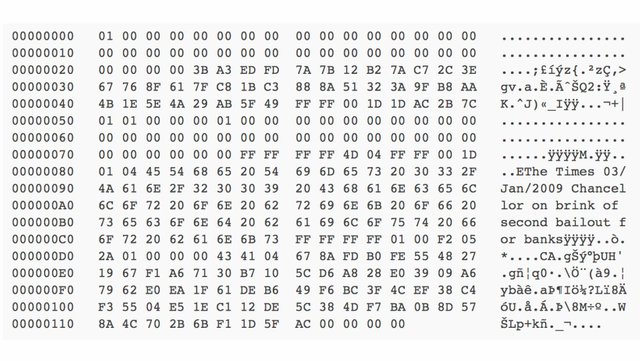
Satoshi’s message located in block 0.
The genesis block’s hash has two additional leading hex zeroes which are not seen in block creation today (except for the infamous 21e800 hash on June 19, 2018). The content of the ‘input’ in a generated bitcoin block contains what’s called a ‘coinbase parameter,’ which in the genesis block’s case is recognized as one of the most fascinating examples of hardcoded text stored inside the chain.
The coinbase parameter for block 0 states:
The Times 03/Jan/2009 Chancellor on brink of second bailout for banks
There are many theories to why Satoshi created this text, the prevailing one being that it was a philosophical message in response to 2008’s economic crisis and the subsequent bank bailouts. In addition to the coinbase parameter, when someone decrypts the hexadecimal format, the message also shows the “Chancellor bailout” text written backward. With Satoshi mining bitcoin with his CPU, it took six days to find block 1 on January 9 after the genesis block’s creation, and some people consider this day to be Bitcoin’s birthday as well. Some bitcoiners also assume Satoshi took a break in between mining blocks 0-1, in order for the timeline to represent the Bible’s Genesis story where God’s creation of the earth took seven days.
Hal Finney, Cryptographers, Internet Geeks, Anarchists, Tech Entrepreneurs, Venture Capitalists, and Grandma
Three days later, Satoshi sent the first transaction to the developer Hal Finney who decided to run the software and accepted 10 BTC from the creator. In fact, Finney was running the Bitcoin protocol on his computer the day after block 1 was mined on January 10 and tweeted about the software that day. However, even though Finney was the first known or identified bitcoin recipient, Satoshi sent coins to quite a few people on that same day. The creator also chose to send coins from block 9, as opposed to sending funds from blocks 1-8 for another unknown reason. On March 19, 2013, Finney explained how he got excited about the protocol after it was released by the anonymous inventor.
“When Satoshi announced the first release of the software, I grabbed it right away — I think I was the first person besides Satoshi to run bitcoin,” explained Finney’s recollection of the events. “I mined block 70-something, and I was the recipient of the first bitcoin transaction when Satoshi sent ten coins to me as a test — I carried on an email conversation with Satoshi over the next few days, mostly me reporting bugs and him fixing them,” the cryptographer added.
Seven days after the creation of the Genesis block, Hal Finney tweeted that he was running the Bitcoin software.
The creation of Bitcoin’s Genesis block and the beginning stages of the network slowly started to gather more supporters as time progressed. To this day, we don’t know what happened to Satoshi when the creator left the scene in 2010, by which point he is credited with having mined close to 1 million bitcoins. Since then, the establishment has scorned the technology year after year, while Bitcoin has steadily gained traction. Meanwhile, large swathes of geeks and political idealists started to believe the protocol would revolutionize the entire monetary system on a global level. For six years after block 0 was mined, the financial elites called cryptocurrencies crap before attempting to commercialize them in 2015.
Bitmex sponsored a thank you message to Satoshi for The Times’ January 3rd, 2019 front page. Included on the front page is the hash of Bitcoin block 554,509 in which Bitmain’s Jihan Wu and the mining pool BTC.com added the message “Thanks Satoshi” in the coinbase parameter.
Hard Money and the 21 Million Deliverable Pieces of Subjective Value
Satoshi’s software is more than just a fundamental breakthrough in computer science; the technology is also a peer-to-peer, open, secure, censorship-resistant, and the most deliverable type of money ever created. Since the creation of the genesis block 10 years ago today, the technological innovation has allowed for a pure form of voluntary free market exchange. Transactions between global individuals are conducted in a permissionless manner across hundreds of invisible borders without the need for any pre-existing trust. The innovation Satoshi gave to the world in 2008 is the current monetary system’s black swan, equipped with a positive feedback loop. Its ability to survive 10 turbulent and testing years is surely an event worth celebrating.
What do you think about the 10-year anniversary of the genesis block and Satoshi Nakamoto’s infamous creation? Let us know what you think about this subject in the comments section below.
Images via Shutterstock, The Times, Twitter, Brave the World, and Pixabay.
Need to calculate your bitcoin holdings? Check our tools section.
The only kids programming language worth using, Scratch, just celebrated the launch of Scratch 3.0, an update that adds some interesting new functionality to the powerful open source tool.
Scratch, for those without school aged children, is a block-based programming language that lets you make little games and “cartoons” with sprites and animated figures. The system is surprisingly complex and kids have created things like Minecraft platformers, fun arcade games, and whatever this is.
The new version of scratch includes extensions that allow you to control hardware as well as new control blocks.
Scratch 3.0 is the next generation of Scratch – designed to expand how, what, and where you can create with Scratch. It includes dozens of new sprites, a totally new sound editor, and many new programming blocks. And with Scratch 3.0, you are able to create and play projects on your tablet, in addition to your laptop or desk computer.
Scratch is quite literally the only programming “game” my kids will use again and again and it’s an amazing introduction for kids as young as pre-school age. Check out the update and don’t forget to share your animations with the class!
from Startups – TechCrunch https://tcrn.ch/2CNqDmq


 The report discusses the start of the South Korean cryptocurrency mining industry with the operator of a mine who purchased roughly 1,000 mining rigs for generating ether while prices were approaching all-time record highs during January last year.
 Financial Channel asserts that the challenges faced by Korean miners were compounded by a dramatic slump in the premium on cryptocurrency prices in Korea — the so-called “Kimchi premium” — from as high as 40 percent at the start of 2018 to just 1 percent today.
 Last November, the U.S. state of Ohio





 Lamassu, the well-known
  Despite some difficulties, Switzerland’s approach in offering “a place where rules are well defined and regulators are pro-innovation,” has been quite successful so far in attracting crypto entrepreneurs. According to a
 ]
] 

 On Halloween 2008, an anonymous developer named Satoshi Nakamoto announced a paper called