About Startup365

Chaque jour nous vous présenterons une nouvelle Startup française ! Notre pays regorge de talents et d'entrepreneurs brillants ! Alors partons à la découverte des meilleures startup françaises ! Certaines d'entre elles sont dans une étape essentielle dans la vie d'une startup : la recherche de financement, notamment par le financement participatif (ou crowdfunding en anglais). Alors participez à cette grande aventure en leur faisant une petite donation ! Les startups françaises ont besoin de vous !

#UK Why Cambridge is well placed to buck a Brexit slowdown

//

With Brexit decisions just around the corner several questions have been raised regarding the future of the UK as a global business location, writes Rob Sadler, head of Savills’ Cambridge office

There remains little indication of what a deal might look like at this stage, however despite uncertainty Cambridge’s future remains brighter than ever before. 

The ecosystem that serves Cambridge’s 1,000 plus technology and life sciences companies, which connects entrepreneurs, investors and academics, has been developed over many decades, fostered by strong links to the world famous university as well as a number of high profile medical facilities.

As a result, a number of international and European businesses have made the city their home and while Brexit negotiations have undoubtedly caused unease, several larger firms including AstraZeneca and Arm Holdings have confirmed their long term commitment to Cambridge since the 2016 referendum. 

Crucially they aren’t the only ones. At present, Savills is tracking more than a quarter of a million sq ft of requirements from businesses looking to expand within Cambridge, despite what the future may hold.  

The amount of corporate investment into the city, including mergers and acquisitions, private equity and venture capital funding, also paints a promising picture. 

Since the referendum, the ‘Cambridge Phenomenon’ has driven capital growth value by an average of 7.3 per cent, far exceeding other key regional cities. With £35.43 billion invested in 2016 and 2017 alone, Brexit has clearly had little impact on investor confidence. 

Looking forward, Cambridge is also well placed to nurture emerging sectors such as Artificial Intelligence (AI). Samsung, Microsoft and local success story Darktrace have already gone some way to create a growing cluster of both mature and start-up AI developers. 

What’s more, with a limited supply of AI experts across the UK, the talent coming out of the University of Cambridge will prove invaluable. For this reason the city is in a good position to take advantage of the Government’s AI Deal, which is set to be worth more than £1 billion. 

Overall, Cambridge’s growth prospects remain strong and the fact that the city is not overly reliant on the financial services sector also insulates it from some of the problems impacting other key business centres across the UK. 

In order to sustain this growth, Cambridge will need to maintain the delivery of commercial space as well as improving residential affordability. Business expansion is all well and good, but if these businesses have nowhere to go, and their employees have nowhere to live, then it is likely to falter with or without Brexit. 

However, with a commitment from central Government and a more localised City Deal in place to try and solve some of these issues, Cambridge is well placed to capitalise – deal or no deal. 

from Business Weekly http://bit.ly/2CMcAh7

Posted in #UK

#Blockchain Hive Criticizes Norwegian Government Amid Concession Cuts to Miners

Hive Criticizes Norwegian Government Amid Concession Cuts to Miners

Hive Blockchain Technologies has published an update regarding the company’s response to the Norwegian Parliament’s recent approval of a legislative bill that will restrict cryptocurrency miners from accessing the tax relief on electricity consumption available to other power-intensive industries. The release criticizes the government’s “unilateral” move to suspend the subsidy without consulting with representatives of the mining industry and discusses proposed changes to the loan agreement pertaining to Hive’s sole asset located in Norway.

Also Read: Pump and Dumps Are the Final Indignity for Dying Coins

Hive Criticizes Norwegian Decision to Revoke Electricity Subsidies to Miners

Hive Criticizes Norwegian Government Amid Concession Cuts to MinersHive has taken aim at the Norwegian government’s decision to revoke subsidies on power consumption that are available to energy-intensive industries operating in Norway. The legislative bill moving to revoke cryptocurrency miners’ access to the subsidy was passed in early December and is expected to take effect during March of this year.

Hive states that it is “deeply disappointed and frustrated” by the proposed legislative changes, expressing its dissatisfaction with the government’s decision to take “unilateral” action without “discussion, consultation, or dialogue with the industry.”

The company describes the bill as comprising a “significant impediment” to Norway’s capacity to attract long-term foreign investment in the country, warning that the bill will deter “all energy-intensive industries” that are considering “long-term capital investments” from establishing operations in Norway.

Hive to Conduct Assessment of Damages to Kolos Data Center

Hive Criticizes Norwegian Government Amid Concession Cuts to MinersAs a result of the legislative changes, Hive states it will conduct an assessment of the impact of the bill on the economics of its sole Norwegian asset, the ‘Kolos’ data center.

On Dec. 20, 2018, Hive issued a letter to debt holders associated with the Kolos acquisition proposing changes to the loan agreement pertaining to the asset. The company is currently seeking a one year extension of the term of the approximately $2.4 million loan that financed the asset’s acquisition while the Hive determines the impact that the legislative changes will have on the value and future plans for the Kolos data center. Hive expects to have completed its damage assessment prior to the end of the fiscal year on March 31, 2019.

In November 2018, Norwegian parliamentary representative Lars Haltbrekken criticized the subsidies available to cryptocurrency miners, stating that Norway “cannot continue to provide tax incentives for the most dirty form of cryptographic output as bitcoin.”

Do you expect that Norway will see an exodus of cryptocurrency miners in response to the legislative changes? Share your thoughts in the comments section below!


Images courtesy of Shutterstock


At Bitcoin.com there’s a bunch of free helpful services. For instance, have you seen our Tools page? You can even lookup the exchange rate for a transaction in the past. Or calculate the value of your current holdings. Or create a paper wallet. And much more.

The post Hive Criticizes Norwegian Government Amid Concession Cuts to Miners appeared first on Bitcoin News.

from Bitcoin News http://bit.ly/2SxAulE Hive Criticizes Norwegian Government Amid Concession Cuts to Miners

#Blockchain The Cashaccount.info Platform Tethers Names to Bitcoin Cash Addresses

The Cashaccount.info Platform Tethers Names to Bitcoin Cash Addresses

Last October, Bitcoin Cash (BCH) proponent and developer, Jonathan Silverblood, told the BCH community about a new identification system he developed that ties a custom human-readable alias to a bitcoin cash address. Silverblood has launched a beta version of the platform Cashaccount.info so visitors can test out the platform’s functionality and give the developer feedback. On the 10-year anniversary of the Bitcoin Genesis block, all beta account names will be invalid when the system finalizes on January 3rd.

Also Read: How Institutional Investors Are Changing the Cryptocurrency Market

Bitcoin Cash-Powered Human Readable Account Names You Can Share in Conversation

Bitcoin Cash proponents can experiment with a new BCH-powered alias-address system called Cashaccount.info. News.Bitcoin.com reported on the initial development of the BCH name system that allows for human-readable account names tied to the keys of a BCH address. The protocol is open source and uses an OP_Return transaction when the name is broadcast and confirmed on the BCH network. Silverblood’s Cash Accounts code and specifications can be found on Gitlab if a user wants to review how naming the process works.

The Cashaccount.info Platform Tethers Names to Bitcoin Cash Addresses

“The Bitcoin address system based on hashing data creates complex and difficult to share identifiers,” explains Silverblood’s motivation behind creating Cash Accounts on Gitlab. “While these identifiers have proper checksums and misspellings are rare, they are still very cumbersome to transfer over the telephone, in a regular chat or similar — Many attempts have been made to obfuscate the addresses by transferring them as QR codes or NFC tags, but the need for a human-accessible format remains.”

The Cashaccount.info Platform Tethers Names to Bitcoin Cash Addresses
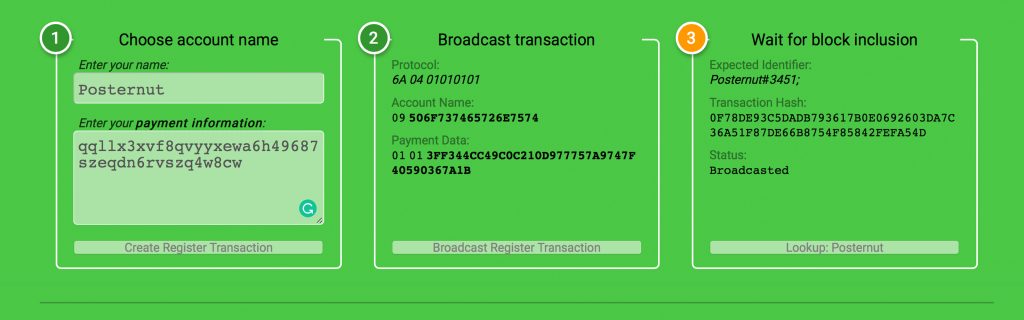
Registering the name “Posternut 3451” on the Cash Accounts platform.

Experimenting With a Cash Accounts Name System Until January 3rd

News.Bitcoin.com tested the Cash Accounts platform by registering a temporary name using the beta version. Everything is fairly straightforward as you simply type your alias and tether the name to a public BCH address. After that, the user presses a button that says “Create Register Transaction,” which then gives the registrant a protocol number, account name, and payment data.

The Cashaccount.info Platform Tethers Names to Bitcoin Cash Addresses
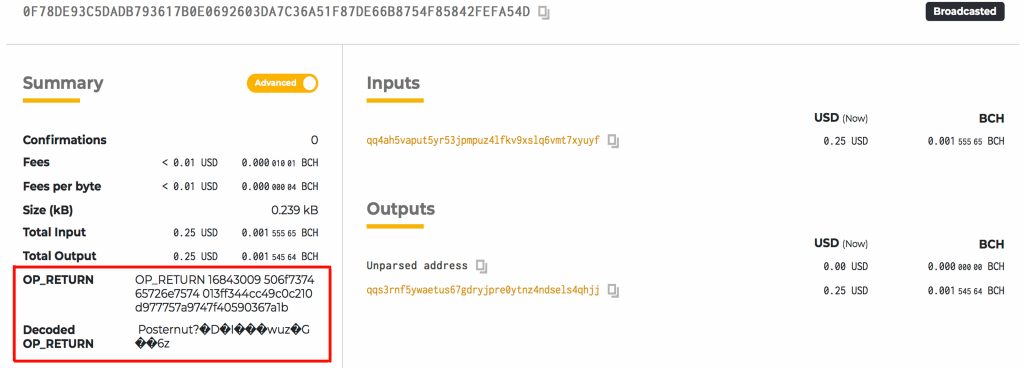
You can look up the OP_Return transaction’s hash on any Bitcoin Cash block explorer.

Pressing the “Broadcast Register Transaction” will then broadcast the information to the Bitcoin Cash network so miners can include the transaction in a block. The registrant will have to wait for the transaction to confirm in order to “Lookup” the name they just created. The process only took news.Bitcoin.com about 2 minutes to register and then waiting a few more minutes for the name “Posternut #3451” to be registered in a block.

The Cashaccount.info Platform Tethers Names to Bitcoin Cash Addresses
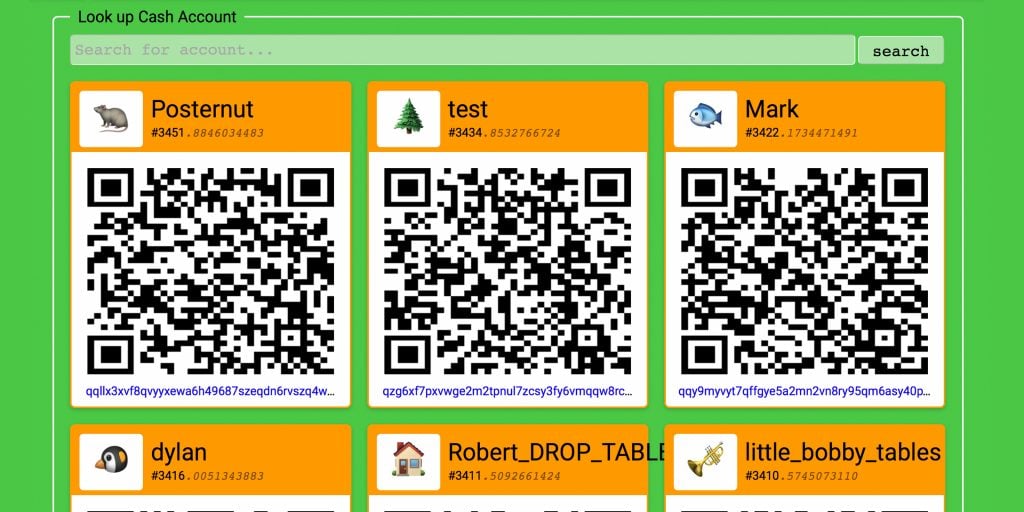
All the registered Cash Accounts on the platform including news.Bitcoin.com’s “Posternut 3451” handle.

The Cash Accounts concept could do well if a lot of users registered for usernames or aliases, but the protocol would also work more smoothly with a lot of infrastructure behind it. At the moment the Cashaccount.info website displays all the bitcoin cash supporting wallets the developer has reached out to for client compatibility. Wallets include BRD, Edge, Bitcoin.com, Electron Cash, Copay, Stash, Ledger and more. Some wallet providers have responded back and Silverblood has initiated pull requests for other clients.

What do you think about the Cashaccount.info concept? Let us know what you think about this platform in the comments section below.

Disclaimer: Readers should do their own due diligence before taking any actions related to the mentioned software/company/organization or any of its affiliates or services/products. Bitcoin.com and the author are not responsible, directly or indirectly, for any damage or loss caused or alleged to be caused by or in connection with the use of or reliance on any content, goods or services mentioned in this article. This editorial is for informational purposes only.


Images via Shutterstock, Bitcoin.com’s BCH Block Explorer, and Cashaccount.info


Need to calculate your bitcoin holdings? Check our tools section.

The post The Cashaccount.info Platform Tethers Names to Bitcoin Cash Addresses appeared first on Bitcoin News.

from Bitcoin News http://bit.ly/2BUXioA The Cashaccount.info Platform Tethers Names to Bitcoin Cash Addresses

#Africa 12 African startups to watch in 2019

//

Over the past 12 months Disrupt Africa has yet again been fortunate to meet with hundreds of inspiring, innovative tech-fueled startups shaking up the status quo all around the African continent.  But which startups stood out for our team? Here, we give you our pick of the top 12 African startups to watch in 2019.

NORTH AFRICA

Shezlong

Egyptian startup Shezlong ticks the disruption and impact boxes, with its mission to address the stigma in North Africa surrounding mental health issues.  The company operates an online mental health platform allowing patients to connect with licensed therapists via video on mobile or web.

While it has been around for a few years, Shezlong had a very strong 2018 – raising US$350,000 funding; accepted onto the 500 Startups accelerator; and selected to pitch at the annual Africa Early Stage Investor Summit.  

We expect the startup to hit the ground running in 2019, and we look forward to the exciting developments as this e-health innovation really takes off.

Elves

Egypt’s tech-driven virtual assistant app Elves has seen activity accelerating over the past 18 months, and we’re pretty sure the snowball will continue into 2019.

Elves uses a “human in the loop” methodology to drive machine learning and build AI; with the chat-based platform allowing users to talk to a “super human assistant” to do anything, anywhere in the world, for free.

The startup raised US$2 million in seed funding right at the close of 2017, giving it a huge boost to get to work in 2018 – which it has done, expanding to the US.  Elves has opened an office in Los Angeles with an initial team of six, which is focused exclusively on conquering the US market.  We look forward to updates.

Halan

Transportation is a major sticking point in many African cities, and there’s startups scattered continent-wide trying to address travel logistics in their local markets.  One of them sticks out to us this year – Egypt’s Halan.

Founded in 2017, Halan is a motorcycle and tuk tuk ride-hailing and on-demand logistics application, which has already facilitated over three million rides across several governorates in Egypt and Sudan.

The startup secured a “multi-million dollar” funding round in 2018, from the likes of Singapore’s Battery Road Digital Holdings and Egypt’s Algebra Ventures, with a view to pressing on with expansion to further markets.  We’re excited to see the progress Halan makes over the coming year.

EAST AFRICA

Nala

Our first East African pick is Tanzania’s Nala, a simplified mobile money application that allows users to make faster, smarter and safer transactions without an internet connection.

Beginning life as a Stanford University student’s side-project, and moving to on-the-ground research and operations in Tanzania in 2017, the past year has seen Nala’s progress accelerate quickly – it received funding from DFS Lab; won the Ecobank Fintech Challenge; took home the AppsAfrica Award for Disruptive Innovation; and was named winner of Seedstars Tanzania in December.

We’ll certainly be keeping a keen eye on Nala in 2019.

Taimba

The agri-tech space in Africa is booming, with the number of startups operating in the market growing 110 per cent over the past two years, and over US$19 million invested into the sector in the same period, according to the Agrinnovating for Africa report released by Disrupt Africa.  

One of the quality agri-tech ventures emerging on the continent is Kenya’s Taimba, which operates a business-to-business mobile-based cashless platform connecting farmers with retailers; with the aim of improving the supply chain, as well as regulating the price of agricultural produce.

Launched mid-2017, the startup has already caught people’s attention – named one of three winners of the Food+City Challenge Prize hosted by SXSW; and winning the inaugural Disrupt Africa Live Pitch Competition.  2019 is sure to hold more developments for Taimba.

UTU

Kenyan artificial intelligence startup UTU caught our (and investors’) attention in 2018, and we foresee big things ahead in the coming year.

UTU –  which is the company behind socially-powered taxi and transport app Maramoja – has developed an algorithm optimised for trust that utilises proprietary innovations in the fields of AI and distributed ledger technology.

The startup has been raising seed funding across 2018, first collecting  an undisclosed amount of funding from Hong Kong-based accelerator Zeroth in April; followed by US$250,000 from the Bulgaria-based æternity Ventures, after taking part in its Starfleet Incubator for blockchain startups.  UTU closed the year with the announcement it had added Tokyo-based incubator and venture capital firm DEEPCORE to its list of seed investors.

Definitely one to watch in 2019.

SOUTHERN AFRICA

FinChatBot

It’s been an interesting year for South Africa’s FinChatBot.  Founded in 2016, FinChatBot develops chatbots to help financial service providers acquire and retain customers through artificial intelligence (AI)-powered conversations.

Although the early plan was to expand to multiple markets at once – with resellers on the ground in Morocco and Kenya, the startup this year decided to focus more on its home market of South Africa – and has had a strong year as a result.

FinChatbot was selected to compete at the first African edition of the Visa Everywhere Initiative; as well as pitching at the annual AfricArena conference.

The startup concluded 2018 with a bang – announcing it had raised ZAR8 million (US$563,000) in funding from local venture capital firm Kalon Venture Partners and the Mauritius-based Compass Capital, to continue its rapid growth and expand its client pipeline… and we’ll be watching.

Appy Saude

Angolan startup Appy Saude is transforming access to healthcare in the country, through its healthcare database app.

Launched in 2017, Appy Saude allows users to access information such as services offered, medical specialities covered, insurance accepted, as well as the contact details of the over 2,000 medical facilities listed, which are located around the full span of Angola.  The startup claims no such directory existed prior to its launch.

The startup has been busy rolling out new features throughout 2018, with users now able to find, research and book doctor’s appointments, as well as locate and reserve medical products for pick-up.  It has also partnered with the country’s largest mobile operator, Unitel, to allow the operator’s 12 million users to access Appy Saúde for free.

While the startup has been working under the radar for the past year or so, given the pace at which the team is working we expect big announcements in 2019.

Vizibiliti Insight

South African startup Vizibiliti Insight has seen some major action in 2018, and we expect the excitement to continue in 2019.  The startup uses AI to help the commercial property sector pre-screen tenants and predict the chances of them defaulting.

Vizibiliti Insight was picked to pitch at the Viva Tech event held in Paris in May; and came away the overall winner for the Customer Experience Transformation through Digital challenge, winning the cash prize and an invitation to Verizon’s New York office to collaborate with the company.

In November, the startup was chosen to take part in Knife Capital’s fourth Grindstone Accelerator programme, which helps businesses become more investable, sustainable and exit-ready.  So we look forward to hearing what’s next.

WEST AFRICA

CowryWise

Nigerian fintech startup CowryWise launched in 2017, and has been catching people’s attention since then both within Africa and over in Silicon Valley.

CowryWise operates a secure automated service that helps users save money and enjoy high returns from risk-free investments in Nigeria with zero fees. It has so far processed over US$1.5 million in savings for its customers.

The startup secured investment from Nigerian early-stage fund Microtraction in June, and was accepted into the Y Combinator Summer 2018 Batch – gaining access to the Silicon Valley-based three-month programme and receiving US$120,000 in funding.  

With all that fine-tuning, mentoring and backing behind it, we’re sure CowryWise will put on a great show in 2019.

CowTribe

Ghana’s CowTribe has been around for a couple of years, but things ramped up for the startup in 2018 and we expect to see more from it in 2019.

Launched in 2016, Cowtribe sources and aggregates genuine and affordable animal vaccinations from large suppliers, and works through a network of qualified agents to deliver them to farmers.  Vaccines can be ordered via USSD, text and telephone, as well as through community agents.

CowTribe has had a busy year.  In July, the startup was named winner of Seedstars Ghana; in August it announced plans to expand aggressively to reach all 10 regions of Ghana within 18 months; and in November secured US$300,000 investment from the United States (US)-based Draper Richards Kaplan Foundation in order to give its expansion plans a boost.

KudiGO

Ghana dominates our West African picks this year, with the country’s KudiGO taking the final spot on the 2019 list.

KudiGO provides an integrated, mobile-based retail, payments, accounting and analytics engine for the consumer retail industry, providing a complete solution for businesses to receive payments, track inventories and build sound financial models based on past trends.

After a year in public beta, the startup officially launched in 2018, and hit the ground running.  Not only is KudiGO already expanding to more African markets, but in November the startup said it was closing in on a US$300,000 funding round to facilitate further expansion, while also securing all-important partnerships.

We look forward to seeing what’s next for KudiGO; and for all the startups on the Disrupt Africa list of startups to watch in 2019.

The post 12 African startups to watch in 2019 appeared first on Disrupt Africa.

from Disrupt Africa http://bit.ly/2QhxFmO

#Blockchain Japan’s DMM Exiting Cryptocurrency Mining Business

Japan's DMM Exiting Cryptocurrency Mining Business

Japanese e-commerce giant DMM.com is reportedly exiting its cryptocurrency mining business due to “deteriorating profitability,” local media reported. This news follows an announcement by another major Japanese company, GMO Internet, that it will no longer manufacture and sell mining machines, citing similar reasons.

Also read: Indian Supreme Court Moves Crypto Hearing, Community Calls for Positive Regulations

Out of the Mining Business

Japan’s DMM Exiting Cryptocurrency Mining BusinessJapanese entertainment and e-commerce giant DMM.com Inc. is reportedly exiting its cryptocurrency mining business, according to local media. Toyo Keizai publication reported on Dec. 30 that DMM made a decision to exit the crypto mining business since September. “Deteriorating profitability is the main cause,” the publication quoted the company as saying, elaborating:

The withdrawal process such as the sale of the machines will go over to the first half of 2019.

Japan’s DMM Exiting Cryptocurrency Mining BusinessDMM founder Keishi Kameyama described on Dec. 31 that, going forward, “he will work hard on ‘[the] exchange [business] and blockchains,’” Nikkei reported. A subsidiary of the group, DMM Bitcoin, is one of the 16 regulated crypto exchanges in Japan.

The company announced the establishment of its virtual currency division in September last year and began mining operations in Japan’s Kanazawa city in October. Multiple cryptocurrencies were mined “such as bitcoin, ethereum, [and] litecoin,” Toyo Keizai detailed.

Japan’s DMM Exiting Cryptocurrency Mining Business

Launching with ambitious goals for its mining division, DMM announced at the time that it “will operate a mass-scale, made-in-Japan quality, mining farm whose operating size will be unmatched by any of the domestic operators.” It also planned to rank in the “top three of the world’s mining farm companies in terms of scale.” DMM also created a “research and development specialty lab” for crypto mining called DMM Mining Labo.

Showroom Closing

Japan’s DMM Exiting Cryptocurrency Mining BusinessAlong with the official launch of its mining farm, DMM announced in February a plan to open up a showroom for public access at its mining facility in Kanazawa. The company planned to operate 1,000 mining machines in the showroom of about 500 square meters in April. “We plan to start accepting from the middle of March tours for the general public,” DMM detailed at the time.

However, Toyo Keizai reported that DMM had underestimated security concerns and quoted the company explaining:

I would like users to experience the extraordinary mining site in their lives. From such thought DMM opened a part of the [mining] farm to the public, but this was canceled in early June. It is because it is judged that ensuring security is difficult. Overseas, theft of virtual currency mining machines has been steady, and [there were attempts] even at the DMM’s Kanazawa farm.

Last week, DMM announced that its crypto trading app Cointap will not be launched as planned. According to the publication, the company believes that attracting beginner crypto traders has become difficult due to the decline in cryptocurrency prices and the hack of Coincheck exchange in January.

Japan’s DMM Exiting Cryptocurrency Mining BusinessDMM’s news came less than a week after another major Japanese company, GMO Internet, announced that it will no longer manufacture and sell mining machines. However, GMO said that it will continue to mine in-house and will relocate its mining farm. “Regarding the current mining machine markets, the environment is increasingly competitive because of the decreased demand mainly due to the decline in the cryptocurrency price, the decline in the sales price, etc,” GMO explained.

Attempts to contact DMM.com for comments have not yielded any results at press time.

What do you think of DMM shutting down its cryptocurrency mining business? Let us know in the comments section below.


Images courtesy of Shutterstock, DMM.com Inc., and GMO Internet.


Need to calculate your bitcoin holdings? Check our tools section.

The post Japan’s DMM Exiting Cryptocurrency Mining Business appeared first on Bitcoin News.

from Bitcoin News http://bit.ly/2F5uPzk Japan’s DMM Exiting Cryptocurrency Mining Business

#Blockchain Pump and Dumps Are the Final Indignity for Dying Coins

Pump and Dumps Are the Final Indignity for Dying Coins

You can tell an altcoin is close to death when its price soars. That may sound like a contradiction in terms, but that’s what can happen to crypto assets when they’re in the throes of death. With low liquidity and thin volume, exchange-listed altcoins are prey to manipulators who will send them skyward one final time for a quick profit.

Also read: Bitcoin History Part 7: The First Major Hack

Pump and Dumps Are the Swansong of Dying Altcoins

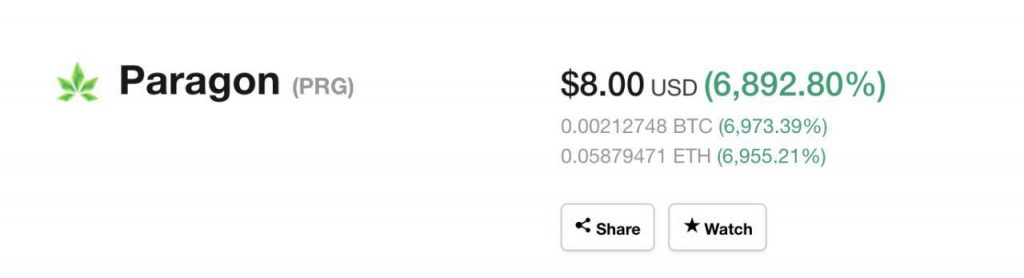
Holders of paragon (PRG) woke up to a pleasant surprise this morning: their coin was up 6,800% overnight. The project has effectively been dead for months, with the SEC ruling in November that Paragon must refund investors who participated in its token sale. News that the worthless token had mooned overnight was thus greeted with astonishment by PRG holders. At 7 a.m. EST on Jan. 1, paragon was trading for over $10, having been changing hands for just $0.30 the day before.

Pump and Dumps Are the Final Indignity for Dying Coins
Paragon reached a peak of $10 on Yobit on Jan. 1 before crashing back to near its former level.

On closer inspection, however, it became clear that the Paragon project wasn’t enjoying a new lease on life. It had not been let off the hook by the SEC, nor had it announced a major partnership that had set the coin’s price rocketing. Rather, paragon had become the latest moribund coin to be subjected to a pump and dump. It had taken just $27,000 of trading volume on a single exchange, Yobit, to propel PRG to double-digit dollar prices, and then back down almost to where it began hours earlier.

Pump and Dumps Are the Final Indignity for Dying Coins

P&Ds and 51 Percents Herald the Beginning of the End

The final indignity of dying coins, it appears, is to be fraudulently manipulated to enrich insiders one more time. As other tokens that launched during 2017’s ICO mania die off like paragon, they risk succumbing to the same fate. As for Proof of Work coins that are also in the process of dying quietly, there’s another means of manipulation – the 51 percent attack. In a blog post published on Jan. 1, prominent bitcoiner Nic Carter performed a post-mortem on 15 cryptocurrencies whose demise he’d predicted at the start of 2018.

Pump and Dumps Are the Final Indignity for Dying CoinsOf the projects he successfully called out, two had their demise hastened by 51 percent attacks – Verge and Bitcoin Gold. As Carter acknowledged, it is virtually impossible for a cryptocurrency project to die out entirely, as there will always be residual trading volume and someone willing to pay a rock-bottom price in the hope that the asset will return to its former glories, just as paragon fleetingly did today. Even for those coins that are artificially coaxed back into life, however, the movement merely reaffirms that they are on the way out and destined for an entry on Deadcoins.com. Paragon is already there.

Do you think exchanges should be more proactive in delisting low-volume altcoins? Let us know in the comments section below.

OP-ed disclaimer: This is an op-ed article. The opinions expressed in this article are the author’s own. Bitcoin.com does not endorse nor support views, opinions or conclusions drawn in this post. Bitcoin.com is not responsible for or liable for any content, accuracy or quality within the Op-ed article. The opinion editorial is for informational purposes only.


Images courtesy of Shutterstock and Coinmarketcap.


Need to calculate your bitcoin holdings? Check our tools section.

The post Pump and Dumps Are the Final Indignity for Dying Coins appeared first on Bitcoin News.

from Bitcoin News http://bit.ly/2Qi2kjW Pump and Dumps Are the Final Indignity for Dying Coins

#Blockchain How Institutional Investors Are Changing the Cryptocurrency Market

Institutional investors trading cryptocurrency gained ground in 2018, with a number of high profile players edging in and taking a seat at the table. Increased interest from larger investors may have played a part in supporting digital assets as well as distorting the market. 

Also Read: KPMG: Institutional Investment Key to Cryptoassets Growth

Will Crypto Markets Turn Bullish Again in 2019?

How Institutional Investors Are Changing the Cryptocurrency MarketLast year, reports emerged that George Soros and the Rockefeller family were beginning to take positions in the emergent crypto asset class, according to Bloomberg. The family’s $26 billion Soros Fund Management was supposedly considering trading digital assets. The Rockefeller family’s VC arm, Venrock, decided to take a different approach by partnering with Coinfund to assist entrepreneurs in launching blockchain businesses. 

Mike Novogratz, the chief executive officer of Galaxy Investment Partners, said he sees Q1 and Q2 2019 as a period when more institutions will start to come into crypto. He also expects the crypto markets to turn bullish again in 2019. 

Crypto Is Not a Playground Anymore

Previously, investors were hesitant to enter the crypto markets due to high volatility and lack of regulation, but this is changing, with large players starting to take positions. How Institutional Investors Are Changing the Cryptocurrency Market

Stefan Neagu, co-founder of digital identify management system Persona, said: “BTC attracted large players, as the institutional investors saw BTC as an investment instrument. This helped the crypto market because it was not a playground anymore, but rather the sandbox of a limited group of people with money from a real economy being shifted to the crypto market.”      

In 2018, over-the-counter (OTC) market makers have thrived, with many institutional traders shifting to OTC. Etoro announced that it had opened an OTC platform for institutional buyers and Coinbase and Hodl Hodl launched OTC desks in November. 

According to cryptocurrency research group Diar, institutional cryptocurrency trading on traditional exchanges has been diminishing in volume due to BTC being welcomed into major outfit portfolios this year. There has instead been a shift to OTC trading. 

During OTC market hours, there has seen an increase in BTC trading volume by 20 percent, while Grayscale’s Bitcoin Investment Trust (GBTC) volumes were down 35 percent in 2017 vs. 2018 for the same period. It seems institutional traders might be shifting towards higher liquidity OTC physical BTC markets. 

Coinbase records more BTC trading volume than Grayscale’s Bitcoin Investment Trust (GBTC) on its OTC markets where the institutional cryptocurrency product is listed.

Liquidity Issues and Susceptibility to Manipulation

Another issue with the cryptocurrency market is low liquidity and its susceptibility to manipulation. The increased entry of institutional investors may have helped anchor the current market and distort prices.

Neagu said: “I doubt that this [increased institutional investor] interest will cause liquidity issues. I don’t see any reason why the crypto market should be different than the stock market. As for distorting the prices, I don’t think that they would see any big ripples.” He added: “Let’s remember that the Mt. Gox trustee sold $230 million worth of BTC in four months, and they did it using exchanges, not OTC desks. For the moment, the “weight” of these institutional players is not that big to send the BTC price down.”

Hong Kong Crypto Regulations Favor Institutional Investors

In Asia, Hong Kong’s Securities and Futures Commission (SFC) has introduced new rules which limit crypto trading to institutionHow Institutional Investors Are Changing the Cryptocurrency Marketal investors. Licensed portfolio managers and funds that invest more than 10 percent of their portfolios in virtual assets are required to obtain a license which means only qualified institutional investors will be allowed to invest in virtual asset portfolios.   

Roger Lim of Singapore-based NEO Global Capital (NGC) explains that crypto regulation in East Asia are still fragmented. However, further regulation will drive both governance and the mainstream adoption of cryptocurrencies. 

Lim said: “As institutional investors, high net worth individuals, and family offices continue to monitor and take cryptocurrency seriously, and with regulators working to improve standards and guidelines for adoption, I expect that the market will mature in parallel. If the industry can continue to shift gears and direct its attention towards this narrative of growth, I think it’s very likely that we will see a comeback in 2019.”

Crypto Custody Issues Must Be Addressed

Cryptocurrency custody lies in safeguarding crypto assets. Scarcely a month goes by without an exchange hacking, funds being lost, stolen or compromised, with little hope or possibility of recovery. It is in the interest of any financial institution holding assets for another party to lower the risk of theft.

According to the Bank of New York Mellon, there is increasing demand in the market for a traditional, established custodian to provide custody of cryptocurrencies. There have been a number of firms launching services to secure assets and there have been reports of major banks testing and in some cases rolling out crypto custody solutions. Nomura and Intercontinental Exchange have announced plans, and sources state that other major banks such as J.P. Morgan, Goldman Sachs, and Bank of New York Mellon are exploring offerings. Introduction of custody would also unlock large amounts of capital, blogs Tom Shaughnessy, founder of 51percent Crypto Research.

Coinbase has received approval from New York regulators to form a custodial firm for cryptocurrencies. Previously, CEO Brian Armstrong has acknowledged this issue stating that there is $10 billion of institutional money waiting on the sidelines and that the number one issue preventing these individuals from getting involved is the lack of secure custodial services. 

Will we see more institutional investors entering crypto in 2019? Let us know in the comments section below.


Images courtesy of Shutterstock.


Need to calculate your bitcoin holdings? Check our tools section.

The post How Institutional Investors Are Changing the Cryptocurrency Market appeared first on Bitcoin News.

from Bitcoin News http://bit.ly/2LKZVO2 How Institutional Investors Are Changing the Cryptocurrency Market

#Blockchain Abkhazia Temporarily Shuts Down 15 Mining Farms

Authorities in Abkhazia have cut off 15 mining facilities from the territory’s electrical grid. The short-term measure is meant to alleviate power shortages during the cold winter months. The operators of the farms have fully cooperated with the local electric utility.

Also read: Two Mining Companies Among Georgia’s Major Electricity Consumers

8,950 kWt of Mining Hardware Unplugged

Abkhazia Temporarily Shuts Down 15 Mining FarmsChernomorenergo, the state-owned company responsible for the electricity distribution in the breakaway republic, said it disconnected all mining farms it managed to locate. The utility announced on its Facebook page that the shut down facilities had a total power capacity of 8,950 kWt. Their consumption is equal to that of 1,800 households, or the administrative region around Abkhazia’s capital, Sukhumi.

The move follows a decision by the government of the partially recognized entity in northwestern Georgia to temporarily halt cryptocurrency mining with locally produced electricity. The Abkhazian authorities explained the measure, which was approved at the end of last year, was necessary to guarantee the electricity supply for homes, social institutions and important production facilities.

The country’s electric power system has been over stressed by rising consumption due to the low winter temperatures. Chernomorenergo said the miners have complied with the recently issued government decree to limit their consumption. In summer months, however, the bitcoin farms help utilize excess electrical energy produced by a large hydro-power complex located on the de facto border and shared with Georgia.

Abkhazia Temporarily Shuts Down 15 Mining Farms
The Enguri hydroelectric power station.

The Enguri hydroelectric station, along with the smaller Vardnili plant, satisfies most of Abkhazia’s needs for electricity. According to an analysis published by The Financial last year, the total electricity consumption of Georgia reached 1,116 million kWh in March 2018. Around 19 percent of the electrical energy, or 207 million kWh, was consumed by Abkhazia.

Emerging Mining Destination

Much like neighboring Georgia and other countries in the Transcaucasian region such as Armenia, Abkhazia has seen a rapid development of the cryptocurrency mining industry. That’s largely due to the lack of strict regulations and the low operating costs, including cheap electricity which is a major expense in the energy-intensive process of minting digital coins.

Abkhazia Temporarily Shuts Down 15 Mining FarmsThe executive power in Sukhumi has recognized the need to regulate the activities of a growing number of mining businesses. The president of Abkhazia, Raul Khajimba, recently scheduled a government meeting to discuss the drafting of a new law that is expected to legalize the sector and place it under state oversight.

Cryptocurrency miners in Abkhazia have so far played a positive role. Their farms are often located on the premises of abandoned factories from Soviet times. Like several other countries and entities in the post-Soviet space such as Transnistria, for example, the self-proclaimed republic now has a chance to attract fresh foreign investments and increase its budget receipts by inviting more miners and other crypto companies.

Do you expect Abkhazia to become a crypto mining destination like other countries in the Transcaucasian region? Tell us in the comments section below.


Images courtesy of Shutterstock, Chernomorenergo.


Make sure you do not miss any important Bitcoin-related news! Follow our news feed any which way you prefer; via Twitter, Facebook, Telegram, RSS or email (scroll down to the bottom of this page to subscribe). We’ve got daily, weekly and quarterly summaries in newsletter form. Bitcoin never sleeps. Neither do we.

The post Abkhazia Temporarily Shuts Down 15 Mining Farms appeared first on Bitcoin News.

from Bitcoin News http://bit.ly/2Ar3t3T Abkhazia Temporarily Shuts Down 15 Mining Farms

#Blockchain Markets Update: Crypto Traders Enter the New Year With Uncertainty

Markets Update: Crypto-Traders Enter the New Year With Uncertainty

On the first day of 2019, cryptocurrency prices have been steadily moving sideways in a consolidated pattern after taking some slight losses on New Year’s Eve. At the moment, the entire digital asset economy is worth about $126 billion and global trade volume has been thinning out over the last 48 hours.

Also Read: Embracing Utility in 2019: Unreliable Crypto Networks Will Lose to Hyperbitcoinization

2019’s Top Crypto Market Valuations

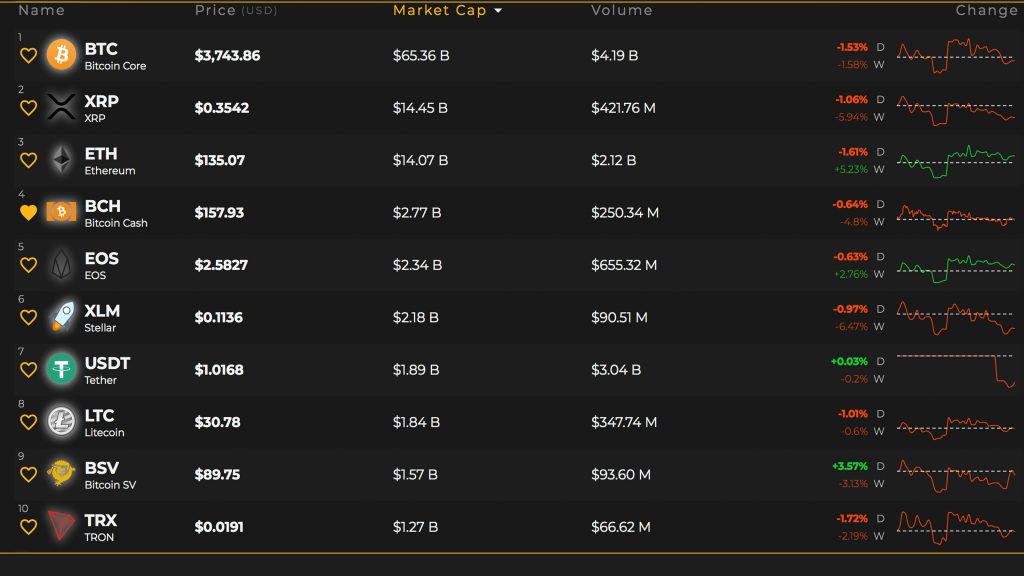
2018 is over and many cryptocurrency enthusiasts are hoping the bearish sentiment that lasted all year long is left behind as well. Trade volume has been light over the last two days, which is likely due to traders celebrating the holidays. It’s likely that heavier digital asset trading will resume at some point today and into the new year. At the moment, global trade volume for all 2000+ assets this Tuesday is around $12.8 billion. Bitcoin core (BTC) is trading for $3,743 and is down 1.5% on Jan.1. The last seven days show BTC is also down a small percentage and trade volume is around $4.2 billion.

Markets Update: Crypto Traders Enter the New Year With Uncertainty
The top 10 cryptocurrencies on Jan. 1, 2019.

The second largest market capitalization held by ripple (XRP) is down 1% today and 5.9% for the week. One XRP is trading for $0.35 and ripple’s overall market valuation is $14.4 billion. Ethereum (ETH) had a decent runup last week as the cryptocurrency is still up 5% over the last seven days but is down 1.6% today. One ETH is trading for $135 and the total market capitalization is awfully close to ripple’s at $14 billion. The cryptocurrency eos (EOS) is having a better day than most. Even though the currency is down 0.63% today, it is up 2.7% for the week. At the time of publication, a single eos is swapping for $2.58 per coin.

Bitcoin Cash (BCH) Market Action

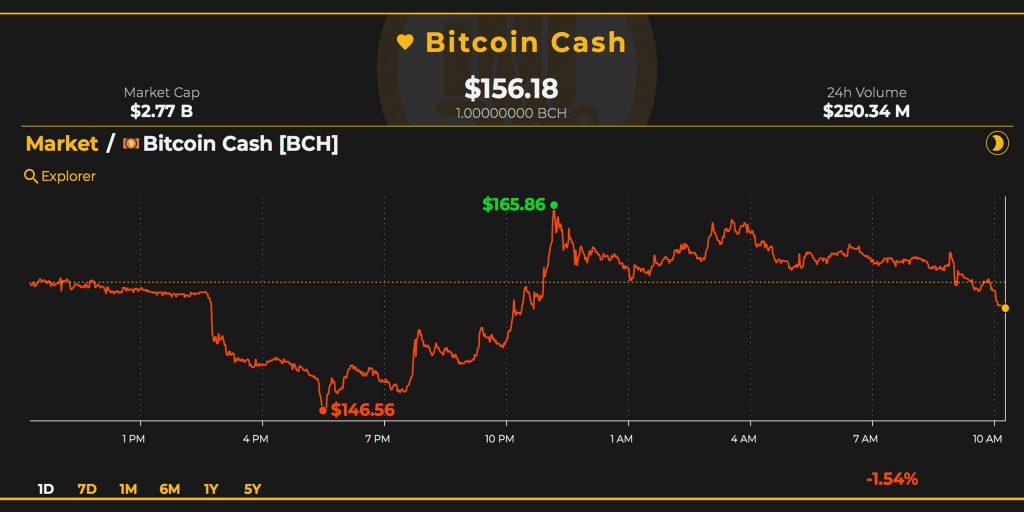
Bitcoin cash (BCH) markets are seeing some improvement on the first day of the year, but prices are down 0.64% over the last 24 hours. BCH is also still down over 4% for the week and trade volume is much lower than last week’s data with only $250 million today. One BCH is trading for $156 at the time of publication. The top five exchanges swapping the most BCH this Tuesday include Lbank, Binance, Huobi, Hitbtc, and Coinbase. A list of currency pair statistics shows that USDT is dominating BCH trades by 42.4% today. This is followed by BTC (19.6%), ETH (18%), USD (9.8%), and JPY (4.5%). The EUR and KRW both have about 1-3% of daily BCH trades today as well. Bitcoin cash is the seventh most traded currency just below litecoin (LTC) and above zcash (ZEC).

Markets Update: Crypto Traders Enter the New Year With Uncertainty
BCH/USD daily chart on Jan. 1, 2019.

BCH/USD Technical Indicators

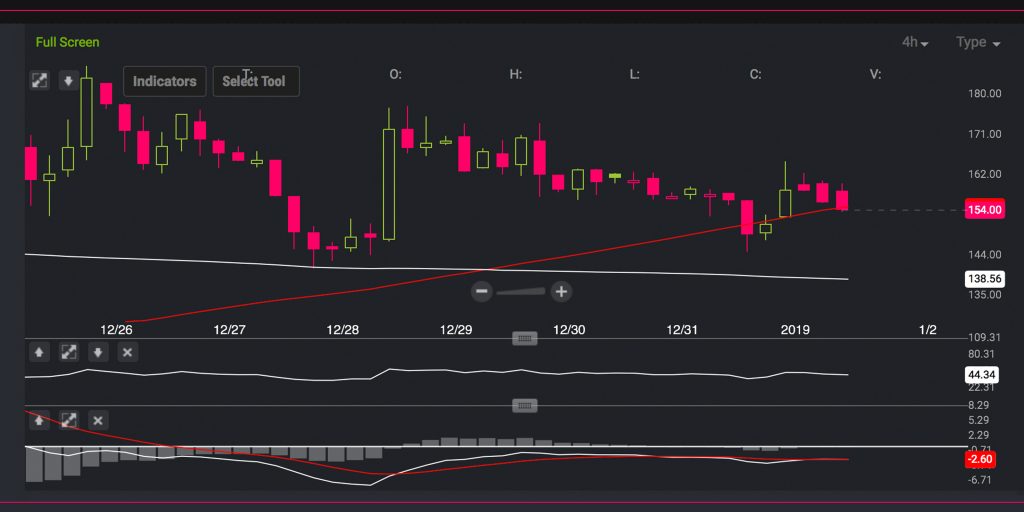
Looking at the BCH/USD daily and 4-hour charts on Bitstamp shows there have been some meaningful trend changes. As explained in our last markets update, the two long-term and short-term Simple Moving Averages (SMA 200,100) were about to cross hairs. Today the 100 SMA has climbed above the long-term 200 SMA indicating some possible upswings ahead.

Markets Update: Crypto Traders Enter the New Year With Uncertainty
BCH/USD 4-H chart on Jan. 1, 2019. Bitstamp.

The Relative Strength Index (RSI) on the BCH/USD 4-H chart shows uncertainty at -46 while the Stochastic and MACd indicators show similar findings. Looking at order books ahead, we can see that bulls will meet resistance at the current vantage point and up until $190-225 per coin. On the back side, foundations have grown stronger and bears will see a few pit stops between $155-135 per coin.

Markets Update: Crypto Traders Enter the New Year With Uncertainty
BCH/USD 4-H chart on Jan. 1, 2019. Bitstamp.

The Hope for 2019 Crypto Market Trend Reversal

Overall, most traders know that the holiday lull may pick up soon as far as volume, but the bearish trends may not be over. Unfortunately, just like the myriad of nonsensical price predictions throughout 2018, there has been a ton of people who think they’ve called “the bottom.” Traditionally, cryptocurrency markets in January don’t fare so well because of people selling for tax reasons and settling end of the year purchases. However, usually after a long-winded year of bearish sentiment sometimes certain markets reverse. On New Year’s Eve John Bollinger, the esteemed inventor of statistical chart characterization tool Bollinger Bands, reminded traders and his Twitter followers of this example.

“Happy New Year,” Bollinger said. “Please keep in mind that there is a long tradition of what did poorly last year, doing well the next — Good trading.”

Where do you see the price of BCH, BTC and other coins heading from here? Let us know in the comments below.

Disclaimer: Price articles and markets updates are intended for informational purposes only and should not to be considered as trading advice. Neither Bitcoin.com nor the author is responsible for any losses or gains, as the ultimate decision to conduct a trade is made by the reader. Always remember that only those in possession of the private keys are in control of the “money.”


Images via Shutterstock, Trading View, Coinlib.io, Bitstamp, and Satoshi Pulse.


Want to create your own secure cold storage paper wallet? Check our tools section.

The post Markets Update: Crypto Traders Enter the New Year With Uncertainty appeared first on Bitcoin News.

from Bitcoin News http://bit.ly/2AskGK3 Markets Update: Crypto Traders Enter the New Year With Uncertainty

#UK Cambridge Artificial Intelligence and machine learning to be even more pervasive in 2019

//

With new ideas innovation continuing to drive Cambridge’s businesses, Stephen Hodsdon – a partner, patent and trade mark attorney in the Cambridge office of J A Kemp – considers what engineering and IT fields may lead the way in 2019.

2019 looks likely to be another exciting year for the world-leading R & D that Cambridge excels in producing. 

It is a well-known statistic that Cambridge produces significantly more patent applications per head than any other area of the UK and this shows little sign of decreasing. As a patent attorney, this is of course unsurprising, but it doesn’t happen by accident.

The diversity of Cambridge-based innovation makes it hard to pick even a selection of sectors which will lead the way in 2018. However, gazing into my crystal ball (sadly neither real nor, as far as I can determine, a Cambridge invention), here are a few thoughts on the areas that could drive 2019’s innovation output.

First we are likely to see an increasing pervasiveness of Artificial Intelligence and its baby brother machine learning in every field of technology.  

As a result of larger data sets and new profiling approaches, there will be further advances in personalised medicine and the ability to diagnose (and hopefully treat) rare, and not-so-rare, diseases.  

The recent completion of the 100,000 Genomes Project provides an unprecedented data set to be worked on and it will be interesting to see how the results from this are taken forward.  

Improvements in, and wider deployment of, AI and ML-driven dynamic resource allocation is likely to create increasing efficiencies in all kinds of industries, from transport to computing, from finance to hospital care.  Indeed, applications to agriculture and the food chain provide opportunities to make a global impact on sustainability and tackling poverty and hunger.

Protecting AI inventions poses its own problems and often requires a balance between patenting and keeping aspects of the underlying data sets and decision-making algorithms as secret knowhow.

CleanTech is another area where Cambridge-based companies continue to lead the way, and attention is unlikely to shift away anytime soon. We will surely see (further) breakthroughs in battery technology which enable even wider adoption of electrical vehicles and moves towards the wider electrification of other modes of transport. 

Improved storage, together with continuing improvements in smart grid technologies, will also help maximise our ability to utilise the fluctuating output of renewables.

Finally, there are the seemingly perennial hot topics of 5G and IoT. 2019 should see the roll-out of 5G networks in the UK.

Although Cambridge is not one of the testbeds, Cambridge-based companies will inevitably be providing technology and continuing to innovate in this sphere.  

Happy inventing for 2019!

from Business Weekly http://bit.ly/2VmIZSB

Posted in #UK