Chaque jour nous vous présenterons une nouvelle Startup française !
Notre pays regorge de talents et d'entrepreneurs brillants ! Alors partons à la découverte des meilleures startup françaises ! Certaines d'entre elles sont dans une étape essentielle dans la vie d'une startup : la recherche de financement, notamment par le financement participatif (ou crowdfunding en anglais). Alors participez à cette grande aventure en leur faisant une petite donation ! Les startups françaises ont besoin de vous !
Riot Blockchain, Inc. replaced its CEO in September after the SEC charged him in connection with a fraudulent $27 million pump and dump scheme. Now another person involved in that case, biotech billionaire Phillip Frost, has agreed to pay $5.5 million to settle the charges.
The Securities and Exchange Commission (SEC) charged a group of 10 individuals and 10 associated entities back in September for fraudulent schemes that generated over $27 million from unlawful stock sales and “caused significant harm to retail investors who were left holding virtually worthless stock.”
According to the SEC’s complaint, the group of “microcap fraudsters” was led by Barry Honig who was once the largest shareholder in Riot Blockchain, Inc. (NASDAQ:RIOT) and included John O’Rourke, its former CEO. From 2013 to 2018, the South Florida-based group manipulated the share price of the stock of three companies in pump-and-dump schemes, and Miami billionaire Phillip Frost allegedly participated in two of these.
On Thursday, Frost and his company OPKO Health, Inc. (NASDAQ: OPK) announced they have agreed to a settlement with the SEC to resolve the action brought against them, subject to court approval. Without admitting or denying the SEC’s allegations, OPKO agreed to a $100,000 penalty. Frost agreed, also without admitting or denying the SEC’s allegations, to approximately $5.5 million in penalties, disgorgement, and prejudgment interest. He also agreed to a prohibition from trading in penny stocks, with certain exceptions. Frost will continue to serve as OPKO’s CEO and Chairman.
“We have reached agreement with the SEC that will end a potentially expensive, contentious and time-consuming litigation and I am happy that we can focus on an exciting and productive 2019 for OPKO Health,” said Frost.
Riot Blockchain
Before October 2017, Riot was a biotechnology company known as Bioptix, Inc. that specialized in the development of veterinary diagnostic tools. On October 4, 2017 Bioptix announced it was changing its name to Riot Blockchain and shifting its business focus to investing in blockchain technologies.
In February 2018 Riot was hit with a class action lawsuit in the Southern District of Florida. The complaint alleged that the company failed to disclose that it had changed its name to Riot Blockchain in order to generate investor enthusiasm and tie the company to the then recent rise in the price of cryptocurrencies. This was done despite Riot’s lack of a significant blockchain business in order to further an insider scheme that would allow controlling shareholder Barry Honig and his associates to sell their Riot securities at artificially inflated prices.
Do you think the $5.5 million settlement imposed by the SEC was fair? Share your thoughts in the comments section below.
Images courtesy of Shutterstock.
Verify and track bitcoin cash transactions on our BCH Block Explorer, the best of its kind anywhere in the world. Also, keep up with your holdings, BCH and other coins, on our market charts at Satoshi’s Pulse, another original and free service from Bitcoin.com.
The five most traded cryptocurrency markets saw an increase in volume during December, when compared with the previous month. Despite the spike in trading activity posted by the dominant markets, many crypto assets ranked below the top five saw a decline in month-over-month volume.
BTC saw a slight increase in volume during December, with $157.2 billion worth of trade taking place, up from $156.5 billion during November. As such, BTC posted its strongest volume since May.
Tether (USDT) has continued to see a rise in month-over-month volume, likely reflecting the increase in altcoin trading that has taken place in recent months. December saw $115.7 billion worth of USDT change hands, a roughly 8.5% increase over last month, and a 66% increase when compared with October’s volume. This past month comprised the strongest month of trade during the second half of 2018.
$68.2 billion worth of Ethereum (ETH) was traded during December, up 16% month-over-month, and 65.5% since October. ETH also posted the strongest volume for the second half of 2018.
XRP Sees Drop-Off in Volume
Eos (EOS) was the fourth-most traded cryptocurrency of the past month, posting a 30-day volume of $25.3 billion – the strongest since June. EOS saw a slight gain in month-over-month trade activity, gaining 4.5% over November’s 24.2 billion.
Ripple (XRP) was among the few leading altcoin markets to see a reduction in monthly trade activity during December, with nearly $17.3 billion worth of XRP changing hands. Despite volume dropping 21% month-over-month, December produced the second-strongest 30-day volume for XRP pairings of the second half of 2018.
Litecoin (LTC) has held its position as the sixth-ranked cryptocurrency by monthly volume, producing $13.2 billion worth of trade during December. LTC saw a slight gain over November’s $13 billion, making December the strongest month of trade for the latter half of the year.
BCH and ETC See Recession in Monthly Volume
Bitcoin Cash (BCH), which was the seventh-most traded cryptocurrency of the past month, posted its second-weakest monthly volume for 2018 during December with $9.87 billion in trade. 30-day volume fell by 38% when compared with November’s $13.6 billion, pushing BCH to its lowest rank by monthly volume for 2018.
December saw Qtum (QTUM) rank eighth by 30-day volume, placing it in the top 10 for the first time since June. QTUM pairing generated approximately $4.4 billion worth of trade for the second consecutive month during December.
Ethereum Classic (ETC) was the ninth-most traded cryptocurrency of December, comprising its weakest ranking since May. ETC pairings produced roughly $4.23, down 20% from November’s $5.27 billion.
Dash Holds Position in Top 10
Dash (DASH) closed the month as the 10th-ranked cryptocurrency by 30-day volume, placing in the top 10 for the entire second half of 2018. Dash produced $4.09 billion in trade during December, a 21% decline month-over-month.
Zcash (ZEC) ascended two ranks by monthly volume, placing 11th with $3.78 billion worth of ZEC changing hands in the last 30 days. Despite moving up the rankings, total trade activity for ZEC pairings dropped by 7.5%
Bitcoin SV (BSV) pairing produced $3.74 billion worth of trade during December, moving it from 14th to 12th by 30-day volume. BS saw a 14.5% increase in trade activity when compared with November’s $3.27 billion.
NEO, XLM and TRX See Increase in Trade Activity
December saw Neo (NEO) comprise the 13th most-traded cryptocurrency following two consecutive months of ranking in the top 10. $3.73 billion worth of NEO changed hands this past month, a 33% drop from last month’s $5.57 billion.
Stellar (XLM) saw a significant increase in trade activity during December, moving up one position to rank as the 14th-most traded cryptocurrency. $3.29 worth of XLM was traded during the last 30 days, the strongest month of trade for the second half of 2018 and a 20% increase over November’s $2.74 billion.
Tron (TRX) pairings produced $2.97 billion in trade this past month, ranking it as the 15th-most traded cryptocurrency. TRX saw a roughly 23% gain in 30-day volume when compared with last month’s $2.42 billion.
Stablecoins Increasingly Crowd Volume Leaderboard
Pairings for Ck Usd (CKUSD), a stablecoin traded exclusively on Allcoin and Bcex, produced $2.81 billion in volume during December. CKUSD ranked as the 16th-most traded crypto asset for December, falling five places after posting a 37% reduction in the 30-day volume.
Paxos standard token (PAX) ranked 17th by monthly volume during December, producing $2.03 billion in trade over the last 30 days. PAX posted an approximately 32% gain in trade activity month-over-month.
Trueusd (TUSD) retained its position as the 18th-most traded crypto asset during December, with TUSD pairing generating $1.44 billion in trade. TUSD trade activity increased by roughly 45% when compared with November’s $995.5 million.
BIT-Z token (BZ), an in-house token traded on Bit-Z exchange, ranked among most traded cryptocurrencies for the first time during December, placing 19th with a 30-day volume of $1.02 billion.
Waves (WAVES) also placed as a top-ranking cryptocurrency by trade volume during December, ranking 20th with nearly $920 million worth of Waves changing hands.
Do you think that we will see a continual increase in trade volume throughout 2019? Share your outlook for the markets in the comments section below!
Images courtesy of Shutterstock
The Bitcoin universe is vast. So is Bitcoin.com. Check ourWiki, where you can learn everything you were afraid to ask. Or read ournews coverage to stay up to date on the latest. Or delve into statistics on our helpfultools page.
This is a paid press release, which contains forward looking statements, and should be treated as advertising or promotional material. Bitcoin.com does not endorse nor support this product/service. Bitcoin.com is not responsible for or liable for any content, accuracy or quality within the press release.
2019.1.1, one of the world’s largest ZCash mines—ZPool officially opened up its ZCash mining pool, and started recruiting miners from all over the world free of service charges.
KIENG KESSARA, the founder of ZPool, noted that, ZPool was formerly known as Megabigpower Bitcoin mine, which was built in September 2017 in Idaho, the United States. It now only serves ZCash, a digital currency. ZCash is an encrypted currency that realized complete privacy protection by using the zero-knowledge proof (zk-SNARKS). For individuals, privacy is a rigid demand; enterprises, on the other hand, propose more demanding requirements for privacy protection in the block chain. Therefore, privacy protection is one of the most important and the most difficult directions of the technical pursuit related to block chain. In addition, through totaling 21 million, ZCash only had about 5.5 million circulating in the market—high rarity. With respect to investment, ZCash is the most valuable digital currency; moreover, compared with BTC and ETH, it boasts less difficult to compute power and higher return.
For miners, a good mining pool would lead to better results, no matter “good” here refers to safe and stable or a good service attitude. ZPool owns the first-rate technical team and a professional management system. The unique technical architecture of its mining pool could directly improve its security and stability. What’s more, ZPool plans to arrange its nodes worldwide, minimizing rejection rate and guaranteeing miners’ profits through the expansion of mining broadband or the deployment of proxy servers combined with optimization of network layers and other methods.
To facilitate miners’ profit analysis and measurement and to stabilize miners’ gains, ZPool, supported by the powerful mine and the computing power, directly adopted the PPS revenue model, under which profits were generated as long as the mining machine functioned normally (and the profits had nothing to do with the lucky point of the pool and the transaction fees).
ZPool’s direct profits come from the ZCash mines and the computing-power ecology. Since January 2018, many digital currencies have seen the drop of their prices by 60%-90%, for which the profits received from mining was next to nothing. Under such a situation, every pool still took the service charge of 1%-3%, increasing the pressure on miners. ZPool’s founder believed that, time has passed when the mining pool industry made profits on high service charges. To expand the ZPool ecology and to maximize the profits from computing power-based mining, ZPool practiced zero-service charge for miners and realized free renting global computing power, measurable transactions and the negotiable and visualized computing value.
ZPool has begun to enter Hong Kong and other areas in the Asian-Pacific region for development of its ecology, including opening the service addresses for mining in the Asian-Pacific region, computing power rental servicers, node campaign, exchange, wallet, shopping mall and other one-stop supporting services on the mining pool. ZPool will provide to users top-grade block chain products and services in a software and hardware-combined manner, while promoting the development of mining pools toward the new mining industry.
Service Address for ZCash Mining :zec.pool.zpool.vip:9518
This is a paid press release. Readers should do their own due diligence before taking any actions related to the promoted company or any of its affiliates or services. Bitcoin.com is not responsible, directly or indirectly, for any damage or loss caused or alleged to be caused by or in connection with the use of or reliance on any content, goods or services mentioned in the press release.
In the first edition of The Daily for 2019, we feature two best selling authors from outside the cryptocurrency community that recently used their social media reach to introduce the idea of Bitcoin to their numerous followers. Tony Robbins simply wants his readers to know “what the heck is bitcoin,” and Jordan Peterson explores crypto donations to avoid possible censorship by the likes of Patreon, Paypal, Visa or Mastercard.
Tony Robbins is a popular motivational speaker who published four best-selling self-help books. He recently sent out a link to an article on his website to his over three million followers on Twitter promising to explain, “What the heck is bitcoin, and how does it work?”.
The article, which was written by Team Tony back when the price of BTC was at $9979, introduces cryptocurrency as a brand new concept. It uses simple language rather than insider jargon to make the somewhat complex subject accessible to a boarder audience.
“Bitcoin is decentralized,” the article explains. “No single bank, government, company or individual owns the network or has control over it. This means that your accounts can never be frozen, a government cannot devalue the currency, it can be used in every country, and, more ominously, because of the anonymous nature of bitcoin, the technically savvy can avoid taxation and use bitcoin as payment for any kind of illegal good or service.”
Jordan B. Peterson is a clinical psychologist and professor at the University of Toronto whose last book sold around 2 million copies around the world during 2018. He recently became alarmed about the power Patreon has over many public figures on Youtube who depend on it for securing their livelihoods after the crowdfunding platform banned without warning a video creator with over 800,000 subscribers.
Peterson, who has a following of over 1.7 million subscribers on Youtube himself, begun looking for an alternative to Patreon and for now simply added a BTC address for donations on his site. “Time magazine praises Bitcoin as a potential bastion of freedom,” Peterson twitted, linking to an article by a human rights activist that explains how cryptocurrency can help people retake control of their lives from oppressive governments.
“Further down the rabbit hole,” Peterson later added. “Why are MC/Visa/PayPal/Patreon transforming themselves into censors? They have decided to fight ‘hate speech.’ But, the crucial question–the Achilles heel–remains: who defines hate? Answer: those to whom you would least want to grant such power.”
What do you think about today’s news tidbits? Share your thoughts in the comments section below.
Images courtesy of Shutterstock.
Verify and track bitcoin cash transactions on our BCH Block Explorer, the best of its kind anywhere in the world. Also, keep up with your holdings, BCH and other coins, on our market charts at Satoshi’s Pulse, another original and free service from Bitcoin.com.
The Indian government has reportedly provided an update on its progress toward the country’s regulatory framework for cryptocurrencies. The government provided its latest stance in areas such as the national cryptocurrency and licensing of crypto businesses. It is pursuing crypto regulations “with due caution,” according to reports.
The Indian Ministry of Finance has reportedly answered some questions regarding cryptocurrencies asked by Lok Sabha, the lower house of India’s bicameral parliament. A document circulating on social media details five questions as well as their answers by Shri Pon Radhakrishnan, Minister of State in the Ministry of Finance. According to the document, the questions were to be answered on Dec. 28.
One of the questions concerns the composition of the panel established to draft crypto regulations, its recommendations, and “the timeline for the expected release of the regulation,” the document reads.
The minister explained that the government has constituted an inter-ministerial committee “under the chairmanship of Secretary, Department of Economic Affairs, with representatives from concerned departments to study all aspects of cryptocurrencies and crypto-assets including bitcoin.” The committee includes representation from the Ministry of Electronics and Information Technology, the Reserve Bank of India (RBI), the Securities and Exchange Board of India, and the Central Board of Direct Taxes. The answer to this question reads:
In absense of a globally acceptable solution and the need to devise [a] technically feasible solution, the department is pursuing the matter with due caution. It is difficult to state a specific timeline to come up with clear recommendations.
This document surfaced after the media reported on the panel recommending a ban on crypto transactions and another report claiming that there were recommendations to legalize cryptocurrencies with strong riders. Both cited anonymous sources.
National Crypto and Licensing
In response to the question of legality, the minister wrote, “The government has not recognised cryptocurrencies as legal tender. The issue of permitting trading in cryptocurrencies is currently under examination by an inter-ministerial committee.”
The government also denied keeping track of the value of cryptocurrencies traded by Indian nationals within the country. Regarding licensing or authorizing any entities or businesses to deal with bitcoin or other cryptocurrencies, the minister confirmed:
No decision on licensing and authorising any entity or company to operate such schemes or deal with bitcoins or any virtual currency has been made as yet.
Lastly, the minister also revealed that the committee “is examining all issues, including the pros and cons of the introduction of an official digital currency in India.”
What do you think of the Indian government’s approach to regulating the crypto industry? Let us know in the comments section below.
Images courtesy of Shutterstock.
Need to calculate your bitcoin holdings? Check our tools section.
Applications have opened for the fifth edition of the Tony Elumelu Entrepreneurship Programme (TEEP), which will provide 1,000 startups with training, mentorship and US$5,000 in funding.
The programme, run by the Tony Elumelu Foundation (TEF), is a 10-year, US$100 million commitment to identify, train, mentor and fund 10,000 African entrepreneurs by 2024.
Applications have now opened for the latest edition, with successful applicants to receive 12 weeks of intensive online training, access to a world-class mentor, and US$5,000 in seed capital to prove the concept, plus access to further funding. They will also gain access to the TEF network of startups.
So far the programme has empowered 4,470 African entrepreneurs, connecting them with high profile private and public sector individuals, investors and advocates to boost their business profiles and scale their opportunities.
Warnings of an imminent financial crisis are in the media more than ever before. But could such an event be the tipping point that puts Bitcoin and cryptocurrency firmly into the mainstream? Politician and tech entrepreneur Rick Falkvinge says it would be the perfect time to finally convert people to crypto.
A global financial crisis is imminent – and we’re not prepared, experts have warned. The deputy head of the International Monetary Fund, David Lipton, said in December that he sees “storm clouds building” and fears “the work on crisis prevention is incomplete.” While Janet Yellen, the former chairwoman of the Federal Reserve, has said the loss of authority by banking regulators and a move toward deregulation are also warning signs of another economic disaster.
A sustained trade war between the U.S. and China could damage the global economy, it has been warned, and the level of global debt has reached record levels. Combined with the risk of leveraged loans and a lack of tools available to deal with a future crisis, it would seem the warning signs are everywhere.
But what would this mean for the crypto-world? Could a crash do the crypto-market any good – as has been seen in Venezuela – or could it see people trying to cash out as quickly by selling their digital assets at the highest possible price?
Make Or Break Opportunity
The founder of Sweden’s libertarian Pirate Party, Rick Falkvinge, told news.Bitcoin.com that not only is a future financial crisis on the horizon, it will be the “make or break” opportunity to convert the masses to using cryptocurrency. “It’s like watching a mountainside full of wet snow, you can’t tell what’s going to set off the avalanche but you know for sure the avalanche is coming,” he said of the current warning signs.
“Since august 15, 1971 [the date of the Nixon shock] the bubble has been inflating. The situation is what we call metastable, it’s kind of like when we have one of the spinning tops. It stays stable for a little while but it can’t stay stable forever.”
But Mr. Falkvinge, a proponent of Bitcoin Cash (BCH) and an evangelist for digital rights, went on to say that the future crash will be the ultimate opportunity to convert the masses to cryptocurrency.
And the crypto world would have to prove that digital currency is of use and a better option than fiat, Mr. Falkvinge added. “We will have to make the case,” he said. “We have to provide the value for it to be a better offering. At the end of the day it’s got to deliver. That’s the point I’m coming to full circle here. At the end of the day a crunch – credit crunch, stock market crunch, housing market crunch – is when we really have an excellent shot at introducing the world to crypto and using it to break free of this nickel-and-diming that’s so prevalent in existing markets.”
He added: “We have to make the case. We have to provide the value for it to be a better offering. That’s a once in a lifetime opportunity and it’s not coming back. That’s the make or break.”
Do you think a financial crisis could do the crypto world good? Tell us in the comments below.
Images courtesy of: Shutterstock and The Pirate Party.
Need to calculate your bitcoin holdings? Check our tools section.
After a limited rollout, Go-Jek said today that it will extend its ride-hailing service to all of Singapore tomorrow while continuing its beta phase. The Indonesian-based company began offering rides in Singapore at the end of November, but only for passengers riding to and from certain areas. It http://bit.ly/2Roif56 dynamic pricing there, which increases prices during peak times, a few days ago.
“We continue to welcome feedback from driver-partners and riders during this enhanced beta phase, as we work to fine-tune the app and create the best experience for our users,” the company said in a statement.
After Uber exited from Southeast Asia earlier this year by selling its local business to Grab, Go-Jek became Grab’s main rival. Uber still maintains a presence in the region, however, thanks to its 27.5 percent stake in Grab.
There is currently a waiting list for Go-Jek in Singapore, with customers of DBS/POSB being given priority.
When asked about how long new users need to wait, a Go-Jek spokesperson said in a statement that the time depends on supply and demand. “The response from the driver community since we opened pre-registration has been overwhelming with tens of thousands of drivers signing up via the pre-registration portal. While we can’t disclose figure at this moment, we are confident we can meet consumer expectations during the beta service period.”
from Startups – TechCrunch https://tcrn.ch/2GRNQIb
Cryptocurrencies started gaining significant mainstream attention in 2017 and speculation brought coin values to unseen levels, before quickly deflating. Now, after a decade, it seems this technology is entering a new era that can actually move past speculation to embrace real-world utility. The only way this feat will be accomplished, however, is by offering a complete mixture of accessibility, sensible transaction fees, and censorship resistance, as promised by proponents years ago.
10 years ago Satoshi Nakamoto released a very profound technological innovation that gave global users the chance to embrace economic freedom, no matter where they resided in the world. For decades, traditional markets and the global economy have been manipulated by the world’s banking cartels, which continues to exacerbate growing debt and runaway inflation. The people hurting from these financial crimes are citizens living in countries suffering from hyperinflation like Venezuela, Zimbabwe, Sierra Leone, and Turkey. Moreover, the nation state’s central banks and bureaucrats in every country have been conspirators to some of the worst financial crimes history has ever recorded.
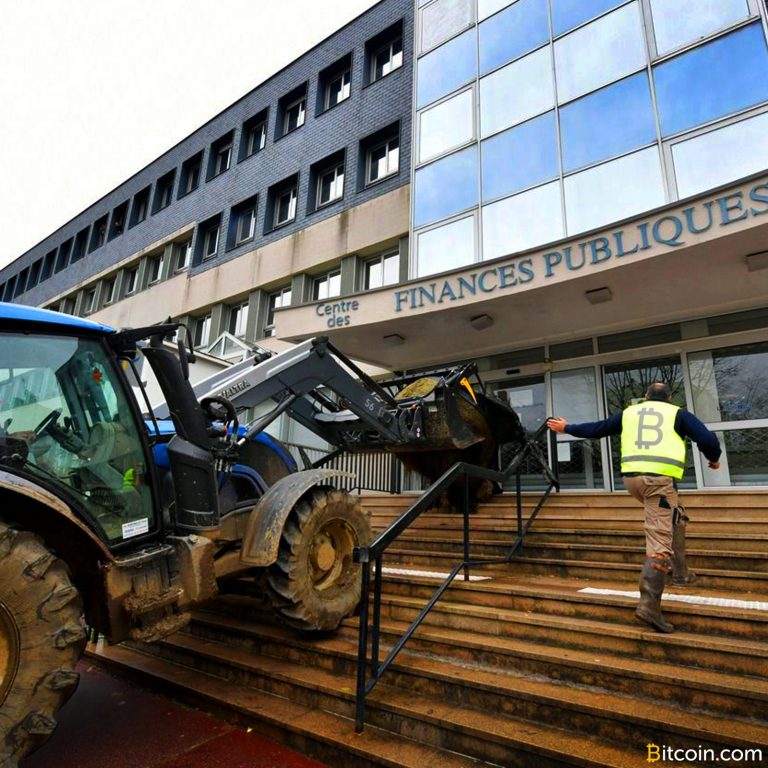
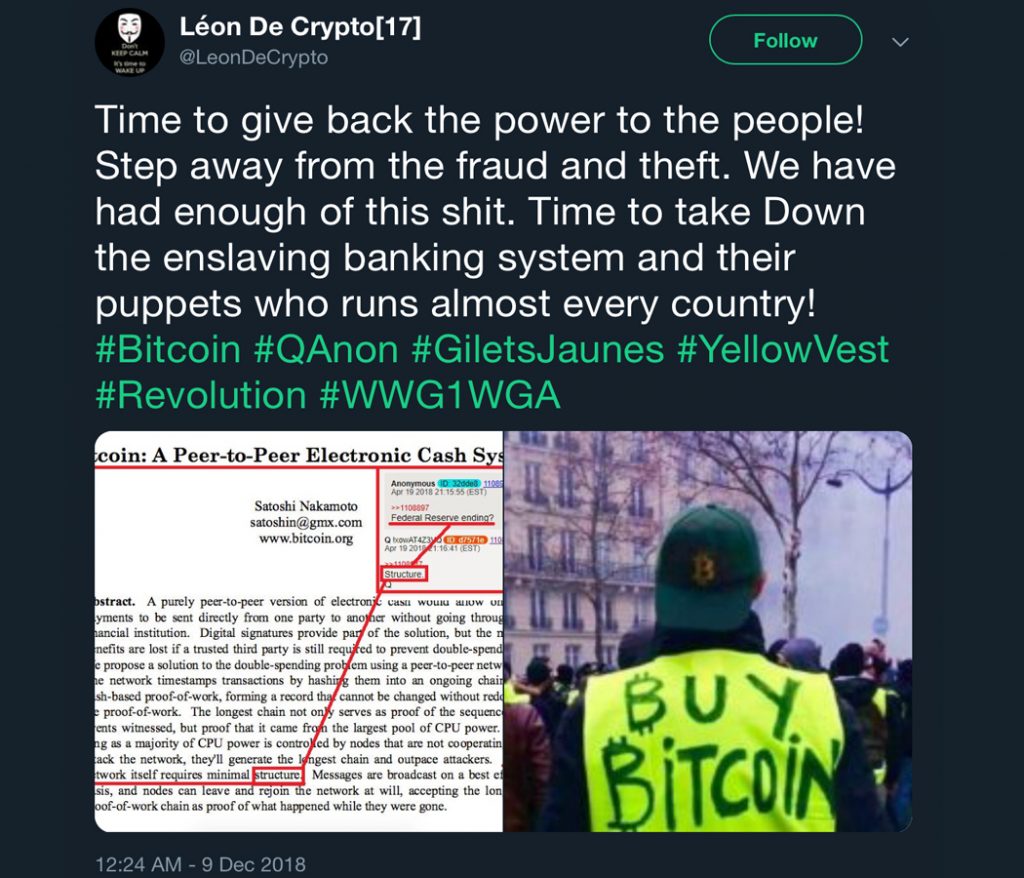
Cryptocurrencies are the perfect tools of freedom for certain groups, individuals, and global movements. In France, many citizens recently took to the streets in yellow vests (some of which read “Buy Bitcoin”) in order to protest the government and banking system. The yellow vest movement is a grassroots protest that began demonstrations on Nov. 17 because of obscene taxes, rising fuel prices, and higher costs of living. Paris is notorious for its revolutionary uprisings and the French Gilets Jaunes have scared elite members of the Republic once again. Emmanuel Macron’s tax freeze did not appease the people and the mounting frustration has remained. Instead of spurring arrests and burning cars, the yellow vest movement could use a less dangerous form of protest and actually hit the banks where it hurts.
For instance, on December 9, the Bitcoin proponent and show host Max Keiser explained on Twitter that the protesters could induce a real French banking crisis by withdrawing funds and depositing them into bitcoin.
“My research indicates a 20 percent deposit withdrawal will trigger an unsustainable chain reaction resulting in a severe French bank crisis,” Keiser stated. “If every French person converted 20 percent of their bank deposits into bitcoin, French banks would collapse and a lot of bloodshed could be avoided.”
“If we have a Bitcoin universe, you don’t get to print money for war. You don’t get to have money for a prison/industrial complex. You don’t get money for a war on drugs. You have to ask the people.” ~ Stefan Molyneux
‘Bitcoin Is the Real Occupy’
The French are not the only ones feeling the oppression of devalued currencies and failing economies that have been manipulated by the central banking cartel and the ‘elected’ oligarchy. Seven years ago, a similar uprising in New York City’s Zuccotti Park got widespread attention, and these protestors dubbed themselves the Occupy Wall Street movement. Like the yellow vest movement, occupiers were pissed off about the financial inequalities and hoped the protests would enlighten people regarding social and economic injustices worldwide. Occupy was a big movement that managed to cover 951 cities across 82 countries worldwide. However, it also showed the world the massive power of the financial elite’s police state. The movement was quickly forgotten after tent cities were bulldozed and protesters pepper-sprayed on television. The massive amount of protestors could have actually demonstrated a deep financial blow to the 1 percent and the fascist bureaucrats. In fact, occupiers can still vacate Wall Street with a cryptocurrency that’s prepared for mass adoption.
In December of 2017, the Wikileaks founder and author Julian Assange explained to his Twitter followers an alternative currency was the best way to circumvent the status quo. At the time Assange stated:
Bitcoin is the real Occupy Wall Street.
Reliable Permissionless Settlement
Cryptocurrencies need to grasp the attention of not only yellow vest types and occupiers, but also ordinary citizens living in countries that suffer from hyperinflation. In countries like Venezuela, accessibility is key for people who need a tool that shelters them from economic hardships. We all know there are many other countries in dire straits and billions of unbanked people throughout the globe. The problem as it stands is that when one of these large groups of protestors or a whole country of unbanked citizens flocks to a blockchain solution, if it is not ready to be reliable, it will not be sustainable.
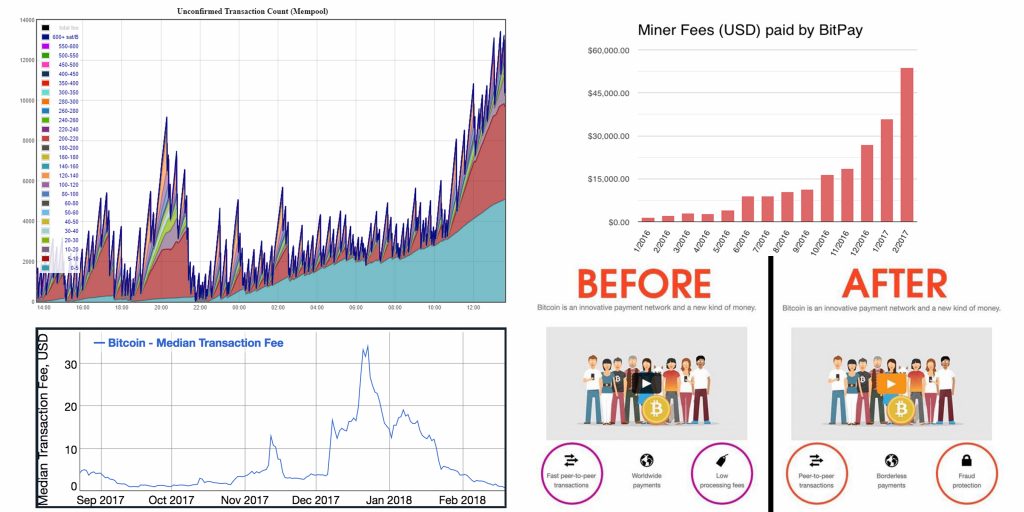
At the moment, there’s a wide variety of cryptocurrencies that provide a permissionless way to transact and offer some form of censorship-resistance for a small fee. Whether maximalists like it or not, these networks exist by providing a voluntary exchange in a manner unlike the traditional fiat system. Now, some form of hyperbitcoinization could very well happen if the decentralized currency dominates fiat, like Daniel Krawisz described in 2014. But after 10 years, that day is not here and the free market has yet to decide what decentralized coin will win or rule them all. The cryptocurrency that will be likely chosen by free market participants will provide low transaction fees in contrast to the fees back in December 2017 on the BTC network. One lesson history always teaches is that reliability should never be taken for granted.
Artwork by Daniel Krawisz.
If two thirds of the world cannot utilize the expensive fees on a blockchain network that provides permissionless settlement they will find another blockchain that will. After 10 years of spreading the gospel of bitcoin to the masses with an absolutely wretched UX, to think we will introduce another even less inviting UX like Lightning Network is absolutely absurd. The magnitude of the current network effect is already strong and it is not just with BTC. Ordinary people are learning about private keys and sending funds to alphanumeric addresses from a wide variety of blockchain systems in which the process is very much the same. Bitcoin cannot be the choice of the Sixth Republic of France, or for occupiers wanting to send a blow to the financial system if only certain users can afford the fees. Individuals will recognize an unfair system if it works like a Ponzi. If crypto tribalists think a person from Sierra Leone is going to use an unreliable network with sporadic fees that could eclipse the $1-5 of savings they want to spend at any given moment then maximalists have their heads in the sand.
The Free Market Has Not Chosen
Going forward in 2019, the cryptocurrency ecosystem will likely still be subject to speculation tied to the ecosystem, but over time, if people continue to be concerned about “Wall Street acceptance and Lambos,” this trope will get old pretty quick. I still believe Krawisz is correct that some type of hyperbitcoinization event will take place in the future and agree that it will be “much quicker than a hyperinflation event.” Furthermore, the recent mainstream article published by Time magazine and the economic freedom described is exactly why I and many others got into bitcoin in the first place. But the network that wins or rules them all will allow for global participation, and it will offer permissionless settlement and censorship resistance with sensible transaction fees.
Hyperbitcoinization will not strike on a network that performs unreliably as BTC did in 2017. If the network is not ready for this type of event, then it will be quickly passed over by free market participants for a better solution.
When a hyperbitcoinization event takes place, it is then, and only then, that we will know who has won the technical and philosophical war. Until then, each and every crypto-infused free market construct must be ready for a hyperbitcoinization event. As for maximalists, they will be quite confused if their ‘precious’ is not ready when insatiable demand strikes, because free market participants will not wait for stubborn developers and another “18 months.” The free market does not care what tribalists think, as the maximalist thought process is a major source of objection to a free economy. As Milton Friedman stated: “[Free market constructs] give people what they want instead of what a particular group thinks they ought to want — Underlying most arguments against the free market is a lack of belief in freedom itself.”
What do you think about cryptocurrencies going forward in 2019 and beyond? Let us know what you think about this subject in the comments section below.
OP-ed disclaimer: This is an op-ed article. The opinions expressed in this article are the author’s own. Bitcoin.com does not endorse nor support views, opinions or conclusions drawn in this post. Bitcoin.com is not responsible for or liable for any content, accuracy or quality within the Op-ed article. The opinion editorial is for informational purposes only.
Images via Shutterstock, Daniel Krawisz, Bitcoin Not Bombs, and Twitter.
Have you seen ourwidget service? It allows anyone to embed informative Bitcoin.com widgets on their website. They’re pretty cool, and you can customize by size and color. The widgets include price-only, price and graph, price and news, and forum threads. There’s also a widget dedicated to our mining pool, displaying our hash power.
Hacks and heists have been a threat for as long as bitcoin has been worth stealing. By 2011, as Bitcoin was easing into its second year of life and its first bubble, early cryptocurrency exchanges were bringing liquidity and price discovery to the nascent ecosystem. At the same time, they were providing an outlet for thieves to offload stolen coins, which they proceeded to do by the thousands.
Certain hacks have gone down in Bitcoin history on account of their magnitude and notoriety. Exchanges such as Mt. Gox and Coincheck are synonymous today with the record-breaking sums stolen from them, which ran into the hundreds of millions of dollars. Others, such as Bitstamp and Bitfinex, have suffered their own well-document heists, the memories of which still burn bright. The first major hack in Bitcoin’s history, however, occurred long before Bitfinex was a thing, and indeed long before most people had even heard of Bitcoin.
On June 13, 2011, Bitcointalk forum user “allinvain” posted a frantic message titled “I just got hacked.” In it, he wrote: “I am totally devastated today. I just woke up to see a very large chunk of my bitcoin balance gone.” He went on to explain: “The theft occurred right after someone broke into my slush’s pool account. In a moment of sheer stupidity I did not think that maybe my whole system was compromised. I merely thought that someone brute forced my slush’s pool password.”
25,000 BTC Gone in an Instant
Blockchain records attest to the veracity of allinvain’s claim, with the majority of the stolen coins extracted in 50 BTC increments, showing that they had been minted as coinbase rewards. The 25K BTC stolen was worth $480,000 at the time, a small fortune for a miner, even by 2011’s standards. Today, that haul of coins would be worth $94 million. Monitoring the movement of the stolen coins in the wake of the hack proved difficult because the only block explorer available at the time kept crashing.
The transaction that saw 25,000 BTC stolen in June 2011.
It appears that the thief sent the stolen BTC over to Mt. Gox to try and cash out. Anticipating the slippage of 25,000 BTC being dumped in 2011’s illiquid market, allinvain wrote: “It would suck if bitcoin price tanked because of me. God, that would be double worse for me and for everyone else.” Whoever allinvain’s hacker may have been, he was certainly prolific. “Same hacker got to my mtgox account, he converted the USD i had to bitcoins and transferred them to the same address,” complained another forum user.
Many of the opsec suggestions that forum users submitted to allinvain still hold true today. “One thing that I would advise for anyone with a large amount of BTC … is to split it up across multiple wallets, the majority of them completely offline and stored in physically secure locations,” read one recommendation.
History Repeats
“I’m an idiot for keeping a wallet.dat file with so much money on my day to day machine – especially one running windows,” rued allinvain. “This story is going to happen over and over. I guarantee that,” predicted one forum user. They were right. While the sophistication of bitcoin wallets has increased over the years, so has that of the hackers intent on plundering them. Techniques such as social engineering and SIM swapping, which weren’t widely used attack vectors in Bitcoin’s early days, have now become the norm.
Though allinvain would have had no way of knowing it at the time, for just $2,500, he could have rebought enough BTC to recoup his half a million dollar loss today, based on current prices. Victims of modern-day hacks can take solace from knowing that a simple buy and hold strategy has been empirically shown to restore the dollar value of even the most devastating of bitcoin hacks.
Bitcoin History is a multipart series from news.Bitcoin.com charting pivotal moments in the evolution of the world’s first and finest cryptocurrency. Read part six here.
Images courtesy of Shutterstock.
Need to calculate your bitcoin holdings? Check our tools section.


 The Securities and Exchange Commission (SEC) charged a group of 10 individuals and 10 associated entities back in September for fraudulent schemes that generated over $27 million from unlawful stock sales and “caused significant harm to retail investors who were left holding virtually worthless stock.”

 Eos (
Eos ( Bitcoin Cash (
 Dash (
 December saw Neo (
 Pairings for Ck Usd (CKUSD), a stablecoin traded exclusively on Allcoin and Bcex, produced $2.81 billion in volume during December. CKUSD ranked as the 16th-most traded crypto asset for December, falling five places after posting a 37% reduction in the 30-day volume.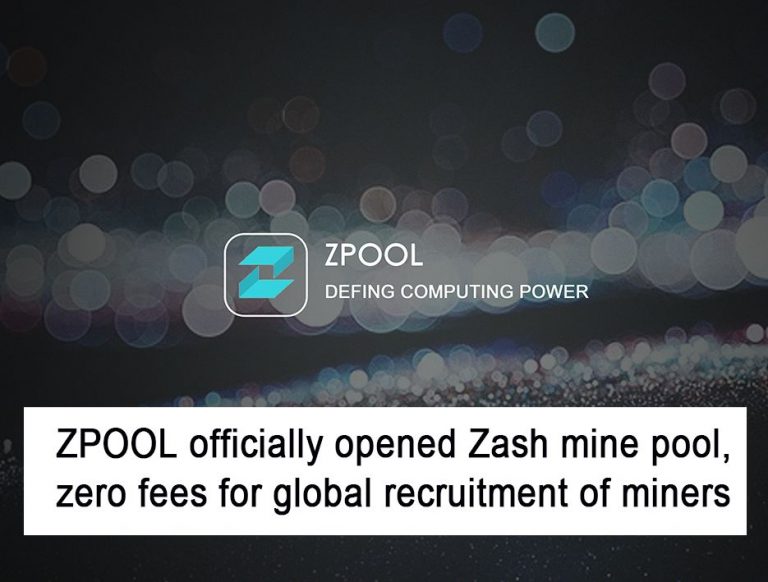

 Tony Robbins is a popular motivational speaker who published four best-selling self-help books. He recently sent out a link to an article on his website to his over three million followers on Twitter promising to explain, “What the heck is bitcoin, and how does it work?”.
 Jordan B. Peterson is a clinical psychologist and professor at the University of Toronto whose last book sold around 2 million copies around the world during 2018. He recently became alarmed about the power Patreon has over many public figures on Youtube who depend on it for securing their livelihoods after the crowdfunding platform
 One of the questions concerns the composition of the panel established to draft crypto regulations, its recommendations, and “the timeline for the expected release of the regulation,” the document reads.
 In response to the question of legality, the minister wrote, “The government has not recognised cryptocurrencies as legal tender. The issue of permitting trading in cryptocurrencies is currently under examination by an inter-ministerial committee.”


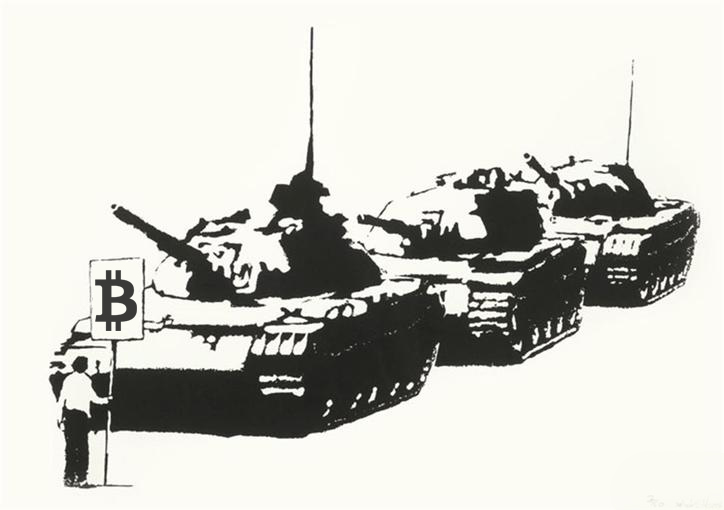
 The French are not the only ones feeling the oppression of devalued currencies and failing economies that have been manipulated by the central banking cartel and the ‘elected’ oligarchy. Seven years ago, a similar uprising in New York City’s Zuccotti Park got widespread attention, and these protestors dubbed themselves the Occupy Wall Street movement. Like the yellow vest movement, occupiers were pissed off about the financial inequalities and hoped the protests would enlighten people regarding social and economic injustices worldwide. Occupy was a big movement that managed to cover 951 cities across 82 countries worldwide. However, it also showed the world the massive power of the financial elite’s police state. The movement was quickly forgotten after tent cities were bulldozed and protesters pepper-sprayed on television. The massive amount of protestors could have actually demonstrated a deep financial blow to the 1 percent and the fascist bureaucrats. In fact, occupiers can still
 Certain hacks have gone down in Bitcoin history on account of their magnitude and notoriety. Exchanges such as Mt. Gox and Coincheck are synonymous today with the record-breaking sums stolen from them, which ran into the hundreds of millions of dollars. Others, such as Bitstamp and Bitfinex, have suffered their own well-document heists, the memories of which still burn bright. The first major hack in Bitcoin’s history, however, occurred long before Bitfinex was a thing, and indeed long before most people had even heard of Bitcoin.
 “I’m an idiot for keeping a wallet.dat file with so much money on my day to day machine – especially one running windows,” rued allinvain. “This story is going to happen over and over. I guarantee that,” predicted one forum user. They were right. While the sophistication of bitcoin wallets has increased over the years, so has that of the hackers intent on plundering them. Techniques such as social engineering and SIM swapping, which weren’t widely used attack vectors in Bitcoin’s early days, have now become the norm.