Chaque jour nous vous présenterons une nouvelle Startup française !
Notre pays regorge de talents et d'entrepreneurs brillants ! Alors partons à la découverte des meilleures startup françaises ! Certaines d'entre elles sont dans une étape essentielle dans la vie d'une startup : la recherche de financement, notamment par le financement participatif (ou crowdfunding en anglais). Alors participez à cette grande aventure en leur faisant une petite donation ! Les startups françaises ont besoin de vous !
This is a paid press release, which contains forward looking statements, and should be treated as advertising or promotional material. Bitcoin.com does not endorse nor support this product/service. Bitcoin.com is not responsible for or liable for any content, accuracy or quality within the press release.
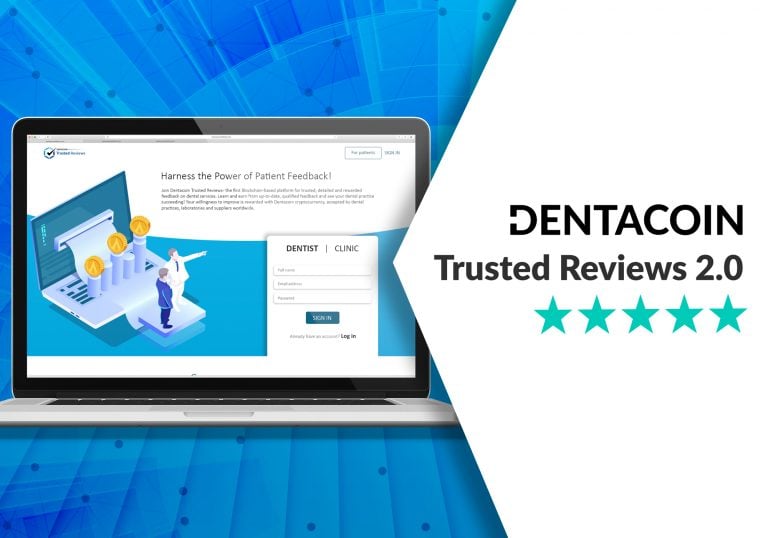
The Netherlands-based Dentacoin Foundation released a brand new version of Dentacoin Trusted Reviews. The first blockchain-based platform for verified, incentivized and detailed dental treatment reviews now provides improved user experience and reliability.
Background
Dentacoin Trusted Reviews is the pilot product of Dentacoin Foundation, developing the first blockchain solution for the global dental industry. It surprised the Blockchain and Dental communities with its unique use case, pre-ICO release and fast-growing user base. Up to now, the platform has attracted 14,904 Patients and 1,801 Dental Offices.
“Today we see thousands of websites, forums, social media channels with reviews. The paradox is that we can hardly find any that we can rely on as customers and learn from as providers. In a crucially important field like Dentistry, reviews are also often compromised, not verified and shallow to say the least. Dentists lack detailed feedback covering all aspects of the Patient journey and thus cannot extract sufficient information to help improve their service and treatment quality,” explains Donika Kraeva, Marketing Manager at Dentacoin Foundation and adds: “With the relaunch of Dentacoin Trusted Reviews, we are making a step towards delivering the missing reliable infrastructure for trustworthy, thorough, industry-changing feedback on dental services.”
Improved Design and User Experience
The new version of Dentacoin Trusted Reviews provides better visual appeal and ease of use. Dentists and Patients now have different, more intuitive homepages tailored to their needs, wants and most often used features. The registration process for Dentists and Clinics has been massively simplified and undergoes manual verification. Patients have Civic as a second registration alternative along with the good old Facebook sign-up. Live search, improved geolocation, filter, and sort options help Patients to more quickly find their Dentist.
Better Sharing Options for Dentist Profiles and Reviews
All sharing options are also enhanced. When sharing a Dentist’s profile on social networks, a live image with their current rating appears. When sharing a certain review, a preview of it is automatically generated. “Having been engaged in Dental Marketing for 5 years now, I know firsthand how important it is for Dentists to make their Patient testimonials visible. That’s the reason for implementing this new feature which – along with the Widget for showing reviews on their websites – will help Dentists to better visualize their reviews and thus reach more current and potential Patients”, explains Ms. Kraeva.
Higher Rewards for “TRUSTED” Reviews, No Rewards for Standard Ones
“TRUSTED” reviews are vital for ensuring genuine feedback that has the power to change Dentistry to the better. To recap: “TRUSTED” are reviews written by Patients with verified identities after receiving a unique email invitation by their Dentist. From now on, Dentacoin rewards with DCN tokens ONLY this proven authentic feedback.
Moreover, Patients can shoot a short video testimonial for an even higher incentive.
Patients who have not received invitations from the Dentists can request such from the respective button in their Dentist’s profile. If a Patient cannot find their Dentist, they can invite them to join through the unique referral link or via email (the same way Friends are invited).
Enhanced User Verification and Security
Patients and Dentists registered on Dentacoin Trusted Reviews undergo extensive verification to ensure that the platform is only used by real people. Patients are requested to verify their identity through the Blockchain-based Civic Identity Solutions and KYC (upon reward withdrawal). Multiple other protections against fake profiles are implemented, including but not limited to: requiring unique combinations of account data, blocking registrations from a repetitive IP address, anti-VPN protection, etc. All personal data stored by Dentacoin B.V. is protected and processed as per the latest GDPR rules that came into force in May 2018, as specifically described in Dentacoin’s official Privacy Policy.
20x Higher Referral Rewards Until the End of 2018
To kick off the relaunch, Dentacoin Trusted Reviews will now reward both Patients and Dentists with USD 0.10 equivalent in Dentacoin (DCN) for each active user invited to the platform. Active users are the ones that have not only registered but have also written a review. Both Patients and Dentists can benefit from this limited referral opportunity on DentaVox as well.
This is a paid press release. Readers should do their own due diligence before taking any actions related to the promoted company or any of its affiliates or services. Bitcoin.com is not responsible, directly or indirectly, for any damage or loss caused or alleged to be caused by or in connection with the use of or reliance on any content, goods or services mentioned in the press release.
China’s Center for Information and Industry Development has released its latest crypto project ranking. The center evaluated one more crypto project this month, bringing the total number of ranked projects to 34. Bitcoin has been downgraded while the top two positions remain unchanged.
The Center for Information and Industry Development (CCID), under China’s Ministry of Industry and Information Technology, released its eighth crypto project ranking update on Thursday. Thirty-four crypto projects were evaluated this time, with Ontology as the newest addition.
EOS remains number one in the overall ranking, followed by Ethereum. Ontology debuted at number five. BTC dropped from the 13th position in the previous ranking to the 18th position, while BCH fell one place from the 29th spot to the 30th. Dwelling at the bottom is Decred, with NEM and Litecoin ranking just above it.
New Addition: Ontology
Ontology describes itself as a distributed trust collaboration platform. Its “blockchain framework supports public blockchain systems and is able to customize different public blockchains for different applications,” according to its website. The center specifically evaluated Ont ID, Ontology’s protocol for a “complete distributed identity framework supporting identity verification and authentication for people, assets, objects, and affairs.” According to the CCID:
Its [Ontology’s] main network was launched in June 2018. In this assessment, Ontology has outstanding performance in basic technology and application, with a composite index of 112.6, ranking fourth in the [overall] list.
Rankings Across 3 Categories
The 34 projects were evaluated overall as well as in three separate categories: basic technology, applicability and innovation.
In the basic technology category, EOS, Bitshares, Steam, Gxchain, and Ontology top the list this month. NULS has improved rapidly in this category, the CCID revealed. “According to the evaluation model, the basic technology [category] mainly examines the technical realization level of public chains, including functionality, performance, security and decentralization.”
In terms of applicability, the top five projects are Ethereum, NEO, Ontology, Nebulas, and Qtum. “The new Ontology replaced Dash in the top five,” the center wrote. “The applicability [category] mainly evaluates the comprehensive level of public chain support for practical applications, including node deployment, wallet application, development support and application implementation.” As for the innovation category, the top five positions are occupied by BTC, EOS, Ethereum, Komodo, and Cardano.
What do you think of this crypto project ranking? Let us know in the comments section below.
Images courtesy of Shutterstock and Ontology.
Need to calculate your bitcoin holdings? Check our tools section.
Last year, crypto KYC and AML requirements came bursting onto the scene with thunderous applause and approbation. Many traders felt like the ICO sector was rife with scammers and con artists. In this sense, they believed there would be redemption through government. The scammers and hucksters would go to prison for defrauding investors and all would be well. After all, many people believed government regulations were necessary to curb people’s appetite for ethereum-based shitcoins. “All financial markets need regulations!” was their lodestone.
The emergence of more government into the cryptocurrency space reflected a sentiment antithetical to the crypto-anarchist dream. This is the dream of being financially independent and removed from the state apparatus. Bitcoin emerged on the heels of the 2007 and 2008 financial collapse as a way to stop onerous regulations and crush the banking elite under the weight of financial sovereignty. And yet many players in the cryptocurrency ecosystem seem to have forgotten the purpose of Bitcoin’s evolution.
As a reminder, there are three powerful reasons why the cryptocurrency industry as a whole should reject KYC and AML regulations and the governments that issue them. These are the same reasons why the industry should not uphold the broken, parasitical system that has caused the suffering of millions.
Regulations Are Threats of Violence
Right out of the gate, a regulation is a de facto threat of violence. When a government issues any kind of regulation, they are effectively saying, “Do what we want or we will put you in jail or kill you.” A lot of people try to avoid or dance around this truth. They say regulations protect consumers, investors and businesses
However, these threats of violence do not protect anyone. KYC and AML regulations are the most obvious examples. When government forces people to comply with “know your customer” regulations, they force people to provide personal, sensitive information. They are likewise coercing financial institutions into demanding this information from their customers. It creates a predatory, unnatural environment.
In a free market, companies would not issue these threats or they would simply lose business. It’s economically insane. Government is thus an artificial player in the market that also harms people via its regulatory requirements. Governments create misaligned incentives. In this regard, regulations are a miasma pervading the financial life of humankind. What is worse is these coercive regulations also have serious collateral consequences.
Regulations Cause Financial Exclusion
The most talked about consequence of regulation is the financial exclusion it promotes. There are millions of unbanked people across the world. These people do not have access to financial institutions or a way to adopt electronic banking. This is primarily due to KYC and AML requirements. If people do not have the proper documentation and identifying materials, there is no way they can adopt modern financial services. This makes the industry a walled garden of fascist-like control that only accepts witting participants from first would countries.
The system effectively removes people living in sub-Saharan Africa, Venezuela, the Middle East, and other technologically bereft places from the equation. This is what happens when compliance trumps the need to modernize isolated locales across the globe. An article titled “There’s a Bigger Scam Than Anything in Crypto, It’s Called KYC/AML,” further explores this issue:
An entire country, Somalia, began to starve because U.K. banks decided it was not worth the bother to bank remittance services. Forty percent of the country’s population relied on these remittances – people sending their hard-earned savings home to feed their families. The U.K. banks’ excuse: payments to Somalia were “high-risk,” a euphemism for not worth the compliance cost of dealing with people with poor documentation. Invariably, those who pay the highest cost are society’s weakest.
Hackers Prey on Data Honeypots
KYC and AML regulations also bring out the hackers and opportunists. If government forces a company to adopt KYC, they naturally store customer data on a centralized server. This unwise play creates an attractive honey pot for thieves on the dark web. A Daily Hodl article elaborated:
“According to Reddit user Gamm86, a hacker can circumvent the 2FA by posing as a user who lost their 2FA access (which can happen to anyone who loses a phone). The crypto exchange will then ask for proof of identity from the user, which the hacker can access via the dark web. Once a hacker sends in the requested documents, the exchange either resets or removes the 2FA codes. The hacker can then gain access and effectively drain a crypto account.”
In the absence of KYC regulations, the industry would not have to worry about this kind of collateral damage. Unfortunately, this is what happens when people who do not understand the industry get involved with “regulating” it. They create scenarios that make market actors vulnerable to malevolent forces.
A Return to Crypto-Anarchy: Self-Governance
The crypto community should work to mitigate government regulation. It is factual and clear that government mandates are acts that harm individuals as well as whole communities. A regulation is just scribbling on a sheet of paper that doubles as a thinly-veiled threat of violence, causing a cascade of harm to befall the ecosystem.
The solution is to embrace a state of crypto-anarchism. This means all the iconoclasts, entrepreneurs, developers, and philosophers in the space should work to produce more freedom and educate neophytes about the purpose of the tech. There is a seductive element of government regulation mixed with ample pressure, but the reality is self-government — or free market solutions — is more effective. It reduces coercion and violence, and creates natural remedies to any seemingly intractable problem.
The last thing the ecosystem needs is for AML and KYC regulations to grow so unwieldy and confusing that it induces corporate fascism and regulatory capture through an extensive and confusing array of impossible rules no one can navigate. Crypto-anarchy is the only answer to the Gordian knot of statist politicking.
Do you support KYC and AML? Or are regulations naturally bad? What are market alternatives to government-mandated regulations?
Images courtesy of Shutterstock
OP-ed disclaimer: This is an Op-ed article. The opinions expressed in this article are the author’s own. Bitcoin.com does not endorse nor support views, opinions or conclusions drawn in this post. Bitcoin.com is not responsible for or liable for any content, accuracy or quality within the Op-ed article. Readers should do their own due diligence before taking any actions related to the content. Bitcoin.com is not responsible, directly or indirectly, for any damage or loss caused or alleged to be caused by or in connection with the use of or reliance on any information in this Op-ed article.
There’s been plenty of fanfare surrounding Uber and Lyft’s initial public offerings — slated for early 2019 — since the two companies filed confidential IPO paperwork with the U.S. Securities and Exchange Commission in early December. On top of that, public and private investors have had plenty to say about Slack and Pinterest’s rumored 2019 IPOs but those aren’t the only “unicorn” exits we should expect to witness in the year ahead.
Using its proprietary company rating algorithm, data provider CB Insights ranked five billion dollar companies most likely to perform IPOs next year in its latest tech IPO report. The algorithm analyzes non-traditional public signals, including hiring activity, web traffic and mobile app data to make its predictions. These are the startups that topped their list.
Peloton
Peloton Co-Founder and CEO John Foley speaks onstage during TechCrunch Disrupt SF 2018 on September 6, 2018 in San Francisco, California. (Photo by Kimberly White/Getty Images for TechCrunch).
Peloton, dubbed the “Netflix of fitness,” has raised nearly $1 billion in venture capital funding in the six years since it was founded by John Foley, most recently raising $550 million at a $4 billion valuation. The manufacturer of tech-enabled exercise equipment is more than doubling in size every year and is “weirdly profitable,” an unusual characteristic for a venture-backed business of its age. Headquartered in New York, Peloton doesn’t have any public IPO plans, though Foley recently told The Wall Street Journal that 2019 “makes a lot of sense” for its stock market debut.
Cloudflare co-founder and CEO Matthew Prince appears on stage at the 2014 TechCrunch Disrupt Europe/London. (Photo by Anthony Harvey/Getty Images for TechCrunch)
Cybersecurity unicorn Cloudflare is likely to transition to the public markets in the first half of 2019 in what is poised to be a strong year for IPOs in the security industry. The web performance and security platform is said to be preparing for an IPO at a potential valuation of more than $3.5 billion after last raising capital in 2015 at a $1.8 billion valuation. Since it was founded in 2009, the San Francisco-based company has raised just north of $250 million in VC funding. CrowdStrike, another security unicorn, is also on track to go public next year and it wouldn’t be surprising to see Illumio and Lookout make the jump to the public markets as well.
San Jose-based Zoom Video Communications has reportedly tapped Morgan Stanley to lead its upcoming IPO.
Zoom, a provider of video conferencing services, online meeting and group messaging tools that’s raised $160 million in VC cash to date, is eyeing a multi-billion IPO in 2019 and has reportedly hired Morgan Stanley to lead the offering. Founded in 2011, the company most recently brought in a $100 million Series D financing, entirely funded by Sequoia, at a $1 billion valuation in early 2017. Based in San Jose, Zoom is hoping to garner a valuation significantly larger than $1 billion when it IPOs, according to Reuters.
Select investors: Sequoia, Emergence Capital Partners, Horizons Ventures
Rubrik
Data management company Rubrik co-founder and CEO Bipul Sinha.
Data management company Rubrik has quietly made moves indicative of an impending IPO. The startup, which provides data backup and recovery services for businesses across cloud and on-premises environments, hired former Atlassian chief financial officer Murray Demo as its CFO earlier this year, as well as its first chief legal officer, Peter McGoff. Palo Alto-based Rubrik was valued at over of $1 billion with a $180 million funding round in 2017. The company has raised nearly $300 million to date.
Medallia, a customer experience management platform that’s nearly two decades old, may finally become a public company in 2019. The San Mateo-based company, which has been rumored to be planning an IPO for several years, hired a new CEO this year and reported $250 million in GAAP revenue for the year ending Jan. 31, 2018, according to Forbes. Medallia hasn’t raised capital since 2015, when it secured a $150 million funding deal at a $1.2 billion valuation. It has raised a total of just over $250 million.
HQ’s expansion beyond trivia emerges from beta tonight, but the question is whether it’s different and accessible enough to revive the startup’s growth. HQ Words opens to everyone with today’s 6:30pm pacific broadcast within the HQ Trivia app after several weeks of closed beta testing of the Wheel Of Fortune-style game. The launch will be the first big move of Rus Yusupov now that’s been officially renamed CEO a week after the tragic death of fellow co-founder and former CEO Colin Kroll, HQ confirms to TechCrunch.
“Intermedia Labs introduced the world to a category defining product, HQ Trivia. Once again, with HQ Words, Intermedia Labs is poised to captivate the world with a revolutionary experience that will bring people together in new ways around live mobile video” Yusupov tells us. “HQ Words is the most interactive experience we’ve ever made.”
Kroll’s passing comes at a tough time for HQ. Its daily player count has declined since it became a phenomenon a year ago. The novelty has begun to wear off, and with so many experienced trivia whizzes, cash jackpots are often split between enough people that winners only get a few bucks. Interrupting your days or nights to play at a particular time can be inconvenient compared to the legions of always-available other games. Yusupov, who was HQ’s CEO until Kroll took over in September, will have to figure out what will attract casual crosswords players and those who flocked to Zynga’s Words With Friends — the kind of disruptive thinking Kroll excelled at.
“Colin and I shared many incredible life moments over the last 7 years. We embarked on an incredible journey co-founding two breakthrough companies together – and the lessons we learned at Vine and HQ will continue to have a big impact on me. Like many relationships, we’ve also had our challenges – but it was during these challenging times that Colin’s kind soul and big heart would truly shine” Yusupov wrote in a statement about his co-founder that was originally published by Digiday in a touching memorial post. Between building Vine and HQ together, the pair have reimagined mobile entertainment, giving millions a chance to show off their wits and creativity. “He had this incredible ability to make everyone feel special. He listened well. He thought deeply. But above all, he cared about people more than work. The driving force behind his innovations was the positive impact they would have on people and world. Colin’s innovations and inventions have changed many people’s lives for the better and will continue to impact the world for years to come.”
HQ Trivia’s co-founder and former CEO Colin Kroll passed away earlier this month
How To Play HQ Words
In HQ Words, players compete live to solve word puzzles by correctly choosing what letters are hidden. You can find the game inside the existing HQ Trivia iOS and Android apps. Host Anna Roisman pluckily provides a clue and then dispenses hints as the 25-second timer for each puzzle counts down. If the clue is “gemstone” and you’re shown “_ _ _ m _ _ _”, you’ll have to tap D, I, A, O, and N in any order. Choose three wrong letters or fail to fill out the words and you lose. You’ll spin a wheel before the game starts to get one letter that’s automatically revealed each round.
Make it through ten rounds and you and other winners get a cut of the cash prize, with the three who solved the puzzles fastest scoring a bigger chunk of the jackpot. The startup earns money through selling you extra lives inside Words, though it will probably feature sponsored games and product placement like Trivia does to pull in marketing dollars. Words will go live daily at 6:30pm pacific after Trivia’s 6:00 game, so you can turn it into HQ hour with family and friends.
HQ Words is much more frenetic than Trivia. Rather than picking a single answer, you have to rapidly tap letters through a combination of educated and uneducated guesses. That means it really does feel more interactive since you’re not sitting for minutes with just a sole answer tap to keep you awake. And because it doesn’t require deep and broad trivia knowledge, Words could appeal to a wider audience. The spinner also adds an element of pure luck, as a weaker player who gets to auto-reveal a vowel might fare better than a wiser player who gets stuck with a “Z” like I always seem to.
Fill In The Blank
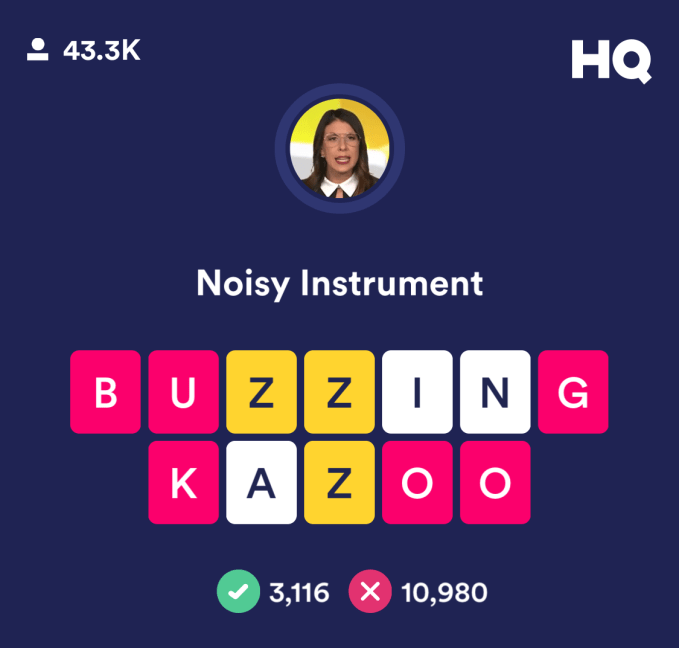
The concern is that at its core, Words is still quite similar to Trivia. They’re both real-time, elimination round-based knowledge games played against everyone for money. Both at times feel like they use cheap tricks to eliminate you. A recent Words puzzle asked you to name a noisy instrument, but the answer wasn’t “kazoo” but “buzzing kazoo” — something I’m not sure anyone has ever formally called it. Given the faster pace of interaction, even tiny glitches or moments of lag can be enough to make you lose a round. An HQ Words beta game earlier this week failed to show some users the keyboard, causing mass elimination. The pressure to get HQ’s engineering working flawlessly has never been higher.
HQ originally agreed to let TechCrunch interview Kroll about what makes Words different enough to change the startup’s momentum. Yusupov was supposed to fill in after Kroll was sadly found dead last Friday of an apparent drug overdose. He later declined to talk or provide written responses. That’s understandable during this time of mourning and transition. But HQ will still need to build an answer into its app. Meanwhile, Chinese clones and US competitors have begun co-opting the live video quiz idea. Facebook has even built a game show platform for content makers to create their own.
HQ could benefit from a better onboarding experience that lets people play a sample game solo to get them hooked and tide them over until the next scheduled broadcast. Mini-games or ways to play along after you’re eliminated could boost total view time and the value of brand sponsorships. A “quiet mode” that silences the between-round chatter and distills HQ to just the questions and puzzles might make it easier to play while multi-tasking. Head-to-head versions of Trivia and Words might help HQ feel more intimate, and there’s an opportunity to integrate peer-to-peer gambling like ProveIt trivia. And branching out beyond knowledge games into more social or arcade-style titles would counter the idea that HQ is just for brainiacs.
Around the height of HQ’s popularity it raised a $15 million funding round at a $100 million valuation. That seems justified given HQ will reportedly earn around $10 million in revenue this year. Gamers are fickle, though, and today’s Fortnite can wind up tomorrow’s Pokemon Go — a flash in the pan that fizzles out. Words is a great bridge to a world outside of Trivia, but HQ must evolve not just iterate.
from Startups – TechCrunch https://tcrn.ch/2EL83O1
Draft legislation designed to hamper Iran’s efforts to create a sovereign cryptocurrency has been introduced in the U.S. Congress. The Blocking Iran Illicit Finance Act bans U.S. citizens and companies from all transactions and dealings in Iranian digital currency. The bill also introduces sanctions against foreign nationals and organizations that support the development of the crypto.
The draft law, filed in the House of Representatives this week, is sponsored by a group of members led by Wisconsin Republican Mike Gallagher. The main focus of the act is to strengthen existing U.S. sanctions regarding a number of activities and impose new restrictions with respect to Iranian financial institutions and organizations providing services to Iranian banks. The authors of the bill have also proposed measures designed to prevent Iran from issuing its own digital coin to circumvent economic sanctions imposed by Washington.
The draft law bans transactions and other dealings in any digital token or coin that can be identified as “Iranian digital currency.” It introduces penalties against U.S. citizens and corporate entities as well as foreign nationals and companies providing financial, material or technological support for the development of the Iranian crypto. Individuals and companies that conduct or facilitate transactions related to the purchase or sale of Iranian digital currency or any derivative will also be sanctioned. The same applies if they maintain significant amounts of such coins.
The legal document details that “All transactions related to, provision of financing for, and other dealings in Iranian digital currency by a United States person or within the United States are prohibited.” The bill describes the sanctions President Trump may impose on violators that are based abroad. The measures include prohibiting the opening of a bank account and blocking any property transactions in the United States. Foreigners may also be denied visa or other entry document for the U.S.
Assessing Iran’s Progress Towards Sovereign Crypto
The Republican representatives have also tasked the Secretary of the Treasury with producing a report on the progress made by the government of the Islamic Republic in creating a sovereign cryptocurrency. The document should be submitted to Congress within four months after the enactment of the new law. It is expected to contain a description of the technical details of the cryptocurrency that’s being developed by Tehran and provide a list of the involved organizations. The lawmakers also want an assessment of the state and non-state actors that are assisting the Iranians, including the governments of China, Russia, Venezuela, and Turkey.
The introduction of the Blocking Iran Illicit Finance Act comes after mounting reports that the country is advancing in its plans to issue a national cryptocurrency backed by its fiat, the rial. In November, local media announced that the organizations working on the project have already finalized the development of the coin and are only waiting for approval from the Central Bank of Iran.
Tehran stepped up its plan for a sovereign crypto after the Trump administration decided to pull out of the Iranian nuclear deal and reintroduced U.S. sanctions earlier this year. They were followed by a move to isolate Iran from the international banking network Swift and other measures that restricted its access to U.S. currency. Last month, trying to avoid breaching U.S. sanctions, a number of leading cryptocurrency exchanges stopped offering services to Iranian residents.
Do you think the new sanctions will slow down Iran’s progress towards a national cryptocurrency? Tell us in the comments section below.
Images courtesy of Shutterstock.
Express yourself freely at Bitcoin.com’s user forums. We don’t censor on political grounds. Checkforum.Bitcoin.com.
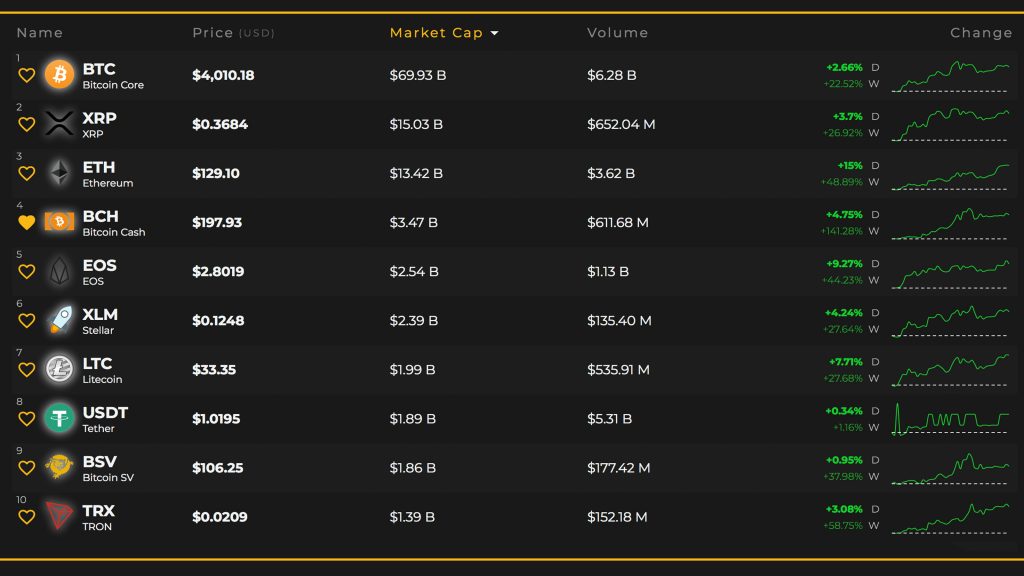
Cryptocurrency markets have been bullish lately as most of the top digital asset prices have seen decent gains over the last week. The overall market capitalization of all the coins in existence is roughly $132 billion this Sunday and global trade volume has increased significantly considering it’s the weekend before the holidays with $20 billion traded over the last 24 hours.
On Sunday, Dec. 23 the day before Christmas Eve, there’s been more digital asset swaps than usual compared to a few holiday trading sessions in the past. Global digital currency trade volume for many of the top cryptocurrencies has increased significantly since the big drops in price two weeks ago. The top ten digital asset markets are also up in value between 2 to 15 percent over the last 24 hours increasing the general market valuation of the entire crypto-economy. Bitcoin core is up 2.6% for the day and 21.7% over the last seven days. This gives BTC a global average of about $3,991 per coin and a market capitalization of around $69.6 billion. The cryptocurrency BTC currently has $6.2 billion worth of the entire ecosystem’s $20 billion worth of 24 hour global trade volumes.
The second highest valued market today is ripple (XRP) which is trading for $0.37 per coin and has a $14.9 billion market valuation. There’s been more than $648 million worth of XRP swapped over the last day and markets are up 3.3% this Sunday. The third highest valued market today commanded by ethereum (ETH) is up 14.5% over the last 24 hours and 47% for the week. One ETH is swapping for $128 across global exchanges and has a market valuation of around $13.3 billion. Lastly, the fifth position belongs to eos (EOS) this weekend as each coin is trading for $2.79 and markets are up today 9%. EOS markets have jumped 43% over the last seven days.
Bitcoin Cash (BCH) Market Action
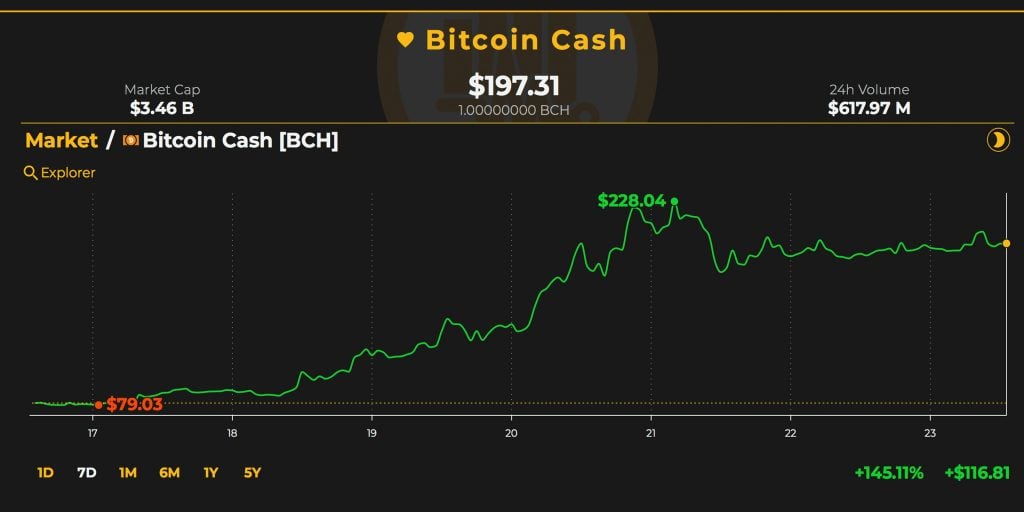
The phenomenal gains that bitcoin cash (BCH) had seen a few days ago have tapered a bit but BCH gained a whopping total of 140% for the week. Today BCH is up 4.6% and each coin is trading for $197. The top five BCH trading platforms swapping the most BCH this Sunday includes Lbank, Binance, Huobi, Coinbase, and Bitbank. Bitcoin cash trade volume is fairly high today capturing $610 million in trades over the last day. BCH is the sixth most traded cryptocurrency this weekend below ripple and above litecoin markets. The top currency pairs trading with BCH include USDT (42%), BTC (21%), ETH (19%), USD (8.7%), and the JPY (4.2%). The Korean won (KRW 1.9%), and the euro (EUR 1.5%) pairs against BCH are trailing not too far behind.
BCH/USD Technical Indicators
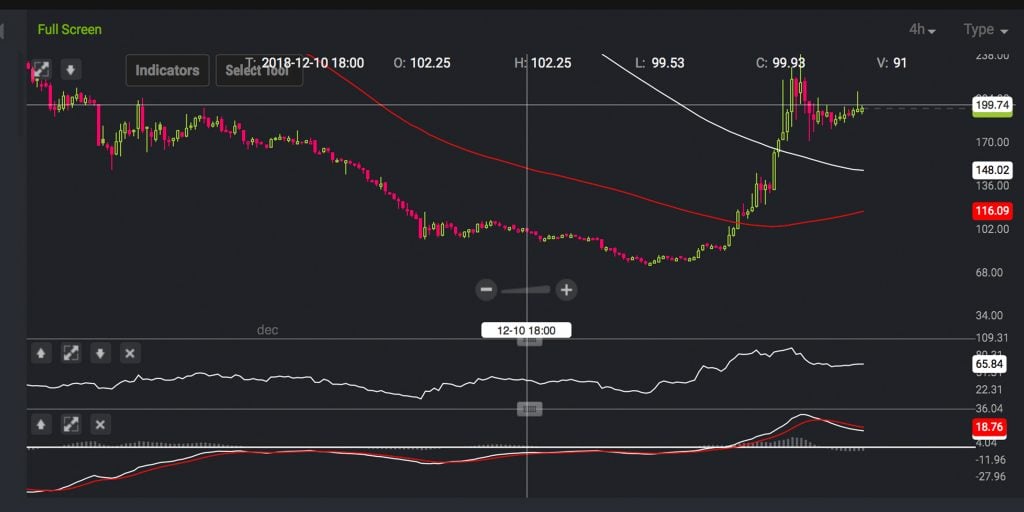
Looking at the BCH/USD 4-hour charts on Bitstamp shows bulls have the reigns and are seemingly still going strong. At the moment there is a lot of resistance between the current vantage point and price higher than $225. The two Simple Moving Averages (SMA) still have a decent gap between them but the 200 SMA looks as though it may drop below the short term 100 SMA trendline. This would indicate that the path towards least resistance would change to the upside but for now, it remains toward the downside.
The Relative Strength Index (RSI) shows conditions are nearing overbought regions at 65.84 on the 4-hour chart. BCH bulls have shown their prowess on the 3-day chart and the percentage gains were far more than most digital assets in this time frame. The Moving Average Convergence/Divergence (MACd) has been dipping downward at the time of publication and shows room for improvement over the next 24 hours. As mentioned above, order books also show bulls need to surpass the $225 range to get some better momentum. On the backside, bears will see some light resistance back to $177 but after that, there are fewer foundations.
2017’s All-Time Highs Are Still Far Away
Cryptocurrency market sentiment this weekend is far better than the last few weeks of brutal dumps and price fake outs. Although 80-90% corrections are not out of the ordinary when it comes to digital asset volatility and market declines in the past. There is still a strong amount of skepticism and pessimistic traders who feel the past few days may not be indicative of a market bottom. On the other hand, BTC/USD and ETH/USD short positions on Bitfinex have dropped considerably this week indicating that traders may not be so confident the price will drop again. Overall cryptocurrency infrastructure continues to grow stronger and well known financial institutions are clearly making moves on the sidelines. Still, it will take a large factor to drive cryptocurrencies higher in value and surpass the all-time highs of 2017.
Where do you see the price of BCH, BTC and other coins heading from here? Let us know in the comments below.
Disclaimer: Price articles and markets updates are intended for informational purposes only and should not to be considered as trading advice. Neither Bitcoin.com nor the author is responsible for any losses or gains, as the ultimate decision to conduct a trade is made by the reader. Always remember that only those in possession of the private keys are in control of the “money.”
Images via Shutterstock, Trading View, Coinlib.io, Bitstamp, the Coinbase Dashboard, and Satoshi Pulse.
Want to create your own secure cold storage paper wallet? Check our tools section.
After acquiring your first bitcoins you might want to swap the digital asset for another token or test your luck for some quick profits with one of the many cryptocurrency exchanges. And even though you don’t need to be an expert to begin trading cryptocurrencies, some people want to know the very basics on how to get started.
Reviewing a Cryptocurrency Trading Platform’s Reputation and Registering for an Exchange Account
Cryptocurrency trading has become extremely popular these days and there’s a large swathe of individuals who swap digital assets every day to make more money. In the early days there were only a few trustworthy trading platforms available for people who wanted to exchange cryptocurrencies, but nowadays there’s a great number of reputable exchanges in most countries.
There are plenty of reviews of all the available cryptocurrency trading exchanges online.
In order to begin trading, you will need a verified account on one of the many global digital asset exchanges in existence. Beginners should know that most trading platforms require the user to verify their identity in order to withdraw fiat, and some businesses also mandate this rule for withdrawing large amounts of digital currencies.
If you are new to trading you should research the variety of exchanges that allow residents from your region to swap digital assets and make sure the trading platform is reputable. There will definitely be reviews on most of the well-known cryptocurrency exchanges available today and people will describe their experiences with the business. After being verified by an exchange most traders like to keep a noncustodial wallet on the side in order to store coins for long-term savings. If traders plan to flip their assets on cryptocurrency platforms for some quick bucks, then keeping funds on an exchange for a temporary period is ideal. However, most veterans know and beginners should forever remember: “If you don’t store your own private keys you don’t own cryptocurrencies.”
A basic example of the information required for a good portion of exchanges. There are a few exchanges that allow trading with much less verification.
Markets, Wallets, and Orders
After a trader is verified they can begin trading on the exchange, but they will need some funds to get started. If you already own a popular cryptocurrency like BCH, ETH, or BTC then you can deposit the money into the wallet section located on the exchange. Some exchanges will allow you to make cryptocurrency purchases and sell coins using fiat. This is a good time to get a feel for the exchange dashboard and user profile. New traders should learn how to activate two-factor authentication on the platform and review all the options available. Most exchanges will have a few sections to choose from like a “markets,” “wallets,” “settings and profile,” and an “orders” section. The “markets” option brings the user to the exchange and shows all the cryptocurrency and fiat pairs available to trade on the platform.
Typical sections found on the trading platform’s dashboard.
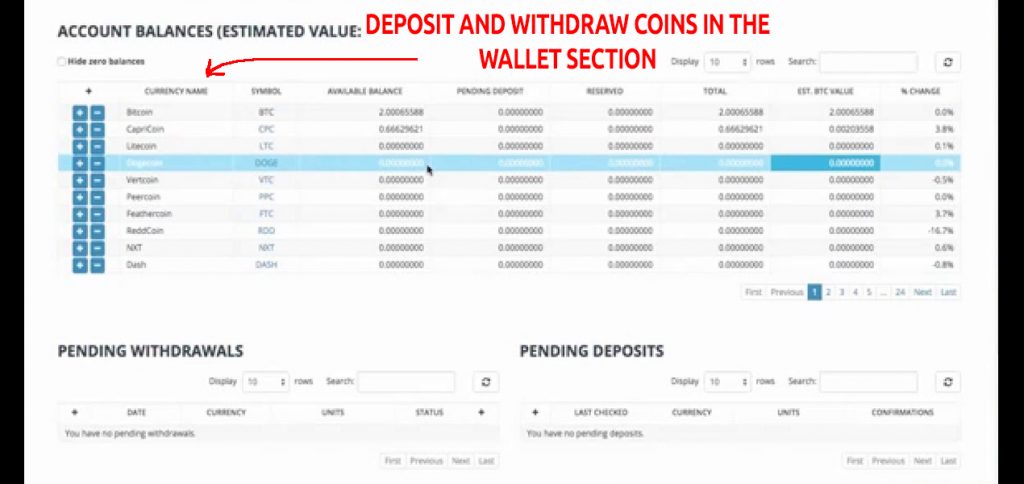
The “wallets” section shows all the wallets available on the exchange and this is where you can deposit, withdraw and store all the digital assets supported by the business. Usually, in the “wallets” area users will find the pending deposit and withdrawals and this can be monitored for confirmations. Traditionally, most exchanges have a confirmation period where traders must wait for a certain amount of confirmations to begin trading the cryptocurrency.
Exchanges give cryptocurrency deposit addresses to customers so they can fund their account with money for trading. This area can usually be found in the “wallets” or “deposits and withdrawals” section. A “+” icon will usually reveal the deposit address, and a “-” icon will bring the user to the withdrawal section.
The “settings and profile” area is where the user can customize settings like two-factor authentication, user information, email, and other important data tied to the account. This includes information such as passwords, API keys, UI settings, IP whitelist, and more. The trading platform’s “settings and profile” section will also tell you whether or not your account is verified and show a withdrawal limit as well. In the “orders” area users will find orders they had placed that are unfilled or completed.
Sometimes orders get partially filled too and this is a natural occurrence. This happens if you bid on a cryptocurrency at a certain price and there are not enough coins available at that specific price that you can purchase at one time. In these occasions, an exchange may fill a quarter or some fraction of your order. Typically in this case, when more coins are made available at the same price the exchange will fill the remainder of the order. In the “orders” section you should find your trade history and all the buys and sells that have been completed on your account.
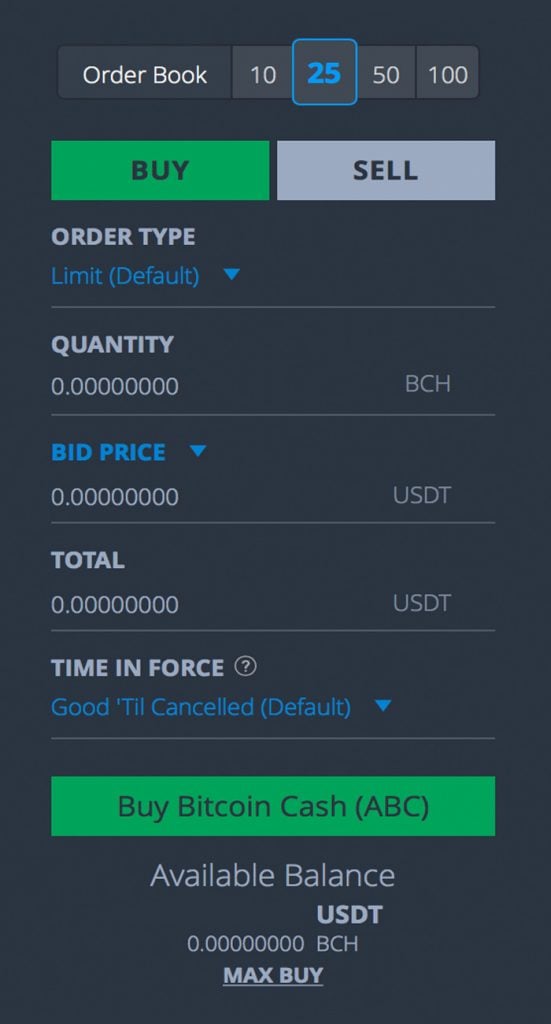
Placing an order on a cryptocurrency exchange, whether it is a buy or sell, is fairly intuitive. For instance, if you are planning to sell 10 ETH on an exchange for USD there usually is a limit (default) order type or a conditional order. A limit order is a traditional buy and sell while a conditional order has to meet certain conditions in order to execute. Most beginners should choose a traditional limit order when attempting some of their first crypto-trades. In the “quantity” window, you would enter 10 ETH or the amount of cryptocurrency you want to purchase or sell. After that comes choosing the price you want to sell the ETH at, and a limit order consists of a few choices. The user can sell the asset for the current “bid” price which is the highest price the market is willing to pay for the coin. Then there’s the “ask” price that represents the lowest price the market is willing to pay for the cryptocurrency at the time. Then the last choice is the “last” price which is essentially the price of the last executed trade. Of course, users can customize the price to anything they want but traditionally beginners will choose between these three options.
After completing the type of order, quantity, and price the exchange will show the total cost of the trade including the fees the exchange charges to execute the swap. After confirming that everything looks good as far as the order is concerned the trader can also set a “time in force” option which is usually set to “good until canceled” by default or it can be changed to a specific time frame.
The markets page should show you all the choices available for orders including the current market orders, history, and the user’s trade history as well. This page will likely show a depth chart which is a graphic visualization of the current market order book, a written log of the order book, and a customizable trading chart showing the cryptocurrency’s performance. The order books and the charts set at different time frames can give a trader a little insight on the current market sentiment and may indicate whether or not its bearish or bullish.
Charts, Tools, and Indicators
With the charts showing trends, certain charting tools available on the exchange may help a trader better predict short-term and long-term cryptocurrency market movements. After getting acquainted with an exchange and making a few simple trades you might want to learn about some of the technical indicators and charting tools. For example, the Relative Strength Index (RSI) measures both speed and the strength of a market’s price volatility. The RSI will give traders some insight into whether or not the market is “oversold” or “overbought.” The sister to the RSI oscillator is the stochastic indicator that measures current momentum within the markets and collects data on the digital asset’s support and resistance. Another relative of the two oscillators is the Moving Average Convergence/Divergence (MACd). This particular indicator consists of two exponential moving averages and uses them to track momentum as well. In fact, these three technical indicators will often look similarly placed on a chart and move in corresponding directions.
Exchanges offer charts, indicators, and order book views so traders can get a glimpse of the current market action.
Following learning about momentum indicators it is good to learn about moving averages and there are all kinds of moving averages on the charts like “exponential moving averages (EMA)”, and “simple moving averages (SMA).” Moving averages collect data on a series of time frames in order to smooth out a visualized look at long and short-term trends. With trading statistics moving averages can be set to all kinds of data points by creating a trendline of averages and most traders look at moving averages like the 50, 100, and 200-day averages. The momentum oscillators and moving average trend lines are some of the basics of technical analysis and there are many more tools like Bollinger Bands, Aroon oscillators, ATR bands and trailing stops, fractals, medians, and Fibonacci ratios.
Check out these four articles after understanding the basics of trading digital assets:
You Don’t Need to Know Technical Analysis or Charts to Understand the Very Basics of Trading Cryptocurrencies
When you are just a beginner learning how to deposit and withdraw funds, as well as execute a very basic trade, this is all you really need to know in order to swap cryptocurrencies. Having a noncustodial wallet available to send funds to for long-term storage is a good idea to have handy when using cryptocurrency trading platforms. This way you are in control of your private keys and if you ever want to sell those assets you can simply deposit the funds into the exchange at any time. The basics of trading cryptocurrencies are fairly easy and after a few times messing around it’s not too hard to understand. In time, if you are good enough, you could use the cryptocurrencies’ price swings to make a few bucks selling high and buying low. Getting a feel for using the digital assets exchange and making a couple of simple trades is the best way to get started.
A quick recap of required items and things you might need to begin trading cryptocurrencies:
A valid email, and username & strong password
Proof-of-identity; license, state ID, residential address information.
Funds; such as a cryptocurrency or fiat deposit.
Two-factor authentication (2FA); some exchanges require the use of 2FA platforms such as Authy or Google Authenticator.
A noncustodial wallet; in addition to an exchange account, it’s good to have a wallet on the side that can store digital assets for long periods of time.
Research; it’s a good idea to research the reputations of exchanges, how the trading platform works, and eventually you can study technical analysis and methods on how to trade like a pro.
Have you ever traded on a cryptocurrency exchange? What kind of tips would you offer to first time traders attempting to exchange digital assets on a trading platform? Let us know what you think about this subject in the comments section below.
Disclaimer: Price/trading articles and markets updates are intended for informational purposes only and should not to be considered as trading advice. Neither Bitcoin.com nor the author is responsible for any losses or gains, as the ultimate decision to conduct a trade is made by the reader. Always remember that only those in possession of the private keys are in control of the “money.”
Images via Shutterstock, Poloniex, Bittrex, Bitstamp, Google, and Pixabay.
Want to create your own secure cold storage paper wallet? Check our tools section.
With the dust all but settled on 2018, it’s time to reflect on the year’s best and worst performing cryptocurrencies. In the Best category, there are few standout candidates, with all major altcoins deeply mired in the red. The Worst category, however, is stocked with shockers, including coins that need to multiply more than 100x in price to reach their former glory.
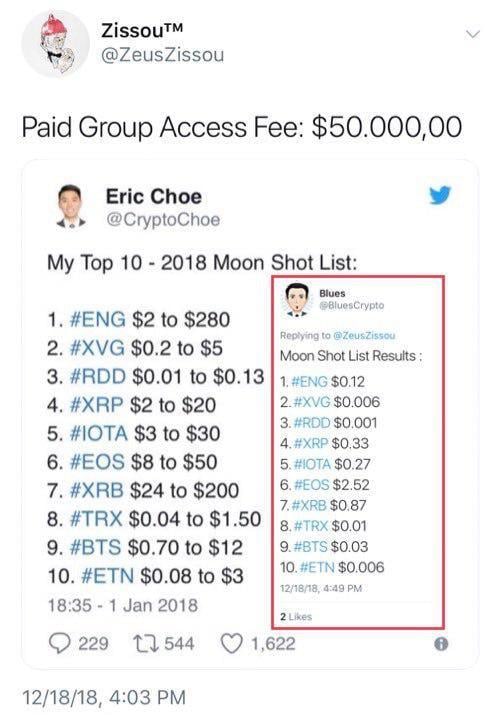
The last seven days have been extremely positive for the cryptocurrency markets, with many digital assets up between 40 and 70 percent. Iota is up 67 percent, stratis 108 percent, and bitcoin cash 150 percent. It’s an impressive recovery, but it’s certainly not a reversal. Back in January, “expert” traders were throwing out wildly ambitious end of year targets that, amidst full bull market hysteria, may not have seemed that outlandish at the time. With 11 months of hindsight, however, it’s evident that calls for $500 neo and $20 ripple were total fantasy.
None of the altcoins that were tradable at the start of 2018 are on course to finish the year in the green, and it’s no coincidence that the coins that have lost the least, such as BSV, are also the newest, having been spared the bulk of the bloodletting that’s characterized 2018’s protracted bear market. An examination of the break-even multiple – i.e. the number of times an asset would need to double to reach its former all-time high – shows that many altcoins haven’t a snowball’s chance in hell of reaching the giddy heights they once occupied.
188x to Break Even
The worst performing altcoin, based on Messari’s break-even multiple, is zclassic (ZCL). One year ago, it was pumped to a high of $235 ahead of a fork to create bitcoin private (BTCP). Both coins have since performed disastrously, ZCL because it’s a dead coin and BTCP because it was always a shitcoin whose primary purpose was to enrich ZCL bagholders. Today, ZCL trades at $1.25 and would require a 188x to reach its former top. Down 97 percent from its own all-time high, BTCP would require a 33x.
Worst performing cryptocurrencies by break-even multiple
Other altcoins that have a long way to climb include rchain (RHOC), a project that is close to bankruptcy, and which has a break-even multiple of 83x. Ethos requires an 85x and smartcash 113x. To place these losses in context, BTC is down 5x from its high one year ago. This puts it in the top 10 cryptocurrencies based on break-even multiple. Only a handful of altcoins that were available one year ago, such as mana, waves, binance coin, and link, have outperformed BTC this year.
While altcoins can provide significant profits, if realized in a bull market, holding onto them in a bear market can see them plummet to almost zero. It will be interesting to see whether crypto traders are as bullish with their price calls for 2019, or whether this year’s abject failure will have taught caution.
What are your thoughts on how cryptocurrencies will perform in 2019? Let us know in the comments section below.
Images courtesy of Shutterstock and Messari.
Need to calculate your bitcoin holdings? Check our tools section.
There’s a new app for cryptocurrency holders to track their portfolios of digital assets across multiple exchanges and addresses. Spot has developed a sleek new app focusing on ease of use built on a clean and user-friendly platform.
First released in open beta back in April 2018, Spot has now fully launched on Product Hunt. Its stated aim is to offer cryptocurrency holders a beautiful user interface with features that are powerful yet easy to use. The native iOS and Android app brings an aggregated view of all holdings on exchanges and public wallet addresses into one tool, tracking over 2,300 different coins and tokens.
The company isn’t content with the app merely displaying assets, as it plans to offer trading too further down the line. “Spot’s vision isn’t to build a portfolio tracker — we went a bit overboard with this feature,” CEO Edouard Steegmann told Tech Crunch. “Eventually, we want to become the app to manage all your cryptos, a sort of Revolut but with a crypto DNA.”
Rebuilding Coinmarketcap From the Ground Up
Other features of the Spot app include a watch-list to follow specific crypto pairs, smart charts with live and historical prices on simple or double charts, and performance tracking for following transactions. It also offers what the developers call “smart holdings”, wherein built-in algorithms analyze all instances of a particular asset’s storage and help maximize revenues across all cryptocurrency exchanges, replacing the need for spreadsheets.
Spot is also said to have built its own built market data API by connecting directly to more than 150 exchanges so it doesn’t become dependent on anyone else’s price feeds. “We’ve rebuilt Coinmarketcap from the ground up, and we’re one of the few companies that have done it,” Steegmann stated.
The startup recently raised about $1.2 million in seed funding. The round was backed by Kima Ventures and several angel investors such as Eric Larchevêque and Thomas France of Ledger among others.
What’s your favorite cryptocurrency portfolio app? Share your thoughts in the comments section below.
Images courtesy of Shutterstock.
Verify and track bitcoin cash transactions on our BCH Block Explorer, the best of its kind anywhere in the world. Also, keep up with your holdings, BCH and other coins, on our market charts at Satoshi’s Pulse, another original and free service from Bitcoin.com.


 The Center for Information and Industry Development (CCID), under China’s Ministry of Industry and Information Technology, released its eighth crypto project ranking update on Thursday. Thirty-four crypto projects were evaluated this time, with Ontology as the newest addition.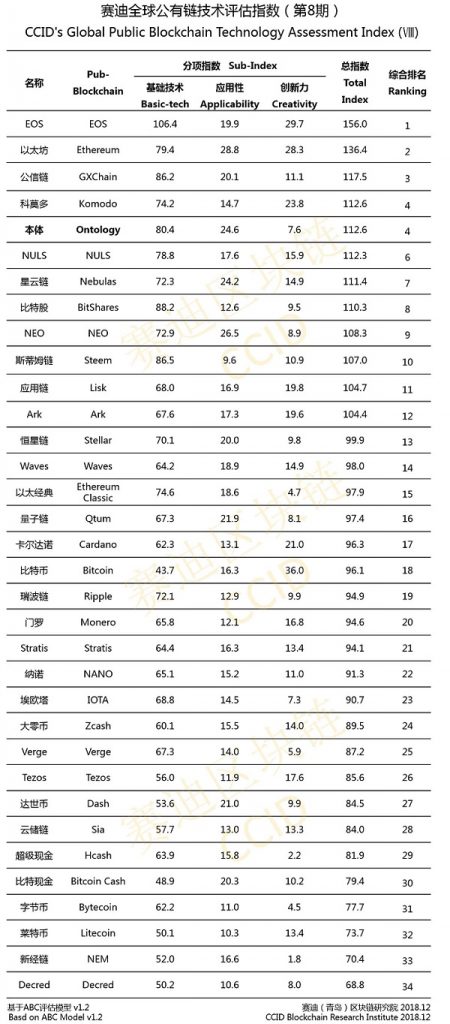
 Ontology describes itself as a distributed trust collaboration platform. Its “blockchain framework supports public blockchain systems and is able to customize different public blockchains for different applications,” according to its website. The center specifically evaluated Ont ID, Ontology’s protocol for a “complete distributed identity framework supporting identity verification and authentication for people, assets, objects, and affairs.” According to the CCID:
 In the basic technology category, EOS, Bitshares, Steam, Gxchain, and Ontology top the list this month. NULS has improved rapidly in this category, the CCID revealed. “According to the evaluation model, the basic technology [category] mainly examines the technical realization level of public chains, including functionality, performance, security and decentralization.”




 “Intermedia Labs introduced the world to a category defining product, HQ Trivia. Once again, with HQ Words, Intermedia Labs is poised to captivate the world with a revolutionary experience that will bring people together in new ways around live mobile video” Yusupov tells us. “HQ Words is the most interactive experience we’ve ever made.”

 HQ could benefit from a better onboarding experience that lets people play a sample game solo to get them hooked and tide them over until the next scheduled broadcast. Mini-games or ways to play along after you’re eliminated could boost total view time and the value of brand sponsorships. A “quiet mode” that silences the between-round chatter and distills HQ to just the questions and puzzles might make it easier to play while multi-tasking. Head-to-head versions of Trivia and Words might help HQ feel more intimate, and there’s an opportunity to integrate peer-to-peer gambling like
 The draft law bans transactions and other dealings in any digital token or coin that can be identified as “Iranian digital currency.” It introduces penalties against U.S. citizens and corporate entities as well as foreign nationals and companies providing financial, material or technological support for the development of the Iranian crypto. Individuals and companies that conduct or facilitate transactions related to the purchase or sale of Iranian digital currency or any derivative will also be sanctioned. The same applies if they maintain significant amounts of such coins.




 If you are new to trading you should research the variety of exchanges that allow residents from your region to swap digital assets and make sure the trading platform is reputable. There will definitely be reviews on most of the well-known cryptocurrency exchanges available today and people will describe their experiences with the business. After being verified by an exchange most traders like to keep a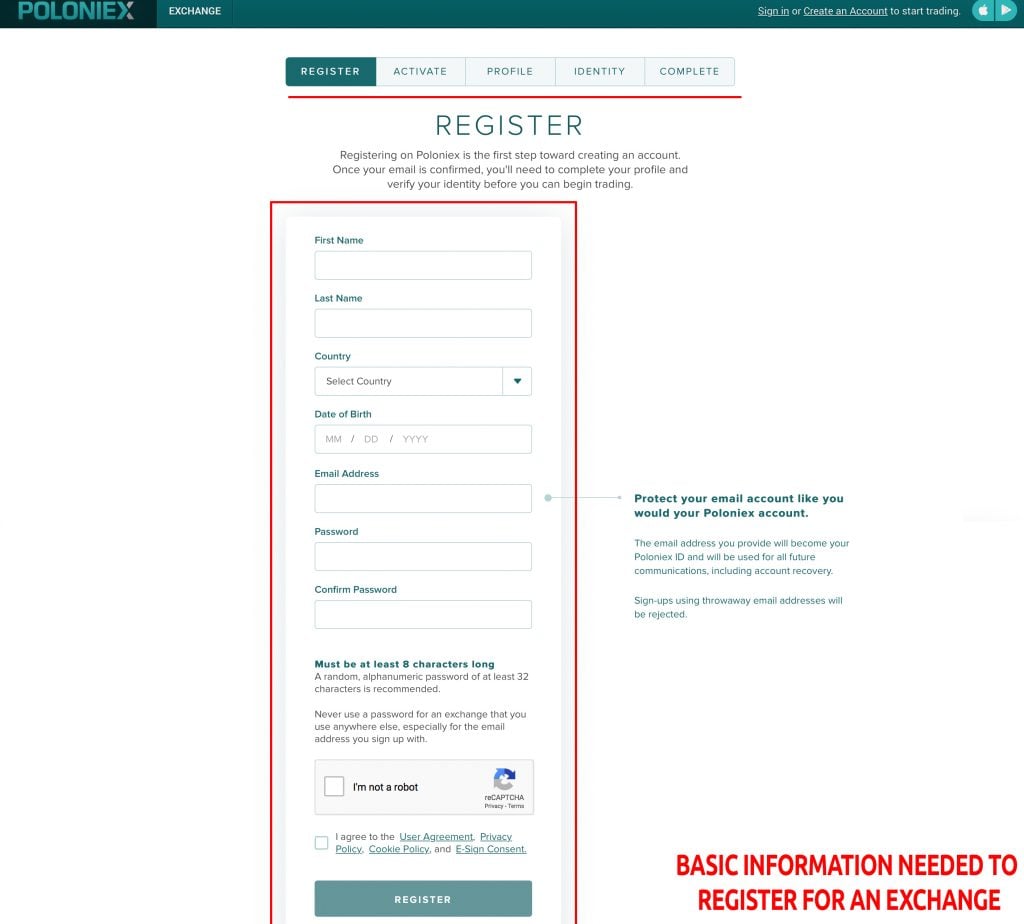

 Placing an order on a cryptocurrency exchange, whether it is a buy or sell, is fairly intuitive. For instance, if you are planning to sell 10 ETH on an exchange for USD there usually is a limit (default) order type or a conditional order. A limit order is a traditional buy and sell while a conditional order has to meet certain conditions in order to execute. Most beginners should choose a traditional limit order when attempting some of their first crypto-trades. In the “quantity” window, you would enter 10 ETH or the amount of cryptocurrency you want to purchase or sell. After that comes choosing the price you want to sell the ETH at, and a limit order consists of a few choices. The user can sell the asset for the current “bid” price which is the highest price the market is willing to pay for the coin. Then there’s the “ask” price that represents the lowest price the market is willing to pay for the cryptocurrency at the time. Then the last choice is the “last” price which is essentially the price of the last executed trade. Of course, users can customize the price to anything they want but traditionally beginners will choose between these three options.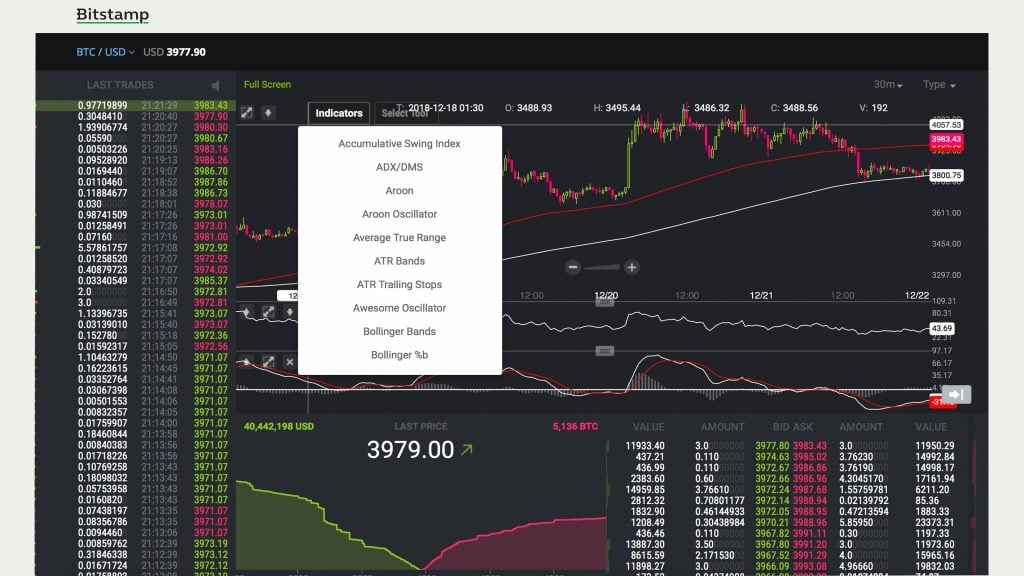



 Other features of the Spot app include a watch-list to follow specific crypto pairs, smart charts with live and historical prices on simple or double charts, and performance tracking for following transactions. It also offers what the developers call “smart holdings”, wherein built-in algorithms analyze all instances of a particular asset’s storage and help maximize revenues across all cryptocurrency exchanges, replacing the need for spreadsheets.