About Startup365

Chaque jour nous vous présenterons une nouvelle Startup française ! Notre pays regorge de talents et d'entrepreneurs brillants ! Alors partons à la découverte des meilleures startup françaises ! Certaines d'entre elles sont dans une étape essentielle dans la vie d'une startup : la recherche de financement, notamment par le financement participatif (ou crowdfunding en anglais). Alors participez à cette grande aventure en leur faisant une petite donation ! Les startups françaises ont besoin de vous !

#Blockchain The Daily: Bitfinex Launches Tether Margin Trading, Zebpay Resumes BCH Transactions

The Daily: Bitfinex Launches Tether Margin Trading, Zebpay Resumes BCH Transactions

In today’s edition of The Daily, we feature a number of recent developments from influential cryptocurrency exchanges including Bitfinex, Coinbase and Zebpay. We also cover the latest investment in the field by Paypal co-founder, Peter Thiel.

Also Read: Poll Shows 13% of Russians Use Cryptocurrency for Online Purchases

Bitfinex Launches Tether Margin Trading

The Daily: Bitfinex Launches Tether Margin Trading, Zebpay Resumes BCH TransactionsBitfinex, the exchange linked to the controversial Tether stablecoin, has introduced trading on margin for the USDT/USD pair. As strange as it may sound, offering leveraged trading on an instrument against the fiat base it is supposed to be matching can have some uses. And above all, it signals that the company is confidant about being able to maintain the 1:1 backing, even under new pressure from leveraged traders.

Bitfinex claims that adding margin trading on USDT/USD “will not only allow for more efficient price discovery, but in an important move for risk management, unlock the ability to hedge the exposure taken on stablecoins. Along with a dedicated lending market, USDT will be available as collateral for margin positions.”

The exchange further claims that while stablecoin margin trading is limited to USDT/USD for now, Bitfinex has plans to introduce margin trading for other stablecoin pairings, as part of its “commitment to providing a coin agnostic platform, when sufficient liquidity is reached.”

Coinbase Expands to Six European Markets

Coinbase has announced the rollout of its basic service to six additional European regions, encompassing about three and a half million people. This means that customers in Andorra, Gibraltar, Guernsey, Iceland, Isle of Man, and Lithuania will be able to use the website and mobile apps to buy and sell cryptocurrencies on the platform. And the company also hopes to make Coinbase Pro and Prime available in these regions over time.

“Cryptocurrencies are global by their very nature and we believe that they should exist without borders. To realize our mission means making crypto easily available to everyone, irrespective of their geographical location,” the team stated. “Next year we will continue expanding rapidly into new regions and adding assets to the Coinbase platform to meet customer demand.”

Zebpay Resumes Bitcoin Cash Transactions
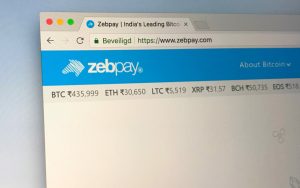
The Daily: Bitfinex Launches Tether Margin Trading, Zebpay Resumes BCH TransactionsZebpay, formerly one of India’s largest exchanges which recently launched in Europe, has notified clients on Friday that it is now reenabling BCH deposits and withdrawals paused since the recent hard fork. The exchange will also restart BCH trading for supported fiat and crypto pairs in supported countries over a couple of days.

“We have closely monitored the BCH network, it is now stable and safe to resume BCH wallet transactions. You can perform Bitcoin Cash sends and receives from your Zebpay wallet,” the team explained. “We are providing support for the Bitcoin ABC network which is identified on the Zebpay platform as Bitcoin Cash with ticker BCH. ABC chain is leading in blocks, hash rate, total chain difficulty. In your Zebpay wallet, BCHABC will be called BCH, balances will be credited in 1:1 from fork time.”

Peter Thiel Invests in New Crypto Platform

San Francisco-based crypto investment platform Layer1 has announced the closing of $2.1 million in seed funding. The round was backed by notable investors such as Peter Thiel, Digital Currency Group, Jeffrey Tarrant, and others.

The company’s stated mode of operation is to take a long-term position in crypto assets it believes represent promising technologies with network effects, then deploy capital and resources in order to improve their fundamental value and support market adoption. It is said to have a heavy focus on programmable money and store-of-value applications.

Layer1 is led by co-founder, Alexander Liegl, and the team comes with experience from both big tech companies, such as Google and Facebook, and major investment funds such as Protégé Partners and Stanford Management.

“We believe that the crypto investment company of the future will look radically different to status quo, with a clear focus on an engineering-first and pro-activist investment approach,” said Liegl. “Cryptocurrencies, as open-source protocols, offer the unprecedented opportunity for companies like Layer1 to meaningfully add value. This is fundamentally different from the possibilities available in traditional asset classes.”

What do you think about today’s news tidbits? Share your thoughts in the comments section below.


Images courtesy of Shutterstock.


Verify and track bitcoin cash transactions on our BCH Block Explorer, the best of its kind anywhere in the world. Also, keep up with your holdings, BCH and other coins, on our market charts at Satoshi’s Pulse, another original and free service from Bitcoin.com.

The post The Daily: Bitfinex Launches Tether Margin Trading, Zebpay Resumes BCH Transactions appeared first on Bitcoin News.

from Bitcoin News http://bit.ly/2LyKnwT The Daily: Bitfinex Launches Tether Margin Trading, Zebpay Resumes BCH Transactions


#Blockchain South Korean Business School Launches Crypto MBA Program

South Korean Business School Launches Crypto MBA Program

A major business school in South Korea is now offering a master’s degree in cryptocurrency. Crypto MBA is a one-and-a-half-year program that covers topics such as Bitcoin, Ethereum, smart contracts, crypto funds, Dapp planning, game theory, and how to write persuasive whitepapers. Meanwhile, the government is working on follow-up crypto regulations.

Also read: Indian Supreme Court Moves Crypto Hearing, Community Calls for Positive Regulations

Crypto MBA

South Korean Business School Launches Crypto MBA ProgramSeoul School of Integrated Sciences and Technologies, often known as Assist, announced on Friday that it is now offering a Master of Business Administration (MBA) degree program dedicated to cryptocurrency and blockchain technology. The new course is “a master’s degree program in blockchain, cryptoeconomics and token economy courses from technological, cryptoeconomic and business strategic perspectives,” the school described.

Claiming that it has “launched the world’s first crypto MBA course for a business graduate school,” Assist wrote:

The mission of Assist business school’s Crypto MBA program is to remedy the lack of academic research and systematic education currently available in the industry, despite a high level of social interest in the blockchain and cryptocurrency.

South Korean Business School Launches Crypto MBA ProgramThe professional graduate school has been offering master’s degrees and doctorate degrees in business administration since 2004. Its website claims that the school “has been evaluated as the no. 1 graduate school for business administration,” noting that large corporations such as LG Electronics, KT, Doosan Infracore, and Korea Electric Power Corporation continuously use its courses.
Crypto Curriculum and Regulation

South Korean Business School Launches Crypto MBA ProgramAccording to Friday’s announcement, “The curriculum includes Bitcoin, Ethereum, smart contract, cryptology, EOS, deep learning and system dynamics mechanisms. The cryptoeconomics curriculum consists of digital currency studies, microeconomics, macroeconomics, behavioral economics and theory on currency finance, game theory and mechanism design.” In addition, students will learn about “management mechanisms, strategic statistics, digital financial accounting, digital marketing strategies, crypto funds, Dapp planning and writing strategy for the persuasive whitepaper.”

South Korean Business School Launches Crypto MBA ProgramThe South Korean government is currently working on additional crypto regulatory measures following the implementation of the real-name system in January. Initial coin offerings (ICOs) have been banned domestically since September last year. However, a number of lawmakers have introduced several bills to regulate them.

Recently, a fintech startup filed a complaint with the country’s constitutional court alleging that the government’s ICO ban is unconstitutional.

Crypto Classes on the Rise

While Assist offers an actual MBA degree in crypto, a growing number of business schools worldwide have added crypto classes including Stanford Graduate School of Business, Wharton School of the University of Pennsylvania and Georgetown University Mcdonough School of Business. Cnbc previously reported that these top schools “are expanding classes in digital currency and blockchain to keep up with demand from students and their future employers.”

South Korean Business School Launches Crypto MBA ProgramStanford’s business school, ranked number one globally by the Financial Times this year, added a course called “Cryptocurrencies and Blockchain Technologies.” The school’s website describes, “The course covers all aspects of cryptocurrencies, including distributed consensus, blockchains, smart contracts and applications. We will focus in detail on Bitcoin and Ethereum as case studies.”


Wharton, ranked number one by Forbes, added a class in the fall called “Blockchain, Cryptocurrency, and Distributed Ledger Technology,” while Georgetown offers an elective that teaches topics such as the history and evolution of fintech, blockchain technology, and their applications.

What do you think of the Crypto MBA program? Let us know in the comments section below.


Images courtesy of Shutterstock, Assist, and the South Korean FSC.


Need to calculate your bitcoin holdings? Check our tools section.

The post South Korean Business School Launches Crypto MBA Program appeared first on Bitcoin News.

from Bitcoin News http://bit.ly/2Cvr7gI South Korean Business School Launches Crypto MBA Program

#Blockchain Poll Shows 13% of Russians Use Cryptocurrency for Online Purchases

Poll Shows 13% of Russians Use Cryptocurrency for Online Purchases

Cryptocurrency transactions are becoming a viable alternative to traditional electronic payments and Russia is no exception to the trend. Recently conducted surveys indicate that a large number of Russians have already started using digital coins for online purchases and many others are willing to try.   

Also read: Russians to Be Allowed ICO Investments up to $9,000 per Year

Crypto Payments Among Preferred Cashless Methods

Poll Shows 13% of Russians Use Cryptocurrency for Online PurchasesA poll conducted among 924 residents of the Russian Federation on the eve of the Christmas holidays shows that 13 percent of Russians use cryptocurrencies to pay for items they buy on the internet. That may not sound like a lot, but the results of the survey, which covers the full range of cashless payment methods, also demonstrate there is more ground to be conquered.

For example, 18 percent of respondents said they are using peer-to-peer mobile payment systems and 38 percent are regularly making payments through contactless applications such as Paypass, Apple Pay, Android Pay and Samsung Pay, Forklog reported.

Another 48 percent have a mobile bank account and 56 percent prefer alternative nonbank payment systems. 76 percent have stated they use electronic wallets to buy goods and services. That means many of the participants in the study are well acquainted with a number of digital payment methods and could easily switch to cryptocurrency-based platforms in the future.

The majority of the respondents have confirmed they often pay with debit and credit cards or through direct bank transfers, as is the case in any country with a developed traditional banking system. Almost half of those questioned in the poll, which was ordered by Kaspersky Lab, admitted they are uneasy about online payments in general because they don’t feel their funds are safe.

Muscovites Who Never Owned Crypto Want to Spend It

By eliminating third party intermediaries and providing full control over one’s money, cryptocurrencies offer an alternative approach to securing financial assets. In many respects, crypto transactions can also be faster, cheaper, more convenient and to a large degree anonymous.

Poll Shows 13% of Russians Use Cryptocurrency for Online PurchasesThese are likely some of the reasons why 5 percent of the participants in another survey said they were willing to try cryptocurrency payments, despite never having owned digital coins before. The poll was conducted by Russia’s largest electronic payment service Yandex Money in cooperation with the Digital Technologies Department of the city of Moscow and published last month.


The researchers found that 34 percent of the residents of the Russian capital prefer cashless payment methods. Of them, 63 percent conduct such transactions on a daily basis. The report identifies insufficient knowledge and confusion about cryptocurrencies as the main obstacles to wider adoption.

Despite gaining significant popularity over the last couple of years, cryptocurrencies remain unregulated in Russia. Three bills were introduced and approved on first reading in the lower house of Russia’s parliament earlier this year, but lawmakers are still fine-tuning the legislation. The adoption of the main draft, the law “On Digital Financial Assets,” was recently postponed for the spring parliamentary session.

What payment method do you prefer for online purchases? Let us know in the comments section below.


Images courtesy of Shutterstock.


At Bitcoin.com there’s a bunch of free helpful services. For instance, have you seen our Tools page? You can even lookup the exchange rate for a transaction in the past. Or calculate the value of your current holdings. Or create a paper wallet. And much more.

The post Poll Shows 13% of Russians Use Cryptocurrency for Online Purchases appeared first on Bitcoin News.

from Bitcoin News http://bit.ly/2VcQ8oy Poll Shows 13% of Russians Use Cryptocurrency for Online Purchases

#Blockchain Cryptocurrency and Taxes: How to Use 2018’s Losses to Your Advantage

Taxes have been a hot topic in the cryptocurrency world this year. Many countries have been trying to figure out how to tax crypto assets, while traders have been figuring out how to lever them to write off losses. As bitcoin and other cryptocurrencies enter the mainstream, tax reduction strategies are starting to emerge.

Also read: UK Investors to Pay Capital Gains and Income Tax on Bitcoin Investments

Governments Belatedly Address Bitcoin Taxation

As cryptocurrencies have entered the collective conscious and adoption has grown, governments have been trying to figure out how to tax them. Most recently, the U.K. government released a sprawling crypto tax advice document. Her Majesty’s Revenue and Customs (HMRC) reveals in the document that individual investors will be liable to pay capital gains tax each time they sell crypto assets such as BTC for profit. HMRC ruled that investors would not be allowed to classify their investment in cryptocurrency as “gambling”, which is tax-free when it comes to winnings.  Cryptocurrency and Taxes: How to Use 2018's Losses to Your Advantage

At the beginning of the year, U.K. Prime Minister Theresa May said her government would be looking at bitcoin and cryptocurrencies “very seriously” because of their potential to be “used by criminals.”

Elsewhere in Europe, the European Union has been advised to devise common cryptocurrency rules – and that includes tax. While Switzerland has decided to do away with regulation, the Swiss Federal Council has stated that it wants “the best possible framework conditions so that Switzerland can establish itself and evolve as a leading, innovative and sustainable location for fintech and blockchain companies.” In Russia, while the government is working out a regulatory framework, citizens are obliged to pay 13 percent tax on their crypto-related incomes.

This year in Asia, Korea said it is planning to tax cryptocurrencies and initial coin offerings (ICOs), while proposals to lower taxes on crypto in Japan were announced this month; currently the government can take as much as 55 percent from cryptocurrency transactions as miscellaneous income. Cryptocurrency and Taxes: How to Use 2018's Losses to Your Advantage

Taxation guidelines in the U.S. have generally been unclear. On Dec. 21, lawmakers filed a bill to create tax exemptions for certain cryptocurrency transactions. The state of Ohio also said it would accept BTC from its citizens to pay taxes.

Meanwhile, South Africa’s government, generally considered to be crypto-friendly, this year said income accrued from crypto transactions must be declared – and said it would be cracking down on tax-dodging cryptocurrency traders.

How Cryptocurrencies Can Help You Save on Taxes

While governments are figuring out how to tax cryptocurrencies, there are actually ways in U.S. citizens can use them to their advantage to pay less taxes.  This is due to a 2014 notice by the Internal Revenue Service (IRS) which treats cryptocurrencies as an investment property, rather than a currency. Whenever you trade cryptocurrency, the transaction is either a capital gain (where you make money) or a capital loss (where you lose money). And any losses this year could ultimately place you in a lower tax bracket.

The IRS allows taxpayers to deduct $3,000 in capital losses for any given year from money earned from a day job. Losses beyond that cannot be deducted until several years later.

As an example, let’s look at someone who bought $5,000 worth of BTC this year. After turning that into $10,000 through trading, they later lost cash due to a dip in the markets and took a big hit, losing $8,000. They cashed out, walking away with just $2,000. They would then be able to harvest a loss of $3,000 for the year which would be deducted from their taxable income. If that person made $50,000 in regular income, only $47,000 of it would be taxable.

In order to write off cryptocurrency losses as tax deductible in the U.S., it’s essential to properly file, with exact dates, all transactions incuding gains and losses. Certain online tools, such as bitcoin.tax, can be useful in calculating capital gains and losses. While 2018 has been a bad year for cryptocurrency investors, the ability to write off thousands of dollars of bad trades should provide some consolation.

Disclaimer: This editorial is intended for informational purposes only. Bitcoin.com and the author are not experts on taxes and cannot be held responsible, directly or indirectly, for any damage or loss caused or alleged to be caused by following the information in this article. 

How have you managed with taxation on your crypto assets this year? Let us know in the comments section below.


Images courtesy of Shutterstock.


Need to calculate your bitcoin holdings? Check our tools section.

The post Cryptocurrency and Taxes: How to Use 2018’s Losses to Your Advantage appeared first on Bitcoin News.

from Bitcoin News http://bit.ly/2T91DLV Cryptocurrency and Taxes: How to Use 2018’s Losses to Your Advantage

#Blockchain Bitcoincash.org Publishes Redesigned Website and Development Roadmap

Bitcoincash.org Publishes Redesigned Website and Development Roadmap

Bitcoin Cash (BCH) supporters have noticed the Bitcoincash.org website has been redesigned. The web portal hosts a comprehensive list of the network’s infrastructure including nodes, wallets, community services, and exchanges. Alongside the recent upgrade, the landing page leads to the BCH network’s development roadmap which highlights the plan to make bitcoin cash sound money that is usable by everyone in the world.

Also read: How to Spend and Give Bitcoin Cash Over the Holidays

All Things Bitcoin Cash

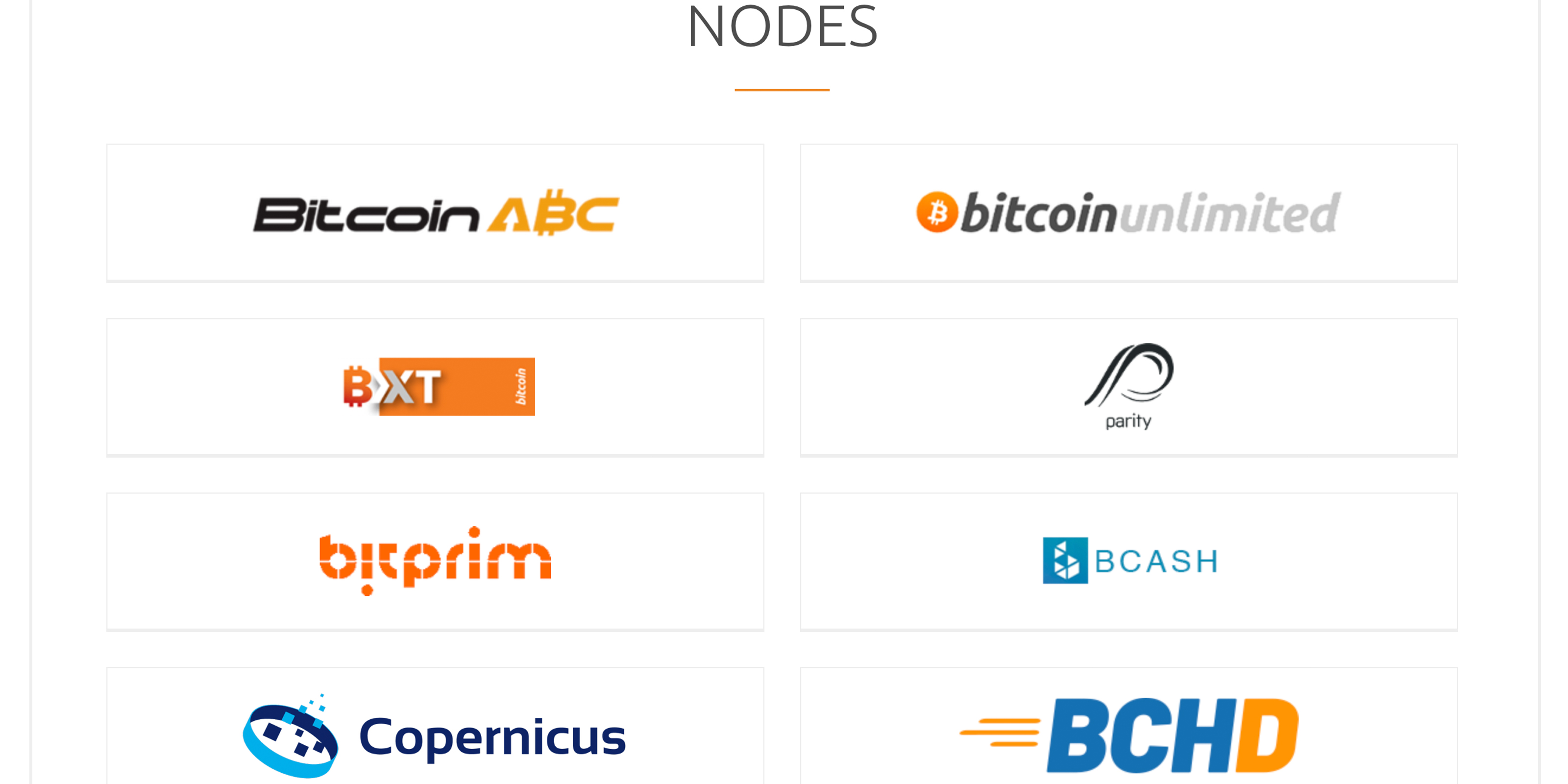
Bitcoincash.orgBitcoincash.org Publishes Redesigned Website and Development Roadmap has seen a complete overhaul as the page has a whole new look and feel for visitors who happen to stumble upon the website. The main emphasis of the web page showcases the benefits of peer-to-peer electronic cash that allows for cheap transactions on a secure and reliable blockchain. “[Bitcoin Cash] will enable new economies with low fee micro-transactions, large business transactions, and permissionless spending,” explains the website. Like the older version of the website, Bitcoincash.org features all the full node implementations that support the BCH network. This includes Bitcoin Unlimited, ABC, XT, Parity, Bitprim, Bcash, Bchd, and Copernicus. Each node window will take the visitor to the full node client’s webpage, where they can view the source code and binaries.

Bitcoincash.org Publishes Redesigned Website and Development Roadmap
The variety of full node implementations available for BCH.

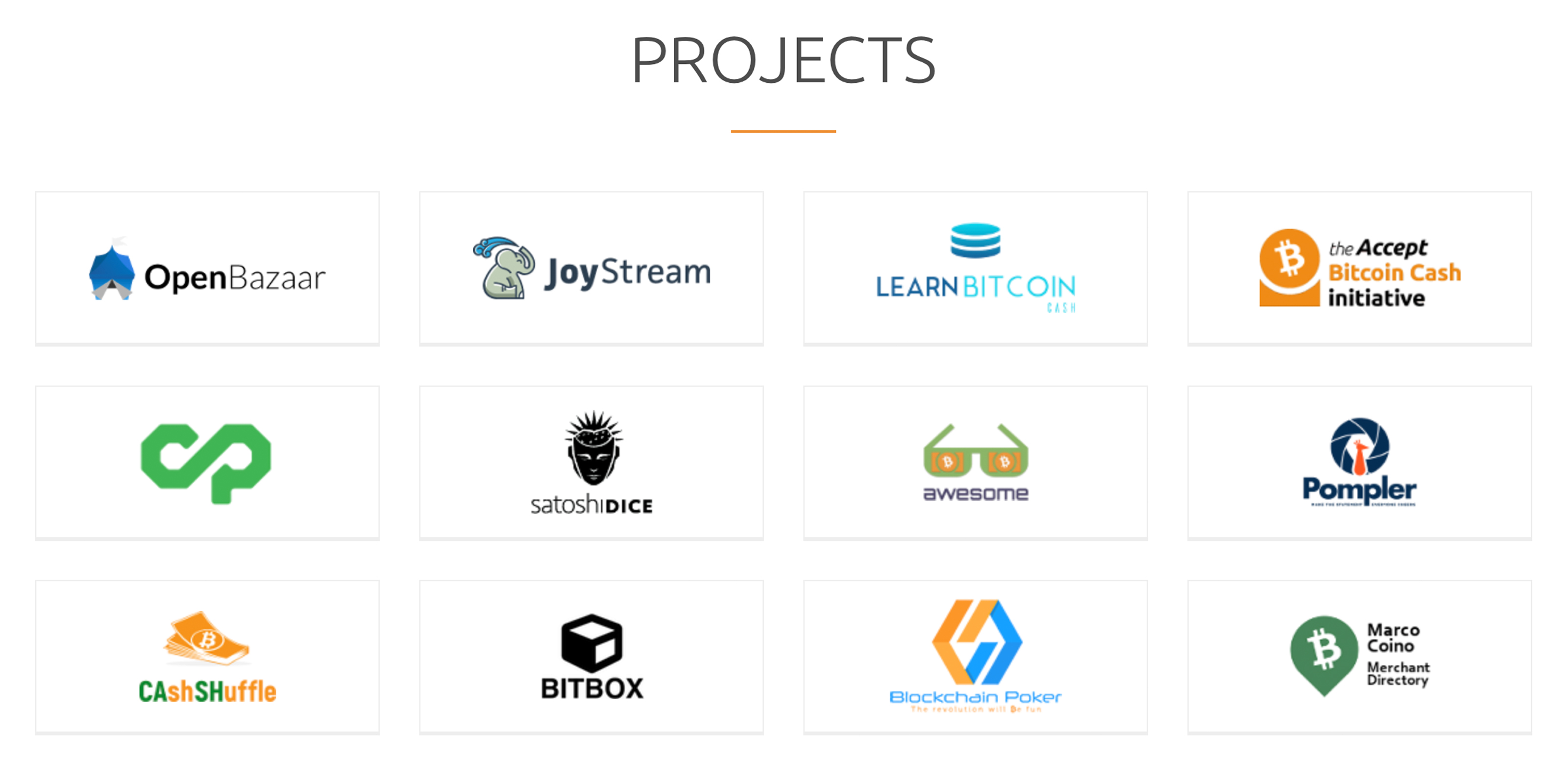
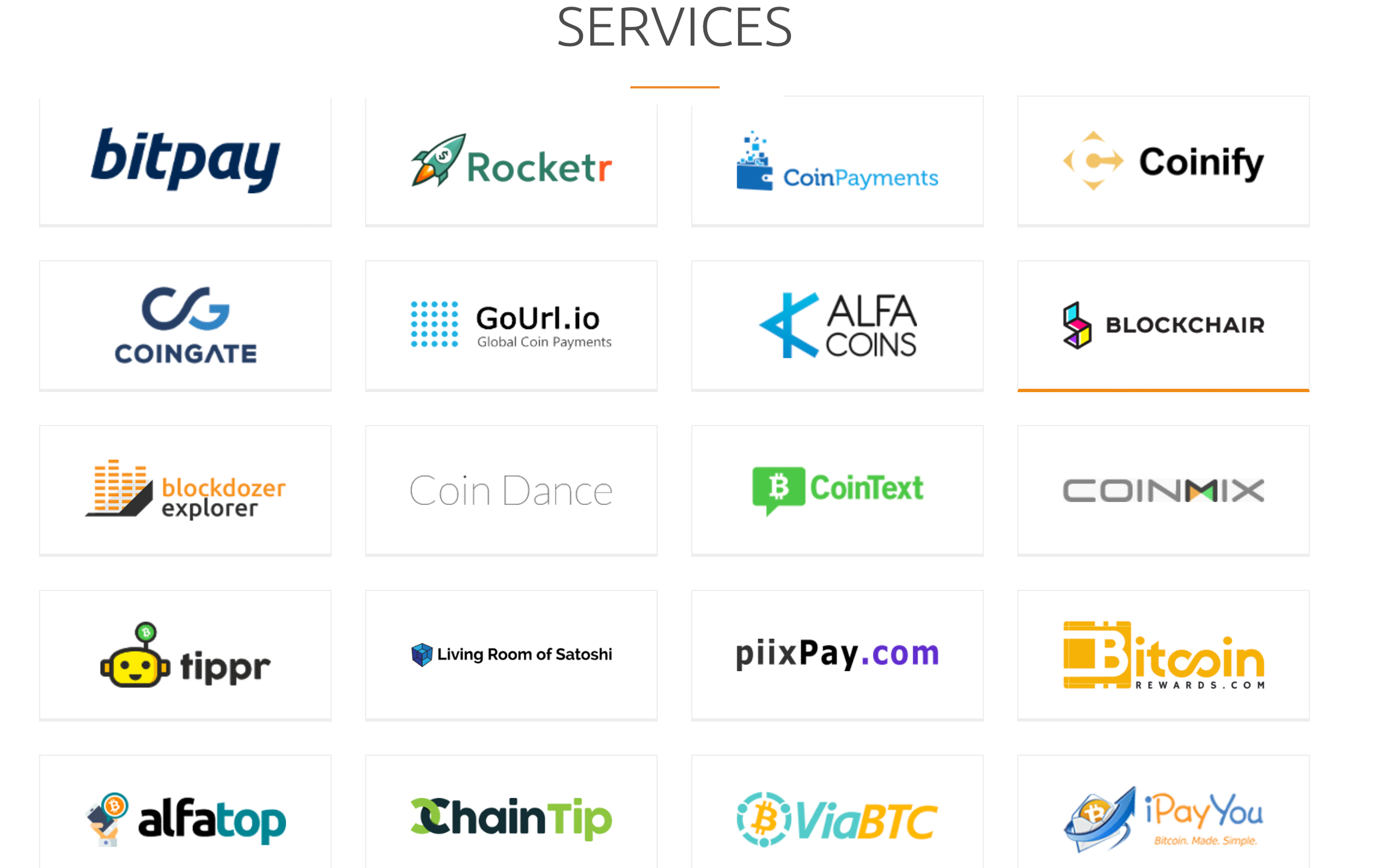
The wallet section gives a bit more detail on what type of wallet people might be looking for and suggests a few methods of BCH programs that allow fast transactions and secure storage. This includes mobile wallets, desktop implementations, hardware wallets, and paper wallet generators. The community section lists services, projects, and the wide variety of exchanges that support the BCH network.

Bitcoincash.org Publishes Redesigned Website and Development Roadmap
Projects tethered to the Bitcoin Cash (BCH) protocol.

The newly refurbished site also has a logo section for people who want to download certain BCH graphics and even the Ubuntu bold and italic font. Moreover, Bitcoincash.org has a ‘getting started’ section which has various educational resources available for people just getting their feet wet in this vast ocean of innovative technology.

“Peer-to-peer (P2P) electronic cash is simply described as online money sent from one person to another without the need for a trusted third-party,” the introduction to the getting started page details.

Bitcoincash.org Publishes Redesigned Website and Development Roadmap
Infrastructure services that support Bitcoin Cash (BCH).

The BCH Roadmap for Optimizations and Protocol Upgrades

Bitcoincash.org has also published its roadmap, which gives details on the upcoming upgrades that are currently being developed and discussed. The very basics of the Bitcoin Cash is sound, the website explains, but it is not perfect. “It is prudent to make incremental improvements to the system with technically sound design and careful engineering. By implementing optimizations and protocol upgrades, peer-to-peer digital cash will scale many orders of magnitude beyond current limits,” the BCH roadmap reads. Furthermore, Bitcoincash.org details that technical improvements can be defined by the following three categories:

  • Enable Bitcoin Cash to scale from ~100 Tx/s to over 5,000,000 Tx/s. Protocol improvements must be made so that mass-parallelization can enable this level of transaction processing.
  • Improving the payment experience to ensure that it is instant and reliable. Transactions should be secure within three seconds.
  • Make Bitcoin Cash extensible. An extensible protocol makes future improvements less disruptive and provides a solid base for businesses and developers to build on.
Bitcoincash.org Publishes Redesigned Website and Development Roadmap
A visual of the Bitcoin Cash (BCH) development roadmap.

News.Bitcoin.com previously reported on the 2019 BCH hard fork specification draft proposal #143 on Github. The specifications discussed the possible implementation of Schnorr signatures and re-enabling the following opcodes: OP_Mul, OP_Invert, OP_Lshift, and OP_Rshift. Bitcoincash.org’s roadmap notes that in order for BCH to become a solid base for application, development and innovation must continuously improve and compete. “Working together, we can build a technical foundation to empower Bitcoin Cash to be the best money the world has ever seen.” The development documentation also includes an infographic on the roadmap that was originally published on Aug. 24, 2018.

What do you think about the Bitcoincash.org revamped website and development roadmap? Let us know what you think about this subject in the comments section below.  


Images via Bitcoincash.org and Shutterstock. 


At news.Bitcoin.com all comments containing links are automatically held up for moderation in the Disqus system. That means an editor has to take a look at the comment to approve it. This is due to the many, repetitive, spam and scam links people post under our articles. We do not censor any comment content based on politics or personal opinions. So, please be patient. Your comment will be published.

The post Bitcoincash.org Publishes Redesigned Website and Development Roadmap appeared first on Bitcoin News.

from Bitcoin News http://bit.ly/2EKAN9K Bitcoincash.org Publishes Redesigned Website and Development Roadmap

#Blockchain Almost 5,000 Crypto Pump and Dumps Posted on Discord and Telegram in 6 Months

4,818 Ads for Pump and Dumps Posted to Discord and Telegram in Six Months

A report compiled by researchers from Tel Aviv University, The University of Tulsa, and the University of New Mexico has found nearly 5,000 advertisements for cryptocurrency pump and dump signals on social platforms Discord and Telegram posted during the first half of 2018.

Also Read: Asian News Headlines Exert Significant Impact on Cryptocurrency Prices

Nearly 5,000 Ads For Crypto Pumps Posted to Discord and Telegram in First Half of 2018

Almost 5,000 Crypto Pump and Dumps Posted on Discord and Telegram in 6 Monthsreport examining the prevalence of advertisements for cryptocurrency pump signals across Discord and Telegram has found the phenomenon to be “widespread and often quite profitable.”

The authors collected five-minute interval price data for “nearly 2,000 coins across 220 cryptocurrency trading exchanges from Coinmarketcap” from mid-Jan. 2018 to early July 2018. “Pump data” was then obtained through “collecting messages posted to hundreds of dedicated Discord and Telegram channels using their APIs and manually labeling messages that signaled pumps,” and “consistently mapped to the trading data.”

In total, the researchers found 1,051 pump signals advertised on Discord and 3,767 ads on Telegram pertaining to more than 200 different cryptocurrencies.

The report asserts that the “proliferation of cryptocurrencies” and “changes in technology” have aided those who wish to conduct pumps, with a large number of the roughly 2,000 cryptocurrencies currently trading being “illiquid” and “characterized by very low trading volumes on most days, with occasional volume and price spikes.”

Twice as Many Low-Cap Pumps Promoted on Telegram Than Discord

Almost 5,000 Crypto Pump and Dumps Posted on Discord and Telegram in 6 MonthsThe report describes the volume and market capitalization ranking of a coin as “the most important factor in determining the profitability of the pump,” adding that “pumping obscure coins (with low volume) is much more profitable than pumping the dominant coins in the ecosystem.”



The median price increase for coins ranked within the top 75 by market cap was 3.5 percent on Discord, and 4.8 percent on Telegram. For projects ranked from 76 to 200, the median price increase was 5.2 percent on Discord and 6.5 percent on Telegram. Coins ranked from 201 to 500 saw median gains of 5.3 percent on Discord and 8.1 percent on Telegram. Cryptocurrencies ranked below 500 produced median gains of 23.2 percent on Discord and 18.7 percent on Telegram.

Of the coins ranked in the top 75 by market cap, 52 saw pumps promoted on Discord and 56 on Telegram. Among projects ranked 76 to 200, 58 were pumped on Discord and 62 on Telegram. Of the cryptocurrencies ranked 201 to 500, 75 pumps were advertised on Discord and 84 on Telegram. Lastly, 80 coins ranked below 500 were pumped using Discord, while pumps for 176 lower-capitalized projects were promoted on Telegram.

The report notes that “January-July 2018 was a period in which cryptocurrency prices and trading volume were falling significantly,” emphasizing the success of the examined pumps despite the relatively moderate gains when contrasted with the 2017 bull market.

Do you think that we will see regulators seek to crack down on pump and dumps? Share your thoughts in the comments section below!


Images courtesy of Shutterstock


At Bitcoin.com there’s a bunch of free helpful services. For instance, have you seen our Tools page? You can even lookup the exchange rate for a transaction in the past. Or calculate the value of your current holdings. Or create a paper wallet. And much more.

The post Almost 5,000 Crypto Pump and Dumps Posted on Discord and Telegram in 6 Months appeared first on Bitcoin News.

from Bitcoin News http://bit.ly/2BDtgFs Almost 5,000 Crypto Pump and Dumps Posted on Discord and Telegram in 6 Months

#USA How Juul made vaping viral to become worth a dirty $38 billion

//

A Juul is not a cigarette. It’s much easier than that. Through devilishly slick product design I’ll discuss here, the startup has massively lowered the barrier to getting hooked on nicotine. Juul has dismantled every deterrent to taking a puff.

The result is both a new $38 billion valuation thanks to a $12.8 billion investment from Marlboro Cigarettes-maker Altria this week, and an explosion in popularity of vaping amongst teenagers and the rest of the population. Game recognize game, and Altria’s game is nicotine addiction. It knows it’s been one-upped by Juul’s tactics, so it’s hedged its own success by handing the startup over a tenth of the public corporation’s market cap in cash.

Juul argues it can help people switch from obviously dangerous smoking to supposedly healthier vaping. But in reality, the tiny aluminum device helps people switch from nothing to vaping…which can lead some to start smoking the real thing. A study found it causes more people to pick up cigarettes than put them down.

Photographer: Gabby Jones/Bloomberg via Getty Images

How fast has Juul swept the nation? Nielsen says it controls 75 percent of the U.S. e-cigarette market up from 27 percent in September last year. In the year since then, the CDC says the percentage of high school students who’ve used an e-cigarette in the last 30 days has grown 75 percent. That’s 3 million teens or roughly 20 percent of all high school kids. CNBC reports that Juul 2018 revenue could be around $1.5 billion.

The health consequences aside, Juul makes it radically simple to pick up a lifelong vice. Parents, regulators, and potential vapers need to understand why Juul works so well if they’ll have any hope of suppressing its temptations.

Shareable

It’s tough to try a cigarette for the first time. The heat and smoke burn your throat. The taste is harsh and overwhelming. The smell coats your fingers and clothes, marking you as smoker. There’s pressure to smoke a whole one lest you waste the tobacco. Even if you want to try a friend’s, they have to ignite one first. And unlike bigger box mod vaporizers where you customize the temperature and e-juice, Juul doesn’t make you look like some dorky hardcore vapelord.

Juul is much more gentle on your throat. The taste is more mild and can be masked with flavors. The vapor doesn’t stain you with a smell as quickly. You can try just a single puff from a friend’s at a bar or during a smoking break with no pressure to inhale more. The elegant, discrete form factor doesn’t brand you as a serious vape users. It’s casual. Yet the public gesture and clouds people exhale are still eye catching to trigger the questions, “Whats that? Can I try?”

And perhaps most insidiously, vaping seems healthier. A lifetime of anti-smoking ads and warning labels drilled the dangers into our heads. But how much harm could a little vapor do?

A friend who had never smoked tells me they burn through a full Juul pod per day now. Someone got him to try a single puff at a nightclub. Soon he was asking for drag off of strangers’ Juuls. Then he bought one and never looked back. He’d been around cigarettes at parties his whole life but never got into them. Juul made it too effortless to resist.

Concealable

Lighting up a cigarette is a garish activity prohibited in many places. Not so with discretely sipping from a Juul.

Cigarettes often aren’t allowed to be smoked inside. Hiding it is no easy feat and can get you kicked out. You need to have a lighter and play with fire to get one started. They can get crushed or damp in your pocket. The burning tip makes them unruly in tight quarters, and the bud or falling ash can damage clothing and make a mess. You smoke a cigarette because you really want to smoke a cigarette.

Public establishments are still figuring out how to handle Juuls and other vaporizers. Many places that ban smoking don’t explicitly do the same for vaping. The less stinky vapor and more discrete motion makes it easy to hide. Beyond airplanes, you could probably play dumb and say you didn’t know the rules if you did get caught. The metal stick is hard to break. You won’t singe anyone. There’s no mess, need for an ashtray, or holes in your jackets or couches.

As long as your battery is charged, there’s no need for extra equipment and you won’t draw attention like with a lighter. Battery life is a major concern for heavy Juulers that smokers don’t have worry about, but I know people who now carry a giant portable charger just to keep their Juul alive. But there’s also a network effect that’s developing. Similar to iPhone cords, Juuls are becoming common enough that you can often conveniently borrow a battery stick or charger from another user. 

And again, the modular ability to take as few or as many puffs as you want lets you absent-mindedly Juul at any moment. At your desk, on the dance floor, as you drive, or even in bed. A friend’s nieces and nephews say that they see fellow teens Juul in class by concealing it in the cuff of their sleeve. No kid would be so brazen as to try smoke in cigarette in the middle of a math lesson.

Distributable

Gillette pioneered the brilliant razor and blade business model. Buy the sometimes-discounted razor, and you’re compelled to keep buying the expensive proprietary blades. Dollar Shave Club leveled up the strategy by offering a subscription that delivers the consumable blades to your door. Juul combines both with a product that’s physically addictive.

When you finish a pack of cigarettes, you could be done smoking. There’s nothing left. But with Juul you’ve still got the $35 battery pack when you finish vaping a pod. There’s a sunk cost fallacy goading you to keep buying the pods to get the most out of your investment and stay locked into the Juul ecosystem.

(Photo by Scott Olson/Getty Images)

One of Juul’s sole virality disadvantages compared to cigarettes is that they’re not as ubiquitously available. Some stores that sells cigs just don’t carry them yet. But more and more shops are picking them up, which will continue with Altria’s help. And Juul offers an “auto-ship” delivery option that knocks $2 off the $16 pack of four pods so you don’t even have to think about buying more. Catch the urge to quit? Well you’ve got pods on the way so you might as well use them. Whether due to regulation or a lack of innovation, I couldn’t find subscription delivery options for traditional cigarettes.

And for minors that want to buy Juuls or Juul pods illegally, their tiny size makes them easy to smuggle and resell. A recent South Park episode featured warring syndicates of fourth-graders selling Juul pods to even younger kids.

Dishonorable

Juul co-founder James Monsees told the San Jose Mercury News that “The first phase is proving the value and creating a product that makes cigarettes obsolete.” But notice he didn’t say Juul wants to make nicotine obsolete or reduce the number of people addicted to it.

Juul co-founder James Monsees

If Juul actually cared about fighting addiction, it’d offer a regimen for weaning yourself off of nicotine. Yet it doesn’t sell low-dose or no-dose pods that could help people quit entirely. In the US it only sells 5% and 3% nicotine versions. It does make 1.7% pods for foreign markets like Israel where that’s the maximum legal strengths, though refuses to sell them in the States. Along with taking over $12 billion from one of the largest cigarette companies, that makes the mission statement ring hollow.

Juul is the death stick business as usual, but strengthened by the product design and virality typically reserved for Apple and Facebook.

from Startups – TechCrunch https://tcrn.ch/2T64pRQ

#Blockchain Bermuda Issues Draft Crypto Custodial Services Regulation

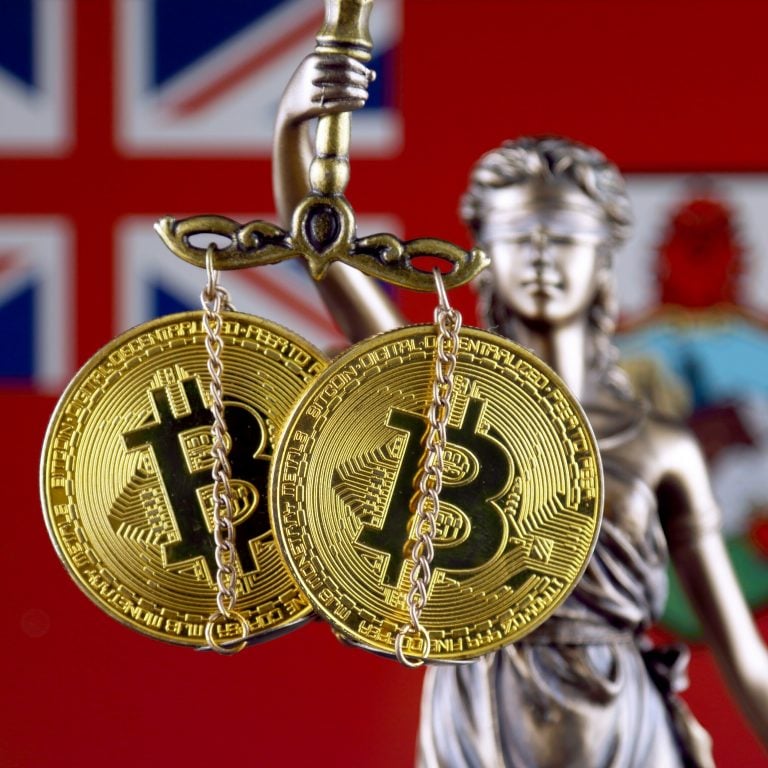
The Bermuda Monetary Authority (BMA), the island’s foremost financial services regulator, has published a draft regulation for cryptocurrency custodial services. The regulation – Code of Practice for Digital Asset Custody – outlines prescriptions to ensure the secure handling of customers’ crypto assets.

Also read: Brazilian Supermarket Chain Now Accepts Payment in Bitcoin

‘Safe Space for Investment’

Bermuda Issues Draft Crypto Custodial Services Regulation

The authority, which is also tasked with prevention of financial crime, drafted the code to expand a safe space for investment that will not only protect local investors but also attract foreign businesses, it said in a statement on Dec. 18.

Security concerns with respect to hot and cold storage of assets, key generation, transaction handling and incident reporting are covered by the prescriptions, both technology and business wise. The regulatory clarity provided by the code is expected to ensure that business is done in a prudent manner.

Moad Fahmi, senior advisor on financial technology with the BMA, commended the draft regulation as progressive. “The code complements the extensive body of rules for Digital Asset Businesses. We view custody as an important part of a healthy digital asset ecosystem – one that will encourage quality players to contribute positively to our financial system,” Fahmi said.

Bermuda Issues Draft Crypto Custodial Services Regulation

He stated that the framework was built “with the aim of making sure that the core objectives of financial regulation are respected.” These include “protecting consumers, ensuring stability of our institutions and maintaining integrity and confidence in financial markets – with a focus on maintaining the highest standards of AML/ATF,” Fahmi detailed.

Craig Swan, the managing director of insurance at the authority said the code will expand BMA’s cybersecurity capacity as it moves into the regulation of digital assets, in keeping with its mandate to be forward-looking and comprehensive.

Some of the regulations are targeted at forestalling security breaches in the crypto world such as those that affected Mt. Gox, where one of the points of opacity is whether the former CEO embezzled clients’ money or used the company’s revenue procedurally. According to the BMA regulation, clients’ assets must be kept apart from the company’s assets for security reasons.

Bermuda Looks to Become Crypto Hub

The authority, which recently undertook consultations about the future of cryptocurrencies in Bermuda’s financial sector, is bent to weed out illegal activities such as money laundering. The code allows indemnity insurance for cryptocurrency exchanges. It also permits the roping in of qualified custodians and contingency measures to safeguard clients’ money.

Bermuda Issues Draft Crypto Custodial Services Regulation

Bermuda has been positioning itself as a choice destination for cryptocurrency businesses, with notable competition from Malta, Gibraltar and Liechtenstein, by providing regulatory clarity and maintaining a progressive attitude towards the industry. Earlier this year, Bermuda’s legislature passed a law allowing startups that do initial coin offerings to apply to the finance minister for speedy approval.

“We want to position Bermuda as the incubator for this industry,” E. David Bart, Prime Minister of Bermuda, said in an interview during a cryptocurrency conference in May. The latest regulation is a logical step towards bolstering investor confidence in the small but economically advanced country.

What do you think about Bermuda’s draft regulation on custodial services? Let us know in the comments section below.


Images courtesy of Shutterstock.


Need to calculate your bitcoin holdings? Check our tools section.

The post Bermuda Issues Draft Crypto Custodial Services Regulation appeared first on Bitcoin News.

from Bitcoin News http://bit.ly/2ByEb3w Bermuda Issues Draft Crypto Custodial Services Regulation

#Blockchain Wendy McElroy: Satoshi Revolution – Afterword

Satoshi Revolution - Afterword

The Satoshi Revolution: A Revolution of Rising Expectations.
Afterword
by Wendy McElroy

I meant to end this book by discussing the blockchain’s impact on physical violence, on crimes of violence. I can’t. I don’t think there is an impact. I don’t know how the blockchain can prevent back-alley rapes, for example. I could talk about putting sex work on an open ledger, but that would be weak tea, and it would feel like an evasion. This is a book of original theory, which explores what has never been said before about cryptocurrency. I don’t always know where the ideas are taking me. But the impact on physical violence isn’t one of those destinations.

And, so, I am writing the afterword to my book, instead.

My journey through cryptocurrency began in a kitchen in Chile. I was the featured speaker at a conference that also presented a panel of three experts on bitcoin. My husband and I decided to rent a house through airbnb because we wanted to extend the couple of days into two weeks of bouncing around the country, which was magical. The house we ended up with, however, was outfitted for weddings. Translation: there were no fewer than thirty beds crammed into about twenty rooms that were linked by floors that consisted of cracked plywood between which there was you and a two-story drop. It wasn’t a house; it was an adventure, with one working bathroom. I prefer to consider it “quaint.”

The conference housed the speakers and attendants on a remote compound, which quickly filled up. At some point, the organizers asked us to put up the bitcoin experts. We immediately and gladly agreed. They were pleasant, presentable fellows—albeit men who spoke of matters that made no sense whatsoever to me. Fortunately, my husband develops hardware and software for embedded systems, so I am used to not quite understanding things.

And, then, there was the morning after they arrived. One fellow slept in. One insisted on cooking breakfast; I do not mean to cast aspersions upon him, because he was wonderful and trying to be a good guest. But people do not cook around me. I cook; you eat; we get along fine. He cooked.

So I was in a cranky mood when I stared across the breakfast table into the coal-black eyes of Michael Goldstein, whom I later learned is the Satoshi Institute. A remarkable young man. Michael is nicknamed Bitstein by those who have affection for him…and, really, all you have to do is meet him for that to happen. When I looked into his eyes, I had an oh-so-familiar feeling because I do have mirrors in my bathroom. “This is a fanatic,” I concluded. I happen to like fanatics, depending on the topic under discussion, of course. I had nothing against the topic of bitcoin, which had started to interest me because so many people I liked took it so darned seriously.

With an unwavering stare, Bitstein told me the blockchain was an open ledger that delivered anarchy. Okay. I immediately understood the power of crypto to bypass the central banking system…if it was widely adopted; if it was not outlawed, if… But anarchy? All my reservations were political and entirely different than those of husband, who joined us after about fifteen minutes. Brad waited until Michael took a breath and, then, he said one word: “scalability.” It was the first time Michael stumbled. Michael said, “we’re working on that.” I saw Brad lose interest.

I didn’t. I didn’t know what scalability was, except in the definitional sense. But I didn’t care because the word “anarchy” had been uttered, and that I knew about. Michael seemed more than happy to leave behind scalability for politics, and I pursued why he thought the dawn of freedom had arrived like the cavalry on an algorithm.

Michael answered, and he did not convince me, but he did prompt me to read. As did my old friend Jeff Tucker. As did the incredible Stephan Kinsella. Other people tried to raise my awareness, as well. Mihai Alisie, of Bitcoin Magazine, asked me to write for him on anarchism, for example. I don’t think I adequately thanked the man for having such automatic confidence in me. And, at that point, his confidence was probably ill-founded. I submitted one article to Bitcoin Magazine, which was far from my best work. It drew a better response than I deserved: they were willing to “work with me.” I thanked the editor, and backed away with the absolutely genuine excuse that I did not know if I had anything original to contribute to the discussion. I had nothing new to say. I had not yet grasped the hard, cold edges of crypto theory, and I did not understand its power. Which meant I had not yet staked out the one area where I could and can contribute something original: the integration of crypto-anarchism with the rich history of anarchist-libertarian theory that has spanned centuries.

As I read further, I became ashamed of myself. Crypto-anarchism: the most important political development in my lifetime had occurred without my noticing it happening, which is inexcusable. I had spent my time on “official” libertarianism—donation-driven and donation-defined institutes, tax-funded universities, academic journals… When did freedom ever come packaged in tax dollars, awards, and honors delivered at rubber-chicken dinners? Freedom is a street fight. Crypto-anarchism took over the streets without my noticing. I notice now.

Enter Roger Ver. Our first contact was an email that he sent out of the blue. Roger’s email “had” me at hello, because he used the word “voluntaryism” while asking me to write for his site. In 1982, I was one of three people who created the modern Voluntaryist movement during a bull-session in a two-bedroom rent-controlled apartment in Hollywood, California. I remember my fingertips literally buzzing from the excitement of the ideas and plans we were forging back then: Carl Watner, George H. Smith, and me. But, mostly, Carl. It was and is almost unbelievable to me that, decades and decades later, a voluntaryist visionary named Roger would be knocking on my door (so to speak).

Roger had good timing. In science-fiction language, I had finally grokked bitcoin; I tip my hat to Robert A Heinlein for that word, BTW. I also tip my hat to Roger and the entire bitcoin.com crew for never– and I mean not once, in any manner whatsoever–trying to influence the ideas as I spun them out in my sometimes clumsy attempt to integrate crypto-anarchism into the broader traditions of classical liberalism, Austrian economics, and individualist anarchism. And, yes, a period of fierce editing will ensue. Clumsiness will be eradicated.

Before closing, I must address another aspect of crypto-anarchism. I did not expect this side benefit, but there you have it; life is often unexpected. Crypto has made me young again.

I’ve had the immense good fortune to befriend and to spend so many years with people who helped found the modern libertarian movement. Murray Rothbard used to joke at conferences in the 1980s that libertarianism could be eliminated by one well-placed bomb. He was correct.

There is a downside to my immense good fortune, however. The people with whom I grew into intellectual adulthood now make me feel old, mostly because so many of them are dead. Feeling old is feeling tired, with nothing in sight that makes your eyes sparkle.

I remember Murray, and his passion—I remember it so vividly. But, increasingly and over years, something went wrong with his passion. It came from anger, and it was expressed by attacking other people. I remember an after-conference dinner at which a diner had the incredible misfortune to say something positive about Keynes. And, then—God help us all!–he elaborated. Murray finally exploded into a rant in his Brooklyneque-squawk of a voice, and the fellow started to back down. I think he would have backed his chair out of the restaurant, if that had been a possibility. He conceded that Keynes may have been wrong on “this” issue, and on “that” one, and that Keynes was probably weak on historical context. Murray slammed his open hand down on the table and declared, “And Hiter was ‘weak’ on the Jews!” Everyone laughed, but it was an attack, nevertheless.

Crypto sparkles like a spinning thing in the sun, and the sparkle is clean, because it does not come from anger or from demeaning someone or something else. The passion is positive. A door has been flung open, and I don’t know where the path outside of it will lead me because I could never have predicted the path up to this point. Let it evolve.

One thing I know. I am in good company; the bitcoin.com crew has been nothing but decent and grinning toward this gal who plopped into their midst. That means the world to me. I don’t know where I will end up next, but I do know that technology—not merely crypto—is going to give us all a wild ride for the rest of our lives. I will have my hands on the keyboard, trying to put the dizzy changes into historical perspective, even as they happen.

I have a chance of doing so…because I am young again. I am hopeful. And nothing, nothing is impossible. That’s what this book has meant to me. I pause in this journey to thank you for being part of it.

Reprints of this article should credit bitcoin.com and include a link back to the original links to all previous chapters


Wendy McElroy has agreed to ”live-publish” her new book The Satoshi Revolution exclusively with Bitcoin.com. Every Saturday you’ll find another installment in a series of posts planned to conclude after about 18 months. Altogether they’ll make up her new book ”The Satoshi Revolution”. Read it here first.

The post Wendy McElroy: Satoshi Revolution – Afterword appeared first on Bitcoin News.

from Bitcoin News http://bit.ly/2Ac70md Wendy McElroy: Satoshi Revolution – Afterword

#Blockchain Bitcoin Cash Payment API Gateway.cash Adds a Variety of New Features

Bitcoin Cash Payment API Gateway.cash Adds a Variety of New Features

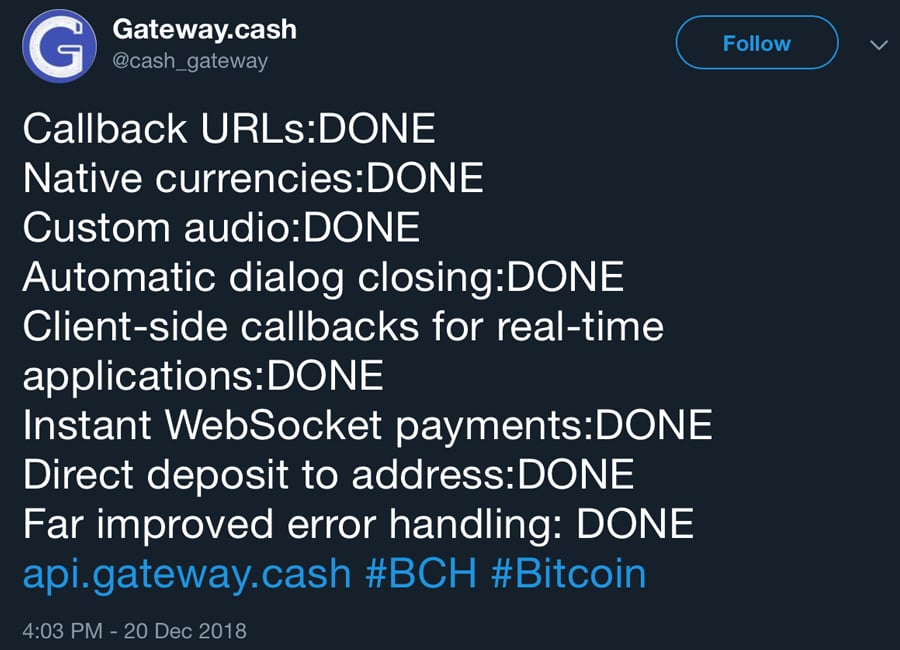
Last October, news.Bitcoin.com reported on a new Bitcoin Cash (BCH) payment processor called Gateway.cash. Since then the Gateway developers have added a variety of features to the BCH platform like instant web-sockets, custom audio, and client-side callbacks for real-time applications.

Also read: How to Spend and Give Bitcoin Cash Over the Holidays

After the BCH Split Organizations Like Gateway.cash Have Emphasized ‘We Will Compete’

Bitcoin Cash Payment API Gateway.cash Adds a Variety of New FeaturesAfter the Bitcoin Cash split, the Money Button and Yours.org creator Ryan X Charles told his Twitter followers his apps would be following the BSV network. Four days later on Twitter, Charles said: “I look forward to seeing the ABC competitors to Yours and Money Button — Best of luck to you all.” Not too long after the post, a new Bitcoin Cash blogging website was launched called Honest Cash and the payment processor Gateway responded to Charle’s tweet.
“Hi, Gateway.cash will be a Money Button competitor for Bitcoin Cash and is now released open-source — The project is led by Ty Everett and he is looking for contributors,” the Gateway organization stated responding to Charles on Nov. 19.

Bitcoin Cash Payment API Gateway.cash Adds a Variety of New Features

New API Enhancements

Since the Gateway bitcoin cash-powered payment button and the processing application launched, the developer has added a slew of new features to the application program interface (API). Added enhancements include callback URLs, native currencies, custom audio sounds, client-side callbacks for real-time applications, instant web-socket payments, direct deposit to an address, and more. The Gateway developers have also published specifications for the Gateway.cash API which gives platform examples, useful descriptions and annotations. The documentation explains that the API can be hosted over HTTP or HTTPS with the user’s current URL as the basepoint. The website’s API documentation is quite extensive with examples shown on the right side of the screen and the Gateway API specifications page welcoming the user by stating:

Welcome to the Gateway.cash API — You can use our API to create and manage merchant accounts, make and receive Bitcoin Cash payments, keep track of invoices and more.      

Bitcoin Cash Payment API Gateway.cash Adds a Variety of New Features

Open Source Community Pitches In

When news.Bitcoin.com first reviewed Gateway back in October, the button feature worked well and also offered a QR code so any wallet could pay the button. In contrast to the Money Button, there were no issues using the Safari browser as the application worked well in every browser tested. With the latest developments, the Gateway team and lead programmer Ty Everett have been offering the community bounties so the open-source community can contribute to the Gateway project.

Bitcoin Cash Payment API Gateway.cash Adds a Variety of New Features

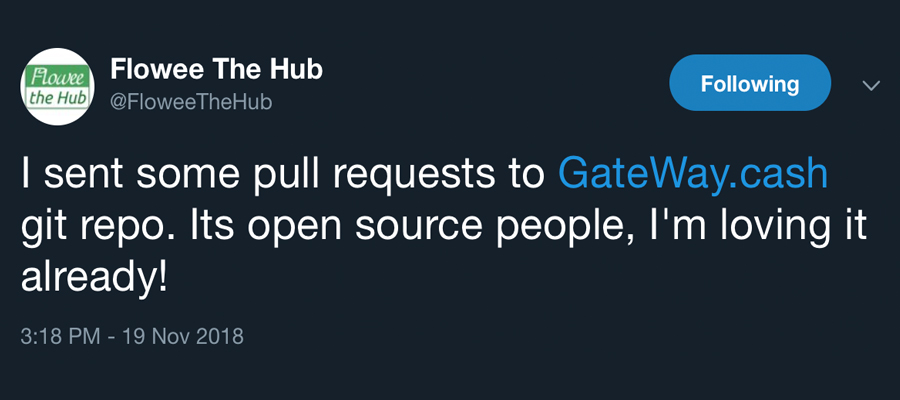
Other well known developers have been helping the Gateway project like the BCH programmer Ftrader and Flowee the Hub have given the Github repository some assistance. “The first PR by a community member has been merged,” detailed the Gateway team. “Big thanks to Flowee the Hub for being the first contributor to Gateway.”

The Gateway project has explained on social media channels and forums that the developers are extremely grateful to the Bitcoin Cash development community.

“Thank you for contributing — Open-source is the future of software and Bitcoin Cash is the future of money,” the Gateway project explained on Twitter.

What do you think about the Gateway.cash project? Let us know what you think about this payment button and processing platform in the comments section below.

Disclaimer: Readers should do their own due diligence before taking any actions related to the mentioned company or any of its affiliates or services. Bitcoin.com and the author are not responsible, directly or indirectly, for any damage or loss caused or alleged to be caused by or in connection with the use of or reliance on any content, goods or services mentioned in this article. 


Images via Shutterstock, Twitter, Gateway.cash, and Pixabay.


At news.Bitcoin.com all comments containing links are automatically held up for moderation in the Disqus system. That means an editor has to take a look at the comment to approve it. This is due to the many, repetitive, spam and scam links people post under our articles. We do not censor any comment content based on politics or personal opinions. So, please be patient. Your comment will be published.

The post Bitcoin Cash Payment API Gateway.cash Adds a Variety of New Features appeared first on Bitcoin News.

from Bitcoin News http://bit.ly/2SeNVXB Bitcoin Cash Payment API Gateway.cash Adds a Variety of New Features