About Startup365

Chaque jour nous vous présenterons une nouvelle Startup française ! Notre pays regorge de talents et d'entrepreneurs brillants ! Alors partons à la découverte des meilleures startup françaises ! Certaines d'entre elles sont dans une étape essentielle dans la vie d'une startup : la recherche de financement, notamment par le financement participatif (ou crowdfunding en anglais). Alors participez à cette grande aventure en leur faisant une petite donation ! Les startups françaises ont besoin de vous !

#Blockchain Brazilian Supermarket Chain Now Accepts Payment in Bitcoin

Brazilian Supermarket Chain Now Accepts Payment in Bitcoin

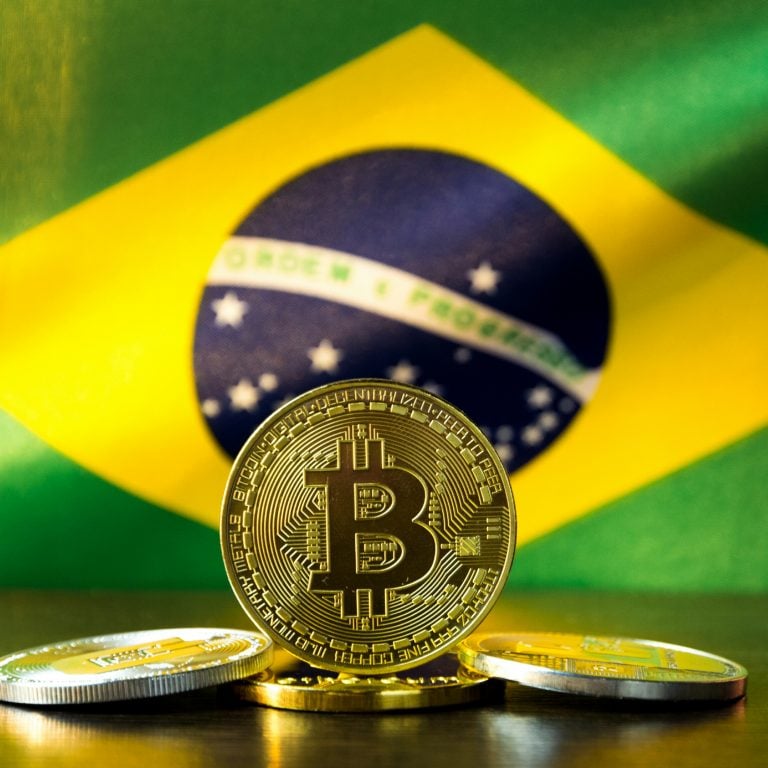
A Rio de Janeiro supermarket chain, Oásis Supermercados, is now accepting payment in bitcoin core, bitcoin cash and litecoin. It joins a growing number of Brazilian businesses in construction, ecommerce, hospitality and transport, already taking payment in cryptocurrency.

Also read: Pan-African Bitcoin Exchange Kubitx Goes Live, Launches OTC Wallet

Shopping the Cryptocurrency Way

Beginning Dec. 18, shoppers can pay for goods directly in BTC, BCH or LTC at Oásis Supermercados. Payments are processed through crypto payments processor Coinwise. Once a customer chooses the cryptocurrency they want to use to make a purchase, the system receives the digital coins and converts them into the fiat equivalent. Coinwise will later send the Brazilian reals to the supermarket in three days.

Brazilian Supermarket Chain Now Accepts Payment Bitcoin

As with most crypto-pioneering businesses, management at the supermarket claim to be Bitcoin enthusiasts and investors. Although virtual currency acceptance is on the way to becoming mainstream in Brazil, this recent adoption is a significant one for a supermarket.

Douglas Andrade revealed that his brother and co-manager Thiago picked up the idea of accepting digital currency payments from a video on the subject and consulted a cryptocurrency brokerage firm for more information.

The duo had already been privately exposed to cryptocurrencies after “a former employee introduced us to the crypto-coins and taught us how to invest,” Andrade told local publication Portal do Bitcoin.

Brazilian Supermarket Chain Now Accepts Payment Bitcoin

Andrade also revealed that cryptocurrency purchases are similar to paying by credit card. “The client says which cryptocurrency he wants to pay, the operator types in reais and the system immediately converts to that crypto. Then just get the QR code and you’re done,” he explained.

Oásis Supermercados makes around 25 million reals ($6.45 million) in annual revenue, operating two stores with 90 workers, 20 of them cash operators. All staff have been trained in handling virtual currency payments. Even though no crypto purchases have been completed since the service launched on Dec. 18, Andrade claims there has been noticeable interest from the public.

 Growing Number of Businesses Accepting Crypto

Brazilian Supermarket Chain Now Accepts Payment Bitcoin

In June, Brazilian road transport company Viação Garcia started accepting bitcoin core, bitcoin cash and litecoin payments. Only BTC was initially accepted, but the other two digital currencies soon joined the basket.

Las Magrelas, a bicycle shop integrated in a bar, is a pioneer in bitcoin payments. Since 2013, the shop has been taking payments in crypto. Another transport company, Metrô Brasília, also offers the option of paying in virtual currency.

Major construction firm Tecnisa gives a 5 percent discount to customers who choose to make the first payment in BTC. However, crypto payments are limited to the initial payment only. Other businesses including Nobile Plaza Hotel, ecommerce website Fasttech.com, robotic and electronic parts retailer Webtronico hotels, and Imperius Food are also taking crypto payments in Brazil.

What do you think about the Brazilian supermarket cryptocurrency payment initiative? Let us know in the comments section below.


Images courtesy of Shutterstock.


Need to calculate your bitcoin holdings? Check our tools section.

The post Brazilian Supermarket Chain Now Accepts Payment in Bitcoin appeared first on Bitcoin News.

from Bitcoin News http://bit.ly/2AcGppa Brazilian Supermarket Chain Now Accepts Payment in Bitcoin


#USA Layer1 wants to thrive in the age of the crypto crash

//

A year ago, crypto was reaching ever new highs, and I was talking about whether ICOs would supplant the VC funding round and warning about Kim Jong Un’s crypto trading operations.

And then the world turned upside down.

Crypto prices are near rock bottom prices, with Bitcoin hanging around $4,000 and Ethereum around $113, down from their highs earlier this year of around $16,600 and $1,400 respectively.

While that has put a dampener on the enthusiasm of a lot of cryptocurrency retail investors, the bigger question is how do institutional players work through this market? What’s the strategy for finding value in this technology sector long-term?

I chatted with Alexander Liegl, who may just have at least part of the answer. He’s the founder of Layer1, which announced a $2.1 million fundraise this week from Peter Thiel, Digital Currency Group, and Jeffrey Tarrant.

Liegl saw a huge challenge in the blockchain and cryptocurrency spaces: too many good ideas and not enough developers working on product development work. So he decided to create an “activist fund for cryptocurrencies” that would “take concentrated bets on protocols that we think have a need in this world.” Layer1 then supplies developers and other experts to provide “infrastructure and support,” he explained. “An operating entity like us can have a lot of influence in moving the needle.” He describes Layer1 as “a combination of Polychain and Blockstreet” and “the Rocket Internet of crypto.”

That might sound vaguely similar to ConsenSys, the loosely-coupled group of startups and infrastructure engineers trying to build out Ethereum which has run into very hard times recently. Unlike ConsenSys, which was founded by Ethereum co-founder Joe Lubin and is directly focused on that ecosystem, Layer1 isn’t wedded to one blockchain or ecosystem, and instead selects a single project at a time through a mix of financial analysis and thesis development.

With capital in the bank, Layer1 has backed Grin as its first cryptocurrency. Grin is designed to be a completely private and censorship-resistant transaction medium, and Liegl says that “conceptually it really reconciles with our view in the space.” He particularly liked that Grin has an anonymous founder like Bitcoin, since no founder controls the governance of the project. Grin is intending to publicly launch in mid-January.

I asked Liegl how he was responding to the crypto crunch this year in the markets, and he considered it far more of an opportunity than a detriment to his work. “I’m really pumped about all of this,” he explained. “a lot of the bad actors have to be flushed out.” He noted that the low of the bear market may not be reached yet, but that Layer1 was in a good position to take advantage of the timing. “We raised the newest dollars, so we are not suffering from any of these ICO-induced problems,” he said.

Liegl, who graduated from Stanford in 2015 and briefly worked at Stanford’s endowment, has certainly seen the vagaries of the cryptocurrency markets. He learned about Bitcoin during its first popular run-up in 2013, even convincing his parents to invest in the budding project.

Now, he has his eyes set on Grin, and then additional projects. He thinks Layer1 will invest in a new project roughly every 6-9 months, which will accelerate over time with additional capital.

While these “platform” models have struggled a bit in the venture world, I think it’s reasonable that blockchain projects, which often suffer from a lack of attention from developers and end uses, could use a strong engineering and popularization boost. Layer1 isn’t the first in the blockchain world to take this approach nor I am sure will it be the last, but it might be just the ticket forward for a world that has struggled to pay its employees and bills in a crash.

from Startups – TechCrunch https://tcrn.ch/2PTl0Xi

#USA CherryHome raises $5.2M to apply AI to home care cameras, detecting behavior changes

//

A new startup using AI to look after elderly people at home has raised a new round of funding to apply its platform to detect changes in gait or behavior, falls or stumbles. In other words, it could start to predict changes in long-term health.

CherryHome, the home AI security system created by startup Cherry Labs, has raised $5.2 million in funding from GSR Ventures to drive the technology’s use for in-home senior care. CherryHome uses its proprietary computer vision algorithms to interpret camera data into virtual “skeletons.” These are used by the AI to understand and analyze home events and people’s behaviors, such as how someone might develop a limp over time, for instance.

The startup competes with Safely You, which sends alerts in response to very obvious falls; Nest and Lighthouse, which tend to only offer very basic AI over its imaging; and Amazon’s Ring, which only offers outdoor security.

With CherryHome, all information is processed locally, so the video doesn’t leave the house, while the senior citizen is replaced in the video with a virtual “stick-person” to preserve their privacy. This last aspect, in particular, is a really good idea.

With this new round of funding, CherryHome has signed pilot deals with TheraCare in-home care-giving service and TriCura, a tech ecosystem for care agencies. Both are based in the Bay Area.

Max Goncharov, CEO and co-founder of CherryHome says: “Understanding human behavior has a long list of applications, from home security to in-home senior care to the overall goal of making smart homes totally autonomous. But improving senior care is arguably one of the most important areas for technological improvement.” He says seniors currently make up 15 percent of the U.S. population, and by 2030, one in five Americans will be of retirement age. Several studies show the majority of those people wish to remain at home, as opposed to moving into an assisted-living facility.

from Startups – TechCrunch https://tcrn.ch/2T3zpSq

#Blockchain Officials at Top Korean Cryptocurrency Exchange Upbit Indicted for Fraud

Officials at South Korea’s largest cryptocurrency exchange, Upbit, have been indicted for fraud. They allegedly made bogus crypto orders worth approximately $226 billion and sold 11,550 BTC to around 26,000 investors. Upbit has denied the charges and insisted that it did not commit fraud, engage in wash trades, or trade cryptocurrencies it did not own.

Also read: Indian Supreme Court Moves Crypto Hearing, Community Calls for Positive Regulations

Officials Indicted

Officials at Top Korean Cryptocurrency Exchange Upbit Indicted for FraudThree officials at South Korea’s largest cryptocurrency exchange, Upbit, have been “indicted for offering fraudulent transactions and swindling money from investors,” Yonhap reported Friday.

According to the Southern Seoul District Prosecutors’ Office, a board chairman, a financial director and a working-level official of the exchange “allegedly opened a fake account around September last year,” the news outlet conveyed. The prosecutors said the officials “made bogus orders worth 254 trillion won (US$226.2 billion) over a period of about two months to inflate the currency transactions and lure more customers,” the publication detailed, adding:

While rigging transactions, they actually sold 11,550 bitcoins to around 26,000 customers and pocketed 150 billion won.

Upbit is currently the largest cryptocurrency exchange in the country, with over 50 percent domestic market share. With an adjusted 24-hour trading volume of almost $1.1 billion at the time of this writing, the exchange currently ranks as the world’s third-largest crypto exchange, according to Coinmarketcap.

Upbit Denies Allegations

Officials at Top Korean Cryptocurrency Exchange Upbit Indicted for FraudYonhap also reported that Upbit “strongly denies the allegations.” The investigation into the exchange’s operations started eight months ago.

On Friday, the Kakao-backed exchange released a detailed explanation of what happened. “First of all, we would like to express our deepest regrets for causing much anxiety aroused by the indictment,” the exchange began. “The case is related to some transactions during a three-month period [last year], from Sept. 24 to Dec. 31.” Noting that its exchange was launched on Oct. 24, Upbit explained that all transactions in question were from “when our company was preparing for and had just launched Upbit service. All transactions which took place in Upbit after that period are not related to the case.” The exchange wrote:

Upbit did not commit wash trading (cross trading), imaginary orders (provision of liquidity), or fraudulent trading. The company did not trade cryptocurrencies which it didn’t own, or have its staff and employees benefit from such trading.

Upbit continued to explain that “Liquidity has been provided through a corporate account, and no one was swindled out of benefits or engaged in fake trading during the process.” Upbit, however, admitted that “For about two months after launching the service, some cross trading took place for marketing purposes.” Nonetheless, the exchange claims that “such trading had no influence on the market price, and the volume of such trading took up about 3% of the total trade volume at that time.”

The exchange also noted that its auditor has confirmed three times — on Jan. 19, June 28, and Oct. 8 — that its combined cash and cryptocurrency balance exceeds the amount owed to customers. “As of Oct. 8 when the most recent audit took place, Upbit held about 103% of the cryptocurrencies payable to customers. Also, Upbit’s bank balance is 165% of the cash payable to customers,” claimed the company’s statement released on Friday.

Do you think Upbit is guilty? Let us know in the comments section below.


Images courtesy of Shutterstock and Upbit.


Need to calculate your bitcoin holdings? Check our tools section.

The post Officials at Top Korean Cryptocurrency Exchange Upbit Indicted for Fraud appeared first on Bitcoin News.

from Bitcoin News http://bit.ly/2By4qXS Officials at Top Korean Cryptocurrency Exchange Upbit Indicted for Fraud

#USA Spot is a cryptocurrency app to control all your wallets and exchange accounts

//

Meet Spot, a beautifully-designed mobile app to control your cryptocurrencies. Spot looks like a portfolio tracking app. But the company has built a strong foundation to add more features in the coming months. Spot wants to be your unique gateway to the world of cryptocurrencies.

“Spot’s vision isn’t to build a portfolio tracker — we went a bit overboard with this feature,” co-founder and CEO Edouard Steegmann told me. “Eventually, we want to become the app to manage all your cryptos, a sort of Revolut but with a crypto DNA.”

When you first install the app, you can connect it to your existing wallets by adding public addresses. Even if you store your tokens on a hardware wallet, Spot can read the public details of your wallet to show them in the app.

“We have our own nodes on Ethereum, Bitcoin, Litecoin, Stellar and others to recover the amount on your wallet,” Steegmann said. Data is also cross-checked with third-party services to make sure that everything is fine.

Spot also lets you connect to an exchange account using API keys. Right now, the app supports Binance, Kraken, Bitfinex and Poloniex, but the company already plans to add more exchanges.

The app then gives you a detailed overview of your holdings across all services and wallets. You can see detailed charts, discover which token is performing better than the rest. It’s also one of the most well-designed mobile app I’ve seen this year — animations and interactions are gorgeous.

But Spot doesn’t rely on an API to get pricing information for each token. “We’ve rebuilt CoinMarketCap from the ground up, and we’re one of few companies that have done it,” Steegmann said. The company stores pricing information for dozens of tokens across 150 exchanges. That’s a lot of pairings.

If you tap on the Spot logo at the top of the app, you can see the maximum value of your portfolio if you cash out on exchanges with the highest prices for your tokens. The company makes sure that there’s enough volume to show you coherent prices.

Spot thinks that controlling your own data is too important to rely on API calls. When you have your own data, you don’t have any API rate limits, you don’t have a major dependency and you can scale more calmly.

Up next, you’ll be able to trade directly in the app. The company isn’t going to build its own exchange, but you can expect to buy and sell tokens on a third-party exchange without having to visit the website.

“We think that many things will be tokenized and that there’s no user-friendly interface to transfer, receive, buy and sell,” Steegmann said.

The company raised a $1.2 million round (€1.056 million to be exact) from Kima Ventures and business angels, including Eric Larchevêque and Thomas France from Ledger, Jean-Daniel Guyot, Thibaud Elzière, Eduardo Ronzano, Nicolas Steegmann, Sébastien Lucas and Nicolas Debock.

Disclosure: I own small amounts of various cryptocurrencies.

from Startups – TechCrunch https://tcrn.ch/2Sa4dRK

#USA Join us in Las Vegas during CES

//

We will be holding a small event during CES in Las Vegas and we want to see you! We’re looking to meet some cool hardware and crypto startups so the good folks at Work In Progress have opened up their space to us and 200 of you all to hold a meetup and pitch-off.

The event will be held at Work In Progress, 317 South 6th Street on Wed, January 9, 2019 between 6:00 PM – 9:00 PM PST.

There are only 200 tickets so if you want to come please pick one up ASAP. The meetup is open to everyone so head over if you’d like to talk tech. You can pick up a ticket here.

If you’d like to pitch at the event I’ll be picking ten companies who will have three minutes to pitch without slides. Since this is a hardware event I recommend bringing a few of your items to show off. If you’d like to pitch, fill this out and I will contact those who will be coming up on stage.

See you in the Big Easy!

from Startups – TechCrunch https://tcrn.ch/2V2njen

#Blockchain Study Finds Less Than 40% of BTC Addresses Are Economically Relevant

Study Finds Less Than 40% of BTC Addresses Are Economically Relevant

The number of unique addresses on the Bitcoin Core (BTC) network is constantly growing but only 37 percent of them are “economically relevant,” according to a recent study by Chainalysis. The vast majority of them – 86 percent – are controlled by service providers and the rest are used by private investors. Another key finding is that just 20 percent of BTC transaction value is economic.  

Also read: Russians to Be Allowed ICO Investments up to $9,000 per Year

Researchers Say 27 Million Addresses Hold BTC

Study Finds Less Than 40% of BTC Addresses Are Economically RelevantBlockchain surveillance company Chainalysis sets the total number of BTC addresses at around 460 million as of December 2018. The research claims 172 million of these are economically relevant – in other words, controlled by people and companies that currently own bitcoin core. Yet only 27 million of these addresses actually hold BTC.
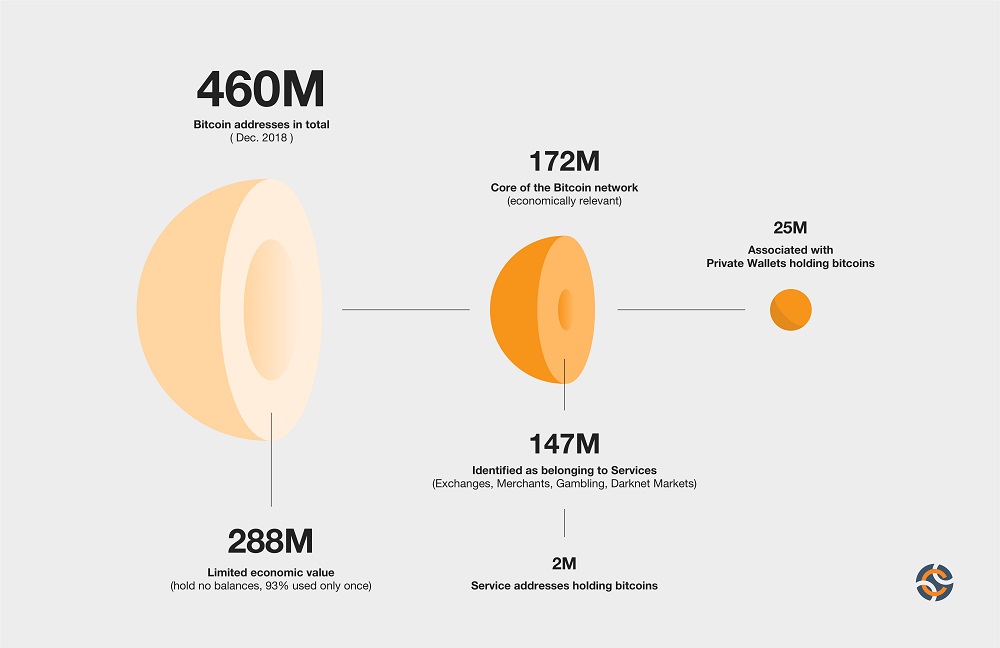
Chainalysis further notes that 86 percent of the economically relevant addresses, or 147 million, belong to named services such as cryptocurrency exchanges, merchants, gambling platforms or darknet markets. The other 25 million addresses are associated with private wallets holding cryptocurrency.

The authors of the study explain that the non-economically relevant addresses are mostly single-use addresses that hold bitcoin for short periods of time. Three quarters of them have held BTC for less than a day.

A total of 288 million addresses have limited economic value. These currently hold no balances and 93 percent of them have been used just once.

Study Finds Less Than 40% of BTC Addresses Are Economically Relevant

Only a Fifth of BTC Transaction Value Is ‘Economic’

In November, Chainalysis revealed that the use of bitcoin core for commercial payments has dropped significantly during the course of the bearish 2018. Its data showed that the value of BTC transacted by major payment processors has decreased by almost 80 percent between January and September.

Study Finds Less Than 40% of BTC Addresses Are Economically Relevant

According to its latest report, the majority of non-economically relevant addresses hold digital coins for a short time in order to facilitate payments between people and services. The study concludes that many of the addresses are created only to transfer BTC. The researchers also detail:

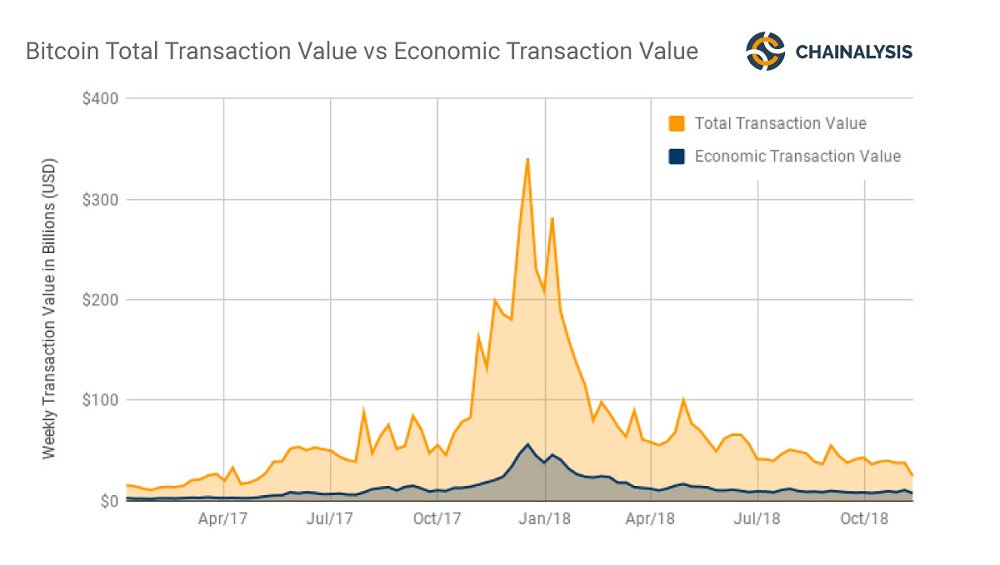
We estimate that on average only 20 percent of the bitcoin transaction value is economic, in that it is a final transfer between different people via economically relevant addresses. The remaining 80 percent is returned as change.

The authors have found that around $41 billion of transactions were executed between August and October of this year. However, the transactions that had real economic value were worth $9 billion. The majority of non-economically relevant addresses have been identified as either change addresses or “connective tissue.”

Chainalysis points out that the data about the number of addresses and the transaction volumes does not fully reflect the complex nature of the BTC network. The digital forensics company emphasizes that only a fraction of all created addresses actually hold coins and notes that a small proportion of the conducted transactions have economic value.

What do you make of the numbers in the Chainalysis report? Share your thoughts on the subject in the comments section below.


Images courtesy of Shutterstock, Chainalysis.


Make sure you do not miss any important Bitcoin-related news! Follow our news feed any which way you prefer; via Twitter, Facebook, Telegram, RSS or email (scroll down to the bottom of this page to subscribe). We’ve got daily, weekly and quarterly summaries in newsletter form. Bitcoin never sleeps. Neither do we.

The post Study Finds Less Than 40% of BTC Addresses Are Economically Relevant appeared first on Bitcoin News.

from Bitcoin News http://bit.ly/2AdvnA5 Study Finds Less Than 40% of BTC Addresses Are Economically Relevant

#Blockchain US Lawmakers File Bill to Exclude Cryptocurrencies From Securities Definition

US Lawmakers File Bill to Exclude Cryptocurrencies From Securities Definition

Two U.S. congressmen have introduced a bill aimed at amending the country’s securities laws to exclude cryptocurrencies from the definition of a security. The bipartisan bill also seeks to adjust taxation and create tax exemptions for certain cryptocurrency transactions.

Also read: Indian Supreme Court Moves Crypto Hearing, Community Calls for Positive Regulations

Bill Introduced

US Bill to Exclude Cryptocurrencies From Securities Definition FiledU.S. Reps. Warren Davidson, R-Ohio, and Darren Soto, D-Fla, introduced a bipartisan bill on Thursday aimed at excluding cryptocurrencies from the definition of a security. The bill, called Token Taxonomy Act, seeks “To amend the Securities Act of 1933 and the Securities Exchange Act of 1934 to exclude digital tokens from the definition of a security,” according to the text of the bill.

US Bill to Exclude Cryptocurrencies From Securities Definition FiledIt also directs the Securities and Exchange Commission (SEC) “to enact certain regulatory changes regarding digital units secured through public key cryptography.” Moreover, it seeks to “adjust taxation of virtual currencies held in individual retirement accounts, to create a tax exemption for exchanges of one virtual currency for another, to create a de minimis exemption from taxation for gains realized from the sale or exchange of virtual currency for other than cash, and for other purposes.”

Cnbc explained that the bill resulted primarily from a September roundtable hosted by Davidson. More than 50 industry participants attended including Fidelity, Nasdaq, State Street, Andreessen Horowitz and the U.S. Chamber of Commerce, the news outlet noted, adding that this bill has been in the works for months.

Changing the Law

US Bill to Exclude Cryptocurrencies From Securities Definition FiledThe bill introduced on Thursday defines digital tokens and clarifies why securities laws do not apply to cryptocurrencies. Currently, the SEC uses the Howey Test to determine whether a cryptocurrency is a security.

Last month, U.S. District Judge Gonzalo P. Curiel ruled that the commission was not successful at showing the court that Blockvest tokens were securities based on the Howey Test. The agency has been cracking down on numerous cryptocurrency projects this year.

SEC Chairman Jay Clayton has emphasized that he does not intend to update the commission’s standards to include cryptocurrencies. At the Senate hearing earlier this year, he said that every ICO he had seen is a security. The only exceptions were BTC and ETH, he clarified, noting that the two cryptocurrencies are regulated as commodities by the Commodity Futures Trading Commission (CFTC).

“This week’s bill is largely symbolic,” Cnbc elaborated. “Friday is likely the last day Congress is in session and the bill will need to be reintroduced next year, when Democrats are in control of the House.”

Do you think cryptocurrencies will be excluded from the definition of a security? Let us know in the comments section below.


Images courtesy of Shutterstock.


Need to calculate your bitcoin holdings? Check our tools section.

The post US Lawmakers File Bill to Exclude Cryptocurrencies From Securities Definition appeared first on Bitcoin News.

from Bitcoin News http://bit.ly/2rNGMCd US Lawmakers File Bill to Exclude Cryptocurrencies From Securities Definition

#Blockchain The Daily: Bitcoin Posts Record Volume, Ledger Plans Major Update

The Daily: Bitcoin Posts Record Volume, Ledger Plans Major Update

The news is bullish in this edition of the The Daily, mirroring the mood of the crypto markets. We’ll start by delving into BTC’s record-breaking day for trading volume and then examine a couple of stories that suggest 2019 is poised to get off to a very positive start.

Also read: Only Sharks Will Feed on the Crypto Market’s Elusive Price Bottom

BTC Posts Record Daily Volume

The Daily: Bitcoin Posts Record Volume, Ledger Plans Major UpdateIt’s not just the price of bitcoin – both cash and core – that’s been shooting up this week – volume has followed suit. In fact, the real headline about this week’s price rally isn’t BCH doing a 3x or BTC passing and then holding the $4,000 mark. Rather, it’s the significant increase in trading volume that occurred on Dec 20, which some traders have taken as evidence of a full reversal. That’s right, the bottom may finally be in – though no one’s willing to publicly make that call just yet it seems.
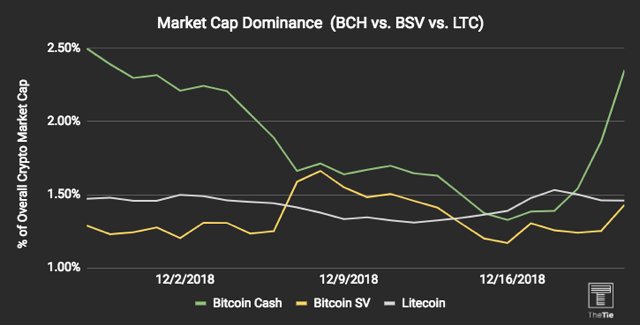
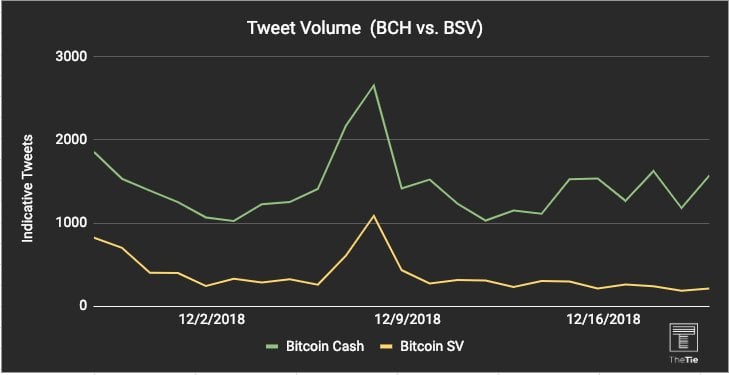
Crypto Quantamental noted that the $2.26 billion of BTC traded on Thursday, Nov. 20 was the highest recorded in the cryptocurrency’s history. Compared to previous days when BTC was trading in the $3,500-$4,500 bracket, yesterday’s BTC volume was greater by a factor of 3-4x. Regardless of which way BTC moves next, it’s fair to say that interest in the crypto market has been fully restored. BCH has also been on a tear, as this graphic by The Tie shows, comparing the cryptocurrency’s market cap to that of BSV and LTC this week.

The Daily: Bitcoin Posts Record Volume, Ledger Plans Major Update

Looking back at Twitter activity since the start of the month, the sentiment analysis platform noted that “while indicative tweet volume (# of tweets that contribute to sentiment score) peaked for both BCH and BSV on Dec. 7, BSV has basically been completely flat as the amount of twitter conversation around BCH has trended upwards. It’s safe to assume BCH’s astonishing growth over the past three days may have contributed to that interest.

The Daily: Bitcoin Posts Record Volume, Ledger Plans Major Update

Ledger Schedules Major Firmware Update

French hardware wallet manufacturer Ledger has planned its biggest upgrade yet to its Nano S devices. Version 1.5, scheduled for release in early January, will feature new hashes, signatures and derivation schemes, enabling the wallet to support new cryptocurrencies. These updates will be accompanied by a slew of security improvements including:

  • Full redesign of the arithmetic architecture
  • Improved MCU genuine check (firmware attestation)
  • PIN code implementation improved for better resistance to hardware attacks
  • Hardening of the PIN code against various hardware and side channel attacks

In the arms race hardware manufacturers are engaged in, the biggest winners are consumers, who now have a wide range of increasingly robust hardware wallets to choose from.

Virtual Land Goes up in Smoke

The Daily: Bitcoin Posts Record Volume, Ledger Plans Major Update
Decentraland

47 million mana tokens have now been burnt in Decentraland’s second land auction which ends over the weekend. This equates to around $2.5 million of tokens destroyed, in return for purchasing plots of land in the virtual world. With the price of each parcel dropping ever closer to its lowest possible price of 1,000 mana over the weekend, a bidding frenzy is suspected. Just 6,000 of the 9,300 parcels available a week ago are left, with nonfungible.com recording an average price per 10x10m parcel of $850.

What are your thoughts on today’s news tidbits as featured in The Daily? Let us know in the comments section below.


Images courtesy of Shutterstock.


Need to calculate your bitcoin holdings? Check our tools section.

The post The Daily: Bitcoin Posts Record Volume, Ledger Plans Major Update appeared first on Bitcoin News.

from Bitcoin News http://bit.ly/2V1fqpC The Daily: Bitcoin Posts Record Volume, Ledger Plans Major Update

#Blockchain Consensys’ Wild Ideas and Squandered Funds Has Led to Major Layoffs

Ethereum incubator Consensys is to cut 50 to 60 percent of its employees. The blockchain software company has already laid off 13 percent of its workforce in order to survive the bear market. According to one source, lack of product, wild ideas and an inability to sell technologies has made Consensys’ position financially precarious. As a result, Consensys will need to make further cuts.

Also read: Thai SEC Plans to Relax ICO Regulation

Consenys Spinning Projects Without Financial Support

Consensys co-founder and crypto billionaire Joseph Lubin is aiming to transition the firm into “Consenys 2.0”, a scaled down version of the company believed to have had around 1,200 employees until recently. The Verge reports it has reviewed term sheets showing that at least two incubated startups within the company show Consensys is beginning to spin out its large portfolio of blockchain projects without the financial support they require to find outside funding and succeed.Consensys’ Wild Ideas and Squandered Funds Has Led to Major Layoffs

The current bear market has been difficult for many firms. The key question is what else may have contributed to the downfall of Consensys – careless planning? Mismanagement? Overzealousness?  According to one source, for all the money Consensys raised, its lack of marketable products, overly ambitious ideas, and attempt to sell technologies that were not yet fully realized may all have hastened its downfall.

“Raising Money for Projects Proved to Be an El Dorado”

Ștefan Neagu, the co-founder of Persona, said: “Back in 2013, I was in Silicon Valley, trying to raise funds for a project I’ve been working on. I was talking with Tim Draper and he was willing to invest $500,000 in our project at the time. The due diligence was in the range of months, with cap table, pre-money valuation and a lot of legal work. There is no such thing that exists within crypto projects.  Raising money for crypto projects proved to be an “El Dorado”, in which every project was over-funded.” Consensys’ Wild Ideas and Squandered Funds Has Led to Major Layoffs

In 2017, projects started to spend Consensys’ money with reckless abandon. “In my opinion, we reached this moment when projects are shutting down because of a combination of lack of skills or inexperienced management and a lot of overspending,” opined Neagu. “There were projects funded that were decentralizing everything, from bananas to sending the North Korean President into space. I think that this “purge period” is similar to the dotcom crisis, and only those projects that have a real value proposition and represent ‘a win for the masses’ will succeed to survive.”

As further evidence of the downsizing trend, Steemit has also recently laid off 70 percent of its staff. Harsha Cuttari, CTO of AQUA Intelligencesays that the layoffs at Consensys are not out of the ordinary when considering the steep shift in prices for cryptocurrencies amid the recent fork. Cuttari believes the situation is similar to the 90s dot-com boom and subsequent decline, leaving companies like Consensys at the mercy of market forces.

Do you think that Consensys mismanaged funds? Let us know in the comments section below.


Images courtesy of Shutterstock.


Need to calculate your bitcoin holdings? Check our tools section.

The post Consensys’ Wild Ideas and Squandered Funds Has Led to Major Layoffs appeared first on Bitcoin News.

from Bitcoin News http://bit.ly/2EAqRyB Consensys’ Wild Ideas and Squandered Funds Has Led to Major Layoffs