About Startup365

Chaque jour nous vous présenterons une nouvelle Startup française ! Notre pays regorge de talents et d'entrepreneurs brillants ! Alors partons à la découverte des meilleures startup françaises ! Certaines d'entre elles sont dans une étape essentielle dans la vie d'une startup : la recherche de financement, notamment par le financement participatif (ou crowdfunding en anglais). Alors participez à cette grande aventure en leur faisant une petite donation ! Les startups françaises ont besoin de vous !

#Africa How AI is slowly becoming a major sector in Africa’s tech scene

//

It has gone mostly under the radar, but the use of artificial intelligence (AI) by African tech startups is on the rise, with the sector becoming bigger by the week and attracting more funding.

Back in April, Google announced it was opening an AI research centre in Ghana, bringing the potential of Africa as a hub for AI and machine learning into sharp focus. Yet things had been bubbling along for a while before that, with a number of startups using these technologies in a host of different spaces.

Some of these have already secured VC funding, but investment into AI startups, or companies looking to utilise AI within their existing operations, looks set to grow substantially with the recent news that South African private equity investment firm Ethos has launched a ZAR600 million (US$42.9 million) fund for startups that will benefit from AI-based algorithmic decision making.

In fact, South Africa has already established itself as something of a hub for African AI. Several startups are making names for themselves in different areas, believing they have spotted a major gap and that increased uptake of AI and machine learning across multiple industries is inevitable.

AI for manufacturing

The Cape Town-based DataProphet is one of the main players. Managing director Frans Cronje has an MSc in statistics from the University of Cape Town, and began his working life consulting on machine learning for various companies as he identified business problems that could be solved with these advanced technologies.

Founded in 2015, DataProphet uses AI within the manufacturing sector, to improve the efficiency of the process by optimising the variable process parameters.

“Over the years, manufacturing businesses have amassed a lot of data which is underutilised, in some cases, only collected for compliance purposes. Most manufacturers are still using traditional approaches to analyse their data, which were not built to handle the amount of data being collected nowadays, therefore sub-optimal,” Cronje told Disrupt Africa.

“Much investment has gone into the setting up of infrastructure for the acquisition and storage of such data, with very little advanced analytics happening on it. You’ll, therefore, find that manufacturers are sitting on a lot of insights into their process within that data and the potential for a return on their investment.”  

DataProphet developed a system specifically for manufacturing firms that helps them reduce defects and increase yield, and works with customers that include car manufacturers like Mercedes-Benz and BMW, and various foundries. Earlier this year, it raised a multi-million dollar funding round from South African VC firm Knife Capital to accelerate its global expansion.

Cronje says the nascent nature of the AI space means it offers huge opportunities to startups entering the market at this time.

“In general, AI has been rapidly introduced to processes around the world – and so it is underutilised. In Africa, that is also the case, more so as processes are typically less mature due to it being a developing continent, and skills are more scarce here,” he said.

“The extent to which AI can be used is so large that we have not even scratched the surface, and this is increasing with further developments in this field, moving into the deep learning space.”

More and more industries are “getting their feet wet” when it comes to AI, however, and more budgets are being made available.

“AI projects are still seen as innovation projects as most organisations are not sure of the results. Currently, AI is used to optimise processes – make them more efficient – but it does require the process to be in place. This will, however,  gradually change as processes are built with AI in mind, rather than AI attached. So we will see a move from a manufacturer improved by AI, to a manufacturer built around AI.”

AI for agriculture

Another massive African industry with the potential to be hugely disrupted by AI is agriculture. Another Cape Town-based startup is taking the lead in this respect. Aerobotics has developed proprietary AI to process data it gathers using satellite imagery and drones, in order to learn about different tree and vine crops, analyse trees down to the canopy level, and provide insights and data to farmers that they would not have identified with the naked eye or through satellite imagery alone.

The startup, which raised funding of around US$2 million earlier this year and recently released a host of new products, has more than eight million trees in its database, which chief executive officer (CEO) James Paterson told Disrupt Africa means its AI is getting smarter and more accurate by the minute.

“Through our AI, we are getting highly accurate tree counts and size and health measurements on a per tree basis that help the farmer identify pests and diseases early and equip them with critical insights, so they can make better decisions to reduce loss and increase yield,” he said.

Paterson, who was himself brought up on a South African farm and therefore knows a thing or two about the challenges faced by farmers, said he fully believes in the potential of AI to positively impact farming and other industries around the world.

“AI is already being used in places like customer service, transportation, shipping and healthcare, but there has been a relatively lower uptake in farming up until the last couple years. The farming digital transformation is happening, and we believe we are at its forefront in Africa and around the world,” he said.

“The more we speak with farmers and partners in the agriculture industry, the more we are able to showcase how we are helping the agriculture industry, which is causing us to see an increase in the utilisation of our AI in the agriculture industry in South Africa and around the world.”

He believes the space will grow exponentially as the market matures, meaning startups already active in the AI sector have much to gain.

“There will be an increase in the use of the tech and a distinction between the different offerings out there, which will help Aerobotics immensely as we provide world leading early problem detection technology,” said Paterson.

AI for finance

Fintech is one of the major sub-sectors of the African tech space, and here too AI is having an impact. Leading the way is Nigerian company Mines, which uses AI to power its Credit-as-a-Service digital platform, enabling institutions in emerging markets to offer credit products to their customers with no smartphone required.

“Leveraging their own data sets, domestic institutions are able to serve loans to customers ignored by available credit systems and open up entirely new revenue opportunities. By mining high-volume data like phone records, bank records, and payment transactions in real-time, Mines can instantly assess credit risk in markets that lack robust credit bureau infrastructure,” said the company’s Nigeria managing director Adia Sowho.

“It then integrates its risk models with identity, origination, payments, loan lifecycle management, and customer service to form a holistic platform. The net result is a seamless user experience where partners’ customers can apply for and receive a loan in less than 60 seconds or make instant purchases with virtual or physical credit cards.”

Such is the impact of this that Mines has proven very attractive to investors, bagging a US$13 million funding round earlier this year. This finance is to be used for expansion, with Sowho saying there is a great opportunity for AI in Africa as it enables the development of digital infrastructure in lieu of the physical structures that many countries are challenged to deploy.  

“There is an opportunity to use AI to overcome these logistical and infrastructure challenges, achieve scale across the diverse populace,” she said.

Encouraging uptake

The potential impact of AI in Africa, then, is massive. Yet many of these companies are utilising these technologies in relatively undisrupted markets, and often with users that are less than tech savvy. Do they take some convincing of its merits and ease of use?

From a DataProphet perspective, Cronje said it depends on whether customers are collecting data and whether their processes support the additional information that AI can find in that data.

“We find that some organisations will have the necessary infrastructure, data and the right resources to start using AI effectively. In addition to that, they have problem statements that speak to AI and an immediate need,” he said.

Beyond manufacturing, however, there are challenges. Paterson said farmers live in the “tangible world”, perhaps more so than any other industry.

“This can create some initial hurdles when bringing our products to a farmer that is used to feeling, seeing and smelling everything on the farm,” he said.

Paterson’s own background in farming helps in the conversion process, and Aerobotics has designed its products from the ground up with the farmer in mind.

“Additionally, while building our products, we consult our customers and industry-leading agronomists to be sure that we are solving real world challenges,” he said.

In the end, it comes down to the product in question and the extent of the problem it is solving, says Sowho.

“Users will respond to a right product. Adoption is determined by the product-market fit and the value proposition to the end user,” she said. “The tech does play a role in adoption but only as an enabler.”

The post How AI is slowly becoming a major sector in Africa’s tech scene appeared first on Disrupt Africa.

from Disrupt Africa https://ift.tt/2LqDvBG

#Africa How AI is slowly becoming a major sector in Africa’s tech scene

//

It has gone mostly under the radar, but the use of artificial intelligence (AI) by African tech startups is on the rise, with the sector becoming bigger by the week and attracting more funding.

Back in April, Google announced it was opening an AI research centre in Ghana, bringing the potential of Africa as a hub for AI and machine learning into sharp focus. Yet things had been bubbling along for a while before that, with a number of startups using these technologies in a host of different spaces.

Some of these have already secured VC funding, but investment into AI startups, or companies looking to utilise AI within their existing operations, looks set to grow substantially with the recent news that South African private equity investment firm Ethos has launched a ZAR600 million (US$42.9 million) fund for startups that will benefit from AI-based algorithmic decision making.

In fact, South Africa has already established itself as something of a hub for African AI. Several startups are making names for themselves in different areas, believing they have spotted a major gap and that increased uptake of AI and machine learning across multiple industries is inevitable.

AI for manufacturing

The Cape Town-based DataProphet is one of the main players. Managing director Frans Cronje has an MSc in statistics from the University of Cape Town, and began his working life consulting on machine learning for various companies as he identified business problems that could be solved with these advanced technologies.

Founded in 2015, DataProphet uses AI within the manufacturing sector, to improve the efficiency of the process by optimising the variable process parameters.

“Over the years, manufacturing businesses have amassed a lot of data which is underutilised, in some cases, only collected for compliance purposes. Most manufacturers are still using traditional approaches to analyse their data, which were not built to handle the amount of data being collected nowadays, therefore sub-optimal,” Cronje told Disrupt Africa.

“Much investment has gone into the setting up of infrastructure for the acquisition and storage of such data, with very little advanced analytics happening on it. You’ll, therefore, find that manufacturers are sitting on a lot of insights into their process within that data and the potential for a return on their investment.”  

DataProphet developed a system specifically for manufacturing firms that helps them reduce defects and increase yield, and works with customers that include car manufacturers like Mercedes-Benz and BMW, and various foundries. Earlier this year, it raised a multi-million dollar funding round from South African VC firm Knife Capital to accelerate its global expansion.

Cronje says the nascent nature of the AI space means it offers huge opportunities to startups entering the market at this time.

“In general, AI has been rapidly introduced to processes around the world – and so it is underutilised. In Africa, that is also the case, more so as processes are typically less mature due to it being a developing continent, and skills are more scarce here,” he said.

“The extent to which AI can be used is so large that we have not even scratched the surface, and this is increasing with further developments in this field, moving into the deep learning space.”

More and more industries are “getting their feet wet” when it comes to AI, however, and more budgets are being made available.

“AI projects are still seen as innovation projects as most organisations are not sure of the results. Currently, AI is used to optimise processes – make them more efficient – but it does require the process to be in place. This will, however,  gradually change as processes are built with AI in mind, rather than AI attached. So we will see a move from a manufacturer improved by AI, to a manufacturer built around AI.”

AI for agriculture

Another massive African industry with the potential to be hugely disrupted by AI is agriculture. Another Cape Town-based startup is taking the lead in this respect. Aerobotics has developed proprietary AI to process data it gathers using satellite imagery and drones, in order to learn about different tree and vine crops, analyse trees down to the canopy level, and provide insights and data to farmers that they would not have identified with the naked eye or through satellite imagery alone.

The startup, which raised funding of around US$2 million earlier this year and recently released a host of new products, has more than eight million trees in its database, which chief executive officer (CEO) James Paterson told Disrupt Africa means its AI is getting smarter and more accurate by the minute.

“Through our AI, we are getting highly accurate tree counts and size and health measurements on a per tree basis that help the farmer identify pests and diseases early and equip them with critical insights, so they can make better decisions to reduce loss and increase yield,” he said.

Paterson, who was himself brought up on a South African farm and therefore knows a thing or two about the challenges faced by farmers, said he fully believes in the potential of AI to positively impact farming and other industries around the world.

“AI is already being used in places like customer service, transportation, shipping and healthcare, but there has been a relatively lower uptake in farming up until the last couple years. The farming digital transformation is happening, and we believe we are at its forefront in Africa and around the world,” he said.

“The more we speak with farmers and partners in the agriculture industry, the more we are able to showcase how we are helping the agriculture industry, which is causing us to see an increase in the utilisation of our AI in the agriculture industry in South Africa and around the world.”

He believes the space will grow exponentially as the market matures, meaning startups already active in the AI sector have much to gain.

“There will be an increase in the use of the tech and a distinction between the different offerings out there, which will help Aerobotics immensely as we provide world leading early problem detection technology,” said Paterson.

AI for finance

Fintech is one of the major sub-sectors of the African tech space, and here too AI is having an impact. Leading the way is Nigerian company Mines, which uses AI to power its Credit-as-a-Service digital platform, enabling institutions in emerging markets to offer credit products to their customers with no smartphone required.

“Leveraging their own data sets, domestic institutions are able to serve loans to customers ignored by available credit systems and open up entirely new revenue opportunities. By mining high-volume data like phone records, bank records, and payment transactions in real-time, Mines can instantly assess credit risk in markets that lack robust credit bureau infrastructure,” said the company’s Nigeria managing director Adia Sowho.

“It then integrates its risk models with identity, origination, payments, loan lifecycle management, and customer service to form a holistic platform. The net result is a seamless user experience where partners’ customers can apply for and receive a loan in less than 60 seconds or make instant purchases with virtual or physical credit cards.”

Such is the impact of this that Mines has proven very attractive to investors, bagging a US$13 million funding round earlier this year. This finance is to be used for expansion, with Sowho saying there is a great opportunity for AI in Africa as it enables the development of digital infrastructure in lieu of the physical structures that many countries are challenged to deploy.  

“There is an opportunity to use AI to overcome these logistical and infrastructure challenges, achieve scale across the diverse populace,” she said.

Encouraging uptake

The potential impact of AI in Africa, then, is massive. Yet many of these companies are utilising these technologies in relatively undisrupted markets, and often with users that are less than tech savvy. Do they take some convincing of its merits and ease of use?

From a DataProphet perspective, Cronje said it depends on whether customers are collecting data and whether their processes support the additional information that AI can find in that data.

“We find that some organisations will have the necessary infrastructure, data and the right resources to start using AI effectively. In addition to that, they have problem statements that speak to AI and an immediate need,” he said.

Beyond manufacturing, however, there are challenges. Paterson said farmers live in the “tangible world”, perhaps more so than any other industry.

“This can create some initial hurdles when bringing our products to a farmer that is used to feeling, seeing and smelling everything on the farm,” he said.

Paterson’s own background in farming helps in the conversion process, and Aerobotics has designed its products from the ground up with the farmer in mind.

“Additionally, while building our products, we consult our customers and industry-leading agronomists to be sure that we are solving real world challenges,” he said.

In the end, it comes down to the product in question and the extent of the problem it is solving, says Sowho.

“Users will respond to a right product. Adoption is determined by the product-market fit and the value proposition to the end user,” she said. “The tech does play a role in adoption but only as an enabler.”

The post How AI is slowly becoming a major sector in Africa’s tech scene appeared first on Disrupt Africa.

from Disrupt Africa https://ift.tt/2LqDvBG

#Blockchain Canadian Cryptocurrency Exchange Coinsquare Now in 25 European Countries

Canadian Cryptocurrency Exchange Coinsquare Now in 25 European Countries

One of Canada’s largest cryptocurrency exchanges, Coinsquare, has officially launched in 25 European countries. A Coinsquare spokesperson has shared some details with news.Bitcoin.com. Users in Europe now have access to all major services the exchange offers, including all supported cryptocurrencies.

Also read: Indian Supreme Court Moves Crypto Hearing, Community Calls for Positive Regulations

Coinsquare in 25 Countries in Europe

Canadian Cryptocurrency Exchange Coinsquare Now in 25 European CountriesCoinsquare announced on Wednesday that it has simultaneously launched in 25 countries in the European Union. The exchange first unveiled its plans to expand into European crypto markets in August.

A spokesperson for Coinsquare told news.Bitcoin.com, “We went live in beta [in 25 European countries] a couple of weeks ago, but officially live as of today,” adding that the 25 countries are:

Austria, Belgium, Bulgaria, Croatia, Cyprus, Czech Republic, Denmark, Estonia, Finland, France, Greece, Hungary, Ireland, Italy, Latvia, Liechtenstein, Netherlands, Norway, Poland, Portugal, Romania, Slovakia, Slovenia, Spain, [and the] United Kingdom.

Founded in 2014, Coinsquare says that it has over 100,000 customers and claims to be “Canada’s most secure digital currency trading platform,” with a “95% cold storage policy on all digital currency.”

Canadian Cryptocurrency Exchange Coinsquare Now in 25 European Countries

Services Available

Its expansion into Europe “marks the first international expansion for Coinsquare, which to date has only been available to Canadian customers,” the exchange detailed.

Canadian Cryptocurrency Exchange Coinsquare Now in 25 European CountriesCoinsquare CEO Cole Diamond explained that “given the size of the opportunity and our ability to offer something unique to that market,” the company decided on Europe for its first expansion. “Europe is a rapidly-growing cryptocurrency market and the cryptocurrency community there is excited to have an option that puts security, compliance, and risk management at the forefront of its offering.”



Thomas Jankowski, Coinsquare’s Chief Digital and Growth Officer, described his exchange as “a regulated, fully-compliant trading platform,” adding that “we’re thrilled to offer the European market the same secure and intuitive interface that we offer to Canadians.”

The exchange currently supports the trading of BTC against the U.S. dollar, the Canadian dollar and the euro. In addition, BTC can be traded against BCH (trading as BAB), BSV, ETH, ETC, LTC, XRP, DOGE, and DASH. Other services Coinsquare offers are investment management, APIs for B2B clients, and capital markets for institutional and family office investors.

In its Wednesday’s announcement, the Canadian exchange wrote:

European users will have access to all major services from Coinsquare including cryptocurrency purchase and trade … European customers can now fund their Coinsquare accounts with a variety of funding methods.

Funding with euros can be done via credit cards, Sepa, and bank transfers. While funding with credit cards carries a 5 percent fee, the other two funding methods carry no fee.

What do you think of Coinsquare launching in 25 European countries? Let us know in the comments section below.


Images courtesy of Shutterstock and Coinsquare.


Need to calculate your bitcoin holdings? Check our tools section.

The post Canadian Cryptocurrency Exchange Coinsquare Now in 25 European Countries appeared first on Bitcoin News.

from Bitcoin News https://ift.tt/2UYx11p Canadian Cryptocurrency Exchange Coinsquare Now in 25 European Countries

#Blockchain UK Investors to Pay Capital Gains and Income Tax on Bitcoin Investments

U.K. Investors to Pay Capital Gains and Income Tax on Bitcoin Investments

The U.K. government has said that individual investors will be liable to pay capital gains tax each time they sell crypto assets such as BTC for profit. In new taxation guidelines published Dec. 19, Her Majesty’s Revenue and Customs (HMRC) also stated that digital assets received from employers in lieu of cash or gained from mining activities and airdrops will be taxed in line with existing income tax and national insurance contribution laws.

Also read: Bibox Buys 100% Shares of Decentralized Exchange Dex.top

Taxing Crypto-Assets Case by Case

UK Investors to Pay Capital Gains and Income Tax on Bitcoin Investments

Governments throughout the world are trying to cash in on the thriving blockchain and cryptocurrency industry via a range of individual and corporate tax measures. The latest HMRC taxation framework excludes British digital asset businesses and companies and “does not explicitly consider” those tokens held by individuals for business purposes.

“The tax treatment of crypto-assets continues to develop due to the evolving nature of the underlying technology and the areas in which crypto-assets are used,” explained the revenue collector. “As such, HMRC will look at the facts of each case and apply the relevant tax provisions according to what has actually taken place (rather than by reference to terminology),” it added.

The British tax agency has tended to look at virtual currencies more as property than as currency. It reiterated this position in the new policy document while emphasizing that cryptocurrency trading was not “gambling.”

Capital gains payable on cryptocurrency sales – in this context treated as property – may be between 10 percent and 28 percent depending on the taxpayer’s rate of income. Investors who earn money from mining, transaction fees or airdrops “that are provided in return for or in expectation of a service” will be required to pay income tax and contribute to the national insurance scheme, the agency detailed. HMRC stated:

In the vast majority of cases, individuals hold crypto-assets as a personal investment, usually for capital appreciation in its value or to make particular purchases. They will be liable to pay capital gains tax when they dispose of their crypto-assets.

It added that “there may be cases where the individual is running a business which is carrying on a financial trade in crypto assets and will therefore have taxable trading profits. This is likely to be unusual, but in such cases income tax would take priority over the capital gains tax rules.”

 European Regulators Circle in on Cryptocurrencies

Throughout Europe, regulators have complained that cryptocurrencies are risky, and repeatedly alleged that they help to fuel money laundering and terrorism while placing investor funds at the mercy of fraudsters. Their alarmist entreaties have ramped up pressure on governments to act, with many promulgating a series of regulations ostensibly to safeguard public funds and prevent the risk of financial instability.

UK Investors to Pay Capital Gains and Income Tax on Bitcoin Investments

In October, the U.K.’s Financial Conduct Authority announced plans to ban crypto-linked derivative products. It also said that fiat-to-crypto exchanges and custodian wallet providers will be brought within the scope of anti-money laundering regulation. The intention is to enhance consumer protection and curb illicit financial flows.

HMRC’s taxation guidelines will inevitably ring-fence taxes and prevent tax evasion, particularly on an asset class that up until now has appeared to be largely exempt from regulatory oversight. In its report, the revenue collector also speaks about taxation related to forked digital coins, lost private keys, stolen assets and others. Hard-forked coins will generally be liable for capital gains tax, but HMRC “will consider cases of difficulty as they arise.”

What are your thoughts on the new taxation guidelines from HMRC? Let us know in the comments section below.


Images courtesy of Shutterstock.


Need to calculate your bitcoin holdings? Check our tools section.

The post UK Investors to Pay Capital Gains and Income Tax on Bitcoin Investments appeared first on Bitcoin News.

from Bitcoin News https://ift.tt/2SYRmBW UK Investors to Pay Capital Gains and Income Tax on Bitcoin Investments

#Blockchain Saxo Bank Founder Lars Christensen Is Waiting for a Cryptocurrency Panic Sell-Off

Danish Saxo Bank founder Lars Seier Christensen made millions trading BTC, but as the CEO of a bank, he had a hard time persuading his staff to offer crypto services. Now he’s waiting on the sidelines for another panic sell-off before re-entering crypto trading. 

Also read: Saxo Bank Offers Bitcoin Exchange Traded Notes

‘Our Current System Is Deeply Inefficient’

55-year-old Danish banker Christensen, also known as Stig, says he has always had an “ultra-libertarian streak” and is critical of the current banking system. He explained that after spending 30 years in fiat currency trading he is naturally fascinated by any significant innovations in the realm of currencies.  Saxo Bank Founder Lars Christensen Is Waiting for a Cryptocurrency Panic Sell-Off

“There are many ways in which our current system is deeply inefficient and can be improved, both by better delivery of fiat currencies and asset-backed tokens, as well as true cryptocurrencies. It is all about mainstream adoption, and whether a real store of value argument can be lifted on a long-term basis, or whether speculation and high velocity utility will prevail,” said Christensen.

He described the banking industry as “old wine in new bottles, not that different from the past” and believes that through the adoption of new technology things can be vastly improved.

Crypto Gamble Pays off as Christensen Gets the Last Laugh

Christensen made an early investment in BTC, buying when it was priced at $100 – $400 five years ago. He then cashed out over one million dollars when BTC reached $6,300 in 2017.  

“This was just before the blow-off rally in the last part of the year, so I looked like an idiot for a while, particularly because the main Danish financial paper got wind of it and ran a front-page story on my sale! But now I look a little smarter, I guess … I haven’t invested in cryptocurrencies like BTC and ETH since,” said Christensen. 

Christensen explained that he will only jump back into crypto again if prices go significantly lower. BTC wasn’t the only thing he sold off; last year the Dane also sold off his stake in Saxo Bank to Chinese billionaire Li Shufu.

Searching for Gold Nuggets

Saxo Bank Founder Lars Christensen Is Waiting for a Cryptocurrency Panic Sell-OffOn the more speculative side of things, I am looking for a final panic sell-off in ethereum, say below $25, where I will be tempted to pick some up and wait patiently for a possible revival. I am also looking at a couple of serious fund vehicles that do extensive research across the space. Because of course there will be some gold nuggets that have been dragged down unfairly in this bear market as happens in all bear markets, and also in traditional asset classes,” explained Christensen.

After stepping down as the bank’s head, Christensen is now busy with the launch of a new blockchain business, Concordium.  “For me it is fascinating to try to do the same [role as I formerly held] in this area. I think Concordium could be a major game-changer for the industry and help the true DNA of public blockchains progress to the next level,” he enthused.

Watch out for Further Crypto Regulation

Having been involved in retail derivatives trading for more than 25 years, and after building a platform in the crypto sector, Christensen believes he’s had a front row seat from which to observe how regulations have developed in the foreign exchange and derivatives space since the 1980s.  He warns that similar developments will be seen in cryptocurrencies, and believes that nearly all existing crypto projects are ill-prepared for this. In his view, further cryptocurrency regulation is inevitable and unavoidable.

Do you agree with Christensen that the current crypto system is deeply inefficient and can be improved? Let us know in the comments section below.


Images courtesy of Shutterstock.


Verify and track bitcoin cash transactions on our BCH Block Explorer, the best of its kind anywhere in the world. Also, keep up with your holdings, BCH and other coins, on our market charts at Satoshi’s Pulse, another original and free service from Bitcoin.com.

The post Saxo Bank Founder Lars Christensen Is Waiting for a Cryptocurrency Panic Sell-Off appeared first on Bitcoin News.

from Bitcoin News https://ift.tt/2LvkjTy Saxo Bank Founder Lars Christensen Is Waiting for a Cryptocurrency Panic Sell-Off

#USA Square Roots is bringing more transparency to its produce

//

If you’re concerned about what you eat, there’s a good chance you’ve looked at the food in the supermarket, or in your fridge, and wondered where it actually comes from. Now urban farming incubator Square Roots is introducing a new way for you to check full history of the produce that you’re about to purchase.

To do so, you just scan the QR code or type in the lot number that the company says will be included in the packaging of all its produce moving forward. Either way, you’ll be taken to to what Square Roots calls a Transparency Timeline. You can actually try this out on the QR codes included in the announcement — the timelines show where and when the produce was planted, grown and harvested, and when it were delivered to the store.

To do this, Square Roots says it’s taking advantage of its indoor growing system, which involves refurbished, climate-controlled shipping containers, as well as “software that enables us to monitor and control every aspect of the process” — that’s supposed to help the farmers who are being trained at Square Roots, but apparently it gives the company data that it can package for consumers too.

Square Roots Transparency Timeline

In the announcement, Kimbal Musk (who founded Square Roots with Tobias Peggs) laid out the reasoning behind the Transparency Timeline:

Consumers across the world are demanding greater transparency into where and how their food is grown — and with good reason. As mentioned above, this past Thanksgiving, another ecoli outbreak resulted in the recall of all romaine lettuce grown in the US. This was the third such outbreak in the last two years. It put millions of consumers at major risk of foodborne illnesses. The situation was compounded by opaque supply chains in the Industrial Food System, making it ridiculously difficult to accurately trace the source of guilty pathogens. To their credit, the big lettuce producers did eventually react, and agreed to start labeling their products with a mark of the state in which their products are grown. But that’s not enough. Consumers demand — and deserve — to know more.

Musk acknowledged that some companies are trying to use blockchain technology to introduce more transparency to the food supply chain, but he suggested that the results have been “underwhelming,” and that the solution is more straightforward: “What people want to know, simply, is where and how was my food grown and who grew it? With that information, they can make their own informed choices about whether to trust the food and whether to buy it.”

Square Roots produce is only sold in select New York City locations, so the rest of you probably won’t get a chance to try this out in your own supermarket anytime soon. But it sounds like Musk has expansion plans, and he said, “As we scale, we will keep building local farms in the same neighborhood as the consumers — so we can always own the supply chain end to end.”

from Startups – TechCrunch https://ift.tt/2SbVUVB

#Blockchain Openswap Makes In-Wallet BCH and BTC Atomic Swaps Possible

Openswap Launch Makes In-Wallet BCH and BTC Atomic Swaps Possible

Bitcoin Cash (BCH) developer Mark Lundeberg has revealed his new project, a fork of the Electron Cash wallet that performs trustless atomic swaps between BCH and BTC. On Dec. 18, Lundeberg officially launched the first iteration of his Openswap platform with a video tutorial on how to trade between two different cryptocurrencies.

Also read: Only Sharks Will Feed on the Crypto Market’s Elusive Price Bottom

Openswap Version 0.1 Published — Swap BTC & BCH Trustlessly 

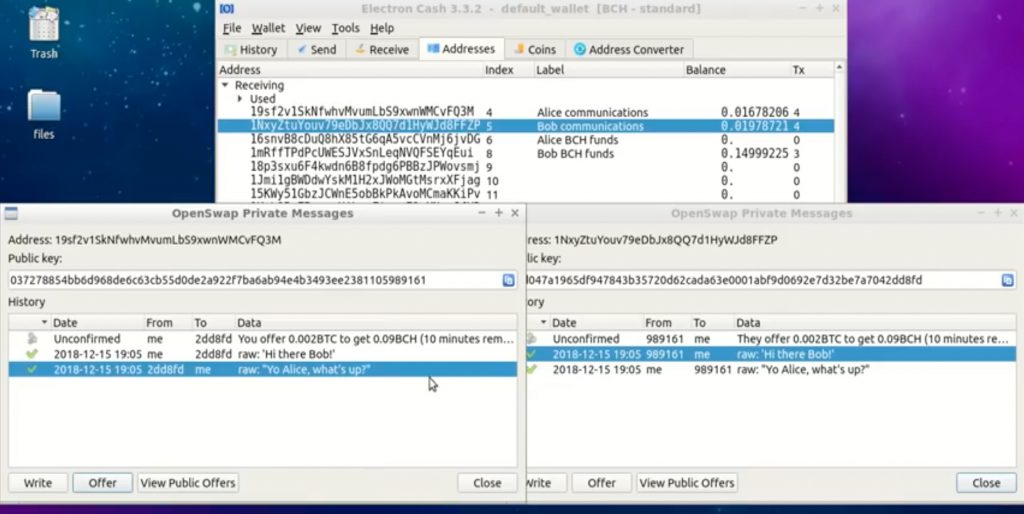
On Tuesday, the first version of the Openswap wallet was released to the general public. Speaking with news.Bitcoin.com, BCH developer Mark Lundeberg explained that Openswap version 0.1 was released for Windows and Linux operating systems. The developer also mentioned that an OSX build is on the way. Lundeberg has published a video demonstration showing a cross-cryptocurrency swap between both cryptocurrencies on Youtube. The programmer performed the trade himself using a BCH wallet called ‘Bob’ and BTC wallet named ‘Alice.’ The Bob wallet had an allocated amount of BCH, while the Alice client had some BTC in order to process the trade. In the video, Lundeberg showed how the two parties communicate with each other via an onchain private messaging feature.

Openswap Makes In-Wallet BCH and BTC Atomic Swaps Possible

The communication window shows an exchange of messages back and forth including both parties’ addresses and public keys. Behind the scenes of the conversation between Bob and Alice, the messages are using the BCH OP_Return function. The information is encrypted using a shared secret only Alice and Bob hold and at any time they can review the message history in order to resolve a dispute. When using the Openswap messaging feature, no one else is able to decrypt the messages transferred between Alice and Bob on the blockchain. In the message window, there is an “offer” button where the person can draft an offer and propose the trade to the other person in the private conversation.

Openswap Makes In-Wallet BCH and BTC Atomic Swaps Possible

Lundeberg demonstrates how Alice makes an offer for some BCH and the suggested trade is displayed in Bob’s message window. Now Bob can accept the proposal, but if he doesn’t like the price Alice submitted, he can send her a counter-offer. Lundeberg shows how Bob can simply edit the price of the trade and submit a counter-offer back to Alice, which will be displayed on her message window. Alice can also counter-offer again, ignore Bob’s offer, or accept it by clicking “accept,” which triggers the initiation of the atomic swap.

Alice Must Release the Secret to Bob in Order to Claim Her Funds

Openswap Makes In-Wallet BCH and BTC Atomic Swaps PossibleWhile in private conversation, the two parties have already exchanged enough smart contract information to perform the cross-cryptocurrency trade. Alice can then send her bitcoins to a specific smart contract address and Bob can abort the deal by not sending any funds into the smart contract, whereupon her funds would be refunded. But if Bob sends his agreed amount to the contract then Alice can redeem her BCH using the secret, but she has to reveal the secret to Bob, which in turn unlocks his BTC.


“I’ve been interested in atomic swaps ever since I got involved with cryptocurrency (especially BCH) back in February,” Lundeberg told news.Bitcoin.com. “I started [Openswap] back in September, and it was basically completed by the end of October — But with all the hard fork drama it got put on the back burner for a while.”

As far as adding other coins to Openswap, Lundeberg said he was going to be focusing on other projects for a while and won’t be adding any other coins right now. “But, pull requests from other developers are welcome,” the programmer stated. Lundeberg said that version 0.1 could be buggy, but he doesn’t think there will be any “money-losing bugs,” though still he believes it’s best to play safe with a small fraction of funds for now.

What do you think about Mark Lundeberg’s Openswap cross-cryptocurrency trading feature? Let us know what you think about this subject in the comments section below.


Images via Shutterstock, Youtube, and Pixabay.


Want to create your own secure cold storage paper wallet? Check our tools section.

The post Openswap Makes In-Wallet BCH and BTC Atomic Swaps Possible appeared first on Bitcoin News.

from Bitcoin News https://ift.tt/2PP1w6b Openswap Makes In-Wallet BCH and BTC Atomic Swaps Possible

#USA Report: Pinterest may go public as soon as April

//

Pinterest may follow Lyft and Uber to the public markets in the first half of 2019, according to a report from The Wall Street Journal.

The visual search engine and shopping tool is expected to tap underwriters in January and complete an initial public offering as soon as April. The company was valued at just over $12 billion with its last private fundraise, a $150 million round in mid-2017, and is on pace to bring in $700 million in revenue this year.

The company, founded in 2008 by Ben Silbermann (pictured), is also in talks to secure a $500 million credit line, per the report, not an uncommon move for a pre-IPO giant like Pinterest.

To date, the company has raised nearly $1.5 billion from key stakeholders such as Bessemer Venture Partners, Andreessen Horowitz, FirstMark Capital, Fidelity and SV Angel.

Pinterest recently reached 250 million monthly active users, up from 200 million in 2017.

This year, it launched several new features to make it easier for passive Pinterest users to actually buy products on the platform and introduced the following tab, where users could view only the content from brands and people they follow. It also added the Pinterest Propel program as part of an effort to create more local content for its users and it implemented full-screen video ads to beef up its advertising options — an area where it competes directly with Facebook and Google.

2019 is poised to be a banner year for venture-backed IPOs. Both Uber and Lyft are in IPO registration, filing privately to go public within hours of each other earlier this month, and Slack, too, has reportedly hired Goldman Sachs to lead its 2019 float.

Pinterest didn’t immediately respond to a request for comment.

from Startups – TechCrunch https://ift.tt/2rMOGf2

#USA Coinbase’s Earn.com becomes a crypto webinar with crypto rewards

//

Coinbase acquired Earn.com for $120 million back in April. And the company plans to transform Earn.com into Coinbase Earn, a website with educational content to learn more about cryptocurrencies. Users who complete those classes will earn tokens.

Coinbase acquired Earn.com partly so that it could appoint Earn.com co-founder and CEO Balaji Srinivasan as Coinbase’s CTO. The previous iteration of Earn.com wasn’t a priority for Coinbase.

Earn.com started as a service where you can contact busy people for a small fee. Busy people would get paid in cryptocurrencies to accept those requests. The platform quickly became a way to massively contact Earn.com’s user base for initial coin offerings and airdrops.

Coinbase Earn is launching today in private beta. Some Coinbase users will receive an invitation to the service. The company says that educational content will go beyond Bitcoin and Ethereum. Developing education pages for obscure cryptocurrencies makes sense as Coinbase plans to add dozens of cryptocurrencies over the coming months.

At first, there is just one track. Users can learn more about 0x (ZRX), a protocol that lets you create decentralized exchanges. Cryptocurrency trades can be executed without a centralized exchange thanks to 0x .

0x content includes video lessons and quizzes — and yes, writing this makes me feel like it’s 2005 and webinars are cool again. Even if you’re not invited to Coinbase Earn, you can view the content. But those who are part of Coinbase Earn will receive a small amount of ZRX at the end of the track.

Coinbase has previously launched a learning hub to understand the basics of cryptocurrencies.

Disclosure: I own small amounts of various cryptocurrencies.

from Startups – TechCrunch https://ift.tt/2Lq08pY

#Blockchain BCH Leads the Way as Crypto Markets Brighten Up

BCH Leads the Way as Crypto Markets Brighten Up

One year to the day since reaching its all-time high, BTC did something it hadn’t done in a long time on Dec. 17 – it posted double digit growth. Over the last 72 hours, BTC has risen by over 20 percent, helping to drag the crypto market’s capitalization up by a total of $21 billion. At the head of the charge, however, has been BCH, up more than 40 percent in a day. While too early to call it a recovery, traders are feeling cautiously optimistic.

Also read: Offchain Indicators Suggest JP Morgan Is Wrong to Write off Bitcoin

Green Shoots and Cautious Optimism

Even the most stoic of traders would have to concede that the last few months have been grim. While two green wicks don’t signal a bull market, this week has eased some of the despair, and coaxed no shortage of Twitter traders out of hibernation. Making correct calls becomes a much easier undertaking when digital assets are rising or looking primed to break out across the board.

BCH Leads the Way as Crypto Markets Brighten Up
BTC trading volume has picked up noticeably in the last seven days.

The sense of relief that’s permeated the cryptosphere since Monday, one year to the day since BTC reached its all-time high of almost $20,000, has been palpable. No one is getting carried away at this stage, however, for to do so would be ridiculous; the top five cryptocurrencies by market cap are still down 25-52 percent each in the last 30 days. This week’s mini-rally, which has included BCH climbing from a low of $80 to $140 per coin, has only reversed recent losses.

Crypto Twitter Learns How to Laugh Again

BCH Leads the Way as Crypto Markets Brighten Up
Chainlink’s Sergey “meets” Donald Trump

As BTC passed $3,900 in trading sessions today, before retreating, and BCH went through the gears, cryptocurrency traders relished the respite from what has at times felt like a year of red candles. Other top gainers on Dec. 19 have included stratis (STRAT), up 50 percent, and chainlink (LINK), up 22 percent, much to the jubilation of bag-holders on /biz/ who remain convinced that memeing the project’s founder into increasingly preposterous photoshops will keep their altcoin pumping.

“Actually starting to feel bullish for the first time since we started dumping from $20k,” confessed one imageboard user. “The thing that really sucks about this pump is I decided pretty early on not to bother with it and watch multiple coins I normally hold when not tethered do a 40%,” replied another. “The stress of not fomoing in has been intense … Now I have to deal with weeks of this shit before we continue down again.”

The latter remark perhaps best captures the current mood: traders are happy for the uplift in crypto prices, but aren’t banking on the good times to last. They’ve been burnt too many times this year, and with 12 days to run, 2018 might yet have a sting in its tail.

What are your thoughts on this week’s market action? Do you think the good times will last or is this just another fake out? Let us know in the comments section below.


Images courtesy of Shutterstock and Bitcoinity.org.


Need to calculate your bitcoin holdings? Check our tools section.

The post BCH Leads the Way as Crypto Markets Brighten Up appeared first on Bitcoin News.

from Bitcoin News https://ift.tt/2QLyYQo BCH Leads the Way as Crypto Markets Brighten Up