About Startup365

Chaque jour nous vous présenterons une nouvelle Startup française ! Notre pays regorge de talents et d'entrepreneurs brillants ! Alors partons à la découverte des meilleures startup françaises ! Certaines d'entre elles sont dans une étape essentielle dans la vie d'une startup : la recherche de financement, notamment par le financement participatif (ou crowdfunding en anglais). Alors participez à cette grande aventure en leur faisant une petite donation ! Les startups françaises ont besoin de vous !

#USA The Wing gets $75M from Sequoia, Airbnb

//

The Wing, the owner of several co-working spaces and social clubs designed for women, has garnered the support of Sequoia Capital in its latest funding round.

The startup has announced a $75 million Series C led by the storied venture capital firm, with support from Airbnb and Upfront Ventures, as well as existing investors NEA and WeWork.

Headquartered in New York, The Wing was founded by Audrey Gelman and Lauren Kassan in 2015. To date, the pair have raised $117.5 million, including a $32 million Series B in November 2017 led by WeWork, a co-working giant presumably interested in an eventual acquisition of its female-friendly counterpart.

A spokesperson for The Wing declined to disclose its valuation.

The Wing has 6,000 members across locations in New York, Washington, DC and San Francisco — where it first opened its doors just two months ago. The company has additional spots slated to open in West Hollywood, Chicago, Boston, London, Toronto and Paris in 2019. Memberships at the workspaces, which are complete with feminist imagery, conference rooms, a cafe, library, lactation room, beauty room, showers and more, are $215 apiece.

The Wing’s staff is majority female and its spaces are designed by female architects. It’s not surprising the investors behind its latest fundraise are mostly women, too.

As part of the Series C funding, Sequoia partner Jess Lee and Upfront partner Kara Nortman have joined The Wing’s board of directors. Lee, in a statement, said the funding would assist The Wing in bringing its physical community of career-oriented women into the digital realm.

Earlier this year, the company launched a mobile application for its members to stay connected with each other and to RSVP to Wing events.

“This investment will enable us to further The Wing’s mission and scale to new heights both offline and online,” Gelman, The Wing’s chief executive officer, said in a statement.

“The Wing’s mission is the advancement of women through community, and we could not be more excited to partner with such a powerful community of women who lead their fields in tech, Hollywood, policy, and sports. This round is proof positive that women can be on both sides of the table.”

Also participating in the financing are actress Kerry Washington, producer Katie McGrath, former White House senior advisor Valerie Jarrett, and two of the TIME’S UP Legal Defense co-founders Robbie Kaplan and Hilary Rosen. U.S. Women’s National Soccer Team players Alex Morgan, Megan Rapinoe, Meghan Klingenberg and Becky Sauerbrunn also provided capital to The Wing.

Airbnb, for its part, has not previously invested in The Wing and is not an active investor in startups. It’s unclear what sort of partnership may be brewing between the home-sharing “unicorn” and the feminist co-working space. In a statement provided to TechCrunch, Airbnb CEO Brian Chesky said he was “incredibly inspired” by The Wing and was “thrilled to support them.”

According to a report from The Information published Tuesday, Airbnb is in talks to lead a $75 million investment in a startup called Lyric, which transforms apartment buildings into hotels for travelers. That, coupled with its contribution to The Wing’s funding round, could mean Airbnb is foraying into the business of startup investing.

from Startups – TechCrunch https://ift.tt/2CohfWd

#Blockchain Bitcoin History Part 5: A Wild Altcoin Appears

Bitcoin History Part 5: A Wild Altcoin Appears

It’s hard to imagine a time before cryptocurrency exchanges were stocked with hundreds of digital assets. A time before the pejorative “shitcoin” had been coined and there was no such metric as bitcoin dominance. But travel back to late 2010 and that’s exactly what you’d have found: a cryptosphere in which BTC was the only coin in town. But all that was about to change.

Also read: Bitcoin History Part 4: Casascius Creates Physical Bitcoins

Namecoin Is First Out the Blocks

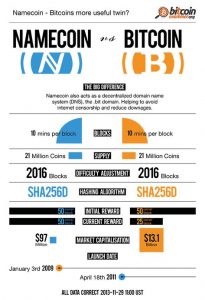
Bitcoin History Part 5: A Wild Altcoin AppearsThe first altcoin to emerge following bitcoin wasn’t litecoin, peercoin or dash. Rather, it was a now obscure cryptocurrency called namecoin (NMC). It was unveiled on the Bitcointalk forum on April 18, 2011, with a mandate that read quite differently from that of BTC. Compared to the many identikit alts that sprung up in the months to follow, NMC began life with novel intentions. “Namecoin is a naming system based on bitcoin with a few modifications,” explained its [announce] thread, utilizing a formula that is today known as an [ANN]. “This is a new blockchain, separate from the main Bitcoin chain. Name/value pairs are stored in the blockchain attached to coin … Names expire after 12000 blocks unless renewed with an update.”

Curiously, but perhaps not surprisingly, the inspiration for Namecoin came from Satoshi himself, though he had no hand in its development. Four months earlier, Bitcoin’s creator had essentially conceived the idea of Namecoin, writing, in a thread titled “BitDNS and Generalizing Bitcoin,” “While you are generating bitcoins, why not also get free domain names for the same work? If you currently generate 50 BTC per week, now you could get 50 BTC and some domain names too.” Satoshi went on to explain a technical proposal involving merkle trees that would eventually form the basis for Namecoin.

Moreover, Namecoin’s goal of serving as a decentralized domain registration system may have been partially inspired by Satoshi’s own experience of purchasing the bitcoin.org domain in 2008. With no anonymous cryptocurrency with which to pay, he was forced to use anonymouspeech.com, which enables services to be acquired using gift cards.

Bitcoin History Part 5: A Wild Altcoin Appears
In April 2013, namecoin was the fourth largest cryptocurrency based on market cap.

What’s in a Namecoin?

Bitcoin History Part 5: A Wild Altcoin AppearsToday, namecoin is effectively a dead coin, despite still being listed on Poloniex and Livecoin. In its seven-year history, NMC has had its moments of glory, like the time it pumped to $15.41 per coin or 0.014 BTC in Nov. 2013. Or the time it hit $8.64 in January of this year, one final burst of nostalgia at a time when every shitcoin under the sun was pumping. By then, namecoin was already a dead coin, with its bitcoin value reaching just 0.0006 BTC per coin. Today, its 24-hour trade volume stands at $15,000 and Namecoin’s DNS naming system is dead in the water. That’s not to say NMC has been an outright failure, however.

With over 2,000 cryptocurrencies now vying for supremacy, Namecoin can be credited with either starting the stampede or instigating the rot. Whatever one’s assessment of Namecoin and the plethora of altcoins that followed, NMC was pivotal in demonstrating that there is space in the cryptosphere for more than just one digital asset. Today there are multiple bitcoins and a panoply of shitcoins, but at a 97 percent reduction from its all-time high, Namecoin embodies the fate of all altcoins to date. As the history books show, Bitcoin is easily emulated but never bettered.

Bitcoin History is a multipart series from news.Bitcoin.com charting pivotal moments in the evolution of the world’s first and finest cryptocurrency. Read part four here.


Images courtesy of Shutterstock and Coinmarketcap.


Need to calculate your bitcoin holdings? Check our tools section.

The post Bitcoin History Part 5: A Wild Altcoin Appears appeared first on Bitcoin News.

from Bitcoin News https://ift.tt/2R5gFox Bitcoin History Part 5: A Wild Altcoin Appears

#USA Flux raises $7.5M Series A to bring its digital receipts platform to more banks and merchants

//

Flux, the London fintech that has built a technology platform for banks and merchants to power itemised digital receipts and a lot more, has raised $7.5 million in Series A funding. The round is led by VC firm e.ventures (which has previously backed the likes of Farfetch, Sonos and Groupon), with participation from existing investors PROfounders, and Anthemis.

Founded in 2016 by former early employees at Revolut, Flux bridges the gap between the itemised receipt data captured by a merchant’s point-of-sale (POS) system and what little information typically shows up on your bank statement or mobile banking app. Off the back of this, it can also power loyalty schemes and card-linked offers, as well as give merchants much deeper POS analytics via aggregated and anonymised data on consumer behaviour, such as which products are selling best in unique baskets.

On the banking side, Flux is currently available through Barclays (via Barclays Launchpad), challenger bank Starling, and for a small alpha group of Monzo customers. Once banking customers link their account to the service, Flux delivers digital receipts (and where available rewards and loyalty) for transactions at Flux retailer partners.

To that end, merchant partnerships include Costa Coffee, EAT, pod and itsu. Flux also recently announced that Pure is joining the service.

“Our mission has always been to liberate the world’s receipt data because by doing this we can enrich trillions of experiences globally,” Flux co-founder and CEO Matty Cusden-Ross tells me.

“The information on a receipt is used all the time in everyday life, from budgeting to loyalty to expensing but today these all require manual steps. We see a future in which all of these manual processes become seamless experiences, simplifying and enriching people’s lives. Our focus today is on establishing a standard, the Flux platform, to make this a reality within the U.K. before expanding to our first international market”.

Of course, Flux’s attempts to become a standard for the interchange of item level digital receipt data — and the proprietary platform that powers that standard — has always faced a chicken and egg problem: It needs bank integrations to sign up merchants and it needs merchant integrations to sign up banks. Cracking this problem has clearly started to gather momentum, something that hasn’t gone unnoticed by investors.

“We’ve transitioned from having to prove it’s possible to now scaling and that’s a great feeling,” says Cusden-Ross. “The aim for this round is to continue making Flux the gold standard for anything that touches receipt data, [ensuring] Flux remains super easy to use for everyone — consumers, banks and retailers. What this means is going fully live across some of the largest U.K. retail banks as well as ramping our up our live merchants”.

(Related, I understand that Flux has already begun integrating with one of the major U.K. supermarkets and an “international fast food chain,” amongst other unannounced partnerships.)

“Creating a real-time platform that handles massive data volumes is hard, but we’ve cracked it,” adds the Flux CEO. “We’re investing heavily in bringing on the best engineers to continue scaling in a big way. Having figured out the recipe for working with banks and retailers quickly, it’s now all about growing as fast as possible”.

from Startups – TechCrunch https://ift.tt/2S4apum

#USA PixelMe raises $1.3 million for its retargeting URL shortener

//

Meet PixelMe, a new software-as-a-service startup that wants to help marketers retarget customers using an URL shortener. The company just raised a $1.3 million at a $4 million pre-money valuation — investors now own 22 percent of the company.

PixelMe is taking a Buffer approach by sharing many behind-the-scene details of the company’s journey. You can even download the pitch deck, the term sheet and the cap table after this round.

The team realized that many people have been using URL shortener to include tracking parameters (UTMs) to track which campaign is working. PixelMe is taking this concept one step further by letting users embed one or multiple retargeting pixels when you follow a PixelMe link.

It means that you can add tracking pixels from Adwords, Facebook or Twitter for instance and leverage that to display relevant ads on Facebook, Twitter or Google later.

If you run your own store or website, you might not see the point of that as you can include all the tracking pixels you want on your website (as long as you remain GDPR compliant). But PixelMe lets you retarget users even if you promote an Amazon page for instance.

And the company claims that it complies with GDPR and works with Safari’s Intelligent Tracking Prevention feature in its pitch deck.

So far, PixelMe has attracted 10,000 users who have generated $130,000 in revenue. The company reached $10,000 in monthly recurring revenue after 12 months and without raising any money.

Serena Capital is leading the round with €880,000. Kima Ventures is investing €50,000. Thomas Rebaud, Christophe Chausson, Stan Massueras, Manuel Jaffrin, Edouard Dessain-Gelinet, Gregory Gazagne are all investing between €10,000 and €15,000.

from Startups – TechCrunch https://ift.tt/2PNZQcO

#Africa Tunisian fintech startup Expensya raised $4,5m funding

//

Tunisian expense management software developer Expensya has raised a EUR4 million (US$4.5 million) funding round to continue its growth.

Founded in 2014 by Karim Jouini and Jihed Othmani, Expensya is a smart web and mobile solution that helps users more efficiently manage their expenses reports, and addresses the issue of mobility and automation of expenses.

After previously raising funding in 2016 and 2017, the startup has now secured EUR4 million in backing from French investment firms Seventure Partners and ISAI, as well as existing investors TDR and business angels, to fuel its growth and speed internationalisation.

Expensya develops partnerships with many large European corporate groups to cover the entire business travel market, and offer a complete and optimal experience to its users. The startup employs nearly 60 people and recorded growth of of 200 per cent in 2018.

The funding will give the company the chance to pursue a growth strategy capitalising on its unique expertise and position as a major player on the European expense management market.

“These funds will allow us to strengthen our research and development capacity and enable us to make expense reports more intelligent both on the French market and internationally,” said Expensya chief executive officer (CEO) Karim Jouini.

“We will also increase the recruitment of new sales forces to best meet the needs of our customers and deploy our strategy internationally.”

The solution is already used in more than 60 countries, by more than 4,000 companies, and in eight different languages, with this fundraising strengthening its commercial presence in several strategic markets.

“Expensya’s technology edge, including its OCR and intelligent recognition technology, is well ahead of the competition and has convinced us of the company’s ability to disrupt the expense reports market,” said Thierry Vandewalle, associate director at ISAI.

The post Tunisian fintech startup Expensya raised $4,5m funding appeared first on Disrupt Africa.

from Disrupt Africa https://ift.tt/2GrGU4w

#Blockchain Chatter Report: Schiff Accuses Kelly of Pump and Dump, Lingham Calls for ‘Real Adoption’

Schiff Accuses Kelly of ‘Pump and Dump’, Lingham Calls for ‘Real Adoption’

In our latest roundup of crypto chatter, tensions run high as Peter Schiff accuses Brian Kelly of dumping bitcoin on retail investors. The accusation surfaced after Kelly recently revealed that he is net short on BTC. Also, Vinny Lingham gives great advice to the crypto community on building for the future.

Also read: Bitcoin Skeptic Peter Schiff to Joe Rogan: BTC Will Plummet, Voorhees Debate Rigged

CNBC Regular Accused of P&D

Longtime gold proponent and bitcoin skeptic Peter Schiff has accused Brian Kelly Capital Management founder Brian Kelly of using his position as a CNBC regular to “pump and dump” bitcoin. In a recent video released by CNBC, Kelly casually mentions that he is net short on bitcoin.

Under normal circumstances, Kelly shorting bitcoin would not raise eyebrows in this bear market. However, Kelly’s recent comments seem to be entirely incongruent with almost every other clip of him on CNBC.

A Trip Down Memory Lane

Just watch this video of Kelly released by CNBC last August, where he heavily shills bitcoin. While referencing a BTC price that was around $7,400, Kelly boldly proclaims, “If you’re looking for an entry point in bitcoin this might just be the place”.

There is a huge disconnect between Kelly recommending the “completely under-appreciated” cryptocurrency markets in August and the same man sheepishly mentioning that we are “getting closer to the bottom” in the recent CNBC video.

Even more disturbing are the implications of Kelly’s actions, as he may have been shorting and dumping cryptocurrency bags on retail investors who listened to him on CNBC, which would be a massive conflict of interest. Alternatively, Kelly could have only recently taken short positions some time after he was shilling cryptocurrencies throughout most of 2018. That would imply that Kelly is unqualified to talk about cryptocurrency price movements, however, as he has been completely wrong on his predictions thus far.

Vinny Lingham on Building for the Future

In other news, Civic CEO Vinny Lingham has been tweeting advice for the cryptocurrency community to build for the future.

Lingham explains that traders and speculators feed off volatility and do not care about creating value in the cryptocurrency ecosystem. He describes this profit-seeking behavior with no value creation as a skill gap for traders. Traders will trade and influence prices in the short term, but in the long run, the market will reveal the value of good cryptocurrency projects.

Quoting Jeff Bezos, Lingham explains that builders are “misunderstood for long periods of time.” Their hard work doesn’t seem to be reflected in the prices of the cryptocurrency projects that they are a part of. However, by keeping their heads down and focusing on real world adoption, builders will see the value of their work reflected in future prices.

What do you think of Schiff accusing Kelly of dumping on investors? What about Lingham’s advice for building? Let us know in the comments below.


Images courtesy of Shutterstock.


Do you agree with us that Bitcoin is the best invention since sliced bread? Thought so. That’s why we are building this online universe revolving around anything and everything Bitcoin. We have a store. And a forum. And a casino, a pool and real-time price statistics.

The post Chatter Report: Schiff Accuses Kelly of Pump and Dump, Lingham Calls for ‘Real Adoption’ appeared first on Bitcoin News.

from Bitcoin News https://ift.tt/2LrmvLE Chatter Report: Schiff Accuses Kelly of Pump and Dump, Lingham Calls for ‘Real Adoption’

#Africa Africa Tech Ventures fund raises $7.5m from AfDB

//

Newly-established investment fund Africa Tech Ventures has raised US$7.5 million from the African Development Bank (AfDB) to back highly scalable companies that use technology to innovate across key sectors.

Launched by managing partners Eline Blaauboer and Mairead Cahill, Africa Tech Ventures plans to invest in startups from across Africa, and is aiming for a first close of US$50 million.

The funds raised from the AfDB come as part of the Boost Africa Investment Programme, a joint collaboration between the bank, the European Commission (EC) and the European Investment Bank (EIB), which has already committed US$10 million to the fund.

Africa Tech Ventures will provide seed investment to early-stage companies that improve and facilitate access of essential goods and services to the underserved, effectively promoting inclusive growth.

“Africa is experiencing rapid mobile penetration. This provides huge opportunity to the development of start-ups and small and medium scale enterprises. But there is a scarce risk capital to venture capital funds targeting early stage businesses,” said Stefan Nalletamby, the AfDB’s director for financial sector development.

He said the equity investment will “leverage innovations to leapfrog technologies and harness key opportunities that have the potential to scale across Africa”.

The overarching goal of Africa Tech Ventures is to expand economic opportunities for African youth by providing 15 to 20 startups with capital throughout their growth cycle, enabling each of them to grow to a user base of one million people. The US$50 million fund intends to hold a first closing in the second quarter of 2019 and a final closing 12 months thereafter.

The post Africa Tech Ventures fund raises $7.5m from AfDB appeared first on Disrupt Africa.

from Disrupt Africa https://ift.tt/2Lo26qJ

#Blockchain Bitcoin.com’s Oracle Aims to Bolster BCH-Powered Smart Contracts

Bitcoin.com’s Oracle Aims to Bolster BCH-Powered Smart Contracts

Bitcoin.com is pleased to unveil plans to offer one of the world’s first oracles for smart contracts on the Bitcoin Cash (BCH) blockchain. The autonomous feature will allow specialized prediction markets and decision-based transactions for sports scores, political results, and market exchange rates.

Also read: How to Spend and Give Bitcoin Cash Over the Holidays

Bitcoin.com’s Oracle Section: Verifiable Multi-Sourced Facts

Since the Bitcoin Cash network upgrades in May and November, the protocol and its scripting language is now far easier for coding smart contracts, decision-based transactions, and predictive oracles. Aided by opcodes like OP_Checkdatasig (DSV) and Bitcoin Cash’s 32MB blocks, BCH is one of the simplest and most secure platforms to build your smart contract. By building the Bitcoin.com Oracle, we plan to utilize the benefits of the BCH network and all the new features added during the last upgrades in order to provide verifiable multi-sourced facts.

Bitcoin.com’s Oracle Aims to Bolster BCH-Powered Smart Contracts

The basics of an oracle with enough valid data can prove ideal for executing decisions and triggering smart contracts. Back in the ancient days of civilization, humans often visited oracles, validated reports, created prediction markets, and attempted to forecast the probability of outcomes in order to make better decisions. With the new opcodes like DSV, Bitcoin Cash network participants can validate data when certain conditions are met within the smart contract. BCH-based oracles can theoretically trigger any type of smart contract from any type of data that exists outside the Bitcoin Cash blockchain.

Bitcoin.com’s Oracle Aims to Bolster BCH-Powered Smart Contracts

Empowering Global Participation

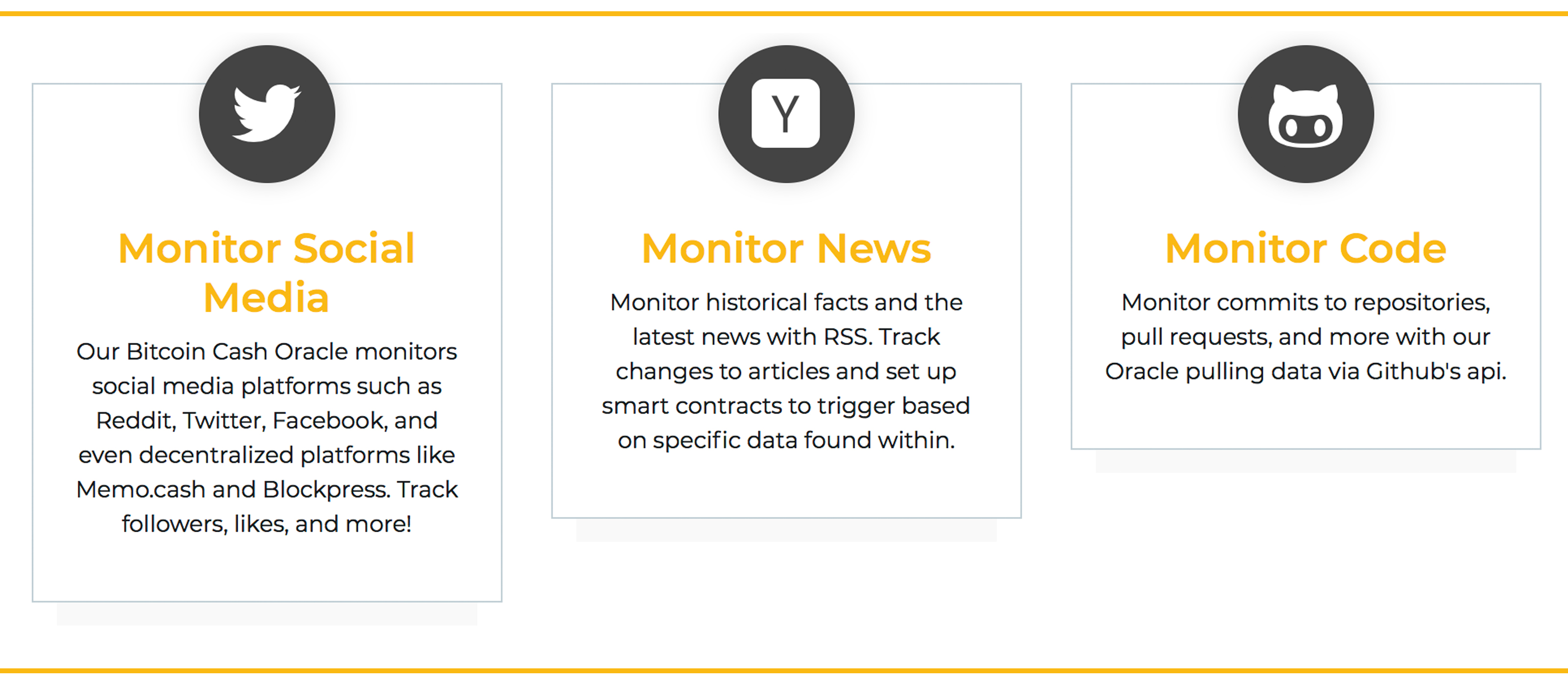
There are so many use cases for BCH-powered oracles and autonomous contracts that can be executed by using verifiable data. With Bitcoin.com’s Oracle, we hope to provide tools that can monitor personal goals, track sports results, detect exchange rate movements, record social media platforms, and monitor news. Alongside this, you could even track the Bitcoin Cash code repository, pull requests and more with our oracle pulling data from Github’s API and other sources. Historically, oracles have been centralized, but by utilizing the security of the distributed BCH ledger we can trust the autonomous oracles to determine certain outcomes. Going beyond the limits of centralized entities, BCH-based oracles provide the means for global participation because peer-to-peer BCH transactions are cheap and reliable.

Bitcoin.com’s Oracle Aims to Bolster BCH-Powered Smart ContractsAt the moment our Bitcoin.com Oracle is still under development. But if you would like to get in on beta access when the code is available, please sign up for our Oracle Newsletter. Furthermore, if you would like to contribute or provide feedback, you can reach out to us through the oracle landing page and we’ll get back to you as soon as possible. “We’d love some help charting out exactly what the most usable platform would look like for the users,” explained Bitcoin.com CEO Roger Ver on the Reddit forum r/btc on Monday.

What do you think about the Bitcoin.com Oracle idea? Let us know what you think about this project in the comments section below.


Images via Shutterstock, and Bitcoin.com Oracle.


Want to create your own secure cold storage paper wallet? Check our tools section.

The post Bitcoin.com’s Oracle Aims to Bolster BCH-Powered Smart Contracts appeared first on Bitcoin News.

from Bitcoin News https://ift.tt/2QHl95m Bitcoin.com’s Oracle Aims to Bolster BCH-Powered Smart Contracts

#Blockchain Bitcoin.com’s Oracle Aims to Bolster BCH-Powered Smart Contracts

Bitcoin.com’s Oracle Aims to Bolster BCH-Powered Smart Contracts

Bitcoin.com is pleased to unveil plans to offer one of the world’s first oracles for smart contracts on the Bitcoin Cash (BCH) blockchain. The autonomous feature will allow specialized prediction markets and decision-based transactions for sports scores, political results, and market exchange rates.

Also read: How to Spend and Give Bitcoin Cash Over the Holidays

Bitcoin.com’s Oracle Section: Verifiable Multi-Sourced Facts

Since the Bitcoin Cash network upgrades in May and November, the protocol and its scripting language is now far easier for coding smart contracts, decision-based transactions, and predictive oracles. Aided by opcodes like OP_Checkdatasig (DSV) and Bitcoin Cash’s 32MB blocks, BCH is one of the simplest and most secure platforms to build your smart contract. By building the Bitcoin.com Oracle, we plan to utilize the benefits of the BCH network and all the new features added during the last upgrades in order to provide verifiable multi-sourced facts.

Bitcoin.com’s Oracle Aims to Bolster BCH-Powered Smart Contracts

The basics of an oracle with enough valid data can prove ideal for executing decisions and triggering smart contracts. Back in the ancient days of civilization, humans often visited oracles, validated reports, created prediction markets, and attempted to forecast the probability of outcomes in order to make better decisions. With the new opcodes like DSV, Bitcoin Cash network participants can validate data when certain conditions are met within the smart contract. BCH-based oracles can theoretically trigger any type of smart contract from any type of data that exists outside the Bitcoin Cash blockchain.

Bitcoin.com’s Oracle Aims to Bolster BCH-Powered Smart Contracts

Empowering Global Participation

There are so many use cases for BCH-powered oracles and autonomous contracts that can be executed by using verifiable data. With Bitcoin.com’s Oracle, we hope to provide tools that can monitor personal goals, track sports results, detect exchange rate movements, record social media platforms, and monitor news. Alongside this, you could even track the Bitcoin Cash code repository, pull requests and more with our oracle pulling data from Github’s API and other sources. Historically, oracles have been centralized, but by utilizing the security of the distributed BCH ledger we can trust the autonomous oracles to determine certain outcomes. Going beyond the limits of centralized entities, BCH-based oracles provide the means for global participation because peer-to-peer BCH transactions are cheap and reliable.

Bitcoin.com’s Oracle Aims to Bolster BCH-Powered Smart ContractsAt the moment our Bitcoin.com Oracle is still under development. But if you would like to get in on beta access when the code is available, please sign up for our Oracle Newsletter. Furthermore, if you would like to contribute or provide feedback, you can reach out to us through the oracle landing page and we’ll get back to you as soon as possible. “We’d love some help charting out exactly what the most usable platform would look like for the users,” explained Bitcoin.com CEO Roger Ver on the Reddit forum r/btc on Monday.

What do you think about the Bitcoin.com Oracle idea? Let us know what you think about this project in the comments section below.


Images via Shutterstock, and Bitcoin.com Oracle.


Want to create your own secure cold storage paper wallet? Check our tools section.

The post Bitcoin.com’s Oracle Aims to Bolster BCH-Powered Smart Contracts appeared first on Bitcoin News.

from Bitcoin News https://ift.tt/2QHl95m Bitcoin.com’s Oracle Aims to Bolster BCH-Powered Smart Contracts

#Blockchain Bitcoin.com’s Oracle Aims to Bolster BCH-Powered Smart Contracts

Bitcoin.com’s Oracle Aims to Bolster BCH-Powered Smart Contracts

Bitcoin.com is pleased to unveil plans to offer one of the world’s first oracles for smart contracts on the Bitcoin Cash (BCH) blockchain. The autonomous feature will allow specialized prediction markets and decision-based transactions for sports scores, political results, and market exchange rates.

Also read: How to Spend and Give Bitcoin Cash Over the Holidays

Bitcoin.com’s Oracle Section: Verifiable Multi-Sourced Facts

Since the Bitcoin Cash network upgrades in May and November, the protocol and its scripting language is now far easier for coding smart contracts, decision-based transactions, and predictive oracles. Aided by opcodes like OP_Checkdatasig (DSV) and Bitcoin Cash’s 32MB blocks, BCH is one of the simplest and most secure platforms to build your smart contract. By building the Bitcoin.com Oracle, we plan to utilize the benefits of the BCH network and all the new features added during the last upgrades in order to provide verifiable multi-sourced facts.

Bitcoin.com’s Oracle Aims to Bolster BCH-Powered Smart Contracts

The basics of an oracle with enough valid data can prove ideal for executing decisions and triggering smart contracts. Back in the ancient days of civilization, humans often visited oracles, validated reports, created prediction markets, and attempted to forecast the probability of outcomes in order to make better decisions. With the new opcodes like DSV, Bitcoin Cash network participants can validate data when certain conditions are met within the smart contract. BCH-based oracles can theoretically trigger any type of smart contract from any type of data that exists outside the Bitcoin Cash blockchain.

Bitcoin.com’s Oracle Aims to Bolster BCH-Powered Smart Contracts

Empowering Global Participation

There are so many use cases for BCH-powered oracles and autonomous contracts that can be executed by using verifiable data. With Bitcoin.com’s Oracle, we hope to provide tools that can monitor personal goals, track sports results, detect exchange rate movements, record social media platforms, and monitor news. Alongside this, you could even track the Bitcoin Cash code repository, pull requests and more with our oracle pulling data from Github’s API and other sources. Historically, oracles have been centralized, but by utilizing the security of the distributed BCH ledger we can trust the autonomous oracles to determine certain outcomes. Going beyond the limits of centralized entities, BCH-based oracles provide the means for global participation because peer-to-peer BCH transactions are cheap and reliable.

Bitcoin.com’s Oracle Aims to Bolster BCH-Powered Smart ContractsAt the moment our Bitcoin.com Oracle is still under development. But if you would like to get in on beta access when the code is available, please sign up for our Oracle Newsletter. Furthermore, if you would like to contribute or provide feedback, you can reach out to us through the oracle landing page and we’ll get back to you as soon as possible. “We’d love some help charting out exactly what the most usable platform would look like for the users,” explained Bitcoin.com CEO Roger Ver on the Reddit forum r/btc on Monday.

What do you think about the Bitcoin.com Oracle idea? Let us know what you think about this project in the comments section below.


Images via Shutterstock, and Bitcoin.com Oracle.


Want to create your own secure cold storage paper wallet? Check our tools section.

The post Bitcoin.com’s Oracle Aims to Bolster BCH-Powered Smart Contracts appeared first on Bitcoin News.

from Bitcoin News https://ift.tt/2QHl95m Bitcoin.com’s Oracle Aims to Bolster BCH-Powered Smart Contracts