About Startup365

Chaque jour nous vous présenterons une nouvelle Startup française ! Notre pays regorge de talents et d'entrepreneurs brillants ! Alors partons à la découverte des meilleures startup françaises ! Certaines d'entre elles sont dans une étape essentielle dans la vie d'une startup : la recherche de financement, notamment par le financement participatif (ou crowdfunding en anglais). Alors participez à cette grande aventure en leur faisant une petite donation ! Les startups françaises ont besoin de vous !

#USA Ada nets $19 million Series A to grow its customer service chatbot

//

Ada is on a mission to build chatbots powered by artificial intelligence. The company today is announcing a $19 million Series A that will go far in helping it reach that goal. The company sees the capital fueling international expansion and launching products into new verticals as well as doubling down on employees.

Chatbots were a buzzword several years back. After the initial buildup and bust, the remaining players in the space are building upon the expectations set early on. Users of chatbots expect services to take actions on their behalf and perform routine functions quickly and efficiently. Likewise, companies are seeking solutions that exceed customer expectations, while offering features that allow the company to scale and expand.

“While many enterprises are choosing to invest in AI and automation,” the company tells TechCrunch, “the recurring investment of time and resources to implement, manage and improve highly technical solutions is diminishing the ROI. In turn, businesses are seeking inclusive and accessible platforms that empower non-technical support teams to build, manage and track the automated customer experience. Even among our own clients, we’ve seen the formation of some of the world’s first automated automation customer experience service (ACX) departments–made up of customer service professionals, not programmers–dedicated to building an automated, AI-powered customer experience. Ada’s automation is changing how people are working and the role of customer service by creating completely new departments, titles, and roles.”

Ada sees the Series A capital to expand the features built-into its products, allowing for a deeper level of personalization and customization — items that will go far with its clients. Launched in 2016 the Toronto-based startup expects to double its staff in the coming months. Right now the company has 70 employees and hopes to be at 140 sometime in 2019.

“2018 was an exciting time for the customer service industry,” Ada said. “Reservations about chatbots and virtual assistants are dissipating, as consumers continue to realize the tremendous benefits of instant, automated, self-service support. Their rising expectations have resulted in an industry-wide shift, with businesses changing from an ‘agent-first’ to an ‘automation-first’ customer strategy.”

The Series A was round was led by FirstMark Capital with participation from Leaders Fund and Burst Capital, as well as returning investors Bessemer, Version One, and computer scientist, Barney Pell.

“Ada’s accessible and scalable platform lets non-technical customer service teams build and manage AI-powered chatbots to automate interactions. Ada has delivered transformational, measurable results to some of the world’s most innovative brands, helping them shift from a reactive, expensive support strategy to a proactive model that reduces customer effort,” said Matt Turck, Managing Director of FirstMark Capital, in a released statement “Ada has played an important role in driving automated customer experience, and we’re confident in the team and the platform to surpass their rapid projected growth.”

The company is based in Toronto. When asked why Toronto, the company points to several data points such as the city’s designation of the fastest growing tech market in North America and the recent announcements of significant new office complexes from Microsoft and Google .

from Startups – TechCrunch https://ift.tt/2rIlRQI

#Blockchain A Chinese Government-Controlled Bitcoin Alternative Is Reportedly in the Works

China's Very Own Bitcoin Alternative is In the Works

In the midst of a sino-U.S. trade war, the People’s Bank of China is working to develop its own cryptocurrency prototype. It apparently believes this centralized digital asset can ultimately trump BTC and perhaps even the U.S. Dollar.

Also read: Bibox Buys 100% Share of Decentralized Exchange Dex.top

A Love-Hate Relationship With Cryptocurrency

A Chinese Government-Controlled Bitcoin Alternative Is Reportedly in the WorksThe government of China has been infamously hostile towards cryptocurrency-related economic activities like crypto trading, mining, P2P loans, and ICOs. But this doesn’t mean that the Chinese government disapproves of the underlying idea of Bitcoin. Although Xi Jinping’s administration has done much to kill the domestic cryptocurrency market, it’s currently at work developing its own secure, blockchain-based digital currency.

Reports reveal that the People’s Bank of China (PBoC) has registered 78 digital currency patents, of which 44 are blockchain related, since at least 2016, ranking the PBoC as the fifth most prolific patenter in the space, as has been reported by China’s IPR Daily.

Further, the PBoC has been actively hiring developers and economic specialists for its Beijing-based Digital Currency Institute, whose stated goal is to issue and distribute a blockchain-based currency.

Unprecedented Control

A Chinese Government-Controlled Bitcoin Alternative Is Reportedly in the WorksThe project was originally conceived by the PBoC’s deputy governor Zhou Xiaochuan, with the intention of “protecting” China from Bitcoin, an asset it couldn’t control. In contrast with the decentralized digital currencies we know and love, the PBoC’s alternative could, in fact, allow the Chinese government to exert even greater control over the lives of the country’s citizens.
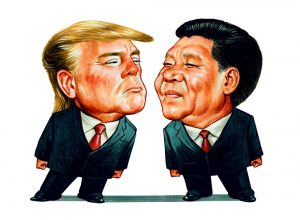

The current Deputy Governor of the Bank, Mr. Fan Yifei, announced earlier this year that once implemented, the Chinese-controlled cryptocurrency would replace the country’s fiat currency and would ultimately help the bank curtail risks associated with money laundering and other crimes.

Some of the patents filed by the PBoC reveal what the Chinese government has in mind for the future. According to a Bloomberg review of recent patent filings, the government not only wants to track its citizen’s everyday transactions, but aims to force banks to share all data related to potential borrowers before authorizing any type of transaction.

Also, the PBoC would be immediately able to prohibit any financial institution from dealing with “blacklisted” companies. Although there is no evidence that the bank intends to deny individuals from accessing financial services, the recent efforts by the Chinese government to establish a social credit system may point to this possibility.

Trump’s Administration May Hasten China’s Digital Currency Development

With the U.S. unrelenting in its current trade war against China, bankers and politicians alike are becoming increasingly interested in accessing an alternative payment method that would reduce the United States’ dominance of international financial markets, all while rumors of a Chinese-backed crypto are gaining momentum.

A Chinese Government-Controlled Bitcoin Alternative Is Reportedly in the Works

The recent arrest of Huawei’s CFO Sabrina Meng Wanzhou in Canada at the behest of the U.S. government has rekindled this discussion in China. Meng was arrested under charges of U.S.-imposed international sanctions on Iran, charges that may involve HSBC and the Standard Chartered Bank.

As reported by the South China Morning Post on Dec. 17, Richard Jerram, chief economist at Bank of Singapore, declared:

President Trump is promoting an ‘America first’ policy, so you cannot rely on America to keep its borders open for trade, or to rely on it to support the World Trade Organization or the International Monetary Fund. So you can understand why countries are looking for substitutes … In a world of fracturing of multilateral order, countries will be looking to reduce their dependence on the US.

Even though the Chinese yuan only accounts for 1 percent of the international payments market and 1.8 percent of all reserve assets held by central banks, China contributed 27.2 percent of total global GDP growth in 2018 alone. This performance makes it the single largest contributor to the current global economy despite the ongoing U.S. trade war and depreciation of the Chinese yuan.

Its position as an economic powerhouse and the current climate of political tension with the United States may compel the Chinese government to redouble its efforts to end U.S. hegemony by attacking the U.S. dollar.

Given that the world’s economy is slowly migrating towards digital systems, it wouldn’t be too farfetched to think that an alternative to the U.S. dollar might take the form of a digital asset much like the Chinese government’s proposed cryptocurrency.

Will China roll out its own cryptocurrency? Do you think such a digital asset could end up having consequences in the world stage? Let us know in the comment section below.


Images courtesy of Shutterstock.


Need to calculate your bitcoin holdings? Check our tools section.

The post A Chinese Government-Controlled Bitcoin Alternative Is Reportedly in the Works appeared first on Bitcoin News.

from Bitcoin News https://ift.tt/2Etrrhu A Chinese Government-Controlled Bitcoin Alternative Is Reportedly in the Works

#USA A month after $70M, Clearbanc raises $50M fund to front startups ad money

//

Clearbanc is disrupting startup funding by providing companies cash to buy ads in exchange for a revenue share so they don’t have to sell as much equity to venue capitalists. That idea has proven so appealing that 1000 companies seeking up to $1 billion total hit up Clearbanc since we reported it raised $70 million last month. So to meet the demand of the most eligible startups asking for marketing cash, Clearbanc has just raised a $50 million fund from Seamless co-founder Jason Finger’s new firm Upper90.

If a company’s Facebook ads and Stripe sales metrics show it’s a sure bet, Clearbanc can provide $5,000 to $10 million in funding to pour fuel on the fire. Startups invest that into ad spend, and then split the revenue with Clearbanc from the sales triggered by those ads until it’s paid back plus six percent. Essentially, Clearbanc offers an alternative to selling valuable equity and control to VCs by offering capital based on new data sources traditional banks aren’t looking at.

“In 2018, Clearbanc has funded over $100M into 500 different companies. Our portfolio companies are putting that capital to work and growing at over 100% year over year on average” co-founder and CEO Andrew D’Souza tells us.

Clearbanc co-founder Michele Romanow

To back the investments, Clearbanc raises sub-funds from LPs who earn a return through a slice of the revenue sharing deals. Part of the last $70 million was used to set up the first Clearbanc fund, and the whole $50 million being announced today is the second fund. Clearbanc expects the funds to mature and pay out after just two years, offering LPs a faster but lower-stakes return then typical eight-year VC funds. Upper90’s goal is just those sort of steady gains. “This deal literally came together in 3 weeks from first meeting to close, which was unheard of” D’Souza notes.

He wouldn’t say exactly how much Clearbanc has raised in traditional equity for itself, but revealed most of the $70 million round’s investors were buying standard equity and it has some flexibility in how it applies some of the funding. D’Souza tells me “We have been largely focused on ecommerce companies and subscription ecommerce, but have started doing some deals with enterprise companies.  In 2019 we plan to expand internationally beyond the US and Canada, introduce new verticals, and launch new financial products to help entrepreneurs.”

Previously at McKinsey, D’Souza had raised over $300 million in venture for startups before teaming up on angel investments with Michele Romanow, an investor from Canada’s Shark Tank-style TV show Dragons’ Den. The two have become a romantic couple amidst Clearbanc’s start in 2015. It’s now taken cash from Emergence Capital, Social, Social Capital, CoVenture, Founders Fund, 8VC and others. Groupon co-founder Ranjen Ruparell and Third Point hedge fund partner Keri Findley are now joining Clearbanc’s board. “We may take on more traditional equity in the future but we don’t need it right now” D’Souza reveals. “We will raise an additional 250-300M in LP capital next year to continue to meet demand.”

We are witnessing an evolution of the growth capital business – entrepreneurs do not want to be forced to choose between restrictive equity or debt arrangements to fund their business growth” Cleabanc’s new board member Findley says. “Clearbanc is building a new asset class that is compelling for entrepreneurs as well as investors looking for strong risk-adjusted returns.”

The business model depends on Clearbanc accurately assessing demand for the products for which it’s funding ad buys. If products flop and the startups don’t have much revenue to share, its influx of LPs will dry up. Clearbanc is also vulnerable to changes in the ad market and platforms like Facebook or Google. If ad prices go up or new content formats like Instagram Stories don’t work as well for direct response ecommerce ads, that could also put the squeeze on Clearbanc. “We’re funding customer acquisition across platforms (it just happens to be primarily on Facebook and Google right now)” D’Souza counters. “We’re looking at data across our portfolio and building relationships with emerging platforms to help our companies stay ahead of the curve”

Given the explosion of direct to consumer brands in the wake of successes like Dollar Shave Club’s acquisition for $1 billion, there may be plenty of startups clamoring for Clearbanc’s capital.

from Startups – TechCrunch https://ift.tt/2Eqazbo

#Blockchain A Chinese Government-Controlled Bitcoin Alternative Is Reportedly in the Works

China's Very Own Bitcoin Alternative is In the Works

In the midst of a sino-U.S. trade war, the People’s Bank of China is working to develop its own cryptocurrency prototype. It apparently believes this centralized digital asset can ultimately trump BTC and perhaps even the U.S. Dollar.

Also read: Bibox Buys 100% Share of Decentralized Exchange Dex.top

A Love-Hate Relationship With Cryptocurrency

A Chinese Government-Controlled Bitcoin Alternative Is Reportedly in the WorksThe government of China has been infamously hostile towards cryptocurrency-related economic activities like crypto trading, mining, P2P loans, and ICOs. But this doesn’t mean that the Chinese government disapproves of the underlying idea of Bitcoin. Although Xi Jinping’s administration has done much to kill the domestic cryptocurrency market, it’s currently at work developing its own secure, blockchain-based digital currency.

Reports reveal that the People’s Bank of China (PBoC) has registered 78 digital currency patents, of which 44 are blockchain related, since at least 2016, ranking the PBoC as the fifth most prolific patenter in the space, as has been reported by China’s IPR Daily.

Further, the PBoC has been actively hiring developers and economic specialists for its Beijing-based Digital Currency Institute, whose stated goal is to issue and distribute a blockchain-based currency.

Unprecedented Control

A Chinese Government-Controlled Bitcoin Alternative Is Reportedly in the WorksThe project was originally conceived by the PBoC’s deputy governor Zhou Xiaochuan, with the intention of “protecting” China from Bitcoin, an asset it couldn’t control. In contrast with the decentralized digital currencies we know and love, the PBoC’s alternative could, in fact, allow the Chinese government to exert even greater control over the lives of the country’s citizens.

The current Deputy Governor of the Bank, Mr. Fan Yifei, announced earlier this year that once implemented, the Chinese-controlled cryptocurrency would replace the country’s fiat currency and would ultimately help the bank curtail risks associated with money laundering and other crimes.

Some of the patents filed by the PBoC reveal what the Chinese government has in mind for the future. According to a Bloomberg review of recent patent filings, the government not only wants to track its citizen’s everyday transactions, but aims to force banks to share all data related to potential borrowers before authorizing any type of transaction.

Also, the PBoC would be immediately able to prohibit any financial institution from dealing with “blacklisted” companies. Although there is no evidence that the bank intends to deny individuals from accessing financial services, the recent efforts by the Chinese government to establish a social credit system may point to this possibility.

Trump’s Administration May Hasten China’s Digital Currency Development

With the U.S. unrelenting in its current trade war against China, bankers and politicians alike are becoming increasingly interested in accessing an alternative payment method that would reduce the United States’ dominance of international financial markets, all while rumors of a Chinese-backed crypto are gaining momentum.

A Chinese Government-Controlled Bitcoin Alternative Is Reportedly in the Works

The recent arrest of Huawei’s CFO Sabrina Meng Wanzhou in Canada at the behest of the U.S. government has rekindled this discussion in China. Meng was arrested under charges of U.S.-imposed international sanctions on Iran, charges that may involve HSBC and the Standard Chartered Bank.

As reported by the South China Morning Post on Dec. 17, Richard Jerram, chief economist at Bank of Singapore, declared:

President Trump is promoting an ‘America first’ policy, so you cannot rely on America to keep its borders open for trade, or to rely on it to support the World Trade Organization or the International Monetary Fund. So you can understand why countries are looking for substitutes … In a world of fracturing of multilateral order, countries will be looking to reduce their dependence on the US.

Even though the Chinese yuan only accounts for 1 percent of the international payments market and 1.8 percent of all reserve assets held by central banks, China contributed 27.2 percent of total global GDP growth in 2018 alone. This performance makes it the single largest contributor to the current global economy despite the ongoing U.S. trade war and depreciation of the Chinese yuan.

Its position as an economic powerhouse and the current climate of political tension with the United States may compel the Chinese government to redouble its efforts to end U.S. hegemony by attacking the U.S. dollar.

Given that the world’s economy is slowly migrating towards digital systems, it wouldn’t be too farfetched to think that an alternative to the U.S. dollar might take the form of a digital asset much like the Chinese government’s proposed cryptocurrency.

Will China roll out its own cryptocurrency? Do you think such a digital asset could end up having consequences in the world stage? Let us know in the comment section below.


Images courtesy of Shutterstock.


Need to calculate your bitcoin holdings? Check our tools section.

The post A Chinese Government-Controlled Bitcoin Alternative Is Reportedly in the Works appeared first on Bitcoin News.

from Bitcoin News https://ift.tt/2Etrrhu A Chinese Government-Controlled Bitcoin Alternative Is Reportedly in the Works

#Blockchain PR: Buy Crypto with Credit or Debit Card Using EO.Finance

Buy Crypto with Credit or Debit Card Using EO.Finance

This is a paid press release, which contains forward looking statements, and should be treated as advertising or promotional material. Bitcoin.com does not endorse nor support this product/service. Bitcoin.com is not responsible for or liable for any content, accuracy or quality within the press release.

EO.Finance has launched a crypto-fiat gateway. Now it is possible to buy cryptocurrencies directly from the wallet using your debit or credit card, the maximum amount per single transaction is $25,000. Right now EO.Finance works with 40 different cryptos, and soon even more currencies will become available for purchase.

The introduction of crypto purchases made using traditional fiat payments is much in demand, and will allow EO.Finance to provide ease of access to the crypto market for new and experienced traders alike.

Until recently banks were anxious to ban any crypto companies they encountered. Making it almost impossible to purchase cryptos with a traditional bank card. Now those banks have agreed to work to with licensed companies, a sign of how quickly times are changing. EO.Finance which is operated by EOTRADEX, holds European licenses for crypto wallet #FVR000161 and crypto-fiat exchange #FRK000193

The forthcoming update of EO.Finance will introduce even more currencies available for purchase. Whilst the addition of a function allowing traders to convert cryptocurrencies into fiat, and then withdraw those same funds to card are well underway.

EO Coin is the heart of the EO ecosystem, which includes numerous products from EO.Finance to the upcoming EO.Trade crypto exchange. Paying commission on transactions with the EO Coin will also come with significant discounts on both EO.Finance and EO.Trade.

The Airdrop which has been scheduled to take place on December 20th will see 44 million EO Coins distributed equally amongst coin holders. Then in February the burn will take place with 459 million EO Coins being burnt to further benefit EO Coin Hodlers with a reduction in total circulation.

It is now possible to buy EO Coins with your bank card through the EO.Finance wallet.

Website: https://eo.finance/
iOS app: https://itunes.apple.com/app/eo-finance-crypto-fiat-wallet/id1415386724
Android app: https://ift.tt/2EnVFU3

Video on how to buy cryptos with EO.Finance: https://www.youtube.com/watch?v=25oKGgAawn8

Contact Email Address
press@eo.finance

Supporting Link
https://eo.finance/

This is a paid press release. Readers should do their own due diligence before taking any actions related to the promoted company or any of its affiliates or services. Bitcoin.com is not responsible, directly or indirectly, for any damage or loss caused or alleged to be caused by or in connection with the use of or reliance on any content, goods or services mentioned in the press release.

The post PR: Buy Crypto with Credit or Debit Card Using EO.Finance appeared first on Bitcoin News.

from Bitcoin News https://ift.tt/2SUjXYV PR: Buy Crypto with Credit or Debit Card Using EO.Finance

#Africa Pick your spot for a Cape Town meeting with this mobile workspace

//

Got an important meeting with an investor, or need a cool way to celebrate your latest big deal? Cape Town co-working space Work & Co may have just the thing for you.

Located on Bree Street since 2016, Work & Co has all the usual co-working facilities, but its mobile workspace NOVA provides quite the twist.

For ZAR3,000 (US$220) a day, startups – or anyone else for that matter – can rent the NOVA pod. Fully connected and self-sufficient, it can be parked anywhere for day of work or a meeting, be it on top of Signal Hill, on Camps Bay beach, or at the V&A Waterfront.

“We knew that versatility, creativity and inspiration are key factors for business growth. We wanted to offer an alternative space for conducting meetings, work or strategy sessions or just changing up your work environment,” said Jolize Pienaar, general manager at Work & Co.

NOVA comes with all the office essentials – fast Wi-Fi, a Smart TV, Apple TV, printer, white board, Nespresso machine, stocked mini fridge, charging station, plug points, bathroom facility and running water. It is solar-powered, and can seat up to six people.

“The mobile office pod was designed for the receptive and built for the adventurous,” Pienaar said. “This allows teams to think, meet and work anywhere. The concept of sharing space in such a densely populated areas as Cape Town makes sense, and progressive thinkers understand that immediately.”

The post Pick your spot for a Cape Town meeting with this mobile workspace appeared first on Disrupt Africa.

from Disrupt Africa https://ift.tt/2rQSIDj

#USA Atari teams up with some startup to pretend to make blockchain-based games

//

Animoca Brands will produce and publish blockchain-based versions of RollerCoaster Tycoon and Goon Squad worldwide (excluding China, Hong Kong, Taiwan, and Macau); the new titles will feature the integration of non-fungible tokens (NFTs). The term of the Agreement extends through to 31 March 2022.

In honor of this exciting announcement I’d like to propose the following blockchain-based products available for license to those hunting for a quick buck:

Blockchain! The Musical
Blockchain Cereal
Blockchain Brand Kombucha
Blockchain & Me, An Alien Adventure
Blockchain Whiskey
Blockchain Soda
Blockchain The Miniseries
Blockchain Lingerie – Shake His Merkle Tree
Blockchain Brand Firestarters
Blockchain Pessaries For Her
Blockchain French Ticklers
Blockchain Getaway Cars
Blockchain Killer Apps (rumored not to exist)
Blockchain Airlines
Blockchain Margarita Mix
Blockchain Cowboy Hats
Blockchain Burgers
Blockchain Dance Studios
Blockchain Pants

from Startups – TechCrunch https://ift.tt/2Cln0nz

#USA Tonsser scores €5.5M Series A to help discover the next soccer star

//

Tonsser, the Copenhagen-based startup that offers a “football performance app” aimed at youth soccer players who want to build their own online profile and potentially get discovered by a bigger club, has raised €5.5 million in Series A funding. The round is led by Alven Capital, with participation from existing investors SEED Capital and Wellington Partners

Currently launched in eight European countries — including France, Germany, Denmark, Sweden, and Norway — and claiming more than 800,000 football players registered on the app, Tonsser could well be described as akin to a LinkedIn for youth soccer players, perhaps with a bit of Instagram thrown in, but actually the company’s mission is a lot more defined than that.

As reiterated in a call this week with Peter Holm, the soccer app’s co-founder and CEO, Tonsser wants to make it easier for young soccer talent to become better players by learning and being inspired by each other and through sponsored competitions and soccer skills content. And, perhaps more lofty, the Danish startup wants to make the beautiful game more meritocratic by enabling unsigned talent to be discovered by professional football clubs through the app, and in turn help the soccer industry become more accountable. Impressively, he says this has already started happening.

At the heart of this mission is Tonsser’s increasing emphasis on using technology and data — namely, sporting metrics — to help bubble up undiscovered players. The iOS and Android app’s features include the ability to create your own soccer profile, upload and share photo and videos of match highlights, add various match and team stats, and follow other clubs and players. Tapping into some of this data is Tonsser’s algorithm that gives every player registered on the app a dynamic score.

“After a match the Tonsser algorithm computes a rating for each player based on the individual performance, the performance of the team and ‘Man of the Match’ votes from teammates,” explained Holm in a follow-up email.

“The rating system has been developed and tested over the past 3 years with pro licensed coaches and academies to provide the most accurate calculation for each player. Match after match and season after season the rating becomes the reference point for each player and the gateway for leaderboards, awards like Team of the Week and Player of the Season and also for pro trials, scout reports and the chance of getting discovered by clubs and scouts”.

It’s this data — or discovery engine — along with brand partnerships, and sponsored content, competitions and trials (see video below), that forms Tonsser’s business model. The app is free for players and coaches, but scouts pay for special access. Related to this, I’m told that premier League clubs like Huddersfield are now using Tonsser to identify and scout youth talent.

To enhance this in 2019, Tonsser will add integrations with “automated video recordings” using computer vision, enabling players and teams to catch and share their match highlights in a simple way. It is also working on how to accommodate data from wearables to track physical performance and potentially feed this into the Tonsser score.

Meanwhile, Tonsser says the new investment will be used to support growth and to maintain the startup as the leading community for youth players. Holm says that 86 percent of French youth teams from 15-19 are now using Tonsser,. The app will launch in England in Spring 2019 and is preparing a global roll out that will include the U.S. and beyond.

from Startups – TechCrunch https://ift.tt/2PJNa6Q

#USA YouGov acquires social analytics company Portent.IO

//

YouGov, the international data and analytics group, has acquired ‘social analytics’ startup Portent.IO, a company that it had previously invested in. Terms of the deal remain undisclosed, although I understand the acquisition includes Portent.IO‘s technology, clients and its team, including its data scientists.

“We’re all staying on and the entire team including myself have 3-year lock-ins,” Portent.IO co-founder and CEO Hamish Brocklebank tells me. “We are also going to be rebranded as ‘YouGov Signal’ and the existing team will continue to run the business — I’ll be MD & founder of YouGov Signal, for example — but with the added operational, administrative and technical support of the broader YouGov family”.

As well as YouGov providing financially backing for Portent.IO, the two firms had also been working together, with Portent.IO utilising YouGov data within its solution, which mainly focussed on the film and television industry. This includes using YouGov’s panel to survey consumers and using YouGov Profiles data to help media teams plan their marketing campaigns by “mining” audiences around movies, programmes, and actors.

Portent.IO’s customer base includes Paramount, Sony, Lionsgate, the BBC, along with other major film studios and a number of TV networks.

“Without trying to be too buzzwordy, we’re a data science-focused social listening and digital media analytics platform,” says Brocklebank. “In short, we track social, news, product reviews and digital data around movies, TV shows, sports teams and now brands across the web and across 40 countries. This data includes text analysis data, view counts of videos, comments, likes, retweets and more”.

Meanwhile, the acquisition is said to enable YouGov to increase the scope of its offering and provide clients with better social monitoring and data science analytics tools. And although Portent.IO’s tech is currently focussed on the entertainment industry, YouGov plans to extend its application across other sectors.

“The platform plugs into YouGov’s wider product suite – complementing its current services, including data products, data services, and custom research – to provide a 360 degree view of marketing campaigns,” says the two companies in a statement.

“Our data science team and advance machine learning NLP tools will be assisting with YouGov’s ongoing data science efforts and a lot of our text classification tools can be applied to their broader market research efforts,” adds Brocklebank. “Our expertise in the film and TV space will [also] help YouGov expand further into that market”.

from Startups – TechCrunch https://ift.tt/2EtQ0Lq

#Blockchain Cypherpunk Godfather Timothy May Was Lightyears Ahead of His Time

Cypherpunk Godfather Timothy May Was Lightyears Ahead of His Time

The crypto world has been mourning the passing of Timothy C. May at the age of 67. While an unknown entity to the general public, to early internet adopters, cypherpunks, libertarians, and cryptography evangelists, May’s writings remain hallowed. The intellectual was an early advocate against state surveillance, defender from privacy erosions, and bête noire of the tech dystopia that has surreptitiously smothered modern society. His legacy lives on through his powerful writings that are as potent today as when they first appeared in the late 80s.

Also readHow Crypto Miners Are Adapting to Survive the Bear Market

Timothy May: Taken Too Early and Ahead of His Time

“Interactions over networks will be untraceable, via extensive re-routing of encrypted packets and tamper-proof boxes which implement cryptographic protocols with nearly perfect assurance against any tampering,” predicted Timothy May in 1988 with uncanny prescience. “Reputations will be of central importance, far more important in dealings than even the credit ratings of today. These developments will alter completely the nature of government regulation, the ability to tax and control economic interactions, the ability to keep information secret, and will even alter the nature of trust and reputation.”

Cypherpunk Godfather Timothy May Was Lightyears Ahead of His Time

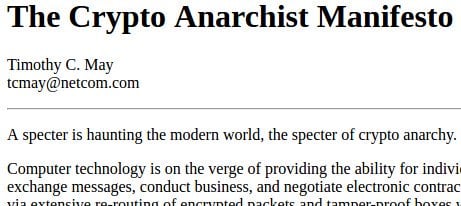
The cryptography community has often bemoaned the cryptocurrency community’s commandeering of the phrase “crypto”. In the case of Timothy May, however, both groups can lay claim to the cypherpunk godfather’s legacy. May was crypto in every sense of the word, shaping the nascent cypherpunk movement, which pioneered cryptographic protocols, while paving the way for the cryptocurrency revolution that would burst into life more than two decades after he published his seminal Crypto Anarchist Manifesto.

A Free Bird Who Refused to Be Pigeon-Holed

Cypherpunk Godfather Timothy May Was Lightyears Ahead of His Time
May (left) gracing the cover on a 1993 Wired magazine

Timothy C. May, or simply Tim to his friends, was a visionary, a maverick and a free-thinker. The phrase “ahead of his time” has long since been reduced to the realm of cliché, but if ever there was a man to whom the the term belonged, it was May. While it’s easy to compose hagiographies of the recently deceased, it’s hard to look at May’s most famous writings and not feel a sense of awe. Had they been composed in 2018 they would have warranted all the RTs, regrams, shares and faves they would have doubtless received.

Many of the crypto OGs tweeting out tributes to Timothy May this week weren’t even born when his magnum opus was composed, or even when it was later subsumed into The Cyphernomicon. But for those who previously took the time to read May’s words, their resonance and relevance will have been felt as strongly today as they did upon first perusal. In 1994, most people had yet to even envisage using the internet, let alone conceive the need for electronic privacy and anonymous digital currency. May wasn’t so much ahead of the curve as on another racetrack altogether.

“The State will of course try to slow or halt the spread of this technology, citing national security concerns, use of the technology by drug dealers and tax evaders, and fears of societal disintegration,” predicted May with unfailing accuracy. “Many of these concerns will be valid; crypto anarchy will allow national secrets to be trade freely and will allow illicit and stolen materials to be traded. An anonymous computerized market will even make possible abhorrent markets for assassinations and extortion … But this will not halt the spread of crypto anarchy.” He further foretold:

Just as a seemingly minor invention like barbed wire made possible the fencing-off of vast ranches and farms, thus altering forever the concepts of land and property rights in the frontier West, so too will the seemingly minor discovery out of an arcane branch of mathematics come to be the wire clippers which dismantle the barbed wire around intellectual property.

It wasn’t just what May envisioned that captivated his modest but passionate audience – it was the way he told it. Two decades after Timothy C. May shared his anarchist’s rallying cry to a cryptographic mailing list, a certain S. Nakamoto followed suit. The latter’s decision to share his own manifesto with the world via the same obscure route is no coincidence. What the cypherpunks, led by Timothy May, started, Satoshi propelled to its logical conclusion, sowing the seeds for the anonymous digital currency his forebear had prophesied.

“I can’t speak for what Satoshi intended,” said May in October, in what would be his last major interview, “but I sure don’t think it involved bitcoin exchanges that have draconian rules about KYC, AML, passports, freezes on accounts and laws about reporting ‘suspicious activity’ to the local secret police. There’s a real possibility that all the noise about ‘governance,’ ‘regulation’ and ‘blockchain’ will effectively create a surveillance state, a dossier society.” It is up to those of us who still care deeply about May and Satoshi’s vision to ensure the cryptographic protocols we we’re blessed to possess remain the preserve of the people.

All humans are fallible, but Timothy May’s perfections and imperfections made him the man he was and the perfect mouthpiece for the current crypto generation. Don’t follow leaders, but do read the writings of Timothy C. May. Combined with Satoshi’s whitepaper, they make the quintessential starter kit for any self-respecting bitcoiner.

What are your thoughts on Timothy May’s passing? Let us know in the comments section below.


Images courtesy of Shutterstock and Wired.


Need to calculate your bitcoin holdings? Check our tools section.

The post Cypherpunk Godfather Timothy May Was Lightyears Ahead of His Time appeared first on Bitcoin News.

from Bitcoin News https://ift.tt/2BwomtU Cypherpunk Godfather Timothy May Was Lightyears Ahead of His Time