About Startup365

Chaque jour nous vous présenterons une nouvelle Startup française ! Notre pays regorge de talents et d'entrepreneurs brillants ! Alors partons à la découverte des meilleures startup françaises ! Certaines d'entre elles sont dans une étape essentielle dans la vie d'une startup : la recherche de financement, notamment par le financement participatif (ou crowdfunding en anglais). Alors participez à cette grande aventure en leur faisant une petite donation ! Les startups françaises ont besoin de vous !

#USA Minted lands $208M Series E from Permira and T. Rowe Price

//

Minted, a company we’ve been covering on this site for a decade-plus, plans to double down on its wholesale and licensing business, which helps larger retailers sell stationery, art and home decor designed by its community of independent artists.

To fund the growing initiative, the design marketplace is today announcing a $208 million Series E funding led by Permira, with participation from T. Rowe Price. The round brings Minted’s total raised to date to $300 million. The company, founded in 2007, has previously landed backing from Benchmark, Menlo Ventures, Norwest Venture Partners, Technology Crossover Ventures and others.

“Minted is playing into a trend that’s really fortunate for us, which is a need for differentiated design that helps retailers compete,” the company’s founder and chief executive officer Mariam Naficy told TechCrunch.

Naficy, a former vice president of U.S. e-commerce at The Body Shop, declined to disclose the company’s valuation but says it’s profitable on an earnings before interest, tax, depreciation and amortization (EBITDA) basis and is on track to post “low hundreds of millions” in revenue this year. Its wholesale and licensing operation, she says, is itself expected to become a nine-figure business, too, and will likely represent 50 percent of Minted’s earnings in four years.

Minted is best known as an online marketplace for printed goods, like wedding invitations, greeting cards, notebooks, stationery and wall art. The company crowdsources work from independent illustrators, textile designers, painters and other artists, then lets its customers vote on the designs they like best to determine what is sold on Minted. Then, the platform leverages predictive analytics to forecast bestsellers. As a result, Naficy says they’ve collected hoards of valuable data surrounding consumer preferences.

Minted, in addition to fueling growth of its wholesale business, will use the investment to build out a robust supply chain, expand the team and continue experimenting with new business strategies, like its first brick-and-mortar store that recently popped up on San Francisco’s Fillmore Street, where the company is selling wall art and stationery.

from Startups – TechCrunch https://ift.tt/2SL2u4Z

#USA Minted lands $208M Series E from Permira and T. Rowe Price

//

Minted, a company we’ve been covering on this site for a decade-plus, plans to double down on its wholesale and licensing business, which helps larger retailers sell stationery, art and home decor designed by its community of independent artists.

To fund the growing initiative, the design marketplace is today announcing a $208 million Series E funding led by Permira, with participation from T. Rowe Price. The round brings Minted’s total raised to date to $300 million. The company, founded in 2007, has previously landed backing from Benchmark, Menlo Ventures, Norwest Venture Partners, Technology Crossover Ventures and others.

“Minted is playing into a trend that’s really fortunate for us, which is a need for differentiated design that helps retailers compete,” the company’s founder and chief executive officer Mariam Naficy told TechCrunch.

Naficy, a former vice president of U.S. e-commerce at The Body Shop, declined to disclose the company’s valuation but says it’s profitable on an earnings before interest, tax, depreciation and amortization (EBITDA) basis and is on track to post “low hundreds of millions” in revenue this year. Its wholesale and licensing operation, she says, is itself expected to become a nine-figure business, too, and will likely represent 50 percent of Minted’s earnings in four years.

Minted is best known as an online marketplace for printed goods, like wedding invitations, greeting cards, notebooks, stationery and wall art. The company crowdsources work from independent illustrators, textile designers, painters and other artists, then lets its customers vote on the designs they like best to determine what is sold on Minted. Then, the platform leverages predictive analytics to forecast bestsellers. As a result, Naficy says they’ve collected hoards of valuable data surrounding consumer preferences.

Minted, in addition to fueling growth of its wholesale business, will use the investment to build out a robust supply chain, expand the team and continue experimenting with new business strategies, like its first brick-and-mortar store that recently popped up on San Francisco’s Fillmore Street, where the company is selling wall art and stationery.

from Startups – TechCrunch https://ift.tt/2SL2u4Z
#USA Minted lands $208M Series E from Permira and T. Rowe Price

//

Minted, a company we’ve been covering on this site for a decade-plus, plans to double down on its wholesale and licensing business, which helps larger retailers sell stationery, art and home decor designed by its community of independent artists.

To fund the growing initiative, the design marketplace is today announcing a $208 million Series E funding led by Permira, with participation from T. Rowe Price. The round brings Minted’s total raised to date to $300 million. The company, founded in 2007, has previously landed backing from Benchmark, Menlo Ventures, Norwest Venture Partners, Technology Crossover Ventures and others.

“Minted is playing into a trend that’s really fortunate for us, which is a need for differentiated design that helps retailers compete,” the company’s founder and chief executive officer Mariam Naficy told TechCrunch.

Naficy, a former vice president of U.S. e-commerce at The Body Shop, declined to disclose the company’s valuation but says it’s profitable on an earnings before interest, tax, depreciation and amortization (EBITDA) basis and is on track to post “low hundreds of millions” in revenue this year. Its wholesale and licensing operation, she says, is itself expected to become a nine-figure business, too, and will likely represent 50 percent of Minted’s earnings in four years.

Minted is best known as an online marketplace for printed goods, like wedding invitations, greeting cards, notebooks, stationery and wall art. The company crowdsources work from independent illustrators, textile designers, painters and other artists, then lets its customers vote on the designs they like best to determine what is sold on Minted. Then, the platform leverages predictive analytics to forecast bestsellers. As a result, Naficy says they’ve collected hoards of valuable data surrounding consumer preferences.

Minted, in addition to fueling growth of its wholesale business, will use the investment to build out a robust supply chain, expand the team and continue experimenting with new business strategies, like its first brick-and-mortar store that recently popped up on San Francisco’s Fillmore Street, where the company is selling wall art and stationery.

from Startups – TechCrunch https://ift.tt/2SL2u4Z

#Blockchain The Daily: Uber Meets Bitcoin, Basis Stablecoin Shuts Down

The Daily: Uber Meets Bitcoin, Basis Stablecoin Shuts Down

In Thursday’s installment of The Daily, we report on a highly anticipated stablecoin project that’s failed before it’s even launched, and explore the strangely centralized world of crypto Twitter. First though, we’ll start with the news that a third party app has made it possible to pay for your Uber ride using BTC.

Also read: Benchmark University Study Shines a Spotlight on Crypto Assets

Fold Brings Bitcoin to Uber

The Daily: Uber Meets Bitcoin, Basis Stablecoin Shuts DownFold, an app dedicated to making it easy to spend BTC in the real world, has added one of its biggest integrations yet. “We are excited to welcome Uber to Fold lineup,” explained the team in a blog post. “You can now use bitcoin to purchase your next Uber ride. Simply select the dollar amount, send your bitcoin, and then ride safely to your next event.” The app, which also enables BTC to be spent at stores such as Starbucks and Dunkin’ Donuts, works by converting cryptocurrency into a corresponding gift card balance within the Fold wallet that can then be redeemed by scanning a code in-store.

Developers Pull the Plug on Basis Stablecoin

It’s being reported that Basis, the largest stablecoin project to date based on early stage funding, has been sunsetted. The algorithmic stablecoin, which had been categorized in the same bracket as coins like dai, raised $133 million in venture funding from the likes of a16z, Bain, DCG, Metastable, Pantera Capital, Polychain, Lightspeed, and Google Ventures. The bulk of that funding is now believed to have been returned, with the Basis team reportedly having been spooked by regulatory concerns. While the technical skills of the Basis team have generally been praised within the crypto space, not everyone was convinced by the merits of their algorithmic stablecoin. Back in May, Messari Crypto’s Qiao Wang predicted that Basis would “fail catastrophically”.

The Daily: Uber Meets Bitcoin, Basis Stablecoin Shuts DownCommenting on the rumored shutdown of Basis, Three Arrows Capital CEO Su Zhu wrote “I hope the industry thinks more critically about what the shape of a good project is in this space. You can’t just cobble together ex-bigtech/bankers, raise [nine figures], and then pop the champagne. More importantly I hope LPs ask their VCs harder questions.” Stablecoin skeptic Preston Byrne was equally unimpressed, linking to a blog he had penned a year ago in which he called Basis “the worst idea in cryptocurrency.”

Bitcoin Cash and Ripple Dominate Crypto Twitter

Social sentiment service The Tie has been looking at what crypto Twitter’s had to say over the last few weeks. It’s plotted the change in sentiment for the top five cryptocurrencies, with a view to extrapolating actionable insights for the benefit of traders. The platform found bitcoin cash (BCH) and ripple (XRP) to be the most active Twitter communities over the past month, the former on account of the hard fork that got everyone talking, and the latter because the Ripple army is famed for its slavish devotion to its altcoin through good times and bad. How much of that discourse comes from unique accounts, however, is debatable.

The Daily: Uber Meets Bitcoin, Basis Stablecoin Shuts Down

“While accounting for only 3 percent of overall trading volume, XRP accounts for 8.97 percent of total conversational volume on Twitter. On average, 50 percent of daily tweets come from unique accounts, which means that much of the conversation is driven by the same accounts,” reported The Tie. The platform shared the above image with news.Bitcoin.com, which it claims “highlights how XRP has a centralized strong community.” Its acolytes might harp on about ripple’s “inherently decentralized” nature, but the coin’s community is as centralized as it gets.

What are your thoughts on today’s news tidbits as featured in The Daily? Let us know in the comments section below.


Images courtesy of Shutterstock.


Need to calculate your bitcoin holdings? Check our tools section.

The post The Daily: Uber Meets Bitcoin, Basis Stablecoin Shuts Down appeared first on Bitcoin News.

from Bitcoin News https://ift.tt/2QtRHQ7 The Daily: Uber Meets Bitcoin, Basis Stablecoin Shuts Down

#Blockchain P2P Markets Report: Latin American Markets Continue to Post Record Volume

This past week has seen Latin American peer-to-peer markets continue to set records for trade volume. For the week ending Dec. 8, Argentina and Venezuela posted a new record for Localbitcoins trade when measured in fiat, while Colombia, Peru, and Venezuela also posted records for trade measured in BTC.

Also Read: Zebpay Exchange Now Live in 21 European Countries

Fiat Volume Records Posted by Argentina and Venezuela

Argentina posted a new record for fiat P2P trade volume on Localbitcoins this past week, with over 9.4 million pesos worth of BTC changing hands. The week also saw a significant uptick in the number of BTC traded, with the 65 BTC comprising the most bitcoins traded in a single week since March 2017.

P2P Markets Report: Latin American Markets Continue to Post Record Volume
ARS/BTC Localbitcoins trade measured in ARS

Venezuela set a new record in fiat volume for the third consecutive week, with 3.2 billion Venezuelan bolivars’ worth of trade. The week of Dec. 8 also saw the third consecutive record for trade when measuring in BTC for Venezuela, with 1,636 BTC changing hands.

P2P Markets Report: Latin American Markets Continue to Post Record Volume
VES/BTC Localbitcoins trade measured in VES

BTC Records for Colombia and Peru

660 BTC were exchanged for Colombian pesos via Localbitcoins this past week, the most in the market’s history. The same week also comprised the fifth strongest when measuring in fiat currency, with 7.1 billion Colombian pesos’ worth of trade taking place.

P2P Markets Report: Latin American Markets Continue to Post Record Volume
COP/BTC Localbitcoins trade measured in BTC

Peru also posted a new record for the number of BTC traded on Localbitcoins in a single week, with 213 BTC exchanged. This comprised the eighth strongest on record when measuring in fiat, with roughly 2.68 million Peruvian sol of trade.

P2P Markets Report: Latin American Markets Continue to Post Record Volume
PEN/BTC Localbitcoins trade measured in BTC

Chile and Mexico Post Strong Volume

The week of Dec. 8 was the sixth strongest on record for Chilean P2P trade, with 196.4 million Chilean pesos’ worth of BTC changing hands. The week also comprised the fourth strongest on record when measuring in cryptocurrency, with 69 BTC traded.

P2P Markets Report: Latin American Markets Continue to Post Record Volume
CLP/BTC Localbitcoins trade measured in BTC

Mexico also saw a strong week for P2P trade, posting the 10th strongest week on record for trade between BTC and Mexican pesos. The week also comprised the strongest since May 2017 when measuring in BTC, with 99 BTC worth of trade occurring.

P2P Markets Report: Latin American Markets Continue to Post Record Volume
MXN/BTC Localbitcoins trade measured in MXN

Do you think recent Latin American volume records will continue to be broken in the coming weeks? Share your thoughts in the comments section below!


Images courtesy of Shutterstock, Coin.dance


At Bitcoin.com there’s a bunch of free helpful services. For instance, have you seen our Tools page? You can even lookup the exchange rate for a transaction in the past. Or calculate the value of your current holdings. Or create a paper wallet. And much more.

The post P2P Markets Report: Latin American Markets Continue to Post Record Volume appeared first on Bitcoin News.

from Bitcoin News https://ift.tt/2QNHHAv P2P Markets Report: Latin American Markets Continue to Post Record Volume

#USA Glose raises $3.4 million for its collaborative reading app

//

French startup Glose just raised a $3.4 million funding round (€3 million) for its reading app on iPhone, iPad and Android. The company wants to make reading books more social.

If you’re an avid book reader, chances are you always carry a pencil with you to write some notes in the margins. Or maybe you have a tiny notebook with important quotes. But that experience hasn’t worked well with ebooks.

Sure, you can highlight text on your ereader, in the Kindle app and other ebook apps. But it’s hard to do anything with them down the road. Glose wants to leverage your phone to let you do more with the book you’re currently reading.

OneRagTime, Expon Capital, Kima Ventures, Bpifrance participated in today’s funding round as well as business angels, such as Sébastien Breteau, Patrick Bertrand and Julien Codorniou.

Glose has its own bookstore and lets you read your own DRM-free ebooks. The app then keeps you motivated with reading streaks and other gamification aspects. But my favorite feature is that you can highlight texts, write annotations and share them with your friends.

When your friends read the same book six months later, they can open the annotations in the margin to see what you wrote down. You can follow booklists, create private reading groups and see the progress of your friends. 600,000 people have downloaded the app.

Up next, Glose wants to release a separate service called Glose Education. This version will be tailored for universities and high schools. Teachers will be able to create reading groups, assign homework, write down annotations for the class and more. This seems like a natural use case for a social reading app.

from Startups – TechCrunch https://ift.tt/2QUwOx6

#Africa Sawari Ventures raises $35m to invest in North African tech startups

//

Investment firm Sawari Ventures has announced the US$35 million first closing of a fund for investing in technology and knowledge driven companies in Egypt, Tunisia and Morocco.

The raise, which is part of the US$70 million Sawari Ventures North Africa Fund I (SVNFI), was announced on the sidelines of the Africa 2018 Business Forum in Sharm El Sheikh, Egypt. Investors include the European Investment Bank (EIB), the UK’s CDC, Proparco, and the Dutch Good Growth Fund (DGGF) managed by Triple Jump.

The fund will invest an average ticket size of US$1.5 million and will be looking to back 25 growth stage North African companies leading the knowledge economy in sectors such as ICT, fintech, ed-tech, e-health, and renewable energy. Sawari Ventures will also soon announce the closing of an Egypt only fund in parallel to SVNFI.

“We are creating the first of a kind VC vehicle to combine top tier international and local institutional investors to cement VC as an asset class in Egypt; we are initiating a sustainable Egyptian VC industry to ensure availability of funding for future entrepreneurs,” said Wael Amin, partner at Sawari Ventures.

The post Sawari Ventures raises $35m to invest in North African tech startups appeared first on Disrupt Africa.

from Disrupt Africa https://ift.tt/2S29oTO

#Africa Sawari Ventures raises $35m to invest in North African tech startups

//

Investment firm Sawari Ventures has announced the US$35 million first closing of a fund for investing in technology and knowledge driven companies in Egypt, Tunisia and Morocco.

The raise, which is part of the US$70 million Sawari Ventures North Africa Fund I (SVNFI), was announced on the sidelines of the Africa 2018 Business Forum in Sharm El Sheikh, Egypt. Investors include the European Investment Bank (EIB), the UK’s CDC, Proparco, and the Dutch Good Growth Fund (DGGF) managed by Triple Jump.

The fund will invest an average ticket size of US$1.5 million and will be looking to back 25 growth stage North African companies leading the knowledge economy in sectors such as ICT, fintech, ed-tech, e-health, and renewable energy. Sawari Ventures will also soon announce the closing of an Egypt only fund in parallel to SVNFI.

“We are creating the first of a kind VC vehicle to combine top tier international and local institutional investors to cement VC as an asset class in Egypt; we are initiating a sustainable Egyptian VC industry to ensure availability of funding for future entrepreneurs,” said Wael Amin, partner at Sawari Ventures.

The post Sawari Ventures raises $35m to invest in North African tech startups appeared first on Disrupt Africa.

from Disrupt Africa https://ift.tt/2S29oTO

#USA Finalcad, the mobile platform for the construction industry, raises $40M Series C

//

Finalcad, a mobile platform that enables the construction industry to digitize much of its processes, has closed $40 million in Series C funding. The round was led by publicly listed London venture capital firm Draper Esprit, and Cathay Innovation, with the support of Salesforce Ventures. Existing existing French investors Serena, Aster and CapHorn Invest also participated.

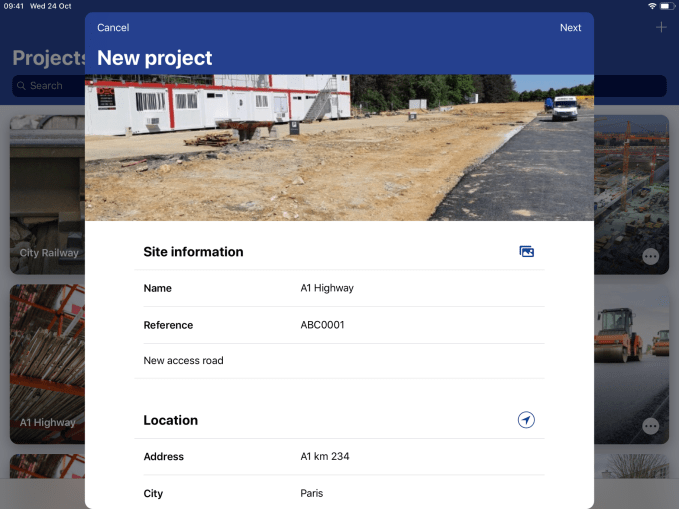
Funded in 2012 by Jimmy Louchart, Joffroy Louchart and David Vauthrin, Finalcad has set out to solve the construction industry’s “chronic low productivity” problem. The Paris-based company has developed a SaaS and mobile app to help construction workers and other construction stakeholders collaborate digitally, which is believed to be the key to removing many of the efficiencies in construction.

Specifically — and according to McKinsey — labor-productivity growth in construction has averaged only 1 percent a year over the past two decades, compared with growth of 2.8 percent for the total world economy and 3.6 percent in the case of manufacturing. The construction industry is also lagging behind in terms of digitization: MGI’s digitization index places it among the least digitized sectors.

To help remedy this, Finalcad’s SaaS lets construction site engineers, foremen, architects and consultants work together via the Finalcad mobile app, enabling collaboration across a wide variety of workflows both on site and at the office.

Along with acting as a communication tool — akin to a ‘Yammer for construction’ — the software also enables stakeholders to work on drawings, BIM models, tasks, controls, safety procedures and progress monitoring. From this vantage point, Finalcad is able to provide insights and “best practices at a company level,” powered by its analytics technology.

On who Finalcad’s competition is, unsurprisingly co-founder and CMO David Vauthrin says it’s a “mix of paper and pencil, excel sheets, and IM platforms,” such as WhatsApp or WeChat etc.

“On direct competiton, we face some players, but they are all very small companies, limited to one trade (e.g. buildings) or to a [single] geography,” he says.

Vauthrin also tells me that the Paris-based company’s business model is not based on per project sales, but is designed to encourage company-wide digital transformation. This sees Finalcad operate a subscription model based on a percentage of a company’s turnover.

“We created and implement into our customer’s organisation a ‘change management’ methodology to make sure that the majority of our customer’s workforce is going to embrace this change,” he adds.

To that end, Finalcad says it will use the new Series C funding to extend its SaaS, which spans support for buildings and infrastructure to energy, operations, and maintenance. It will also invest in R&D related to its Construction Insight Platform, and plans to hire an additional 100 people globally, adding to a current headcount of 170 people across 12 countries.

“When we raised our Series B in 2016, we intended to implement pivotal change: moving from a project-based business model to a company-wide digital transformation one. This involved covering all the main activities of our industry: buildings, infrastructure, energy, operations and maintenance,” says Jimmy Louchart, co-founder and CEO, in a statement.

“Since then, we validated this shift with some major contract wins in Europe and Asia. Now this Series C allows us to fully deploy our new strategy on a global scale. We firmly believe that this unique approach is coming to fruition, and the value we bring to our customers is the right path towards changing the way we build”.

from Startups – TechCrunch https://ift.tt/2Efl3dA

#Africa GSMA backs 6 African startups through innovation fund

//

Six African tech startups are among the 11 companies provided with equity-free funding as part of the third cohort of the GSMA Ecosystem Accelerator Innovation Fund.

Launched in July 2016, the fund offers between GB£100,000 (US$140,000) and GB£250,000 (US$349,000) to startups leveraging mobile to achieve socio-economic impact in their local markets in Africa and Asia.

The first round of the fund saw nine grantees backed in April 2017, while a further 15 investments were made through the Fund’s second round in February 2018. Fifteen of those 24 startups were African.

Eleven more recipients have now been announced by the GSMA Ecosystem Accelerator after an application process earlier this year, with six of them hailing from the continent. They include Ghanaian agri-tech startup AgroCenta, Ivory Coast-based mobile-supported plastic recycling solution Coliba and Kenyan ed-tech platform Eneza Education.

Also funded are Cameroonian maternal health platform GiftedMom, Benin-based mobile identity solution KEA Medicals, and Ethiopian recruitment service Taskmoby.

The six African recipients are joined by five more companies, namely Greenovator (Myanmar), Pacific Ads Group (Papua New Guinea), Qlue (Indonesia), SkyEye (Samoa), and  oDoc (Sri Lanka).

“With the latest additions, our portfolio now covers 23 markets in total, including eight new countries. The representation of very diverse ecosystems is critical for us to help demonstrate that the case for collaboration between startups and mobile operators is not the prerogative of more structured ecosystems like Nairobi or Jakarta, but can also become a reality in Apia or Cotonou,” said Max Cuvellier, head of the GSMA Ecosystem Accelerator.

“The breadth of sectors represented within the portfolio is also expanding, with new challenges such as citizen engagement, waste management, or universal medical identity being tackled by the newcomers.”

The post GSMA backs 6 African startups through innovation fund appeared first on Disrupt Africa.

from Disrupt Africa https://ift.tt/2CaefwG