About Startup365

Chaque jour nous vous présenterons une nouvelle Startup française ! Notre pays regorge de talents et d'entrepreneurs brillants ! Alors partons à la découverte des meilleures startup françaises ! Certaines d'entre elles sont dans une étape essentielle dans la vie d'une startup : la recherche de financement, notamment par le financement participatif (ou crowdfunding en anglais). Alors participez à cette grande aventure en leur faisant une petite donation ! Les startups françaises ont besoin de vous !

#Blockchain Markets Update: Cryptocurrency Traders Are Still Searching for the Elusive ‘Bottom’

The entire crypto-economy has been meandering just above $109 billion after the last two weeks of market dumps. Volume has been light this week as digital asset enthusiasts and traders are now pondering the crypto market’s next big move.

Also Read: Former Israeli Prime Minister Calls Cryptocurrencies a ‘Ponzi Scheme’

Market Surfers Wait for the Next Big Crypto Wave

Digital currency prices are at their lowest in over 15 months and prices have dropped considerably over the last few weeks. After many of the top cryptocurrencies touched significant lows on Dec. 7, about 48 hours later markets saw a brief spike upwards. Right now, most of the top coins are moving in a consolidated triangular pattern, seeing some lighter swings on Monday, Dec. 10.

Markets Update: Cryptocurrency Traders Are Still Searching for the Elusive 'Bottom'
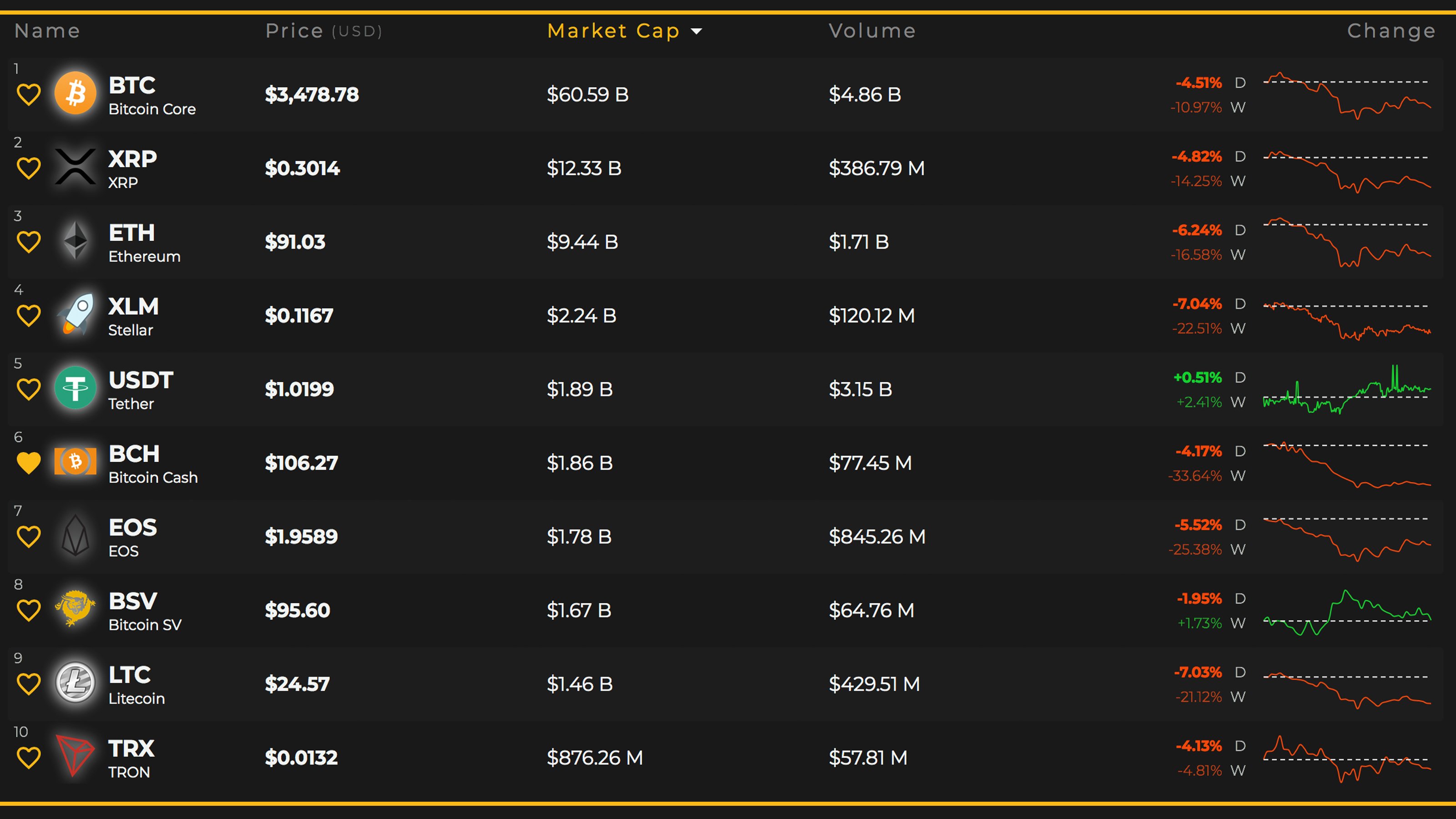
The top 10 cryptocurrencies on Monday, Dec. 10, 2018.

At the time of publication, the price of bitcoin core (BTC) is about $3,478 and is down roughly 4.5% over the last 24 hours. The second highest valued market held by ripple (XRP) is down 4.8% and each coin is trading for $0.30. Ethereum (ETH) prices have lost 6.2% during the last day and the coin is being swapped for $91. The cryptocurrency stellar (XLM) is the fourth largest market cap today as each coin trades for $0.11. Meanwhile, the stablecoin tether (USDT) has seen significant demand and now captures the fifth largest crypto valuation. Tether usage has reached a three-month low, however, as other stablecoins like TUSD, USDC, and GUSD have seen significant volume increases.  

Bitcoin Cash (BCH) Market Action

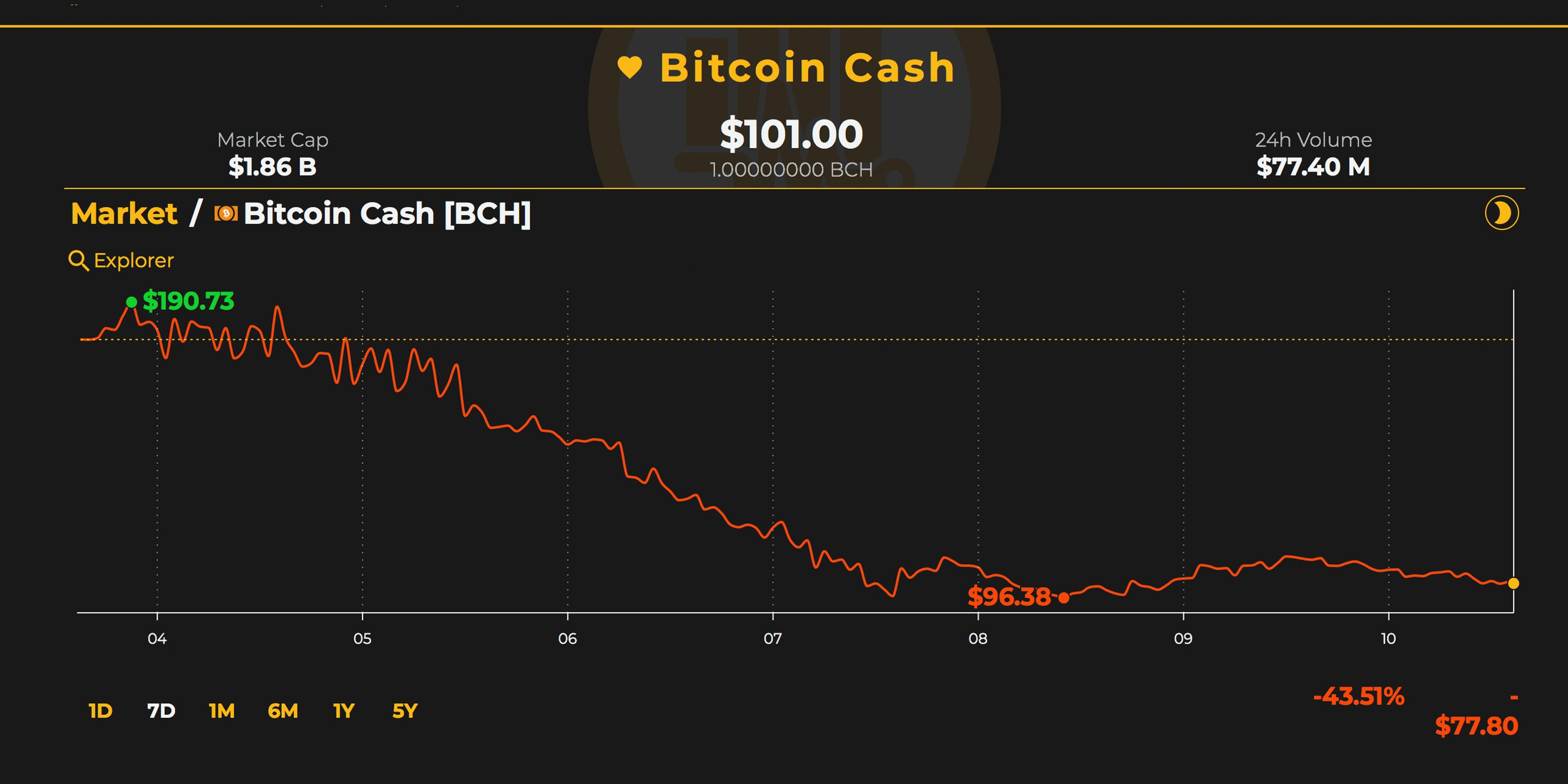
Bitcoin cash (BCH) markets are doing better today after a little skirmish with BSV in terms of prices on Dec. 7. Today, BCH is trading for $106 per coin and markets are down 2.9% for the day and 33% for the week. Bitcoin cash has about $86 million in trade volume which still pales in comparison to the $500 million global trades per day the coin held prior to the fork. The top five trading platforms swapping the most BCH today are Lbank, Binance, Huobi, Bluebelt, and Hitbtc. The biggest pair today being swapped against BCH is ethereum (ETH) which captures over 34% of Monday’s BCH trades. This is followed by BTC (28.5%), USDT (25.6%), USD (4.9%), and the EUR (2.3%). This week BCH is the 13th most traded cryptocurrency out of the 2,000+ coins on the market.

Markets Update: Cryptocurrency Traders Are Still Searching for the Elusive 'Bottom'
BCH/USD 7-day chart on Dec. 10.

BCH/USD Technical Indicators

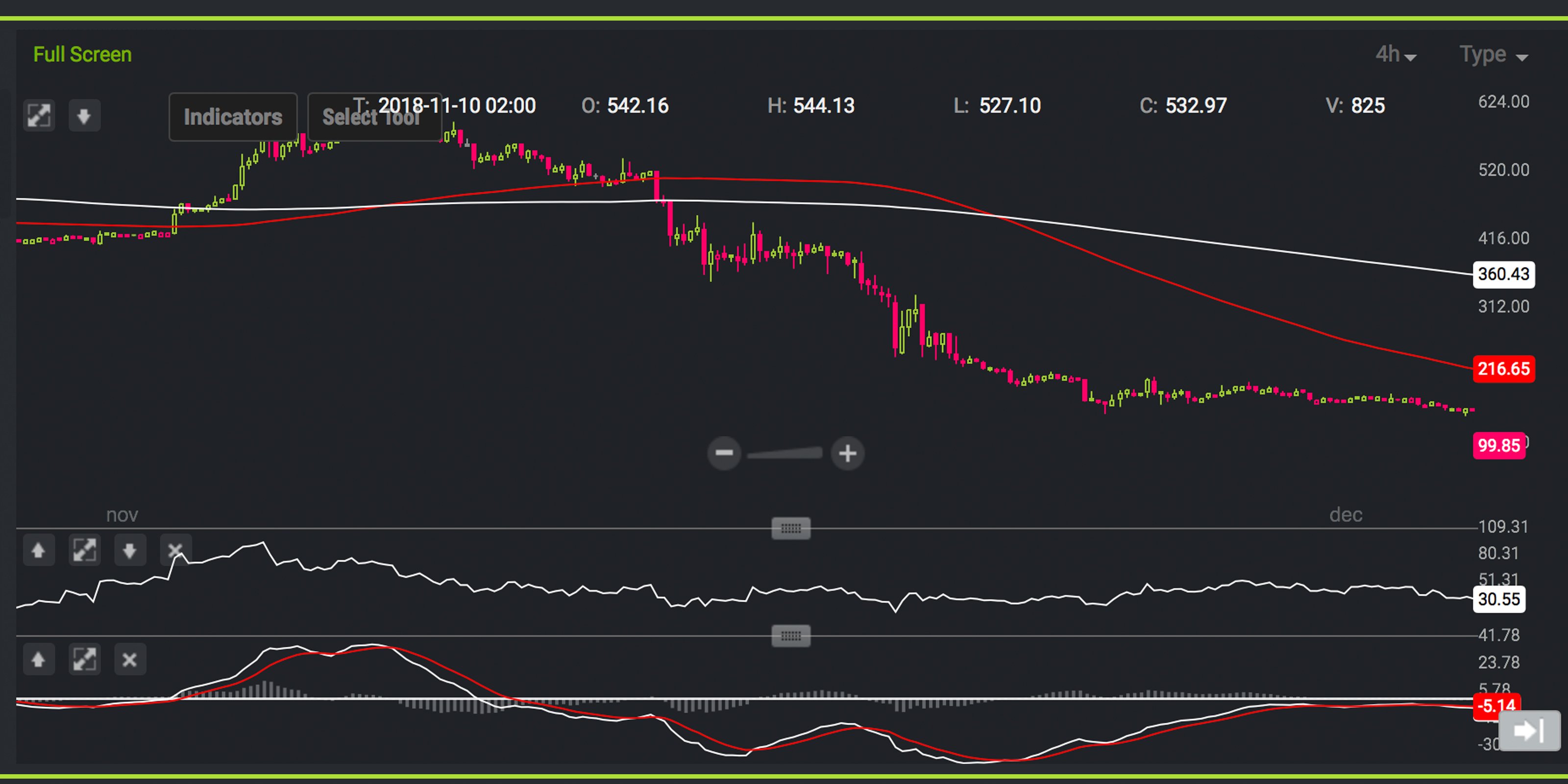
Looking at the BCH/USD four-hour chart on Bitstamp shows bulls are attempting to push forward after some heavy hits the past few days. At the moment, one BCH is trading for $101 per coin. The two Simple Moving Averages (SMA) show the long-term 200 SMA is still above the short term trendline indicating the path toward the least resistance is still down.

Markets Update: Cryptocurrency Traders Are Still Searching for the Elusive 'Bottom'
BCH/USD 4-hour chart on Bitstamp. 12/10/18

However, the 30-minute BCH/USD chart shows the two trend lines recently crossed paths and on the four-hour chart it looks as though they may cross hairs as well. The relative strength index on the four-hour shows oversold conditions at -39 and the MACd shows room for improvement too, but more so toward the downside. Order books on Bitstamp indicate that BCH bulls need to fight current resistance that’s stacked up until the $125-$150 zones. If bulls can surpass this region then they could gain some upward momentum. On the backside, order books show fairly solid foundations between now and $88 per BCH.

Markets Update: Cryptocurrency Traders Are Still Searching for the Elusive 'Bottom'
BCH/USD 4-hour chart 3:00 p.m. EST, 12/10/18.

The Verdict: Traders Too Skeptical to Call the Bottom

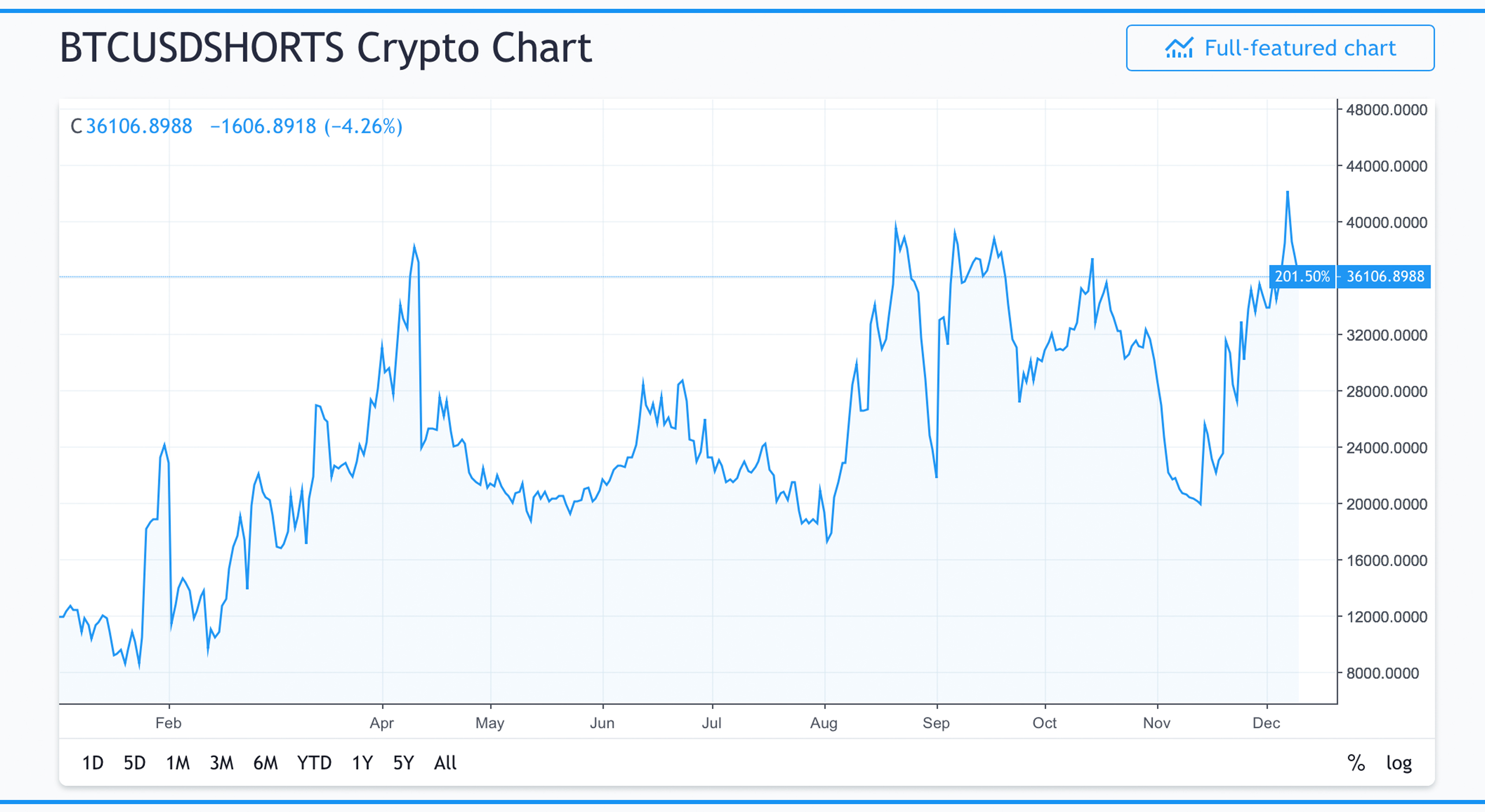
Most traders have been conversing about whether or not current prices can be regarded as ‘the bottom’, a topic they have pondered multiple times this year. Prices have shown various bull traps and dead kittens bouncing from the all-time highs last December all the way to the lowest of lows this December. BTC/USD shorts are still incredibly high and short positions placed on Bitfinex touched all-time highs on Dec. 6, reaching more than 42,000 that day.

Markets Update: Cryptocurrency Traders Are Still Searching for the Elusive 'Bottom'
BTC/USD shorts on Bitfinex. 12/10/18.

This metric has tapered off a little, but BTC/USD short positions are still incredibly high (37,000) with the price as low as it is today. Nevertheless, BTC dominance among all digital asset market valuations has remained unscathed over the last three months. Again, another week has passed and cryptocurrencies have seemingly bottomed out and continue to consolidate for now, leaving traders to pray they played their positions right this time around.

Where do you see the price of BCH, BTC and other coins heading from here? Let us know in the comments below.

Disclaimer: Price articles and markets updates are intended for informational purposes only and should not to be considered as trading advice. Neither Bitcoin.com nor the author is responsible for any losses or gains, as the ultimate decision to conduct a trade is made by the reader. Always remember that only those in possession of the private keys are in control of the “money.”


Images via Shutterstock, Trading View, and Satoshi Pulse.


Want to create your own secure cold storage paper wallet? Check our tools section.

The post Markets Update: Cryptocurrency Traders Are Still Searching for the Elusive ‘Bottom’ appeared first on Bitcoin News.

from Bitcoin News https://ift.tt/2rsXJBs Markets Update: Cryptocurrency Traders Are Still Searching for the Elusive ‘Bottom’

#Blockchain Markets Update: Cryptocurrency Traders Are Still Searching for the Elusive ‘Bottom’

The entire crypto-economy has been meandering just above $109 billion after the last two weeks of market dumps. Volume has been light this week as digital asset enthusiasts and traders are now pondering the crypto market’s next big move.

Also Read: Former Israeli Prime Minister Calls Cryptocurrencies a ‘Ponzi Scheme’

Market Surfers Wait for the Next Big Crypto Wave

Digital currency prices are at their lowest in over 15 months and prices have dropped considerably over the last few weeks. After many of the top cryptocurrencies touched significant lows on Dec. 7, about 48 hours later markets saw a brief spike upwards. Right now, most of the top coins are moving in a consolidated triangular pattern, seeing some lighter swings on Monday, Dec. 10.

Markets Update: Cryptocurrency Traders Are Still Searching for the Elusive 'Bottom'
The top 10 cryptocurrencies on Monday, Dec. 10, 2018.

At the time of publication, the price of bitcoin core (BTC) is about $3,478 and is down roughly 4.5% over the last 24 hours. The second highest valued market held by ripple (XRP) is down 4.8% and each coin is trading for $0.30. Ethereum (ETH) prices have lost 6.2% during the last day and the coin is being swapped for $91. The cryptocurrency stellar (XLM) is the fourth largest market cap today as each coin trades for $0.11. Meanwhile, the stablecoin tether (USDT) has seen significant demand and now captures the fifth largest crypto valuation. Tether usage has reached a three-month low, however, as other stablecoins like TUSD, USDC, and GUSD have seen significant volume increases.  

Bitcoin Cash (BCH) Market Action

Bitcoin cash (BCH) markets are doing better today after a little skirmish with BSV in terms of prices on Dec. 7. Today, BCH is trading for $106 per coin and markets are down 2.9% for the day and 33% for the week. Bitcoin cash has about $86 million in trade volume which still pales in comparison to the $500 million global trades per day the coin held prior to the fork. The top five trading platforms swapping the most BCH today are Lbank, Binance, Huobi, Bluebelt, and Hitbtc. The biggest pair today being swapped against BCH is ethereum (ETH) which captures over 34% of Monday’s BCH trades. This is followed by BTC (28.5%), USDT (25.6%), USD (4.9%), and the EUR (2.3%). This week BCH is the 13th most traded cryptocurrency out of the 2,000+ coins on the market.

Markets Update: Cryptocurrency Traders Are Still Searching for the Elusive 'Bottom'
BCH/USD 7-day chart on Dec. 10.

BCH/USD Technical Indicators

Looking at the BCH/USD four-hour chart on Bitstamp shows bulls are attempting to push forward after some heavy hits the past few days. At the moment, one BCH is trading for $101 per coin. The two Simple Moving Averages (SMA) show the long-term 200 SMA is still above the short term trendline indicating the path toward the least resistance is still down.

Markets Update: Cryptocurrency Traders Are Still Searching for the Elusive 'Bottom'
BCH/USD 4-hour chart on Bitstamp. 12/10/18

However, the 30-minute BCH/USD chart shows the two trend lines recently crossed paths and on the four-hour chart it looks as though they may cross hairs as well. The relative strength index on the four-hour shows oversold conditions at -39 and the MACd shows room for improvement too, but more so toward the downside. Order books on Bitstamp indicate that BCH bulls need to fight current resistance that’s stacked up until the $125-$150 zones. If bulls can surpass this region then they could gain some upward momentum. On the backside, order books show fairly solid foundations between now and $88 per BCH.

Markets Update: Cryptocurrency Traders Are Still Searching for the Elusive 'Bottom'
BCH/USD 4-hour chart 3:00 p.m. EST, 12/10/18.

The Verdict: Traders Too Skeptical to Call the Bottom

Most traders have been conversing about whether or not current prices can be regarded as ‘the bottom’, a topic they have pondered multiple times this year. Prices have shown various bull traps and dead kittens bouncing from the all-time highs last December all the way to the lowest of lows this December. BTC/USD shorts are still incredibly high and short positions placed on Bitfinex touched all-time highs on Dec. 6, reaching more than 42,000 that day.

Markets Update: Cryptocurrency Traders Are Still Searching for the Elusive 'Bottom'
BTC/USD shorts on Bitfinex. 12/10/18.

This metric has tapered off a little, but BTC/USD short positions are still incredibly high (37,000) with the price as low as it is today. Nevertheless, BTC dominance among all digital asset market valuations has remained unscathed over the last three months. Again, another week has passed and cryptocurrencies have seemingly bottomed out and continue to consolidate for now, leaving traders to pray they played their positions right this time around.

Where do you see the price of BCH, BTC and other coins heading from here? Let us know in the comments below.

Disclaimer: Price articles and markets updates are intended for informational purposes only and should not to be considered as trading advice. Neither Bitcoin.com nor the author is responsible for any losses or gains, as the ultimate decision to conduct a trade is made by the reader. Always remember that only those in possession of the private keys are in control of the “money.”


Images via Shutterstock, Trading View, and Satoshi Pulse.


Want to create your own secure cold storage paper wallet? Check our tools section.

The post Markets Update: Cryptocurrency Traders Are Still Searching for the Elusive ‘Bottom’ appeared first on Bitcoin News.

from Bitcoin News https://ift.tt/2rsXJBs Markets Update: Cryptocurrency Traders Are Still Searching for the Elusive ‘Bottom’

#USA Africa Roundup: Terragon’s Asia acquisition, Twiga Foods’ $10M raise, SimbaPay’s China payment service

//

Nigerian consumer data analytics firm Terragon Group acquired Asian mobile marketing company Bizense in a cash and stock deal. The price of the acquisition was not disclosed.

Based in Singapore, with operations in India and Indonesia, Bizense specializes in “mobile ad platform[s] for Telco’s, large publishers, and [e-commerce] ad networks.”

Headquartered in Lagos, Terragon’s software services give its clients — primarily telecommunications and financial services companies — data on Africa’s growing consumer markets.

“Most of the problems we seek to solve for our clients in Africa also exist in places like South East Asia and Latin America,” Umeh told TechCrunch of the logic for the acquisition.

Umeh indicated the company is contemplating further expansion in Asia and Latin America, where Terragon already has consumer data research and development teams.

Tarragon has a team of 100 employees across Nigeria, Kenya, Ghana and South Africa. Clients include local firms, such as Honeywell, and global names, including Unilever, DHL and international agribusiness firm Olam.

Terragon’s acquisition in Singapore, and moves by several other Nigerian ventures this year, signal greater global possibilities for Sub-Saharan African startups.

African financial technology companies like Mines and Paga announced their intent to expand in and outside Africa. They would join e-commerce site MallforAfrica, which went global in July in a partnership with DHL.

Kenya’s Twiga Foods has raised $10 million and announced it will add to its product line-up processed food and fast-moving consumer goods.

The $10 million IFC and TLcom Capital co-led investment comes in the form of convertible notes, available later as equity, according to Wale Ayeni, regional head of IFC’s Africa VC practice.

Twiga Foods has built a B2B platform to improve the supply chain from farmers to markets. The startup now aims to scale additional merchandise on its digital network that coordinates pricing, payment, quality control and logistics across sellers and vendors.

CEO and co-founder Grant Brooke sees “a growth horizon…to build a B2B Amazon,” with produce as the base.

“If we can build a business around fresh fruit and vegetables, everything else after that is much simpler to add on,” he told TechCrunch in this feature.

Forging another link between Africa and China’s digital economies, the African-focused money transfer startup SimbaPay and Kenya’s Family Bank have launched an instant payment service from East Africa to China.

The new product — which piggy-backs on WeChat’s  messaging service — is aimed at Kenyan merchants that purchase goods from China, Kenya’s largest import source.

To be clear, SimbaPay isn’t partnering with WeChat on this service, neither to provide the payments nor to build the service.

Using QR codes, SimbaPay developed a third-party payment aggregator that enables funds delivery when the buyer and seller both use WeChat’s network, which today has more than 1 billion registered accounts.

Individuals and businesses can now send funds to China through Family Bank’s PesaPap app, Safaricom’s M-Pesa or by texting USSD using the code *325#.

The service opens a faster and less expensive money transfer option between Kenya and China through the Tencent-owned WeChat social media platform.

SimbaPay transfers funds to 11 countries — nine in Africa then to China and India. “Early next year we’ll increase this to 29 countries,” SimbaPay co-founder Sagini Onyancha told TechCrunch in this feature.

In case you missed it, TLcom Capital senior partner Omobola Johnson and Terragon CEO Elo Umeh joined TechCrunch editor Jon Shieber for a breakdown of African tech at Disrupt Berlin. They covered everything from digital skills to the pros and cons of Andela in African IT markets and Africa’s IPO prospects.

Umeh described how “copying and pasting” Silicon Valley models didn’t work for his Nigerian startup’s mission “to help…enterprise companies achieve value at scale.”

Johnson envisioned Africa’s next unicorn as “as a B2B — business to very small business and SMEs — company” that can solve small businesses challenges, across advertising, access to markets, and finance.

TechCrunch’s discussion of African tech with top founders, IT leaders, and VCs continues December 11 in Lagos for the second Startup Battlefield Africa. In addition to the pitch competition of 15 top early-stage startups, discussions are teed up on blockchain in Africa, unique VC models for the continent and solving Africa’s connectivity equation. Hopefully tickets aren’t sold out by the time you read this.

More Africa Related Stories @TechCrunch

African Tech Around the Net

from Startups – TechCrunch https://ift.tt/2Ptu44E

#USA Africa Roundup: Terragon’s Asia acquisition, Twiga Foods’ $10M raise, SimbaPay’s China payment service

//

Nigerian consumer data analytics firm Terragon Group acquired Asian mobile marketing company Bizense in a cash and stock deal. The price of the acquisition was not disclosed.

Based in Singapore, with operations in India and Indonesia, Bizense specializes in “mobile ad platform[s] for Telco’s, large publishers, and [e-commerce] ad networks.”

Headquartered in Lagos, Terragon’s software services give its clients — primarily telecommunications and financial services companies — data on Africa’s growing consumer markets.

“Most of the problems we seek to solve for our clients in Africa also exist in places like South East Asia and Latin America,” Umeh told TechCrunch of the logic for the acquisition.

Umeh indicated the company is contemplating further expansion in Asia and Latin America, where Terragon already has consumer data research and development teams.

Tarragon has a team of 100 employees across Nigeria, Kenya, Ghana and South Africa. Clients include local firms, such as Honeywell, and global names, including Unilever, DHL and international agribusiness firm Olam.

Terragon’s acquisition in Singapore, and moves by several other Nigerian ventures this year, signal greater global possibilities for Sub-Saharan African startups.

African financial technology companies like Mines and Paga announced their intent to expand in and outside Africa. They would join e-commerce site MallforAfrica, which went global in July in a partnership with DHL.

Kenya’s Twiga Foods has raised $10 million and announced it will add to its product line-up processed food and fast-moving consumer goods.

The $10 million IFC and TLcom Capital co-led investment comes in the form of convertible notes, available later as equity, according to Wale Ayeni, regional head of IFC’s Africa VC practice.

Twiga Foods has built a B2B platform to improve the supply chain from farmers to markets. The startup now aims to scale additional merchandise on its digital network that coordinates pricing, payment, quality control and logistics across sellers and vendors.

CEO and co-founder Grant Brooke sees “a growth horizon…to build a B2B Amazon,” with produce as the base.

“If we can build a business around fresh fruit and vegetables, everything else after that is much simpler to add on,” he told TechCrunch in this feature.

Forging another link between Africa and China’s digital economies, the African-focused money transfer startup SimbaPay and Kenya’s Family Bank have launched an instant payment service from East Africa to China.

The new product — which piggy-backs on WeChat’s  messaging service — is aimed at Kenyan merchants that purchase goods from China, Kenya’s largest import source.

To be clear, SimbaPay isn’t partnering with WeChat on this service, neither to provide the payments nor to build the service.

Using QR codes, SimbaPay developed a third-party payment aggregator that enables funds delivery when the buyer and seller both use WeChat’s network, which today has more than 1 billion registered accounts.

Individuals and businesses can now send funds to China through Family Bank’s PesaPap app, Safaricom’s M-Pesa or by texting USSD using the code *325#.

The service opens a faster and less expensive money transfer option between Kenya and China through the Tencent-owned WeChat social media platform.

SimbaPay transfers funds to 11 countries — nine in Africa then to China and India. “Early next year we’ll increase this to 29 countries,” SimbaPay co-founder Sagini Onyancha told TechCrunch in this feature.

In case you missed it, TLcom Capital senior partner Omobola Johnson and Terragon CEO Elo Umeh joined TechCrunch editor Jon Shieber for a breakdown of African tech at Disrupt Berlin. They covered everything from digital skills to the pros and cons of Andela in African IT markets and Africa’s IPO prospects.

Umeh described how “copying and pasting” Silicon Valley models didn’t work for his Nigerian startup’s mission “to help…enterprise companies achieve value at scale.”

Johnson envisioned Africa’s next unicorn as “as a B2B — business to very small business and SMEs — company” that can solve small businesses challenges, across advertising, access to markets, and finance.

TechCrunch’s discussion of African tech with top founders, IT leaders, and VCs continues December 11 in Lagos for the second Startup Battlefield Africa. In addition to the pitch competition of 15 top early-stage startups, discussions are teed up on blockchain in Africa, unique VC models for the continent and solving Africa’s connectivity equation. Hopefully tickets aren’t sold out by the time you read this.

More Africa Related Stories @TechCrunch

African Tech Around the Net

from Startups – TechCrunch https://ift.tt/2Ptu44E

#USA AR startup Blippar in danger of becoming a blip as shareholders fight over future funding

//

Blippar, the U.K.-based AR startup that raised more than $130 million, may be nearing the end of the road. The company has been burning through cash in a bid to pivot in search of a profitable AR business model, and now shareholders are in dispute over whether to throw Blippar any more money to aid that effort, according to a statement the company provided to TechCrunch.

The company has been on the brink for a while now, but things have taken a hard turn in the past few months on the back of yet another pivot.

A Blippar spokesperson told TechCrunch that a single shareholder is blocking the required unanimous vote to close on emergency funding, without which Blippar must begin insolvency proceedings. The company is hoping to continue negotiating with the holdout and come to a resolution this week.

A source close to the company confirmed The Sunday Times report from this weekend, which stated that Khazanah, a strategic investment fund from the Malaysian government, did not approve Blippar’s bid for emergency funding. In July, Khazanah’s board resigned as part of the transition to a new government, meaning that the top brass at the firm are not the same people who invested in Blippar originally.

In September, Blippar raised $37 million from Candy Ventures and Qualcomm Ventures, stating that the Series E financing would help the company achieve its goal of becoming profitable by September 2019. But the private company has posted losses for the past two years, according to BI. It’s unclear whether or not the emergency funding being blocked now is the same $37 million Series E the company claimed to have closed in September or new cash.

Blippar has been a contender in the AR space since 2011. The company started as a marketing agency that would allow brands to purchase augmented reality ads placed on real-world objects or on magazines. Users could scan these “Blipps” to unlock additional AR content and offers.

In 2013, Blippar launched in the U.S. and the company grew alongside the momentum of the AR space in general. But there were more than a few missteps.

The company spent time and money building for short-lived platforms like Windows Phone and Google Glass.

But even if resources weren’t wasted on now-defunct platforms, the general premise of Blippar was always somewhat questionable. Even if the format of the engagement was novel, an ad is still an ad. Few consumers are interested in downloading and engaging with an app that simply serves up brand content.

So Blippar switched things up. The company pivoted on the heels of its $45 million Series C to become a computer vision-powered visual search engine.

Blippar overhauled the technology to allow for content to be unlocked by any object in the real world via computer vision, instead of relying on physical stickers (Blipps). The company also started incorporating content that wasn’t necessarily ad-based but information-based, such as the make and model of a car or the scientific name of a plant.

Indeed, there seems to be a use case for visual-based search. There are times when we simply don’t have the words to properly identify something we see in the real world. But in a world where really only one company dominates search, executing on that proved incredibly complicated for Blippar.

Google has offered a form of visual search for years, and you could argue that those companies that are already strong players in search and information discovery might become strong players (or at least tough competition) in visual search, an extension of what they already do.

Blippar has claimed it has upwards of 65 million registered users via its network of brand and publishing partners, white-label SDK partners, etc.; actual downloads of its app were closer to 500,000 in 2017, reports BI. (And it’s not clear how many of those registered users were regular users, anyway.)

After a number of attempts at making visual search relevant — including a truly bizarre move into social with the launch of a Snapchat-esque feature called Halos — Blippar turned its attention to spaces.

In 2017, the company launched the AR City app, which lets users navigate their way through more than 300 cities using the camera on their smartphone. The company argued that navigation via its computer vision tech was more accurate than GPS. In August 2018, Blippar took the technology indoors with the launch of the Indoor Visual Positioning System. The hope with this launch is that it would attract whales for clients, as it was built to be used in large commercial spaces like stadiums, airports, shopping centers and large office buildings/campuses.

The positioning system not only allowed for hyper accurate indoor navigation, but also extra AR content such as points of interest, personalized content, etc.

Shortly after the launch, in September of this year, Blippar picked up its most recent $37 million Series E funding, which it said would “help the company reach its profitability goal within the next 12 months.”

But, if this report is true, it would appear that it’s just too little too late.

While being an early player can have its advantages, many pioneers in the tech startup landscape don’t have the benefit of learning from others’ mistakes. With a launch in 2011, Blippar most certainly falls into that category.

But beyond the timing, Blippar also seemed to be building technology for the sake of building technology, without ever really nailing down a focused way for that technology to earn money.

We reached out to the company and a Blippar spokesperson had this to say:

The rate of change in the AR industry resulted in a lack of standardisation across platforms and tools which has become a barrier to greater adoption and application of the technology. In response to these we refined our strategy to primarily focus on our SaaS self-service AR creation and publishing platform and we are on the path to accelerate the developments of this platform. Our goal is to unify and standardise all AR formats and make it easy for everybody to create AR.

Our strategy and product roadmap to enable this goal has unanimous approval from our board, for which we require an additional amount of funding to accelerate our growth and fulfill our profitability plans. The additional funding has been secured and approved by the whole board, but ultimately requires shareholders’ approval, which was given by all except one.

Despite not participating in any further funding of the business, that shareholder took the decision to vote against the additional funding. We tried to reach an agreement with them that would allow the business to continue with these plans and have offered various solutions, and so far they have refused all proposals.

Our board is still trying to negotiate with them and we hope to have a reasonable position at some point this week.

We also reached out to Qualcomm Ventures but have not heard back. We will update if/when we do.

from Startups – TechCrunch https://ift.tt/2rqz4xE

#USA AR startup Blippar in danger of becoming a blip as shareholders fight over future funding

//

Blippar, the U.K.-based AR startup that raised more than $130 million, may be nearing the end of the road. The company has been burning through cash in a bid to pivot in search of a profitable AR business model, and now shareholders are in dispute over whether to throw Blippar any more money to aid that effort, according to a statement the company provided to TechCrunch.

The company has been on the brink for a while now, but things have taken a hard turn in the past few months on the back of yet another pivot.

A Blippar spokesperson told TechCrunch that a single shareholder is blocking the required unanimous vote to close on emergency funding, without which Blippar must begin insolvency proceedings. The company is hoping to continue negotiating with the holdout and come to a resolution this week.

A source close to the company confirmed The Sunday Times report from this weekend, which stated that Khazanah, a strategic investment fund from the Malaysian government, did not approve Blippar’s bid for emergency funding. In July, Khazanah’s board resigned as part of the transition to a new government, meaning that the top brass at the firm are not the same people who invested in Blippar originally.

In September, Blippar raised $37 million from Candy Ventures and Qualcomm Ventures, stating that the Series E financing would help the company achieve its goal of becoming profitable by September 2019. But the private company has posted losses for the past two years, according to BI. It’s unclear whether or not the emergency funding being blocked now is the same $37 million Series E the company claimed to have closed in September or new cash.

Blippar has been a contender in the AR space since 2011. The company started as a marketing agency that would allow brands to purchase augmented reality ads placed on real-world objects or on magazines. Users could scan these “Blipps” to unlock additional AR content and offers.

In 2013, Blippar launched in the U.S. and the company grew alongside the momentum of the AR space in general. But there were more than a few missteps.

The company spent time and money building for short-lived platforms like Windows Phone and Google Glass.

But even if resources weren’t wasted on now-defunct platforms, the general premise of Blippar was always somewhat questionable. Even if the format of the engagement was novel, an ad is still an ad. Few consumers are interested in downloading and engaging with an app that simply serves up brand content.

So Blippar switched things up. The company pivoted on the heels of its $45 million Series C to become a computer vision-powered visual search engine.

Blippar overhauled the technology to allow for content to be unlocked by any object in the real world via computer vision, instead of relying on physical stickers (Blipps). The company also started incorporating content that wasn’t necessarily ad-based but information-based, such as the make and model of a car or the scientific name of a plant.

Indeed, there seems to be a use case for visual-based search. There are times when we simply don’t have the words to properly identify something we see in the real world. But in a world where really only one company dominates search, executing on that proved incredibly complicated for Blippar.

Google has offered a form of visual search for years, and you could argue that those companies that are already strong players in search and information discovery might become strong players (or at least tough competition) in visual search, an extension of what they already do.

Blippar has claimed it has upwards of 65 million registered users via its network of brand and publishing partners, white-label SDK partners, etc.; actual downloads of its app were closer to 500,000 in 2017, reports BI. (And it’s not clear how many of those registered users were regular users, anyway.)

After a number of attempts at making visual search relevant — including a truly bizarre move into social with the launch of a Snapchat-esque feature called Halos — Blippar turned its attention to spaces.

In 2017, the company launched the AR City app, which lets users navigate their way through more than 300 cities using the camera on their smartphone. The company argued that navigation via its computer vision tech was more accurate than GPS. In August 2018, Blippar took the technology indoors with the launch of the Indoor Visual Positioning System. The hope with this launch is that it would attract whales for clients, as it was built to be used in large commercial spaces like stadiums, airports, shopping centers and large office buildings/campuses.

The positioning system not only allowed for hyper accurate indoor navigation, but also extra AR content such as points of interest, personalized content, etc.

Shortly after the launch, in September of this year, Blippar picked up its most recent $37 million Series E funding, which it said would “help the company reach its profitability goal within the next 12 months.”

But, if this report is true, it would appear that it’s just too little too late.

While being an early player can have its advantages, many pioneers in the tech startup landscape don’t have the benefit of learning from others’ mistakes. With a launch in 2011, Blippar most certainly falls into that category.

But beyond the timing, Blippar also seemed to be building technology for the sake of building technology, without ever really nailing down a focused way for that technology to earn money.

We reached out to the company and a Blippar spokesperson had this to say:

The rate of change in the AR industry resulted in a lack of standardisation across platforms and tools which has become a barrier to greater adoption and application of the technology. In response to these we refined our strategy to primarily focus on our SaaS self-service AR creation and publishing platform and we are on the path to accelerate the developments of this platform. Our goal is to unify and standardise all AR formats and make it easy for everybody to create AR.

Our strategy and product roadmap to enable this goal has unanimous approval from our board, for which we require an additional amount of funding to accelerate our growth and fulfill our profitability plans. The additional funding has been secured and approved by the whole board, but ultimately requires shareholders’ approval, which was given by all except one.

Despite not participating in any further funding of the business, that shareholder took the decision to vote against the additional funding. We tried to reach an agreement with them that would allow the business to continue with these plans and have offered various solutions, and so far they have refused all proposals.

Our board is still trying to negotiate with them and we hope to have a reasonable position at some point this week.

We also reached out to Qualcomm Ventures but have not heard back. We will update if/when we do.

from Startups – TechCrunch https://ift.tt/2rqz4xE

#USA Solo.io raises $11M to help enterprises adopt cloud-native technologies

//

Solo.io, a Cambridge, Mass-based startup that helps enterprises adopt cloud-native technologies, is coming out of stealth mode today and announcing both its Series A funding round and the launch of its Gloo Enterprise API gateway.

Redpoint Ventures led the $11 million Series A round, with participation from seed investor True Ventures . Like most companies at the Series A state, Solo.io plans to use the money to invest in the product development of its enterprise and open-source tools, as well as to grow its sales and marketing teams.

Solo.io offers a number of open-source tools, like the Gloo function gateway, the Sqoop GraphQL server and the SuperGloo (see a theme here?) service mesh orchestration platform. In addition, the team has also, among others, open-sourced its Kubernetes debugger, a tool for building and running unikernels.

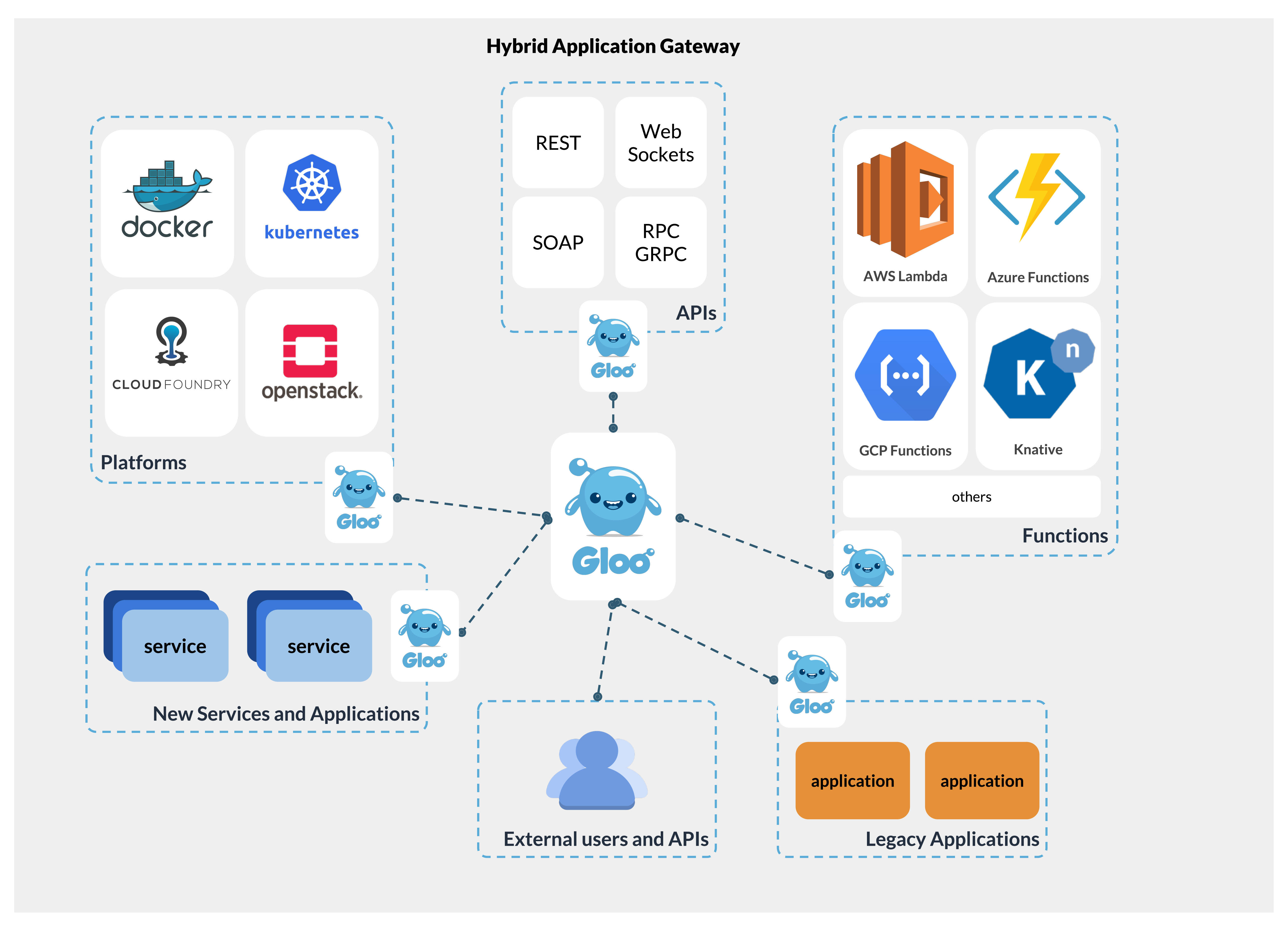
Its first commercial offering, though, is an enterprise version of the Gloo function gateway. Built on top of the Envoy proxy, Gloo can handle the routing necessary to connect incoming API requests to microservices, serverless applications (on the likes of AWS Lambda) and traditional monolithic applications behind the proxy. Gloo handles the load balancing and other functions necessary to aggregate the incoming API requests and route them to their destinations.

“Costumers who use Gloo to connect between microservices and serverless found that invocation of [AWS] Lambda is 350ms faster than the AWS API Gateway,” Idit Levine, the founder and CEO of Solo.io, told me. “Gloo also offers them direct money saving, since AWS bills per invocation. In general, Gloo offers money saving because it allows our clients to use the less expensive technologies — like their legacy apps, and sometimes containers — whenever they can, and limit the use of more expensive stuff to whenever it’s necessary.”

The enterprise version adds features like audit controls, single sign-on and more advanced security tools to the platform.

In addition to broadening its customer base, the company plans to invest heavily into its customer success and support teams, as well as its evangelism and education efforts, Levine tells me.

“Helping enterprises easily adopt innovative technologies like microservices, serverless and service mesh is our goal at Solo.io,” Levine in today’s announcement. “Melding different technologies into one coherent environment, by supplying a suite of tools to route, debug, manage, monitor and secure applications, lets organizations focus on their software without worrying about the complexity of the underlying environment.”

from Startups – TechCrunch https://ift.tt/2SEAYpU

#Blockchain Israel Tax Authority Launches Offensive on Undisclosed Crypto Earnings

Israel Tax Authority Launches Offensive on Undisclosed Crypto Earnings

Local reports have asserted that the Israel Tax Authority has launched a renewed crackdown on unreported cryptocurrency earnings. The Israeli tax regulator has opened hundreds of tax accounts and sent letters of notice to Israeli citizens suspected of failing to disclose earnings derived from cryptocurrency-relate activities.

Also Read: $1 Million BTC Options Position Set to Expire on Dec. 28

Israel Tax Authority Targets Undisclosed Cryptocurrency Earnings

Israel Tax Authority Launches Offensive on Undisclosed Crypto EarningsThe Israel Tax Authority has launched an offensive designed to crack down on cryptocurrency earnings not reported by Israeli citizens, reportedly resulting in the opening of hundreds of tax accounts.

Citing an anonymous “Israeli official familiar with the matter,” local media outlet Calcalistech has reported that the Israel’s tax regulator has sent letters to citizens suspected of failing to report crypto income, as well as individuals who frequently travel overseas without possessing the required funds on paper and individuals who own more than three apartments.

Eran Yaakov, the head of the Israel Tax Authority, stated that the regulator will continue to actively target withheld cryptocurrency earnings moving forward.

Crackdown Expands on Previous Action Taken by Israel Tax Authority in May

Israel Tax Authority Launches Offensive on Undisclosed Crypto EarningsIn February, the Israel Tax Authority announced that it would mandate the taxation of cryptocurrency as an asset, resulting in the introduction of a 25 percent capital gains tax for private investors and a 47 percent marginal rate for businesses. Additionally, individuals mining or trading cryptocurrencies through a business were made liable for Israel’s 17 percent value-added tax.

Soon thereafter, the Israel Tax Authority sought to crack down on undisclosed cryptocurrency earnings and holdings, issuing letters to citizens suspected of failing to divulge pertinent cryptocurrency-related activities in May of this year.

At the time, news.Bitcoin.com reported on rumors that undercover agents of the Israeli tax regulator were monitoring local groups for the peer-to-peer trade of cryptocurrencies on major social media platforms including Facebook, Whatsapp, and Telegram.

What do you think of Israel’s tax regime for cryptocurrency earnings? Share your thoughts in the comments section below!


Images courtesy of Shutterstock, gov.il


At Bitcoin.com there’s a bunch of free helpful services. For instance, have you seen our Tools page? You can even lookup the exchange rate for a transaction in the past. Or calculate the value of your current holdings. Or create a paper wallet. And much more.

The post Israel Tax Authority Launches Offensive on Undisclosed Crypto Earnings appeared first on Bitcoin News.

from Bitcoin News https://ift.tt/2Lf1bsR Israel Tax Authority Launches Offensive on Undisclosed Crypto Earnings

#Blockchain Israel Tax Authority Launches Offensive on Undisclosed Crypto Earnings

Israel Tax Authority Launches Offensive on Undisclosed Crypto Earnings

Local reports have asserted that the Israel Tax Authority has launched a renewed crackdown on unreported cryptocurrency earnings. The Israeli tax regulator has opened hundreds of tax accounts and sent letters of notice to Israeli citizens suspected of failing to disclose earnings derived from cryptocurrency-relate activities.

Also Read: $1 Million BTC Options Position Set to Expire on Dec. 28

Israel Tax Authority Targets Undisclosed Cryptocurrency Earnings

Israel Tax Authority Launches Offensive on Undisclosed Crypto EarningsThe Israel Tax Authority has launched an offensive designed to crack down on cryptocurrency earnings not reported by Israeli citizens, reportedly resulting in the opening of hundreds of tax accounts.

Citing an anonymous “Israeli official familiar with the matter,” local media outlet Calcalistech has reported that the Israel’s tax regulator has sent letters to citizens suspected of failing to report crypto income, as well as individuals who frequently travel overseas without possessing the required funds on paper and individuals who own more than three apartments.

Eran Yaakov, the head of the Israel Tax Authority, stated that the regulator will continue to actively target withheld cryptocurrency earnings moving forward.

Crackdown Expands on Previous Action Taken by Israel Tax Authority in May

Israel Tax Authority Launches Offensive on Undisclosed Crypto EarningsIn February, the Israel Tax Authority announced that it would mandate the taxation of cryptocurrency as an asset, resulting in the introduction of a 25 percent capital gains tax for private investors and a 47 percent marginal rate for businesses. Additionally, individuals mining or trading cryptocurrencies through a business were made liable for Israel’s 17 percent value-added tax.

Soon thereafter, the Israel Tax Authority sought to crack down on undisclosed cryptocurrency earnings and holdings, issuing letters to citizens suspected of failing to divulge pertinent cryptocurrency-related activities in May of this year.

At the time, news.Bitcoin.com reported on rumors that undercover agents of the Israeli tax regulator were monitoring local groups for the peer-to-peer trade of cryptocurrencies on major social media platforms including Facebook, Whatsapp, and Telegram.

What do you think of Israel’s tax regime for cryptocurrency earnings? Share your thoughts in the comments section below!


Images courtesy of Shutterstock, gov.il


At Bitcoin.com there’s a bunch of free helpful services. For instance, have you seen our Tools page? You can even lookup the exchange rate for a transaction in the past. Or calculate the value of your current holdings. Or create a paper wallet. And much more.

The post Israel Tax Authority Launches Offensive on Undisclosed Crypto Earnings appeared first on Bitcoin News.

from Bitcoin News https://ift.tt/2Lf1bsR Israel Tax Authority Launches Offensive on Undisclosed Crypto Earnings

#USA Q&A with Diversity VC’s Check Warner on newly-launched Diversity & Inclusion guide for tech companies

//

If the last few years has seen a growing consensus that the tech industry has a diversity and inclusion problem, then what is clearly needed next are practical solutions. While most people agree that building a diverse and inclusive company culture is easier to achieve the earlier you set out to do so, for startups and even much larger companies it is often difficult to know where to start, let alone what your own eventual D&I strategy might look like.

Conversely, there’s a body of evidence that points to diverse teams creating more successful and longer-lasting companies. Besides, it’s never smart to leave talent on the table. Enter a new initiative from Diversity VC, a non-profit partnership promoting diversity in Venture Capital, and London venture capital firm Atomico.

The pair have teamed up to launch what may well be an industry-first resource: a practical and hands-on guide for ambitious technology entrepreneurs to “help them build companies that have diversity and inclusion at their core”. The guide can be found online here, and is also in print. It was unveiled last week on stage at Slush 2018 by Diversity VC’s Check Warner and Atomico founder Niklas Zennström.

The objective of the “Founder Guide” is to be a central place for technology companies, large and small to “find pragmatic, actionable advice for planning, implementing and measuring their D&I strategy. It’s also meant to be a work in progress, and with the help of feedback and suggestions, will evolve as the industry’s understanding of D&I develops.

More broadly, the guide focuses on diversity and inclusion in the workplace in its broadest sense, looking at ethnicity, socio-economic backgrounds, disability, gender, sexuality, religious faith, cognitive differences, dependents, caring responsibilities and how all of those factors, and the “intersections of those factors,” can impact on an individual’s success in tech companies, and therefore the success of companies overall.

In an email Q&A with Diversity VC co-founder and CEO Check Warner, we delved deeper into what the guide hopes to achieve, why D&I matters, and what diversity and inclusion might look like as an end goal. I also argued that the way we think about D&I is currently too narrow and needs to put a greater emphasis on social mobility, which at times is seems to be missing from the conversation entirely.

TC: Why did you decide to create a Diversity & Inclusion guide for tech companies? And why was it needed?

CW: The conversation on Diversity and Inclusion until now has focused on highlighting the challenge we face (which are significant), but there’s been very little actionable advice. The idea of the Diversity and Inclusion guide is to move the discussion forward. We want to start a positive conversation around what tech companies can do to promote diversity and inclusion, and we want entrepreneurs to start making simple, meaningful changes today. 65% of founders surveyed in the Atomico State of European Tech Report said they didn’t have a Diversity and Inclusion policy for hiring, and 55% said there was no Diversity & Inclusion lead in their company (source – Atomico’s State of European Tech Report 2018).

The guide is intended to make it as simple and frictionless as possible to start that conversation and put in place a plan. At the same time, we know that this Guide is only the first step. It’s not a panacea for all ills. But we hope it helps moves the conversation forward, and constitutes a step towards tackling the deep and nuanced challenge of creating an industry where everyone has a fair chance to succeed.

The organisation Diversity VC is a non-profit dedicated to promoting diversity and inclusion in venture capital and tech. We focus on positive interventions and this guide is a high impact, useful resource for VCs to give their portfolio companies, and for the industry as a whole. Atomico share this mission and were being asked by their portfolio for help with Diversity and Inclusion, so we joined forces.

We hope that by publishing this guide now, and publishing it in a format which people can contribute and add to through our website www.inclusionintech.com, that we encourage input from companies who have had success in promoting Diversity and Inclusion. We’ve already started to see this happen, as we’ve had several notes from founders with suggestions of other interventions that can be made, even in the two days since the guide was released.

TC: Clearly diversity within the workforce is always going to be a ‘work in progress’, but in terms of an end goal, what does diversity actually look like?

CW: For us, success looks like a technology and venture capital industry where anyone, from any background, ability, religion, ethnicity, gender, sexuality and socio-economic background can succeed and thrive. We want there to be equity of opportunity between these groups and everyone else.

TC: What would you say to people who believe that although a diverse and inclusive workforce is a noble aim, early-stage companies and founders have much more immediate problems to solve, such as finding product-market fit, fundraising or making their first 10 hires. Therefore, a D&I strategy is a nice to have but ultimately a distraction for a startup?

CW: Having a diversity and inclusion strategy is not ‘additional to’ any of these things, but instead a key part of them, and an essential ingredient to success. When it comes to finding product market fit, having a diverse team has been shown to increase creativity, improve performance and profitability. A diverse team will also help the company connect to, and empathise with, a broader base of customers, which competitors who have homogenous teams will be in a much worse position to do. Having an inclusive company culture will ensure that a company can attract the broadest range of talent, and therefore pick and retain the very best people.

TC: The guide is pretty dense — yes, I’ve read it! — and packed with lots of actionable advice but at times asks as many questions of a company than it provides answers. Where should a founder or D&I champion within a company start if it all feels a bit overwhelming at first?

CW: Thank you for reading it! We’ve tried as much as possible to focus on practical advice and we have over 40 tech tools and resources included in the guide which can help with everything from hiring, to culture to product design. There’s also a two page summary of the key takeaways to make it as easy as possible for founders to digest. However – the structural inequalities that we’re talking about are multi-faceted and complex – so it’s unfortunately not something that can be simply ‘solved’ . In our research we found the companies that were most successful in fostering a diverse and inclusive culture were the ones that included their employees, at all levels, in inputting and crafting solutions and answers, so we suggest that starting a conversation, asking questions, and making sure that the whole company feels part of that conversation is a good beginning.

TC: The guide has a few passages on the role of PR as part of a D&I strategy. Shouldn’t this be one area where it explicitly isn’t about publicity as this leaves companies open to accusations — rightly or wrongly — of being superficial or so-called virtue signalling?

CW: The emphasis we have put on PR is about the need for leaders across the technology industry, to show public commitment to promoting diversity and inclusion in their companies. For too long, this is a subject that people have been afraid of talking about for fear of ‘getting it wrong’ or of revealing that they are not making progress fast enough. So long as the commitment to Diversity and Inclusion comes from a place of understanding and the actions being taken are genuine and actually helping, then companies should have nothing to fear in talking about their work in this area. In fact, I would like to see more leaders across the technology industry state, like Niklas Zennstrom has this week, where they are struggling and where they need to make more progress as I think this will accelerate getting answers!

TC: The report provides some very good tips on how to get ‘buy in’ for a D&I agenda across the whole company and from other stakeholders. Why is this important and what are the biggest mistakes a founder or other D&I champion can make in this regard along the way?

CW: Like any strategic project or undertaking, making sure that there’s a shared goal in terms of what the founder is trying to achieve is important, but it is particularly so when it comes to putting in place a D&I strategy because the impact of getting it wrong compounds as the company grows. One mistake I’ve seen is where well-meaning companies isolate a single group of people, and focus their a D&I strategy on them, which may actually be to the detriment of other underrepresented groups, or to those at the intersection of multiple groups.

TC: It is very noticeable that in the ‘The current state of diversity and inclusion in tech’ section of the guide the entire conversation is reduced to the underrepresentation of women in tech, leaving out other marginalised groups or other definitions of diversity. This seems to be quite common across the industry as a whole where diversity at is times simply a byword for gender imbalances. Do you see this as a problem?

CW: I see this as a big problem. The whole guide is written to address the broad topic of diversity and we have deliberately chosen contributors to reflect these diverse perspectives, from LGBTQ founders, to people with cognitive and physical disabilities, to BAME founders and combinations of the above. Unfortunately the section on the ‘State of Diversity in Tech’ is a reflection of the current frustrating lack of available data on any other aspect of diversity than gender diversity in the tech industry, which makes it very difficult to quantify the challenge.

This is something that Diversity VC and Atomico are working hard on. As an organization Diversity VC are focused on Diversity and Inclusion in its broadest sense, and one of the big challenges that we set out to tackle was the lack of data on diversity in the VC industry. In 2019 we will be publishing the first ever study on UK VCs that includes ethnicity data, educational backgrounds and career backgrounds, which will also help us understand the socio-economic backgrounds of the VC industry. Whilst this is not nearly enough, it goes some way to helping us understand diversity and inclusion beyond the narrow subject of gender imbalance.

TC: Related to this, socio-economic diversity or the tech industry’s need to do a better job promoting social mobility as part of a D&I agenda seems almost entirely lacking from the wider industry conversation and I’m not sure this guide does enough to change that. Isn’t this odd when it would seem evident to anyone who works in the tech industry that economic privilege and lack of social mobility is intrinsically linked to the marginalisation of many underrepresented groups?

CW: I agree that it’s hugely lacking in the conversation and that we need much more focus on this area. For me the biggest mindset shift required is to remove the rigid criteria of what hiring managers and recruiters are screening for when they are making hires. Our case study on Backstage Capital in section 3 is about recruiting through Twitter and Instagram, and having no set criteria for qualifications or subjects studied, and instead, hiring for aptitude and investing in training hires either on the job or through courses. Both apprenticeships and internships are an important part of this conversation and I’d like to see more done to promote these across the industry. At Diversity VC we are running an internship programme which aims to help people who don’t have qualifications (MBA or similar) which are sometimes sought by recruiters for venture capital. We’ve found this internship programme to be an effective way of getting young people into full-time jobs, despite the fact that a recruiter would probably have passed over their CV in a traditional recruitment process.

TC: I say this as a white male who comes from a middle class family (both my parents were teachers): you are a white woman who is private school and Oxbridge educated and so some might say you are part of the problem as much as the solution. How do you square that circle in the important work you are doing at Diversity VC?

CW: Absolutely – this is something I’m very conscious of. I’ve been privileged in the opportunities I’ve had, which has given me an enormous leg up in getting into the industry. I find it completely unjust that others haven’t had the same chance which made me determined, almost as soon as I got into the industry, to get together with Travis, Lillian, Farooq and Anna, as well as our advisors, to do something about it. But, to echo a sentiment that I’m sure all of us share, the worst thing you can do in the face of something unjust is to stay silent.

The mission and the organization are also so much bigger than any individual. There are over 50 people across the industry that have volunteered on Diversity VC’s data projects, joined training programmes, mentored founders from diverse backgrounds, spoken at schools and universities, contributed to the Guide. In order for Diversity VC to be successful in its aims it is important that the leadership group is as diverse as possible, which is not the case today.

TC: Lastly, it is great to see a practical guide that has the potential to help produce some really tangible improvements in how tech companies approach D&I. If we look ahead, how different do you hope or expect the industry to be with regards to diversity and inclusion in one, five or ten years time?

CW: I hope that in one year’s time the industry is more comfortable and proactive in discussing the subject of diversity and inclusion, and that we have significantly more data than we do today to enable us to target solutions. In five and ten years’ time I hope that the tech industry will have emerged as a leader in being inclusive and sets an example for other industries to follow. Since it is growing 5x faster than the economy, the impact that getting this right will make is hard to overstate.

from Startups – TechCrunch https://ift.tt/2C0VqvN