About Startup365

Chaque jour nous vous présenterons une nouvelle Startup française ! Notre pays regorge de talents et d'entrepreneurs brillants ! Alors partons à la découverte des meilleures startup françaises ! Certaines d'entre elles sont dans une étape essentielle dans la vie d'une startup : la recherche de financement, notamment par le financement participatif (ou crowdfunding en anglais). Alors participez à cette grande aventure en leur faisant une petite donation ! Les startups françaises ont besoin de vous !

#USA Let’s meet in Poland next week.

//

I’m heading back to Europe to run a pitch-off in Wroclaw and Warsaw, Poland. Are you ready?

The Wroclaw event, called In-Ference, is happening on December 17 and you can submit to pitch here. The team will notify you if you have been chosen. The winner will receive a table at TC Disrupt in San Francisco.

The Warsaw event, here, is on the 19th. You can sign up to pitch here. I’ll notify the folks I’ve chosen and the winner gets a table as well.

Special thanks to WeWork Labs in Warsaw for supplying some beer and pizza for the event and, as always, special thanks to Dermot Corr and Ahmad Piraiee for putting these things together. See you soon!

from Startups – TechCrunch https://ift.tt/2QkTuHf

#USA Let’s meet in Poland next week.

//

I’m heading back to Europe to run a pitch-off in Wroclaw and Warsaw, Poland. Are you ready?

The Wroclaw event, called In-Ference, is happening on December 17 and you can submit to pitch here. The team will notify you if you have been chosen. The winner will receive a table at TC Disrupt in San Francisco.

The Warsaw event, here, is on the 19th. You can sign up to pitch here. I’ll notify the folks I’ve chosen and the winner gets a table as well.

Special thanks to WeWork Labs in Warsaw for supplying some beer and pizza for the event and, as always, special thanks to Dermot Corr and Ahmad Piraiee for putting these things together. See you soon!

from Startups – TechCrunch https://ift.tt/2QkTuHf

#USA Let’s meet in Poland next week.

//

I’m heading back to Europe to run a pitch-off in Wroclaw and Warsaw, Poland. Are you ready?

The Wroclaw event, called In-Ference, is happening on December 17 and you can submit to pitch here. The team will notify you if you have been chosen. The winner will receive a table at TC Disrupt in San Francisco.

The Warsaw event, here, is on the 19th. You can sign up to pitch here. I’ll notify the folks I’ve chosen and the winner gets a table as well.

Special thanks to WeWork Labs in Warsaw for supplying some beer and pizza for the event and, as always, special thanks to Dermot Corr and Ahmad Piraiee for putting these things together. See you soon!

from Startups – TechCrunch https://ift.tt/2QkTuHf

#USA How Uber will become an ad company, starting with Eats Pool

//

Where there is discovery in an app, there is paid discovery. Google helped you choose between links, then sold ads that promote a few. Facebook helped you choose between pieces of content, then sold ads that promote a few. And eventually, as Uber helps you choose between restaurants, it will sell ads that promote a few. It could become the marketing platform through which the physical world vies for your attention.

We got our first glimpse of this future last week when I reported that Uber Eats was offering restaurants in India bonus visibility in a Specials section if they’d offer discounts on meal bundles to Uber’s customers. Knock some rupees off the price of a sandwich, fries, and a drink, and a restaurants wins itself some enhanced discoverability. Whether a chef wants to boost orders during slow hours, get rid of surplus food, preference high margin items, or just score new customers, there’s plenty of reasons to pay Uber — even if currently only indirectly through discounts instead of a direct ad buy.

But now Uber’s senior director and head of Eats product Stephen Chau has confirmed to me the company’s intentions to become an ad company. “There’s a bunch of different ways we can work with restaurants over time. If we have all the restaurants on the marketplace and we give them tools to help them grow, then this will be a very efficient marketplace. They’re going to be spending those ad dollars somewhere” Chau tells me. “One of the things we’ve been experimenting with is allowing retailers to create promotions themselves and show them within the product.”

This conversation emerged from TechCrunch spotting Uber’s latest effort to influence where people choose to eat. To be worthy of ad dollars, Uber has to build leverage over restaurants by accruing sway over how people decide between restaurants. And with Uber confidentially filing to go public last week, it needs to prep new revenue streams. So it’s created what’s effectively “Uber Eats Pool”.

Gaining Leverage With Eats Pool
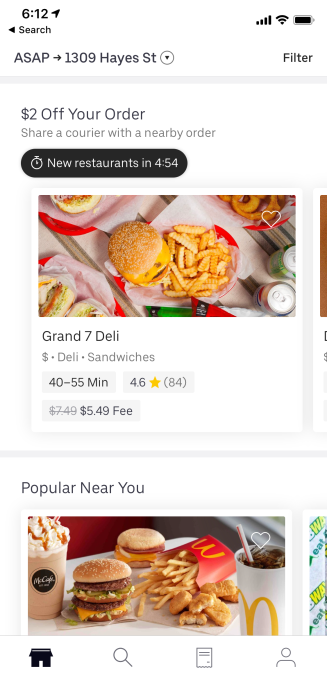
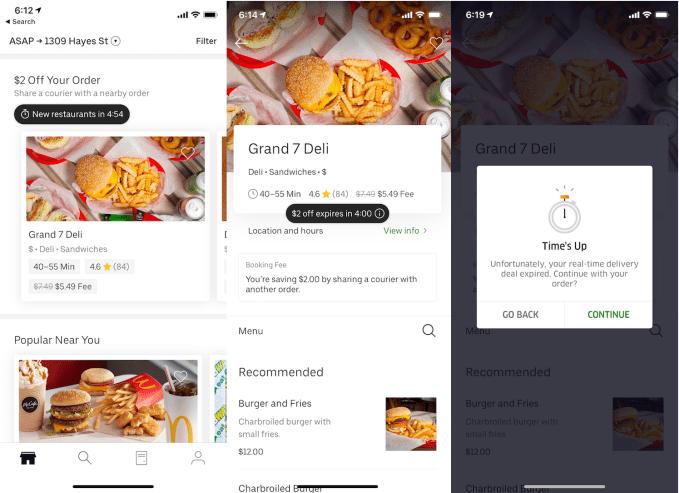
In response to our inquiry, Uber confirmed it’s now testing in some markets a system designed to batch multiple orders from different customers nearby each other to a single restaurant. That way, a single delivery driver can pick up all the orders at once and then speedily distribute them to neighbors or co-workers. Uber must incentivize customers who are close to each other to pick the same restaurant in rapid succession, so it offers a discount.

“$2 off your order — share a courier with a nearby order” the promotion announces atop the Uber Eats homescreen above a carousel of restaurants where you can grab the discount. It’s equipped with a countdown timer to when it will refresh the list of restaurants that follows users on an eatery’s order page. This triggers a sense of urgency to hurriedly buy through Uber Eats (and not check competitors), but also to ensure orders come in close enough together that the first one cooked won’t have to wait long for the last before they’re all scooped up for delivery.

Some customers actually play the Uber Eats Pool discounts like a game they can beat, waiting through several rounds of the timer until they spot one of their favorite restaurants, Chau says with a laugh. For now, passengers don’t ride alongside food orders, though that’s certainly a possibility in the future. And if Uber Eats can batch your order into a Pool with other customers, it will retroactively give you the discount.

“It’s similar to what we did with Uber Pool” Chau tells me. “Generally people are coming in with an intent to eat but there are many, many options available to them. We’re giving you a discount on the food delivery by using machine learning to understand these are some restaurants it might make sense to order from. When multiple people order from the same restaurant, delivery drivers can pick up multiple people’s food.”

Therein lies the leverage. As Stratechery’s Ben Thompson writes about aggregation theory, internet companies are gaining great influence by becoming marketplaces that connect customers with suppliers when previously customers preemptively chose a particular supplier. These platforms not only gain enormous amounts of data on customer preferences, but they also hold the power to point customers to certain suppliers that are willing to play ball.

Uber Builds A Toll Bridge

With all the data, the platforms know just who to show the ads to for a maximum conversion rate. And over time as the aggregator’s perks lure in more customers, it can pit suppliers against each other to further drop their prices or pay more for ads. Spotify used its own playlists to control what songs became popular, and the artists and record labels became beholden to cutting it sweeter deals to stay visible. Amazon looks like the best place to shop because it makes merchants fiercely fight to offer the lowest prices and best customer experience. With Uber Eats Pool, Uber is flexing its ability to influence where you eat, training you to trust where it points you when businesses eventually pay directly to be ranked higher in its app.

“Eats proves the power and potential of the Uber platform, showing how our logistics expertise can create the easiest way to eat” Chau tells me. “We partner with a wide selection of restaurants and bring our trademark speed and coverage to the food delivery experience. This feature shows how leveraging the Uber network allows us to offer people even more affordable dining options.” That quote is even more telling than at first glance. It’s the logistic network that accrues the power and creates leverage over the supplier to benefit customers with the lowest prices.
“We can see on Eats how much more business they’re bringing in and how much is incremental new business. Eventually we’ll be able to do very precise targeting. ‘People who haven’t tried my restaurant before, let’s give them a discount’” Chau tells us. Restaurants are asking him how to grow delivery as a percentage of their orders. “We can see the types of food people are ordering right now but also what they’re searching or are not able to order [because that cuisine isn’t available nearby]. We’re working with them to create new options to fill that gap. They’re able to get much more utilization of their fixed assets and iterate on these concepts much faster than they’re used to.”

Uber demonstrated the data science it could dangle over restaurants with its review of Uber Eats 2018 trends it published this morning. It predicts clean eating, plant-based foods, smoothie bowls, milk alternatives, fermented items like kimchi, and Instagrammably dark ‘goth food’ will rise in popularity next year. Meanwhile, now-tired social media bait ‘rainbow-colored foods’, brussel sprouts, and seaweed are on the decline.

It becomes easy to imagine restaurants running Uber Eats software for tracking order trends and predicting spikes to better manage food and staffing resources, with a baked-in option to buy ads or give deeper discounts to get seen by more hungry people. Chau concludes “Restaurants can think of Uber Eats as a platform that gives them this intelligence.”

from Startups – TechCrunch https://ift.tt/2SBHxJO


#USA How Uber will become an ad company, starting with Eats Pool

//

Where there is discovery in an app, there is paid discovery. Google helped you choose between links, then sold ads that promote a few. Facebook helped you choose between pieces of content, then sold ads that promote a few. And eventually, as Uber helps you choose between restaurants, it will sell ads that promote a few. It could become the marketing platform through which the physical world vies for your attention.

We got our first glimpse of this future last week when I reported that Uber Eats was offering restaurants in India bonus visibility in a Specials section if they’d offer discounts on meal bundles to Uber’s customers. Knock some rupees off the price of a sandwich, fries, and a drink, and a restaurants wins itself some enhanced discoverability. Whether a chef wants to boost orders during slow hours, get rid of surplus food, preference high margin items, or just score new customers, there’s plenty of reasons to pay Uber — even if currently only indirectly through discounts instead of a direct ad buy.

But now Uber’s senior director and head of Eats product Stephen Chau has confirmed to me the company’s intentions to become an ad company. “There’s a bunch of different ways we can work with restaurants over time. If we have all the restaurants on the marketplace and we give them tools to help them grow, then this will be a very efficient marketplace. They’re going to be spending those ad dollars somewhere” Chau tells me. “One of the things we’ve been experimenting with is allowing retailers to create promotions themselves and show them within the product.”

This conversation emerged from TechCrunch spotting Uber’s latest effort to influence where people choose to eat. To be worthy of ad dollars, Uber has to build leverage over restaurants by accruing sway over how people decide between restaurants. And with Uber confidentially filing to go public last week, it needs to prep new revenue streams. So it’s created what’s effectively “Uber Eats Pool”.

Gaining Leverage With Eats Pool

In response to our inquiry, Uber confirmed it’s now testing in some markets a system designed to batch multiple orders from different customers nearby each other to a single restaurant. That way, a single delivery driver can pick up all the orders at once and then speedily distribute them to neighbors or co-workers. Uber must incentivize customers who are close to each other to pick the same restaurant in rapid succession, so it offers a discount.

“$2 off your order — share a courier with a nearby order” the promotion announces atop the Uber Eats homescreen above a carousel of restaurants where you can grab the discount. It’s equipped with a countdown timer to when it will refresh the list of restaurants that follows users on an eatery’s order page. This triggers a sense of urgency to hurriedly buy through Uber Eats (and not check competitors), but also to ensure orders come in close enough together that the first one cooked won’t have to wait long for the last before they’re all scooped up for delivery.

Some customers actually play the Uber Eats Pool discounts like a game they can beat, waiting through several rounds of the timer until they spot one of their favorite restaurants, Chau says with a laugh. For now, passengers don’t ride alongside food orders, though that’s certainly a possibility in the future. And if Uber Eats can batch your order into a Pool with other customers, it will retroactively give you the discount.

“It’s similar to what we did with Uber Pool” Chau tells me. “Generally people are coming in with an intent to eat but there are many, many options available to them. We’re giving you a discount on the food delivery by using machine learning to understand these are some restaurants it might make sense to order from. When multiple people order from the same restaurant, delivery drivers can pick up multiple people’s food.”

Therein lies the leverage. As Stratechery’s Ben Thompson writes about aggregation theory, internet companies are gaining great influence by becoming marketplaces that connect customers with suppliers when previously customers preemptively chose a particular supplier. These platforms not only gain enormous amounts of data on customer preferences, but they also hold the power to point customers to certain suppliers that are willing to play ball.

Uber Builds A Toll Bridge

With all the data, the platforms know just who to show the ads to for a maximum conversion rate. And over time as the aggregator’s perks lure in more customers, it can pit suppliers against each other to further drop their prices or pay more for ads. Spotify used its own playlists to control what songs became popular, and the artists and record labels became beholden to cutting it sweeter deals to stay visible. Amazon looks like the best place to shop because it makes merchants fiercely fight to offer the lowest prices and best customer experience. With Uber Eats Pool, Uber is flexing its ability to influence where you eat, training you to trust where it points you when businesses eventually pay directly to be ranked higher in its app.

“Eats proves the power and potential of the Uber platform, showing how our logistics expertise can create the easiest way to eat” Chau tells me. “We partner with a wide selection of restaurants and bring our trademark speed and coverage to the food delivery experience. This feature shows how leveraging the Uber network allows us to offer people even more affordable dining options.” That quote is even more telling than at first glance. It’s the logistic network that accrues the power and creates leverage over the supplier to benefit customers with the lowest prices.

“We can see on Eats how much more business they’re bringing in and how much is incremental new business. Eventually we’ll be able to do very precise targeting. ‘People who haven’t tried my restaurant before, let’s give them a discount’” Chau tells us. Restaurants are asking him how to grow delivery as a percentage of their orders. “We can see the types of food people are ordering right now but also what they’re searching or are not able to order [because that cuisine isn’t available nearby]. We’re working with them to create new options to fill that gap. They’re able to get much more utilization of their fixed assets and iterate on these concepts much faster than they’re used to.”

Uber demonstrated the data science it could dangle over restaurants with its review of Uber Eats 2018 trends it published this morning. It predicts clean eating, plant-based foods, smoothie bowls, milk alternatives, fermented items like kimchi, and Instagrammably dark ‘goth food’ will rise in popularity next year. Meanwhile, now-tired social media bait ‘rainbow-colored foods’, brussel sprouts, and seaweed are on the decline.

It becomes easy to imagine restaurants running Uber Eats software for tracking order trends and predicting spikes to better manage food and staffing resources, with a baked-in option to buy ads or give deeper discounts to get seen by more hungry people. Chau concludes “Restaurants can think of Uber Eats as a platform that gives them this intelligence.”

from Startups – TechCrunch https://ift.tt/2SBHxJO

#USA How Uber will become an ad company, starting with Eats Pool

//

Where there is discovery in an app, there is paid discovery. Google helped you choose between links, then sold ads that promote a few. Facebook helped you choose between pieces of content, then sold ads that promote a few. And eventually, as Uber helps you choose between restaurants, it will sell ads that promote a few. It could become the marketing platform through which the physical world vies for your attention.

We got our first glimpse of this future last week when I reported that Uber Eats was offering restaurants in India bonus visibility in a Specials section if they’d offer discounts on meal bundles to Uber’s customers. Knock some rupees off the price of a sandwich, fries, and a drink, and a restaurants wins itself some enhanced discoverability. Whether a chef wants to boost orders during slow hours, get rid of surplus food, preference high margin items, or just score new customers, there’s plenty of reasons to pay Uber — even if currently only indirectly through discounts instead of a direct ad buy.

But now Uber’s senior director and head of Eats product Stephen Chau has confirmed to me the company’s intentions to become an ad company. “There’s a bunch of different ways we can work with restaurants over time. If we have all the restaurants on the marketplace and we give them tools to help them grow, then this will be a very efficient marketplace. They’re going to be spending those ad dollars somewhere” Chau tells me. “One of the things we’ve been experimenting with is allowing retailers to create promotions themselves and show them within the product.”

This conversation emerged from TechCrunch spotting Uber’s latest effort to influence where people choose to eat. To be worthy of ad dollars, Uber has to build leverage over restaurants by accruing sway over how people decide between restaurants. And with Uber confidentially filing to go public last week, it needs to prep new revenue streams. So it’s created what’s effectively “Uber Eats Pool”.

In response to our inquiry, Uber confirmed it’s now testing in some markets a system designed to batch multiple orders from different customers nearby each other to a single restaurant. That way, a single delivery driver can pick up all the orders at once and then speedily distribute them to neighbors or co-workers. Uber must incentivize customers who are close to each other to pick the same restaurant in rapid succession, so it offers a discount.

“$2 off your order — share a courier with a nearby order” the promotion announces atop the Uber Eats homescreen above a carousel of restaurants where you can grab the discount. It’s equipped with a countdown timer to when it will refresh the list of restaurants that follows users on an eatery’s order page. This triggers a sense of urgency to hurriedly buy through Uber Eats (and not check competitors), but also to ensure orders come in close enough together that the first one cooked won’t have to wait long for the last before they’re all scooped up for delivery.

Some customers actually play the Uber Eats Pool discounts like a game they can beat, waiting through several rounds of the timer until they spot one of their favorite restaurants, Chau says with a laugh. For now, passengers don’t ride alongside food orders, though that’s certainly a possibility in the future. And if Uber Eats can batch your order into a Pool with other customers, it will retroactively give you the discount.

“It’s similar to what we did with Uber Pool” Chau tells me. “Generally people are coming in with an intent to eat but there are many, many options available to them. We’re giving you a discount on the food delivery by using machine learning to understand these are some restaurants it might make sense to order from. When multiple people order from the same restaurant, delivery drivers can pick up multiple people’s food.”

Therein lies the leverage. As Stratechery’s Ben Thompson writes about aggregation theory, internet companies are gaining great influence by becoming marketplaces that connect customers with suppliers when previously customers preemptively chose a particular supplier. These platforms not only gain enormous amounts of data on customer preferences, but they also hold the power to point customers to certain suppliers that are willing to play ball.

With all the data, the platforms know just who to show the ads to for a maximum conversion rate. And over time as the aggregator’s perks lure in more customers, it can pit suppliers against each other to further drop their prices or pay more for ads. Spotify used its own playlists to control what songs became popular, and the artists and record labels became beholden to cutting it sweeter deals to stay visible. Amazon looks like the best place to shop because it makes merchants fiercely fight to offer the lowest prices and best customer experience. With Uber Eats Pool, Uber is flexing its ability to influence where you eat, training you to trust where it points you when businesses eventually pay directly to be ranked higher in its app.

“Eats proves the power and potential of the Uber platform, showing how our logistics expertise can create the easiest way to eat” Chau tells me. “We partner with a wide selection of restaurants and bring our trademark speed and coverage to the food delivery experience. This feature shows how leveraging the Uber network allows us to offer people even more affordable dining options.” That quote is even more telling than at first glance. It’s the logistic network that accrues the power and creates leverage over the supplier to benefit customers with the lowest prices.

“We can see on Eats how much more business they’re bringing in and how much is incremental new business. Eventually we’ll be able to do very precise targeting. ‘People who haven’t tried my restaurant before, let’s give them a discount’” Chau tells us. Restaurants are asking him how to grow delivery as a percentage of their orders. “We can see the types of food people are ordering right now but also what they’re searching or are not able to order [because that cuisine isn’t available nearby]. We’re working with them to create new options to fill that gap. They’re able to get much more utilization of their fixed assets and iterate on these concepts much faster than they’re used to.”

Uber demonstrated the data science it could dangle over restaurants with its review of Uber Eats 2018 trends it published this morning. It predicts clean eating, plant-based foods, smoothie bowls, milk alternatives, fermented items like kimchi, and Instagrammably dark ‘goth food’ will rise in popularity next year. Meanwhile, now-tired social media bait ‘rainbow-colored foods’, brussel sprouts, and seaweed are on the decline.

It becomes easy to imagine restaurants running Uber Eats software for tracking order trends and predicting spikes to better manage food and staffing resources, with a baked-in option to buy ads or give deeper discounts to get seen by more hungry people. Chau concludes “Restaurants can think of Uber Eats as a platform that gives them this intelligence.”

from Startups – TechCrunch https://ift.tt/2SBHxJO

#Blockchain The Daily: Virtual Land Auction Goes Live, How the Crypto Crash Affects Miners

The Daily: Virtual Land Auction Goes Live, How the Crypto Crash Affects Miners

From mining virtual currencies to purchasing virtual land, Monday’s episode of The Daily spans very different regions of the cryptosphere. We begin with an examination of how the latest bitcoin crash has affected miners, and then follow up with a look at the second Decentraland virtual land auction, which commences at 10 a.m. EST today.

Also read: Trace Mayer Draws Support for Proof of Keys — Celebrating Genesis Block Day

Miners Struggle to Keep the Lights on in Bitcoin’s Darkest Hour

It isn’t easy being a bitcoin miner, what with sunk costs, rapidly devaluing hardware, market volatility, and the stress of competing against every other entrepreneur in the world with the same idea. When the going’s good, the rewards for mining cryptocurrencies such as BTC can be handsome, but when it’s bad, the only certainty is a huge electricity bill at the end of the month. In its latest report, Bitmex Research has examined the effect that plummeting crypto prices have had on miners. It charts the two recent downward difficulty adjustments, in mid-November and early December, before observing that BTC “mining industry revenue has fallen from around $13 million per day, at the start of November, to around $6 million per day, at the start of December.”

The Daily: Virtual Land Auction Goes Live, How the Crypto Crash Affects Miners

The drop in mining revenue outstripped the drop in the price of BTC during this period. The report notes that “There has been considerable speculation around the causes of the price crash, with some saying miners sold [BTC] in order to finance a costly hashwar in Bitcoin Cash. The cryptocurrency intelligence monitoring platform Boltzmann flagged to us that their platform had detected unusually large miner selling of [BTC] on 12th November, a few days before the Bitcoin Cash split.” The report concludes with an observation that others within the crypto community have also made in recent weeks, to the effect that bitcoin mining will remain cost-effective for sufficient miners to secure the network for the foreseeable future:

This is likely to be a very tough time for the mining industry. However, for miners with lower costs, our basic analysis indicates that the situation may be better than people expect. If the miners acquired their equipment from Bitmain at below-cost prices, they could still be in the green, even when including depreciation and other administrative expenses.

Over 9,000 Decentraland Parcels Go Up for Auction

The second Decentraland auction commenced at 10 a.m. EST today, following on from the initial auction that took place in the virtual city last year. All of the remaining 9,331 parcels of land, currently marked as black squares on the map, will be made available via a Dutch auction in which prices begin at 200,000 mana ($12,000), before dropping gradually to as low as 1,000 mana if required. It is expected that all of the new parcels will have been purchased by the time the bidding price falls to around 5,000 mana, however.

The Daily: Virtual Land Auction Goes Live, How the Crypto Crash Affects Miners
Decentraland

During the past week, Decentraland has announced a number of partnerships and integrations, enabling bidders to purchase land using not only mana, but also ZIL, SNT, ELF, DAI, MKR, KNC, RCN, and BNB. There has been significant interest in the project as the auction date has neared, offsetting some of the gloom that’s pervaded the market at large amidst falling cryptocurrency prices. Bloggers have published guides advising interested parties on where the pick of the unclaimed lands lie on the map, and how to go about obtaining them. Despite Decentraland’s virtual world yet to have launched, interest in trading the parcels, represented as ERC721 non-fungible tokens, has been keen, with land fetching as much as $175,000 a square.

What are your thoughts on today’s news tidbits as featured in The Daily? Let us know in the comments section below.


Images courtesy of Shutterstock, Decentraland, and Bitmex Research.


Need to calculate your bitcoin holdings? Check our tools section.

The post The Daily: Virtual Land Auction Goes Live, How the Crypto Crash Affects Miners appeared first on Bitcoin News.

from Bitcoin News https://ift.tt/2QlF6hQ The Daily: Virtual Land Auction Goes Live, How the Crypto Crash Affects Miners

#USA Verve, the word-of-mouth selling platform, acquires Campus Vacations for $7M

//

Verve, the word-of-mouth selling platform, has acquired Campus Vacations, a provider of “unforgettable” travel experiences to students across North America.

The thinking behind the acquisition is to increase Verve’s market share and competitive positioning in the North America and Canada markets. Specifically, Verse says it will provide the company with an entrance into the ski market, including key destinations like Punta Cana and Cancun.

Refreshingly, Verve is also disclosing the purchase price of Campus Vacations: $7 million in aggregate, consisting of a combination of cash, shares and “incentives” over time (presumably based on certain milestones and earn-outs being met).

It follows the acquisition of U.S.-based student travel company JusCollege for $25 million in April, as Verve continues to expand beyond its original focus on live music and sporting events, and into travel.

Members of the Campus Vacations team, including co-founder Justin Van Camp, are joining Verve as part of the acquisition. The other co-founders, Alex Handa and Eugene Winer, are to act as Verve advisors. With the assimilation of the Campus Vacations team, Verve now has over 200 employees globally.

Formerly known as StreetTeam, Verve is a platform that enables people to sell experiences to their friends in exchange for rewards, such as event tickets, trips and backstage passes. It counts more than 25,000 active ambassadors and claims to be the global market leader in word-of-mouth sales for live entertainment and travel experiences.

The company works with over 500 music, travel, hotel and sports brands across North America and Europe. Verve also has global partnerships with ticketing companies including Ticketmaster, Eventbrite, Paylogic and Front Gate Tickets.

“Following the success of acquiring the collegiate travel company JusCollege, and the resulting organic growth, we are continuing our aggressive expansion,” say Verve founders Callum and Liam Negus-Fancey in a joint statement.

“Campus Vacations gives us access to incredible destinations, increases our East Coast presence, delivers us a beachhead into ski, and brings us an incredible team. Not only have they built a fast-growing company that sells high-quality student travel packages, but like us, they understand the unique power and opportunity of harnessing the power of enthusiasts to elevate experiences for them and their friends”.

from Startups – TechCrunch https://ift.tt/2Syjyv8

#Blockchain Trace Mayer Draws Support for Proof of Keys — Celebrating Genesis Block Day

Trace Mayer Draws Support for Proof of Keys - Celebrating Genesis Block Day

Trace Mayer is calling for all bitcoiners to participate in a “Proof of Keys” celebration on Genesis Block day. “Not your keys; not your bitcoin,” he emphasized, urging bitcoiners to declare monetary sovereignty by withdrawing all of their bitcoins held with trusted third parties to software for which they control the private keys.

Also read: Indian Supreme Court Moves Crypto Hearing, Community Calls for Positive Regulations

Proof of Keys

Trace Mayer Draws Support for Proof of Keys — Celebrating Genesis Block DayEarly Bitcoin promoter, investor and podcaster Trace Mayer is hoping to inspire the community to take their bitcoins out of exchanges and third-party wallets on Genesis Block day.

“Let’s start a new #Bitcoin cultural tradition,” he tweeted on Sunday. “I want to start a new cultural tradition where we declare and re-declare our monetary sovereignty every Jan. 3 as a celebration of the Genesis Block,” he said. Mayer has created a website, Proofofkeys.com, to provide details of the event and spread the word. He described:

Every January 3rd the Bitcoin community HODLers of last resort participate in a Proof of Keys celebration by demanding and taking possession of all bitcoins held by trusted third parties on their behalf.

The concept for the event originated from Reddit user “sotashi,” whom Mayer credited on his new website. He further explained that “By demanding and taking possession of their assets, individuals will learn real fast with blockchain proof whether they are part of the elite HODLers or not. Proof of Keys is the annual HODLer initiation.”

Genesis Block Celebration

Trace Mayer Draws Support for Proof of Keys — Celebrating Genesis Block DayMayer has invited anyone interested in participating in the Proof of Keys event to tweet or retweet his message and fill out a form on the Proof of Keys website with links to their tweets. Their names will then be displayed on the website. At the time of this writing, 70 people have filled out the form, including crypto personalities such as Keiser Report co-host Stacy Herbert and Adamant Capital founder Tuur Demeester.

This event will also be “The ultimate stress test,” Mayer added, given that the movement of participants’ coins would result in a large number of transactions on that day. Noting that “Companies and exchanges must prove their trustworthiness and consensus,” he asserted:

This simple exercise costs little, perhaps a few transaction fees, yet proves possession and strengthens network consensus.

“Remember, remember the 3rd of January! And please help spread the word,” Mayer reiterated, adding that “Then on the 4th of January there can be a return to business as usual with renewed confidence based on Proof of Keys.”

Will you be participating in the Proof of Keys event? Let us know in the comments section below.


Images courtesy of Shutterstock and Trace Mayer.


Need to calculate your bitcoin holdings? Check our tools section.

The post Trace Mayer Draws Support for Proof of Keys — Celebrating Genesis Block Day appeared first on Bitcoin News.

from Bitcoin News https://ift.tt/2zN5jLW Trace Mayer Draws Support for Proof of Keys — Celebrating Genesis Block Day

#Blockchain Wirex Introduces Iban for All European Crypto Card Accounts

Wirex Introduces Iban for All Euro Accounts

Cryptocurrency debit card provider Wirex has introduced Iban support for all EUR accounts in the past few weeks. Users in the European Economic Area (EEA) are now able to fund their accounts by bank transfer and receive euro payments. They can also have their salary deposited directly into their Wirex account.  

Also read: Australian Company Issues Loans Backed by Cryptocurrencies

Iban Added to Wirex Accounts in the EEA

Wirex Introduces Iban for All European Crypto Card AccountsThe U.K.-based fintech startup has rolled out Iban functionality across Europe after a successful pilot in four countries over the last couple of months. In September, the company launched Iban support for accounts opened in Spain and France. Later Italy and Germany were added. U.K.-registered accounts had Iban numbers even earlier. The company also raised the funding limits for account holders in the EEA to £15,000, €16,000 and $20,000.

Iban, or international bank account number, is a system of identifying bank accounts that allows international payments. Each Iban is unique and consists of up to 34 alphanumeric characters representing country code, domestic bank account number, branch identifier, and routing information. The Iban also has two check digits which allow the verification of the number and reduce the risk of errors.

Wirex has been a popular choice for cryptocurrency users in Europe since it became the first platform to reintroduce crypto debit cards after they were suspended by Visa last year. Its cards allow users to spend several major cryptocurrencies – bitcoin core (BTC), litecoin (LTC), ethereum (ETH), and ripple (XRP) – in stores and online, anywhere Visa is accepted. That’s possible thanks to instant conversion to three leading fiat currencies – British pound (GBP), euro (EUR) and U.S. dollar (USD). Wirex wallets support all three currencies and can be linked to the Wirex plastic and virtual cards.

Expansion in North America

Wirex Introduces Iban for All European Crypto Card AccountsThe British fintech startup has announced plans to offer its services to customers in North American markets. In August, the company was granted a Fintrac and Money Service Business registration by regulators in Canada, where users can already set up and use Wirex cryptocurrency wallets. The next step is to introduce fiat currency accounts and start issuing contactless crypto debit cards.

Wirex is also preparing to launch in the United States. The company recently posted in its blog that it’s currently looking for beta testers to trial its onboarding process in the U.S. In the announcement, Wirex detailed:

We’ll soon be testing our market-leading offering on American soil for the first time. We’d like to know your thoughts – what you like, what you don’t like and if you detect any bugs that may need our attention before the launch.

Residents of seven pilot states, Nevada, Alaska, Virginia, Tennessee, Massachusetts, Louisiana, and Montana, who have a registered Wirex account have been invited to apply. Wirex will grant approved candidates access to the testing program and they will be able to try its new features before the service is rolled out to the public in the U.S.

What do you think of Wirex adding Iban support for European accounts? Tell us in the comments section below.


Images courtesy of Shutterstock, Smartmockups, Wirex.


Need to calculate your bitcoin holdings? Check our tools section.

The post Wirex Introduces Iban for All European Crypto Card Accounts appeared first on Bitcoin News.

from Bitcoin News https://ift.tt/2GcjCiL Wirex Introduces Iban for All European Crypto Card Accounts