
About Startup365

Chaque jour nous vous présenterons une nouvelle Startup française ! Notre pays regorge de talents et d'entrepreneurs brillants ! Alors partons à la découverte des meilleures startup françaises ! Certaines d'entre elles sont dans une étape essentielle dans la vie d'une startup : la recherche de financement, notamment par le financement participatif (ou crowdfunding en anglais). Alors participez à cette grande aventure en leur faisant une petite donation ! Les startups françaises ont besoin de vous !

#Blockchain Eight Reasons to Use Cryptocurrency Payments in 2019

Op-Ed: 8 Reasons to use Cryptocurrency Payments in 2019

This article on cryptocurrency payments was written by Thomas Highwater, who is an avid fan of all things crypto-related. Mr. Highwater teaches high-school level robotics and programming.

***

While there is a growing number of fiat based-payment processors with a variety of practical tools and methods of payment, adding cryptocurrency payments into the mix provides consumers and merchants with unparalleled benefits. Some of these benefits include simplicity, lower overall cost, security, privacy and a greater level of control over one’s funds. 

Reasons to Use Crypto Next Year

Also read: Wendy McElroy: Avoiding Fraud by Going Crypto-Anarchist

Cryptocurrencies are numerous and versatile and can be utilized as entirely private bank accounts and payment cards for almost any occasion. They offer a multitude of ways to earn a form of interest with little or no effort and help users protect sensitive data and holdings on the go 24/7.

1. Fees

There was a time, not that long ago, when cash was king and financial institutions gave generous incentives to people who chose to put their cold hard cash into institutional coffers. Today, bank accounts of all sorts, as well as debit and credit cards, have fees associated with them — money that goes down the drain and provides no benefit, never mind interest earned. There are debit and credit card fees, ATM fees, merchant fees, checking account fees, overdraft fees, paper fees, check fees, transfer fees, change fees, charge-back fees, foreign transaction fees, minimum balance fees, inactivity fees, false decline fees, et cetera, et cetera.

In comparison, popular cryptocurrency payment gateways like Bitpay and Coinpayments charge between 0.5 perecent and 1 percent per transaction. In most cases, a cryptocurrency account in the form of a digital wallet is entirely free and unless one chooses to invest in cryptocurrency hardware wallets or prepaid cards, other than the transaction fee, using cryptocurrency as money costs absolutely nothing.

2. Sensitive Data

Banks and credit institutions, as well as retailers and service providers, obtain and retain too much of their customers’ personal and financial information. Details including our name, address, employers, social security number, net worth, assets, investments, account balances, credit score, credit line, and transaction history, along with everything we do and buy, who we associate with, when, where, etc. comprise our personal, professional and financial data sets. With traditional financial institutions and traditional fiat currency, we can no longer preserve our privacy. 

Cryptocurrency transactions provide an alternative by limiting the amount of transaction data to mere numbers also known as cryptocurrency wallet addresses and transaction IDs confirming that a wallet-to-wallet transaction took place. A cryptocurrency payment processor acting as a third party will typically require your name (and shipping address for the delivery of physical goods), but the rest of your information will remain private as long as you don’t connect your bank or credit card account and transact solely in BTC and altcoins.

3. International Use

Cryptocurrencies are a borderless means of exchange allowing for instant and cost-effective transactions across the world. There is no waiting, no international fees and no limitations as to who can or cannot send funds to whom or when and where those funds can be accessed. All that is needed is an internet-enabled device like a cellphone and someone without access to a banking institution is given an alternative solution with which they can pay bills, earn income, safe-keep their funds, make purchases and conduct business.

Using cryptocurrencies while traveling adds an extra layer of security and can be used as a remote source of emergency funds that can be accessed without an ID, a bank account, credit cards, a wire transfer or even a personal computer device.

4. Ecommerce

Accepting cryptocurrency online has never been easier. Shopify and Etsy merchants can select to accept BTC, BCH, and altcoins. Woocommerce and Easy Digital Downloads vendors can use WordPress plugins like Mycryptocheckout for the purpose. And then there’s Shapeshift which gives customers the choice to pay with dozens of cryptocurrencies. Shapeshift is integrated with cryptocurrency payment processors like Bitpay and Coingate, and cryptocurrency wallets like Coinomi and Keepkey.

Moreover, there is Purse.io, an online platform where users can buy items from Amazon with cryptocurrency and it is also integrated with Shapeshift, as are Magento and Openbazaar. Setting up cryptocurrency payments is super simple and quick and merchant transaction fees are 60-70 percent lower compared to fiat transaction fees.

5. No Charge Backs

Unfortunately, there are customers who make a purchase, receive the items they ordered and, perhaps, even use them only to cancel their payment. They can do this because fiat payments are not instant.

With cryptocurrencies, things are quite different. Once a transaction has occurred, there is no turning back. Funds ‘travel’ from one wallet to another, the transaction is recorded and it cannot be reversed. This is not to say that a customer cannot return an item and request a refund by communicating directly with the vendor. Of course they can. What they cannot do is place an order, pay for it, receive it and then get the sum they paid back on their account because of money back policies overseen by online payment processors and credit card companies.

Charge backs are meant to prevent fraud and yet they often accomplish the very opposite. In this instance, cryptocurrency works the same way as cash. After you’ve taken the item you paid for with cash, you can’t go back to the store with a damaged or used item, never mind empty-handed, and demand your money back.

6. Mobility

Mobile payments have become all the rage. Being able to use a smartphone in place of a credit card is awfully convenient.

From Paypal and Apple Pay to Mastercard’s Paypass and Visa’s Paywave with near-field communication (NFC) technology and modern POS terminals, getting the check has never been easier. And yet the same privacy and security issues arise as with the rest of traditional, fiat-based financial transactions, namely too much data in one place. All currently available mobile fiat payment processors store credit card information which include all of our financial information and more. Not to mention that all that data is online and on our mobile devices everywhere we go.

Cryptocurrencies are a safer digital cash option and are ideal for mobile payments by default due to their virtual, decentralized nature.

7. A Growing Market

Bitpay, one of the most successful crypto payment gateways, is processing $1 billion worth of transactions annually at a rate of a quarter million transactions per month. Coinpayments already serves millions of vendors in 200 countries and has just integrated with Bittorrent to give its 100 million users the option to pay with BTC and altcoins. Coingate serves 50,000 merchants and has processed hundreds of thousands of cryptocurrency payments, and Utrust just partnered with Payrexx and its 10,000 European merchants.

More integrations and partnerships between cryptocurrency payment processors and fiat payment processors are in the works and the market is expected to grow by 50 percent in the next two years. In particular, Foton announced plans to attract 100 million users by 2020 and offer competitive features including its own stablecoin, fiat pairs, atomic swaps, a loan and escrow service, and a payment card with loyalty rewards and cash back. 

So there is no doubt: millions of merchants all over the world accept cryptocurrencies, as do tens of thousands of websites.

8. Commercial Use

It has been estimated that some 20 million people worldwide own cryptocurrency. Most others have heard of bitcoin and many plan on adding it to their portfolio.

Square, a credit card payment processor serving merchants, employers and mobile payment users, is gradually out-competing Paypal while also increasing its profits through BTC sales. The majority of Square’s merchant customers have expressed interest in accepting bitcoin core and a 2017 Cambridge Centre for Alternative Finance study confirmed that 40 percent of consumers would, indeed, like to be able to make purchases with BTC.

Countries with weaker than average fiat currencies tend to favor the use of cryptos. Turkey, Venezuela, Brazil, Australia and South Africa appear to have large numbers of cryptocurrency users. In fact, a whopping 80 percent of Australians would like to use cryptocurrencies for daily purchases. Merchants in Eastern Europe and small western European towns seem more open toward adding bitcoin as a method of payment. Even before the 2017 cryptocurrency bull market, more than 10 percent of Eastern Europeans reported using cryptocurrency in place of fiat for everyday purchases.

Crypto as Money

Nowadays, almost anything can be paid directly with cryptocurrencies: homes, condos, boats, cars, clothing, electronics, health and pet products, food, wine, accessories, plane tickets, vacations, tools, musical instruments, as well as dating services, professional services, internet services, and, of course crypto gear.

Without pointing out the obvious, let’s look at the most interesting things digital currencies can buy you:

  •  Enjoy a Thai or Indian restaurant in Montreal or have Dutch pancakes in Aruba
  •  Buy vintage furniture in Massachusetts or rent an office in Miami
  •  See the Cerro Negro volcano in Nicaragua or charter a yacht in South Florida
  •  Buy a Benz or a Beamer in California or a Rolex in Europe

The Market According to Experts

In January, a company called Bakkt, owned by the Intercontinental Exchange (ICE) which also owns the New York Stock Exchange (NYSE), will launch bitcoin futures which will be settled in BTC, not cash. Its partners include Microsoft, Starbucks and Pantera Capital. There will be no leverage trading, meaning that actual bitcoin will have to be bought and owned for the duration of the contract. Given that these are institutional investors, BTC’s volume is expected to reach new heights. The CEO of ICE and NYSE chairman Jeff Sprecher stated that digital assets are here to stay and that they “have a future in regulated markets.”

It is evident that the cryptocurrency industry has grown by leaps and bounds in the past 10 years since Bitcoin was born. Fintech is transforming the financial industry and more and more people are getting onboard. Shopping in-store and online is going fully digital but raising cyber security fears, which can be drastically reduced with a broader acceptance of cryptocurrencies as a means of payment.

Do you think payments in crypto will continue to trend? Is this the route to mass adoption? 


Images courtesy of Shutterstock


OP-ed disclaimer: This is an Op-ed article. The opinions expressed in this article are the author’s own. Bitcoin.com does not endorse nor support views, opinions or conclusions drawn in this post. Bitcoin.com is not responsible for or liable for any content, accuracy or quality within the Op-ed article. Readers should do their own due diligence before taking any actions related to the content. Bitcoin.com is not responsible, directly or indirectly, for any damage or loss caused or alleged to be caused by or in connection with the use of or reliance on any information in this Op-ed article.


The post Eight Reasons to Use Cryptocurrency Payments in 2019 appeared first on Bitcoin News.

from Bitcoin News https://ift.tt/2RG3Y0d Eight Reasons to Use Cryptocurrency Payments in 2019

#Blockchain Korean Court Case Alleges Government’s ICO Ban Is Unconstitutional

Korean Court Case Alleges Government's ICO Ban Is Unconstitutional

A constitutional complaint has reportedly been filed in South Korea alleging that the government’s ban on initial coin offerings is unconstitutional. It has been more than a year since token sales were banned in the country but the government has yet to introduce any regulations for them, causing problems for startups.

Also read: Indian Supreme Court Moves Crypto Hearing, Community Calls for Positive Regulations

Constitutional Complaint Filed

South Korean blockchain startup Presto announced on Friday that it has filed a constitutional complaint alleging that the government’s ban on all forms of initial coin offerings (ICOs) in September last year is unconstitutional, local media reported. The company has requested an appeal of the ban, according to Sedaily.

Korean Court Case Alleges Government’s ICO Ban Is Unconstitutional
Constitutional Court of Korea.

Presto CEO Kang Kyung-won explained that although his company had considered alternative means such as setting up an overseas corporation to issue tokens, the Korea Economic Daily quoted him as saying, “We trusted that the government will foster [this] new industry through follow-up measures.” However, it has been more than a year since the ban and the government has yet to introduce any forms of ICO guidelines or regulations. Kang was further quoted by Sedaily as saying:

As a blockchain startup company, we face a great deal of difficulties due to the ICO ban and the lack of legislation from the government and the parliament for more than a year. I am requesting confirmation of the unconstitutionality of the lack of legislation.

Lawyer Explains Why the Ban Is Unconstitutional

Korean Court Case Alleges Government’s ICO Ban Is UnconstitutionalLawyer Park Ju-hyun, who is in charge of filing this case, explained last week why the government’s ICO measures are unconstitutional, Zdnet Korea reported. He noted that the measures can be subject to a constitutional appeal if a request is filed with the constitutional court.

Park said the ban is unconstitutional on two grounds. The first is that it infringes on “the basic rights of the Constitution,” such as “freedom of occupation, right to property, [and] right to equality,” Sedaily wrote. His “second point is that the basic restrictions were imposed without legal basis,” which he cited Article 37 (2) of the Korean Constitution, the news outlet added.

Korean Court Case Alleges Government’s ICO Ban Is UnconstitutionalThe lawyer also referenced a recent court case where the court ruled that one of the country’s largest banks, Nonghyup Bank, illegally blocked transactions of cryptocurrency exchange Coinis. He reiterated the importance of “whether there is a legal basis,” noting that the bank’s action was illegal because it was done without a legal basis.

Presto emphasized that the ban infringes on “the right to equality because it arbitrarily discriminates against ICO companies without reason,” compared to initial public offerings or other types of crowdfunding methods, Sedaily conveyed.

Do you think the Korean government’s ICO ban is unconstitutional? What do you think the court will do? Let us know in the comments section below.


Images courtesy of Shutterstock.


Need to calculate your bitcoin holdings? Check our tools section.

The post Korean Court Case Alleges Government’s ICO Ban Is Unconstitutional appeared first on Bitcoin News.

from Bitcoin News https://ift.tt/2Ep4Ovw Korean Court Case Alleges Government’s ICO Ban Is Unconstitutional

#Blockchain Australian Company Issues Loans Backed by Cryptocurrencies

Australian Company Issues Loans Backed by Cryptocurrencies

A Melbourne-based company is now offering crypto-backed loans. Helio operates under an Australian Credit License (ACL) issued by the Australian Securities and Investments Commission (ASIC). In the current bear market, cryptocurrency holders can borrow fiat money and keep their digital coins for better times.   

Also read: Chat Bot Advises Crypto Startups and Investors

Helio Lends Fiat Against Crypto as Collateral

Australian Company Issues Loans Backed by CryptocurrenciesHelio Lending accepts four major cryptocurrencies as collateral. The platform currently supports bitcoin core (BTC), ethereum (ETH), litecoin (LTC), and ripple (XRP). It offers loans for up to 48 months and with an APR of between 17 and 24 percent, depending on the value of the collateral.

Customers can choose between 30, 40 and 50 percent loan-to-value (LTV) ratio. For example, a 10,000 Australian-dollar loan with a 30 percent LTV would require the borrower to pledge 7.19 BTC as collateral. In this case, the APR would be 17 percent and the monthly payment 350 Australian dollars (around US $250).

Helio’s website has a calculator that can produce different loan configurations. The minimum amount that can be borrowed is set at 1,000 Australian dollars. The application process starts with providing a valid email address. To complete signup, applicants should follow the confirmation link sent by the platform.

Credit License Secured

Australian Company Issues Loans Backed by CryptocurrenciesAccording to Helio’s founder, John O’Shea, his company is the first licensed entity in Australia to offer crypto-backed loans. He believes there’s a massive market for digital assets in the country. Some estimates suggest that Australians perform cryptocurrency transactions worth around $2.8 million daily.


Speaking to Businessbuyinvest.com, O’Shea stated there are currently not enough service providers and companies willing or able to support the growing market and to loan against crypto assets. That’s why he sees an opportunity to “capitalize on something that is so highly sought after, yet so underserviced.” The entrepreneur explained:

We provide finance to both individuals and businesses through cryptocurrency asset-backed lending. This means that clients who hold bitcoin, ethereum, litecoin or ripple are able to use their assets as collateral for loan financing.

Unlike traditional lenders, Helio can rely on the digital assets transferred by its customers to a secured collateral wallet. In the event of a default, the company can sell the coins to cover the losses. At the same time, Helio’s customers can benefit from the protection provided by ACL and ASIC laws and regulations.

According to Australian media reports, Helio Lending has obtained its credit license by acquiring another company that held one, Cashflow Investment. The ACL license will allow Helio to offer its clients even more favorable terms in the future.

What do you think about cryptocurrency-backed loans? Share your thoughts on the subject in the comments section below.  


Images courtesy of Shutterstock.


Make sure you do not miss any important Bitcoin-related news! Follow our news feed any which way you prefer; via Twitter, Facebook, Telegram, RSS or email (scroll down to the bottom of this page to subscribe). We’ve got daily, weekly and quarterly summaries in newsletter form. Bitcoin never sleeps. Neither do we.

The post Australian Company Issues Loans Backed by Cryptocurrencies appeared first on Bitcoin News.

from Bitcoin News https://ift.tt/2E9GD39 Australian Company Issues Loans Backed by Cryptocurrencies

#Blockchain Simple Ledger Developers Publish Monthly Puzzle With Bitcoin Cash Treasure

Simple Ledger Developers Publish Monthly Puzzle With Bitcoin Cash Treasure

In late November, the creators of the Simple Ledger Protocol announced the launch of Ledger Treasure, a contest in which contestants must solve a puzzle to win over $100 worth of bitcoin cash (BCH). On Dec. 6, Simple Ledger developer James Cramer revealed the winner of the first puzzle solved by gaining access to the BCH funds locked in a special P2SH address.

Also read: Previously Inactive Whales Are Moving Large Amounts of BTC

Simple Ledger Treasure

Simple Ledger Developers Publish Monthly Puzzle With Bitcoin Cash TreasureDevelopers of the Simpleledger.io (SLP) project are hosting a monthly contest that offers the chance to win over $100 worth of BCH for solving a puzzle. The team will be giving away BCH after crafting a solvable puzzle and publishing it with the project’s monthly newsletter. On Dec. 6, the first winner received 1 BCH for unlocking the funds contained in a bitcoin cash P2SH address. The first issue of the Ledger Treasure newsletter sent out to registrants contained the maiden puzzle, called “Stashed Cash 1.” The 1 BCH of locked funds in a P2SH address was solved one hour after the puzzle was published, explained its creator James Cramer.

Simple Ledger Developers Publish Monthly Puzzle With Bitcoin Cash Treasure

The first thing people need to do to solve the puzzle is load a script template JSON file into the P2SH.cash website, a tool that enables a P2SH spend, a calculator, and oracle. After loading the template, the user needs to actually search for the address with the funded BCH inside. If the treasure hunter doesn’t understand much about P2SH script then the puzzle gives a great lesson about the protocol. In order to complete it, the contestant needs to fill in the blanks within the “redeem script” section. A math equation is then presented within the script template which shows the basics of how stack-based math operates.

“The final requirement of this puzzle was to interact with the Ledger Treasure Newsletter, which is accomplished using the ‘Oracles’ tab of the P2SH.cash website,” explained Cramer’s blog post on the subject. “The oracle’s public key was required for the redeem script section and the unlocking script section oracle’s signature was required for the unlocking script section in the ‘Spend P2SH’ tab,” the developer added.

The creator of the Ledger Treasure Newsletter hunt continued by stating:   

The only way to obtain a valid signature for this puzzle is to first be a subscriber of the Ledger Treasure newsletter.

Simple Ledger Developers Publish Monthly Puzzle With Bitcoin Cash Treasure

More Difficult Bitcoin Cash P2SH Puzzles Are on the Way

Cramer concluded that the first puzzle was a success and stated that at least three other challengers solved it within three days. The Simple Ledger developer said that he looks forward to devising more puzzles and that the first one wasn’t that hard. Eventually, the creator intends to make the puzzles significantly more difficult as time passes but still wants to create simple puzzles for new visitors. Cryptocurrency enthusiasts who want to attempt to solve the next Ledger puzzle need to sign up for the newsletter before the second edition is published on the first of January.

What do you think about the Simple Ledger treasure hunt? Let us know what you think about this subject in the comments section below.


Images via the Ledger Treasure newsletter, SLP, and Shutterstock. 


Need to calculate your bitcoin holdings? Check our tools section.

The post Simple Ledger Developers Publish Monthly Puzzle With Bitcoin Cash Treasure appeared first on Bitcoin News.

from Bitcoin News https://ift.tt/2E9xYOn Simple Ledger Developers Publish Monthly Puzzle With Bitcoin Cash Treasure

#USA Why you need a supercomputer to build a house

//

When the hell did building a house become so complicated?

Don’t let the folks on HGTV fool you. The process of building a home nowadays is incredibly painful. Just applying for the necessary permits can be a soul-crushing undertaking that’ll have you running around the city, filling out useless forms, and waiting in motionless lines under fluorescent lights at City Hall wondering whether you should have just moved back in with your parents.

Consider this an ongoing discussion about Urban Tech, its intersection with regulation, issues of public service, and other complexities that people have full PHDs on. I’m just a bitter, born-and-bred New Yorker trying to figure out why I’ve been stuck in between subway stops for the last 15 minutes, so please reach out with your take on any of these thoughts: @Arman.Tabatabai@techcrunch.com.

And to actually get approval for those permits, your future home will have to satisfy a set of conditions that is a factorial of complex and conflicting federal, state and city building codes, separate sets of fire and energy requirements, and quasi-legal construction standards set by various independent agencies.

It wasn’t always this hard – remember when you’d hear people say “my grandparents built this house with their bare hands?” These proliferating rules have been among the main causes of the rapidly rising cost of housing in America and other developed nations. The good news is that a new generation of startups is identifying and simplifying these thickets of rules, and the future of housing may be determined as much by machine learning as woodworking.

When directions become deterrents

Photo by Bill Oxford via Getty Images

Cities once solely created the building codes that dictate the requirements for almost every aspect of a building’s design, and they structured those guidelines based on local terrain, climates and risks. Over time, townships, states, federally-recognized organizations and independent groups that sprouted from the insurance industry further created their own “model” building codes.

The complexity starts here. The federal codes and independent agency standards are optional for states, who have their own codes which are optional for cities, who have their own codes that are often inconsistent with the state’s and are optional for individual townships. Thus, local building codes are these ever-changing and constantly-swelling mutant books made up of whichever aspects of these different codes local governments choose to mix together. For instance, New York City’s building code is made up of five sections, 76 chapters and 35 appendices, alongside a separate set of 67 updates (The 2014 edition is available as a book for $155, and it makes a great gift for someone you never want to talk to again).

In short: what a shit show.

Because of the hyper-localized and overlapping nature of building codes, a home in one location can be subject to a completely different set of requirements than one elsewhere. So it’s really freaking difficult to even understand what you’re allowed to build, the conditions you need to satisfy, and how to best meet those conditions.

There are certain levels of complexity in housing codes that are hard to avoid. The structural integrity of a home is dependent on everything from walls to erosion and wind-flow. There are countless types of material and technology used in buildings, all of which are constantly evolving.

Thus, each thousand-page codebook from the various federal, state, city, township and independent agencies – all dictating interconnecting, location and structure-dependent needs – lead to an incredibly expansive decision tree that requires an endless set of simulations to fully understand all the options you have to reach compliance, and their respective cost-effectiveness and efficiency.

So homebuilders are often forced to turn to costly consultants or settle on designs that satisfy code but aren’t cost-efficient. And if construction issues cause you to fall short of the outcomes you expected, you could face hefty fines, delays or gigantic cost overruns from redesigns and rebuilds. All these costs flow through the lifecycle of a building, ultimately impacting affordability and access for homeowners and renters.

Startups are helping people crack the code

Photo by Caiaimage/Rafal Rodzoch via Getty Images

Strap on your hard hat – there may be hope for your dream home after all.

The friction, inefficiencies, and pure agony caused by our increasingly convoluted building codes have given rise to a growing set of companies that are helping people make sense of the home-building process by incorporating regulations directly into their software.

Using machine learning, their platforms run advanced scenario-analysis around interweaving building codes and inter-dependent structural variables, allowing users to create compliant designs and regulatory-informed decisions without having to ever encounter the regulations themselves.

For example, the prefab housing startup Cover is helping people figure out what kind of backyard homes they can design and build on their properties based on local zoning and permitting regulations.

Some startups are trying to provide similar services to developers of larger scale buildings as well. Just this past week, I covered the seed round for a startup called Cove.Tool, which analyzes local building energy codes – based on location and project-level characteristics specified by the developer – and spits out the most cost-effective and energy-efficient resource mix that can be built to hit local energy requirements.

And startups aren’t just simplifying the regulatory pains of the housing process through building codes. Envelope is helping developers make sense of our equally tortuous zoning codes, while Cover and companies like Camino are helping steer home and business-owners through arduous and analog permitting processes.

Look, I’m not saying codes are bad. In fact, I think building codes are good and necessary – no one wants to live in a home that might cave in on itself the next time it snows. But I still can’t help but ask myself why the hell does it take AI to figure out how to build a house? Why do we have building codes that take a supercomputer to figure out?

Ultimately, it would probably help to have more standardized building codes that we actually clean-up from time-to-time. More regional standardization would greatly reduce the number of conditional branches that exist. And if there was one set of accepted overarching codes that could still set precise requirements for all components of a building, there would still only be one path of regulations to follow, greatly reducing the knowledge and analysis necessary to efficiently build a home.

But housing’s inherent ties to geography make standardization unlikely. Each region has different land conditions, climates, priorities and political motivations that cause governments to want their own set of rules.

Instead, governments seem to be fine with sidestepping the issues caused by hyper-regional building codes and leaving it up to startups to help people wade through the ridiculousness that paves the home-building process, in the same way Concur aids employee with infuriating corporate expensing policies.

For now, we can count on startups that are unlocking value and making housing more accessible, simpler and cheaper just by making the rules easier to understand. And maybe one day my grandkids can tell their friends how their grandpa built his house with his own supercomputer.

And lastly, some reading while in transit:

from Startups – TechCrunch https://ift.tt/2rAo5BX

#Blockchain Report: South Korea to Push for Major Adoption of Cryptocurrencies

Korea Roundup: Mongolian Government Visits Bithumb, New BTM, Hardware Wallet

South Korea will push for major cryptocurrency adoption, claims a new report, strengthening the spotlight on the tech hub which forms one of the most crypto-friendly countries in the world. 

Also read: Korean Incoming Minister Confirms Crypto Taxation Plans

South Korea’s Enthusiasm for Tech

South Korea to push for major adoption of cryptocurrencies – reportAs one of the most innovative countries in the world, it’s no surprise the tech-savvy population of South Korea has been quick to take to cryptocurrencies and blockchain technology. In fact, the small country makes up around 30 percent of global cryptocurrency trading, despite having a population of little over 51 million.

Now, a report by fintech company Cindicator has stated that the country is going to play an even bigger role in the adoption of cryptocurrencies in the future, partly due to its highly developed cryptocurrency exchange infrastructure and regulatory and taxation framework. The report claims:

These projects and their eventual success are obviously a great indication of what crypto believers in the country feel the new technology could do in the future.

South Korea to push for major adoption of cryptocurrencies – reportThe report states that it is because of exchanges such as Bithumb – the country’s largest – that South Korea ranks so highly worldwide in terms of the sheer volume of trading. As well as the country housing major exchanges such as Upbit, Korbit, and Coinone, it is home to a number of crypto and blockchain projects, which are a “great indication of what crypto believers in the country feel the new technology could do in the future.”


The report notes the many occasions when the announcement of a new altcoin listing on a South Korean exchange saw its value skyrocket. South Koreans have been quick to get involved with crypto because of the desire to reap potentially large profits and an enthusiasm for the technology itself.

Greater Regulation Coming Soon

The South Korean government this week announced it would be taxing cryptocurrencies and initial coin offerings – despite bitcoin and other cryptocurrencies being exempt from capital gains tax since 2013. But the government fully understands the potential of blockchain technology, having recently announced 1 trillion won (USD $880 million) to spend on blockchain development in 2019.

The newly elected mayor of Jeju Island, Won Hee-ryong, who ran on a pro-blockchain and cryptocurrency ticket, provides further evidence to suggest that South Korea will play a pivotal role in advancing global adoption of cryptocurrencies and their underlying technology.

What do you think about the role South Korea will play in the future of global cryptocurrency adoption? Let us know in the comments section below.


Images courtesy of Shutterstock.


Express yourself freely at Bitcoin.com’s user forums. We don’t censor on political grounds. Check forum.Bitcoin.com.

The post Report: South Korea to Push for Major Adoption of Cryptocurrencies appeared first on Bitcoin News.

from Bitcoin News https://ift.tt/2EjJVlr Report: South Korea to Push for Major Adoption of Cryptocurrencies

#Blockchain Malaysian Financial Regulators to Intensify Scrutiny of ICOs, Cryptocurrencies

Malaysia Financial Regulators to Intensify Scrutiny of ICOs, Cryptocurrencies

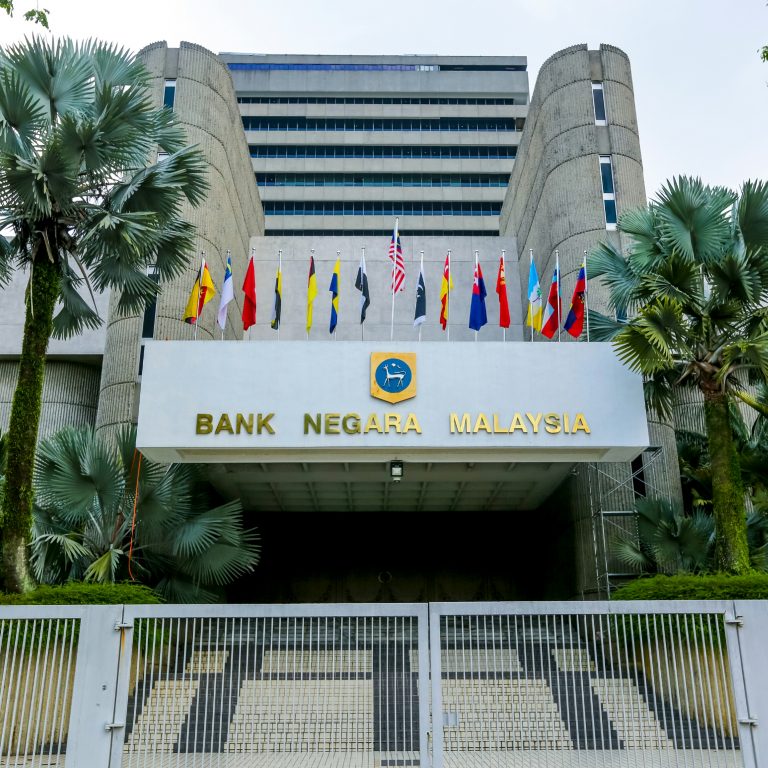
Malaysia’s securities regulator and central bank are to strengthen their scrutiny of initial coin offerings (ICOs) through new rules meant to eliminate issues of unfair trade practices and alleged risk of money laundering and terrorism financing. The Securities Commission Malaysia (SC) and Bank Negara Malaysia (BNM) said they will also tighten regulation in the trade of cryptocurrencies to boost investor security.

Also read: Brazilian Bitcoin Exchange Sends User $35M in Bug-Induced Error

‘Fair and Orderly Trading’

“The SC will regulate issuances of digital assets via ICOs and the trading of digital assets at digital asset exchanges in Malaysia,” the regulators said in a joint statement released Dec. 6. “Regulations are currently being put in place to bring digital assets within the remit of securities laws to promote fair and orderly trading and ensure investor protection,” they added.

Malaysian Financial Regulators to Intensify Scrutiny of ICOs, Cryptocurrencies

Bitcoin and other digital currencies are not recognized as legal tender in Malaysia, but they aren’t banned either. That means individuals or companies trading cryptocurrency are free to do so, but are not protected by law. However, under the anti-money laundering legislation, all crypto asset exchanges operating in Malaysia are subject to reporting obligations.

Malaysian finance minister Lim Guan Eng said cryptocurrency regulations will come into force during the first quarter of 2019. He also warned individuals and companies planning to issue new cryptocurrencies with a stern: “Don’t do it,” advising to wait for guidance from the country’s central bank.

Lim Guan Eng said the government was open to emerging forms of money such as virtual currency, but only if they adhere to the law.

 Enforcing Compliance

Now the Securities Commission and Bank Negara are starting to put that regulatory framework together. The two “will enter into coordination arrangements to ensure compliance with laws and regulations under the purview of both regulators,” said the statement.

Malaysian Financial Regulators to Intensify Scrutiny of ICOs, Cryptocurrencies

It added: “Initial coin offering issuers and digital asset exchanges which are involved in the issuance or dealing of digital assets with a payment function will need to comply with relevant BNM laws and regulations relating to payments and currency matters.”

Malaysia is slowly emerging as a hotbed of cryptocurrency trading. The government isn’t particularly averse to the technology. For example, Pakatan Harapan, Malaysia’s ruling party, is raising political funding through a cryptocurrency called “harapan coin,” in preparation for the 2019 general elections. Party officials say they have submitted documents of the harapan coin to Bank Negara for approval.

What do you think about the regulatory developments in Malaysia? Let us know in the comments section below.


Images courtesy of Shutterstock.


Need to calculate your bitcoin holdings? Check our tools section.

The post Malaysian Financial Regulators to Intensify Scrutiny of ICOs, Cryptocurrencies appeared first on Bitcoin News.

from Bitcoin News https://ift.tt/2rttMl4 Malaysian Financial Regulators to Intensify Scrutiny of ICOs, Cryptocurrencies

#Blockchain BCH App ‘Honest Cash’ Sees Significant Growth and Adds Native Wallet

BCH App 'Honest Cash' Sees Significant Growth and Adds Native Wallet

Social media platform Honest Cash has activated 200 new users and added a few new features, according to its creator Adrian Barwicki. News.Bitcoin.com reported on its initial launch during the last week of November, when the blogging platform started with the first 100 registrants.

Also read: ‘Crypto Crisis’ Mining Simulator Lets Players Relive the Last 10 Years of Bitcoin

Honest Cash Sees 7-10% Daily Growth

BCH App ‘Honest Cash’ Sees Significant Growth and Adds Native WalletSince the Bitcoin Cash (BCH) network hard fork a few weeks ago, a new social media platform called Honest Cash was launched for BCH proponents. Similar to blogging platforms like Medium or Steemit, the Honest Cash application gives registered users the ability to create a unique profile tethered to a BCH wallet and post written content in short or long form. Initially registered users could only post written text, but since then, Barwicki has added the ability to upload photos and videos as well. This means the Honest Cash community of users can reward good content by tipping not just writers, but vloggers, graphic artists, reporters, and more with bitcoin cash.
Barwicki has been registering users by invite-only after people sign up with a valid email address and had approved 100 users during the week news.Bitcoin.com tested the platform. On Friday, the developer announced that the team activated 200 more users and they have only 50 slots open for the rest of the trial period. Moreover, looking at the data, Honest Cash has grown 7-10 percent a day and that’s not including the waiting list Barwicki detailed on Twitter.

“Another 200 accounts have just been activated on Honest Cash,” the founder emphasized.   

190 stories have been published, 150 are being written, 120 tips/upvotes were given since two days ago and we have an elite retention rate of over 50% — Is something growing like this on BSV?

BCH App ‘Honest Cash’ Sees Significant Growth and Adds Native Wallet
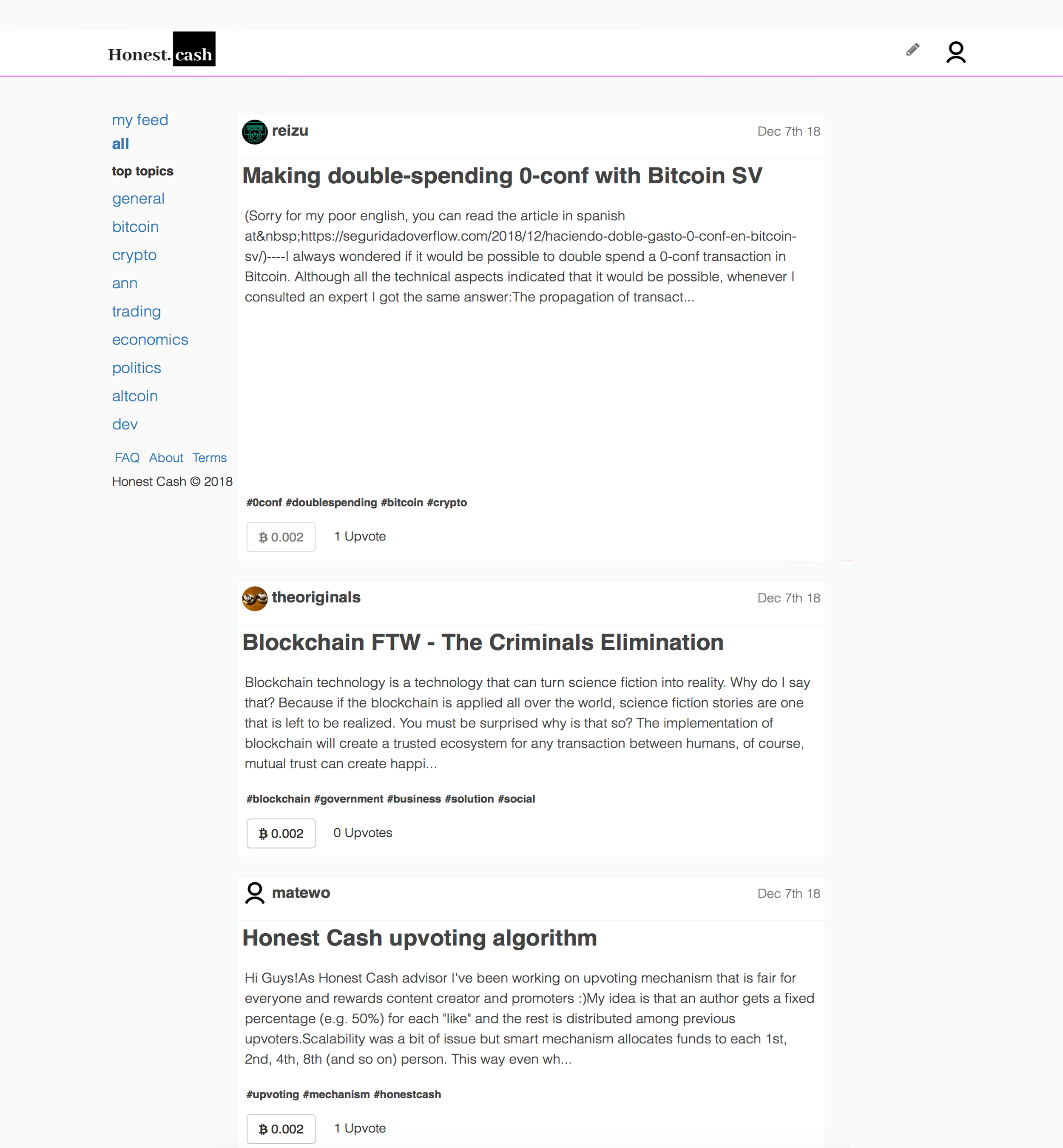
The Honest Cash news feed.

New Native Wallet and the First Uncensorable Post

While scrolling through the Honest Cash front page, the feed consists of subjects like bitcoin, cryptocurrencies, trading, economics, and politics which shows the platform is growing. Users can now follow other users and unique content creators can grow a list of followers too. Additionally, the Honest Cash application allows individuals to tether their Twitter profile or Reddit account to the platform. When news.Bitcoin.com tested the platform in November, you could tether a third-party wallet to a profile. But now Honest Cash has its own native client which can generate a new wallet. Users can also import existing keys with custom HD derivation path support.

BCH App ‘Honest Cash’ Sees Significant Growth and Adds Native Wallet
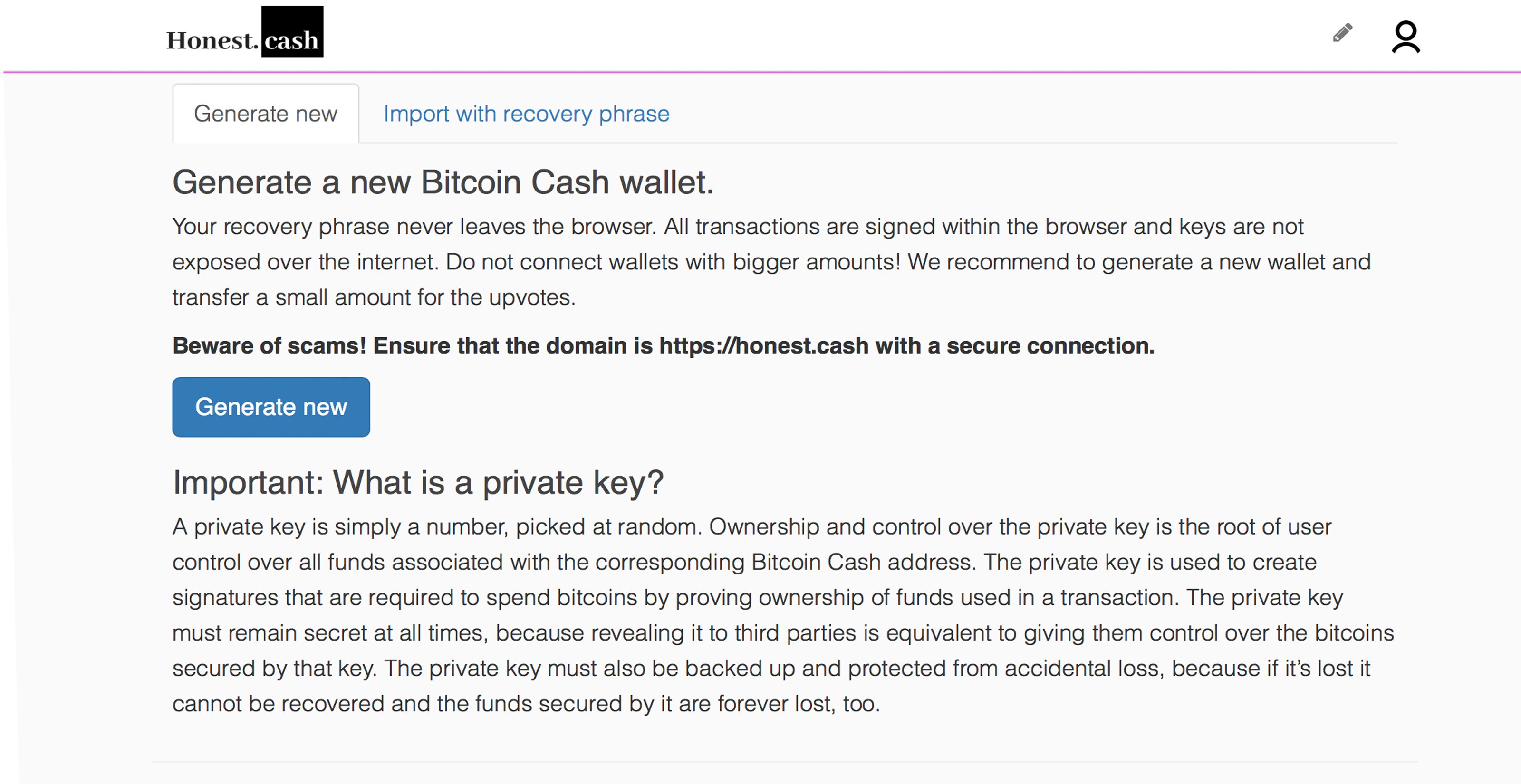
Honest Cash can now generate a new BCH wallet or connect to an existing wallet with a recovery phrase.

Recovery phrases never leave the browser, explains the Honest Cash website, and with all the transactions signed, the software never exposes keys over the internet. However Honest Cash recommends not attaching a wallet with a large amount of BCH, as only a small amount of funds is needed to tip and upvote. Furthermore, five days ago the first uncensorable post was recorded on the Honest Cash platform with a little help from the Bitcoin Files platform.

“It cannot be removed, censored or amended. It is saved in the history of mankind for all times — Be honest,” explains the post with the bitcoin file hash.

What do you think about the Honest Cash platform? Let us know what you think about this subject in the comments section below.


 Images via Shutterstock, Honest Cash, and Pixabay.


At news.Bitcoin.com all comments containing links are automatically held up for moderation in the Disqus system. That means an editor has to take a look at the comment to approve it. This is due to the many, repetitive, spam and scam links people post under our articles. We do not censor any comment content based on politics or personal opinions. So, please be patient. Your comment will be published.

The post BCH App ‘Honest Cash’ Sees Significant Growth and Adds Native Wallet appeared first on Bitcoin News.

from Bitcoin News https://ift.tt/2Qh9Hgx BCH App ‘Honest Cash’ Sees Significant Growth and Adds Native Wallet

#Blockchain Wendy McElroy: Avoiding Fraud by Going Crypto-Anarchist

Avoiding Fraud By Going Crypto-Anarchist

The Satoshi Revolution: A Revolution of Rising Expectations
Section 5: Saving the World Through Anarchism
Chapter 11, Part 8
Avoiding Fraud By Going Crypto-Anarchist

A transfer on the blockchain is a simplistic peer-to-peer contract, which memorializes the terms for those involved and is seen to be valid by the surrounding community through transparency. It is a voluntary exchange. The blockchain is also an instrument of enforcement that embodies the terms of execution, such as irreversibility, to which both parties have agreed; their agreement is expressed through the willingness to use the blockchain. Thus the blockchain expresses both requirements of libertarian law; it facilitates voluntary interaction and it acts as an instrument of enforcement.

–Wendy McElroy, “Don’t Smash the State, Bypass the State”

The late Samuel E. Konkin III (SEK3), the father of agorism and an old drinking buddy of mine, used to answer his telephone with the salutation “Smash the State.” And, yet, his lifestyle did not include direct confrontations with authority. Whenever possible, SEK3 avoided or replaced the state in his daily life, because he knew that the most effective way to smash the state was to render it irrelevant. His lasting legacy to anarchist theory: Agorism is a peaceful revolution that is achieved by counter-economics, which SEK3 defined as “the study or practice of all peaceful human action which is forbidden by the State.” Counter-economics is a black market version of Ludwig von Mises’s praxeology—the study of human action that flaunts the state.

SEK3 would have reveled in the audacity of cryptocurrency, which both avoids and replaces state fiat because being a better currency is the surest way to destroy fiat. He would have declared crypto to be the “counter-economic currency”–the currency of agorism. But more than this. In a flash, SEK3 would have recognized crypto’s implications for justice, because it also avoids and replaces state law as the default position for contracts. The default position becomes the free market or agorism. I can see SEK3 take a swig of black beer and a drag on his constantly present pipe, before announcing that anarchy had arrived.

The message of anarchism never should have been “smash the state” or “convince everyone to become an anarchist.” Those are impossible ends. The message should be “free yourself” by decentralizing the power expressed by every decision into your own hands. To the extent you can act as though the state does not exist, it does not.


The Basis of a Free Society

The contract is the basis of anarchist law because it is tangible evidence of the consent of individuals, upon which a free society rests. That’s why it is essential to decentralize contracts under the direct control of participants. The blockchain is a self-executing transfer, with immutable and transparent terms that are dictated by the users rather than by the jurisdiction of a state; it can become a self-executing agreement through the addition of a smart contract. (Note: smart contracts are still a developing technology, but proof of principle is definitely there.) The blockchain is its own defense against fraud and theft, largely because it bypasses trusted third parties, who are the overwhelming causes of corruption.

A Brookings Institute article asks, “Can Cryptocurrencies and Blockchain help Fight Corruption?” Pointing to accountability and transparency, it presents a practical example of how the blockchain prevents fraud. “If a government decides to construct a road, it can now track how each dollar is being spent, identify all the users of the funds, and ensure that only those authorized to spend money do so on originally intended expenses within the permitted time. Fraud and corruption investigations that now take on average 15 months could be performed at the touch of a button and at a fraction of the cost.”

The blockchain is part of a growing push to minimize the need for lawyers and courtrooms. An article in Futurism, entitled “An AI Law Firm Wants to Automate the Entire Legal World,” explains another aspect of the trend—an automated service called LawGeex. “On LawGeex, users upload a contract and, within a short period of time (an hour on average), they receive a report that states which clauses don’t meet common legal standards. The report also details any vital clauses that could be missing, and where existing clauses might require revision. All of this is calculated by algorithms.” For a modest fee, algorithms can detect clauses that enable fraud or provide inadequate protection. It can vet smart contracts before they are coded.


The Lingering Reality of Fraud

Fraud is like violence. Both will always be present because some people will always choose them as options. As with violence, the goal in countering fraud is not to eliminate it, because that is Utopian. The goal is to drastically reduce it and keep it away from your life.

What is fraud? It is not merely “dishonesty”–a word that is sometimes used as a synonym. Nor is it a breach of contract, which can occur between well-meaning people who then usually come to a settlement. In an anarchist framework, aggression is defined  as the usurpation of property—whether it is a person’s body or goods—without the owner’s consent. In crypto, the aggression is committed against goods or wealth. If it is taken through violence, such as in a mugging or a burglary, then it is straightforward theft. If it is taken through deception or stealth, then it is the type of theft called fraud. In fraud facilitated by a contract, there may be a bogus exchange of value; a person is assured that an expensive watch is a Rolex, for example, when it is a cheap knock-off. Or the exchange may happen on falsely-stated terms; the genuine Rolex is stolen property to which the seller has no title. The seller lies; the buyer believes; the contract of sale—explicit or implicit–is invalid because the values or terms were not agreed upon by both parties.

Before discussing fraud in crypto, it is important to note that the phenomenon may not be as common as many assume. The Australian Competition & Consumer Commission released a report on the level and types of scams that happened in 2017. Crypto-related fraud constituted 0.6% of the total. Each instance seems to draw media attention, however, because powerful forces use the accusation of fraud to call for regulation. Or, as a headline at Panda Security recently stated, “Cryptocurrency fraud is the exception, not the rule.”

I also know that for every scam, there are countless examples of cryptocurrency and blockchain technology being used responsibly to create opportunities, grow economies, and do good in the world. We need to remember that cryptocurrency fraud is the exception, not the rule.

The attention to fraud is warranted, but the conclusion of a need for state involvement is not. Inviting in the state—the greatest trusted third party scam in existence—is dangerous folly. Instead, people need to focus on the correcting the unsafe user practices that are revealed by every scam. They should stop opening their wallets and crypto to thieves, statist or private.

Consider the 2017 “mybtgwallet.com” scam. The website claimed to be an online web wallet for Bitcoin Gold, which was considered to be legitimate. Mybtgwallet.com offered users free Bitcoin Gold wallets through which they could check their balances, and use the website for one day for free transactions. The scam link was lent credibility by appearing briefly on the official Bitcoin Gold site—an act of incredible carelessness on the site’s part, to say the least. To take mybtgwallet.com up on its offer, users had to submit their private keys or recovery seeds. Of course, after they did so, the crypto in their wallets was forwarded to other addresses.

No one should have fallen for this scam but even some crypto veterans did. Coindesk reported that “more than $3.3 million has been stolen as part of an elaborate scam that took advantage of bitcoin users seeking to claim their share of the newly created cryptocurrency bitcoin gold. At least $30,000 in ethereum,$72,000 in litecoin, $107,000 in bitcoin gold and more than $3 million in bitcoin were confiscated.”

What are the lessons of the mybtgwallet.com debacle?

  • Always assume a strange site might be trying to steal crypto. Extend trust only after due diligence.
  • Due diligence or not, never trust anyone with private keys or recovery seeds. This is equivalent to disclosing the combination of a safe or handing over title to your wealth. The keys and recovery seeds are the proof and control of ownership.
  • Immediately distrust anyone who asks for keys or recovery seeds.
  • Never enter your keys or seeds anywhere that is vulnerable to being copied or stored.
  • Always keep a paper version of both in a secure place.
  • In essence, maintain privacy. Thieves require personal data in order to loot.

If the preceding lessons are repetitive, it is because they bear repetition. Remember: when crypto leaves your wallet, it is gone forever. That should at least be the assumption. The transaction cannot be reversed, and there is no insurance company to make you whole (although the crypto community should sell this service). As it is, victims rarely receive back even cents on the dollar, as the Mt. Gox victims did after years and years of strenuous effort.


The Biggest Message of mybtgwallet.com

Avoid trusted third parties, however convenient or alluring they may seem. They are the major point of vulnerability for fraud and other theft.

Third parties may be necessary for some purposes, such as converting between cryptos. If so, use exchanges or other services that require as little trust as possible. Many decentralized exchanges do not require keys or personal information beyond the absolute minimum of an email address and user name; prefer them over centralized exchanges that strip away all privacy. In your account, keep the least amount of crypto possible for as short a period as necessary to accomplish your goal.

The trusted third party to avoid the most is the state. Unfortunately, when massive fraud occurs, even people who should assume some responsibility for the theft call, instead, for government regulation. There is an irony here. One reason fraud happens is because of the statist mindset with which people approach investing and all things monetary. They are accustomed to guarantees of safety from the state, and many believe the guarantees are real. Fiat money is backed by the state and, by law, it must be accepted as payment. Bank deposits are insured; in the U.S., the Federal Deposit Insurance Corporation insures up to $250,000. Law enforcement operates fraud divisions that record reports of theft. In short, the state makes people feel safer than they should, and they neglect the due diligence that is the responsibility of every individual. Protecting your property is part of self-defense. The world’s most fraudulent trusted third party—the state–is not a remedy. It is not a reason to relinquish self-defense. It is a reason to learn how to be comfortable and skilled in exercising it.

[To be continued next week.]

Reprints of this article should credit bitcoin.com and include a link back to the original links to all previous chapters


Wendy McElroy has agreed to ”live-publish” her new book The Satoshi Revolution exclusively with Bitcoin.com. Every Saturday you’ll find another installment in a series of posts planned to conclude after about 18 months. Altogether they’ll make up her new book ”The Satoshi Revolution”. Read it here first.

The post Wendy McElroy: Avoiding Fraud by Going Crypto-Anarchist appeared first on Bitcoin News.

from Bitcoin News https://ift.tt/2Pthse2 Wendy McElroy: Avoiding Fraud by Going Crypto-Anarchist

#Blockchain The Daily: Binance Offers Multiple Accounts, Huobi Plans Institutional Exchange

In this edition of The Daily, cryptocurrency exchange Binance has announced support for multiple accounts and we’ve got all the details. Elsewhere, digital asset exchange Huobi wants to launch a regulated platform for institutional investors under its Gibraltar license. Finally, we cover a warning about an unauthorized crypto brokerage that has been issued by regulators in several European countries.

Also read: Coinbase Adds Paypal Withdrawals, Gazprombank to Manage Crypto Assets

Binance Introduces Subaccount Feature

Binance, currently the largest cryptocurrency exchange by daily trading volume, has announced the launch of a subaccount feature for institutional clients. The upgrade will allow them to set up multiple trading accounts within an organization, providing them with improved control and asset audit tools.

Entities will be able to create up to 200 subaccounts, maintaining control over the movement of digital assets from their main account. They can also grant permissions for different access levels. Each subaccount will have its own API limits which will enable API users to trade with more freedom and capacity, the exchange detailed in a post on Medium.

The Daily: Binance Offers Multiple Accounts, Huobi Plans Institutional Exchange

Under the new arrangements, master accounts will be able to view all data and balances, transfer funds between accounts and exert managerial control. Both types of accounts can place orders, but subaccounts will be allowed to cancel only their own orders. The same applies to API features, where only master accounts will be able to delete keys.

Binance assures customers that the new feature has been designed with security in mind. “Account login information has been properly subdivided to maximize security and minimize risk,” the trading platform noted in the announcement.

Huobi to Launch Regulated Exchange for Institutions

The Daily: Binance Offers Multiple Accounts, Huobi Plans Institutional ExchangeDigital asset exchange Huobi, which was recently granted a Distributed Ledger Technology (DLT) license in Gibraltar, has announced plans to create a global platform for institutional customers. According to a press release, the DLT license allows the Singapore-based company to store and transmit cryptocurrencies on behalf of clients around the world. It also simplifies the exchange between fiat and digital currencies.

Lester Haoda Li, head of Global Institutional Business at Huobi’s London office, emphasized that well-designed regulatory regimes are a key part of the future for the cryptocurrency industry. He further explained:

Our Gibraltar DLT license will allow us to open a fully-regulated exchange for our Global Institutional clients and retail clients alike, so this is a big win for Huobi and a very positive step forward for our global strategy … Among other benefits, our DLT license will allow us to open doors to more institutional investors who were previously unable or unwilling to get involved in an unregulated sphere.

Gibraltar, a British overseas territory, has become a leading crypto-friendly jurisdiction in Europe. Its dedicated DLT regulatory framework entered into force at the beginning of this year. Huobi is among the first licensed crypto trading platforms. In November, the Gibraltar Financial Services Commission issued a DLT license to Gibraltar Blockchain Exchange (GBX), a subsidiary of the Gibraltar Stock Exchange.

Regulators Warn About Unlicensed Crypto Broker

The Daily: Binance Offers Multiple Accounts, Huobi Plans Institutional ExchangeThe Italian Companies and Exchange Commission, the authority regulating the securities market in Italy, has issued a warning against an online platform offering unauthorized crypto brokerage services. The regulator has ordered Solutions CM Ltd., the operator of the Originalcrypto.com website, to cease its activities that infringe the respective provisions of the Italian law.

The warning has been received and published by the Malta Financial Services Authority as well. Earlier this year, the Maltese regulator shared a similar notice issued by the Spanish National Securities Market Commission. According to the Spanish authority, Solutions CM is not authorized to provide investment services or to perform foreign currency transactions in the country.

What are your thoughts on today’s news tidbits? Tell us in the comments section.


Images courtesy of Shutterstock.


Make sure you do not miss any important Bitcoin-related news! Follow our news feed any which way you prefer; via Twitter, Facebook, Telegram, RSS or email (scroll down to the bottom of this page to subscribe). We’ve got daily, weekly and quarterly summaries in newsletter form. Bitcoin never sleeps. Neither do we.

The post The Daily: Binance Offers Multiple Accounts, Huobi Plans Institutional Exchange appeared first on Bitcoin News.

from Bitcoin News https://ift.tt/2UtqgEh The Daily: Binance Offers Multiple Accounts, Huobi Plans Institutional Exchange