
About Startup365

Chaque jour nous vous présenterons une nouvelle Startup française ! Notre pays regorge de talents et d'entrepreneurs brillants ! Alors partons à la découverte des meilleures startup françaises ! Certaines d'entre elles sont dans une étape essentielle dans la vie d'une startup : la recherche de financement, notamment par le financement participatif (ou crowdfunding en anglais). Alors participez à cette grande aventure en leur faisant une petite donation ! Les startups françaises ont besoin de vous !

#Blockchain Anarchism: A Look at the Different Schools of Anarchic Thought

Anarchism: A Look at the Different Schools of Anarchic Thought

In mainstream culture, anarchy is often a dirty word, deployed as a pejorative to describe failed states or an insult by conservative news anchors to describe what could happen if a semi-radical government took charge. The reality is very different. Anarchy runs much deeper and actually goes hand in hand with bitcoin and the quest for a decentralized financial system. 

Also Read: Bitcoin was Built to Incite Peaceful Anarchy 

What Is Anarchy?

Bitcoin and other cryptocurrencies are well aligned with anarchy. Anarchy is, after all, a system which rejects state control and hierarchy. No matter how much Bitcoin is adopted by the mainstream, purists will always contend that the digital asset was created to undermine authority and to remove state control so people could ultimately gain their financial freedom.

Anarchism: A Look at the Different Schools of Anarchic Thought

There are many types of anarchic schools of thought but they all have overarching theme: to do away with the state and its authority. Despite the unified principle of no government, different strands of anarchy extol very different ideas on how a society should run, with philosophies incorporating everything from egalitarianism to free market economics.

Why Bitcoin and Anarchy Go Hand in Hand

Bitcoin can be thought of as an enabler for anarchic liberation. Governments have fiscally failed time and time again throughout history and punished their citizens by mismanaging the economy. By holding monopolies on minting coins, managing central banks that serve the needs of the few, and writing laws telling people what money they should use and how to use it, they have wielded ultimate control over the people. Bitcoin, which was created to avoid third parties such as banks, has the potential to end governmental control of money once and for all. Its very essence, the blockchain, works without a central authority. That is why Bitcoin can work with anarchy: if people have the power to be their own banks, and have economic freedom, then they can proceed to claim their freedom from governments in other domains, too. Here are some of the main schools of anarchic thought.

Anarcho-Capitalism

Often associated with the crypto community, anarcho-capitalism is a school of thought that believes a free market should take the place of the government and serve as the basis for a free and prosperous society. In this case, property rights would rule and things often provided by the state, such as prisons, courts, police or schools, would be taken care of by private companies competing in an open market. Anarcho-capitalists also believe that voluntary actions and charity are what is needed for a functioning and healthy state. Anarcho-capitalists see free market capitalism as the basis for a free and prosperous society.

Anarchism: A Look at the Different Schools of Anarchic Thought

Anarcho-capitalism draws from the Austrian School of Economics and anti-state libertarianism. Like other schools of anarchic thought, anarcho-capitalists argue that governments are inherently bad because they force people to pay taxes, force people to join the military, start wars or impose other restrictions and rules on people.

Crypto-Anarchism

Crypto-anarchism is a form of anarchy that goes hand-in-hand with Bitcoin. The essence of this school of thought holds that through the use of cryptographic software to avoid persecution, people can cultivate financial sovereignty, political freedom and privacy to overthrow the state. Born out of the cypherpunk movement of the 1980s, crypto-anarchism is opposed to state surveillance and argues that the use of cryptography is the main defense against such problems, an idea Julian Assange  – perhaps the most well-known cypherpunk activist – has espoused.

Anarchism: A Look at the Different Schools of Anarchic Thought

Cypherpunk Timothy C. May, who published the Crypto-Anarchist Manifesto in 1988, said that the ability to communicate anonymously online would eventually lead to big changes in societies and governments.

“These developments will alter completely the nature of government regulation, the ability to tax and control economic interactions, the ability to keep information secret, and will even alter the nature of trust and reputation.”

After the arrival of Bitcoin in 2009, it seemed like May’s prediction was right and many crypto-anarchists had got what they were waiting for: a way to exchange payments in a way that was pseudonymous beyond the reach of governments.

Anarcho-Communism

Anarcho-communism argues that the state should be abolished and capitalism be replaced with common ownership or control of the means of production. Through a revolution, collective control can be established and people can be free from governmental domination and economic exploitation. This school of thought argues that social hierarchy and class distinctions come from unequal wealth distributions and should therefore be abolished, as well as private property and money. Society would control production and systems of production and distribution would be managed by their participants.

Anarchism: A Look at the Different Schools of Anarchic Thought

As with the typical communist school ideology, anarcho-communists argue that a revolution would be what leads society to abolish the state and take control of the means of production.

Anarcho-Syndicalism

Another type of anarchism on the left of the political spectrum, anarcho-syndicalism aims to create an industrial workers’ union movement which is rooted in anarchic ideas. Such anarchists argue that workers should group together through unions and then take control by overthrowing the state. This school of thought advocates people having control over the means of production by operating co-ops so workers can run their own workplaces.

Anarcho-syndicalists say that organization on a voluntary basis is what is needed to operate the means of production and public services and superior authorities and their taxes, armies, police or bureaucracies have no place in society. Ultimately, direct action – that is, action carried out by workers as opposed to indirect action, such as electing a representative to a government position – would allow workers to liberate themselves.

What do you think of the different schools of anarchic thought? Would any of them work? Let us know in the comments section below.


Images courtesy of Shutterstock.


Need to calculate your bitcoin holdings? Check our tools section.

The post Anarchism: A Look at the Different Schools of Anarchic Thought appeared first on Bitcoin News.

from Bitcoin News http://bit.ly/2tfOUMs Anarchism: A Look at the Different Schools of Anarchic Thought


#Blockchain 3 Technical Proposals for Increasing Bitcoin’s Privacy

3 Technical Proposals for Increasing Bitcoin’s Privacy

Privacy is a constant battle between those who wish to increase it and those who would strip it away. Never is this war more apparent than in Bitcoin, where factions with opposing ideals find themselves at loggerheads. On the one side are the blockchain surveillance companies that work hand-in-glove with the three-letter agencies, regulators, and governments. And on the other side are the cryptographers and developers seeking to introduce protocols that will bolster Bitcoin’s privacy.

Also read: Privacy and Scaling: Schnorr Signatures Are Coming to Bitcoin Cash

Move Slow and Break Nothing

Introducing privacy tech to altcoins, which are more centralized than Bitcoin Core and Bitcoin Cash, is relatively easy. Only last week, the Litecoin Foundation and Beam entered into a cooperation agreement with a view to bolstering the former’s privacy. “We have started exploration towards adding privacy and fungibility to Litecoin by allowing on-chain conversion of regular LTC into a Mimblewimble variant of LTC and vice versa,” ran the agreement. “Upon such conversion, it will be possible to transact with Mimblewimble LTC in complete confidentiality.”

Bitcoin can’t enter into cooperation agreements, because it has no official team members to sign the paperwork. Reaching consensus on Bitcoin Core upgrades is meant to be hard, to prevent aspiring leaders from implementing changes unilaterally. The downside, however, is that major upgrades that have broad support are hard to pass, as even a few dissenting voices can be enough to quell them. A number of privacy upgrades that have been proposed for Bitcoin fall into this category: in theory they should work, but it may be some time – if ever – before they’re incorporated.

3 Technical Proposals for Increasing Bitcoin’s Privacy

Dandelion

Whenever a transaction is sent on the Bitcoin network, it’s broadcast to multiple nodes before a miner picks it up and incorporates it into a block. During the broadcast process, which is known as diffusion, it’s possible for a bad actor operating as a node to trace the transaction back to its origin, from where there’s a high chance of ascertaining the IP address of the sender. Dandelion is a technology that uses random pathways to send transactions to a variable number of nodes, making it much harder for the sender to be traced.

Chances of implementation into Bitcoin Core: High

Estimated timeline: 12-18 months

Mimblewimble

While Dandelion should make it harder for adversaries to determine the origin of a bitcoin transaction, it does nothing to enhance onchain privacy: sender and recipient’s addresses are still publicly visible to the whole world, as well as the amount sent and a host of other potential identifiers. One privacy technology that makes all transactions private by default is Mimblewimble, as debuted by Grin and Beam this year.

For technical and political reasons, Mimblewimble is unlikely to be incorporated directly into Bitcoin Core or Bitcoin Cash to enact enforced privacy. There is the possibility of it being bolted on to BTC, however, as a sidechain. This would enable parties to transact privately on a Mimblewimble sidechain, without risking the security of the mainchain or enforcing blanket privacy on BTC users who have no desire for it.

Chances of implementation into Bitcoin Core: Moderate (as a sidechain)

Estimated timeline: 18 months+

3 Technical Proposals for Increasing Bitcoin’s Privacy
Mimblewimble derives its name from a Harry Potter spell

Schnorr Signatures

Schnorr is not privacy tech – it’s scaling tech that merges a lot of the input data in a bitcoin transaction, resulting in reduced blockchain size. Schnorr signatures open up the possibility for introducing a host of secondary features that could improve Bitcoin’s privacy. Coinjoin, in which random transactions are mixed together to obfuscate all parties, is more effective with Schnorr, as transaction fees remain lower, incentivizing wider usage, which in turn strengthens the privacy for all users.

Schnorr is often referenced alongside Segwit, the scaling technology that Bitcoin Core has had in place for over 18 months now. Bitcoin Cash does not have Segwit, but it looks like it could be getting Schnorr signatures. As news.Bitcoin.com recently reported, they’ve been tabled for introduction to the BCH network, and could arrive as early as May in its next scheduled upgrade. Here, the benefits would again include increased scalability and enhanced privacy.

Chances of implementation into BTC/BCH: High

Estimated timeline: 9 months+ for BTC, 3 months for BCH.

Which of these privacy features do you think will be introduced to BTC or BCH in the future? Let us know in the comments section below.


Images courtesy of Shutterstock.


Need to calculate your bitcoin holdings? Check our tools section.

The post 3 Technical Proposals for Increasing Bitcoin’s Privacy appeared first on Bitcoin News.

from Bitcoin News http://bit.ly/2Bt5ugd 3 Technical Proposals for Increasing Bitcoin’s Privacy

#Blockchain Union Bank of the Philippines Launching Cryptocurrency ATM

Union Bank of the Philippines Launching Cryptocurrency ATM

One of the largest banks in the Philippines is reportedly launching a two-way cryptocurrency ATM that is in compliance with Bangko Sentral ng Pilipinas’ specifications. In the Philippines, the central bank regulates cryptocurrencies “when used for delivery of financial services, particularly, for payments and remittances.”

Also read: Indian Supreme Court Moves Crypto Hearing, Community Calls for Positive Regulations

Unionbank’s ATM

The Philippine Star reported on Wednesday that the Union Bank of the Philippines (Unionbank) machine will be the country’s first crypto ATM that complies with the rules set by the central bank, Bangko Sentral ng Pilipinas (BSP). The project is part of the Philippine government’s regulatory sandbox. The bank says it has been collaborating with the BSP to provide Filipinos with innovative solutions.

Union Bank of the Philippines Launching Cryptocurrency ATM

Unionbank said in a statement, “In the bank’s continued quest to cater to the evolving needs and tastes of customers, including clients who use virtual currency, the ATM will provide these clients an alternative channel to convert their pesos to virtual currency and vice versa,” the publication conveyed. No specific coins were mentioned in the announcement.

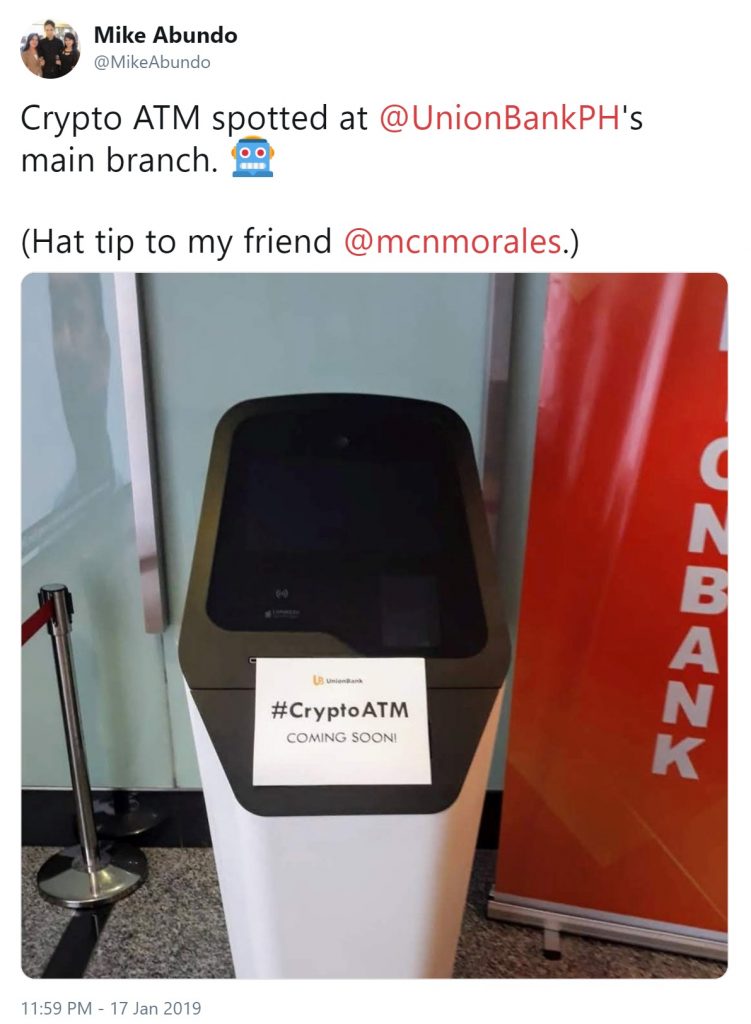
A picture of the bank’s upcoming crypto ATM was posted on social media on Jan. 17 by Twitter user Mike Abundo.Union Bank of the Philippines Launching Cryptocurrency ATM

Crypto Regulation in the Philippines

Bangko Sentral ng Pilipinas explained, “Following the warning advisory issued by the BSP in March 2014, a formal regulatory approach was adopted through the issuance of Circular No. 944 dated 6 February 2017.” This circular establishes “guidelines for virtual currency (VC) exchanges” offering “services or engaging in activities that provide facility for the conversion or exchange of fiat currency to VC or vice versa” in the country, the BSP wrote.

Noting that it “does not intend to endorse” any cryptocurrencies including bitcoin, the BSP clarified that it aims to regulate them “when used for delivery of financial services, particularly, for payments and remittances.”

Union Bank of the Philippines Launching Cryptocurrency ATM

According to the circular, crypto exchanges must obtain a certificate of registration to operate as a remittance and transfer company. In addition, “Large value pay-outs of more than P500,000 [~$183,000] or its foreign currency equivalent, in any single transaction with customers or counterparties, shall only be made via check payment or direct credit to deposit accounts.”

Furthermore, they must “maintain an internal control system commensurate to the nature, size and complexity of their respective businesses” and adhere to the minimum control standard issued by the BSP, the circular describes.

As of November last year, the central bank has issued provisional licenses to seven crypto exchanges and is evaluating over 40 applications currently, according to a document on its website.

What do you think of Unionbank launching a crypto ATM? Let us know in the comments section below.


Images courtesy of Shutterstock, Twitter, Mike Abundo, and Unionbank.


Need to calculate your bitcoin holdings? Check our tools section.

The post Union Bank of the Philippines Launching Cryptocurrency ATM appeared first on Bitcoin News.

from Bitcoin News http://bit.ly/2WUMiRU Union Bank of the Philippines Launching Cryptocurrency ATM

#USA Startup names may have passed peak weirdness

//

For years, decades even, startup names have been getting weirder. This isn’t a scientific verdict, but it is how things have seemed to someone who spends a lot of hours perusing this stuff.

Startups have had a long run of branding themselves with creative misspellings, animal names. human first names, made-up words, adverbs and other odd collections of letters. It’s gone on so long it now seems normal. Names like Google, Airbnb and Hulu, which sounded strange at first, are now part of our everyday vocabulary.

Over the past few quarters, however, a peculiar thing has been happening: Startup founders are choosing more conventional-sounding names.

“As we reach the edge of strangeness… they’re saying: ‘It’s too weird. I’m uncomfortable,’” said Athol Foden, president of Brighter Naming, a naming consultancy. While quirky startup monikers haven’t gone away, founders are increasingly comfortable with less-unusual-sounding choices.

Foden’s observations are reflected in our annual Crunchbase News survey of startup naming trends. We’re seeing a proliferation of startups choosing simple words that describe their businesses, including companies like Hitch, an app for long-distance car rides; Duffel, a trip-booking startup named after the popular travel bag; and Coder, a software development platform.

But fortunately for fans of offbeat names, the trend is only toward less weirdness, not no weirdness. Those who wish to patronage seed-stage startups can still buy tampons from Aunt Flow, get parenting tips from an app called Mush or get insurance from a startup called Marshmallow.

Below, we look in more detail at some of the more popular startup naming practices and how they are trending.

Creativv misPelling5

For a long time, it seemed like a vast number of startups selected names largely by disabling the spell checker.

Most desirable dictionary words were already in use as domains or too pricey to acquire. So founders took to dropping vowels, subbing a “y” for an “i” or adding an extra consonant to make it work. The strategy worked well for a lot of well-known companies, including Lyft, Tumblr, Digg, Flickr, Grindr and Scribd.

These days, creative misspellings are still pretty common among early-stage founders. Our name survey unearthed a big number (see partial list) that recently raised funding, including Houwser, an upstart real estate brokerage; Swytch, developer of a kit for converting bikes to e-bikes; and Wurk, a provider of human resources and compliance software for the cannabis industry.

However, creative misspellings are getting less popular, Foden said. Early-stage founders are turned off by the prospect of having to spell out their names to people unfamiliar with the brand (which for seed-stage companies includes pretty much everyone).

Puns

One of the more fun naming styles is the pun. In our perusal of companies that raised seed funding in the past year, we came across a number of startups employing some sort of play-on words.

We put together a list of seven of the punniest names here. In addition to Aunt Flow, the list includes WeeCare, a network of daycare providers, and Serial Box, a digital content producer. Crunchbase News also created its own fictional startup — drone chicken delivery startup Internet of Wings — in an explainer series on startup funding.

Perhaps some day business naming will harken back to the industrial age, when corporate titans had exceedingly boring and obvious names.

Real companies with pun names that have matured to exit were harder to pinpoint. A couple that have gone public are Groupon and MedMen, a cannabis company that went public in Canada and is valued around CA$2 billion.

For some reason, it appears pun names are more popular in the brick-and-mortar world than the tech startup sphere. Restaurants specializing in the Vietnamese noodle soup Pho have dozens of play-on-word names memorialized in lists like this. Ditto for pet stores.

Personally, I’d like to see more internet startups rolling out pun-based names. Foden would, too, and he has even volunteered one suggestion for someone who wants to start a business applying artificial intelligence to artificial insemination: Ai.ai.

Made-up words that sound real

There are more than 170,000 non-obsolete words in the English language, per the Oxford English Dictionary. Startups, however, are convinced we need more.

Hence, one of the more enduringly popular business-naming practices is to come up with something that sounds like an actual word, even if it isn’t.

We put together a list of examples of this naming style among recently seed-funded startups.

It includes Trustology, which is building a platform to safeguard crypto assets; Invocable, a developer of voice design tools for Alexa apps; and Locomation, which focuses on autonomous trucking technology.

Naming advisors like to see the made-up word name trend on the rise, Foden said, because it’s the kind of thing companies pay a consultant to figure out. Another advantage is it’s easier to top search results for a made-up word.

Normal-sounding names

Lastly, let’s look at those rebel startups choosing familiar dictionary words for their names.

We put together a list of some here. Besides the aforementioned Duffel, Hitch and Coder, there’s Decent, a healthcare startup; Chief, a women’s networking group; Journal, a note organizing tool; and many more.

Startups are less concerned than they used to be with snagging a dot-com domain that contains just their name. Commonly, they’ll add a prefix to their domain (joinchief.com, usejournal.com), choose an alternate domain (Hitch.net) or both.

Overall, Foden said, startups today are putting less emphasis on securing a dot-com suffix or an exact domain name match. Google parent Alphabet, in particular, made the alternate domain idea more palatable. It helped to see one of the world’s richest corporations forego Alphabet.com in favor of abc.xyz.

Where is it all going?

They say history repeats itself. If so, perhaps some day business naming will harken back to the industrial age, when corporate titans had exceedingly boring and obvious names like Standard Oil, U.S. Steel and General Electric.

For now, however, we live in era in which the most valuable companies have names like Google and Facebook. And to us, they sound perfectly normal.

Methodology: For the naming data set, we looked primarily at companies in English-speaking countries that raised seed funding after 2018. To broaden the potential list of names, we also included some companies funded in 2017. We also tried to limit the lists, where possible to companies founded in the past three years, although there were occasional exceptions.

from Startups – TechCrunch https://tcrn.ch/2Sq6jAX

#USA Startups Weekly: Spotify gets acquisitive and Instacart screws up

//

Did anyone else listen to season one of StartUp, Alex Blumberg’s OG Gimlet podcast? I did, and I felt like a proud mom this week reading stories of the major, first-of-its-kind Spotify acquisition of his podcast production company, Gimlet. Spotify also bought Anchor, a podcast monetization platform, signaling a new era for the podcasting industry.

On top of that, Himalaya, a free podcast app I’d never heard of until this week, raised a whopping $100 million in venture capital funding to “establish itself as a new force in the podcast distribution space,” per Variety.

The podcasting business definitely took center stage, but Lime and Bird made headlines, as usual, a new unicorn emerged in the mental health space and Instacart, it turns out, has been screwing its independent contractors.

As mentioned, Spotify, or shall we say Spodify, gobbled up Gimlet and Anchor. More on that here and a full analysis of the deal here. Key takeaway: it’s the dawn of podcasting; expect a whole lot more venture investment and M&A activity in the next few years.

This week’s biggest “yikes” moment was when reports emerged that Instacart was offsetting its wages with tips from customers. An independent contractor has filed a class-action lawsuit against the food delivery business, claiming it “intentionally and maliciously misappropriated gratuities in order to pay plaintiff’s wages even though Instacart maintained that 100 percent of customer tips went directly to shoppers.” TechCrunch’s Megan Rose Dickey has the full story here, as well as Instacart CEO’s apology here.

Slack confidentially filed to go public this week, its first public step toward either an IPO or a direct listing. If it chooses the latter, like Spotify did in 2018, it won’t issue any new shares. Instead, it will sell existing shares held by insiders, employees and investors, a move that will allow it to bypass a roadshow and some of Wall Street’s exorbitant IPO fees. Postmates confidentially filed, too. The 8-year-old company has tapped JPMorgan Chase and Bank of America to lead its upcoming float.

Reddit CEO Steve Huffman delivers remarks on “Redesigning Reddit” during the third day of Web Summit in Altice Arena on November 08, 2017 in Lisbon, Portugal. (Horacio Villalobos-Corbis/Contributor)

It was particularly tough to decide which deal was the most notable this week… But the winner is Reddit, the online platform for chit-chatting about niche topics — r/ProgMetal if you’re Crunchbase editor Alex Wilhelm . The company is raising up to $300 million at a $3 billion valuation, according to TechCrunch’s Josh Constine. Reddit has been around since 2005 and has raised a total of $250 million in equity funding. The forthcoming Series D round is said to be led by Chinese tech giant Tencent at a $2.7 billion pre-money valuation.

Runner up for deal of the week is Calm, the app that helps users reduce anxiety, sleep better and feel happier. The startup brought in an $88 million Series B at a $1 billion valuation. With 40 million downloads worldwide and more than one million paying subscribers, the company says it quadrupled revenue in 2018 from $20 million to $80 million and is now profitable — not a word you hear every day in Silicon Valley.

Here’s your weekly reminder to send me tips, suggestions and more to kate.clark@techcrunch.com or @KateClarkTweets

I listened to the Bird CEO’s chat with Upfront Ventures’ Mark Suster last week and wrote down some key takeaways, including the challenges of seasonality and safety in the scooter business. I also wrote about an investigation by Consumer Reports that found electric scooters to be the cause of more than 1,500 accidents in the U.S. I’m also required to mention that e-scooter unicorn Lime finally closed its highly anticipated round at a $2.4 billion valuation. The news came just a few days after the company beefed up its executive team with a CTO and CMO hire.

Databricks raises $250M at a $2.75B valuation for its analytics platform
Retail technology platform Relex raises $200M from TCV
Raisin raises $114M for its pan-European marketplace for savings and investment products
Self-driving truck startup Ike raises $52M
Signal Sciences secures $35M to protect web apps
Ritual raises $25M for its subscription-based women’s daily vitamin
Little Spoon gets $7M for its organic baby food delivery service
By Humankind picks up $4M to rid your morning routine of single-use plastic

We don’t spend a ton of time talking about the growing, venture-funded, tech-enabled logistics sector, but one startup in the space garnered significant attention this week. Turvo poached three key Uber Freight employees, including two of the unit’s co-founders. What’s that mean for Uber Freight? Well, probably not a ton… Based on my conversation with Turvo’s newest employees, Uber Freight is a rocket ship waiting to take off.

Who knew that investing in female-focused brands could turn a profit for investors? Just kidding, I knew that and this week I have even more proof! This is L., a direct-to-consumer, subscription-based retailer of pads, tampons and condoms made with organic materials sold to P&G for $100 million. The company, founded by Talia Frenkel, launched out of Y Combinator in August 2015. According to PitchBook, it was backed by Halogen Ventures, 500 Startups, Fusion Fund and a few others.

Speaking of ladies getting stuff done, Bessemer Venture Partners promoted Talia Goldberg to partner this week, making the 28-year-old one of the youngest investing partners at the Silicon Valley venture fund. Plus, Palo Alto’s Eclipse Ventures, hot off the heels of a $500 million fundraise, added two general partners: former Flex CEO Mike McNamara and former Global Foundries CEO Sanjay Jha.

If you enjoy this newsletter, be sure to check out TechCrunch’s venture-focused podcast, Equity. In this week’s episode, available here, Crunchbase editor-in-chief Alex Wilhelm and I chat about the expanding podcast industry, Reddit’s big round and scooter accidents.

Want more TechCrunch newsletters? Sign up here.

from Startups – TechCrunch https://tcrn.ch/2UNXYE3

#Blockchain The Daily: Cointelligence’s Exchange Rating System, Bithumb Launches OTC Desk

The Daily: Cointelligence Offers Exchange Rating System, Bithumb Launches OTC Desk

In the first edition of The Daily this weekend, we cover the details around the launch of a new cryptocurrency exchange rating system by Cointelligence. Also, South Korean exchange Bithumb has announced it’s establishing an OTC trading desk in Hong Kong, and the popular messenger service Telegram has postponed the launch of its TON network until March.

Also read: Huobi Adds USD Trading Pairs, Airswap Launches Fiat-to-Crypto Exchange

Cointelligence Launches Crypto Exchange Rating System

A company specializing in data research and analysis for the crypto economy has recently announced it’s launching a cryptocurrency exchange rating system. Cointelligence, which develops tools for investors, already offers rating services for initial coin offerings (ICOs) and security token offerings (STOs).

The Daily: Cointelligence's Exchange Rating System, Bithumb Launches OTC Desk

The new feature will help members of the crypto community find the most reliable digital asset trading platform, the creators promised in a press release. A team of experts from the crypto industry is tasked to produce impartial and accurate reviews of the examined exchanges. They will remain anonymous to prevent the possibility of corruption and harassment.

According to Cointelligence, users will be able to check if an exchange is safe and reliable. The company says that only actual and factual improvement of a crypto trading platform can change its rating. Commenting on the launch of the new system, Cointelligence CEO On Yavin stated:

We looked around the industry and we didn’t see anyone really doing this. Given the number of hacks and exit scams the exchange industry has seen, we felt this was an important tool to protect the community.

Cryptocurrency exchanges will be rated on several main criteria. These include accessibility and usability or the ease of setting up an account; depositing and withdrawing funds and performing trades; and financial benefit which covers applicable fees, market volume, and number of supported cryptocurrencies. The crypto experts will also examine the teams of the platforms and evaluate the associated security risks.

Bithumb Global Announces OTC Desk

Major South Korean crypto exchange Bithumb has launched a new over-the-counter (OTC) trading platform for institutional clients. In an announcement issued by Bithumb Global, the company said the “block deal, matchmaking service” will be offered under the Ortus brand owned by its Hong Kong-based subsidiary.

The Daily: Cointelligence's Exchange Rating System, Bithumb Launches OTC Desk

Institutions that want to take advantage of the OTC desk will have to undergo a strict onboarding process. The applicants will be required to provide sufficient KYC and AML documentation. Upon approval, clients will gain access to a number of services offered by Ortus such as monitored fund transfers from an insured, custodian wallet and a U.S.-based bank account as well as competitive pricing from some of the largest OTC desks and liquidity providers.

“Institutions trading digital assets need to open accounts at exchanges and OTC desks around the world. However, there is no real solution for an aggregated liquidity provider or a trusted interdealer where Institutions can trade these assets,” remarked Bithumb’s director Rahul Khanna. “To fill this market gap, Ortus will operate to allow institutions to buy and sell digital assets through a network of global liquidity providers and benefit from a competitive and best price execution service.”

Telegram Delays the Launch of TON Testnet to March

Popular messaging service Telegram has released new details on finalizing its Telegram Open Network (TON). According to its latest investor update, quoted by The Block, the overall progress has been estimated at 90 percent. The document shows, however, that the company has also delayed its testnet launch from January to March 2019.

The Daily: Cointelligence's Exchange Rating System, Bithumb Launches OTC Desk

According to the publication, Telegram is now working to list the network’s native token, called gram, on cryptocurrency exchanges based in Asia such as Binance, Huobi and Okex. The company, founded by prominent Russian entrepreneur Pavel Durov, is reportedly negotiating partnerships with various online services in preparation for the launch of the messenger’s app store.

What are your thoughts on today’s news tidbits? Tell us in the comments section.


Images courtesy of Shutterstock.


At Bitcoin.com there’s a bunch of free helpful services. For instance, have you seen our Tools page? You can even lookup the exchange rate for a transaction in the past. Or calculate the value of your current holdings. Or create a paper wallet. And much more.

The post The Daily: Cointelligence’s Exchange Rating System, Bithumb Launches OTC Desk appeared first on Bitcoin News.

from Bitcoin News http://bit.ly/2Gygxs0 The Daily: Cointelligence’s Exchange Rating System, Bithumb Launches OTC Desk

#Blockchain US Lawyers: Crypto Regulations Are ‘Tough Waters to Navigate’

"Patchwork" of US Cryptocurrency Regulations are "Tough Waters to Navigate"

In a recent interview, Matt Kohen and Justin Wales, two senior counsels working for Carlton Fields’ virtual currency and distributed ledger technology group, highlighted the challenges that legal practitioners and regulators face in interpreting United States regulations pertaining to cryptocurrency.

Also Read: Quadrigacx Saga: Founder’s Widow Owns $5.6m Properties, Hospital Confirms Cotten’s Death

Cryptocurrency Lawyers Emphasize Challenges of Current US Regulatory Apparatus

Kohen and Wales are currently working on a more than three-year case pertaining to a Florida-based Localbitcoins trader, Michell Espinoza, who is facing felony charges for running an illegal money service business and money laundering violations.

US Lawyers: Crypto Regulations Are 'Tough Waters to Navigate'

All charges were initially dropped against him when Judge Teresa Mary Pooler of the Eleventh Judicial Circuit of Florida ruled that Espinoza could not be charged with illegal money transmission offenses because bitcoin was not considered legal tender in 2016. Pooler’s ruling was recently overturned, however, highlighting the challenges associated with juridical apparatus pertaining to cryptocurrencies in the United States.

Regulators Need to Take ‘Holistic View’ of Legislative Classifications

Describing the current regulatory apparatus as a “patchwork,” Kohen emphasized the contradictions that regularly emerge between state and federal legislation. Kohen asserted that virtual currencies appear to comprise “something different to every agency,” adding that the “IRS can look at it as property like a gold bar. SEC gets to say we have a different view. Then you have state regulators who think a digital asset is a commodity or currency. It is tough waters to navigate.”

US Lawyers: Crypto Regulations Are 'Tough Waters to Navigate'

Wales added: “One of the potential issues is we have securities regulators viewing through a lifetime of experience looking at securities. CFTC is doing the same thing. State and money transmission officers doing the same thing. Tax regulators who do not know what to think of it, look at is as property because it does not look like money. Regulators need to spend more time with a holistic view of what these are.”

International Regulators ‘Struggling’ To Find Solution to Legislative Challenges

With regard to alternative regulatory frameworks developed by international regulators, Wales stated: “Every regulatory agency in every country is struggling to come up with a solution.”

Wales also observed that certain countries are viewing cryptocurrency as “an opportunity” and are implementing “relaxed guidelines,” in contrast with the often contradictory stance taken by U.S. agencies and lawmakers at state and federal level.

Which country do you think has implemented the best regulatory regime for cryptocurrencies? What changes would you like to see made to the current apparatus in the United States? Share your thoughts in the comments section below!


Images courtesy of Shutterstock


At Bitcoin.com there’s a bunch of free helpful services. For instance, have you seen our Tools page? You can even lookup the exchange rate for a transaction in the past. Or calculate the value of your current holdings. Or create a paper wallet. And much more.

The post US Lawyers: Crypto Regulations Are ‘Tough Waters to Navigate’ appeared first on Bitcoin News.

from Bitcoin News http://bit.ly/2Gz6ZNa US Lawyers: Crypto Regulations Are ‘Tough Waters to Navigate’

#Blockchain Gainers and Losers: BTT Falls From Daily Gainers, Grin Sits Among Weekly Losers

Gainers & Losers: BTT Falls From Daily Gainers, Grin Sits Among Weekly Losers

The bullish surge across the cryptocurrency markets has ranked several high profile projects among the top gainers and losers – a distinction predominantly reserved for crypto assets with meager market caps. As of this writing, litecoin (LTC) is the 17th-top gaining cryptocurrency of the last 24 hours after gaining 26%, while the heavily hyped bittorrent token (BTT) sits among the top losers of the last 24 hours despite ranking as a top gaining market of the last seven days.

Also Read: Markets Update: Cryptocurrencies Gain Billions in Less Than an Hour

LTC Ranks Fourth by Market Cap Following 26% Rally in 24 Hours

Litecoin is the top market by both market cap and 24-hour volume to currently rank among the top gainers and losers. LTC rallied by 26% in the last 24 hours, pushing litecoin up two positions to rank as the fourth largest cryptocurrency by capitalization with $2.56 billion, and boosting LTC’s dominance from 1.80% to 2.10%.

Gainers and Losers: BTT Falls From Daily Gainers, Grin Sits Among Weekly Losers

As of this writing, $1.65 billion worth of litecoin has changed hands in the last 24 hours, with LTC currently trading for nearly $42.50.

Bittorrent Token Among Top Weekly Gainers and Daily Losers

The heavily hyped bittorrent token is currently making an unusual appearance in the top gainers and losers list, ranking among the weakest performing markets of the 24 hours while simultaneously appearing as a top 10 gainer on the weekly chart.

BTT currently boasts the largest seven-day volume of the top gaining markets of the week with a weekly price gain of approximately 83.50%.

Gainers and Losers: BTT Falls From Daily Gainers, Grin Sits Among Weekly Losers

Despite the strong weekly performance, the surge across the cryptocurrency markets has seen BTT fall from the top daily gainers to comprise the 19th-weakest performing crypto asset of the last 24 hours, with BTT currently trading for 7.84% less than it was 24 hours ago.

Gainers and Losers: BTT Falls From Daily Gainers, Grin Sits Among Weekly Losers

BTT currently has the largest daily volume of the top losers, with $150.70 million worth of BTT changing hands in the last 24 hours. As of this writing, BTT is trading for 24 satoshis.

Grin Ranks Among Top Weekly Losers

The highly anticipated Mimblewimble-based privacy coin Grin currently ranks as the eighth-weakest performing market of the preceding week, having shed 37% of its fiat value over the last seven days.

Gainers and Losers: BTT Falls From Daily Gainers, Grin Sits Among Weekly Losers

Grin currently has the strongest 24-hour volume of the week’s poorest performing cryptocurrency markets, with nearly $4.39 million worth of Grin being traded in the last day. Grin is currently trading for approximately $4.05.

What market are you most surprised to see ranked among today’s gainers and losers? Share your thoughts in the comments section below!

Disclaimer: Price articles and markets updates are intended for informational purposes only and should not to be considered as trading advice. Neither Bitcoin.com nor the author is responsible for any losses or gains, as the ultimate decision to conduct a trade is made by the reader. Always remember that only those in possession of the private keys are in control of the “money.”


Images courtesy of Shutterstock, Coinmarketcap


At Bitcoin.com there’s a bunch of free helpful services. For instance, have you seen our Tools page? You can even lookup the exchange rate for a transaction in the past. Or calculate the value of your current holdings. Or create a paper wallet. And much more.

The post Gainers and Losers: BTT Falls From Daily Gainers, Grin Sits Among Weekly Losers appeared first on Bitcoin News.

from Bitcoin News http://bit.ly/2Gvy4km Gainers and Losers: BTT Falls From Daily Gainers, Grin Sits Among Weekly Losers

#Blockchain Proposal to Increase Bitcoin’s 21 Million Supply Sparks Debate

Proposal to Increase Bitcoin’s 21 Million Supply Sparks Debate

21 is a number that holds deep symbology to bitcoiners. In addition to denoting the total number of bitcoins, in millions, that will ever be issued, it’s inspired scores of cryptocurrency business names, websites, and merchandise designs. Despite its assumed inviolability, some members of the community are opposed to Bitcoin’s rigidly set 21 million supply. If they have their way, that arbitrary cap will be lifted. For many devout bitcoiners, this suggestion is sacrilegious.

Also read: Quadrigacx Saga: Founder’s Widow Owns $5.6m Properties, Hospital Confirms Cotten’s Death

Bitcoin’s Fixed Supply – Arbitrary or Mandatory?

At a “Satoshi’s Roundtable” event last week, decried by some as Bitcoin’s very own version of Bilderberg, the prospect of raising BTC’s 21 million cap was raised. It was Matt Luongo who floated the proposal, in response to a discussion about anticipated adoption of the Lightning Network (LN). With the block reward halving every four years, and onchain transaction volume likely to be low in future should LN take off, there will be little incentive for miners to secure the network. This could lead to it being vulnerable to 51 percent attacks that would undo the trust instilled in the Bitcoin network over many years.

An argument has also been made for increasing the 21 million supply of Bitcoin Cash in future, on similar grounds. Due to the network’s low fees, miners would theoretically have little economic incentive to secure the network once the block reward diminishes.

Luongo’s suggestion of raising BTC’s total supply is intended to incentivize mining in a future of minimal block rewards and minimal onchain volume. While there may be an economic and security case for doing so, it is a matter that resonates strongly – even emotionally – with a sizeable portion of the Bitcoin community. There are also those who are motivated by purely financial reasons. The fact that there will never be more than 21 million bitcoins is what gives the currency its digital scarcity. Raising the fixed cap, even by a fraction, could dilute the value of everyone’s holdings, it is feared, and consign BTC to the status of an EOS-style inflationary cryptocurrency.

Proposal to Increase Bitcoin’s 21 Million Supply Sparks Debate

A Controversial Proposal That’s Sparked Intense Debate

Numerous Bitcoin luminaries have waded into the debate regarding Bitcoin’s supply following the Satoshi’s Roundtable discussion. Nick Szabo insisted that decreased hash power due to lower mining rewards would not have a significant impact on security, but conceded that “it may require recipients of very-high-value transactions to wait more blocks before relying on them.” Cobra Bitcoin took a more combative approach, tweeting “There will only ever be 21 million bitcoins. If you have a problem with that, get the fuck out of our community because you aren’t welcome.” To this, Matt Luongo responded:

This stuff has to work … If the stars align and this becomes an issue do you sacrifice a core tenet of the community or the entire security of the chain?

It is not entirely known why Satoshi chose 21 million as the number of coins to be issued, though it is speculated that this ties in with the halving reward schedule that occurs every four years. Alternatively, it could be because the total number of sats that will ever be created approximately mirrors the maximum capacity of a 64-bit floating point number.

Given that there was no mention of Bitcoin’s proposed supply in Satoshi’s seminal whitepaper, perhaps the number itself was never particularly significant to him. Whatever the case, 21 million has come to be one of Bitcoin’s defining features, and any attempt to meddle with the magic number is liable to be treated as heresy. Future generations of bitcoiners may be more receptive to raising the supply, but in the here and now, that notion seems untenable.

Do you think Bitcoin’s supply should ever be increased? Let us know in the comments section below.


Images courtesy of Shutterstock.


Need to calculate your bitcoin holdings? Check our tools section.

The post Proposal to Increase Bitcoin’s 21 Million Supply Sparks Debate appeared first on Bitcoin News.

from Bitcoin News http://bit.ly/2GC84DU Proposal to Increase Bitcoin’s 21 Million Supply Sparks Debate