
About Startup365

Chaque jour nous vous présenterons une nouvelle Startup française ! Notre pays regorge de talents et d'entrepreneurs brillants ! Alors partons à la découverte des meilleures startup françaises ! Certaines d'entre elles sont dans une étape essentielle dans la vie d'une startup : la recherche de financement, notamment par le financement participatif (ou crowdfunding en anglais). Alors participez à cette grande aventure en leur faisant une petite donation ! Les startups françaises ont besoin de vous !

#Blockchain These Exchanges Allow You to Purchase Cryptocurrency Without Knowing You

These Exchanges Allow You to Swap Coins Without Knowing You

Platforms providing traders with the opportunity to exchange cryptocurrencies have increasingly started to apply registration requirements. In many cases, these are justified on the basis of newly introduced KYC and AML regulations. Thankfully, there are still exchanges that allow users to swap digital coins without requiring a verified account.

Also read: Coinsquare Lays off 40 Employees in a Troublesome Month for Crypto Exchanges

Losing the Balance, Again

The question regarding the balance between privacy and transparency predates the birth of Bitcoin. Decentralized digital currencies came into existence partly as a response to the trend of economies and societies moving in a cashless direction, which threatened privacy. In a way, they reintroduced the concept of cash, with its relative anonymity, into the digital space, and not at the full expense of transparency per se.

These Exchanges Allow You to Purchase Cryptocurrency Without Knowing You

This new balance has been challenged. Crypto exchanges nowadays find themselves caught in the crossfire between what many of their customers want in terms of privacy, and what regulators require them to do to limit it. Identity verification makes some sense in the case of crypto-to-fiat transactions, for tax purposes or to prevent illicit activities. But crypto-to-crypto transactions have also become a target and it’s not clear why – many countries, like Poland for example, exempt them from taxation.

Leading crypto exchanges operating in the U.S., Europe and globally are now collecting personal information from traders. This is sometimes done through loyalty programs that come with certain benefits and is often justified with the need to comply with new KYC and AML rules. These requests are usually accompanied with promises to protect the collected data. Critics have warned, however, that the risk of your sensitive info ending up with other vendors, being lost to hackers, or shared with some government, not necessarily your own, remains high.

Some crypto trading platforms have recognized the concerns of cryptocurrency users and offer services that are filling the gap left by established exchanges such as Shapeshift. We reported about some of the available alternatives last fall. New ones have since started to gain popularity among crypto enthusiasts including the following selection.

Platforms That Respect Your Privacy

One such exchange is Godex. It offers fast cryptocurrency swaps between over 200 digital coins with no exchange limits other than the minimum amounts required to cover the fees. After choosing a pair, a fixed rate is displayed which is what the trader receives if the exchange receives the amount within 30 minutes. According to a Bitcointalk thread, the platform does not have a central office, and its team is based in Ukraine, the U.S., Italy and Russia.

Users are not asked to share any personal data, set up an account or pass mandatory registration. Providing an email address is optional for confirmations and communication with support. “As we stand for absolute privacy, we erase all transaction data from our servers within a week,” the exchange states on its website. It keeps a minimum amount of information needed to process refunds, for example. That includes the email, transaction hash and the sender’s address.

These Exchanges Allow You to Purchase Cryptocurrency Without Knowing You

Changer.com is another crypto-to-crypto exchange that does not require an account, although it offers discounts for those who create one. If you don’t wish to do so, you can still exchange around 15 coins by providing an email. The trading platform offers its main page in a number of languages and controls two other domains – exchanger.com and the Russian obmen.com. There are mixed comments on crypto forums about its services, with most complaints related to support not answering emails on time.

Fairshift is an exchange that does not collect additional user data, except the information needed to process transactions related to a coin swap. No account is required to use the platform and “no personal info that can be stolen in the event of a hack or other compromise” is collected. Basic data about completed transactions, including refunds, can be seen in the “Past Transactions” section of Fairshift’s website.

Other sites offer limited privacy and conditional anonymity. Simpleswap, for example, says in its FAQ section “Yes, our service is anonymous.” Yet the online exchanger notes that there are exceptions. “Simpleswap collaborates with many partners. Our partners, according to their risk assessment and European AML directives, can apply for a photo of your ID valid in your country and information about the origin of your coins,” the platform explains without specifying the names of its partners.

Then there’s Coinswitch, an exchange aggregator that supports trades between more than 300 cryptocurrencies through integration with many leading exchanges such as Bittrex, Kucoin, Idex, Hitbtc, Shapeshift and others. Before placing a trade, however, users are required to register an account and provide name, date of birth, and country of residence, phone number and a valid email address. Only the last two entries have to be verified however.

Which privacy-oriented crypto exchange do you recommend? Tell us in the comments section below. Share your thoughts on the subject.


Images courtesy of Shutterstock.


Disclaimer: Bitcoin.com does not endorse nor support these products/services.

Readers should do their own due diligence before taking any actions related to the mentioned companies or any of their affiliates or services. Bitcoin.com is not responsible, directly or indirectly, for any damage or loss caused or alleged to be caused by or in connection with the use of or reliance on any content, goods or services mentioned in this article.

The post These Exchanges Allow You to Purchase Cryptocurrency Without Knowing You appeared first on Bitcoin News.

from Bitcoin News http://bit.ly/2WPG59v These Exchanges Allow You to Purchase Cryptocurrency Without Knowing You


#USA Foot Locker invests $100 million in GOAT Group

//

Foot Locker, the mostly mall-bound retailer of mass market sneakers, has invested $100 million in the sneaker marketplace and retailer of primarily rare and exclusive high-end athletic and lifestyle shoes, GOAT Group.

The companies said that the investment would eventually lead to Foot Locker and Goat Group combining their efforts across their digital and physical retail platforms.

GOAT said in a statement that the company would use the investment to accelerate its global operations and expand its omnichannel experience and its technologies.

GOAT

IT Manager Clint Arndt, CEO Eddy Lu

In an interview, the GOAT co-founder and chief product officer declined to disclose the company’s valuation, its revenues, how sales break down across geographic regions or how it will work with Foot Locker going forward.

In 2018, several top sellers on GOAT sold more than $10 million worth of sneakers, up from $2 million in 2017, according to the company. GOAT Group now counts more than 600 employees, up from 200 a year ago, with 12 million users currently active on the platform. That figure is up massively from last year, when 2.5 million folks were on the platform.

Over the same period, GOAT boosted its sneaker listings to 750,000 from 200,000, and now has 150,000 vendors selling to more than 12 million customers. With growth like that, it’s no wonder Foot Locker wants a sip of that GOAT stew.

“At Foot Locker we are constantly looking at new ways to elevate our customer experience and bring sneaker and youth culture to people around the world,” said Richard Johnson, Foot Locker, Inc.’s chairman and chief executive officer, in a statement. “We are excited to leverage GOAT Group’s technology to further innovate the sneaker buying experience and utilize their best-in-class online marketplace to help meet the ever-growing global demand for the latest product. Together, Foot Locker and GOAT Group’s shared commitment to trust and authenticity in the sneaker industry will provide consumers with unparalleled experiences and diversified offerings.”

One savvy online observer commented that the deal was the equivalent of Blockbuster investing in Netflix back when that now-defunct video rental service was still in its waning days, before it became obsolete.

“In 2015, we pioneered the ship-to-verify model with a mission to bring a seamless and safe customer experience to the secondary sneaker market,” said Eddy Lu, co-founder and chief executive officer of GOAT Group. “With over 3,000 retail locations, Foot Locker will support our primarily digital presence with physical access points worldwide, bringing more value to our community of buyers and sellers. Having Foot Locker as a strategic partner will also expand our business as we continue to scale our operations both domestically and internationally.”

Last year, GOAT raised $60 million as it announced its largest strategic move to date — acquiring the physical retailer Flight Club to begin pushing into real-world in-store experiences.

Scott Martin is joining the GOAT Group’s board of directors and extends Foot Locker’s investments in startup companies and brands, which already included the women’s luxury activewear brand Carbon38; tactical play and children’s lifestyle brand Super Heroic; and footwear design academy PENSOLE.

GOAT has raised $197.6 million since it was launched it 2015. The company competes with other vendors like Stock X.

In an interview with Highsnobiety, NPD Group senior sports industry advisor Matt Powell said, “The sneaker resale market has been disruptive to the primary market. Foot Locker is investing in that disruption and believes that the resale market will continue to grow and its wants a piece of that growth.”

from Startups – TechCrunch https://tcrn.ch/2MSFLSP

#Blockchain BCH Publishing App Honest Cash Partners With Patreon Alternative Bitbacker.io

On Wednesday, Feb. 6, the Honest Cash publishing platform powered by bitcoin cash partnered with the cryptocurrency focused Patreon alternative Bitbacker.io. The new partnership aims to bolster the Honest Cash and Bitbacker user base by providing individuals with the means to crowdfund projects while at the same time being incentivized with BCH for sharing unique content.

Also Read: Many Self-Proclaimed Bitcoin Inventors and Satoshi Clues Were Debunked in 2018

Honest Cash and Bitbacker Team Up

In November, news.Bitcoin.com reported on the launch of a new BCH powered publishing platform called Honest Cash. The platform arrived soon after the Nov. 15 BCH blockchain split and the popular blogging platform moved on to support the altcoin BSV. A month later our newsdesk spoke with the creator of the cryptocurrency-fueled Patreon alternative Bitbacker.io and explained how users can crowdfund projects with BCH and BTC. Adrian Barwicki, CEO of Honest Cash, and Jonathan Silverblood, founder of Bitbacker, explained during the partnership announcement that the ultimate goal is to create a larger audience.

“The relationship provides users of both Honest Cash and Bitbacker a larger audience reach — Both users will now have the potential to earn pledges and secure backing within both platforms,” explained the team’s announcement.

BCH Publishing App Honest Cash Partners With Patreon Alternative Bitbacker.io
Adrian Barwicki, CEO of Honest Cash, and Jonathan Silverblood, founder of Bitbacker, just announced they will be releasing a series of blog posts to inform users about the partnership integrations in the near future.

Crypto Powered Applications See Improvement and Growth

Both platforms have been adding a lot of improvements over the last few weeks. For instance, Honest Cash has seen significant growth as the BCH application has encouraged any kind of content including video, images, art, and prose. Some Honest Cash users have made upwards of $1,000 per content piece in bitcoin cash tips. Moreover, the platform recently added a native BCH wallet providing Honest Cash users with the ability to generate a new wallet and import existing BCH keys with custom HD derivation path support.

BCH Publishing App Honest Cash Partners With Patreon Alternative Bitbacker.io
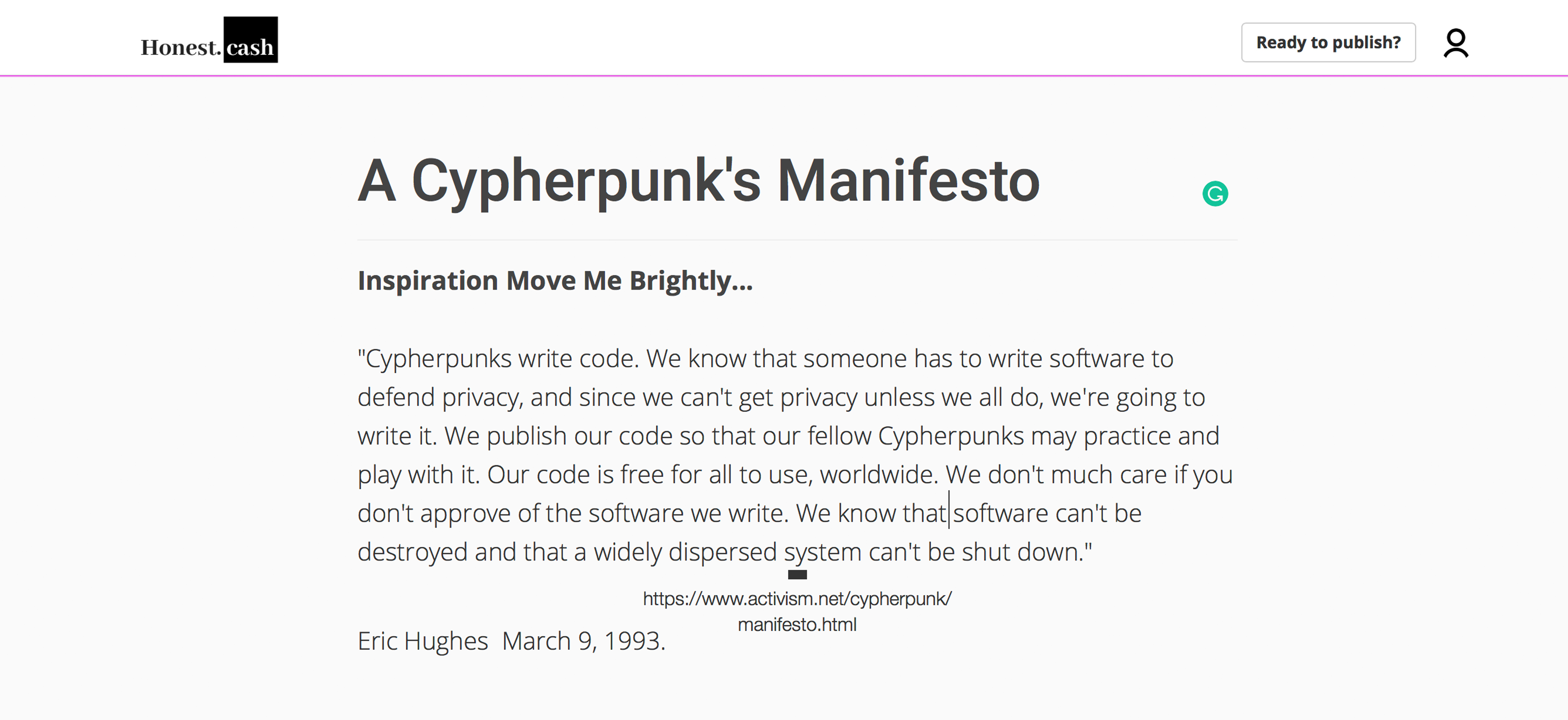
The Honest Cash publishing platform allows people to post all kinds of content like video, blogs, scripts, art, and photos.

Bitbacker.io has seen a lot of growth as well, as many cryptocurrency advocates have switched from Patreon to the alternative application. The platform supports BCH, LTC, Smart, and BTC while providing a variety of the same features the centralized website Patreon supplies. LTC integration was also recently applied to the crowdfunding platform. Jonathan Silverblood spoke with news.Bitcoin.com back in December, when he explained that Bitbacker is able to charge close to 1 percent, while in contrast fiat-based platforms like Patreon and Youtube charge 10-30 percent.

BCH Publishing App Honest Cash Partners With Patreon Alternative Bitbacker.io
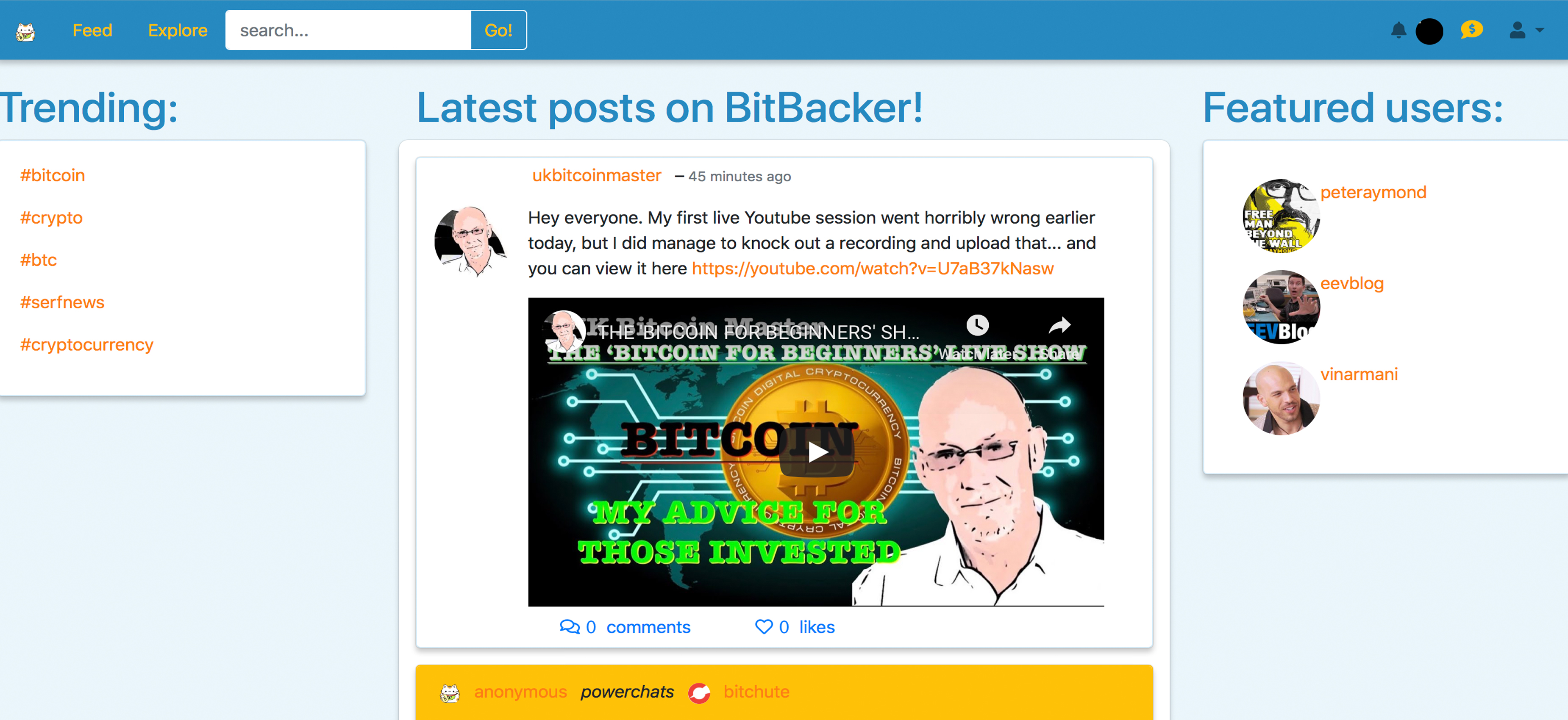
Bitbacker.io is a crypto based alternative to Patreon. The platform supports BCH, Smart, LTC, and BTC.

Both Barwicki and Silverblood say they will soon be releasing a series of blog posts to inform users of both platforms detailing exactly what and when integrations will be made. The team says that the partnership is proof that when two innovative communities and developers support each other “incredible things happen.”

What do you think about the partnership between Bitbacker.io and Honest Cash? Let us know what you think about this project in the comments section below.


Image credits: Shutterstock, Bitbacker.io, Pixabay, and Honest Cash. 


Verify and track bitcoin cash transactions on our BCH Block Explorer, the best of its kind anywhere in the world. Also, keep up with your holdings, BCH, and other coins, on our market charts at Satoshi’s Pulse, another original and free service from Bitcoin.com.

The post BCH Publishing App Honest Cash Partners With Patreon Alternative Bitbacker.io appeared first on Bitcoin News.

from Bitcoin News http://bit.ly/2WLOyKY BCH Publishing App Honest Cash Partners With Patreon Alternative Bitbacker.io

#USA Gametime lets you buy tickets for games and concerts that have already started

//

Ticketing app Gametime is taking its last-minute approach about as far as it can go, with the launch of a new feature called LastCall. This allows users to purchase tickets through Gametime until 90 minutes after an event has started.

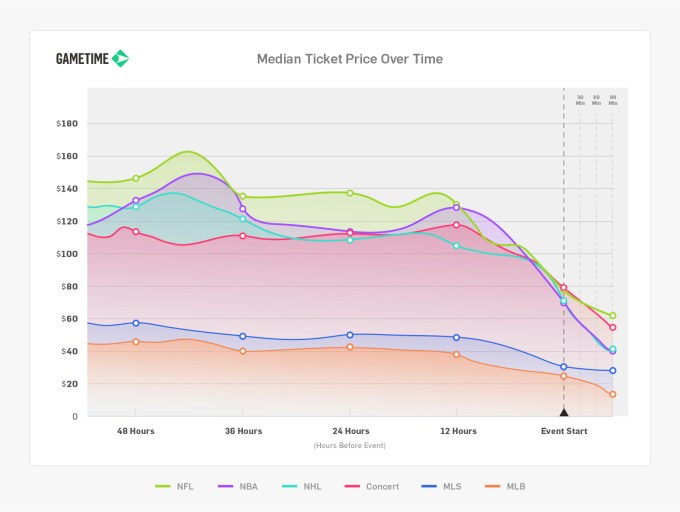
Why would you want to do that? Well, prices usually drop precipitously after the event starts — for example, Gametime said that 48 hours before a game, the median price for a Major League Baseball is (coincidentally?) $48, but it’s dropped to $13 by 90 minutes after the first pitch.

Founder and CEO Brad Griffith acknowledged that most fans probably aren’t interested in just showing up for the fourth quarter or ninth inning of a game, or for the last song in a concert. On the other hand, if you could get a big discount and still catch most of the event, then it might be worth it.

Meanwhile, if you’re a team or a venue with empty seats, or if you’re a ticket-holder who realizes at the last minute that you can’t attend, then it’s good to have one last shot at selling those tickets.

In fact, it sounds like this is one of those “announcements” that’s partly acknowledging what’s already happening, both in the Gametime app and elsewhere. Griffith said the company is “doubling down” on this seriously-last-minute category of tickets, adding that it’s “constantly working through” what it’s actually including under the LastCall umbrella.

LastCall graphic

“The key element is the research that we’ve done, how it relates to the growth of this phenomenon” he said.

That research includes a survey of 287 event attendees, some who use Gametime and some who don’t. Apparently 27 percent said they’ve already purchased tickets after an event’s start time, and 62 percent of those late buyers were either Generation Z or millennials.

And while Gametime started out with a focus on sports, LastCall will include tickets from a variety of live events. In fact, Griffith said concerts are now the app’s fastest-growing category, and he suggested that this approach could help with the declining number of total concert tickets sold.

“We’re starting to see a bifurcation of windows, where the on-sale is still healthy, is strong, and the middle is maybe cratering in terms of transaction volume,” he said. “And then last-minute is vibrant and growing and fast. That is where we aim to do our best work.”

from Startups – TechCrunch https://tcrn.ch/2RQMuOk

#USA Segmented security startup Illumio raises $65M in Series E round

//

Illumio has raised $65 million in its latest round of funding led by J.P. Morgan Asset Management, the security startup has confirmed.

The news comes just weeks after the company was expected to announce a $50 million Series E round, but was delayed after a late addition pushed the figure up.

The data-center monitoring and cloud security company focuses on network segmentation. By isolating critical applications and data centers from the rest of the network, Illumio makes data leaks and breaches far more difficult to spread. That containment stops hackers from pivoting and navigating through a network in an “Equifax-style” attack.

In just six years, the company has exploded in growth, running through several rounds of funding accumulating more than $330 million to date, amassing huge clients like BNP Paribas, Morgan Stanley, Oracle NetSuite and Salesforce. And, the funding lands just a few months after the company obtained FIPS 140-2 certification, allowing it to run on federal government networks of low classification, opening the company up to another burgeoning market.

“With this latest round of funding, we’re investing more in all parts of the business to meet market demand and continue to enable our customers to prevent the spread of breaches in their global infrastructures,” said Andrew Rubin, Illumio’s chief executive.

Specifically, the company said the $65 million will go across its entire business to grow into Europe, the Middle East and Africa — where its headcount has increased by more than fourfold; as well as Asia, and the U.S. where its headquarters is located.

Illumio neither said now nor previously what its valuation is. At its last Series D round of $125 million in mid-2017, the company was said to be worth upwards of $1 billion. For its part, Illumio self-stylizes as a startup unicorn but wouldn’t comment further when pressed.

Along with its funding news, Illumio added that it’s hired Anup Singh as chief financial officer to focus on the company’s continued growth, and it’s also appointed Jonathan Reiber, a former Pentagon chief strategy officer for cyber policy, as Illumio’s new head of cybersecurity strategy. And, angel investor John Hinshaw was appointed to the company’s board.

After five rounds of funding, Illumio is on a list of anticipated IPOs for later this year. When asked about its plans, the company didn’t comment.

from Startups – TechCrunch https://tcrn.ch/2MSM7li

#USA Hired buys Y Combinator grad Py, launches assessment tool

//

To better measure aptitude of applicants, online job search engine Hired has acquired Py, which helps companies like Opendoor and Niantic identify talent with app-based interactive courses on Python, iOS development and more.

As part of the deal, Hired will launch a new feature called Hired Assessments, leveraging tools from the Py platform, as well as a tiered subscription model. The base-level package, called Hired Essential, will provide enhanced search functionality, tools to help candidates arrive to interviews as prepared as possible and more. A spokesperson for Py declined to disclose terms of the deal but did say that Py counts 500,000 users who’ve completed 2 million coding assignments. They also offered this little anecdote:

Py’s co-founder, Derek Lo had initial conversations with Hired’s VP of Strategic Development, Andre Charoo back in October of 2018. But it wasn’t until Lo randomly met one of Hired’s co-founders at a Y Combinator networking event that the partnership started to come into fruition. The Hired co-founder that Lo met was Allan Grant — also a part of the Y Combinator community — and he wasn’t aware of the initial conversations but agreed to have Lo over to his house the next day to share advice about running an early-stage startup. Over coffee at Grant’s house, Lo learned a lot about the purpose of Hired and began to understand why Hired would be a great fit for his product and team. From there, the rest was history. 

Derek Lo, founder and chief executive officer of Py, first began building the mobile app in May 2016 before completing Y Combinator’s accelerator program in summer 2017. Lo started the company in his dorm room after becoming frustrated with Yale’s computer sciences courses, which he felt were useless when it came to real business applications.

Lo has joined Hired as its head of product.

In a conversation with TechCrunch while Py was still completing the accelerator, Lo said the company had decided to turn down a $1 million investment offer because it was unnecessary for such an early-stage startup. At the time, the Py team had brought in $20,000 in pre-seed funding from Dorm Room Fund, plus another $100,000 from the Yale Venture Creation Program. In total, Py has raised $615,000.

“With Py founder Derek Lo, we saw a shared vision for making hiring easier for everyone,” Hired’s vice president of strategic development Andre Charoo said in a statement. “For companies, this means helping them hire in-demand talent quickly and predictably, and for job seekers, it is about empowering them to land their dream job. By combining Py’s technical assessment expertise with Hired’s dependable pipeline of first-rate talent, we’re ready to transform today’s hiring standards.”

Hired Assessments will include online coding quizzes, standardized testing, projects and a “live code” environment where hiring managers can “view, rewind, fast forward and save live candidate challenges.” The features are customizable so companies can tweak assessments based on their hiring needs.

Hired Essential will use machine learning to curate lists of candidates for available roles, as well as help candidates arrive at interviews prepared with a clear outline of hiring steps, expectations and tips.

Founded in 2012, San Francisco-based Hired is backed by venture capital firms including Comcast Ventures, Sherpa Capital, Lumia Ventures and Uncork Capital. To date, the business has raised $133 million, most recently at a post-valuation of $550 million, according to PitchBook.

from Startups – TechCrunch https://tcrn.ch/2UOuEgr

#USA Honest Company co-founder Christopher Gavigan has a new, and newly funded, CBD startup called Prima

//

Christopher Gavigan, sitting in a crisp white shirt inside a small TechCrunch conference room, radiates energy, even in a late-day interview just hours before he’s scheduled to fly home from San Francisco to L.A.

We’re meeting to talk about Prima, a new startup that Gavigan began developing seven months ago with two co-founders. One of them is a former beauty and marketing executive, Jessica Assaf, who was until recently running a company called Cannabis Feminist to sell marijuana wellness products at her L.A. home. The other is Laurel Angelica Myers, who’d spent six years working alongside Gavigan at his last startup, The Honest Company, the now eight-year-old brand that sells nontoxic personal care and household products at Target, Whole Foods, Nordstrom and many other places.

Gavigan is still Honest’s “chief purpose officer” and its most effective evangelist, one quickly gathers. But he’s gotten excited in recent months about a new opportunity that many others are beginning to chase, too: the market for products made with cannabinoids of CBD, a compound that can be derived from both cannabis and hemp plants and which has taken off since industrial hemp cultivation was made legal in the United States last year.

Prima, based in Southern California, is creating a spate of products around hemp cannabinoids that Gavigan manages to make sound magical. He talks of taking the “best organically grown hemp out of Oregon” and using a “very gentle, slow extraction process” to get it into an oil and distillate form that it will then use to create consumer products, starting with “emerging beauty and pain management” for the skin and a “luxurious facial oil,” noting that a “lot of these cannabinoids do a great job with moisture retention and irritation and redness reduction.”

Prima also plans to introduce ingestible products, including a soft gel and mix-in powdered blends that can be used to pour into coffee or tea or water. One will be focused on immunity, another on sleep, another on energy.

None of these products are available for sale today, it’s worth noting. Prima isn’t even sure yet of its packaging, though it sounds like a thicker card stock will be involved.

Still, Gavigan paints a sufficiently compelling picture that the company — which plans to sell directly to consumers via a content-rich site designed to educate while it persuades — has already raised roughly $3.3 million in seed funding. Lerer Hippeau led the round, with participation from Greycroft and other (undisclosed) private and institutional investors.

It’s easy to understand why they are already buying in. Broadly speaking, Prima has a good story as a science-driven plant wellness company that’s championing the strong therapeutic potential of hemp CBD, even if the jury is still out on whether that potential is real or imagined. Given that there is no go-to brand quite yet, its timing actually looks impeccable on this front.

Prima is also registered as a public benefit corporation, which means in addition to its corporate goal of maximizing profit for shareholders, its charter commits the company to spending some of its profits or resources (or both) in support of a specific public benefit. In Prima’s case, that will be invested in cannabis-related research initiatives. Consumers might like this, too.

Yet Gavigan himself may be the company’s best weapon. Having spent much of his career selling natural and “green” products, he understands toxic and questionable ingredients. He also says he loves “very nascent, stigmatized markets” and is well aware of the standards that users expect of them, particularly when the end product is more costly. The Honest Company has fought numerous battles over the years, owing to its marketing, getting sued over its sunscreen (which it later reformulated), its baby formula (the company fought back and a court ruled in its favor) and its laundry detergent and dish soap (it settled a class action lawsuit that claimed it misled buyers about their ingredients).

He also knows how to talk to consumers looking to make better choices on behalf of themselves.

Pictured left to right: Laurel Myers, Christopher Gavigan and Jessica Assaf

The bigger challenge right now for Prima, along with other CBD brands, might simply be convincing regulators that their products are, at a minimum, safe to use. Right now, that’s no small feat.

In New York City, health departments are stopping restaurants from serving CBD-laced foods to their customers. The L.A. County Department of Health similarly said it would ding restaurants for using CBD in their food and drink offerings. As a new story in The Atlantic notes, while CBD can be derived from both cannabis and hemp plants, the FDA has said it will treat CBD the same no matter which plant it comes from, which is to say, it considers both illegal as additives in consumer food products.

Gavigan knows well of this uphill battle, though he also is convinced of the promise of CBD, spending 20 minutes with this reporter outlining the research he has pored over and that suggests promise in numerous areas, including in treating epilepsy. (Last year, the FDA approved an oral CBD drug called Epidiolex for the treatment of seizures associated with two rare and severe forms of epilepsy.)

He points to researchers at Mount Sinai and UCLA and UC Irvine among other places who are currently studying cannabinoids for pain, inflammation, stress, anxiety and insomnia.

Without standards, it could be difficult for any brand to move forward in a meaningful way. In fact, a California-based attorney with whom The Atlantic spoke tells the outlet that the current lack of standardization is what’s making regulatory agencies so nervous about CBD. “If you go buy a CBD beverage and it’s not specially packaged—it just looks like another coffee or whatever—someone might take a sip who doesn’t intend to,” he says.

Still, creams and oils are still on the table while they figure it out. And with the CBD market expected to grow to $22 billion by 2022 — outpacing marijuana — it’s looking smart for Prima and other brands that are barreling forward, hoping theirs is the name that will stick.

from Startups – TechCrunch https://tcrn.ch/2GgiLNk

#USA DataSine raises $5.2M led by Pentech and Propel for its AI content-marketing platform

//

By now, most of us should be familiar with the concept of the tailored news feed. Right now my Facebook feed (yes, I’m still there, alas) has been messed up because I’ve clicked on too many posts about Brexit, but I digress. My point is that content has long since fallen to the tyranny of tailoring and personalization, and content marketing (that stuff that marketers like to pass off as editorial) is a big business. Making that content so enthralling as to be practically addictive is the aim of this industry, but right now all those poor copywriters have to do a lot of manual heavy lifting. Such is their burden.

This is the problem DataSine is trying to address by tailoring content to the reader’s personality. It does this by applying machine learning to behavioral data they hold about that person, whether it be customer profiles or whatever.

The idea is that marketers then make more informed decisions about what content they push out, and thus can spend more time being creative rather than spending time on writing, tweaking and A/B testing.

DataSine has now raised $5.2 million in a Series A round led by U.K.-based VC Pentech Ventures and Propel Venture Partners. Other investors include C.Entrepreneurs/Cathay Innovation, Twin Ventures and Sistema_VC. Customers include BNP Paribas and the Tinkoff bank. DataSine claims it has helped achieve uplifts of up to 80 percent in engagement and 71 percent in sales.

DataSine’s content-personalization platform is called Pomegranate. The company says it provides an AI-powered content-editing platform to guide marketers in tailoring a range of content elements, including words and images. The idea is that it will personalize everything from emails and landing pages to call center scripts. Pomegranate will launch in March, and it integrates with CRMs like HubSpot and email platforms like MailChimp .

Founder and CEO Igor Volzhanin says he launched DataSine after moving to London to do a PhD in psychology because he believed “that personality can help companies understand their customers as a whole… and move beyond the traditional focus of click optimization.”

According to Boston Consulting Group, personalization is worth an extra $800 billion in business to the 15 percent of companies that manage to get it right.

Marc Moens, a partner at Pentech, commented that “DataSine is particularly well-positioned to bring psychology and AI to address contemporary marketing challenges. The idea that digital communications can be tailored for an individual in the age of Big Data is very appealing and addresses the needs of the market.”

The company’s competitors include Meniga, The Signal Open Data Platform, Adapti, Textio, Crobox VisualDNA and Hello Soda. But Volzhanin says their approach differs from most of these in using a single customer profile, collaborative AI and a psychological approach. “We bring together AI and psychology to provide our recommendations. We do a lot of proprietary, cutting edge research to understand what kind of content different people like and use AI to power Pomegranate to provide these recommendations to marketers,” he told me.

from Startups – TechCrunch https://tcrn.ch/2tawVqA

#Blockchain 5 Crypto-Friendly Countries to Base Your Business

Choosing the best country to set up a business is vital in this digital age, and especially so for crypto companies. As governments around the world continue to learn more about cryptocurrencies and elect to either crack down on them or allow them to flourish, some jurisdictions emerge as being better than others for launching a crypto startup.

Also read: Markets Update: Traders Patiently Wait for Crypto’s Longest Bear Run to End

Take Time Choosing Where to Base Your Business

Many governments are still deciding what to do with cryptocurrency. While some are friendly towards it and see the benefit of crypto companies basing themselves in their jurisdiction, a number are openly hostile. If you’re planning to launch a crypto-related business, it makes sense to study the regulatory framework and government policy in a number of jurisdictions before reaching a decision.

Do you want to set up a business in a country that has historically had low taxation? If the country you are considering is receptive to crypto, and there are no signs of impending tighter regulation, will you still be able to attract investors? Does it have a vibrant ecosystem of fintech companies that will support your business? These are all matters that should be considered before setting up shop. The following crypto-friendly countries all have their attributes and are worthy of consideration before you settle on your HQ.

5 Crypto-Friendly Countries to Base Your Business

USA: Booming Bet Right Now

This U.S. is unsurprisingly a hotbed of crypto companies. Many high-profile cryptocurrency exchanges, custody providers, wallet developers, and miners operate from the U.S. and the government is working to enact a clearer legal framework for crypto-related businesses. Policy varies state to state, and while taxation guidelines in the U.S. have generally been unclear, in December lawmakers filed a bill to create tax exemptions for certain cryptocurrency transactions. The cryptocurrency community in the U.S. is thriving and the technology is slowly entering the mainstream. For example, Ohio last year allowed companies in the state to pay a variety of taxes, from tobacco sales tax to employee withholding tax, with bitcoin.

Switzerland: Established and Secure

Switzerland has long been a crypto-friendly nation. Its government has been open to the idea of cryptocurrency, encouraging crypto startups to set up shop there, and in December announcing a new legislative approach to blockchain. Switzerland’s tax rate is also attractive. In general, the country boasts a low-tax environment for businesses and many bitcoin service startups are already based in Switzerland. The country’s tax regulator considers cryptocurrencies to be assets, subject to wealth taxes that must be declared in annual returns. A 2018 report declared the top 50 cryptocurrency and blockchain-related companies in Switzerland’s “Crypto Valley” alone to be worth $44 billion. Bitcoin ATM manufacturer Lamassu moved to Switzerland due to problems with maintaining a bank account elsewhere and has been able to thrive in the progressive landlocked nation. And with some of the best universities in Europe, including the École polytechnique fédérale de Lausanne, which hosts an innovation park, there’s plenty of talent to choose from.

5 Crypto-Friendly Countries to Base Your Business

Japan: Ahead of the Game

With the number of crypto companies in Japan growing – December saw 190 companies express the intention of market entry – the tech-savvy country is an ideal jurisdiction to set up a cryptocurrency business. The island nation has a booming bitcoin and cryptocurrency industry and was one of the first and only countries to recognize cryptocurrency within its legal system. Adoption is growing in the country too, with many businesses, restaurants and cafes accepting crypto for payments compared to other countries and jurisdictions on this list. Last year the country’s Financial Services Agency published its draft report of new cryptocurrency regulations. The country also allowed 16 of the country’s largest crypto exchanges to build a self-regulatory body. This step shows how Japan is ahead of the game in terms of regulation and allowing crypto companies to flourish. As a result, more and more startups are moving to Japan to take advantage of the friendly regulatory environment.

Singapore: Low Tax, Lots of Talent

The business-friendly, low-tax and tech-friendly Singapore is another jurisdiction worth considering. Although the previous regulatory framework for crypto wasn’t entirely clear, and some businesses were unable to expand due to troubles with bank accounts, the country’s financial regulator said in October that it was very open to crypto companies working with banks to reach an agreement to allow these businesses to grow. Last year, the central bank of Singapore finalized the country’s new regulatory framework for payment services, which now includes cryptocurrency. Singapore isn’t quite on a par with Japan, but it’s moving in the right direction. Its large big tech and business community would also be ideal for attracting investors and talent for a crypto-focused startup.

Luxembourg: Most Economically Developed

5 Crypto-Friendly Countries to Base Your Business

A tiny country of little under 600,000, Luxembourg boasts one of the world’s largest cryptocurrency exchanges, Bitstamp. Tokyo-based Bitflyer also has offices in the European country after being granted a Payment Institution license to operate in the European Union. Luxembourg has long been a financial hub and business-friendly nation and the country clearly sees the potential of cryptocurrencies. Crypto exchanges in Luxembourg are governed by the CSSF and must follow the same rules as other financial institutions. Regarding taxes, cryptocurrencies are treated as intangible assets, and are not subject to income tax until they are disposed of, while cryptocurrency transactions are exempt from VAT. The country is also a good place to draw talent for a crypto company, with the innovative University of Luxembourg which is currently working to enhance the security of crypto assets.

What do you think about these countries and the way they deal with crypto companies? Let us know what you think about this subject in the comments section below.


Image credits: Shutterstock.


Verify and track bitcoin cash transactions on our BCH Block Explorer, the best of its kind anywhere in the world. Also, keep up with your holdings, BCH, and other coins, on our market charts at Satoshi’s Pulse, another original and free service from Bitcoin.com. 

The post 5 Crypto-Friendly Countries to Base Your Business appeared first on Bitcoin News.

from Bitcoin News http://bit.ly/2MTW5mt 5 Crypto-Friendly Countries to Base Your Business

#USA Africa Roundup: Zimbabwe’s net blackout, Partech’s $143M fund, Andela’s $100M raise, Flutterwave’s pivot

//

A high court in Zimbabwe ended the government’s restrictions on internet and social media last month.

After days of intermittent blackouts at the order of the country’s Minister of State for National Security, ISPs restored connectivity per a January 21 judicial order.

Similar to net shutdowns around the continent, politics and protests were the catalyst. Shortly after the government announced a dramatic increase in fuel prices on January 12, Zimbabwe’s Congress of Trade Unions called for a national strike.

Web and app blackouts in the southern African country followed demonstrations that broke out in several cities. A government crackdown ensued, with deaths reported.

On January 15, Zimbabwe’s largest mobile carrier, Econet Wireless, confirmed that it had complied with a directive from the Minister of State for National Security to shutdown internet.

Net access was restored, taken down again, then restored, but social media sites remained blocked through January 21.

Throughout the restrictions, many of Zimbabwe’s citizens and techies resorted to VPNs and workarounds to access net and social media, as reported in this TechCrunch feature.

Global internet rights group Access Now sprung to action, attaching its #KeepItOn hashtag to calls for the country’s government to reopen cyberspace soon after digital interference began.

The cyber-affair adds Zimbabwe to a growing list of African countries — including Cameroon, Congo and Ethiopia — whose governments have restricted internet expression in recent years.

It also provides another case study for techies and ISPs regaining their cyber rights. Internet and social media are back up in Zimbabwe — at least for now.

Further attempts to restrict net and app access in Zimbabwe will likely revive what’s become a somewhat ironic cycle for cyber shutdowns. When governments cut off internet and social media access, citizens still find ways to use internet and social media to stop them.

Partech doubled its Africa VC fund to $143 million and opened a Nairobi office to complement its Dakar practice.

The Partech Africa Fund plans to make 20 to 25 investments across roughly 10 countries over the next several years, according to general partner Tidjane Deme. The fund has added Ceasar Nyagha as investment officer for the Kenya office to expand its East Africa reach.

Partech Africa will primarily target Series A and B investments and some pre-series rounds at higher dollar amounts. “We will consider seed-funding — what we call seed-plus — tickets in the $500,000 range,” Deme told TechCrunch for this story on the new fund. Partech is open to all sectors “with a strong appetite for people who are tapping into Africa’s informal economies,” he said.

Partech Africa joined several Africa-focused funds over the last few years to mark a surge in VC for the continent’s startups. Partech announced its first raise of $70 million in early 2018 next to TLcom Capital’s $40 million, and TPG Growth’s $2 billion.

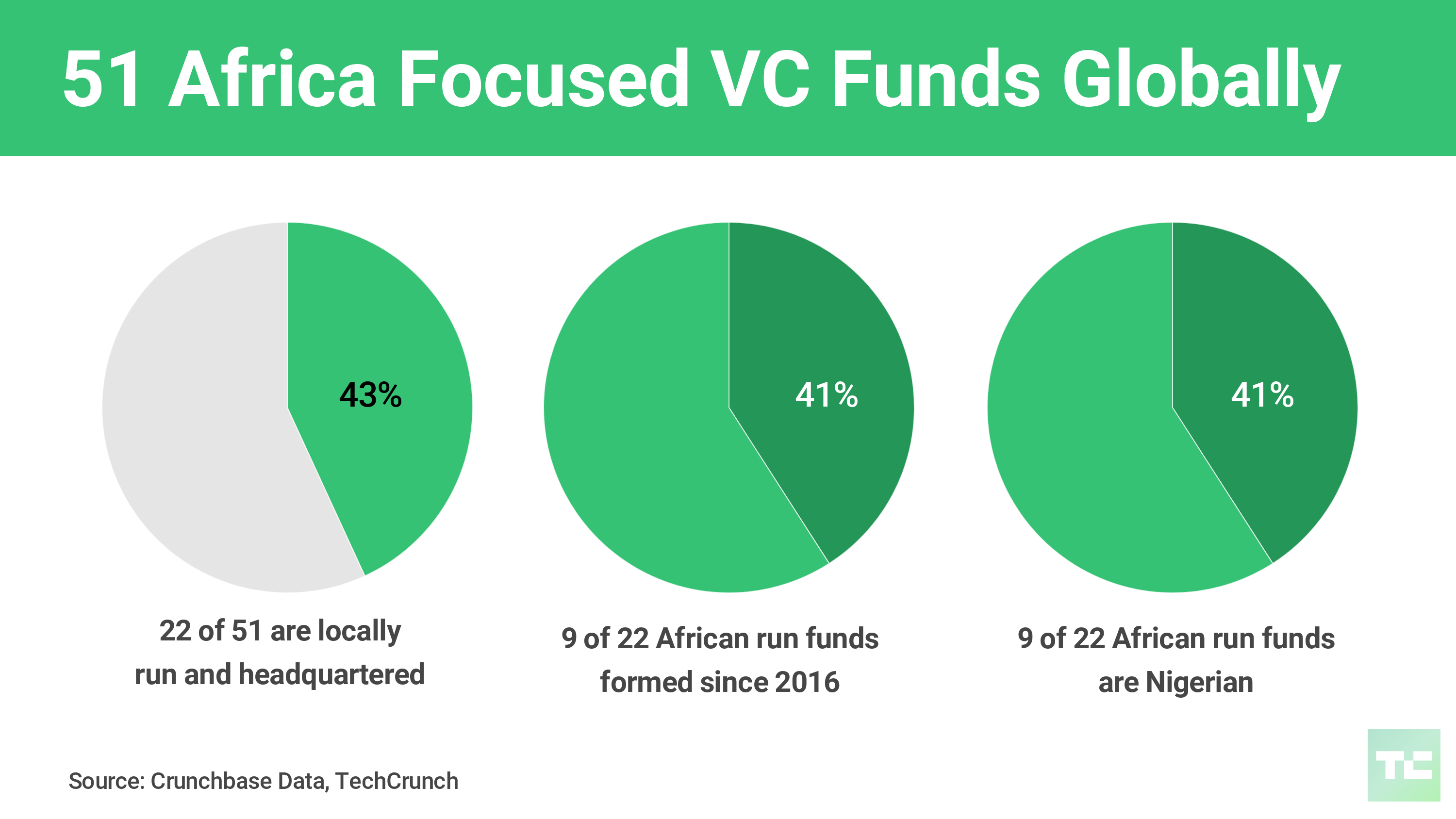
Africa-focused VC firms, including those locally run and managed, have grown to 51 globally, according to recent Crunchbase research.

Andela, the company that connects Africa’s top software developers with technology companies from the U.S. and around the world, raised $100 million in a new round of funding.

The new financing from Generation Investment Management (an investment fund co-founded by former VP Al Gore) puts the valuation of the company at somewhere between $600 million and $700 million—based on data available from PitchBook on the company’s valuation.

The company now has more than 200 customers paying for access to the roughly 1,100 developers Andela has trained and manages.

With the new cash in hand, Andela says it will double in size, hiring another thousand developers, and invest in new product development and its own engineering and data resources. More on Andela’s recent raise and focus here at TechCrunch.

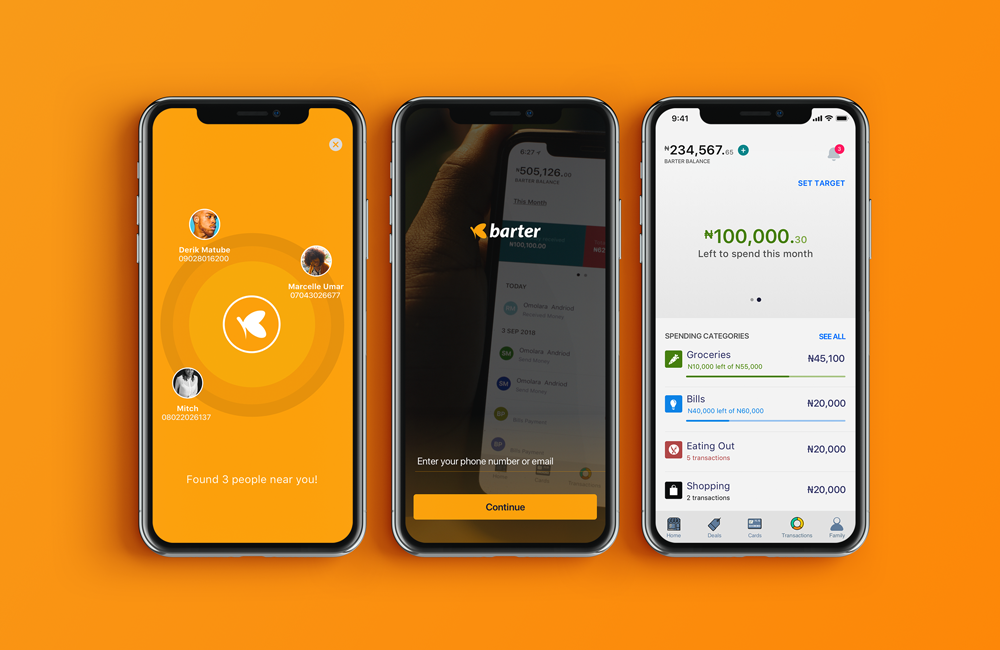
Fintech startup Flutterwave announced a new consumer payment product for Africa called GetBarter, in partnership with Visa.

The app-based offering is aimed at facilitating personal and small merchant payments within and across African countries. Existing Visa  cardholders can send and receive funds at home or internationally on GetBarter.

The product also lets non-cardholders (those with accounts or mobile wallets on other platforms) create a virtual Visa card to link to the app.  A Visa spokesperson confirmed the product partnership.

GetBarter allows Flutterwave  — which has scaled as a payment gateway for big companies through its Rave product — to pivot to African consumers and traders.

The app also creates a network for clients on multiple financial platforms to make transfers across payment products and national borders, and to shop online.

“The target market is pretty much everyone who has a payment need in Africa. That includes the entire customer base of M-Pesa,  the entire bank customer base in Nigeria, mobile money and bank customers in Ghana — pretty much the entire continent,” Flutterwave CEO Olugbenga Agboola told TechCrunch in this exclusive.

Flutterwave and Visa will focus on building a GetBarter user base across mobile money and bank clients in Kenya, Ghana, and South Africa, with plans to grow across the continent and reach those off the financial grid.

Founded in 2016, Flutterwave has positioned itself as a global B2B payments solutions platform for companies in Africa to pay other companies on the continent and abroad. It allows clients to tap its APIs and work with Flutterwave developers to customize payments applications. Existing customers include Uber,  Facebook,  Booking.com and African e-commerce unicorn Jumia.com.

Flutterwave added operations in Uganda in June and raised a $10 million Series A round in October The company also plugged into ledger activity in 2018, becoming a payment processing partner to the Ripple and Stellar blockchain networks.

Headquartered in San Francisco, with its largest operations center in Nigeria, the startup plans to add operations centers in South Africa and Cameroon, which will also become new markets for GetBarter.

And sadly, Africa’s tech community mourned losses in January. A terrorist attack on Nairobi’s 14 Riverside complex claimed the lives of six employees of fintech startup Cellulant and I-Dev CEO Jason Spindler. Both organizations had been engaged with TechCrunch’s Africa work over the last 24 months. Condolences to  family, friends and colleagues of those lost.

More Africa Related Stories @TechCrunch

African Tech Around The Net    

from Startups – TechCrunch https://tcrn.ch/2TBK4ES