Chaque jour nous vous présenterons une nouvelle Startup française !
Notre pays regorge de talents et d'entrepreneurs brillants ! Alors partons à la découverte des meilleures startup françaises ! Certaines d'entre elles sont dans une étape essentielle dans la vie d'une startup : la recherche de financement, notamment par le financement participatif (ou crowdfunding en anglais). Alors participez à cette grande aventure en leur faisant une petite donation ! Les startups françaises ont besoin de vous !
Airbnb made it easier for travelers to find a place to crash. Now it wants to make it easier for them to get around.
The $31 billion home-sharing giant has hired Fred Reid as its first-ever global head of transportation. Reid served as the founding chief executive officer of Virgin America from 2004 to 2007 after a three-year stint as the president of Delta Airlines. Most recently, Reid was president of the Cora Aircraft Program, a division of Kitty Hawk focused on the development of an autonomous electric vertical takeoff and landing aircraft.
The hire suggests Airbnb has broad ambitions to further disrupt the travel and hospitality industry and given the 500 million guest arrivals to Airbnb listings the company says it will have recorded by the first quarter of 2019, integrating transportation services to better serve customers is a no-brainer.
“We’re going to explore a broad range of ideas and partnerships that can make transportation better,” Airbnb co-founder and CEO Brian Chesky said in a statement. “We haven’t settled on exactly what those will look like. I’m not interested in building our own airline or creating just another place on the Internet where you can buy a plane ticket, but there is a tremendous opportunity to improve the transportation experience for everyone.”
Founded in 2008, Airbnb has raised a total of $4.4 billion in venture capital funding from investors including Sequoia and Andreessen Horowitz.
Tony Haile, who previously led analytics company Chartbeat, is trying to rethink the business model for news at his new startup Scroll. Now he’s adding aggregation and curation to the mix with the acquisition of Nuzzel.
Scroll is still an invite-only product, but Haile explained the idea succinctly: “We deliver this amazing, clean, ad-free experience, and we do it for a low monthly price.”
In other words, after you subscribe and download Scroll, anytime you load up one of its partner sites (including USA Today, BuzzFeed and Vox), you should get an ad-free experience, which should work regardless of whether you’re accessing the site directly from your desktop or mobile browser, or from social media. In exchange, the publishers share the subscription revenue.
Haile said that by acquiring Nuzzel, Scroll can also start experimenting with different models for news curation — which is particularly important because if “we have just two algorithms determining who gets traffic and who doesn’t, then that’s not a healthy web ecosystem.”
“It’s really hard to [build] a scalable business as an amazing curation service,” he added. With Nuzzel, he hopes to “start finding ways in which we can build in that value and drive a new model for our user experience services.”
NEW YORK, NY – OCTOBER 01: Tony Haile speaks onstage at the Buyer Beware! panel during AWXI on October 1, 2014 in New York City. (Photo by Andrew Toth/Getty Images for AWXI)
That doesn’t mean existing Nuzzel users shouldn’t expect any dramatic changes to either the app or the newsletters — Haile said they will continue to operate as separate products, and his team is taking the approach of “first do not harm.”
However, Scroll does plan to remove any advertising from the newsletters, and the engineering team behind the Nuzzel Media Intelligence productwill be spinning that out as a separate company.
Haile said there won’t be anyone from the Nuzzel team joining Scroll in a full-time capacity, though some of them may remain involved as contractors. Abrams, meanwhile, told me via email that he and Nuzzel COO Kent Lindstrom are starting a new, yet-to-be-announced company.
“I think current Nuzzel users should see this as great news, since Scroll wants to make sure that Nuzzel’s services continue to operate,” Abrams said. “As you know, a lot of other news app and news aggregation startups were unfortunately shutdown between 2015 and 2018, so like I said, this is good news for Nuzzel users.”
Substack started out by providing individual writers and publishers with a set of tools enabling them to charge a subscription fee for their newsletters. Now it’s giving them the ability to do the same thing with podcasts.
In fact, Morgan Creek Digital Assets founder Anthony “Pomp” Pompliano is already using the platform to introduce a daily podcast to complement his existing, crypto-focused Off the Chain newsletter.
“We’ve always thought the magic of what Substack is doing is the fact that we’re disintermediating the people creating stuff and the people who are consuming it — you are the brand they’re paying for,” Substack CEO Chris Best told me. “That whole model works incredibly well for newsletters, and to us, there’s no reason why it wouldn’t be a great model for podcast content.”
Substack’s podcasting capabilities will allow publishers to either offer a podcast-specific subscription — or, like Pompliano, to include it as part of a broader package with their newsletter subscription. The podcast itself will be distributed through an audio player that can be embedded in both newsletters and on the web.
A web-based audio player might seem like a clunky way to listen to podcasts, but Substack’s player (which you can try out here) works pretty smoothly and includes features like the ability to jump backward and forward 30 seconds, and to play podcasts at various speeds.
Best added that he’s also open to the idea of creating a private, subscriber-only feed that can be accessed by podcast apps.
“We’re going to put it out there and see what people want,” he said. But he argued that the “existing feed-based podcast system” is “not living up to its potential” when it comes to enabling podcasters to make money from subscriptions.
We spoke shortly after Spotify announced that it was acquiring podcast companies Gimlet and Anchor, which Best said illustrates the importance of a tool like Substack, because it’s focused on “empowering individuals”: “We let people get paid directly by people, rather than aggregated into a wider system.”
“We definitely think the world is big enough for both of those things,” Best replied. While he expressed admiration for the Patreon model, he argued, “There’s also room for another kind of thing, where you say, ‘Hey, I’m doing this professionally, it’s my job, I do a good job with it and you should pay for it.’”
And Best doesn’t intend to stop with newsletters and podcasts. There are plans to support other media formats, although the exact timing will depend on Substack’s customers.
“We are hyper-focused on serving the authors that we’re working with,” he said. “The timing tends to depend on when we find people that want to do it. Why we did the podcast thing now [comes from] Pomp wanting to do it now.”
It isn’t super common to find two entrepreneurs in one marriage, especially two entrepreneurs that want to work together. But married couple Rob and Monica Royer are making it happen with a new collaboration between Interior Define and Monica + Andy.
Interior Define, founded by Rob Royer and Steve McClearn, looks to offer super customizable, high-quality furniture at an affordable price point. Users can pick the style of their furniture, the materials used, and even specify dimensions to ensure that their stuff fits perfectly in their space.
Monica + Andy, on the other hand, was founded by Monica Royer and Brian Bloom, launched in 2014 to provide high-quality baby and children’s apparel, all of which is made with Global Organic Textile Standard certified cotton. Both Interior Define and Monica + Andy are digitally native brands, but both have various physical guide shops across the country.
One of Monica + Andy’s claims to fame is the brand’s limited edition prints. With that in mind, Monica and Rob Royer hatched a plan to collaborate on child-sized furniture using fun Monica + Andy prints. The children’s furniture is real furniture, shrunken down, according to Rob Royer. However, the slip covers are 100 percent washable to ensure that kids can still play happily without completely destroying the furniture in the play room.
“To be brutally honest, working together as married, founding CEOs is probably a really bad idea and I do not recommend trying this yourself,” said Monica Royer with a laugh. “But we stumbled into it with this idea, and we’re incredibly passionate about the brands we’ve created. And we have a unique understanding of each other, both as partners, but also as fellow founding CEOs.”
Rob and Monica said that part of the reason the collaboration made sense is because of the faith they have in their teams to execute.
“We both have fantastic teams,” said Rob Royer. “Teams are the ones that do all of the great work. We came to the table with an idea and our teams were the ones who really executed on the vision.”
The children’s furniture, which includes chairs, loveseats, couches and even sectionals, will be sold through the Interior Define website, but Monica + Andy will be selling extra throw pillows through the M+A website.
“We cut our teeth on children’s apparel,” said Monica Royer. “To expand into additional product categories is a unique opportunity for us in general, but it’s made better by working with a brand that aligns from a customer experience, aesthetic, and team perspective.”
from Startups – TechCrunch https://tcrn.ch/2MR7Ry3
Coinbase has announced support for bitcoin core (BTC) in the company’s noncustodial wallet. The wallet was originally originally dedicated to ethereum (ETH), ethereum classic (ETC), ERC721 and ERC20 tokens. The San Francisco based company plans to add more currencies to the wallet in the near future.
After building a slew of custodial services, Coinbase released a noncustodial wallet for storing, sending, and receiving ETH, ETC, and a wide array of ERC-based tokens. Coinbase Wallet is a rebrand of the ‘Toshi’ client the company introduced back in April of 2017. The wallet also connects to a dapp browser that showcases certain ETH-fueled platforms. A few weeks ago Coinbase announced the development team was in the midst of adding BTC support to the wallet, and on Feb. 5, Coinbase representative Siddharth Coelho-Prabhu revealed that developers have fully integrated support for BTC. “Our goal with Coinbase Wallet is to create the world’s leading user custodied crypto wallet,” ran the announcement.
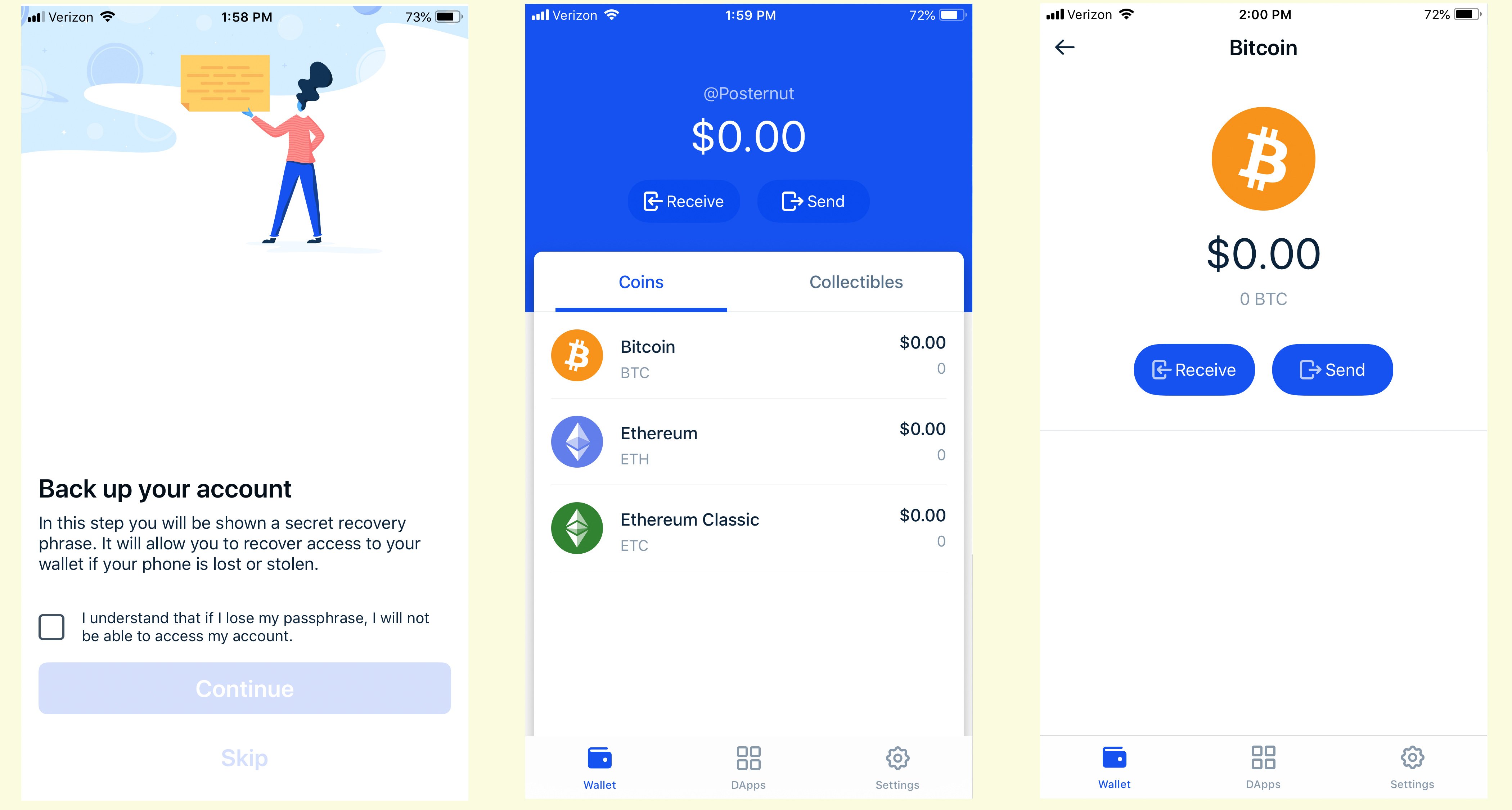
“Bitcoin support is activated by default — all you need to do is tap ‘Receive’ on the main wallet tab and select Bitcoin to send BTC to your Coinbase Wallet,” Coelho-Prabhu detailed. “Coinbase Wallet supports both newer segwit addresses with lower transaction fees, as well as legacy addresses for backward compatibility in all applications.”
Setting up a new Coinbase Wallet with username and passcode.
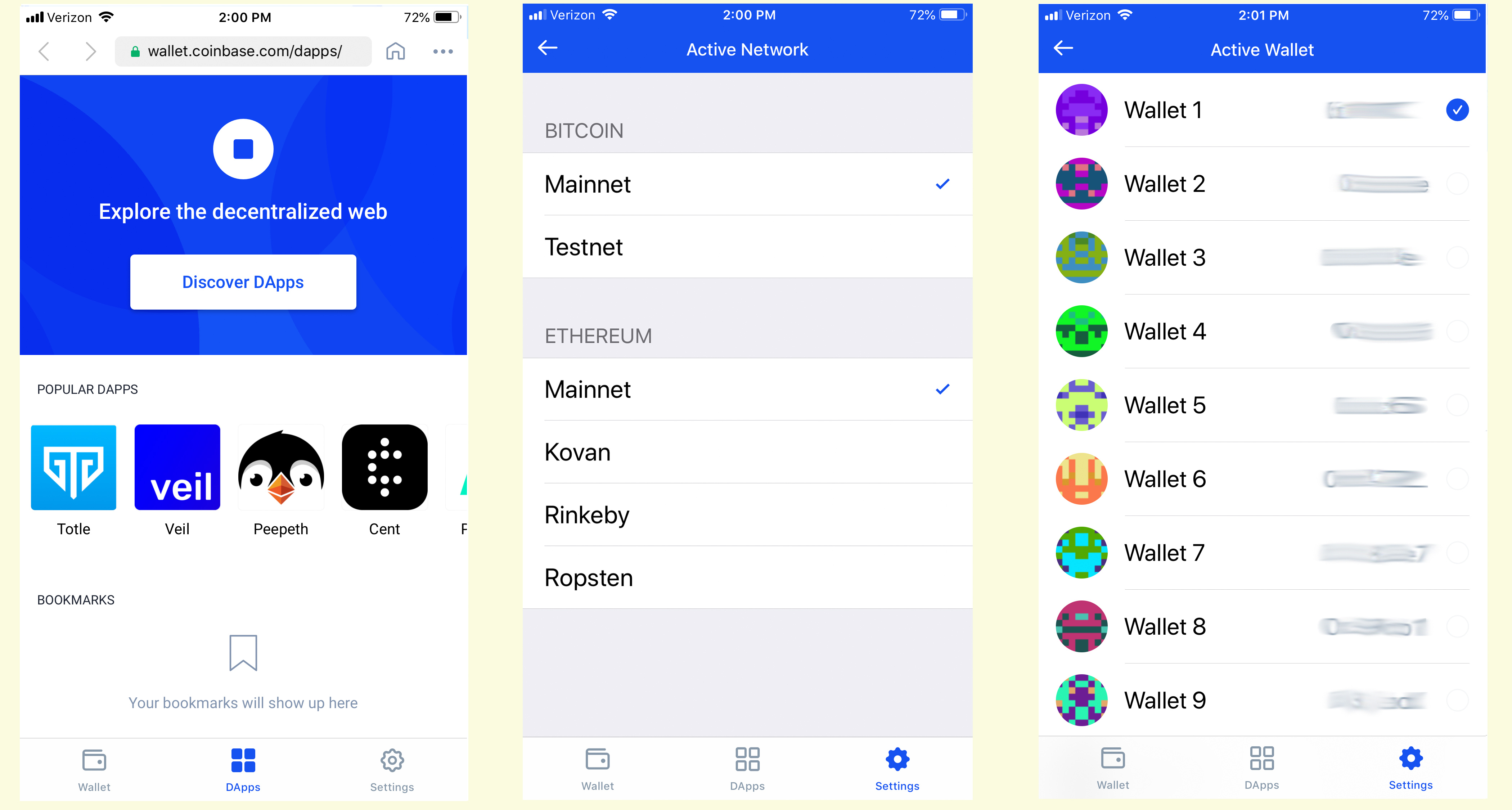
Just like the previous version of the wallet, the light client’s private keys are encrypted on your mobile phone or tablet using secure enclave technology. “This specialized hardware is considered the most secure way to safeguard private data on mobile devices,” Coelho-Prabhu explained. The Coinbase light client also supports the BTC and ETH testnets so programmers can work with testnet coins to deploy cryptocurrency integrated applications. At the moment most applications in the browser, like Peepeth, Instadapp, Totle, Cent, Smartdrops, Compound, Paradex, Oasis Direct, and Airswap are all Ethereum-based protocols. You can also click the “Discover Dapps” button to find more applications within the wallet’s browser.
Backing up the Coinbase Wallet’s private keys and the BTC wallet interface.
Bitcoin Cash, Litecoin, and Other Coins Will Be Supported Soon
Coinbase also details the company will be adding bitcoin cash (BCH), litecoin (LTC) and other popular digital assets soon. When BCH gets added to the wallet lineup there’s a wide variety of dapps that could be added to the Coinbase browser like Memo.cash, Craft.cash, Wormhole, the Simple Ledger Protocol (SLP) and Bookchain.
The Coinbase Wallet’s dapp browser, testnet section, and active wallets.
Not only has Coinbase announced BTC integration, but the company recommends Coinbase.com users should check out the wallet as it gives them control over their keys. The San Francisco company also emphasized the difference between the newly revamped wallet and the firm’s traditional brokerage operations.
“With Coinbase.com, you can buy crypto and Coinbase stores it (along with your private keys) for you; with Coinbase Wallet, you store your own crypto that’s safeguarded by a private key that only you know,” Coelho-Prabhu’s post concludes.
What do you think about the newly revamped Coinbase Wallet with added BTC support? Let us know what you think about this subject in the comments section below.
Image credits: Shutterstock, Jamie Redman, and the Coinbase Wallet.
Verify and track bitcoin cash transactions on our BCH Block Explorer, the best of its kind anywhere in the world. Also, keep up with your holdings, BCH and other coins, on our market charts at Satoshi’s Pulse, another original and free service from Bitcoin.com.
South Korea’s central bank has warned that adopting a state-backed cryptocurrency as an official form of legal tender would threaten the country’s financial integrity. In a report, the Bank of Korea (BoK) said such a currency, also known as a central bank digital currency (CBDC), could result in a spike in interest rates and a liquidity crunch.
‘CBDCs Will Cause Liquidity Shortages and Interest Rates to Rise’
Built on the blockchain, CBDCs are typically issued by central banks to work just like fiat money, but without necessarily replacing bank notes and coins. Korea said at the end of January that it was not considering issuing a government-backed digital currency anytime soon because there wasn’t any urgent need for one.
Now, the Asian country has issued a report to back up that decision. According to a newspaper article published in the Korea Times on Feb. 7, the BoK explained that the introduction of a CBDC will replace demand deposits held by local commercial banks. That’s because people will likely prefer the state-sponsored cryptocurrency, which they may deem safer and secure, to the domestic fiat unit, it said.
The idea behind this thinking is that as depositors withdraw money from the bank, commercial banks will fall into a liquidity trap, forcing the money supply to drop. This will ultimately see interest shooting up.
Kwon Oh-ik, one of the co-authors of the Bank of Korea report, elaborated:
The central bank digital currency is a kind of a BoK-issued bank account. People trust it more than one in a commercial bank. Demand deposits are one of the biggest sources of loans for banks. When people pull out their money, banks raise rates, or lower the reserve ratio, to secure more funds.
Kwon further indicated that the BoK, which has conducted and recently completed a long-term study on cryptocurrencies, should be more cautious and analyze any negative consequences that could arise from the issuance of a CBDC.
Global Central Banks Show Interest in CBDCs
Cashless transactions have soared around the world in recent years, unsettling many of the control freaks who work for various governments. Bitcoin, for example, was created to challenge the conventional financial system and return the ownership of money to the people, beyond the reach of the state.
But this vision has not endeared it to global financial gurus who are steeped in tradition. Unsurprisingly, many national governments have raised concerns about cryptocurrencies and have called for tighter regulation while angling to issue their own versions of centralized digital currencies.
A recent report by the Bank for International Settlements showed about 70 percent of central banks throughout the world are researching CBDCs, although “this work is primarily conceptual and only a few intend to issue a CBDC in the short to medium term”.
Christine Lagarde
However, the International Monetary Fund’s head Christine Lagarde has urged central banks to consider issuing digital currency to make transactions more secure. At a conference in Singapore in November, Lagarde argued that state-backed cryptocurrencies could satisfy public policy goals related to financial inclusion, consumer protection, privacy and fraud prevention.
“I believe we should consider the possibility to issue digital currency,” Lagarde said at the time. “There may be a role for the state to supply money to the digital economy. The advantage is clear. Your payment would be immediate, safe, cheap and potentially semi-anonymous. And central banks would retain a sure footing in payments.”
Citing the example of central banks in Canada, China, Sweden and Uruguay, which are all “seriously considering” the introduction of their own digital currencies, Lagarde said a state-issued cryptocurrency would be a liability of the state, just like fiat money. Such currencies could reduce the cost of transactions while maximizing security and spreading adoption, but they would not be censorship-resistant cryptocurrency in the true sense.
What do you think about CBDCs and financial stability? Let us know in the comments section below.
Images courtesy of Shutterstock.
Express yourself freely at Bitcoin.com’s user forums. We don’t censor on political grounds. Check forum.Bitcoin.com
Cambridge-based legal AI technology business Luminance has raised a fresh $10 million from existing investors Invoke Capital, Talis Capital and Slaughter and May to wrap up a $100m Series B round.
The funds will be used to support the Cambridge University spin-out’s recent product expansion and global growth. The UK company’s machine learning technology is now deployed in over 130 organisations on six continents following its September 2016 launch.
The announcement follows the business’ recent opening of a fifth office in New York to support global growth, adding to bases in London, Cambridge, Chicago and Singapore. The company now has four offerings and over 70 employees.
Whether used for legal due diligence, compliance reviews or eDiscovery, Luminance’s technology operates on advanced pattern recognition and machine learning algorithms that behave much like the human brain, sorting through high-volume documentation and flagging anomalies at speed, offering lawyers greater control and insight into their documents.
In just two years, the company’s technology has been deployed in over 40 countries and is used by thousands of lawyers on a daily basis. In 2018 alone, Luminance’s customer base increased by over 150 per cent, with global employee headcount more than doubling to meet this demand.
CEO Emily Foges said: “2018 was a year of significant achievement for Luminance. We have expanded from one product to four, owing to the flexibility and innovative nature of our core technology.
“This has enabled a remarkable rate of global customer acquisition over the last 12 months and these funds will valuably support this continued expansion.”
Luminance’s decision to open a New York office came as its US customer base continued to expand – now including Global Top 100 firms McDermott Will & Emery and Holland & Knight, among others.
The company was founded by a group of mathematicians and software engineers from the University of Cambridge following years of research into pattern recognition and machine intelligence.
With traditional CRM tools, sales people add basic details about the companies to the database, then a few notes about their interactions. AI has helped automate some of that, but Gong.io wants to take it even further using voice recognition to capture every word of every interaction. Today, it got a $40M Series B investment.
The round was led by Battery Ventures with existing investors Norwest Venture Partners, Shlomo Kramer, Wing Venture Capital, NextWorld Capital and Cisco Investments also participating. Battery general partner Dharmesh Thakker will join the startup’s Board under the terms of the deal. Today’s investment brings the total raised so far to $68 million, according to the company.
$40 million is a hefty Series B, but investors see a tool that has the potential to have a material impact on sales, or at least give management a deeper understanding of why a deal succeeded or failed using artificial intelligence, specifically natural language processing.
Company co-founder and CEO Amit Bendov says the solution starts by monitoring all customer-facing conversation and giving feedback in a fully automated fashion. “Our solution uses AI to extract important bits out of the conversation to provide insights to customer-facing people about how they can get better at what they do, while providing insights to management about how staff is performing,” he explained. It takes it one step further by offering strategic input like how your competitors are trending or how are customers responding to your products.
Screenshot: Gong.io
Bendov says he started the company because he has had this experience at previous startups where he wants to know more about why he lost a sale, but there was no insight from looking at the data in the CRM database. “CRM could tell you what customers you have, how many sales you’re making, who is achieving quota or not, but never give me the information to rationalize and improve operations,” he said.
The company currently has 350 customers, a number that has more than tripled since the end of 2017 when it had 100. He says it’s not only that it’s adding new customers, existing ones are expanding, and he says that there is almost zero churn.
Today, Gong has 120 employees with headquarters in San Francisco and a 55-person R&D team in Israel. Bendov expects the number of employees to double over the next year with the new influx of money to keep up with the customer growth.
from Startups – TechCrunch https://tcrn.ch/2MV4QNg
Flexible electronics pioneer PragmatIC has further ramped global production from its Cambridge UK base after raising an additional $17 million.
Cambridge Innovation Capital led the latest round for PragmatIC, backed by fellow shareholders Arm and Avery Dennison, as well as new investors who share PragmatIC’s vision for leveraging the technology to digitally connect everyday objects.
With funding in place, PragmatIC has announced shipment of the first products in its ConnectIC family, the PR1101 and PR1102 FlexICs, designed for use in closed RFID (radio-frequency identification) systems.
The groundbreaking ConnectIC family will be pivotal in the acceleration of the smart packaging market.
Developed using PragmatIC’s unique platform of patented technologies, ConnectICs deliver connectivity solutions at the lowest cost point in the market.
These revolutionary FlexICs are ultra-thin and flexible; suitable for embedding into a wide range of substrates, including paper and plastic; and reduce the complexity of inlays by using single layer antennas, delivering a further step down in cost to brand owners and retailers.
These ConnectICs are extremely attractive for high-volume fast-moving consumer goods (FMCGs) and other mass market applications, with electronic connectivity no longer limited to high value, luxury items.
The PR1100 product series facilitates rapid detection of objects when one or more low-cost custom readers are integrated into the system. Designed for proximity identification applications, these FlexICs are ideal for applications including hierarchical inventory management, item identification and tracking, supply chain assurance and brand authentication.
They are targeted at market segments such as food and beverage, personal and home care, pharmaceutical and healthcare. They also support the introduction of digital interactivity into physical toys and games.
CEO Scott White said: “The ConnectIC family is set to bring connectivity to items we buy every day. We have already started shipping to our partners and we anticipate rapid expansion based on clear opportunities for global customers with extensive brand portfolios who wish to add traceability and interactivity to their products.”
Victor Christou, CEO of Cambridge Innovation Capital added: “We are delighted to continue to support the PragmatIC team as it develops its range of FlexIC products which are designed to revolutionise the functionality of packaging across an extensive range of industries.”
Raspberry Pi, Cambridge pioneer of the world’s smallest but most powerful micro computer, has followed a trail blazed by global e-retailer giants like Amazon by opening a bricks and mortar shop in the technology cluster’s Grand Arcade.
It has simultaneously introducing a new all-in-one starter kit to address broader consumer markets.
Raspberry Pi’s low-cost, credit card-sized PCs have captured hearts, minds and wallets worldwide.
Its first shop is designed to be an experiential space, offering an environment in which visitors can try their hand at programming the tiny PCs.
Alongside a large range of Raspberry Pi’s existing products and merchandise, the outlet will also offer a new ‘Everything you need to get started with Raspberry Pi’ kit.
This includes the latest Raspberry Pi 3 Model B+ alongside a complete set of official peripherals and everything a beginner needs to get started with programming their PC.
Eben Upton, CEO of Raspberry Pi (Trading), said: “Opening Raspberry Pi’s first shop and introducing the new kit, are important steps on our way to achieving broader adoption of our products.
“Our vision has always been to make low-cost PCs accessible to everyone: the shop provides potential customers with a chance to learn about Raspberry Pi, while at the same time giving us a chance to learn more about their needs. The kit is intended to provide a smoother out-of-box experience for this group of new customers.
“Of course, the shop will also be a great destination for existing Raspberry Pi fans. We have a loyal and highly engaged community and it’s great to be able to offer them another way to interact with us and our products.”
Raspberry Pi was founded in Cambridge and has just taken major office space at The Maurice Wilkes Building at St John’s Innovation Park.
It provides outreach and education to help more people access computing and digital making; this entails developing free resources to help people learn about computing and how to make things with computers, and train educators who can guide other people to learn.