About Startup365

Chaque jour nous vous présenterons une nouvelle Startup française ! Notre pays regorge de talents et d'entrepreneurs brillants ! Alors partons à la découverte des meilleures startup françaises ! Certaines d'entre elles sont dans une étape essentielle dans la vie d'une startup : la recherche de financement, notamment par le financement participatif (ou crowdfunding en anglais). Alors participez à cette grande aventure en leur faisant une petite donation ! Les startups françaises ont besoin de vous !

#Blockchain The Daily: 13% of Shoppers Would Buy Amazon Crypto, Wirex Adds Stablecoin

The Daily: 13% of Shoppers Would Buy Amazon Crypto, Wirex Adds Stablecoin

In Thursday’s edition of The Daily we feature a recent survey that shows 13 percent of shoppers would be happy to buy cryptocurrencies under the Amazon brand. We also cover a new stablecoin integration by crypto card provider Wirex and a token promoted on Coinbase Earn.

Also Read: Abra Adds Stocks and ETF Investing to Its Crypto Exchange App

Survey: 13% of Shoppers Would Buy Amazon Crypto

Online commerce giant Amazon (NASDAQ: AMZN) has one of the strongest brands in the world. What started out as just an online bookstore has become almost a force of nature, taking over entire industries. The company also enjoys a great deal of trust with consumers, especially in the U.S. market where some people allow Amazon to unlock their front doors to make in-home delivery (Amazon Key), install its AI-powered listening devices (Alexa) and even to run the cloud computing systems of the CIA.

It would be fair to say that Amazon is more trusted and liked than most banks. Given this fact, it is not surprising that a good portion of its customers would also trust Amazon with their digital finance needs. A recent survey of over 1,000 Amazon clients by the financial portal Investing.com found that 12.7 percent of them would feel comfortable purchasing cryptocurrencies under the Amazon brand. This could be assumed to be anything from an integrated cryptocurrency wallet to an Amazon-issued token.

The Daily: 13% of Shoppers Would Buy Amazon Crypto, Wirex Adds Stablecoin

Wirex Adds First Stablecoin

Popular online bank and crypto debit card issuer Wirex has added a first stablecoin to its list of supported cryptocurrencies. Users of the Wirex platform in the European Economic Area (EEA) can now buy, store, convert and spend dai (DAI) with their Wirex Visa cards, the U.K.-based company announced in a recent blog post. This is the seventh token made available for Wirex users as the service already supports bitcoin core (BTC), litecoin (LTC), ripple (XRP), ether (ETH), waves (WAVES) and wollo (WLO).

The Daily: 13% of Shoppers Would Buy Amazon Crypto, Wirex Adds Stablecoin

“We want to give our customers access to a full array of cryptocurrencies. Stablecoins are yet another variation of crypto that demonstrates how easily and efficiently it can be integrated into everyday life,” commented Wirex co-founder Pavel Matveev. His co-founder Dmitry Lazarichev added: “Dai is an excellent tool to make international payments at low costs without the volatility. The token feeds into our ethos of enabling mainstream crypto adoption by streamlining traditional and cryptocurrencies. Dai is a solid addition to our existing cryptocurrency portfolio.”

Coinbase Takes a Swing With BAT

Back in December, Coinbase announced an initiative meant to incentive people to learn more about cryptocurrencies. The Coinbase Earn educational platform rewards users with tokens for completing various tasks such as watching videos and taking quizzes on crypto-related content. On Wednesday a section on Basic Attention Token (BAT) was added to the service, offering users the opportunity earn up to $10 worth of BAT in the process of learning about it.

The Coinbase Earn team explained to those new to BAT that “Basic Attention Token seeks to improve the efficiency of digital advertising with a token that can be exchanged between publishers, advertisers, and users on the Ethereum blockchain. The token can be used to obtain a variety of advertising and attention-based services on the BAT platform and the Brave browser.” The token quickly jumped over 10 percent in price, offering a valuable lesson in the power of Coinbase to move the market.

What do you think about today’s news tidbits? Share your thoughts in the comments section below.


Images courtesy of Shutterstock, Investing.com.


Verify and track bitcoin cash transactions on our BCH Block Explorer, the best of its kind anywhere in the world. Also, keep up with your holdings, BCH and other coins, on our market charts at Satoshi’s Pulse, another original and free service from Bitcoin.com.

The post The Daily: 13% of Shoppers Would Buy Amazon Crypto, Wirex Adds Stablecoin appeared first on Bitcoin News.

from Bitcoin News http://bit.ly/2UINrdd The Daily: 13% of Shoppers Would Buy Amazon Crypto, Wirex Adds Stablecoin

#USA Deepomatic raises $6.2 million for its industrial computer vision technology

//

French startup Deepomatic just raised a new funding round of $5.1 million in equity funding and $1.1 million in debt. Hi Inov is leading the round, with Alven Capital and Bertrand Diard also participating.

Deepomatic lets you build your own computer vision applications for your industrial needs. The company gives you all the tools to train a model and connect it to your video feeds. You can then deploy your new shiny service at the edge or on your own infrastructure, wherever you need it. You remain in control of your data.

After that, you can integrate that brick with the rest of your infrastructure using API calls. With such a low barrier to entry, it takes you around three months to deploy Deepomatic.

And it’s already working quite well for some companies. For instance, Compass Group is using it in some of its cafeterias. Instead of waiting in line for the cashier when your food is getting cold on your tray, you can simply pass your tray in front of a camera.

The camera will take a photo of your food and automatically recognize what you got — it works pretty much like Amazon Go. There’s no QR code, no RFID tags. There are 15,000 people using this system every day already.

Belron, the company behind Carglass, Autoglass, Safelite and other vehicle glass repair shops, is also using Deepomatic. Employees can take a photo of a broken windshield with a coin for scale, and the service will tell you the next steps — replacing the windshield, fixing it with resin, etc.

Parking company Indigo is also leveraging Deepomatic’s technology for its security cameras. In addition to traditional CCTV, security cameras can detect if someone is acting suspicious based on various factors — Indigo is keeping those factors confidential so that people can’t defeat the system.

Deepomatic customers pay annual subscription fees like other enterprise software solutions. The startup is going to focus on energy, transportation and infrastructure companies at first.

This is quite a departure from Deepomatic’s first product. The company started with a sort of ‘Shazam for fashion’ using computer vision. “Shopping and retail weren’t in our DNA, we are engineers,” co-founder and CEO Augustin Marty told me.

With today’s funding round, the company is opening a new office in New York to focus on the American market. Deepomatic currently has 20 clients but could quickly become an essential technological brick for many big companies.

from Startups – TechCrunch https://tcrn.ch/2Sf146Z

#Africa Applications open for Startupbootcamp AfriTech FastTrack Tour

//

The Startupbootcamp AfriTech accelerator has opened applications for its FastTrack Tour, which will host 19 events across 14 countries to source startups for its third programme in Cape Town later this year.

The corporate-backed Startupbootcamp AfriTech programme is opening applications for its third edition, offering startups access to seed funding, mentorship, training, business support services, and the chance to securing partnerships with corporates.

Over the three-month programme’s first two years, 20 companies have signed 52 pilots and commercial agreements with large corporations, and the search for the third cohort will begin with the FastTrack tour, comprising 19 events in 14 countries.

FastTracks are informal events that give the Startupbootcamp AfriTech team, mentors and sponsors the opportunity to meet the most suitable early-stage companies interested in joining the programme. This year’s accelerator is anchored and endorsed by leading corporate sponsors Old Mutual, RCS, BNP Paribas Personal Finance, Nedbank and PwC. Leaders from these corporates will be present at the FastTrack events to engage and mentor.

At each event, 10 startups will receive instant feedback from a panel of industry mentors, be able to network with the Startupbootcamp AfriTech investment team and learn more about the programme. Attending a FastTrack will boost a startup’s chances of joining the accelerator by 20 per cent.

“The Startupbootcamp AfriTech FastTrack Tour for 2019 is an open canvas for forward-thinking startups to initiate a shift in traditional thinking while networking with hundreds of other innovative, like-minded people wanting to set new benchmarks in the African tech industry”, said programme director Nsovo Nkatingi.Interested startups can go here to find the FastTrack nearest to them and submit their application.

The post Applications open for Startupbootcamp AfriTech FastTrack Tour appeared first on Disrupt Africa.

from Disrupt Africa http://bit.ly/2DXHNOV

#Africa African e-health startups invited to apply for Sanofi challenge

//

French multinational pharmaceutical company Sanofi, through its Afric@Tech innovation lab, is inviting e-health companies to submit solutions to three challenges.

Sanofi first launched the Afric@Tech challenge last year with the goal of identifying and rewarding the startups revolutionising practices in the health sector in Africa, with the first edition won by South African mobile diagnostics startup Vula Mobile.

This year, Sanofi is looking for solutions to three challenges: enhancing awareness, diagnosis and disease management of patients suffering from Diabetes, improving access to medicines in remote areas, and supporting decision-makers in getting better usage of available health data.

Successful applicants will have the opportunity to present their solutions at the Viva Tech event in Paris in May, which brings together 10,000 startups with top worldwide investors, companies and global tech leaders.
Applications are open here until February 15, with Sanofi looking for African startups with at least a proof of concept, with relevant solutions and developed business models.

The post African e-health startups invited to apply for Sanofi challenge appeared first on Disrupt Africa.

from Disrupt Africa http://bit.ly/2MSETxJ

#Africa South African AI startup Cortex Logic raises funding to expand beyond Africa

//

South African artificial intelligence (AI) startup Cortex Logic has secured investment as it bids to expand its reach to new clients in Europe and the United States (US).

Founded in 2015, Cortex Logic leverage its AI engine to help businesses solve strategic and operationally relevant problems by mobilising data science, the Internet of Things (IoT), and big data analytics.

Cortex Logic is already consulting with and supporting some of the most prominent brands in South Africa and global businesses in a range of sectors, and has now secured funding – the amount and source of which is undisclosed – to expand operations further afield.

“Every sector of commerce will be impacted by AI and we are now attracting interest from Europe and the US, so this is just a natural step in our growth plan,” said founder and chief executive officer (CEO) Dr Jacques Ludik.

“The investment is a great endorsement not only of our team, products and growth strategy, but also an acknowledgement of the reality that enterprises around the world are now deploying artificial intelligence powered solutions to secure a competitive advantage.”

Cortex Logic will use the investment to on-board more staff. It is currently recruiting data scientists, developers and analysts with experience in machine learning, deep learning and complex solution development.  

“Housing our core team in our new Cape Town Office HQ means we have a great working environment to offer new staff allied to an excellent talent pool for growth,” said Ludik.

The post South African AI startup Cortex Logic raises funding to expand beyond Africa appeared first on Disrupt Africa.

from Disrupt Africa http://bit.ly/2Gu3UOr

#USA Car subscription service Cluno scores $28M in Series B funding led by Peter Thiel’s Valar Ventures

//

Cluno, the Munich startup providing what it calls a “car subscription” service, has raised $28 million in Series B funding. The round is led by Valar Ventures, the U.S.-based venture capital firm founded by Peter Thiel.

Acton Capital Partners and Atlantic Labs, which both backed the company’s Series A round, also participated. It brings total raised by Cluno to $36 million in funding in under one year.

Founded in 2017 by the same team behind easyautosale (which exited to Autoscout24 in 2015), Cluno offers an alternative to car ownership or a more restrictive lease by enabling you to subscribe to a car for an all-inclusive monthly fee. Available in Germany only, you book your car online or via the Cluno app, with the monthly fee covering all costs except fuel. After a minimum term of six months, subscribers can return or switch their car with three months notice.

Cluno says it will use the additional capital to further accelerate the company’s growth and to invest in its technology. This sees bookings, as well as credit checks and signatures, all carried out paperlessly via the Cluno app. In terms of car choice, the startup offers almost 50 models from nine different car companies, including BMW, VW, Audi and Ford. Models span small cars to SUVs, including hybrid and electric vehicles.

“Cluno is a full-stack provider,” is how Cluno co-founder and CEO Nico Polleti frames the company. “We control the whole value chain”. This, he tells me, includes doing solvency checks, scoring, buying and financing the cars, analysing and estimating residual values, insurance, and more. “One of the VCs I spoke to said Cluno is 50 percent mobility and 50 percent fintech,” he says. “We invest time and money in structured financing to buy more Cluno cars and make more customers happy”.

The Cluno team is now 55 strong and will grow to around 85 by the end of the year. In particular, Cluno is hiring tech, finance and marketing people based at its office in Munich. The product roadmap still has a way to go, too.

“At the moment, the app only allows you to subscribe to a car out of the predefined Cluno portfolio,” explains Polleti. “[The] next step will be the Cluno app giving access to dealer stock via an API”. This will see Cluno form partnerships with dealers and OEMs to grow the supply side of its offering.

from Startups – TechCrunch https://tcrn.ch/2UNMBvT

#Blockchain A Millennial and Crypto Love Story: How This Generation Is Ghosting Banks

America’s youth has long been in a bad relationship with banks. Their predatory, self-serving practices have left a bad taste in the mouths of many young consumers, who have historically acclimated and resigned themselves to the system as they aged. Millennials have been accused of killing almost every industry, from golf to napkins, but now they’re on the cusp of the biggest breakup yet – with banks. Millennials might finally be the generation to leave their deadbeat ex and have the passion and optimism to envision a new way of doing things financially.

Also read: The Crucible of Privacy: Why Decentralized Exchange Is the Only Way

Breaking up With Banks

During the 2008 financial collapse, the Fed had to lower interest rates to 0 percent, right around when millennials were graduating from college (in debt from bank loans) and trying to build up their finances. Millennials could barely earn interest on their deposits, while banks continued to use those same deposits to charge consumers 25 percent interest on credit cards and keep over 90 percent of the value to themselves. Bank executives have had record earnings and bonuses since 2009, while most Americans struggle to finish the month in the green.

This is a completely one-sided relationship, with millennials giving and banks taking. Besides, healthy relationships are based on trust, and millennials just don’t trust banks. According to a 2018 study by Edelman, 77 percent of affluent millennials feel the traditional financial system is “designed to favor the rich and powerful.” 75 percent worry about the global financial system being hacked and losing their personal information, and 77 percent think it’s a matter of time before finance’s “bad behavior” leads to “another global financial crisis.”

So banks are bad news, and they don’t even pretend not to be. 70 percent of affluent millennials feel that financial service companies “make the purchasing process unnecessarily confusing/frustrating” and 71 percent say these companies leave them feeling “unsure” and “out of their depth.” This is a recipe for an unstable, manipulative relationship. Luckily, millennials have the sense to realize that and pull the plug.

The millennial disruption index slates banking as the most ripe industry for disruption, and reports that 71 percent of millennials would rather go to the dentist than “listen to what their banks have to say.”

The dentist!

The index also reports that all four of the leading banks are among the 10 brands millennials love least.

On top of all of that, banks have historically proved to be ageist, racist, and classist institutions that disfavor minorities in lending practices, fail to provide services to minority neighborhoods, and provide predatory rates to populations most in need. This is no pesky lovers’ quarrel. This is a breakup.

The Cryptocurrency Crush

Luckily, cryptocurrency is waiting to be that shoulder for millennials when banks break their hearts … and their wallets. It didn’t take long for millennials to notice – 17.2 percent of millennials own crypto already. And that number is higher for wealthy millennials: According to Edelman’s study, 25 percent of wealthy millennials own cryptocurrencies, a further 31 percent are interested in crypto, and a whopping 74 percent say technical innovations like blockchain make the global financial system more secure.

Crypto might have started out as the nerdy rebound, but it’s quickly prompting the friend-zoning of its jockey, broad-shouldered big name competitor banks. A Sustany Capital study found that 88 percent of millennials “want to own cryptocurrencies as an investment,” and 42 percent want to “use cryptocurrency as savings.”

The interest is there; we just need some good reliable friends to play matchmaker. Many millennials feel held back from diving into crypto only because of lack of education, but 97 percent of surveyed millennials and generation X said they’d like to learn more.  73 percent of millennials would be significantly more likely to invest in crypto if advised by a financial adviser. Crypto just needs a few good wingmen to help people understand how useful, safe, and fair it really is.

A Romance Built on Values

Lots of people are saying that crypto is a passing fad, like that time you were really into the double-popped collar look, especially as the market has declined in the last few months. But recent reporting by Bloomberg shows that although the price of bitcoin dropped by 80 percent during 2018, the total number of accounts opened has doubled to over 35 million during that same period, indicating that crypto’s popularity is just getting started.

Relationships that last through tough times are based on more than just attraction or novelty, but on deeper shared values. Crypto makes practical, financial sense for millennials: there are lower fees for using and transferring it since there are no middlemen involved, blockchain keeps a consistent and incorruptible record that means bankers can’t steal their money, and it’s impersonal, so there are no worries about discrimination based on previous student loans or social status. More than that, crypto also makes sense in principle to a generation that is moving away from exploitative business practices and buying with their consciences.

Values persist regardless of market highs and lows, as Charles Hoskinson, founder of Cardano, recently tweeted: “The headlines and carnival barking from the media about the current state of Bitcoin and recent losses show they have never gotten our movement. $150 billion in value has been liberated from the banking system and now exists in a parallel economy. Our growth remains unchallenged.” It’s about liberating the economy from the banking system, and that is true in bear and bull markets alike.

Millennials are looking for a new generation of services that will act in their best interest and help society in general by supporting the unbanked and under served. Crypto is the perfect mix of practical and passionate, paying the bills and fighting for a cause. For a generation toeing this balance like never before, crypto is a keeper – one that you can hopefully bring home to mom and dad.

Do you think millennials are breaking up with the banks? What will it take to help millennials get more involved in crypto? Will all generations begin to accept and adopt crypto? 


Images courtesy of Shutterstock


OP-ed disclaimer: This is an Op-ed article. The opinions expressed in this article are the author’s own. Bitcoin.com does not endorse nor support views, opinions or conclusions drawn in this post. Bitcoin.com is not responsible for or liable for any content, accuracy or quality within the Op-ed article. Readers should do their own due diligence before taking any actions related to the content. Bitcoin.com is not responsible, directly or indirectly, for any damage or loss caused or alleged to be caused by or in connection with the use of or reliance on any information in this Op-ed article.


This article was written by Alex Mashinsky. He is CEO of Celsius Network. He is one of the inventors of VOIP (Voice Over Internet Protocol) and is now working on MOIP (Money Over Internet Protocol) technology. Over 35 patents have been issued to Alex, relating to exchanges, VOIP protocols, messaging and communication. As a serial entrepreneur and founder of seven New York City-based startups, Alex has raised more than $1 billion and exited over $3 billion. Alex founded two of New York City’s top 10 venture-backed exits since 2000. Alex has received numerous awards for innovation, including being nominated twice by E&Y as entrepreneur of the year; Crain’s 2010 Top Entrepreneur; the prestigious 2000 Albert Einstein Technology medal; and the Technology Foresight Award for Innovation.

The post A Millennial and Crypto Love Story: How This Generation Is Ghosting Banks appeared first on Bitcoin News.

from Bitcoin News http://bit.ly/2DhoD4K A Millennial and Crypto Love Story: How This Generation Is Ghosting Banks

#USA The plot to revive Mt. Gox and repay victims’ Bitcoin

//

It was the Lehman Brothers of blockchain. 850,000 Bitcoin disappeared when cryptocurrency exchange Mt. Gox imploded in 2014 after a series of hacks. The incident cemented the industry’s reputation as frighteningly insecure. Now a controversial crypto celebrity named Brock Pierce is trying to get the Mt. Gox flameout’s 24,000 victims their money back and build a new company from the ashes.

Pierce spoke to TechCrunch for the first interview about Gox Rising — his plan to reboot the Mt. Gox brand and challenge Coinbase and Binance for the title of top cryptocurrency exchange. He claims there’s around $630 million and 150,000 Bitcoin are waiting in the Mt. Gox bankruptcy trust, and Pierce wants to solve the legal and technical barriers to getting those assets distributed back to their rightful owners.

The consensus from several blockchain startup CEOs I spoke with was that the plot is “crazy”, but that it also has the potential to right one of the biggest wrongs marring the history of Bitcoin.

The Fall Of Mt. Gox

The story starts with Magic: The Gathering. Mt. Gox launched in 2006 as a place for players of the fantasy card game to trade monsters and spells before cryptocurrency came of age. The Magic: The Gathering Online eXchange wasn’t designed to safeguard huge quantities of Bitcoin from legions of hackers, but founder Jed McCaleb pivoted the site to do that in 2010. Seeking to focus on other projects, he gave 88 percent of the company to French software engineer Mark Karpeles, and kept 12 percent. By 2013, the Tokyo-based Mt. Gox had become the world’s leading cryptocurrency exchange, handling 70 percent of all Bitcoin trades. But security breaches, technology problems, and regulations were already plaguing the service.

Then everything fell apart. In February 2014, Mt. Gox halted withdrawls due to what it called a bug in Bitcoin, trapping assets in user accounts. Mt. Gox discovered that it had lost over 700,000 Bitcoins due to theft over the past few years. By the end of the month, it had suspended all trading and filed for bankruptcy protection, which would contribute to a 36 percent decline in Bitcoin’s price. It admitted that 100,000 of its own Bitcoin atop 750,000 owned by customers had been stolen.

Mt. Gox is now undergoing bankruptcy rehabilitation in Japan overseen by court-appointed trustee and veteran bankruptcy lawyer Nobuaki Kobayashi to establish a process for compensating the 24,000 victims who filed claims. There’s now 137,892 Bitcoin, 162,106 Bitcoin Cash, and some other forked coins in Mt. Gox’s holdings, along with $630 million cash from the sale of 25 percent of the Bitcoin that Kobayashi handled at a precient price point above where it is today. But five years later, creditors still haven’t been paid back. 

A Rescue Attempt

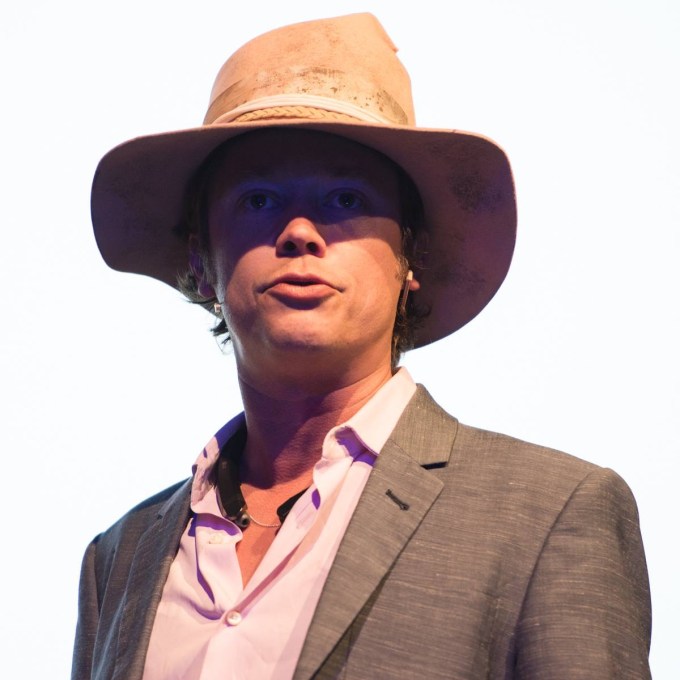
Brock Pierce, the eccentric crypto celebrity

Pierce had actually tried to acquire Mt. Gox in 2013. The child actor known from The Mighty Ducks had gone on to work with a talent management company called Digital Entertainment Network. But accusations of sex crimes led Pierce and some team members to flee the US to Spain until they were extradited back. Pierce wasn’t charged and paid roughly $21,000 to settle civil suits, but his cohorts were convicted of child molestation and child pornography.

The situation still haunts Pierce’s reputation and makes some in the industry apprehensive to be associated with him. But he managed to break into the virtual currency business, setting up World Of Warcraft gold mining farms in China. He claims to have eventually run the world’s largest exchanges for WOW Gold and Second Life Linden Dollars.

Soon Pierce was becoming a central figure in the blockchain scene. He co-founded Blockchain Capital, and eventually the EOS Alliance as well as a “crypto utopia” in Puerto Rico called Sol. His eccentric, Burning Man-influenced fashion made him easy to spot at the industry’s many conferences.

As Bitcoin and Mt. Gox rose in late 2012, Pierce tried to buy it, but “my biggest investor was Goldman Sachs. Goldman was not a fan of me buying the biggest Bitcoin exchange” due to the regulatory issues, Pierce tells me. But he also suspected the exchange was built on a shaky technical foundation that led him to stop pursuing the deal. “I thought there was a big risk factor in the Mt. Gox back-end. That was may intuition and I’m glad I was because my intuition was dead right.”

After Mt. Gox imploded, Pierce claims his investment group Sunlot Holdings successfully bought founder McCaleb’s 12 percent stake for 1 Bitcoin, though McCaleb says he didn’t receive the Bitcoin and it’s not clear if the deal went through. Pierce also claims he had a binding deal with Karpeles to buy the other 88 percent of Mt. Gox, but that Karpeles tried to pull out of the deal that remains in legal limbo.

The Supposed Villain

The Sunlot has since been trying to handle the bankruptcy proceedings, but that arrangement was derailed by a lawsuit from CoinLab. That company had partnered with Mt. Gox to run its North American operations but claimed it never received the necessary assets, and sued Mt. Gox for $75 million, though Mt. Gox countersued saying CoinLab wasn’t legally certified to run the exchange in the US and that it hadn’t returned $5.3 million in customer deposits. For a detailed account the tangle of lawsuits, check out Reuters’ deep-dive into the Mt. Gox fiasco.

CoinLab co-founder Peter Vessenes

This week, CoinLab co-founder Peter Vessenes increased the claim and is now seeking $16 billion. Pierce alleges “this is a frivolous lawsuit. He’s claiming if [the partnership with Mt. Gox] hadn’t been cancelled, CoinLab would have been Coinbase and is suing for all the value. He believes Coinbase is worth $16 billion so he should be paid $16 billion. He embezzled money from Mt. Gox, he committed a crime, and he’s trying to extort the creditors. He’s holding up the entire process hoping he’ll get a payday.” Later, Pierce reiterated that “Coinlab is the villain trying to take all the money and see creditors get nothing.” Industry sources I spoke to agreed with that characterization

Mt. Gox customers worried that they might only receive the cash equivalent of their Bitcoin according to the currency’s $486 value when Gox closed in 2014. That’s despite the rise in Bitcoin’s value rising to around 7X that today, and as high as 40X at the currency’s peak. Luckily, in June 2018 a Japanese District Court halted bankruptcy proceedings and sent Mt. Gox into civil rehabilitation which means the company’s assets would be distributed to its creditors (the users) instead of liquidated. It also declared that users would be paid back their lost Bitcoin rather than the old cash value.

The Plan For Gox Rising

Now Pierce and Sunlot are attempting another rescue of Mt. Gox’s  $1.2 billion assets. He wants to track down the remaining cryptocurrency that’s missing, have it all fairly valued, and then distribute the maximum amount to the robbed users with Mt. Gox equity shareholders including himself receiving nothing.

That’s a much better deal for creditors than if Mt. Gox paid out the undervalued sum, and then shareholders like Pierce got to keep the remaining Bitcoins or proceeds of their sale at today’s true value. “I‘ve been very blessed in my life. I did commit to giving my first billion away” Pierce notes, joking that this plan could account for the first $700 million he plans to ‘donate’.

“Like Game Of Thrones, the last season of Mt. Gox hasn’t been written” Pierce tells me, speaking in terms HBO’s Silicon Valley would be quick to parody. “What kind of ending do we want to make for it? I’m a Joseph Campbell fan so I’m obviously going to go with a hero’s journey, with a rise and a fall, and then a rise from the ashes like a phoenix.”

But to make this happen, Sunlot needs at least half of those Mt. Gox users seeking compensation, or roughly 12,000 that represent the majority of assets, to sign up to join a creditors committee. That’s where GoxRising.com comes in. The plan is to have users join the committee there so they can present a united voice to Kobayashi about how they want Mt. Gox’s assets distributed. “I think that would allow the process to move faster than it would otherise. Things are on track to be resolved in the next three to five years. If [a majority of creditors sign on] this could be resolved in maybe 1 year.

Beyond providing whatever the Mt. Gox estate pays out, Pierce wants to create a Gox Coin that gives original Mt Gox creditors a stake in the new company. He plans to have all of Mt. Gox’s equity wiped out, including his own. Then he’ll arrange to finance and tokenize an independent foundation governed by the creditors that will seek to recover additional lost Mt. Gox assets and then distribute them pro rata to the Gox Coin holders. There are plenty of unanswered questions about the regulatory status of a Gox Coin and what holders would be entitled to, Pierce admits.

Meanwhile, Pierce is bidding to buy the intangibles of Mt. Gox, aka the brand and domain. He wants to then relaunch it as a Gox or Mt. Gox exchange that doesn’t provide custody itself for higher security.

“We want to offer [creditors] more than the bankruptcy trustee can do on its own” Pierce tells me. He concedes that the venture isn’t purely altruistic. “If the exchange is very successful I stand to benefit sometime down the road.” Still, he stands by his plan, even if the revived Mt. Gox never rises to legitimately challenge Binance, Coinbase, and other leading exchanges. Pierce concludes, “Whether we’re successful or not, I want to see the creditors made whole.” Those creditors will have to decide for themselves who to trust.

from Startups – TechCrunch https://tcrn.ch/2GtDcp7

#USA Tink, the European open banking platform, scores €56M in new funding

//

Tink, the European open banking platform headquartered in Sweden, has deposited €56 million in new funding. Leading the round is U.S.-based Insight Venture Partners. Existing backers Sunstone, SEB, Nordea Ventures and ABN AMRO Digital Impact Fund also participated.

A number of other investors have been added to Tink’s cap table, too. They include Christian Clausen, former Chairman of the European Banking Federation, and — most notably — Nikolay Storonsky, co-founder of banking app and fintech ‘unicorn’ Revolut. According to sources, the new round of funding gives Tink a post-money valuation of €240 million.

Originally launched in Sweden in 2013 as a consumer-facing finance app with bank account aggregation at its heart, Tink has since repositioned its offering to provide the same underlying technology and more to banks and other financial service providers who want to ride the open banking/PSD2 train.

Through various APIs, Tink provides four pillars of technology: “Account Aggregation,” “Payment Initiation,” “Personal Finance Management” and “Data Enrichment”. These can be used by third parties to roll their own standalone apps or integrated into existing banking applications.

To that end, Tink says its developer platform is launching in five new markets, significantly boosting the fintech’s European coverage. They are U.K., Austria, Germany, Belgium and Spain, adding to the company’s Nordics base and bringing the total number of markets to nine countries.

Armed with new capital, Tink says the plan is to get to 20 markets by the end of 2019, targeting a range of customers “from big banks to individual developers”. In other words, the aim is to become a truly pan-European open banking platform. To help with this, headcount will increase significantly.

As it stands, Tink employs 150 people at its Stockholm headquarters, and recently opened an office in London. It plans to establish four more offices this year, doubling its European team to around 300. Customers include SEB, ABN AMRO, BNP Paribas Fortis, Nordea and Klarna.

Cue statement from Daniel Kjellén, co-founder and CEO, of Tink: “This funding round allows us to accelerate our European roll-out but also invest further in our data services. As Europe gradually embraces open banking, our platform has proved to be its rails and brains – delivering the technology that makes it possible. We attribute our success to being the first platform provider to combine account aggregation and payment initiation, the scale of our connectivity and our smart data products that make it all understandable”.

That’s not to say that Tink isn’t without competition, even if open banking/PSD2 feels like a bronze stroll rather than a gold rush so far, although things are definitely starting to heat up. Other fintechs in the space with overlapping products include Bud (which is backed by a host of banks, including HSBC), Meniga, and upstart TrueLayer.

from Startups – TechCrunch https://tcrn.ch/2RJH0on

#USA Fabula AI is using social spread to spot ‘fake news’

//

UK startup Fabula AI reckons it’s devised a way for artificial intelligence to help user generated content platforms get on top of the disinformation crisis that keeps rocking the world of social media with antisocial scandals.

Even Facebook’s Mark Zuckerberg has sounded a cautious note about AI technology’s capability to meet the complex, contextual, messy and inherently human challenge of correctly understanding every missive a social media user might send, well-intentioned or its nasty flip-side.

“It will take many years to fully develop these systems,” the Facebook founder wrote two years ago, in an open letter discussing the scale of the challenge of moderating content on platforms thick with billions of users. “This is technically difficult as it requires building AI that can read and understand news.”

But what if AI doesn’t need to read and understand news in order to detect whether it’s true or false?

Step forward Fabula, which has patented what it dubs a “new class” of machine learning algorithms to detect “fake news” — in the emergent field of “Geometric Deep Learning”; where the datasets to be studied are so large and complex that traditional machine learning techniques struggle to find purchase on this ‘non-Euclidean’ space.

The startup says its deep learning algorithms are, by contrast, capable of learning patterns on complex, distributed data sets like social networks. So it’s billing its technology as a breakthrough. (Its written a paper on the approach which can be downloaded here.)

It is, rather unfortunately, using the populist and now frowned upon badge “fake news” in its PR. But it says it’s intending this fuzzy umbrella to refer to both disinformation and misinformation. Which means maliciously minded and unintentional fakes. Or, to put it another way, a photoshopped fake photo or a genuine image spread in the wrong context.

The approach it’s taking to detecting disinformation relies not on algorithms parsing news content to try to identify malicious nonsense but instead looks at how such stuff spreads on social networks — and also therefore who is spreading it.

There are characteristic patterns to how ‘fake news’ spreads vs the genuine article, says Fabula co-founder and chief scientist, Michael Bronstein.

“We look at the way that the news spreads on the social network. And there is — I would say — a mounting amount of evidence that shows that fake news and real news spread differently,” he tells TechCrunch, pointing to a recent major study by MIT academics which found ‘fake news’ spreads differently vs bona fide content on Twitter.

“The essence of geometric deep learning is it can work with network-structured data. So here we can incorporate heterogenous data such as user characteristics; the social network interactions between users; the spread of the news itself; so many features that otherwise would be impossible to deal with under machine learning techniques,” he continues.

Bronstein, who is also a professor at Imperial College London, with a chair in machine learning and pattern recognition, likens the phenomenon Fabula’s machine learning classifier has learnt to spot to the way infectious disease spreads through a population.

“This is of course a very simplified model of how a disease spreads on the network. In this case network models relations or interactions between people. So in a sense you can think of news in this way,” he suggests. “There is evidence of polarization, there is evidence of confirmation bias. So, basically, there are what is called echo chambers that are formed in a social network that favor these behaviours.”

“We didn’t really go into — let’s say — the sociological or the psychological factors that probably explain why this happens. But there is some research that shows that fake news is akin to epidemics.”

The tl;dr of the MIT study, which examined a decade’s worth of tweets, was that not only does the truth spread slower but also that human beings themselves are implicated in accelerating disinformation. (So, yes, actual human beings are the problem.) Ergo, it’s not all bots doing all the heavy lifting of amplifying junk online.

The silver lining of what appears to be an unfortunate quirk of human nature is that a penchant for spreading nonsense may ultimately help give the stuff away — making a scalable AI-based tool for detecting ‘BS’ potentially not such a crazy pipe-dream.

Although, to be clear, Fabula’s AI remains in development at this stage, having been tested internally on Twitter data sub-sets at this stage. And the claims it’s making for its prototype model remain to be commercially tested with customers in the wild using the tech across different social platforms.

It’s hoping to get there this year, though, and intends to offer an API for platforms and publishers towards the end of this year. The AI classifier is intended to run in near real-time on a social network or other content platform, identifying BS.

Fabula envisages its own role, as the company behind the tech, as that of an open, decentralised “truth-risk scoring platform” — akin to a credit referencing agency just related to content, not cash.

Scoring comes into it because the AI generates a score for classifying content based on how confident it is it’s looking at a piece of fake vs true news.
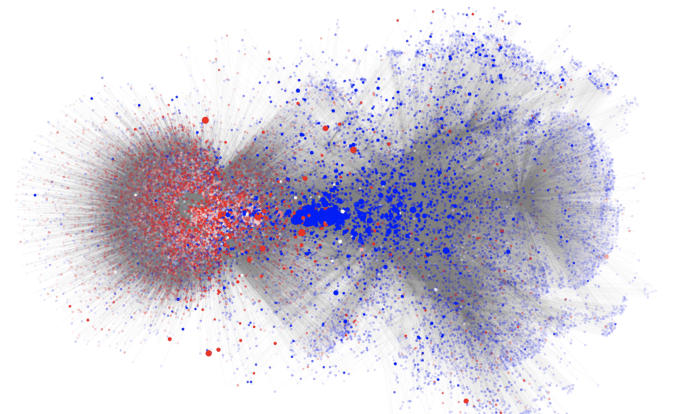
A visualisation of a fake vs real news distribution pattern; users who predominantly share fake news are coloured red and users who don’t share fake news at all are coloured blue — which Fabula says shows the clear separation into distinct groups, and “the immediately recognisable difference in spread pattern of dissemination”.

In its own tests Fabula says its algorithms were able to identify 93 percent of “fake news” within hours of dissemination — which Bronstein claims is “significantly higher” than any other published method for detecting ‘fake news’. (Their accuracy figure uses a standard aggregate measurement of machine learning classification model performance, called ROC AUC.)

The dataset the team used to train their model is a subset of Twitter’s network — comprised of around 250,000 users and containing around 2.5 million “edges” (aka social connections).

For their training dataset Fabula relied on true/fake labels attached to news stories by third party fact checking NGOs, including Snopes and PolitiFact. And, overall, pulling together the dataset was a process of “many months”, according to Bronstein, He also says that around a thousand different stories were used to train the model, adding that the team is confident the approach works on small social networks, as well as Facebook-sized mega-nets.

Asked whether he’s sure the model hasn’t been trained to identified patterns caused by bot-based junk news spreaders, he says the training dataset included some registered (and thus verified ‘true’) users.

“There is multiple research that shows that bots didn’t play a significant amount [of a role in spreading fake news] because the amount of it was just a few percent. And bots can be quite easily detected,” he also suggests, adding: “Usually it’s based on some connectivity analysis or content analysis. With our methods we can also detect bots easily.”

To further check the model, the team tested its performance over time by training it on historical data and then using a different split of test data.

“While we see some drop in performance it is not dramatic. So the model ages well, basically. Up to something like a year the model can still be applied without any re-training,” he notes, while also saying that, when applied in practice, the model would be continually updated as it keeps digesting (ingesting?) new stories and social media content.

Somewhat terrifyingly, the model could also be used to predict virality, according to Bronstein — raising the dystopian prospect of the API being used for the opposite purpose to that which it’s intended: i.e. maliciously, by fake news purveyors, to further amp up their (anti)social spread.

“Potentially putting it into evil hands it might do harm,” Bronstein concedes. Though he takes a philosophical view on the hyper-powerful double-edged sword of AI technology, arguing such technologies will create an imperative for a rethinking of the news ecosystem by all stakeholders, as well as encouraging emphasis on user education and teaching critical thinking.

Let’s certainly hope so. And, on the educational front, Fabula is hoping its technology can play an important role — by spotlighting network-based cause and effect.

“People now like or retweet or basically spread information without thinking too much or the potential harm or damage they’re doing to everyone,” says Bronstein, pointing again to the infectious diseases analogy. “It’s like not vaccinating yourself or your children. If you think a little bit about what you’re spreading on a social network you might prevent an epidemic.”

So, tl;dr, think before you RT.

Returning to the accuracy rate of Fabula’s model, while ~93 per cent might sound pretty impressive, if it were applied to content on a massive social network like Facebook — which has some 2.3BN+ users, uploading what could be trillions of pieces of content daily — even a seven percent failure rate would still make for an awful lot of fakes slipping undetected through the AI’s net.

But Bronstein says the technology does not have to be used as a standalone moderation system. Rather he suggests it could be used in conjunction with other approaches such as content analysis, and thus function as another string on a wider ‘BS detector’s bow.

It could also, he suggests, further aid human content reviewers — to point them to potentially problematic content more quickly.

Depending on how the technology gets used he says it could do away with the need for independent third party fact-checking organizations altogether because the deep learning system can be adapted to different use cases.

Example use-cases he mentions include an entirely automated filter (i.e. with no human reviewer in the loop); or to power a content credibility ranking system that can down-weight dubious stories or even block them entirely; or for intermediate content screening to flag potential fake news for human attention.

Each of those scenarios would likely entail a different truth-risk confidence score. Though most — if not all — would still require some human back-up. If only to manage overarching ethical and legal considerations related to largely automated decisions. (Europe’s GDPR framework has some requirements on that front, for example.)

Facebook’s grave failures around moderating hate speech in Myanmar — which led to its own platform becoming a megaphone for terrible ethnical violence — were very clearly exacerbated by the fact it did not have enough reviewers who were able to understand (the many) local languages and dialects spoken in the country.

So if Fabula’s language-agnostic propagation and user focused approach proves to be as culturally universal as its makers hope, it might be able to raise flags faster than human brains which lack the necessary language skills and local knowledge to intelligently parse context.

“Of course we can incorporate content features but we don’t have to — we don’t want to,” says Bronstein. “The method can be made language independent. So it doesn’t matter whether the news are written in French, in English, in Italian. It is based on the way the news propagates on the network.”

Although he also concedes: “We have not done any geographic, localized studies.”

“Most of the news that we take are from PolitiFact so they somehow regard mainly the American political life but the Twitter users are global. So not all of them, for example, tweet in English. So we don’t yet take into account tweet content itself or their comments in the tweet — we are looking at the propagation features and the user features,” he continues.

“These will be obviously next steps but we hypothesis that it’s less language dependent. It might be somehow geographically varied. But these will be already second order details that might make the model more accurate. But, overall, currently we are not using any location-specific or geographic targeting for the model.

“But it will be an interesting thing to explore. So this is one of the things we’ll be looking into in the future.”

Fabula’s approach being tied to the spread (and the spreaders) of fake news certainly means there’s a raft of associated ethical considerations that any platform making use of its technology would need to be hyper sensitive to.

For instance, if platforms could suddenly identify and label a sub-set of users as ‘junk spreaders’ the next obvious question is how will they treat such people?

Would they penalize them with limits — or even a total block — on their power to socially share on the platform? And would that be ethical or fair given that not every sharer of fake news is maliciously intending to spread lies?

What if it turns out there’s a link between — let’s say — a lack of education and propensity to spread disinformation? As there can be a link between poverty and education… What then? Aren’t your savvy algorithmic content downweights risking exacerbating existing unfair societal divisions?

Bronstein agrees there are major ethical questions ahead when it comes to how a ‘fake news’ classifier gets used.

“Imagine that we find a strong correlation between the political affiliation of a user and this ‘credibility’ score. So for example we can tell with hyper-ability that if someone is a Trump supporter then he or she will be mainly spreading fake news. Of course such an algorithm would provide great accuracy but at least ethically it might be wrong,” he says when we ask about ethics.

He confirms Fabula is not using any kind of political affiliation information in its model at this point — but it’s all too easy to imagine this sort of classifier being used to surface (and even exploit) such links.

“What is very important in these problems is not only to be right — so it’s great of course that we’re able to quantify fake news with this accuracy of ~90 percent — but it must also be for the right reasons,” he adds.

The London-based startup was founded in April last year, though the academic research underpinning the algorithms has been in train for the past four years, according to Bronstein.

The patent for their method was filed in early 2016 and granted last July.

They’ve been funded by $500,000 in angel funding and about another $500,000 in total of European Research Council grants plus academic grants from tech giants Amazon, Google and Facebook, awarded via open research competition awards.

(Bronstein confirms the three companies have no active involvement in the business. Though doubtless Fabula is hoping to turn them into customers for its API down the line. But he says he can’t discuss any potential discussions it might be having with the platforms about using its tech.)

Focusing on spotting patterns in how content spreads as a detection mechanism does have one major and obvious drawback — in that it only works after the fact of (some) fake content spread. So this approach could never entirely stop disinformation in its tracks.

Though Fabula claims detection is possible within a relatively short time frame — of between two and 20 hours after content has been seeded onto a network.

“What we show is that this spread can be very short,” he says. “We looked at up to 24 hours and we’ve seen that just in a few hours… we can already make an accurate prediction. Basically it increases and slowly saturates. Let’s say after four or five hours we’re already about 90 per cent.”

“We never worked with anything that was lower than hours but we could look,” he continues. “It really depends on the news. Some news does not spread that fast. Even the most groundbreaking news do not spread extremely fast. If you look at the percentage of the spread of the news in the first hours you get maybe just a small fraction. The spreading is usually triggered by some important nodes in the social network. Users with many followers, tweeting or retweeting. So there are some key bottlenecks in the network that make something viral or not.”

A network-based approach to content moderation could also serve to further enhance the power and dominance of already hugely powerful content platforms — by making the networks themselves core to social media regulation, i.e. if pattern-spotting algorithms rely on key network components (such as graph structure) to function.

So you can certainly see why — even above a pressing business need — tech giants are at least interested in backing the academic research. Especially with politicians increasingly calling for online content platforms to be regulated like publishers.

At the same time, there are — what look like — some big potential positives to analyzing spread, rather than content, for content moderation purposes.

As noted above, the approach doesn’t require training the algorithms on different languages and (seemingly) cultural contexts — setting it apart from content-based disinformation detection systems. So if it proves as robust as claimed it should be more scalable.

Though, as Bronstein notes, the team have mostly used U.S. political news for training their initial classifier. So some cultural variations in how people spread and react to nonsense online at least remains a possibility.

A more certain challenge is “interpretability” — aka explaining what underlies the patterns the deep learning technology has identified via the spread of fake news.

While algorithmic accountability is very often a challenge for AI technologies, Bronstein admits it’s “more complicated” for geometric deep learning.

“We can potentially identify some features that are the most characteristic of fake vs true news,” he suggests when asked whether some sort of ‘formula’ of fake news can be traced via the data, noting that while they haven’t yet tried to do this they did observe “some polarization”.

“There are basically two communities in the social network that communicate mainly within the community and rarely across the communities,” he says. “Basically it is less likely that somebody who tweets a fake story will be retweeted by somebody who mostly tweets real stories. There is a manifestation of this polarization. It might be related to these theories of echo chambers and various biases that exist. Again we didn’t dive into trying to explain it from a sociological point of view — but we observed it.”

So while, in recent years, there have been some academic efforts to debunk the notion that social media users are stuck inside filter bubble bouncing their own opinions back at them, Fabula’s analysis of the landscape of social media opinions suggests they do exist — albeit, just not encasing every Internet user.

Bronstein says the next steps for the startup is to scale its prototype to be able to deal with multiple requests so it can get the API to market in 2019 — and start charging publishers for a truth-risk/reliability score for each piece of content they host.

“We’ll probably be providing some restricted access maybe with some commercial partners to test the API but eventually we would like to make it useable by multiple people from different businesses,” says requests. “Potentially also private users — journalists or social media platforms or advertisers. Basically we want to be… a clearing house for news.”

from Startups – TechCrunch https://tcrn.ch/2GedEgz