About Startup365

Chaque jour nous vous présenterons une nouvelle Startup française ! Notre pays regorge de talents et d'entrepreneurs brillants ! Alors partons à la découverte des meilleures startup françaises ! Certaines d'entre elles sont dans une étape essentielle dans la vie d'une startup : la recherche de financement, notamment par le financement participatif (ou crowdfunding en anglais). Alors participez à cette grande aventure en leur faisant une petite donation ! Les startups françaises ont besoin de vous !

#Blockchain Abra Adds Stocks and ETF Investing to Its Cryptocurrency Exchange App

Crypto Wallet and Exchange App Abra Adds Stocks and ETF Investing

Abra has decided to add access to collateralized equities investing. This means that users of the exchange and wallet app in 155 countries will be able to trade on popular U.S. stocks and commodities like gold and even use cryptocurrency to do so.

Also Read: The Daily: F1 Team Gets Crypto Sponsor, Dubai Royal Partners Digital Assets Fund

Invest in US Stocks, Gold and ETFs With Crypto

Abra, a cryptocurrency wallet app and exchange with native support for bitcoin cash, has announced that is set to offer its global users the opportunity to invest in stocks, commodities and ETFs, all within the app. The service is going to start with popular U.S. stocks and ETFs and the company also promises to add more global assets in the coming months.

Abra Adds Stocks and ETF Investing to Its Cryptocurrency Exchange App

“Many consumers in the US and other countries already have access to stocks and mutual funds via online brokerages. However, many people (billions actually) are shut out of these investment opportunities due to their geography, financial status or lack of accredited investor status, income level, or lack of trust for their local financial institutions. That’s why Abra is leveling the playing field for everyone,” stated CEO Bill Barhydt. “At Abra, we already have low-income families in the Philippines and rich venture capitalists in the US using our app to invest in cryptocurrencies. Now we’re giving our customers access to the same investment products that everyone in the US has enjoyed for decades.”

Powered by Crypto-Collateralized Contracts

Abra explains that it is able to offer this by using the same “crypto collateralized contract model” that the company deploys for digital assets. Crypto-collateralized contracts allow an investor to gain exposure to any asset by using cryptocurrency as the underlying technology for the investment. When a trader buys such an instrument, they are effectively creating a smart contract which automatically determines whether they have made or lost money based on the price of the underlying asset.

This model also means that the company needs to take the chance that the trade goes against it. “Simply put, Abra is taking that risk,” said Barhydt. “However, Abra hedges away our risk on these contracts in the open market at the moment the consumer creates the investment. Abra has already successfully processed hundreds of millions of dollars worth of these investment contracts and has never lost money on them.”

What do you thunk about the Abra app adding stocks and ETF investing? Share your thoughts in the comments section below.


Images courtesy of Shutterstock.


Verify and track bitcoin cash transactions on our BCH Block Explorer, the best of its kind anywhere in the world. Also, keep up with your holdings, BCH and other coins, on our market charts at Satoshi’s Pulse, another original and free service from Bitcoin.com.

The post Abra Adds Stocks and ETF Investing to Its Cryptocurrency Exchange App appeared first on Bitcoin News.

from Bitcoin News http://bit.ly/2Sfyd2J Abra Adds Stocks and ETF Investing to Its Cryptocurrency Exchange App

#USA How students are founding, funding and joining startups

//

There has never been a better time to start, join or fund a startup as a student. 

Young founders who want to start companies while still in school have an increasing number of resources to tap into that exist just for them. Students that want to learn how to build companies can apply to an increasing number of fast-track programs that allow them to gain valuable early stage operating experience. The energy around student entrepreneurship today is incredible. I’ve been immersed in this community as an investor and adviser for some time now, and to say the least, I’m continually blown away by what the next generation of innovators are dreaming up (from Analytical Space’s global data relay service for satellites to Brooklinen’s reinvention of the luxury bed).

Bill Gates in 1973

First, let’s look at student founders and why they’re important. Student entrepreneurs have long been an important foundation of the startup ecosystem. Many students wrestle with how best to learn while in school —some students learn best through lectures, while more entrepreneurial students like author Julian Docks find it best to leave the classroom altogether and build a business instead.

Indeed, some of our most iconic founders are Microsoft’s Bill Gates and Facebook’s Mark Zuckerberg, both student entrepreneurs who launched their startups at Harvard and then dropped out to build their companies into major tech giants. A sample of the current generation of marquee companies founded on college campuses include Snap at Stanford ($29B valuation at IPO), Warby Parker at Wharton (~$2B valuation), Rent The Runway at HBS (~$1B valuation), and Brex at Stanford (~$1B valuation).

Some of today’s most celebrated tech leaders built their first ventures while in school — even if some student startups fail, the critical first-time founder experience is an invaluable education in how to build great companies. Perhaps the best example of this that I could find is Drew Houston at Dropbox (~$9B valuation at IPO), who previously founded an edtech startup at MIT that, in his words, provided a: “great introduction to the wild world of starting companies.”

Student founders are everywhere, but the highest concentration of venture-backed student founders can be found at just 5 universities. Based on venture fund portfolio data from the last six years, Harvard, Stanford, MIT, UPenn, and UC Berkeley have produced the highest number of student-founded companies that went on to raise $1 million or more in seed capital. Some prospective students will even enroll in a university specifically for its reputation of churning out great entrepreneurs. This is not to say that great companies are not being built out of other universities, nor does it mean students can’t find resources outside a select number of schools. As you can see later in this essay, there are a number of new ways students all around the country can tap into the startup ecosystem. For further reading, PitchBook produces an excellent report each year that tracks where all entrepreneurs earned their undergraduate degrees.
Student founders have a number of new media resources to turn to. New email newsletters focused on student entrepreneurship like Justine and Olivia Moore’s Accelerated and Kyle Robertson’s StartU offer new channels for young founders to reach large audiences. Justine and Olivia, the minds behind Accelerated, have a lot of street cred— they launched Stanford’s on-campus incubator Cardinal Ventures before landing as investors at CRV.

StartU goes above and beyond to be a resource to founders they profile by helping to connect them with investors (they’re active at 12 universities), and run a podcast hosted by their Editor-in-Chief Johnny Hammond that is top notch. My bet is that traditional media will point a larger spotlight at student entrepreneurship going forward.

New pools of capital are also available that are specifically for student founders. There are four categories that I call special attention to:

  • University-affiliated accelerator programs
  • University-affiliated angel networks
  • Professional venture funds investing at specific universities
  • Professional venture funds investing through student scouts
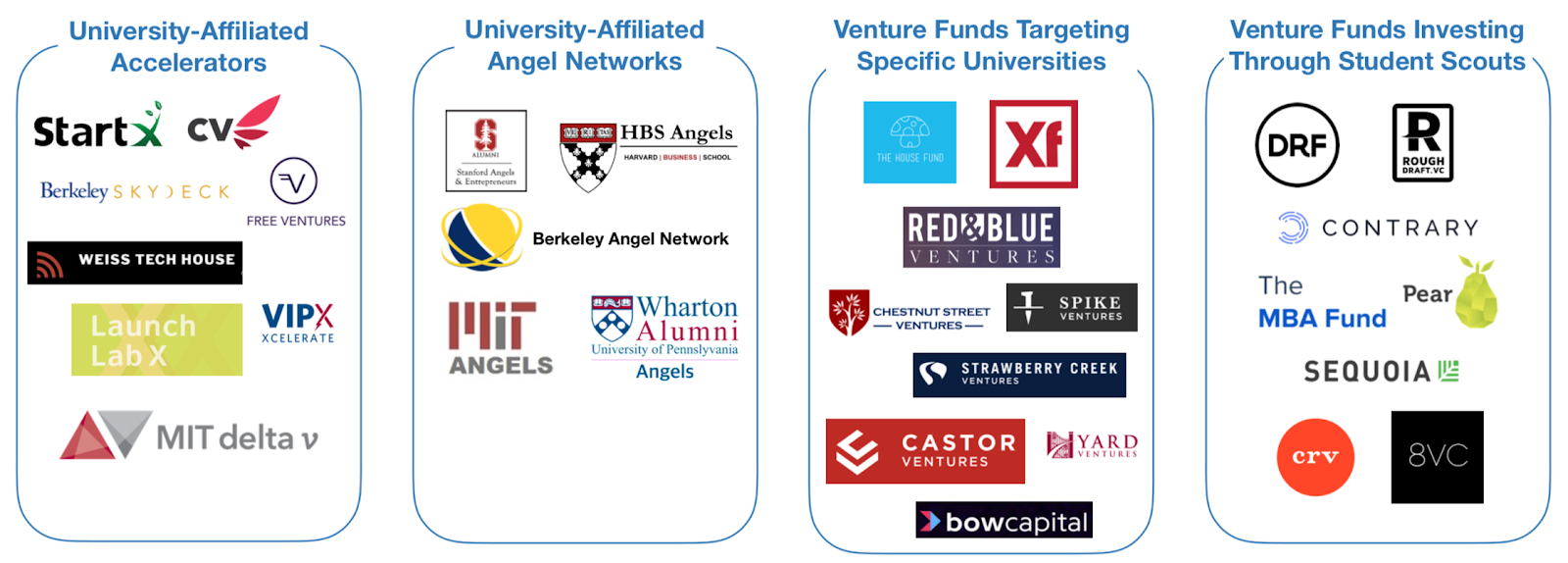
While it is difficult to estimate exactly how much capital has been deployed by each, there is no denying that there has been an explosion in the number of programs that address the pre-seed phase. A sample of the programs available at the Top 5 universities listed above are in the graphic below — listing every resource at every university would be difficult as there are so many.

One alumni-centric fund to highlight is the Alumni Ventures Group, which pools LP capital from alumni at specific universities, then launches individual venture funds that invest in founders connected to those universities (e.g. students, alumni, professors, etc.). Through this model, they’ve deployed more than $200M per year! Another highlight has been student scout programs — which vary in the degree of autonomy and capital invested — but essentially empower students to identify and fund high-potential student-founded companies for their parent venture funds. On campuses with a large concentration of student founders, it is not uncommon to find student scouts from as many as 12 different venture funds actively sourcing deals (as is made clear from David Tao’s analysis at UC Berkeley).

Investment Team at Rough Draft Ventures

In my opinion, the two institutions that have the most expansive line of sight into the student entrepreneurship landscape are First Round’s Dorm Room Fund and General Catalyst’s Rough Draft VenturesSince 2012, these two funds have operated a nationwide network of student scouts that have invested $20K — $25K checks into companies founded by student entrepreneurs at 40+ universities. “Scout” is a loose term and doesn’t do it justice — the student investors at these two funds are almost entirely autonomous, have built their own platform services to support portfolio companies, and have launched programs to incubate companies built by female founders and founders of color. Another student-run fund worth noting that has reach beyond a single region is Contrary Capital, which raised $2.2M last year. They do a particularly great job of reaching founders at a diverse set of schools — their network of student scouts are active at 45 universities and have spoken with 3,000 founders per year since getting started. Contrary is also testing out what they describe as a “YC for university-based founders”. In their first cohort, 100% of their companies raised a pre-seed round after Contrary’s demo day. Another even more recently launched organization is The MBA Fund, which caters to founders from the business schools at Harvard, Wharton, and Stanford. While super exciting, these two funds only launched very recently and manage portfolios that are not large enough for analysis just yet.

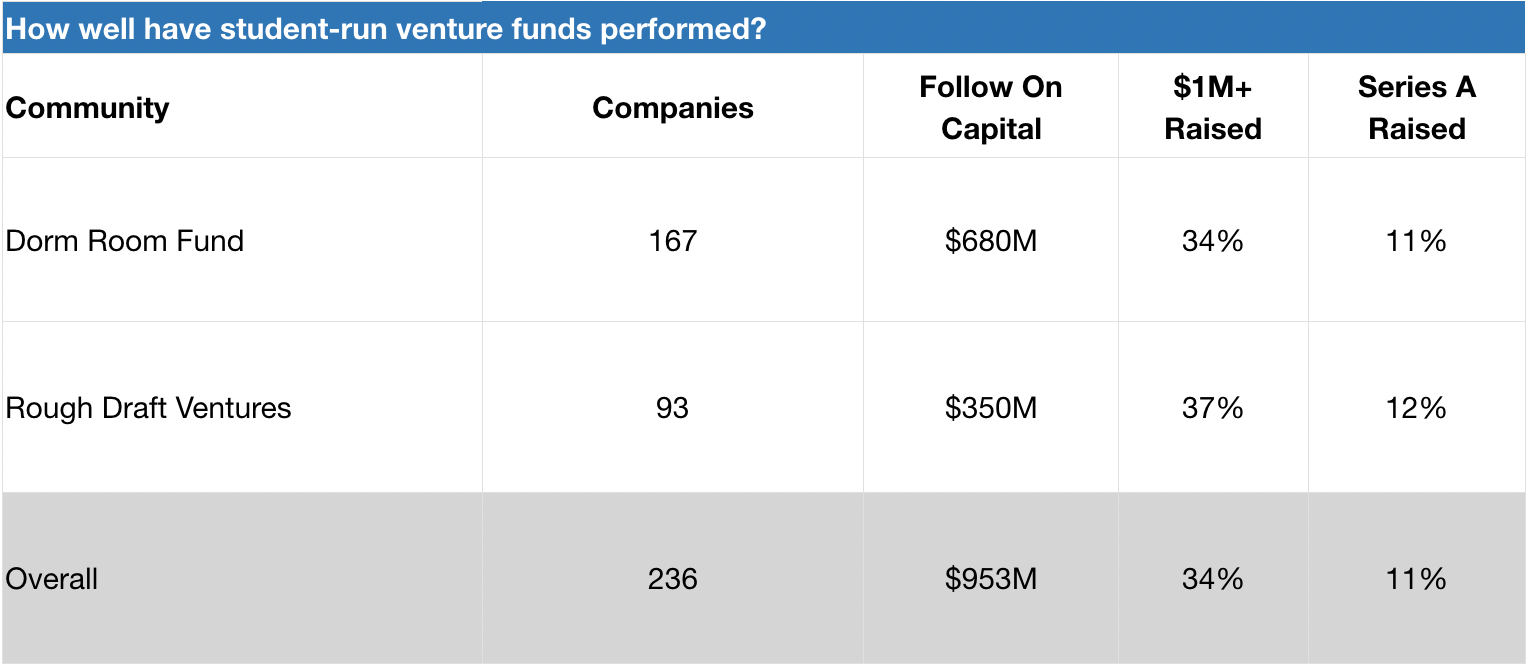
Over the last few months, I’ve collected and cross-referenced publicly available data from both Dorm Room Fund and Rough Draft Ventures to assess the state of student entrepreneurship in the United States. Companies were pulled from each fund’s portfolio page, then checked against Crunchbase for amount raised, accelerator participation, and other metrics. If you’d like to sift through the data yourself, feel free to ping me — my email can be found at the end of this article. To be clear, this does not represent the full scope of investment activity at either fund — many companies in the portfolios of both funds remain confidential and unlisted for good reasons (e.g. startups working in stealth). In fact, the In addition, data for early stage companies is notoriously variable in quality, even with Crunchbase. You should read these insights as directional only, given the debatable confidence interval. Still, the data is still interesting and give good indicators for the health of student entrepreneurship today.

Dorm Room Fund and Rough Draft Ventures have invested in 230+ student-founded companies that have gone on to raise nearly $1 billion in follow on capital. These funds have invested in a diverse range of companies, from govtech (e.g. mark43, raised $77M+ and FiscalNote, raised $50M+) to space tech (e.g. Capella Space, raised ~$34M). Several portfolio companies have had successful exits, such as crypto startup Distributed Systems (acquired by Coinbase) and social networking startup tbh (acquired by Facebook). While it is too early to evaluate the success of these funds on a returns basis (both were launched just 6 years ago), we can get a sense of success by evaluating the rates by which portfolio companies raise additional capital. Taken together, 34% of DRF and RDV companies in our data set have raised $1 million or more in seed capital. For a rough comparison, CB Insights cites that 40% of YC companies and 48% of Techstars companies successfully raise follow on capital (defined as anything above $750K). Certainly within the ballpark!
Source: Crunchbase

Dorm Room Fund and Rough Draft Ventures companies in our data set have an 11–12% rate of survivorship to Series A. As a benchmark, a previous partner at Y Combinator shared that 20% of their accelerator companies raise Series A capital (YC declined to share the official figure, but it’s likely a stat that is increasing given their new Series A support programs. For further reading, check out YC’s reflection on what they’ve learned about helping their companies raise Series A funding). In any case, DRF and RDV’s numbers should be taken with a grain of salt, as the average age of their portfolio companies is very low and raising Series A rounds generally takes time. Ultimately, it is clear that DRF and RDV are active in the earlier (and riskier) phases of the startup journey.

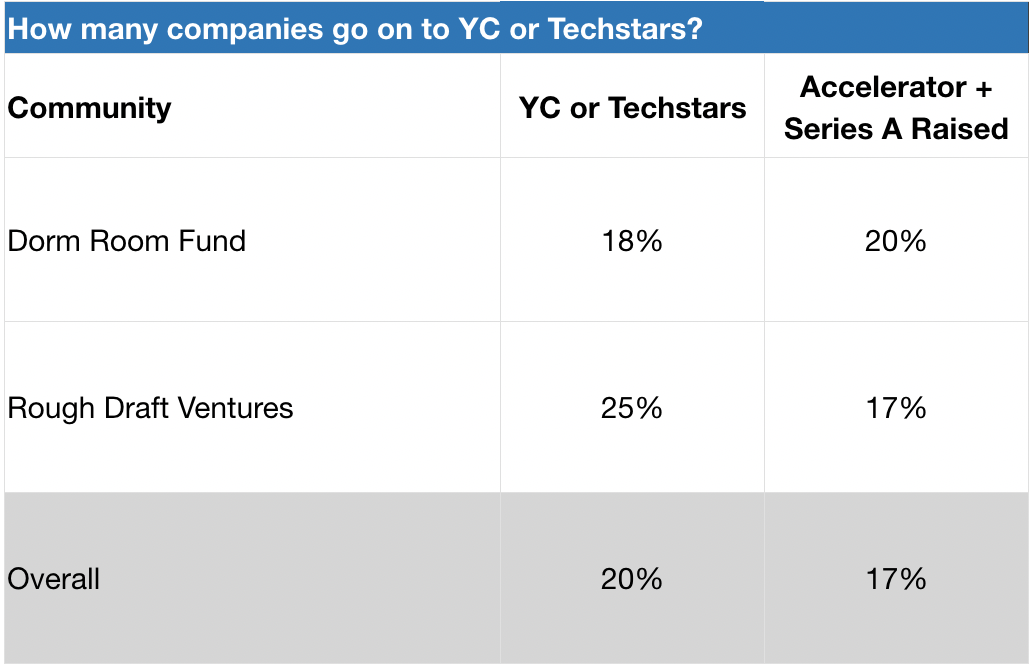
Dorm Room Fund and Rough Draft Ventures send 18–25% of their portfolio companies to Y Combinator or Techstars. Given YC’s 1.5% acceptance rate as reported in Fortune, this is quite significant! Internally, these two funds offer founders an opportunity to participate in mock interviews with YC and Techstars alumni, as well as tap into their communities for peer support (e.g. advice on pitch decks and application content). As a result, Dorm Room Fund and Rough Draft Ventures regularly send cohorts of founders to these prestigious accelerator programs. Based on our data set, 17–20% of DRF and RDV companies that attend one of these accelerators end up raising Series A venture financing.
Source: Crunchbase

Dorm Room Fund and Rough Draft Ventures don’t invest in the same companies. When we take a deeper look at one specific ecosystem where these two funds have been equally active over the last several years — Boston — we actually see that the degree of investment overlap for companies that have raised $1M+ seed rounds sits at 26%. This suggests that these funds are either a) seeing different dealflow or b) have widely different investment decision-making.
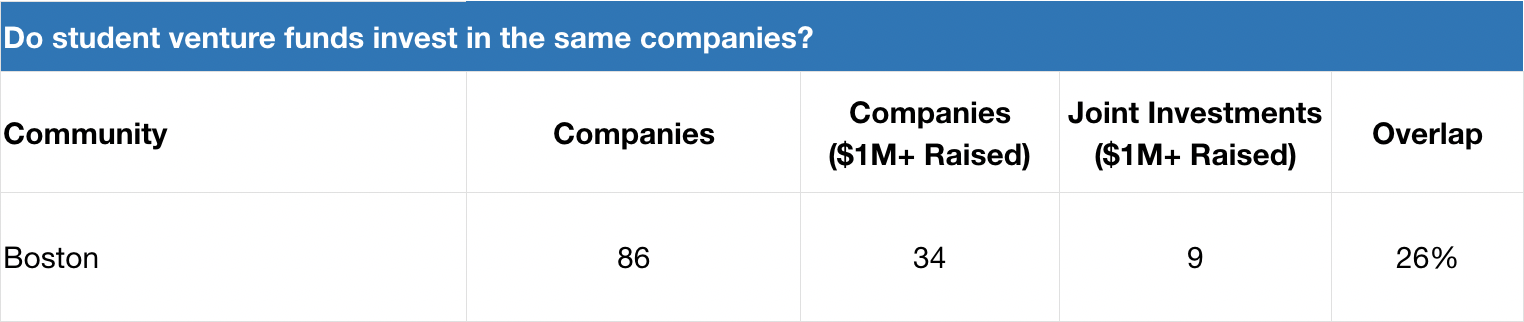
Source: Crunchbase

Dorm Room Fund and Rough Draft Ventures should not just be measured by a returns-basis today, as it’s too early. I hypothesize that DRF and RDV are actually encouraging more entrepreneurial activity in the ecosystem (more students decide to start companies while in school) as well as improving long-term founder outcomes amongst students they touch (portfolio founders build bigger and more successful companies later in their careers). As more students start companies, there’s likely a positive feedback loop where there’s increasing peer pressure to start a company or lean on friends for founder support (e.g. feedback, advice, etc).Both of these subjects warrant additional study, but it’s likely too early to conduct these analyses today.

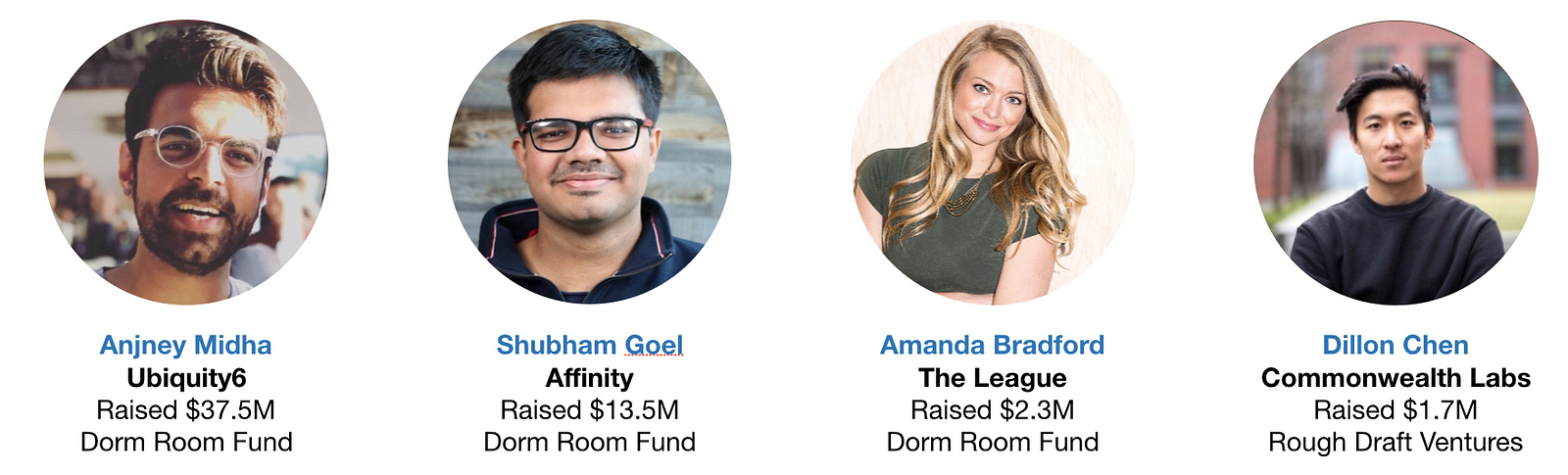
Dorm Room Fund and Rough Draft Ventures have impressive alumni that you will want to track. 1 in 4 alumni partners are founders, and 29% of these founder alumni have raised $1M+ seed rounds for their companies. These include Anjney Midha’s augmented reality startup Ubiquity6 (raised $37M+), Shubham Goel’s investor-focused CRM startup Affinity (raised $13M+), Bruno Faviero’s AI security software startup Synapse (raised $6M+), Amanda Bradford’s dating app The League (raised $2M+), and Dillon Chen’s blockchain startup Commonwealth Labs (raised $1.7M). It makes sense to me that alumni from these communities that decide to start companies have an advantage over their peers — they know what good companies look like and they can tap into powerful networks of young talent / experienced investors.
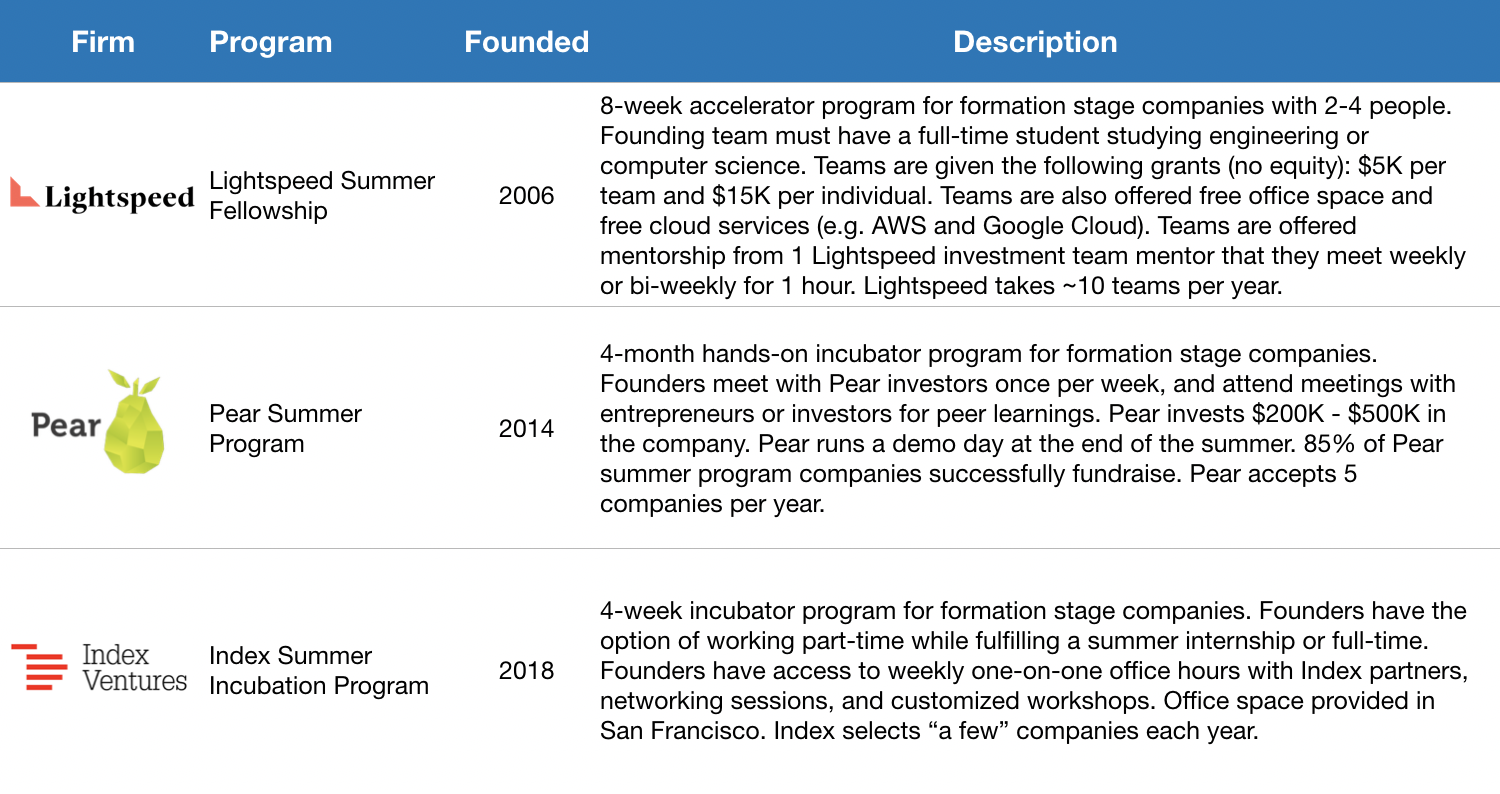
Beyond Dorm Room Fund and Rough Draft Ventures, some venture capital firms focus on incubation for student-founded startups. Credit should first be given to Lightspeed for producing the amazing Summer Fellows bootcamp experience for promising student founders — after all, Pinterest was built there! Jeremy Liew gives a good overview of the program through his sit-down interview with Afterbox’s Zack Banack. Based on a study they conducted last year, 40% of Lightspeed Summer Fellows alumni are currently active founders. Pear Ventures also has an impressive summer incubator program where 85% of its companies successfully complete a fundraise. Index Ventures is the latest to build an incubator program for student founders, and even accepts founders who want to work on an idea part-time while completing a summer internship.
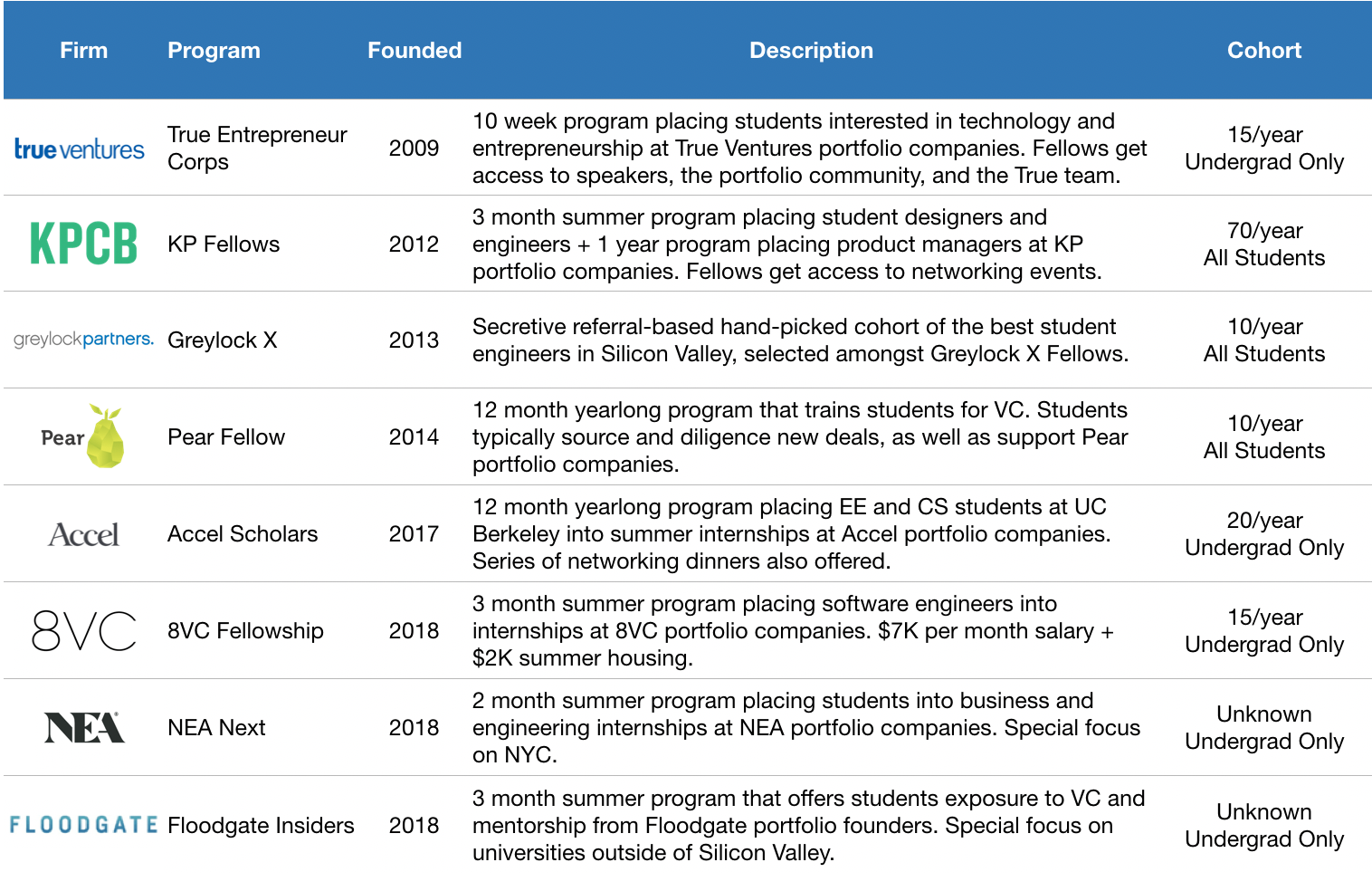
Let’s now look at students who want to join a startup before founding one. Venture funds have historically looked to tap students for talent, and are expanding the engagement lifecycle. The longest running programs include Kleiner Perkins’ class=”m_1196721721246259147gmail-markup–strong m_1196721721246259147gmail-markup–p-strong”> KP Fellows and True Ventures’ TEC Fellows, which focus on placing the next generation’s most promising product managers, engineers, and designers into the portfolio companies of their parent venture funds.

There’s also the secretive Greylock X, a referral-based hand-picked group of the best student engineers in Silicon Valley (among their impressive alumni are founders like Yasyf Mohamedali and Joe Kahn, the folks behind First Round-backed Karuna Health). As these programs have matured, these firms have recognized the long-run value of engaging the alumni of their programs.

More and more alumni are “coming back” to the parent funds as entrepreneurs, like KP Fellow Dylan Field of Figma (and is also hosting a KP Fellow, closing a full circle loop!). Based on their latest data, 10% of KP Fellows alumni are founders — that’s a lot given the fact that their community has grown to 500! This helps explain why Kleiner Perkins has created a structured path to receive $100K in seed funding to companies founded by KP Fellow alumni. It looks like venture funds are beginning to invest in student programs as part of their larger platform strategy, which can have a real impact over the long term (for further reading, see this analysis of platform strategy outcomes by USV’s Bethany Crystal).

KP Fellows in San Francisco

Venture funds are doubling down on student talent engagement — in just the last 18 months, 4 funds have launched student programs. It’s encouraging to see new funds follow in the footsteps of First Round, General Catalyst, Kleiner Perkins, Greylock, and Lightspeed. In 2017, Accel launched their Accel Scholars program to engage top talent at UC Berkeley and Stanford. In 2018, we saw 8VC Fellows, NEA Next, and Floodgate Insiders all launch, targeting elite universities outside of Silicon Valley. Y Combinator implemented Early Decision, which allows student founders to apply one batch early to help with academic scheduling. Most recently, at the start of 2019, First Round launched the Graduate Fund (staffed by Dorm Room Fund alumni) to invest in founders who are recent graduates or young alumni.

Given more time, I’d love to study the rates by which student founders start another company following investments from student scout funds, as well as whether or not they’re more successful in those ventures. In any case, this is an escalation in the number of venture funds that have started to get serious about engaging students — both for talent and dealflow.
Student entrepreneurship 2.0 is here. There are more structured paths to success for students interested in starting or joining a startup. Founders have more opportunities to garner press, seek advice, raise capital, and more. Venture funds are increasingly leveraging students to help improve the three F’s — finding, funding, and fixing. In my personal view, I believe it is becoming more and more important for venture funds to gain mindshare amongst the next generation of founders and operators early, while still in school.

I can’t wait to see what’s next for student entrepreneurship in 2019. If you’re interested in digging in deeper (I’m human — I’m sure I haven’t covered everything related to student entrepreneurship here) or learning more about how you can start or join a startup while still in school, shoot me a note at sxu@dormroomfund.comA massive thanks to Phin Barnes, Rei Wang, Chauncey Hamilton, Peter Boyce, Natalie Bartlett, Denali Tietjen, Eric Tarczynski, Will Robbins, Jasmine Kriston, Alicia Lau, Johnny Hammond, Bruno Faviero, Athena Kan, Shohini Gupta, Alex Immerman, Albert Dong, Phillip Hua-Bon-Hoa, and Trevor Sookraj for your incredible encouragement, support, and insight during the writing of this essay.

from Startups – TechCrunch https://tcrn.ch/2taTc7E


#Blockchain Zcash Bug Demonstrates the Difficulty of Auditing Complex Cryptocurrencies

Zcash Bug Demonstrates the Difficulty of Auditing Complex Cryptocurrencies

A recent counterfeiting bug in Zcash demonstrates that the added functionality of so-called second generation blockchains comes at a price. The vulnerability, which existed for years before being patched in October, could have been exploited to generate additional coins. As every major cryptocurrency since Bitcoin has demonstrated, added complexity corresponds with lower security.

Also read: Australian Banks Fraudulently Collected Fees From Deceased Customers

Zcash Vulnerability Lay Undiscovered for Years

On Feb. 5, the Zcash team shared a blog post acknowledging the existence of a bug that had been in place since the privacy coin launched. Discovering its existence would have called for “a high level of technical and cryptographic sophistication that very few people possess,” claimed Zcash developers. While likely true, this admission has provided little comfort to zcash holders, and doesn’t augur well for any future bugs that have yet to be discovered. It stands to reason that any elementary exploits in the protocol will have long since been identified. As such, any critical Zcash bug to surface at this stage can be assumed to require sophisticated knowledge to pinpoint.

Common sense holds that the less moving parts a device has, the less there is to go wrong. The same concept applies to cryptocurrencies. With the addition of enhanced features such as smart contracts and complex privacy tech like zk-snarks, code becomes harder to audit, and it can be virtually impossible to determine whether vulnerabilities have been exploited. Bitcoin Core is not immune to vulnerabilities, with a bug that had lain undiscovered since 2016 only identified and patched last year. The relative simplicity of Bitcoin’s design, however, means it has less possible attack vectors, having survived a decade of adversarial probing by governments, research groups, and hackers.

Mixed Reactions to Zcash Response

Zcash Bug Demonstrates the Difficulty of Auditing Complex CryptocurrenciesThe disclosure of the vulnerability was greeted with a mixed response. Edward Snowden, who has previously signaled his support for the privacy coin, praised its well-funded developer team who are able to patch bugs of this nature before they are exploited. Others, however, including Monero’s Riccardo Spagni and cryptographer Peter Todd, pointed out the disingenuousness of Zcash claiming the bug was unlikely to have been exploited simply because it would have required high-level knowledge.

“Although we believe that no counterfeiting occurred, we are monitoring pool totals and will act in accordance with our published defense against counterfeiting in an effort to preserve the monetary supply,” noted the Zcash team. Zcash is trading at $46 per coin at the time of publication, down almost 5 percent from 24 hours ago, when the bug was publicly disclosed.

What are your thoughts on how the Zcash team responded to the vulnerability in the privacy coin’s protocol? Let us know in the comments section below.


Images courtesy of Shutterstock.


Need to calculate your bitcoin holdings? Check our tools section.

The post Zcash Bug Demonstrates the Difficulty of Auditing Complex Cryptocurrencies appeared first on Bitcoin News.

from Bitcoin News http://bit.ly/2TBZ9Gf Zcash Bug Demonstrates the Difficulty of Auditing Complex Cryptocurrencies

#USA Instacart CEO apologizes for tipping debacle

//

On the heels of a recently-filed class action lawsuit over wages and tips, as well as drivers and shoppers speaking out about Instacart’s alleged practices of subsidizing wages with tips, Instacart is taking steps to ensure tips are counted separately from what Instacart pays shoppers.

In a blog post today, Instacart CEO Apoorva Mehta said all shoppers will now have a guaranteed higher base compensation, paid by Instacart. Depending on the region, Instacart says it will pay shoppers between $7 to $10 for full-service orders (shopping, picking and delivering) and $5 for delivery-only tasks. The company will also stop including tips in its base pay for shoppers.

“After launching our new earnings structure this past October, we noticed that there were small batches where shoppers weren’t earning enough for their time,” Mehta wrote. “To help with this, we instituted a $10 floor on earnings, inclusive of tips, for all batches. This meant that when Instacart’s payment and the customer tip at checkout was below $10, Instacart supplemented the difference. While our intention was to increase the guaranteed payment for small orders, we understand that the inclusion of tips as a part of this guarantee was misguided. We apologize for taking this approach.”

For the shoppers who were subject that approach, Instacart says it will retroactively pay people whose tips were included in payment minimums.

You can read the full blog post at the bottom of this post. For background, Instacart had previously guaranteed its workers at least $10 per job, but workers said Instacart offsets wages with tips from customers.

The suit alleges Instacart “intentionally and maliciously misappropriated gratuities in order to pay plaintiff’s wages even though Instacart maintained that 100 percent of customer tips went directly to shoppers. Based on this representation, Instacart knew customers would believe their tips were being given to shoppers in addition to wages, not to supplement wages entirely.”

In addition to the lawsuit, workers have taken to Reddit and other online forums to speak out against Instacart’s paying practices. Since introducing a new payments structure in October, which includes things like payments per mile, quality bonuses and customer tips, workers have said the pay has gotten worse — far below minimum wage. In one case, Instacart paid a worker just 80 cents for over an hour of work. Instacart has since said it was a glitch — caused by the fact that the customer tipped $10 — and has introduced a new minimum payment for orders. So, Instacart paid the worker $10.80, but just 80 cents of it came from Instacart.

While Instacart has said this was an edge case, Working Washington says this has happened in other cases. In another case, Instacart paid a worker just $7.26 (including cost of mileage) for over two hour’s worth of work.

“We heard loud and clear the frustration when your compensation didn’t match the effort you put forth,” Mehta wrote in the blog post. “As we looked at some of the extreme examples that have been surfaced by you over the last few days, it’s become clear to us that we can and should do better. Instacart shouldn’t be paying a shopper $0.80 for a batch. It doesn’t matter that this only happens 1 out of 100,000 times – it happened to one shopper and that’s one time too many.”

Here’s the full text of Mehta’s post:

To Our Shopper Community:

Every day, millions of people entrust Instacart to help get the food they need to feed their families and get back valuable time to spend with their loved ones. By delivering to and for our customers, you’ve become household heroes for millions of families across North America. This past week however, it’s become clear, that we’ve fallen short in delivering on our promise to you.

As you know, we’ve made changes to our shopper earnings model over the last year. These changes were designed to increase transparency while also keeping pace with a rapidly-evolving industry. In doing so, we’ve tried, in good faith, to balance those needs, but clearly we haven’t always gotten it right.

As a company, we remain committed to listening and putting our shoppers more at the forefront of our decision making. Based on your feedback, today we’re launching new measures to more fairly and competitively compensate all our shoppers. As part of this, our earnings approach moving forward will adhere to the following:

  • Tips should always be separate from Instacart’s contribution to shopper compensation

  • All batches will have a higher guaranteed compensation floor for shoppers, paid for by Instacart

  • Instacart will retroactively compensate shoppers when tips were included in minimums

Below are details on each new element of shopper earnings, which we will be rolling out in the coming days.

Tips Should Always Be Separate From Instacart’s Contribution to Shopper Compensation – After launching our new earnings structure this past October, we noticed that there were small batches where shoppers weren’t earning enough for their time. To help with this, we instituted a $10 floor on earnings, inclusive of tips, for all batches. This meant that when Instacart’s payment and the customer tip at checkout was below $10, Instacart supplemented the difference. While our intention was to increase the guaranteed payment for small orders, we understand that the inclusion of tips as a part of this guarantee was misguided. We apologize for taking this approach.

All Batches Will Have a Higher Guaranteed Floor for Shoppers, Paid by Instacart – We’re instituting a higher minimum floor payment from Instacart on all batches. Today our minimum batch payment is $3. Depending on the region, our minimum batch payment will increase to between $7 and $10 for full service batches (where a shopper picks, packs and delivers the order) and $5 for delivery only batches (where a shopper delivers the order after a separate person picks the groceries). These increased batch floors will be consistent for all shoppers within a particular geographic area. In addition to the higher guaranteed floors, Instacart will also pay a quality bonus and peak boosts for orders that qualify. Any tips earned by shoppers will be separate and in addition to Instacart’s contribution.

Instacart Will Retroactively Compensate Shoppers When Tips Were Included in Minimums – Over the coming days, as we transition to the new higher minimum floor payments, we will make you whole on the transactions that have occurred since the launch of this feature. Specifically, we will proactively reach out to all shoppers who were adversely affected by instances in which Instacart’s payment was below the $10 threshold. For example, if a shopper was paid $6 by Instacart, to compensate for our mistake, he or she will receive an additional $4 from Instacart.

In creating these changes to improve, enhance and create clarity for shopper compensation, these new measures will do the following:

1. Better protect shoppers from smaller, outlying batches. We heard loud and clear the frustration when your compensation didn’t match the effort you put forth. As we looked at some of the extreme examples that have been surfaced by you over the last few days, it’s become clear to us that we can and should do better. Instacart shouldn’t be paying a shopper $0.80 for a batch. It doesn’t matter that this only happens 1 out of 100,000 times – it happened to one shopper and that’s one time too many. We believe that these new guaranteed floor minimums will better protect our shoppers going forward.

2. Customer tips will no longer have any impact on Instacart’s contribution to shopper earnings. With an average tip of $5, our customers regularly recognize shoppers with tips for the services they provide. We believe that with these changes customers will continue to be able to recognize great service and have full confidence that their tips are going to the shopper who delivered their order, with no impact whatsoever on what the shopper receives from Instacart. As always, shoppers will receive 100% of their tips, regardless of the batch compensation.  

3. These changes will increase Instacart’s overall contribution to our shopper’s earnings and we believe that the change in tip structure will separate Instacart from an industry standard that’s no longer working for our shoppers and our customers.

Finally, I want to thank you for your feedback. It’s our responsibility to change course quickly when we realize we’re on the wrong path and we believe today’s changes are a step in the right direction.

Apoorva Mehta

Founder & CEO of Instacart

from Startups – TechCrunch https://tcrn.ch/2TAyWbk

#Blockchain BCH-Powered Paybutton Launches in Pre-Release

Developer Launches Pre-Release of BCH-Powered Paybutton

On Tuesday, Feb. 5, the well known Bitcoin Cash (BCH) advocate Soupernerd announced the pre-release and testing phase of a new BCH-powered payment button. At the moment the Paybutton.cash application will feature a simple payment button but there are plans to integrate other features down the line.

Also read: Markets Update: Traders Patiently Wait for Crypto’s Longest Bear Run to End

Paybutton Developer Launches Pre-Release and Announces Testing Phase

There’s a new payment button called Paybutton.cash that allows people to easily send and tip bitcoin cash to content creators, services, and websites. The full release of the application is not complete yet but the developer known as Soupernerd has announced the pre-release and testing phase. Soupernerd says the Paybutton team is currently waiting for Badger Wallet updates before activating that as a payment option and there is more to be tested.

“Paybutton.cash is pleased to announce our pre-release launch and testing phase,” explained Soupernerd on the Reddit forum r/btc. “Host a paybutton on your site with just snippet of code and convert 160+ currencies to BCH live — [Paybutton] is fully hosted on Github.”

BCH-Powered Paybutton Launches in Pre-Release
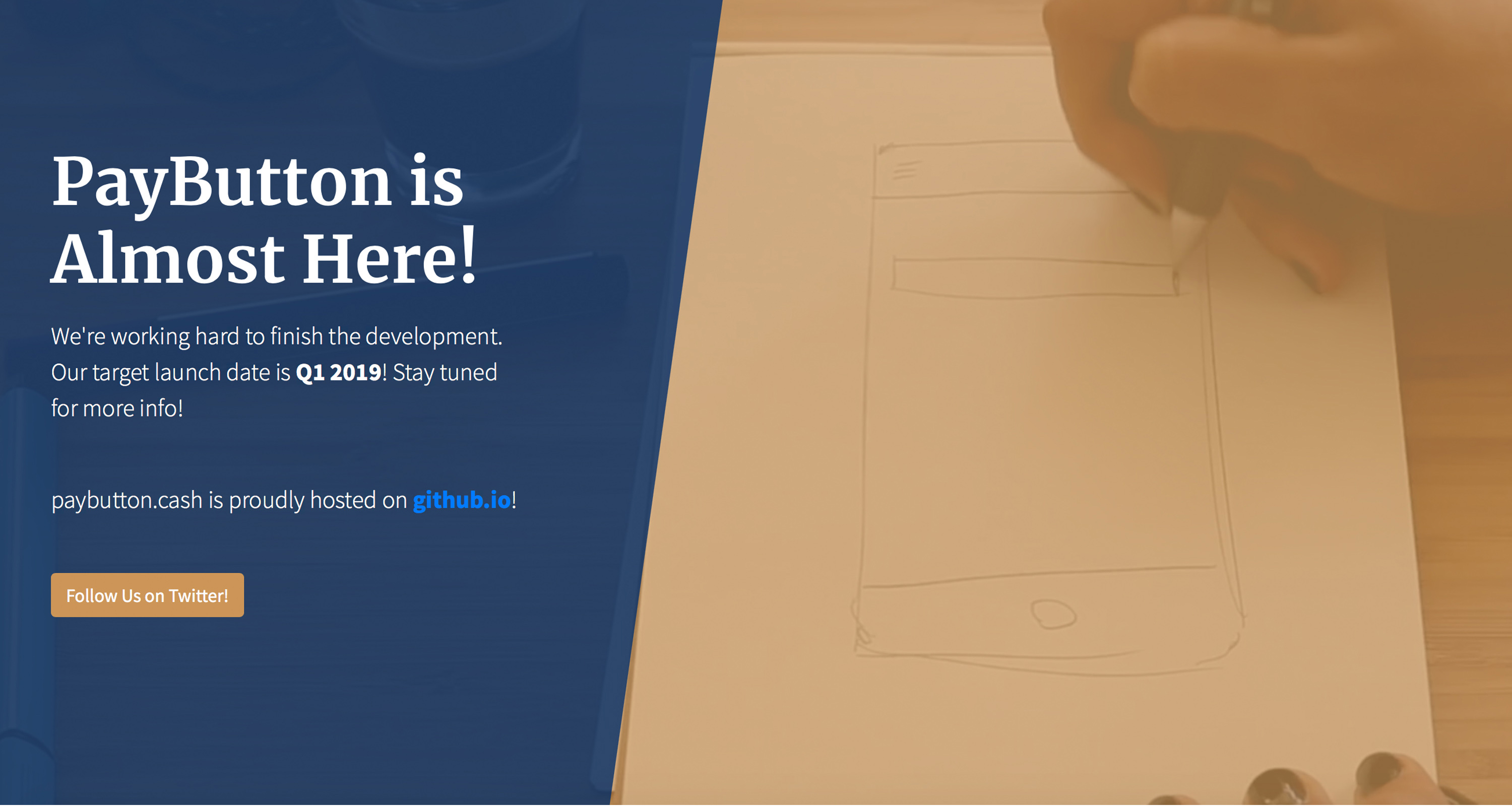
The Paybutton.cash website.

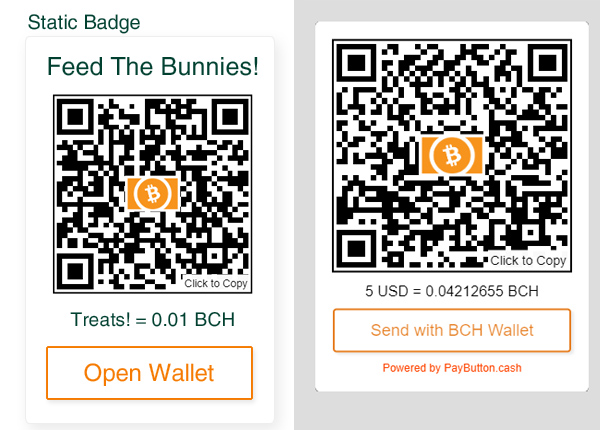
The Paybutton creator explains that a lot of credit goes to the Bitcoin.com and Badger Wallet development teams for making the platform possible. Moreover, Soupernerd says the Paybutton developers have a few more ideas in mind that go beyond just a simple payment button. On the r/btc thread, Soupernerd describes a static badge concept which could be placed next to the BCH Zoo. Further, the creator shows images of a donation badge and mentions a concept called “Paybutton Carts.” “More on that later,” says Soupernerd. “We will keep the pre-release folders up, even upon new releases until further notice.”

BCH-Powered Paybutton Launches in Pre-Release
The creator of Paybutton, ‘Soupernerd,’ is well known in the BCH community.

Other BCH-Powered Button Applications in the Works

The Paybutton platform joins two other BCH payment button applications that are also in early development stages. The applications started spawning after Ryan X Charles removed bitcoin cash support from his Money Button project and decided to support the coin BSV. Following the Money Button departure, the team behind Badger Wallet has been working on refining a BCH payment button. Another competitor to the Money Button is the bitcoin cash payment API and button provided by Gateway.cash.

“Gateway.cash will be a Money Button competitor for bitcoin cash and is now released open-source — The project is led by Ty Everett and he is looking for contributors,” the Gateway.cash developer explained on Nov. 19.

BCH-Powered Paybutton Launches in Pre-Release
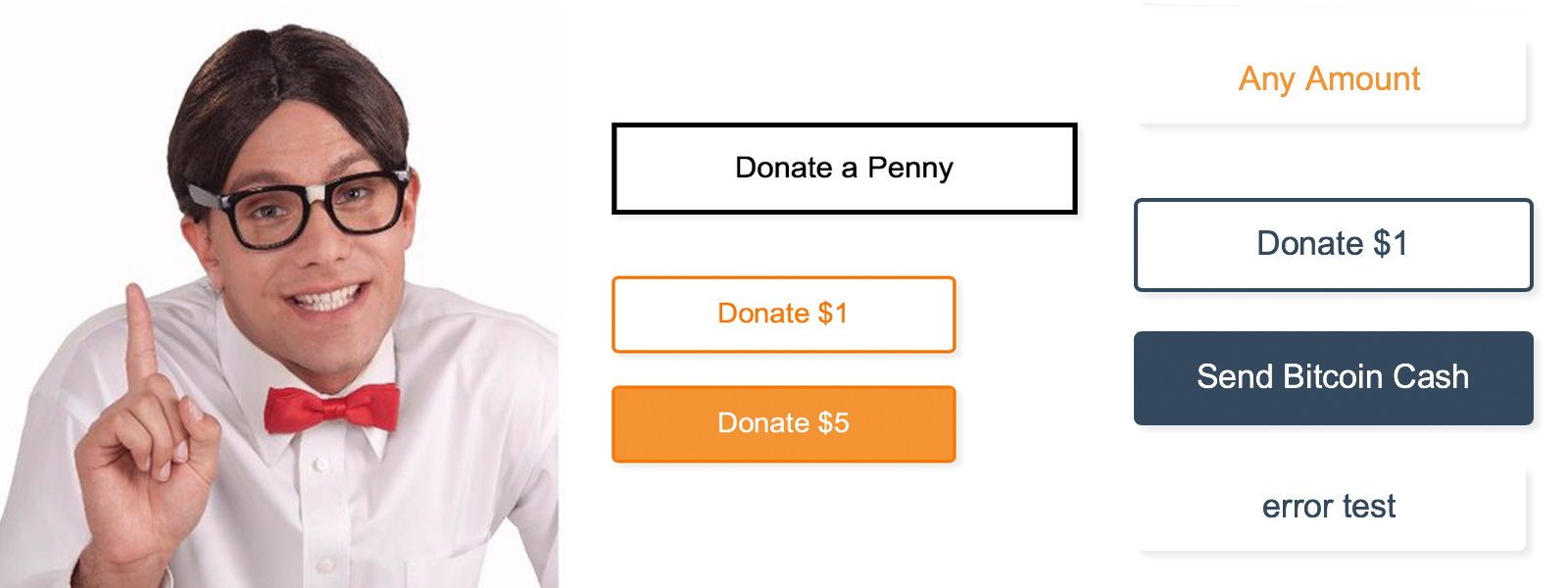
Examples of the current modal pop-up button and a preview of the static badge.

Giving Incentives to Website Hosts, Blogs and Content Creators Even if They Can’t Code

Soupernerd’s announcement on r/btc was welcomed with enthusiasm as BCH supporters are looking forward to a variety of crypto-fueled payment buttons. One BCH supporter proceeded to outline their vision of how payment buttons can transform the web.

BCH-Powered Paybutton Launches in Pre-Release
Paybutton’s donation widget preview.

“Looks cool. For those that don’t get the significance it allows anyone without programming skills to more easily accept BCH — For example, tons of people have blogs or various other web presences where they can post raw HTML for visitors to see,” the Redditor emphasized. He continued:

Without coding skills, if Rick wants to take $1.50 donations for his blog posts he can at best post his BCH address.

Soupernerd’s Paybutton code can be reviewed here, and a description of some of the HTML codes can be seen here. People can test the Paybutton with the pre-release page and wait until the full release is complete. “We’re working hard to finish the development and our target launch date is Q1 2019,” states the Paybutton website.

What do you think about Paybutton.cash? Let us know what you think about this project in the comments section below.


Image credits: Shutterstock, Twitter, Reddit, and Paybutton.cash. 


Need to calculate your bitcoin holdings? Check our tools section.

The post BCH-Powered Paybutton Launches in Pre-Release appeared first on Bitcoin News.

from Bitcoin News http://bit.ly/2HUJmRJ BCH-Powered Paybutton Launches in Pre-Release

#USA Lime raises $310 million Series D round led by Bain Capital and others

//

Lime just announced it has raised a $310 million Series D round. Led by Bain Capital, Andreessen Horowitz, Fidelity Ventures, GV and IVP, the round values Lime at $2.4 billion.

“This new investment demonstrates the fundamental strength of our business and the increasingly rapid adoption of Lime,” Lime CEO Toby Sun wrote in a blog post. “The new funds will give us the ability to expand into new markets, enhance our technology, strengthen the team and pilot new opportunities. We will also continue investing in two critical areas: rider safety and city collaboration.”

In May, Lime partnered with Segway to launch its next generation of electric scooters. These Segway-powered Lime scooters were designed to be safer, longer-lasting via battery power and more durable for what the sharing economy requires, Sun told TechCrunch last year.

But this partnership hasn’t been without its issues. In October, Lime recalled some of its scooters due to battery fire concerns. The next month, Lime put $3 million toward a new safety initiative called “Respect the Ride.” Safety, in general, is a major concern. In September, someone lost their life after a scooter accident.

This brings Lime’s total funding north of $800 million. Lime, which got its beginnings as a bike-share company, has deployed its scooters in more than 100 cities in the U.S. and 27 international cities. Since June, Lime has more than doubled the number of cities where it operates in the U.S. Lime has also partnered with Uber to offer Lime scooters within the Uber app.

from Startups – TechCrunch https://tcrn.ch/2HWUCwL

#USA Robin’s robotic mowers now have a patented doggie door just for them

//

Back in 2016 we had Robin up on stage demonstrating the possibility of a robotic mower as a service rather than just something you buy. They’re still going strong, and just introduced and patented what seems in retrospect a pretty obvious idea: an automatic door for the mower to go through fences between front and back yards.

It’s pretty common, after all, to have a back yard isolated from the front lawn by a wood or chainlink fence so dogs and kids can roam freely there with only light supervision. And if you’re lucky enough to have a robot mower, it can be a pain to carry it from one side to the other. Isn’t the whole point of the thing that you don’t have to pick it up or interact with it in any way?

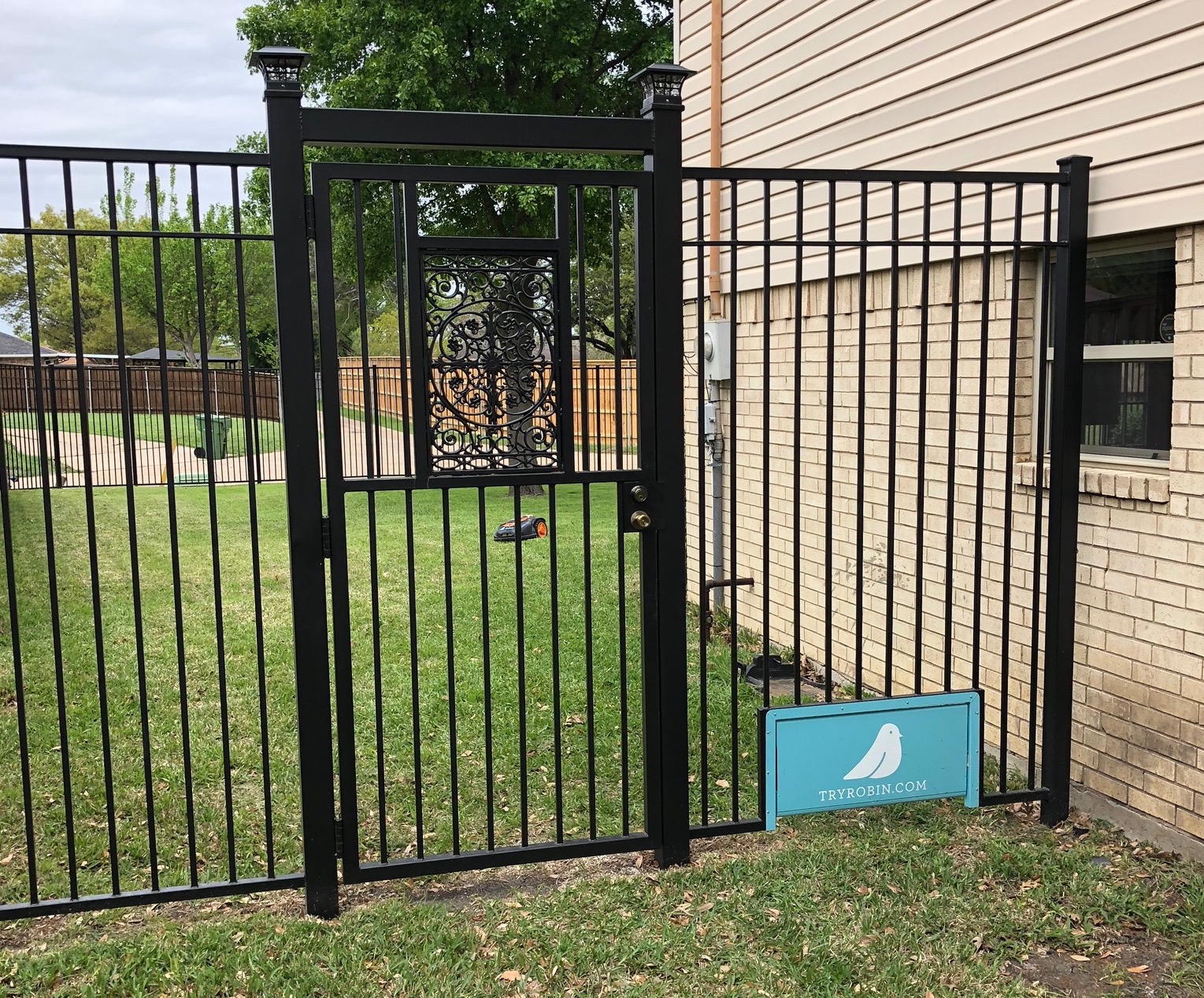
The solution Justin Crandall and his team at Robin came up with is simple and straightforward: an automatic mower-size door that opens only to let it through.

“In Texas over 90 percent of homes have a fenced in backyard, and even in places like Charlotte and Cleveland it’s roughly 25-30 percent, so technology like this is critical to adoption,” Crandall told me. “We generally dock the robots in the backyard for security. When it’s time to mow the front yard, the robots drive to the door we place in the fence. As it approaches the door, the robot drives over a sensor we place in the ground. That sensor unlocks the door to allow the mower access.”

Simple, right? It uses a magetometer rather than wireless or IR sensor, since those introduced possibilities of false positives. And it costs around $100-$150, easily less than a second robot or base, and probably pays for itself in goodwill around the third or fourth time you realize you didn’t have to carry your robot around.

It’s patented, but rivals (like iRobot, which recently introduced its own mower) could certainly build one if it was sufficiently different.

Robin has expanded to several states and a handful of franchises (its plan from the start) and maintains that its all-inclusive robot-as-a-service method is better than going out and buying one for yourself. Got a big yard and no teenage kids who can mow it for you? See if Robin’s available in your area.

from Startups – TechCrunch https://tcrn.ch/2WKuTv0

#USA Investigation finds e-scooters a cause of 1,500+ accidents

//

An investigation by Consumer Reports may force electric scooter businesses to double back on safety measures.

The magazine found electric scooters caused 1,545 injuries in the U.S. since late 2017, according to data collected from 110 hospitals and five public agencies in 47 cities where Bird or Lime, the leading tech-enabled scooter-sharing platforms, operate.

The news comes shortly after UCLA published a study finding that 249 people required medical care following scooter accidents, with one-third of that group arriving at the hospital in an ambulance.

“These injuries can be severe,” Tarak Trivedi, an emergency physician at UCLA and the study’s lead author, told CNET. “These aren’t just minor cuts and scrapes. These are legit fractures.”

Despite commentary from scooter CEOs suggesting otherwise, safety doesn’t seem to be a priority for businesses in the space. Given the nature of the industry, taking a ride on an e-scooter or a dockless bike without a helmet is the norm. That, coupled with failed hardware, irresponsible riding practices and access to scooters in the evening, has unsurprisingly led to several accidents and even casualties. Just this past weekend, the city of Austin reported a pedestrian riding a Lime scooter died after being struck by an Uber driver. The Lime scooter rider was traveling the wrong way down an interstate.

Lime, Bird and other leading scooter providers do provide free helmets to riders and don’t encourage poor scooter etiquette, but ensuring riders actually carry helmets or don’t do stupid things like travel the wrong way down a busy road is impossible.

With a fresh $310 million in Series D funding for Lime, announced today, it will be interesting to see how the company ramps up safety efforts.

from Startups – TechCrunch https://tcrn.ch/2Bm4yuf

#USA Investigation finds e-scooters a cause of 1,500+ accidents

//

An investigation by Consumer Reports may force electric scooter businesses to double back on safety measures.

The magazine found electric scooters caused 1,545 injuries in the U.S. since late 2017, according to data collected from 110 hospitals and five public agencies in 47 cities where Bird or Lime, the leading tech-enabled scooter-sharing platforms, operate.

The news comes shortly after UCLA published a study finding that 249 people required medical care following scooter accidents, with one-third of that group arriving at the hospital in an ambulance.

“These injuries can be severe,” Tarak Trivedi, an emergency physician at UCLA and the study’s lead author, told CNET. “These aren’t just minor cuts and scrapes. These are legit fractures.”

Despite commentary from scooter CEOs suggesting otherwise, safety doesn’t seem to be a priority for businesses in the space. Given the nature of the industry, taking a ride on an e-scooter or a dockless bike without a helmet is the norm. That, coupled with failed hardware, irresponsible riding practices and access to scooters in the evening, has unsurprisingly led to several accidents and even casualties. Just this past weekend, the city of Austin reported a pedestrian riding a Lime scooter died after being struck by an Uber driver. The Lime scooter rider was traveling the wrong way down an interstate.

Lime, Bird and other leading scooter providers do provide free helmets to riders and don’t encourage poor scooter etiquette, but ensuring riders actually carry helmets or don’t do stupid things like travel the wrong way down a busy road is impossible.

With a fresh $310 million in Series D funding for Lime, announced today, it will be interesting to see how the company ramps up safety efforts.

from Startups – TechCrunch https://tcrn.ch/2Bm4yuf

#USA vArmour, a security startup focused on multi-cloud deployments, raises $44M

//

As more organizations move to cloud-based IT architectures, a startup that’s helping them secure that data in an efficient way has raised some capital. vArmour, which provides a platform to help manage security policies across disparate public and private cloud environments in one place, is announcing today that it has raised a growth round of $44 million.

The funding is being led by two VCs that specialise in investments into security startups, AllegisCyber and NightDragon.

CEO Tim Eades said that also participating are “two large software companies” as strategic investors that vArmour works with on a regular basis but asked not to be named. (You might consider that candidates might include some of the big security vendors in the market, as well as the big cloud services providers.) This Series E brings the total raised by vArmour to $127 million.

When asked, Eades said the company would not be disclosing its valuation. That lack of transparency is not uncommon among startups, but perhaps especially should be expected at a business that operated in stealth for the first several years of its life.

According to PitchBook, vArmour was valued at $420 million when it last raised money, a $41 million round in 2016. That would put the startup’s valuation at $464 million with this round, if everything is growing at a steady pace, or possibly more if investors are keen to tap into what appears to be a growing need.

That growing need might be summarised like this: We’re seeing a huge migration of IT to cloud-based services, with public cloud services set to grow 17.3 percent in 2019. A large part of those deployments — for companies typically larger than 1,000 people — are spread across multiple private and public clouds.

This, in turn, has opened a new front in the battle to secure data amid the rising threat of cybercrime. “We believe that hybrid cloud security is a market valued somewhere between $6 billion and $8 billion at the moment,” said Eades. Cybercrime has been estimated by McAfee to cost businesses $600 billion annually worldwide. Accenture is even more bullish on the impact; it puts the impact on companies at $5.2 trillion over the next five years.

The challenge for many organizations is that they store information and apps across multiple locations — between seven and eight data centers on average for, say, a typical bank, Eades said. And while that may help them hedge bets, save money and reach some efficiencies, that lack of cohesion also opens the door to security loopholes.

“Organizations are deploying multiple clouds for business agility and reduced cost, but the rapid adoption is making it a nightmare for security and IT pros to provide consistent security controls across cloud platforms,” said Bob Ackerman, founder and managing director at AllegisCyber, in a statement. “vArmour is already servicing this need with hundreds of customers, and we’re excited to help vArmour grow to the next stage of development.”

vArmour hasn’t developed a security service per se, but it is among the companies — Cisco and others are also competing with it — that are providing a platform to help manage security policies across these disparate locations. That could either mean working on knitting together different security services as delivered in distinct clouds, or taking a single security service and making sure it works the same policies across disparate locations, or a combination of both of those.

In other words, vArmour takes something that is somewhat messy — disparate security policies covering disparate containers and apps — and helps to hand it in a more cohesive and neat way by providing a single way to manage and provision compliance and policies across all of them.

This not only helps to manage the data but potentially can help halt a breach by letting an organization put a stop in place across multiple environments.

“From my experience, this is an important solution for the cloud security space,” said Dave DeWalt, founder of NightDragon, in a statement. “With security teams now having to manage a multitude of cloud estates and inundated with regulatory mandates, they need a simple solution that’s capable of continuous compliance. We haven’t seen anyone else do this as well as vArmour.”

Eades said that one big change for his company in the last couple of years has been that, as cloud services have grown in popularity, vArmour has been putting in place a self-service version of the main product, the vArmour Application Controller, to better target smaller organizations. It’s also been leaning heavily on channel partners (Telstra, which led its previous round, is one strategic of this kind) to help with the heavy lifting of sales.

vArmour isn’t disclosing revenues or how many customers it has at the moment, but Eades said that it’s been growing at 100 percent each year for the last two and has “way more than 100 customers,” ranging from hospitals and churches through to “8-10 of the largest service providers and over 25 financial institutions.”

At this rate, he said the plan will be to take the company public in the next couple of years.

from Startups – TechCrunch https://tcrn.ch/2MTfdAS