
About Startup365

Chaque jour nous vous présenterons une nouvelle Startup française ! Notre pays regorge de talents et d'entrepreneurs brillants ! Alors partons à la découverte des meilleures startup françaises ! Certaines d'entre elles sont dans une étape essentielle dans la vie d'une startup : la recherche de financement, notamment par le financement participatif (ou crowdfunding en anglais). Alors participez à cette grande aventure en leur faisant une petite donation ! Les startups françaises ont besoin de vous !

#Blockchain The Daily: Twitter CEO Talks Bitcoin, Bitstamp Releases New Mobile App

The Daily: Twitter CEO Talks Bitcoin, Bitstamp Releases New Mobile App

In Monday’s edition of The Daily we cover a recent interview with Jack Dorsey where the Twitter CEO again publicly shares his views on the future of cryptocurrency. Additionally covered are a new mobile app from Bitstamp and a report about Nvidia’s revenues from the mining market.

Also Read: SEC Solicits Blockchain Analysis Tool to Identify Wallet Owners

Twitter CEO Talks Bitcoin on Joe Rogan Experience

Jack Dorsey, CEO of Twitter and mobile payments platform Square, recently went on the wildly popular Joe Rogan Experience podcast to talk about his various ventures. Among the topics that came up was cryptocurrency, a recurring theme on the show. Dorsey explained he believes that the internet will have a native currency and he thinks it will be bitcoin because of the principles behind it and its origin. “It was something that was born on the internet, was developed on the internet, was tested on the internet, it is of the internet,” he said.

The Daily: Twitter CEO Talks Bitcoin, Bitstamp Releases New Mobile App
Jack Dorsey on Joe Rogan

The Square CEO touched on the issue of functionality for payments vs store of wealth. “We would love to see something become a global currency. It enables more access. It allows us to serve more people. It allows us to move much faster around the world,” he explained. “We thought we were going to start with how you can use it transactionally, but we noticed that people were treating it more like an asset, like a virtual gold, and we wanted to just make that easy, just the simplest way to buy and sell bitcoin.”

Dorsey also mentioned that the current banking and political systems are threatened by the invention as no one has no centralized control over Bitcoin. “It’s certainly threatening to certain services behind banks and financial institutions. It’s threatening to some governments as well.”

Bitstamp Exchange Releases New Mobile App

Cryptocurrency exchange Bitstamp launched a new mobile app for iOS and Android on Thursday, Jan 31. The app allows users to buy and sell cryptocurrencies, make transfers, check balances and transaction history, and explore the markets through real-time charts. Additional features include a simple interface for beginners and another one for experienced traders, the ability to issue instant, market, limit and stop orders, as well as an option to remotely disable the app in case a user’s phone is lost or stolen.
The Daily: Twitter CEO Talks Bitcoin, Bitstamp Releases New Mobile App

“Built from the ground up to combine all the tools that make Bitstamp attractive for advanced traders in an intuitive interface, simple enough that anyone can begin trading in seconds,” the exchange team stated. “We suggest all users switch to the new app immediately for improved performance, reliability and more features.” The old Bitstamp app will be disabled after a one-month crossover period.

Besides launching the new mobile version of the platform, the Bitstamp team also announced they are preparing a number of upgrades for the desktop platform in an effort to improve users’ trading experience.

Nvidia Reportedly Made Billions From Miners

Could the impact of crypto winter have been harder on Nvidia Corporation (NASDAQ: NVDA) than its management has confessed? This is what a recent report claims. RBC analyst Mitch Steves estimates that the company controls three quarters of the GPU mining market and calculated it made a fortune from miners during the boom time, a revenue stream that is now lost.

“We think NVDA generated $1.95 billion in total revenue related to crypto/blockchain,” noted Steves according to Markets Insider. “This compares to company’s statement that it generated around $602 million over the same time period.”

The Daily: Twitter CEO Talks Bitcoin, Bitstamp Releases New Mobile App

Last week the company updated investors that its previous fourth-quarter guidance had embedded a “sequential decline due to excess mid-range channel inventory following the cryptocurrency boom.” The company claimed that the reduction in that inventory and its impact on the business have “proceeded largely inline with management’s expectations,” and that it was deteriorating macroeconomic conditions, particularly in China, that weakened consumer demand for gaming GPUs.

What do you think about today’s news tidbits? Share your thoughts in the comments section below.


Images courtesy of Shutterstock.


Verify and track bitcoin cash transactions on our BCH Block Explorer, the best of its kind anywhere in the world. Also, keep up with your holdings, BCH and other coins, on our market charts at Satoshi’s Pulse, another original and free service from Bitcoin.com.

The post The Daily: Twitter CEO Talks Bitcoin, Bitstamp Releases New Mobile App appeared first on Bitcoin News.

from Bitcoin News http://bit.ly/2S7NgLv The Daily: Twitter CEO Talks Bitcoin, Bitstamp Releases New Mobile App

#Africa SA’s Kingson Capital launches high-growth tech SME fund

//

South African Section 12J venture capital company Kingson Capital has launched its second fund, which will invest in high-growth tech and black-owned small and medium sized enterprises (SMEs).

Founded in 2015, Kingson Capital supports SMEs in a bid to enable them to accelerate their growth potential. As a Section 12 J firm, all investments with Kingson are fully tax deductible in the tax year that they are made.  

The company invests in entrepreneurs with unique and scalable business concepts, whose products change the current landscape and existing business models. Its new fund pairs investment with business support through its investment structure, allowing investors to score B-BBEE points under both Enterprise and Supplier Development scorecards, whilst acting as a minority shareholder in the black-owned business in which it has invested.

Kingson believes pairing investment with business support facilitates meaningful economic transformation, driving stable and sustainable black-owned business.

“Although we see a substantial rise in South African startups, it is unfortunate that when it comes to them sustaining that startup momentum, many fall by the wayside due to lack of support,” said says Gavin Reardon, founder of Kingson.

The post SA’s Kingson Capital launches high-growth tech SME fund appeared first on Disrupt Africa.

from Disrupt Africa http://bit.ly/2DRUqek

#Blockchain Venezuela’s New Cryptocurrency Rules Enter Into Force

Venezuela’s New Cryptocurrency Rules Enter Into Force

The decree establishing a legal framework for cryptocurrencies in Venezuela has entered into force. It contains 63 articles including rules for the purchase, sale, use, distribution, and exchange of cryptocurrencies and related products. It also mandates a registration system and details audit procedures, penalties for non-compliance, and how mining equipment can be confiscated.

Also read: Indian Supreme Court Moves Crypto Hearing, Community Calls for Positive Regulations

Legal Framework for Cryptocurrencies

Venezuela’s “Constituent Decree on the Integral System of Crypto Assets” has been published in the country’s official gazette. The decree establishing the legal framework for cryptocurrencies and all related activities contains 63 articles; it entered into force with the publication in the gazette.

Ramirez Joselit, the Superintendent of Sunacrip, Venezuela’s Superintendency of Crypto Assets and Related Activities, tweeted on Jan. 31:

Today the constituent decree that will govern the operation of the Integral System of Crypto Assets of Venezuela was published in Official Gazette Number 41.575.

Venezuela’s New Cryptocurrency Rules Enter Into Force

The 63 articles are grouped into six sections. The first section comprises articles 1 to 5 which outline general information about the decree including its objectives and scope of application. It also defines blockchain, digital mining, crypto asset, sovereign crypto asset, cryptography, user, and public price.

The second section explains the “structure of the Integral System of Crypto Assets” in articles 6 to 28. The third section sets rules for the new registration system in articles 29 to 33 while the fourth details the audit and inspection procedures in articles 34 to 41. Articles 42 to 51 make up the fifth section which discusses offenses and penalties whereas articles 52 to 63 are found in the last section which mostly describes administrative procedures.

“The purpose of this constituent decree is to create and define the regulatory framework applicable to the Integral System of Crypto Assets,” the gazette reads. According to article 3:

The scope of application of this constituent decree [covers] goods, services, values or activities related to the constitution, issuance, organization, operation and use of [the] national crypto assets and [other] crypto assets, within the national territory, as well as the purchase, sale, use, distribution and exchange of any product or service derived from them and other activities that are connected.

Venezuela’s New Cryptocurrency Rules Enter Into Force

Sunacrip and the Registration System

Sunacrip, which has already been acting as the regulator of all crypto-related activities in Venezuela, has been given even more power by the decree which states:

[Sunacrip] will exercise the broadest powers within the legal and constitutional framework, to regulate the creation, issuance, organization, operation and use of crypto assets, and consequently, to regulate the operation of the exchange houses and other crypto asset financial services, as well as activities associated with digital mining.

In addition, individuals and legal entities wanting to carry out crypto-related activities including mining are required to register with Sunacrip. Article 11 states that the regulator must “coordinate and monitor the records of digital miners, exchange houses and other financial services” that deal with crypto assets. Article 29 further calls for the regulator to “create the necessary records to systematize the information corresponding to digital miners, exchange houses, other financial services in crypto assets and the intermediation of crypto assets.”

Article 33 states that Sunacrip “will establish the public prices applicable to the system of registry, to the exchange operations, as well as to the services that lend and other considerations.”

Venezuela’s New Cryptocurrency Rules Enter Into Force

Inspections and Confiscations

Article 34 of the decree details how Sunacrip will inspect the activities in the cryptocurrency sector to ensure compliance.

If any signs of non-compliance are detected during an inspection, measures will be taken to prevent further violations, article 37 describes. These measures may consist of confiscation of any mining equipment found, and the “suspension of licenses, permits or authorizations” issued by Sunacrip, as well as the suspension of “Any other provision in the legal system to prevent the violation of the rights of citizens.” The article further details:

When the confiscation measure is ordered on mining equipment, the superintendency will keep the respective assets, which … may be arranged for social purposes.

With all of the new powers granted to Sunacrip, Criptonoticias news outlet commented that “This could mean that Sunacrip would be in a position to monitor any platform that serves the commercialization of cryptocurrencies in Venezuela, whether national or international, centralized or decentralized … which would encompass services like the one offered by Localbitcoins.”

Venezuela’s New Cryptocurrency Rules Enter Into Force

Penalties

The decree also proclaims heavy penalties for unlicensed crypto activities, including mining. According to article 42:

Those who operate or perform any type of activity related to the constitution, issuance, organization, operation and use of sovereign crypto assets or [other] crypto assets, including mining, without the due authorization of the governing body and in breach of the other formalities required by this constituent decree, will be sanctioned with a fine equivalent to 100 to 300 sovereign crypto assets.

Furthermore, article 43 states that those who have obtained, accessed, intercepted, interfered or used “information technologies related to the Integral System of Crypto Assets” without proper authorization “will be punished with imprisonment from one (01) to three (03) years and fined equivalent of fifty (50) to one hundred (100) sovereign crypto assets.” Criptonoticias noted that this rule applies not only to miners but also to “any person that is related to the management of crypto assets.”

What do you think of these Venezuelan crypto rules? Let us know in the comments section below.


Images courtesy of Shutterstock.


Need to calculate your bitcoin holdings? Check our tools section.

The post Venezuela’s New Cryptocurrency Rules Enter Into Force appeared first on Bitcoin News.

from Bitcoin News http://bit.ly/2St7L4E Venezuela’s New Cryptocurrency Rules Enter Into Force

#Blockchain Venezuela’s New Cryptocurrency Rules Enter Into Force

Venezuela’s New Cryptocurrency Rules Enter Into Force

The decree establishing a legal framework for cryptocurrencies in Venezuela has entered into force. It contains 63 articles including rules for the purchase, sale, use, distribution, and exchange of cryptocurrencies and related products. It also mandates a registration system and details audit procedures, penalties for non-compliance, and how mining equipment can be confiscated.

Also read: Indian Supreme Court Moves Crypto Hearing, Community Calls for Positive Regulations

Legal Framework for Cryptocurrencies

Venezuela’s “Constituent Decree on the Integral System of Crypto Assets” has been published in the country’s official gazette. The decree establishing the legal framework for cryptocurrencies and all related activities contains 63 articles; it entered into force with the publication in the gazette.

Ramirez Joselit, the Superintendent of Sunacrip, Venezuela’s Superintendency of Crypto Assets and Related Activities, tweeted on Jan. 31:

Today the constituent decree that will govern the operation of the Integral System of Crypto Assets of Venezuela was published in Official Gazette Number 41.575.

Venezuela’s New Cryptocurrency Rules Enter Into Force

The 63 articles are grouped into six sections. The first section comprises articles 1 to 5 which outline general information about the decree including its objectives and scope of application. It also defines blockchain, digital mining, crypto asset, sovereign crypto asset, cryptography, user, and public price.

The second section explains the “structure of the Integral System of Crypto Assets” in articles 6 to 28. The third section sets rules for the new registration system in articles 29 to 33 while the fourth details the audit and inspection procedures in articles 34 to 41. Articles 42 to 51 make up the fifth section which discusses offenses and penalties whereas articles 52 to 63 are found in the last section which mostly describes administrative procedures.

“The purpose of this constituent decree is to create and define the regulatory framework applicable to the Integral System of Crypto Assets,” the gazette reads. According to article 3:

The scope of application of this constituent decree [covers] goods, services, values or activities related to the constitution, issuance, organization, operation and use of [the] national crypto assets and [other] crypto assets, within the national territory, as well as the purchase, sale, use, distribution and exchange of any product or service derived from them and other activities that are connected.

Venezuela’s New Cryptocurrency Rules Enter Into Force

Sunacrip and the Registration System

Sunacrip, which has already been acting as the regulator of all crypto-related activities in Venezuela, has been given even more power by the decree which states:

[Sunacrip] will exercise the broadest powers within the legal and constitutional framework, to regulate the creation, issuance, organization, operation and use of crypto assets, and consequently, to regulate the operation of the exchange houses and other crypto asset financial services, as well as activities associated with digital mining.

In addition, individuals and legal entities wanting to carry out crypto-related activities including mining are required to register with Sunacrip. Article 11 states that the regulator must “coordinate and monitor the records of digital miners, exchange houses and other financial services” that deal with crypto assets. Article 29 further calls for the regulator to “create the necessary records to systematize the information corresponding to digital miners, exchange houses, other financial services in crypto assets and the intermediation of crypto assets.”

Article 33 states that Sunacrip “will establish the public prices applicable to the system of registry, to the exchange operations, as well as to the services that lend and other considerations.”

Venezuela’s New Cryptocurrency Rules Enter Into Force

Inspections and Confiscations

Article 34 of the decree details how Sunacrip will inspect the activities in the cryptocurrency sector to ensure compliance.

If any signs of non-compliance are detected during an inspection, measures will be taken to prevent further violations, article 37 describes. These measures may consist of confiscation of any mining equipment found, and the “suspension of licenses, permits or authorizations” issued by Sunacrip, as well as the suspension of “Any other provision in the legal system to prevent the violation of the rights of citizens.” The article further details:

When the confiscation measure is ordered on mining equipment, the superintendency will keep the respective assets, which … may be arranged for social purposes.

With all of the new powers granted to Sunacrip, Criptonoticias news outlet commented that “This could mean that Sunacrip would be in a position to monitor any platform that serves the commercialization of cryptocurrencies in Venezuela, whether national or international, centralized or decentralized … which would encompass services like the one offered by Localbitcoins.”

Venezuela’s New Cryptocurrency Rules Enter Into Force

Penalties

The decree also proclaims heavy penalties for unlicensed crypto activities, including mining. According to article 42:

Those who operate or perform any type of activity related to the constitution, issuance, organization, operation and use of sovereign crypto assets or [other] crypto assets, including mining, without the due authorization of the governing body and in breach of the other formalities required by this constituent decree, will be sanctioned with a fine equivalent to 100 to 300 sovereign crypto assets.

Furthermore, article 43 states that those who have obtained, accessed, intercepted, interfered or used “information technologies related to the Integral System of Crypto Assets” without proper authorization “will be punished with imprisonment from one (01) to three (03) years and fined equivalent of fifty (50) to one hundred (100) sovereign crypto assets.” Criptonoticias noted that this rule applies not only to miners but also to “any person that is related to the management of crypto assets.”

What do you think of these Venezuelan crypto rules? Let us know in the comments section below.


Images courtesy of Shutterstock.


Need to calculate your bitcoin holdings? Check our tools section.

The post Venezuela’s New Cryptocurrency Rules Enter Into Force appeared first on Bitcoin News.

from Bitcoin News http://bit.ly/2St7L4E Venezuela’s New Cryptocurrency Rules Enter Into Force

#Africa SA’s Open Kasi launches business management platform

//

South African startup Open Kasi has launched its platform that allows small, medium and micro enterprises (SMMEs) to manage their financial activities in an affordable and easy manner via big data, automation and machine learning.

Formed in October of last year, Open Kasi allows businesses to keep records of their financial transactions for accountability purposes, allowing them to provide immediate financial statements that can be exported from the platform and used for compliance.

“We looked at the SMME ecosystem and discovered that many businesses fail to start or scale because they do not have tools that make it easy,” said co-founder Khabubu Phathutshedzo.

Open Kasi is touting itself as that platform, with the self-funded startup pleased with initial uptake.

“We have attracted quite a number of clients, and we sometimes struggle to meet the demand. But like every journey we expect ups and downs, and hope to learn from every little experience that we come across,” Phathutshedzo said.

Currently operating only in South Africa, Open Kasi plans to expand to at least two other Southern African countries in the next two years, and hopes to have a continental footprint in the next five years. It makes money from subscriptions.

“We treat features like LEGO blocks so that our clients and users can customise and subscribe to features they want, and pay for what they use,” said Phathutshedzo.

The post SA’s Open Kasi launches business management platform appeared first on Disrupt Africa.

from Disrupt Africa http://bit.ly/2GlgnUB

#Africa Kenyan agri-tech startup FarmDrive secures latest funding round

//

Kenyan agri-tech startup FarmDrive has accessed further financing as it expands operations to provide access to credit for three million smallholder farmers.

Founded by Peris Bosire and Rita Kimani, FarmDrive delivers productive digital loans and lay away savings products to smallholder farmers in Kenya, helping them grow their incomes and resilience.

Using a combination of agriculturally relevant data, Know Your Customer (KYC) data, and advanced behavioral analytics, the startup has developed a proprietary lending engine to extend loans to these farmers.

Having previously raised funding from the likes of Safaricom and EWB Canada, FarmDrive has now secured further investment. EWB Canada is again involved in the round, which also includes AK Impact Investors, 1 to 4 Foundation, ADAP Seed Fund 2 and The Lakes Charitable Foundation.

The follow-on investment will allow FarmDrive to scale to US$13 million of loan originations in 2019 with minimal losses and exceptional returns using RiPe, a customisable lending engine that will allow lenders to plug in and access low-cost loan origination channels such as USSD, credit scoring, identity verification, and a portfolio management suite that includes recovery and collections, payments, customer support and advanced real time data analytics.

“We are delighted for this investment from strategic investors to enable us to build financial identities for more smallholder businesses and scale our low cost distribution model. We are going where banks haven’t reached and are creating a trust ecosystem in the most unstructured sector in sub Saharan Africa – Agriculture,” said Bosire.

Elena Haba, acting director of investments at EWB Canada said FarmDrive has the potential to shift market attention and fill the credit gap between creditors and underserved small business owners like smallholder farmers.

“We believe that addressing this credit accessibility issue is a seminal first step towards building more inclusive and sustainable economies,” she said.

The post Kenyan agri-tech startup FarmDrive secures latest funding round appeared first on Disrupt Africa.

from Disrupt Africa http://bit.ly/2SnqPS5

#Blockchain Decentralized Protocols Are Making It Easier Than Ever to Gamble With Cryptocurrency

Americans wagered $140 million on the 2017 Super Bowl, but if sports betting was legal nationwide, that figure would have been closer to $5 billion, it’s believed. Save for a handful of states such as Nevada, sports betting is outlawed in the U.S., though a Supreme Court ruling last year looks set to change that. In the meantime, decentralized protocols are making it easier than ever for cryptocurrency users to bet on a range of events including the Super Bowl.

Also read: New Hampshire House Subcommittee Approves Bitcoin for Taxes Bill

Bitcoin and Betting

Decentralized Protocols Are Making It Easier Than Ever to Gamble With CryptocurrencyAfter drugs, gambling is the vice most commonly associated with cryptocurrencies. While bitcoin has a wealth of applications, it is no coincidence that bitcoin’s first “killer app” was hi-lo betting site Satoshi Dice. Because of its statelessness, suitability for cross-border transfers, and pseudonymity, cryptocurrency is a natural fit for online casinos. Many web-based sportsbooks and casinos accept digital assets such as BTC, BCH, ETH, and DASH, and there are dozens of platforms that exclusively accept cryptocurrency.

The size of the black market for sports betting in the U.S. is difficult to estimate, but is believed to be worth upwards of $80 billion a year. For U.S. bettors seeking a means to wager on their favorite sports, various offshore gambling sites will take their custom. Using a credit card for such purposes heightens the risk of detection and data-loss however. Cryptocurrencies can mitigate some of those risks, but customers are still obliged to sign up to a centralized online sportsbook and disclose their personal information.

Decentralized prediction markets are an alternative solution that is beginning to gain traction. While not ostensibly designed for gambling, they effectively serve as surrogate sportsbooks, enabling cryptocurrency users to wager on the outcome of major sporting events.

Decentralized Protocols Are Making It Easier Than Ever to Gamble With Cryptocurrency
Augur

Prediction Markets and Decentralized Sportsbooks

A string of supposedly decentralized sports betting sites has sprung up over the last 18 months, many of which were funded with ICO money at the peak of the bubble. Projects such as Wagerr will soon be joined by the likes of Block Sports, while the popularity of gambling dapps, which account for the majority of dapp usage on the Eos and Tron blockchains, attests to the lure of crypto-based betting. Decentralized prediction market Augur and the platforms built upon its protocol are the best known examples of borderless betting that’s virtually impossible to censor.

At the time of writing, 330 ETH have been staked on Augur for the question “Will the Patriots defeat the Rams?” 54.6 percent of participants have the Patriots triumphing in the 2019 Super Bowl.

Guesser, a more user-friendly version of Augur, is currently in closed beta. It enables anyone to wager with ETH in just a few clicks using the Metamask browser. Its Super Bowl market is also seeing action, though more serious sports bettors may prefer Veil. Yet another Augur-based derivative, it offers the ability to go long or short on the outcome of the Super Bowl as well as to wager on a host of other events including the Academy Awards.

Decentralized Protocols Are Making It Easier Than Ever to Gamble With Cryptocurrency
Veil

For cryptocurrency users accustomed to using browser wallets such as Metamask to access the decentralized web, the ability to discreetly gamble in a couple of clicks can be tempting. Without the safeguards that licensed betting platforms offer, including the option to self-exclude to prevent problem gambling, the convenience of decentralized prediction markets calls for self-control. With great financial freedom comes great responsibility.

What are your thoughts on decentralized gambling platforms? Let us know in the comments section below.


Images courtesy of Shutterstock, Augur, Veil, and Guesser.


Disclaimer: Bitcoin.com does not endorse nor support these products/services.

Readers should do their own due diligence before taking any actions related to the mentioned companies or any of their affiliates or services. Bitcoin.com is not responsible, directly or indirectly, for any damage or loss caused or alleged to be caused by or in connection with the use of or reliance on any content, goods or services mentioned in this article.

The post Decentralized Protocols Are Making It Easier Than Ever to Gamble With Cryptocurrency appeared first on Bitcoin News.

from Bitcoin News http://bit.ly/2WHhdB5 Decentralized Protocols Are Making It Easier Than Ever to Gamble With Cryptocurrency

#USA Spotify, eBay set standard for fertility benefits, study finds

//

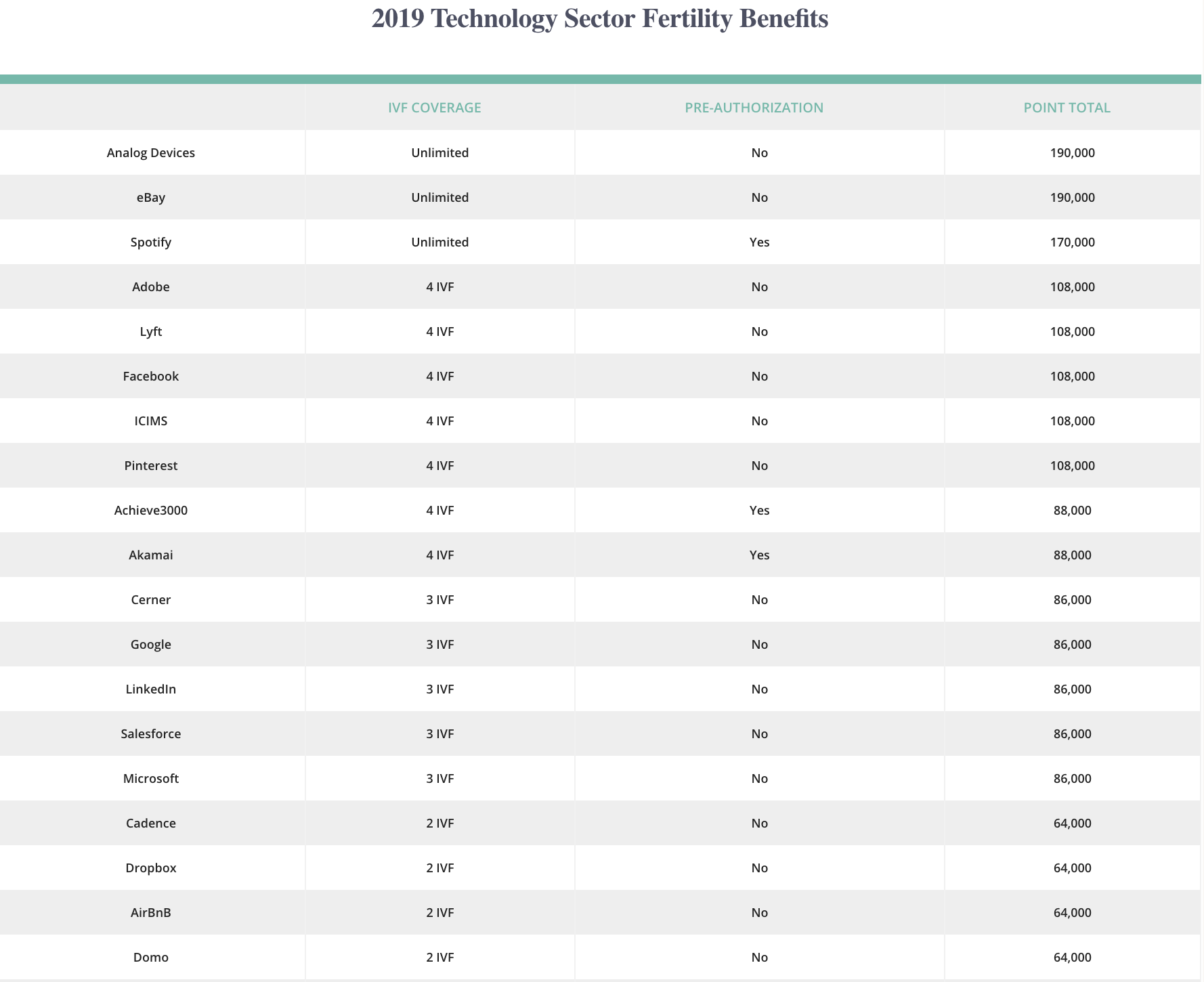
The technology sector awards women and same-sex couples the most comprehensive fertility benefit packages, according to a survey by FertilityIQ, an online platform for fertility patients to review doctors and research treatments.

The company asked 30,000 in vitro fertilisation (IVF) patients across industries about their employers’ — or their spouse’s employer’s’ — 2019 fertility treatment policy, and allocated points based on their support for IVF procedures and egg freezing, among other services.

Silicon Valley semiconductor business Analog Devices and eBay led the ranking. The two companies offer employees unlimited IVF cycles with no pre-authorization requirement, meaning employees do not need permission from insurance providers before seeking certain medical services. Pre-authorization has historically impacted lesbian, gay or unpartnered employees from accessing care quickly or at all, FertilityIQ co-founder Jake Anderson explained

Spotify, Adobe, Lyft, Facebook and Pinterest were amongst the highest-ranked technology businesses, too.

“I think a lot of people see the tech sector as being unenlightened when it comes to family values but it’s still the sector that makes the fertility benefits the most widely acceptable,” Anderson, a former consumer internet investor at Sequoia Capital, told TechCrunch.

FertilityIQ’s fertility benefits survey results.

Despite an initial outpouring of skepticism, Facebook and Apple became leaders in the fertility benefit category when they began paying for their female employees to freeze their eggs in 2014. Since then, smaller firms have opted to beef up those benefits to stay competitive with their much larger and richer counterparts.

“The Lyfts, the Airbnbs and the Ubers of the world, who clearly need to compete for those companies for talent, have effectively matched those companies dollar-for-dollar despite a much smaller war-chest,” Anderson said. “These companies that are worth 1/1000th of these bigger companies are effectively going toe-to-toe to offer whatever women need.”

Anderson and his wife, FertilityIQ co-founder Deborah Anderson, noticed improved benefits in 2018 from companies implicated by the #MeToo movement, such as Vice Media, Under Armour and Uber.

“Silicon Valley is notorious for talent moving around on you but it’s probably not coincidental that some of the companies that were in the spotlight in the #MeToo movement have added really generous benefits,” Deborah Anderson told TechCrunch.

Uber, for example, now pays for its employees to complete two IVF cycles but still requires pre-authorization.

One in 7 Americans struggle with infertility and the rate of IVF procedures only continues to increase, with the latest data indicating a 15 percent year-over-year growth rate. IVF costs roughly $22,000 per cycle, per FertilityIQ’s survey, a cost which has similarly increased 15 percent since 2015.

That’s a whole lot of cash for a fertility patient to dole out. If companies foot the bill, they’ll have a better shot at retaining talent.

“Best we can tell, there is no question that employees that get this benefit and use it are more loyal and more likely to stick around,” Jake Anderson said. “The company that helps you build your family is the company that you remain committed to.”

from Startups – TechCrunch https://tcrn.ch/2BgYdQs

#USA Bud raises $20M to connect banks to fintechs and other financial service providers

//

Bud, the U.K. fintech that helps banks connect their apps and data to other fintech companies and financial service providers, has closed over $20 million in further funding.

The Series A round sees the company pick up backing from a number of banks: HSBC (which, via First Direct, it also counts as a customer), Goldman Sachs, ANZ, Investec’s INVC fund, and InnoCells (the corporate venture arm of Banco Sabadell).

Others participating include Lord Fink (the former chief executive of hedge fund Man Group), and 9Yards Capital (the VC firm to which George Osborne is an advisor).

Originally launched back in 2016 as a consumer app that wanted to make various financial services accessible from a single aggregated interface, the London-based startup has since pivoted to a tech platform it offers to banks to help them remain more competitive in the Open Banking/PSD2 era. Its tech lets banks create new apps and services that enable customers to manage all of their financial products within a single app.

Essentially, Bud acts as the tech layer that intelligently connects bank account data to third-party financial services, including those provided by fintechs and more traditional financial providers, as well as doing a lot of the other heavy-lifting required to create new consumer experiences from bank data.

“The work we have done with First Direct… is a showcase of features and functionalities made possible by new regulation, data science and relevant connections to fintech and banking services,” Bud CTO and co-founder George Dunning tells me.

“We have built a number of data enrichment features using transactional data to make people’s lives that little bit easier. Connection and aggregation of people’s accounts is the standard now, so we focussed on things like increasing financial literacy. ‘Smart Balance’ is a feature that shows users what they can safely spend and ‘Goals’ help them plan ahead. Our advanced regular payment finder filters and tracks bill payments and if you can save money Bud connects you to a service that will make it happen”.

Many of these features are powered by Bud’s ability to use data to detect patterns and behaviours. “Something as simple as detecting if someone is going abroad and helping them get insurance for their trip using one of our partners from within the app is much better than if you do it the traditional way,” says Dunning.

Other than HSBC-owned First Direct, the Bud co-founder isn’t able to disclose any of the company’s other bank customers. “We are working with a handful of banks across the industry, using open banking and our marketplace of services to solve problems for their customers which couldn’t be solved before now,” he says.

On the fintech and financial services side, Bud currently works with 85 different companies. These include fintechs Wealthify and PensionBee to more established companies like Hiscox and AJ Bell.

One other partner Dunning can talk about is the U.K. government, which Bud is working with as part of the Rent Recognition Challenge to create new solutions for people wishing to get on the housing ladder. “First-time buyers have it harder now than ever before. Work we are just finalising with The Treasury uses rent payments to help people grow their credit history to buy a home,” he says.

Meanwhile, Bud says the new capital will support the expansion of the Bud team, as the company moves to double its headcount creating what it claims will be the “largest team dedicated to Open Banking in the world”. Its current headcount is 62.

Cue statement from Raman Bhatia, Head of digital bank at HSBC Retail Banking and Wealth Management: “Since the start of our partnership with Bud back in 2017, we’ve been impressed with the team’s approach to innovation. They have helped to shape our approach to open banking, working with us to deliver services that makes banking easier for our customers. They stand out as motivated by their mission to help people have a better relationship with financial services”.

from Startups – TechCrunch https://tcrn.ch/2GqbOIy

#Blockchain SEC Solicits Blockchain Analysis Tool to Identify Wallet Owners

While U.S. investors are waiting for a bitcoin ETF to be approved, American financial regulators are looking to make the market more transparent. The Securities and Exchange Commission (SEC) is seeking a service that will identify the owners of wallet addresses for multiple cryptocurrencies.

Also Read: Chainalysis: Two Hacker Groups Stole $1 Billion in Crypto

The SEC Wants Crypto Transaction Details

The SEC has issued a ‘sources sought notice’ on January 31, searching for companies that can provide blockchain data to support its efforts to monitor risk and improve compliance of digital assets. The regulator is seeking a service for acquiring data on the “most widely used blockchain ledgers, including the universe of available information and transaction details.” The desired sources should provide the SEC with the capability to derive insights from available data, including “attribution data (i.e. to whom a particular address belongs).”

SEC Solicits Blockchain Analysis Tool to Identify Wallet Owners

Additional required capabilities by the SEC are the provision of data extracts on a recurring basis for the most widely used digital assets based on transaction volume; cleaning and normalizing the data to enable review and exploration; and the means to demonstrate data is accurate and complete. For this, the SEC wants a verification method it can use to ensure there is no data loss due to the processes designed to make the information easily readable.

Moving Forward on Bitcoin ETF?

The SEC is also looking for information on which of the most popular digital assets data can be provided on, options for data sharing and data transmission, processes and tools used to aggregate and compile the data, and other metrics mentioned in the document. Vendors that wish to present their services need to provide cost estimates for ongoing access or subscription to the requested data and should respond to the notice by Feb. 14, 2019.

SEC Solicits Blockchain Analysis Tool to Identify Wallet Owners

The American securities regulator has been the center of a lot of attention from institutional investors recently, as its approval is needed for U.S. financial companies to offer a bitcoin ETF. Perhaps the description of the monitoring capabilities that the SEC is seeking explains the transparency the regulator is seeking before green-lighting an ETF.

What do you think about the SEC’s intentions? Share your thoughts in the comments section below.


Images courtesy of Shutterstock.


Verify and track bitcoin cash transactions on our BCH Block Explorer, the best of its kind anywhere in the world. Also, keep up with your holdings, BCH and other coins, on our market charts at Satoshi’s Pulse, another original and free service from Bitcoin.com.

The post SEC Solicits Blockchain Analysis Tool to Identify Wallet Owners appeared first on Bitcoin News.

from Bitcoin News http://bit.ly/2WGz8I6 SEC Solicits Blockchain Analysis Tool to Identify Wallet Owners