
About Startup365

Chaque jour nous vous présenterons une nouvelle Startup française ! Notre pays regorge de talents et d'entrepreneurs brillants ! Alors partons à la découverte des meilleures startup françaises ! Certaines d'entre elles sont dans une étape essentielle dans la vie d'une startup : la recherche de financement, notamment par le financement participatif (ou crowdfunding en anglais). Alors participez à cette grande aventure en leur faisant une petite donation ! Les startups françaises ont besoin de vous !

#Blockchain Tidbits: Jesse Powell Criticizes Custodial Ownership, Simon Dixon Slams the Banking System

Jesse Powell Explains Gold Ownership, Simon Dixon Criticizes Banking System

Tidbits is a roundup of talking points from across the cryptosphere. Today, Jesse Powell and Samson Mow both voice their opinions on the custodial ownership of assets through trusted, third parties. Paul Sztorc shows the Bitcoin community that forks are not as frequent as they think and Simon Dixon breaks down his three problems with the banking system.     

Also read: Kraken Launches Margin Trading for BCH Pairings 

Not Your Vault, Not Your Gold

Recently, Venezuelan President Nicolas Maduro’s regime was denied the withdrawal of $1.2 billion worth of gold out of the Bank of England. Kraken exchange CEO Jesse Powell quickly pointed out that Maduro’s regime never owned their own gold, because they never stored it in their own vaults.

Similarly, Blockstream CSO Samson Mow took the opportunity to point out the similarities between Maduro regime’s gold and the oil that supposedly backs the Petro cryptocurrency. Both are assets that are held in custody by trusted, third parties that cannot be trusted.

Forks Not as Frequent as Bitcoin Community Thinks

Director of research at Tierion and Bitcoin developer Paul Sztorc recently assembled all Bitcoin upgrade events into a pivot table. Interestingly, his findings showed forks were significantly less frequent than what the Bitcoin community initially assumed.

Sztorc goes on to explain that 2010 had about as many protocol forks as all other years. Also, the last normal upgrade was in July 2016, and the only upgrade since then was segwit.

Simon Dixon’s Three Problems With Banking

Banktothefuture CEO Simon Dixon was recently interviewed, and he explained the three increasingly problematic issues with the banking industry. Dixon believes that the banks are both unable and unwilling to solve these three problems.

The first problem occurs when clients deposit money into banks, and the banks become the legal owner of their clients’ money. During this period, the banks are able to use their clients’ funds any way they see fit. The next issue is that the banks decide how to inject their clients’ money into the economy via loans. Therefore, banks control the economy. Lastly, the monetary system is structured in a way that encourages debt rather than savings. Thus, there is innovation on the government level, the banking level and the investment banking level, to entice people, corporations and governments deeper into debt to increase the money supply. Eventually, this debt will need to be repaid, recycled into new debt, or bailed out through quantitative easing. In summary, banks are problematic because they earn money through the debt they create.

What do you think of custodial ownership of assets? Let us know in the comments below.


Images courtesy of Shutterstock.


Bitcoin Games is a provably fair gaming site with 99% or better expected returns. Try it out here.

The post Tidbits: Jesse Powell Criticizes Custodial Ownership, Simon Dixon Slams the Banking System appeared first on Bitcoin News.

from Bitcoin News http://bit.ly/2FTgZl0 Tidbits: Jesse Powell Criticizes Custodial Ownership, Simon Dixon Slams the Banking System


#Blockchain Just Because Cryptocurrency Isn’t ‘Legal Tender’ Doesn’t Make It Illegal

Cryptocurrency Not 'Legal Tender', but Not Illegal Either

Central bank warnings about crypto assets may give the impression that cryptocurrency is illegal, especially since these entities often cite reasons as to why they’re uncomfortable with virtual currencies encroaching on their turf. But their assertions are often inaccurate, particularly when it comes to determining the legality of cryptocurrency.

Also read: Jamaica Stock Exchange Plans to List Security Tokens

A Currency Legitimized by its Owners

Just Because Cryptocurrency Isn't 'Legal Tender' Doesn't Make It IllegalOn Jan. 24, Singapore’s ministry of law, in an apparent reaction to the growing acceptance of virtual currency, cautioned that cryptocurrency is not legal tender and advised businesses to exercise due diligence before accepting it as a form of payment. The ministry’s pronouncement follows the sealing of a partnership between a jewelry chain store called SK Jewellery and Singapore-based point-of-sale systems firm Bizkey Network to operationalize cryptocurrency payments.

Elsewhere, the Central Bank of Samoa has previously warned citizens that it does not issue or regulate cryptocurrencies. The central bank maintained that cryptocurrencies are not legal tender in Samoa, warning that digital coins are risky and speculative. In Zambia, where cryptocurrencies have yet to register substantial trade volume, the central bank has issued a similar warning.

However, it is important to clarify what “legal tender” means in order to determine the intent of the authorities – who are torn between skepticism and proactive anticipation of crypto disruption – in perspective. Legal tender is a payment method that is sanctioned by law for the settlement of a debt or financial obligation within a particular jurisdiction. Fiat money issued by the central bank of a country is legal tender – a binding medium for the fulfilment of a transaction between parties.

Just Because Cryptocurrency Isn't 'Legal Tender' Doesn't Make It Illegal

However, this does not rule out the legality of other payment methods. For example, individuals may, at their mutual convenience, enter into transactions using currencies issued in other jurisdictions. During Zimbabwe’s hyperinflationary era, particularly between 2006 and 2009, there was widespread trading in U.S dollars, Botswana pula and South African rand.

While these were not legal tender in Zimbabwe, they were not illegal and the government blessed their already widespread use in 2009 by officially adopting a multi-currency financial system. Besides foreign currencies, non-fiat mediums such as cheque and credit card are also widely used without being legal tender.

Scotland’s Legal Currency Which Isn’t Legal Tender

In the U.K., Scottish bank notes are a legal currency approved by the U.K. parliament but they are not legal tender, even in Scotland. “Whether or not notes have legal tender status, their acceptability as a means of payment is essentially a matter for agreement between the parties involved,” a Scottish bank advises.

Disclaimers occasionally issued by governments with respect to cryptocurrencies are uniformly applied to other non-legal tender payment methods without making them illegal. Regulatory authorities, perhaps, feel more need to level these designations against cryptocurrency because they are a novel phenomenon most people are still coming to terms with. Crypto, as non-legal tender, is not a legally enforceable payment method, as one party cannot insist upon the other accepting it in a transaction.

Just Because Cryptocurrency Isn't 'Legal Tender' Doesn't Make It Illegal

According to a Library of Congress article on global regulation of cryptocurrencies, government warnings on virtual money are a form of public education. “Such warnings, mostly issued by central banks, are largely designed to educate the citizenry about the difference between actual currencies, which are issued and guaranteed by the state, and cryptocurrencies, which are not,” the article detailed.

“Most government warnings note the added risk resulting from the high volatility associated with cryptocurrencies and the fact that many of the organizations that facilitate such transactions are unregulated.  Most also note that citizens who invest in cryptocurrencies do so at their own personal risk and that no legal recourse is available to them in the event of loss,” it added.

Governments Aren’t Responsible for Cryptocurrency

At Davos recently, Bank of England governor Mark Carney accused cryptocurrencies of not going anywhere. He argued that cryptocurrency would not revolutionize the financial sector because they are more assets than currencies. Carney also noted the reluctance of e-commerce giants in UK to transact in cryptocurrency because of the relative expense and lower speed.

At any rate, government warnings about trading in cryptocurrency do not infer their illegality. Rather, it means that they are not the institutional responsibility of the governments, something that is actually a fundamental feature of cryptocurrencies.

Just Because Cryptocurrency Isn't 'Legal Tender' Doesn't Make It Illegal

Recently, central banks, with the encouragement of the IMF, have considered the idea of issuing their own digital currencies, faced with the disruptive wave of cryptocurrencies. Central bank digital currencies (CBDCs) will not upstage cryptocurrencies as they will not match the characteristics of cryptocurrencies as an autonomous form of money controlled by its owners, transacted peer-to-peer and insulated from the overbearing whims of governments, legacy financial institutions or corporations.

Clarifying its decision to accept crypto, Singapore’s SK Jewellery maintained that there is nothing legally amiss with this payment mechanism. “The acceptance of crypto merely serves as another option of payment for our customers and, other than it being a more unconventional mode of payment now; it’s business as usual,” the company spokesperson said.

Government warnings cut both sides. They help citizens and businesses decide how far they can trade in cryptocurrency as an unregulated instrument of trust. On the other hand, they serve to reaffirm cryptocurrencies’ fundamental power as an instrument of financial freedom.

What do you think about the legal status of cryptocurrency? Let us know in the comments section below.


Images courtesy of Shutterstock.


Express yourself freely at Bitcoin.com’s user forums. We don’t censor on political grounds. Check forum.Bitcoin.com

The post Just Because Cryptocurrency Isn’t ‘Legal Tender’ Doesn’t Make It Illegal appeared first on Bitcoin News.

from Bitcoin News http://bit.ly/2sOPwIG Just Because Cryptocurrency Isn’t ‘Legal Tender’ Doesn’t Make It Illegal

#Blockchain Swiss Bank Partners With Bitstamp to Enable BTC Funding and Withdrawals

Swiss Bank Partners With Bitstamp to Enable BTC Funding and Withdrawals

Cryptocurrency exchange Bitstamp has partnered with a Swiss bank to allow the bank’s customers to fund their dollar-denominated accounts with BTC as well as withdraw funds in the cryptocurrency. Deposited coins are converted to USD. Withdrawals are converted to BTC and transferred to the crypto wallets linked to client accounts.

Also read: Indian Supreme Court Moves Crypto Hearing, Community Calls for Positive Regulations

The Partnership

Swiss Bank Partners With Bitstamp to Enable BTC Funding and WithdrawalsBitstamp announced on Friday that it has “partnered with Dukascopy Bank, one of the leading Swiss online banks, to enable crypto funding on their platform.” The exchange elaborated:

Dukascopy’s clients can now send bitcoins to their accounts and the crypto will be converted to US dollars, which they can use to trade on the Swiss FX Marketplace. Clients can also withdraw funds back to their cryptocurrency wallets in the form of bitcoins.

Swiss Bank Partners With Bitstamp to Enable BTC Funding and WithdrawalsGeneva-based Dukascopy Bank offers currency and precious metal (forex) trading to retail and institutional clients. Its website explains that the funding and withdrawals of BTC are offered through “crypto-fundable trading accounts,” adding that BTC is currently the only cryptocurrency supported.


Swiss Bank Partners With Bitstamp to Enable BTC Funding and Withdrawals

The bank explained that any BTC sent by clients to it will always be converted to USD. Bitstamp is responsible for exchanging fiat funds to BTC and back for the bank. “The proceeds of the BTC/USD conversion are credited in USD to the crypto-fundable client account,” the bank described, adding:

In case of withdrawal, the bank debits an amount of USD from the crypto-fundable client account, converts such amount into BTC at a current rate and transfers the bitcoins to the client wallet linked to his account.

“This partnership represents another step towards our goal of bridging the gap between crypto and traditional finance,” Bitstamp wrote. “It is further proof that our efforts in compliance and regulation continue to deliver results at a time of rapid maturation for the cryptocurrency industry.”

Dukascopy Bank’s Crypto CFD Offerings

This is not Dukascopy Bank’s first foray into the crypto space. It already provides contract for difference (CFD) “trading on price movements of cryptocurrencies, its derivatives or value estimations,” according to its website. Currently, only CFDs on BTC and ETH are available, both with a 33 percent margin requirement and a leverage ratio of 1:3.

Swiss Bank Partners With Bitstamp to Enable BTC Funding and Withdrawals

Dukascopy Bank’s website further details that customers with opened CFD positions do not own the underlying assets and the “price of cryptocurrency CFD varies significantly across different cryptocurrency exchanges.” The bank also noted that its CFD “prices on cryptocurrencies are unique and based on its ability to hedge Dukascopy positions with external counterparties.”

What do you think of the partnership between Dukascopy Bank and Bitstamp? Let us know in the comments section below.


Images courtesy of Shutterstock, Bitstamp, and Dukascopy Bank.


Need to calculate your bitcoin holdings? Check our tools section.

The post Swiss Bank Partners With Bitstamp to Enable BTC Funding and Withdrawals appeared first on Bitcoin News.

from Bitcoin News http://bit.ly/2RhnS0S Swiss Bank Partners With Bitstamp to Enable BTC Funding and Withdrawals

#Blockchain JP Morgan: Bitcoin Would Only Make Sense in a Dystopian Scenario

Jp Morgan: Bitcoin and Cryptocurrency Would Only Make Sense in a Dystopian Scenario

JP Morgan has continued to bash bitcoin and cryptocurrencies, saying the value of them is still unproven and that it will be at least another three to five years before blockchain technology makes a difference to the banking sector. 

Also read: Jamaica Stock Exchange Plans to List Security Tokens

‘A Dystopian Scenario’

America’s largest bank has reaffirmed that it is still skeptical of cryptocurrencies. JP Morgan said that such assets would only be of any value in a “dystopian scenario” where investors lost faith in gold, the dollar and the global payments system, according to Reuters. “Even in extreme scenarios such as a recession or financial crises, there are more liquid and less complicated instruments for transacting, investing and hedging,” the bank was quoted as saying.

JP Morgan: Bitcoin Would Only Make Sense in a Dystopian Scenario

The Manhattan-based firm said it would still be years until blockchain technology catches on with mainstream financial institutions and added that participation by traditional financial organizations in crypto markets had slipped over the last six months with individuals taking up an increasing share of the market. According to Reuters, pension funds and asset managers have stayed clear so far, although there have been some advances in market infrastructure that have seen safer methods to store digital money emerge. Despite this, people still worry about the volatility of cryptocurrencies, security flaws and digital assets being used for illegal purposes, such as money laundering or buying illicit goods.

JP Morgan added in its report that cryptocurrencies being used for payments will stay “challenged” and no major retailers accepted such assets in 2018, though marketplaces where small businesses have control over payment methods would be fruitful in the future for the spread of cryptocurrencies. JP Morgan added that bitcoin  core(BTC) could fall below $1,260 if a bear market persists. Analysts at the bank also said that BTC is worth less than the cost to mine it, stating:

The drop in bitcoin prices from around $6,500 throughout much of October to below $4,000 now has increasingly pushed margins further and further negative for just about every region except low-cost Chinese miners.

Continued Skepticism

This isn’t the first time JP Morgan has criticized BTC and cryptocurrencies. A group of analysts at the bank in December said that the prolonged bear market of 2018 was scaring institutional investors away from BTC, adding that financial institutions’ interest in bitcoin trading “appears to be fading” as key metrics like the index of open interest in bitcoin futures have diminished. But a number of experts countered the bank’s skepticism, saying it was likely digital assets would survive.

JP Morgan CEO Jamie Dimon made headlines when he said in 2017 that he had “an issue” with non-fiat cryptocurrencies, insisting that people who dealt in them were “stupid” and that “governments will crush it one day.”

Do you agree with what JP Morgan has said about BTC and cryptocurrencies? Let us know in the comments section below.


Images courtesy of Shutterstock.


Want a comprehensive list of the top 500 cryptocurrencies and see their prices and overall market valuation? Check out Satoshi Pulse for all that hot market action.

The post JP Morgan: Bitcoin Would Only Make Sense in a Dystopian Scenario appeared first on Bitcoin News.

from Bitcoin News http://bit.ly/2RN3qK8 JP Morgan: Bitcoin Would Only Make Sense in a Dystopian Scenario

#USA The Predictive Index brings in $50M to help businesses create winning teams

//

Funding will get you a long way, but people, at the end of the day, are the key to a successful business.

The Predictive Index, which develops behavioral and cognitive employee assessments, has raised a $50 million round of growth-stage capital from venture capital firm General Catalyst to help companies choose the right talent.

Kirk Arnold, an executive-in-residence at General Catalyst and new Predictive Index board member, led the deal for the VC firm, which says the round is the largest first check they’ve ever written a company. Predictive Index declined to disclose the valuation.

The workplace analytics service was founded in 1955, making it just a bit older than your typical growth-stage business. Current chief executive officer Mike Zani (pictured, right) acquired the company in 2014 with Predictive Index president and chairman Daniel Muzquiz (pictured, left). Prior to the acquisition, the pair were clients of the business.

With the infusion of VC funding, Zani said he’ll double employee headcount, create a playbook on how to “successfully design, hire and inspire winning teams” and create a talent optimization industry conference, amongst other big plans.

“Most companies are losing the talent war, and not because of the lack of fight, but rather because strategic talent strategies are non-existent or broken,” Zani told TechCrunch. “The irony is that talent is one of the only lasting differentiators in business today. Most tools in the marketplace help with process or tactical aspects of people and ignore the strategic. At [Predictive Index] we offer the strategic talent discipline, or talent optimization, to the hands of those who want to use talent as a business performance lever.”

Headquartered in Boston, Predictive Index says it counts some 7,000 customers in 142 countries, including Nissan, DocuSign and Blue Cross Blue Shield.

“This year, low unemployment and high turnover will further magnify the importance of talent,” Arnold said in a statement. “Having a talent strategy which aligns and supports business strategy is a requirement for any business to be successful.”

from Startups – TechCrunch https://tcrn.ch/2G5eY4i

#USA The Predictive Index brings in $50M to help businesses create winning teams

//

Funding will get you a long way, but people, at the end of the day, are the key to a successful business.

The Predictive Index, which develops behavioral and cognitive employee assessments, has raised a $50 million round of growth-stage capital from venture capital firm General Catalyst to help companies choose the right talent.

Kirk Arnold, an executive-in-residence at General Catalyst and new Predictive Index board member, led the deal for the VC firm, which says the round is the largest first check they’ve ever written a company. Predictive Index declined to disclose the valuation.

The workplace analytics service was founded in 1955, making it just a bit older than your typical growth-stage business. Current chief executive officer Mike Zani (pictured, right) acquired the company in 2014 with Predictive Index president and chairman Daniel Muzquiz (pictured, left). Prior to the acquisition, the pair were clients of the business.

With the infusion of VC funding, Zani said he’ll double employee headcount, create a playbook on how to “successfully design, hire and inspire winning teams” and create a talent optimization industry conference, amongst other big plans.

“Most companies are losing the talent war, and not because of the lack of fight, but rather because strategic talent strategies are non-existent or broken,” Zani told TechCrunch. “The irony is that talent is one of the only lasting differentiators in business today. Most tools in the marketplace help with process or tactical aspects of people and ignore the strategic. At [Predictive Index] we offer the strategic talent discipline, or talent optimization, to the hands of those who want to use talent as a business performance lever.”

Headquartered in Boston, Predictive Index says it counts some 7,000 customers in 142 countries, including Nissan, DocuSign and Blue Cross Blue Shield.

“This year, low unemployment and high turnover will further magnify the importance of talent,” Arnold said in a statement. “Having a talent strategy which aligns and supports business strategy is a requirement for any business to be successful.”

from Startups – TechCrunch https://tcrn.ch/2G5eY4i

#Blockchain ‘XRP Army’ Accused of Harrassment After Intense Debate Over the Token’s Market Cap

'XRP Army' Accused of Harrassment After Intense Debate Over the Token's Market Cap

Over the last few months, there’s been a lot of discussion about the company Ripple Labs and the digital token XRP. A recently published report on the market valuation of XRP, authored by the cryptocurrency data startup Messari, has caused quite a stir among the community. After Messari’s founder Ryan Selkis shared an article concerning the XRP study, he claims someone called his phone and harassed him.

Also read: Fork Debate Drops to New Low, Outspoken Developer Lopp’s Home Surrounded by Police

High up Ripple Community Members and Executives Asked to Denounce Harassment

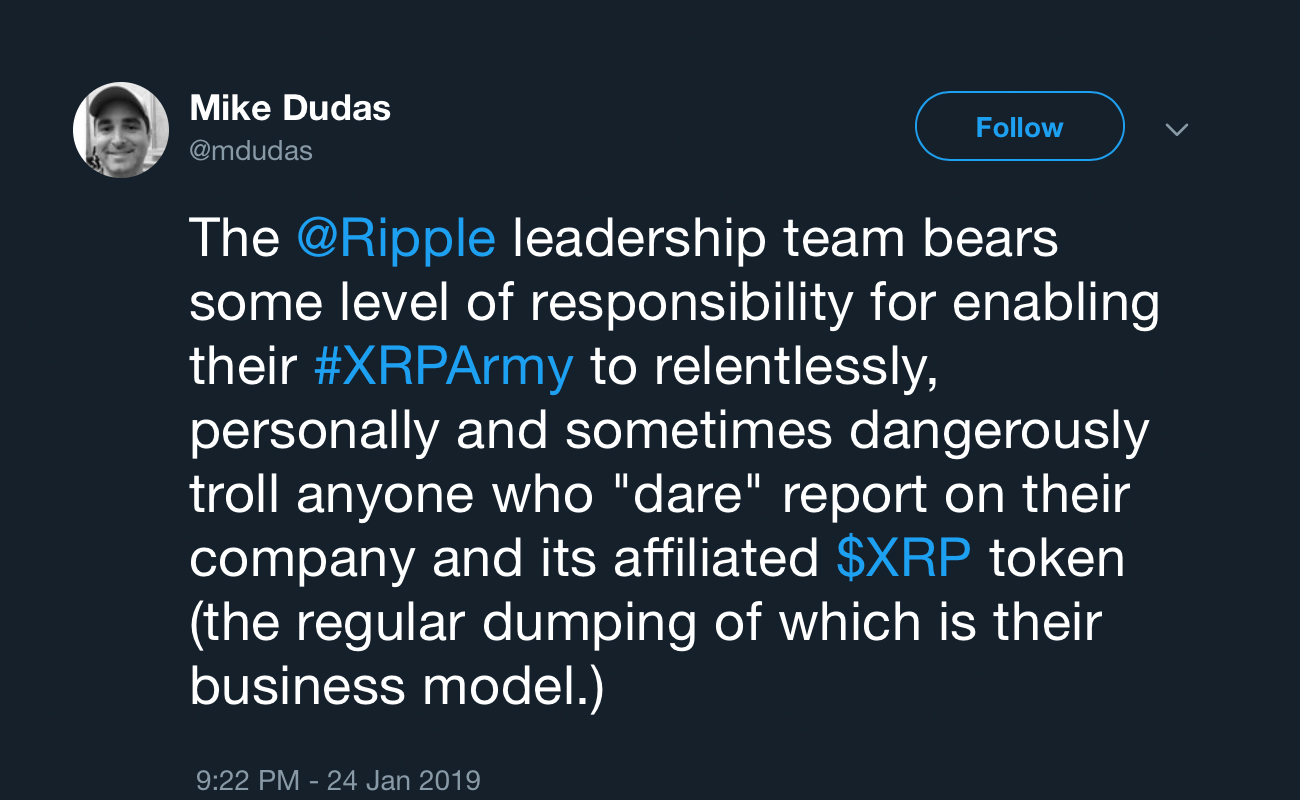
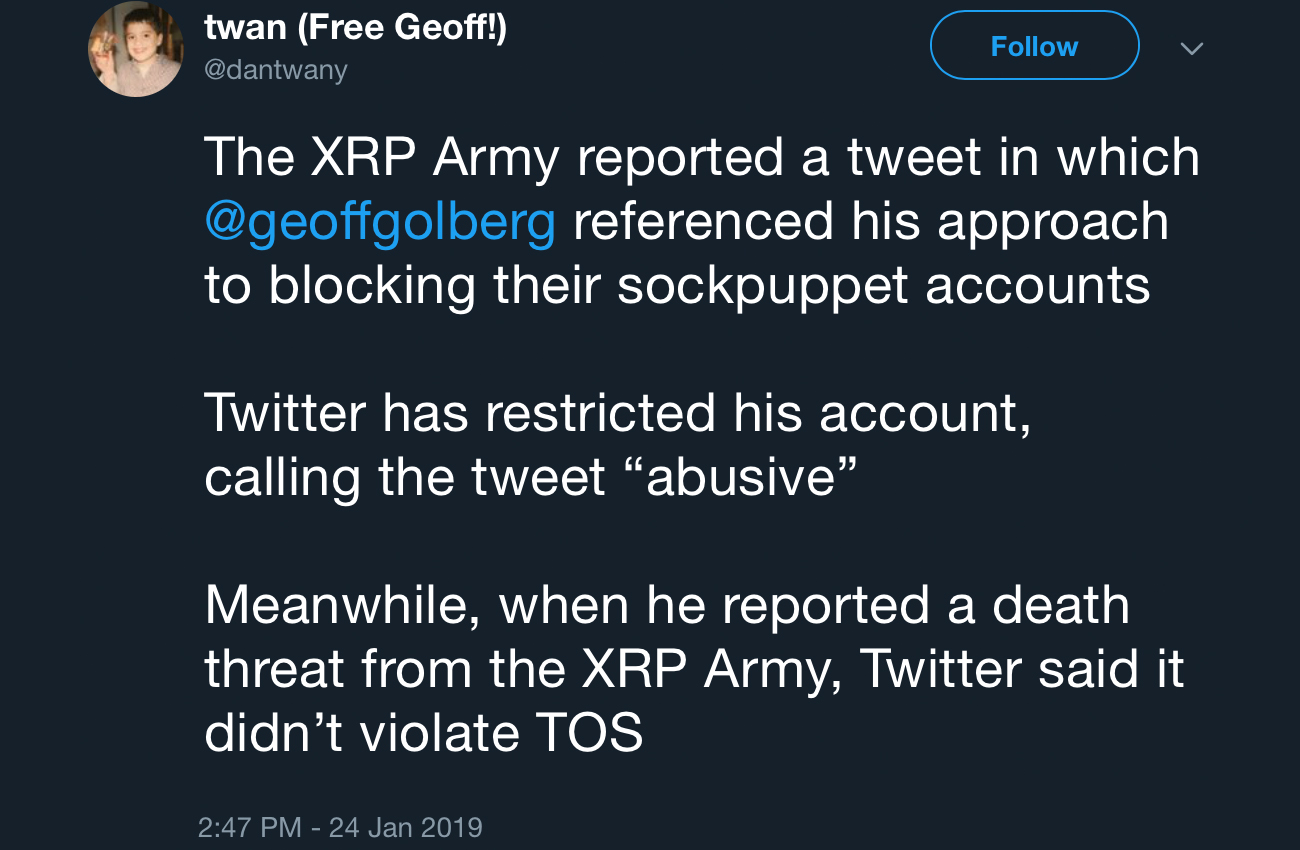
If you’ve been involved in the cryptocurrency scene on social media or forums, you probably noticed the intense debate between XRP proponents and other digital currency communities. There have been many fierce arguments in regard to Ripple Labs and XRP’s relationship, the billions of tokens held in escrow, and whether or not the network even deserves to be called a “blockchain.” Moreover, XRP has done well, as far as fiat value is concerned and has garnered a lot of attention and supporters over the last two years. More recently, however, there have been talks about a group of proponents the community has dubbed the “XRP army” and if someone makes a negative statement about the token, then a swarm of supporters will rebuke the statement and say very negative things about the individual. On Jan. 24, Messari founder Ryan Selkis shared the story about how the cryptocurrency data startup had contested XRP’s market capitalization and he received a lot of backlash on social media.

'XRP Army' Accused of Harrassment After Intense Debate Over the Token's Market Cap

Many XRP supporters called Messari’s study “FUD” and a Ripple spokesperson said the report had “several inaccurate assumptions.” Selkis says his team sent the entire report to well known Ripple community members and executives in advance and also highlighted things they needed clarity on. Ripple chief executive Brad Garlinghouse also dismissed Messari’s study and asked: “When will media coverage of this industry mature?” However, soon after that, things went from a simple discussion to alleged harassment. According to Selkis, someone called him after the Messari study was published and intimidated him.

“Someone just called me from a Nashville number and recited my wife’s birthday to me — Then hung up — [Brad Garlinghouse] these are the type of animals you and your fucking company enable,” explained Selkis on Twitter.

After Selkis made the statement, a person responded by saying: “FYI Ryan bro, you took the first shots.” Selkis continued by saying he will be getting the FBI involved if there are a total of three harassment calls. Messari’s founder stated:

I want Ripple, [Brad Garlinghouse, Monica Long, Cory Johnson, Joel Katz, and Warren Anderson] to denounce any XRP community threats against my family. I’m going to the FBI and local police after three calls — Ensuring our family doesn’t get swatted.

'XRP Army' Accused of Harrassment After Intense Debate Over the Token's Market Cap

Community Members Discuss Past Memories of Crypto-Harassment and Threats

The harassment has brought back memories of other cryptocurrency industry members and developers who have also been harassed in the past. The well known bitcoin developer Jeff Garzik had a similar experience when he was the lead maintainer of the Segwit2x project. “This is what happened to me and my family during Segwit2x brouhaha and local police and the FBI were called then, too — There are some sick parts of this community,” Garzik explained on Twitter in response to the statements Selkis made.

'XRP Army' Accused of Harrassment After Intense Debate Over the Token's Market Cap

In response to Garzik’s tweet, Bitcoin developer Jameson Lopp asked him: “On a scale of 0 to 10 how helpful did you find law enforcement to be?” Lopp was also harassed last year allegedly because of the Segwit2x scaling debate as well. In fact, the developer was “swatted,” an act when someone calls the local swat police to barge down on someone’s home when they haven’t committed a crime. During the early morning hours, Durham, North Carolina police were dispatched to Lopp’s home as they were told there was a hostage situation.

So far there’s been a lot of community response on forums and social media in regard to Selkis telling Ripple executives and developers they should denounce this behavior.

What do you think about the so-called “XRP army” on forums and social media? What do you think about the experience Selkis has had with Ripple’s most faithful proponents? Let us know what you think about this subject in the comments section below.


Image credits: Shutterstock, and Twitter.


At news.Bitcoin.com all comments containing links are automatically held up for moderation in the Disqus system. That means an editor has to take a look at the comment to approve it. This is due to the many, repetitive, spam and scam links people post under our articles. We do not censor any comment content based on politics or personal opinions. So, please be patient. Your comment will be published.

The post ‘XRP Army’ Accused of Harrassment After Intense Debate Over the Token’s Market Cap appeared first on Bitcoin News.

from Bitcoin News http://bit.ly/2sKSlue ‘XRP Army’ Accused of Harrassment After Intense Debate Over the Token’s Market Cap

#USA Tinder agrees to settle age discrimination lawsuit

//

Tinder recently agreed to settle a $23 million class-action age discrimination lawsuit. The lawsuit, filed last April in California, alleged Tinder charged people over 30 years old twice the amount for its subscription services.

The class consists of every person, 29 years of age or older at the time, who subscribed to Tinder Plus or Tinder Gold between March 2, 2015 and the date of preliminary approval, according to the proposed order granting motion for preliminary approval of the class-action settlement.

“Under the Settlement, Defendants agree to a multifaceted Settlement structure, which includes a universal participation component (automatic benefits to all Class Members);,” the settlement states. “An additional cash or cash-equivalent payout to Class Members who submit timely valid claims; and an agreement to substantially halt Defendants’ allegedly discriminatory practices going forward.”

Filed on behalf of about 230,000 class members, each person will be able to receive either $25 in cash, 25 additional Super Likes or a one-month subscription to either Tinder Plus or Tinder Gold. As part of the settlement, Tinder must distribute $11.5 million to all class members, as well as $5.75 million in potential cash or cash-equivalents (e.g. Super Likes) to every class member who submits a claim.

Tinder has also agreed to stop charging people — just those located in California — different prices based on their age. That carries a value of at least $5.75 million, according to the settlement. In total, this amounts to a $23 million settlement.

I’ve reached out to Tinder and will update this story if I hear back.

from Startups – TechCrunch https://tcrn.ch/2Hx8bTE

#Blockchain These Tools Will Help You Calculate Your Crypto Taxes

Filing taxes can be tricky and in jurisdictions like the United States is notoriously complicated. But when cryptocurrencies are added to the equation things start to get even harder. Many aspects of the reporting of crypto income and profits are not yet clearly defined. However, a number of tax filing and calculation tools are trying to address the challenge and automate the process.  

Also read: 8 Crypto Debit Cards You Can Use Around the World Right Now

Popular Tax Calculators for Cryptocurrency Investors

Bitcoin Taxes is one of the earliest and most popular tax calculators for crypto enthusiasts. The online platform allows users to import data regarding their purchases and sales of cryptocurrency throughout the year from a number of major crypto exchanges. The service also includes mined digital coins in the balance and any spent or donated amounts of crypto.

These Tools Will Help You Calculate Your Crypto Taxes

Once the data is uploaded, the tool prepares several reports that cover the crypto-based income and the capital gains from cryptocurrency transactions. A closing report is then produced that contains the net profit or loss during the respective tax year. Bitcoin Taxes provides useful information about tax requirements in countries such as the U.S., the U.K., Germany, Australia, Japan, and Canada, explains basic terms related to crypto taxation, and shares simple tips like how to determine the cost basis of digital coins.

Coin Tracking is another tool that calculates crypto-related taxes. It’s quite popular with investors as it imports data from over 70 exchanges. It compiles the user’s trading history before providing an estimate of their tax obligations. Then, the summarized information can be exported in a variety of formats including Excel and PDF files. A capital gains report is generated only for users that have paid for the premium service.

Coinbase Offers Integration With Turbo Tax

An online crypto tax manager with a similar name, Coin Tracker, provides Coinbase users with the opportunity to obtain a full transaction history across all its platforms. The leading U.S. digital asset exchange recently offered traders help with the filing of their tax returns, announcing an integration with the popular tax filing platform Turbo Tax. Clients can now download their transaction history and upload up to 100 transactions at a time into the tax software through its crypto import feature which works with Coinbase and its iOS and Android apps.

However, to obtain a combined transaction history across all Coinbase platforms, including Coinbase Pro, customers need to use the services of Coin Tracker. Coinbase also offers its users a guide on crypto taxation and has developed its own calculator which can be used to produce a report covering purchases, sales, and other transactions performed through Coinbase accounts.

These Tools Will Help You Calculate Your Crypto Taxes

A universal calculator is offered by Libra Tax. Their tool estimates capital gains and losses after analyzing the crypto-related activities of their clients. The software connects to established cryptocurrency exchanges like Coinbase, Bitstamp and others in order to track transactions in major cryptocurrencies such as BTC, BCH, ETH and a number of altcoins. Crypto taxpayers can use the Libra Tax calculator for free for up to 500 transactions, while the paid subscription allows them to track 5,000. The premium service provides the option to download tax reports.

Zenledger is another provider of tax calculation services for crypto investors. Its solution enables users to import cryptocurrency transactions and calculate capital gains and crypto-related income thanks to its integration with leading digital asset trading platforms and support for most popular coins. Once the transaction history is imported, the tool generates capital gains, income, donations, closing reports, provides a profit and loss statement, and auto-fills tax forms such as the 8949. Zenledger’s starter subscription costs $149 and covers the processing of up to 500 transactions with a maximum total value of $50,000.

Tax Token is a relatively new company in the industry. It has been helping individuals with their cryptocurrency accounting since the beginning of last year but also develops products for CPA firms, crypto exchanges, high frequency trading platforms, and wallet providers. It recently released a new version of its software which uses artificial intelligence technology to automate the tax filing process. Tax Token offers free trials for some of its services, including its tax preparation program.

Do you plan to use specialized software to calculate your crypto-related taxes? Tell us in the comments section below.


Images courtesy of Shutterstock, Twitter.


Disclaimer: Bitcoin.com does not endorse nor support these products/services.

Readers should do their own due diligence before taking any actions related to the mentioned companies or any of their affiliates or services. Bitcoin.com is not responsible, directly or indirectly, for any damage or loss caused or alleged to be caused by or in connection with the use of or reliance on any content, goods or services mentioned in this article.

The post These Tools Will Help You Calculate Your Crypto Taxes appeared first on Bitcoin News.

from Bitcoin News http://bit.ly/2Rh2Mzt These Tools Will Help You Calculate Your Crypto Taxes

#Blockchain The Cypherpunk Dream: Protecting Data and Dismantling the Dossier Society

AI specialist Dr. Rand Hindi conducted a presentation on cypherpunk history and data privacy in St. Moritz, Switzerland, at the Crypto Finance conference. At the beginning of the talk, he asked the audience to unlock their smartphones and pass them to their neighbors. The audience responded with a gasp. Someone in the crowd even vocalized their disdain for the idea. Naturally, people feel guarded when it comes to protecting their digital content and private data. This is why the cypherpunks believed protecting personal info was of paramount importance.

Also Read: Governmental Overreach in Developing Nations Will Hasten Hyperbitcoinization

The Cypherpunks, Data Privacy, and the Dossier Society

Protecting data is not only about preventing hackers and thieves from gaining access to personal credentials. According to the cypherpunks, it is also about denying governments access to large troves of information and surveilling the population. In this sense, data privacy represents the sine qua non of personal sovereignty in cyberspace.

The cypherpunk creator of digital cash David Chaum once lamented that internet technologies would create a dossier society. This dossier society means government would catalog information on each individual, and they would possess piecemeal documentation regarding people’s identity and history. They would also track every person and keep tabs on their comings and goings. In its final incarnation, the dossier society would equate to a horror show worse than the dystopia depicted in George Orwell’s 1984.

In a way, this has already transpired. The U.S. government in partnership with large companies like Google and AT&T constantly collects “metadata.” This metadata allows governments to piece together a picture of an individual, allowing the state to gain more accessibility to their private affairs. It’s essentially a Gestalt panopticon of digital control wound tightly around the neck of each person.

Curtailing the Dossier Society With Encrypted Protocols

In order to fight back, cypherpunks and white hat hackers have been developing and deploying encryption schemes to protect sensitive digital materials. One example is Phil Zimmermann‘s PGP or Pretty Good Privacy. Zimmerman created PGP in 1991 as a method to protect emails through public-private key encryption and symmetric-key cryptography.

This method allows people to secure their communication channels with cryptographic privacy. It keeps snoops and government agents from reading the contents of email information. Governments can still determine the header info on emails to collect metadata, but it at least provides a degree of privacy for any sensitive material contained inside the digital package. Its major flaw is it’s not easy to use, and it requires users to share a private key database.

Homomorphic Encryption

A more recent scheme for protecting credentials, including some header materials, involves the use of homomorphic encryption. In his presentation, Dr. Hindi said new developments in this field will allow users to protect data at entry points and even leverage homomorphically encrypted smart contracts. This type of encryption allows sophisticated computation on ciphertexts, or encrypted messages. However, homomorphic encryption has heretofore been too cumbersome and slow for users to reliably deploy on commercial platforms. Dr. Hindi mentioned it is about a trillion times slower than non-encrypted communications.

With that said, new developments emerge everyday and a new kind of homomorphic encryption is making headway. It’s called TFHE encryption. TFHE encryption leverages machine learning to help process the encryption scheme in real time. Nonetheless, Dr. Hindi pointed out that only one known company presently uses this type of encryption.

The Future of Cypherpunk Tools and Crypto Anarchism

The future is still bright for the cypherpunk movement. It is true the dossier society is in full, disturbing effect. However, cypherpunks work relentlessly to create, build and deploy all the necessary tools to protect individuals and their data. At its core, the cypherpunks are in a battle to undermine the dossier society. But they wish to take their mission a step further. The cypherpunks are crypto-anarchists. They would eventually like to see the abolition of government and all dominance-based power structures.

Many people in the cryptocurrency and technology spheres sometimes forget this original mission. The reason why encrypted protocols were more highly developed after the government initially spawned them was to fight back against the surveillance state. The cypherpunks realized if government gains full control of the internet, it will mean that people’s lives will be totally transparent to the bureaucrat and policeman. It will also mean that digital totalitarianism will reign supreme.

True Names

Timothy May, the creator of crypto-anarchism, compared this dystopian nightmare to a science fiction story written by Vernor Vinge called True Names. In this story, the protagonist hackers had to protect their actual identity, or “true names,” from the United States government. If government acquired their true names, the hackers would die at the hands of government in the form of a “true death.” The story illustrates the power of identity and the potency of digital privacy. It illustrates the deep reasoning behind why the cypherpunks expanded on encrypted protocols and consistently wrote about the horrors of government control.

Do you believe in the cypherpunk mission of protecting data? Can we prevent the dossier society from emerging and compromising our privacy? Could we build a crypto-anarchistic future? Share your thoughts in the comments below.


Images courtesy of Shutterstock


OP-ed disclaimer: This is an Op-ed article. The opinions expressed in this article are the author’s own. Bitcoin.com does not endorse nor support views, opinions or conclusions drawn in this post. Bitcoin.com is not responsible for or liable for any content, accuracy or quality within the Op-ed article. Readers should do their own due diligence before taking any actions related to the content. Bitcoin.com is not responsible, directly or indirectly, for any damage or loss caused or alleged to be caused by or in connection with the use of or reliance on any information in this Op-ed article.

The post The Cypherpunk Dream: Protecting Data and Dismantling the Dossier Society appeared first on Bitcoin News.

from Bitcoin News http://bit.ly/2WgL0QE The Cypherpunk Dream: Protecting Data and Dismantling the Dossier Society