#UK I visited one of the largest megachurches in the US as an atheist Transhumanist presidential candidate — here’s what happened

//

Churchofhighlands

As part of my 2016 US Presidential campaign representing the transhumanist party, I’ve spent much of the last month in America’s highly religious South, traversing the Bible Belt and spreading the news that soon radical science and technology will overcome biological death.

Some experts are predicting a brave new world where gene editing, robotic hearts, and cranial implants may forever change humans into something transhuman.

No matter how you twist it, such concepts don’t easily jibe with biblical scripture.

In my travels, I expected resistance to my message. Instead, people in the South have graciously offered curiosity and even support of my strange campaign.  While I imagined we’d have rocks thrown at our bus, instead we got lots of people wanting selfies with us and local TV crews covering the tour.

In Tennessee, my coffin-shaped bus made a visit to Alabama’s Church of the Highlands. This nondenominational Christian megachurch, which has a dozen campuses and 32,000 members, is the largest church in the state.

Pastor Kyle Cantrell first encountered my crew and I while we were checking out the massive speaking pulpit where Sunday services are held. 

Because I’m an atheist presidential candidate, my wife is a physician at Planned Parenthood, and I endorse microchipping humans for a variety of reasons (I have a chip implant myself), I was thankful my small traveling crew was treated so well.

Pastor Cantrell took us to the main chapel — which is separate from the Sunday service auditoriums — and I pressed him with questions about how technology might affect religion in the future.

One topic we discussed in detail was virtual reality. I asked him if he thought it might be used in teaching people about God. He told me he couldn’t see any reason why virtual reality couldn’t be used to facilitate Christian understanding and preaching. Cantrell seemed to think it might especially be useful for the physically disabled who might not otherwise be able to easily make it into the church.

One pertinent topic I’ve thought about before — especially since I was raised Catholic — is whether robots and artificial intelligences can be saved. I pointed out the Pope had recently mentioned that perhaps aliens could be saved if they existed.

“It’s really the first time I’ve thought about whether robots or artificial intelligence could be saved,” Cantrell told me, “but it’s an interesting concept.”

Zoltanbus

A time is coming, perhaps in as little as 20 years, when scientists will create intelligences as sophisticated as humans, and even I’m curious whether they will embrace spiritual values. I don’t mind if they do — so long as they are not fanatical about it — but I do hope they will always hold reason and the Scientific Method as their highest codes. 

I’ve been openly writing about my atheism for many years now, though if I really had to peg down my beliefs, I’d probably lean towards being atheistcideist  someone who believes a superintelligence like God may have existed at one point, but probably ended its own existence to give free will to the universe. 

Most transhumanists embrace some spirituality, including myself. And despite my secularism, I’m quite certain that other intelligences are out there in the universe that are smarter than human beings. In an expanding universe that is almost 14 billion years old and may have 20 billion habitable planets, it’s egotistical to think that humans are the only entities to evolve with advanced intelligence. 

Zoltan

In the end, technology is changing the human race so rapidly that controversial topics like abortion, the existence of heaven, and saving the souls of robots may not matter in 30 years time. Technology may literally eliminate the questions.

For example, abortions may drastically decline due to artificial wombs, better forms of birth control that we control with our smartphones, and a possible overall decline in biological sex as virtual sex and sex chip implants become better than the real thing. And far fewer people will worry about whether heaven exists if science can conquer death and reverse aging.

Lastly, robots and AI will probably outperform human intelligences, likely teaching us about spirituality and possibly even about a superintelligence like God that may already exist — or did once exist.

Zoltan Istvan is a futurist, 2016 US Presidential Candidate of the Transhumanist Party, and author of The Transhumanist Wager.

Join the conversation about this story »

NOW WATCH: There’s a hidden map in your iPhone of everywhere you’ve been

from Business Insider http://ift.tt/1lXRu3R

Posted in #UK

#UK 8 industries robots will completely transform by 2025

//

Robot doing dishes

Just as ATMs changed banking and computers took over the home and workplace, robots and artificial intelligence are going to transform a bunch of industries over the next decade.

By 2025, a machine may be putting together your driverless car in a factory with no human oversight. A robot maid could be cleaning up after you at home, and your financial advisor might be a computer investing for you automatically. 

And with at least 90 countries operating unmanned aerial vehicles, the wars of the future may increasingly be fought with “drone” aircraft.

These are just some of the interesting — and sometimes scary — predictions to come from a 300-page report released by Merrill Lynch in November, which estimates the global market for robots and AI will grow from $28 billion to more than $150 billion just five years from now.

There’s plenty of disruption bound to happen across the world as drones and much-smarter-than-you AI take over. But we’re likely to see the biggest changes across eight industries in China, Japan, the US, and Korea — the countries currently investing the most in these technologies.

Here are the big predictions from Merrill Lynch:

The auto industry is going to change big-time, especially when fully autonomous — aka driverless — cars officially go mainstream.

Over the next five years, the report says most new cars will be smarter “connected” cars, and in 2025, that’ll mean about 10% of them are fully autonomous.

While the initial price will be about $10,000 more than regular cars, it will inevitably come down as more people and companies adopt them.

See the rest of the story at Business Insider

from Business Insider http://ift.tt/1lXRtNu

Posted in #UK

#UK Cabela’s eyeing options, may sell all or part of business

//

FILE - In this Nov. 16, 2007, file photo, shirts hang on hangers at the Cabela's store in Lacey, Wash. Cabela’s announced Wednesday, Dec. 2, 2015, that it may sell all or part of itself as it looks to boost shareholder value. (AP Photo/Ted S. Warren, File)

OMAHA, Neb. (AP) — Cabela’s, the outdoor sporting goods chain known for its elaborate in-store wildlife displays, may be seeking a buyer.

The retailer has been under pressure since late October when the investment firm Elliott Management started pushing for money-generating maneuvers from Cabela’s, possibly the sale of its credit card unit or the entire company. Elliott owns 6 percent of Cabela’s shares and holds options to buy another 5 percent.

The company has been attempting to cut spending due to weak sales and in September it laid off 70 people, eliminating about 4 percent of its corporate workforce.

Cabela’s has its headquarters in Sidney, Nebraska, a town with a population of less than 7,000. Cabela’s accounts for almost a third of that number in jobs.

CEO Tommy Millner said in a written statement that Cabela’s continues to honor its commitments and that it remains focused on its business.

Millner, who has led Cabela’s since 2009, said the company’s board maintains faith in its current strategy, but will consider other options.

“The Board is committed to taking actions to enhance value for shareholders and believes it is an appropriate time to explore potential strategic options that may drive further value,” Millner said.

Stifel analyst Jim Duffy said he thinks Cabela’s stock continues to be undervalued because the credit card unit alone is worth between $38 and $40 a share. Duffy said both private equity firms and competitors might be interested in buying Cabela’s.

The entire retail sporting goods sector has been under pressure for some time.

Shares of Dick’s Sporting Goods Inc., Hibbett Sports Inc. and Big 5 Sporting Goods Corp. are all down between 20 percent and 35 percent over the past year. In that regard, Cabela’s has fared better.

Shares of Cabela’s Inc., of which the founding family still holds a nearly 24 percent stake, are down 11 percent this year. But they’ve risen more than 18 percent in the last month on speculation of a buyout.

The company was founded in 1961 when Dick Cabela started selling fishing flies through the mail from his kitchen table with his wife, Mary, and brother, Jim.

Join the conversation about this story »

from Business Insider http://ift.tt/1IE6JDN

Posted in #UK

#UK The US military has released footage of it demolishing ISIS positions throughout Iraq

//

anti-ISIS air strike

The US military has released a new series of videos highlighting the anti-ISIS coalition’s latest string of successful airstrikes against the terrorist group throughout Iraq. 

The airstrikes, which were conducted from November 15 to December 1, were aimed at various ISIS staging areas, munition supplies, and warehouses throughout the Anbar province. A large portion of the strikes targeted ISIS (also known as ISIL) areas outside of the ISIS-controlled city of Ramadi, which has recently been encircled by Iraqi troops. 

According to the Combined Joint Task Force (CJTF), the coalition strikes around Ramadi have “destroyed an ISIL mortar position, 10 ISIL fighting positions, an ISIL tactical vehicle, five ISIL heavy machine guns, two ISIL rocket-propelled grenade positions, an ISIL tunnel, an ISIL anti-tank position, an ISIL vehicle bomb, an ISIL staging location, two ISIL buildings, an ISIL command and control node, cratered an ISIL-used road, and denied ISIL access to terrain.” 

These recent strikes come as the US has also stepped up its airstrikes against ISIS’s oil infrastructure. At the end of November, coalition strikes in eastern Syria destroyed 283 ISIS oil tankers. According to the CJTF, oil accounts for about two-thirds of ISIS’s monthly revenue. 

Around Ramadi, the airstrikes targeted ISIS fighting positions as the Iraqi military attempts to retake control of the city.

ISIS air strike

The US also destroyed the militant group’s tunnels.

ISIS air strike

ISIS positions in the nearby city of Fallujah were also targeted and destroyed.

ISIS air strike

Some of the most damaging air strikes targeted ISIS’s potential to store and manufacture arms, such as an ISIS explosive cache.

ISIS air strike

The most recent strikes have destroyed an ISIS workshop responsible for constructing vehicle-borne improvised explosive devices (VBIED), which are some of the most damaging weapons ISIS has at its disposal. 

ISIS air strike

You can watch the videos of the strikes below: 


SEE ALSO: US military has released video of its airstrikes pounding ISIS oil trucks

Join the conversation about this story »

NOW WATCH: The brilliant reason Trump let Obama insult him

from Business Insider http://ift.tt/1lXRtNn

Posted in #UK

#UK AP test: Rio Olympic water badly polluted, even far offshore

//

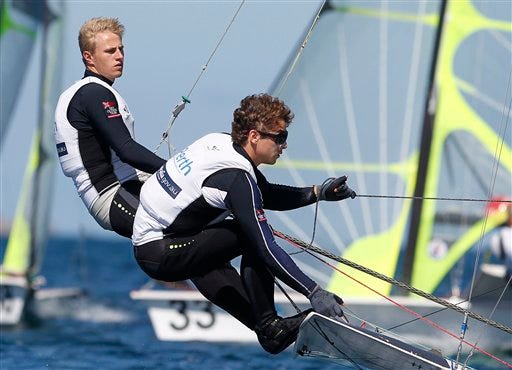
FILE - In this Dec 16, 2011 file photo, Germany's Erik Heil and Thomas Ploessel compete in the men's 49er skiff gold fleet 1 race 10 at the Sailing Championships in Perth, Australia. Heil had to be treated at a Berlin hospital for MRSA, a flesh-eating bacteria, shortly after sailing in an Olympic test event in August at Rio de Janeiro, Brazil, where tests by The Associated Press have found high contamination in waters to be used in the 2016 Olympics. (AP Photo/Theron Kirkman, File)

Olympic sailor Erik Heil floated a novel idea to protect himself from the sewage-infested waters he and other athletes will compete in during next year’s games: He’d wear plastic overalls and peel them off when he was safely past the contaminated waters nearest shore.

Heil, 26, was treated at a Berlin hospital for MRSA, a flesh-eating bacteria, shortly after sailing in an Olympic test event in Rio in August. But his strategy to avoid a repeat infection won’t limit his risk.

A new round of testing by The Associated Press shows the city’s Olympic waterways are as rife with pathogens far offshore as they are nearer land, where raw sewage flows into them from fetid rivers and storm drains. That means there is no dilution factor in the bay or lagoon where events will take place and no less risk to the health of athletes like sailors competing farther from the shore.

“Those virus levels are widespread. It’s not just along the shoreline but it’s elsewhere in the water, therefore it’s going to increase the exposure of the people who come into contact with those waters,” said Kristina Mena, an expert in waterborne viruses and an associate professor of public health at the University of Texas Health Science Center at Houston. “We’re talking about an extreme environment, where the pollution is so high that exposure is imminent and the chance of infection very likely.”

In July, the AP reported that its first round of tests showed disease-causing viruses directly linked to human sewage at levels up to 1.7 million times what would be considered highly alarming in the U.S. or Europe. Experts said athletes were competing in the viral equivalent of raw sewage and exposure to dangerous health risks almost certain.

The results sent shockwaves through the global athletic community, with sports officials pledging to do their own viral testing to ensure the waters were safe for competition in next year’s games. Those promises took on further urgency in August, after pre-Olympic rowing and sailing events in Rio led to illnesses among athletes nearly double the acceptable limit in the U.S. for swimmers in recreational waters.

Nevertheless, Olympic and World Health Organization officials have flip-flopped on promises to carry out viral testing in the wake of the AP’s July report.

Now, the AP’s most recent tests since August show not only no improvement in water quality — but that the water is even more widely contaminated than previously known. The number of viruses found over a kilometer from the shore in Guanabara Bay, where sailors compete at high speeds and get utterly drenched, are equal to those found along shorelines closer to sewage sources.

“The levels of viruses are so high in these Brazilian waters that if we saw those levels here in the United States on beaches, officials would likely close those beaches,” Mena said.

Brazilian, Olympic and WHO officials now say Brazil needs only to carry out testing for bacterial “markers” of pollution to determine water quality. That’s the standard used by nations around the globe, mostly because it’s been historically easier and cheaper.

The WHO on Wednesday said it had no comment on the AP’s latest findings.

The Rio 2016 Olympic organizing committee said in an emailed statement that “the health and safety of athletes is always a top priority and there is no doubt that water within the field of play meets the relevant standards.”

“Rio 2016 follows the expert advice of the World Health Organization, whose guidelines for Safe Recreational Water Environments recommend classifying water through a regular program of microbial water quality testing.”

However, in recent years technological advances have made it simpler and less expensive to monitor viral levels, too.

That’s why many in the scientific communities in the U.S. and Europe are pushing for legislation that would require viral testing of water. They argue that repeated studies dating back decades have shown little to no correlation between the levels of bacteria pathogens in water, which quickly break down in salty and sunny conditions like those in tropical Brazil, and the presence of viruses, which have been shown to last for months, and in some cases years.

That disparity has surfaced in AP’s testing in Rio, where the water often falls within safe levels of fecal bacteria, but the same water sample shows levels of viruses akin to raw sewage. Many of the testing points show spikes in bacterial contamination, too — especially in the Olympic lagoon and in the marina where sailors launch crafts.

Rio’s waterways, like those of many developing nations, are extremely contaminated because most of the city’s sewage is not treated, let alone collected. Massive amounts of it flow straight into Guanabara Bay. The Rodrigo de Freitas Lagoon and the famous Copacabana Beach also are heavily contaminated.

Rio won the right to host the Olympics based on a lengthy bid document that promised to clean up the city’s scenic waterways by improving sewage sanitation, a pledge that was intended to be one of the event’s biggest legacies.

Brazilian officials now acknowledge that won’t happen.

The AP’s first published results were based on samples taken along the shores of the lagoon where rowing and canoeing events will be held. Other samples were drawn from the marina where sailors enter the water and in the Copacabana Beach surf, where marathon and triathlon swimming will take place. Ipanema Beach, popular with tourists and where many of the expected 350,000 foreign visitors will take a dip during the games, was also tested.

Since then, the AP expanded its testing to include offshore sampling sites inside Olympic sailing courses in Guanabara Bay and in the middle of the lagoon where rowing and canoeing lanes were located during recent test events.

The tests found the lagoon and bay to be consistently virus-laden throughout, but it also captured a spike in the bacterial fecal coliforms in the lagoon — to over 16 times the amount permitted under Brazilian law.

Mena, the waterborne virus expert, said it makes sense for athletes to think that deeper into the bay and lagoon would be safer, but the testing doesn’t bear that out.

“One would expect to see more fluctuations with the levels of any pathogen in the water, but it’s not there,” she said.

As a result, none of the venues are fit for swimmers or boaters, she said. Athletes who ingest three teaspoons of water have a 99 percent chance of being infected by viruses.

That assessment was echoed by Brazilian virologist Fernando Spilki, coordinator of the environmental quality program at Feevale University in southern Brazil, who is conducting monthly tests for the AP.

“Samples from the sailing courses and inside the lagoon prove that the viruses are present even away from the shore, away from the sources of pollution, and that they maintain extremely high viral loads,” he said.

Athletes in Rio test events have tried many tricks and treatments to avoid falling ill, including bleaching rowing oars, hosing off their bodies the second they finish competing, and preemptively taking antibiotics — which have no effect on viruses.

Despite those efforts, athletes at a competition in August still fell ill. The World Rowing Federation reported that 6.7 percent of 567 rowers got sick at a junior championships event in Rio.

The International Sailing Federation said just over 7 percent of sailors competing at a mid-August Olympic warm-up event in Guanabara Bay fell ill — but the federation has not conducted a full count of how many athletes got sick in the two weeks following the competition, the rough incubation period for many of the pathogens in the water.

Mena and other experts say it’s difficult to put those figures into international context as each geographic location has unique threats. But in the U.S., for instance, the Environmental Protection Agency’s maximum illness rate for swimming is 3.6 percent — and many experts say that is too high.

The German sailor, Heil, was one of those who got sick at the Rio test event.

“I’ve never had infections on my legs. Never!” he wrote on the German sailing team’s blog in late August as he underwent painful treatment to scrape the infections off his hips and legs. “The origin must be the Marina da Gloria. In the future, we will try to travel to Rio right before the start of any event, so that any diseases that show up only occur when we are already back home.”

In the year preceding the Olympics, AP is examining monthly water samples for three types of human adenovirus as well as enterovirus, rotavirus and bacterial fecal coliforms. The viruses are found in human intestinal and respiratory tracts. They cause digestive illnesses including vomiting, explosive diarrhea and respiratory problems — all of which would knock athletes out of competition. Serious heart and brain disease are also possible, though rare. One type of analysis tests for adenovirus types 2 and 5, markers for the sewage contamination.

Water quality experts say a virus count hitting 1,000 per liter in the U.S. or Europe would cause extreme alarm, leading in many cases to beach closures.

Viral levels were all 30,000 times higher than what is highly alarming in the U.S. or Europe at each of the AP’s new offshore sampling sites: at a point 600 meters (yards) offshore and within the Sugarloaf sailing race course; at 1,300 meters (yards) offshore within the Naval School sailing circuit; and at a spot inside the Olympic lagoon where rowing lanes are located, about 200 meters (yards) from shore.

In September tests at the Naval School race course and offshore lagoon points, the water was positive for enterovirus, a major cause of respiratory illness, gastrointestinal ailments and, less often, serious heart and brain inflammation.

Subsequent cell culture testing showed the viruses in the lagoon water to be “active and infectious,” but the samples taken from the sailing courses in the bay were not. Mena, the risk assessment expert, said several factors inhibit viruses from growing in a laboratory, but the sheer number of pathogens in Rio’s waters means the risk to human health is unacceptable.

Rio de Janeiro state authorities promised to complete sewerage infrastructure near the Marina da Gloria by the end of this year and are making progress. Authorities say Olympic venues will then be safe.

But the high levels of sewage-linked pathogens found in the offshore sailing courses “show that these viruses don’t just come from the marina — there are many, many points where sewage enters the bay,” Spilki, the Brazilian expert, said. “These pathogens we’re looking for, especially the viruses, are able to migrate in the currents in a big way.”

Those pollution points are mostly the dozens of rivers that crisscross metropolitan Rio and dump hundreds of millions of liters of raw sewage into the bay each day. By the government’s own estimate, just half of the city’s wastewater flowing into the bay is treated.

Since the AP report in July exposed the serious risk to athletes, Olympic and World Health Organization officials have flip-flopped over whether they would carry out their own viral testing.

The WHO, which acts in an advisory role to the IOC, took four different positions on whether or not viral testing should be carried out between July and mid-October. In an Oct. 24 email, the WHO told the AP that it didn’t feel Olympic officials needed to conduct “routine” viral testing, but added that it was not “unconcerned with viral pathogens in water” and that water quality and monitoring would be discussed in Brazil once again in late November.

Mel Stewart, an American who won two swimming gold medals and a bronze at the 1992 Barcelona Games, said if his daughter were a contender in an open-water swimming competition in Rio, he would tell her not to compete.

“A gold medal is not worth jeopardizing your health,” Stewart said. “Right now there are too many questions. I don’t see safety. It doesn’t appear at this point that the athletes are being thought of first.”

___

Online:

Interactive, summary findings and methodology of AP’s study: http://ift.tt/1TtA0Yj

___

Associated Press sports writer Stephen Wade contributed to this report.

___

Brad Brooks on Twitter: http://www.twitter.com/bradleybrooks

Join the conversation about this story »

from Business Insider http://ift.tt/1N3u6IW

Posted in #UK

#UK Mark Cuban explains why downloading Snapchat is a huge mistake

//


Billionaire entrepreneur and “Shark Tank” cohost Mark Cuban stopped by the office to talk about a number of topics. In this video he explains why apps like Snapchat are not secure and how any message you send can come back to haunt you.

Snapchat’s response: Not clear on what the context is around [Mark Cuban’s statement], but when we say it’s “deletion by default” it is because it’s closer to regular conversations. You can always record a conversation, but ordinarily you wouldn’t. Snapchat is more about the social norms and expectation than secrecy. 

Mark Cuban is the creator of Cyber Dust, a private messaging app. His user name is +blogmaverick.

*This story was originally posted in June, 2015.

Produced by Joe Avella and Graham Flanagan

Follow BI Video: On Facebook

Join the conversation about this story »

from Business Insider http://ift.tt/1YIiK4q

Posted in #UK

#UK McDonald’s is offering table service and a new menu

//

McDonald's pico guac

More than 600 McDonald’s restaurants in Southern California will soon start offering table service and a new menu.

Customers will be able to order their meals at a register, then go to a table where their food will be brought to them by a McDonald’s employee, the Los Angeles Business Journal reports.

The Southern California restaurants are also planning to roll out a new menu of burgers and chicken sandwiches, the company said in a news release

The “Taste Crafted” menu will give customers the option to choose between beef, buttermilk crispy chicken, or artisan grilled chicken on a sesame seed bun, potato roll, or artisan roll.

Customers will also be able to choose between four flavor combinations: pico guacamole, buffalo bacon, maple bacon dijon, and deluxe. 

The pico guacamole combination includes guacamole, ranch sauce, white cheddar, and lettuce; the buffalo bacon includes blue cheese spread, spicy buffalo sauce, Applewood-smoked bacon, tomato, and shredded lettuce; and for a sweeter twist, maple bacon dijon offers crispy bacon with maple seasoning, grilled onions, Dijon sauce, white cheddar, and lettuce.

The deluxe combination is a classic mix of red onions, mayonnaise, lettuce and tomato.

“Consumers have told us that they are looking for variety and the ability to customize their choices. Taste Crafted Burgers and Chicken allows us to cater to our customers’ desires,” Clay Paschen III, president of McDonald’s Operators’ Association of Southern California, said in a statement. “We’re excited to bring these delicious ingredients, delectable flavors and variety to our Southern California customers.”

SEE ALSO: One of the world’s most iconic toy stores is shutting down

Join the conversation about this story »

NOW WATCH: We tried McDonald’s brand new mozzarella sticks that are going national next year

from Business Insider http://ift.tt/1OxXEmn

Posted in #UK

#UK People are outraged at a YouTube ‘prank’ showing a fake kidnapping and murder

//

sam pepper killing friend prank

A YouTube video where a young man believes he and his best friend are kidnapped — and where his best friend pretends to be murdered by a masked man — has incited outrage from thousands of people.

A YouTuber by the name of Sam Pepper decided to play a prank on a Vine user named Sam Golbach. Pepper got Golbach’s best friend Colby Brock to get in on the joke.

In the video, Golbach and Brock are seen driving down a quiet road when their car suddenly stops. When the friends get out to investigate, a masked man approaches Golbach, throws a black hood over his head, ties him up, and throws him in the trunk. 

The video then cuts to a rooftop, where Golbach and Brock are tied up in chairs next to each other. The masked man points a gun at Brock’s head, as Golbach pleads for his friend’s life. Then suddenly, the gun fires, and Golbach cries and screams in distress.

After a short while, Brock gets back up to assure his friend that’s he’s okay. But Golbach is clearly visibly shaken.

The end of the video shows Golbach a couple of days later, smiling and saying, “That was crazy. Props to you guys, that was insane.”

But YouTube fans and viewers aren’t so forgiving. They’re calling the prank “cruel,” “vile,” and “disgusting.”

We’ve reached out to Sam Pepper on Twitter but we’ve yet to hear back.

The video seems to have caught the attention of Anonymous, the international hacking collective, which claims to have posted Sam Pepper’s home address, IP address, email address, and phone number online.

Pepper’s video was first uploaded to YouTube on Sunday. As of Wednesday afternoon, the video has well over 4 million views, and a Change.org petition has been signed by over 153,000 people who are demanding YouTube deactivate Sam Pepper’s channel in light of the video.

The petition claims Pepper broke two major YouTube guidelines, including the posting of “violent or graphic content,” as well as “harmful or dangerous content.” 

Despite the backlash against this video, YouTube claims it does not break its community guidelines. Therefore, the video will remain on the site.

Meanwhile, Golbach is actually defending Pepper and his video, despite being victimized for the sake of a prank. He posted this note via Twitter:

Sam Pepper has been the center of controversy before. Last year, he uploaded a video where he appeared to pinch women from behind with a fake hand. Though six women accused him of sexual assault and the video received numerous complaints from viewers, Pepper denied those claims, saying the video was a prank and a social experiment.

Join the conversation about this story »

NOW WATCH: One of the most incredible stunts in history has inspired a generation of daredevils and outlaws on Instagram and YouTube

from Business Insider http://ift.tt/1HGC8up

Posted in #UK

#UK Mark Zuckerberg is following his peers: 6 of the 10 biggest U.S. donors made their fortunes in tech

//

Yesterday, Mark Zuckerberg announced that he would donate 99% of his Facebook shares to an “initiative” named after himself and his wife, Priscilla Chan. This group will then use the money in the name of “advancing human potential and promoting equality.” Although the group is a corporation, not a non-profit, the donation is intended to improve the world as Zuckerberg and Chan see it, rather than making profit for profit’s sake.

Zuckerberg is following a long tradition of his peers — as this chart from Statista shows, six out of the top 10 biggest charitable donors in the U.S. last year made their fortunes in the tech industry.

20151202_Donors_BI

SEE ALSO: 2015 is shaping up to be the worst year for IPOs since the 2009

Join the conversation about this story »

from Business Insider http://ift.tt/1OxRgf7

Posted in #UK

#UK Elon Musk just demanded a carbon tax in Paris (tsla)

//

Elon Musk in Paris

Tesla and SpaceX CEO Elon Musk gave a speech in Paris on Wednesday at the Sorbonne, and he called in no uncertain terms for a carbon tax.

“We have to fix the unpriced externality,” he told the audience, shifting into the wonky quasi-academic mode that he actually appears to enjoy indulging in, when he isn’t running two companies and serving as the Chairman of a third, Solar City.

His entire speech hinged on this simple observation: that the addition of carbon to the atmosphere is effectively a worldwide subsidy that’s contributing to global warming.

Musk called this a “hidden carbon subsidy of $5.3 trillion per year,” citing the IMF. In response to questions after his speech, he said that a good outcome of the current UN Climate Summit (COP21) taking place in France would be that governments “put their foot down” and use a revenue neutral, gradually applied carbon tax to accelerate the shift from an economy driven by fossil fuels to one driven by sustainable energy.

Musk is convinced that the current fossil-fuels era will end — it’s just a question of when. In his analysis, the transition will occur simply because we’ll run out of carbon-based stuff that we can dig out of the ground and burn. But the existing carbon subsidy, in his estimation, is slowing down progress. 

He called this, variously, “the dumbest experiment in history” and “madness.”

Musk in Paris Slide

Musk isn’t a newcomer to the idea of a carbon tax. He’s been calling for one for years. But the evolution of his businesses and the advent of Tesla Energy, his power-storage undertaking, appears to have sharpened his pitch.

And it’s important to note that Musk has never just been about building cars, or going to Mars, or applying solar power more widely. He has a vision for the future that uses those businesses as a means to several important ends: freedom from fossil fuels, making us “multi-planetary,” and taking better advantage of what he calls the “big fusion reactor in the sky,” the Sun.

An interesting additional aspect of his speech in Paris was his continued embrace of government as part of the solution to climate change. Some high-flying tech entrepreneurs think government is a problem and an obstacle, but Musk has never dodged the accusation that his undertakings have depended on government action and funding.

“There needs to be a clear message from government in this regard,” he said about the implementation of a carbon tax.

Musk in Paris

SEE ALSO: Elon Musk: Tax Carbon, Don’t Subsidize Electric Cars

Join the conversation about this story »

NOW WATCH: Japan is illegally hunting whales again

from Business Insider http://ift.tt/1lXKV1k

Posted in #UK