#UK ‘Erdogan and his family’ involved in oil trade with IS: Russian defence ministry

//

Turkish President Recep Tayyip Erdogan has vehemently denied that Ankara buys oil from the Islamic State group in Syria

Moscow (AFP) – Russia’s defence ministry on Wednesday accused Turkish President Recep Tayyip Erdogan and his family of involvement in illegal oil trade with Islamic State jihadists, as a dispute rages over Ankara’s downing of one of Moscow’s warplanes.

“The main consumer of this oil stolen from its legitimate owners Syria and Iraq is Turkey. According to available information, the highest level of the political leadership of the country, President Erdogan and his family, are involved in this criminal business,” deputy defence minister Anatoly Antonov told journalists. 

Ties between Turkey and Russia have shattered after Ankara shot down the jet on its border with Syria last Tuesday, with President Vladimir Putin accusing Ankara of downing the plane “to protect the oil supply lines to Turkish territory”.

Erdogan has rubbished earlier Russian claims that Turkey is involved in the illegal oil trade with groups, including IS, in Syria and Iraq, insisting he would resign if allegations were proved true. 

“Today we are presenting only part of the facts in our possession, that there is a unified team of bandits and the Turkish elite working in the region to steal oil from its neighbours,” Antonov said at the packed press conference in the defence ministry.  

“This oil enters the territory of Turkey in huge quantities, on an industrial scale along a living pipeline of thousands of oil tankers,” he said.

Antonov claimed that “terrorists in Syria” earned $2 billion from the illegal oil trade and “that is why IS so protects its thieving oil extraction infrastructure in Syria and Iraq.”

Join the conversation about this story »

from Business Insider http://ift.tt/1O3FxQI

Posted in #UK

#UK Google has been spying on students who use its Chromebooks and apps in school, claims the EFF (GOOG, GOOGL)

//

Chomebook studentGoogle has allegedly been tracking search histories and other personal information from students, says a new complaint filed by The Electronic Frontier Foundation (EFF) with the Federal Trade Commission.

The EFF claims that Google has been “collecting, maintaining, using, and sharing” data from students who use its Chromebooks in schools, and its educational apps.

Google’s “Sync” feature for Chrome is enabled by default on the Chromebooks it sells to schools, according to the EFF. “This allows Google to track, store on its servers, and data mine for non-advertising purposes, records of every Internet site students visit, every search term they use, the results they click on, videos they look for and watch on YouTube, and their saved passwords,” the EFF said in a statement.

The EFF finds this tracking particularly egregious because, in January, Google signed the “Student Privacy Pledge,” a “legally enforceable document,” which promises that the company won’t collect this type of information from students.

“Despite publicly promising not to, Google mines students’ browsing data and other information, and uses it for the company’s own purposes. Making such promises and failing to live up to them is a violation of FTC rules against unfair and deceptive business practices,” EFF Staff Attorney Nate Cardozo said. “Minors shouldn’t be tracked or used as guinea pigs, with their data treated as a profit center. If Google wants to use students’ data to ‘improve Google products,’then it needs to get express consent from parents.”

Business Insider has reached out to Google for comment.

You can read the EFF’s entire complaint here.

SEE ALSO: This Facebook ‘privacy notice’ is a hoax, and you shouldn’t bother sharing it

Join the conversation about this story »

NOW WATCH: Watch the mesmerizing way a company puts camouflage on helmets

from Business Insider http://ift.tt/1YHS0B3

Posted in #UK

#UK North Korean boats full of corpses keep showing up in Japan

//

Dozens of corpse-filled fishing boats drift by Japan every year.

Since late October alone, 11 of these boats have washed up on Japan’s shores, and 145 have drifted by between 2013 and 2014.

Many of the boats carry North Korean signs, as well as fishing equipment. North Korean defectors blame Kim Jong Un, as he makes fishermen fill demanding quotas, which force them to take their rickety boats into increasingly dangerous waters. 

Meanwhile, North Korea puts out propaganda videos about their fishing industry.

Story by Jacob Shamsian and editing by Carl Mueller

INSIDER is on Facebook:  Follow us here

SEE ALSO: Mexico sank its own Navy boat to create a tourist attraction

Join the conversation about this story »

from Business Insider http://ift.tt/1SwAUlT

Posted in #UK

#UK Goldman Sachs is over millennials — it’s time to talk about the larger and more influential ‘Gen-Z’

//

Millennials are over and it’s time to talk about Gen-Z. 

In a note to clients on Wednesday, analysts at Goldman Sachs argued that while much has been made of millennials in the media and investment community, it is actually the generation that follows millennials — who are also known as “snake people” — that matters more. 

“America’s youngest generation, ‘Gen-Z’ or those born after 1998, are now entering their formative years and rising in influence,” Goldman writes.

The firm adds:

At nearly 70 million in size and growing, the eldest of which are now entering college and/or the workforce, this cohort will soon outnumber their Millennial predecessors. Raised by Gen-X parents during a time marred by economic stress, rising student debt burdens, socio-economic tensions and war overseas, these youths carry a less idealistic, more pragmatic perspective on the world. Born device in-hand, Gen-Z is America’s first generation of true “digital-natives” and they will be America’s most diverse to-date (first to be majority non-white). Over the past several years, educators, employers, researchers, retailers and the like have spent significant time and resources dissecting the Millennial mindset. But the time has already come to focus to Gen-Z, which promises to be just as, if not more, influential. 

So I guess that’s it: millennials have had their day in the sun and now it’s over. The more important economic force of tomorrow, it seems, are toddlers with iPhones. 

Screen Shot 2015 12 02 at 9.24.28 AMIn Goldman’s view, the reason it’s time to move on from millennials is that Gen-Z simply represents a bigger, more important change in the US than millennials ever did. 

Gen-Z, for example, will be the most diverse generation to date and as a result, in Goldman’s view, “Gen-Z is not just diverse by a matter of fact, but they also hold a more positive view of the rising ethnic diversity in America than prior generations.”

Goldman adds:

Diversity for Gen-Z transcends race, gender and sexual orientation. Take fashion, for example, where “normcore” has emerged as one the prominent style trends. Bland, boring, basic and in most cases absent of brand logos, this style leans more towards blending in than standing out. And for Gen-Zers, not relying on a designer brand’s latest fashion trends to establish their identities is exactly the point. For the retailers, this presents a new challenge should this trend hold.

Financially, Goldman thinks Gen-Zers will be a more financial conservative generation, with 46% of Gen-Zers saying in a recent TD Ameritrade survey that they are worried about accruing student loan debt, something that has hamstrung many millennials (who are, in some cases, still stuck in their parents’ house instead of forming new households and starting families). 

Millennials, then, were in a lot of ways merely younger versions of their Baby Boomer parents with a little bit more digital fluency and a lot more student debt. 

And on top of all this, the simple reason Gen-Z matters more is that they will soon be a bigger generation than millennials. 

Screen Shot 2015 12 02 at 9.23.39 AM

SEE ALSO: 5 things you need to know about working with Generation Z

Join the conversation about this story »

NOW WATCH: This massive American aircraft carrier is headed to the Persian Gulf to help fight ISIS

from Business Insider http://ift.tt/1Xyis2W

Posted in #UK

#UK The 11 most influential business books of the past decade

//

jeff bezos

For the past decade, the Financial Times has been gathering a panel of judges from academia, media, Wall Street, and Silicon Valley to determine the year’s best business book.

When it started the competition in 2005, it set out to find the most insightful and entertaining book of the year, but when the financial crisis hit in 2008, the prize became more focused on what book led the most conversations that year and had the most potential for effecting change.

We’ve collected each of the winners below and explained why they were chosen.

SEE ALSO: 33 books everyone should read before turning 30

‘Rise of the Robots’ by Martin Ford

Yale bioethicist Wendell Wallach proclaimed in June that the developed world is at an “unparalleled” moment in history where technology is replacing more jobs than it creates. If we use the word “robot” as shorthand for a wide variety of machines and programs fueled by artificial intelligence, then we are in the early stages of a robot revolution.

Tech entrepreneur Martin Ford is one of the loudest voices directing attention to the issue.

In his book he takes an extensive, hard look at how the robot revolution is affecting the developed world and declares that its governments and companies need to take preemptive action to avoid a job crisis sometime in the next few decades.

Find it here >>

‘Capital in the Twenty-First Century’ by Thomas Piketty

As soon as the English translation of French economist Thomas Piketty’s 700-page investigation of income inequality came out in March 2014, it became a surprise New York Times bestseller and media staple for weeks, with passionate opinions for and against Piketty’s conclusion that inequality levels are at dangerous levels around the world.

It’s been hard to find someone without an opinion about Piketty since, and he remains a standout figure in the debate surrounding what to do about dangerously high income inequality, which is now most prominently a hot button topic for US presidential candidates, Democrat and Republican alike.

Find it here >>

‘The Everything Store’ by Brad Stone

Amazon is one of the largest companies in the world, with a market cap of roughly $322 billion, and its founder and CEO Jeff Bezos is one of the richest people in the world, with an estimated net worth of $59.4 billion.

Bezos may have started Amazon in 1994, but before journalist Brad Stone’s 2013 heavily researched book chronicled the company’s early years and the development of its intense work culture, much of it remained unknown due to Bezos’ tendency to remain tight-lipped.

Find it here >>

See the rest of the story at Business Insider

from Business Insider http://ift.tt/1NqoWKO

Posted in #UK

#UK This NFL Hall of Fame quarterback’s investment firm is on a tear

//

Steve Young

NFL Hall of Fame quarterback Steve Young is used to racking up accolades.

He’s a three-time Super Bowl champion and decorated with accomplishments from his collegiate and pro career. 

He’s also running a private equity firm that’s outperforming many of its competitors.

Young is cofounder and partner at HGGC, formerly known as Huntsman Gay Capital Partners.

HGGC closed its second fund in early 2015, raising more than $1.3 billion. The fund has already lined up some big deals, including AutoAlert, which looks to bring data analytics to the automotive market, and insurance services firm Pearl Holding Group.

Going long

Its first fund posted an internal rate of return (IRR) of 18.3% and an investment multiple of 1.7x. It raised that fund in 2008, according to CalPERS’ data. According to Cambridge Associates, which tracks the performance of private equity firms, the upper quartile, of private equity funds raised in 2008 is 1.76x for investment multiple and an IRR of about 22%. The multiple reflects how much cash a fund made compared to the investor’s initial investment. 

Put another way: Steve Young’s investment firm is matching or besting some of the leading US private equity firms, and it is only on its second fund.

Business Insider reached out to Young via e-mail, but he did not respond. 

Prior to co-founding HGGC, Young worked with private equity firms including Sorenson Capital, in Utah, and Northgate Private Equity Partners, a California fund that was launched by former NFL players Brent Jones and Tommy Vardell, among others.  

It seems Young, who is reportedly worth $40 million, is determined to keep going long after so much success on the gridiron. 

Join the conversation about this story »

NOW WATCH: What you need to know before going into business with family

from Business Insider http://ift.tt/1TuZNiS

Posted in #UK

#UK A look at Montenegro, NATO wannabe

//

PODGORICA, Montenegro (AP) — NATO is seeking to expand for the first time after six years by inviting tiny Montenegro to join the alliance. The move on Wednesday has angered Russia which has strong historic, political and cultural influence in Montenegro and is threatening economic and political retaliation. Global tensions are mirrored in Montenegro, where the people remain deeply split over whether to join the Western military alliance which bombed the country in 1999.

THE BASIC FACTS:

Montenegro — which means “Black Mountain” — is a small country in southeast Europe. It is a land of stunning natural beauty, squeezed between the Adriatic Sea and towering mountains, laced with green valleys and rushing rivers. The land area is nearly 14,000 square kilometers (5,300 square miles). Just over 600,000 people live in Montenegro, mostly in the capital Podgorica and along the coast. The economy is weak, relying largely on tourism.

RELIGION:

About 70 percent Montenegrins are Orthodox Christians, which partly explains strong links to Russia, also a predominantly Orthodox Christian country. Until recent history, Montenegro had been a faithful ally of Russia in the Balkans, so much so that it is said to have declared a war on Japan in 1904 just to support Russia in its clash with Japan. Montenegro was also a rare country in the region to have retained a level of autonomy during centuries-long Turkish Ottoman rule.

RECENT HISTORY:

Montenegro was part of the former Yugoslavia and a union with Serbia in the 20th century. As a Serbian ally, Montenegro was bombed in 1999 by NATO which launched air strike to stop a crackdown against Kosovo Albanian separatists. But, after splitting with Serbia in 2006 in a referendum, Montenegro took a strong turn toward Euro-Atlantic integration, despite Russia’s bid to retain political and economic influence. Russian companies have invested millions in Montenegro, which has also become a favorite tourism destination, and Russians have been buying property along the Adriatic sea. There is a pure Russian village on the coast and Russian-language schools were opened for their children.

WHY JOIN?

Montenegro has a small army of just some 2,000 soldiers, but it is strategically located on the Adriatic sea, between NATO members Croatia and Albania, having deep-water navy bases that could be used for big navy ships and submarines. Bringing in Montenegro to the NATO sphere further diminishes Russia’s influence in southeast Europe, and blocks it from the so-called “warm seas” in Europe. The Russians are not so much worried about the strategic military loss, but more about their diminishing political influence on the region.

WHAT’S NEXT?

Montenegrins are almost equally divided over joining NATO. Pro-Russian opposition parties are already demanding a referendum before the entry is formalized next year — mirroring demands by Russian officials. This could lead to tensions after recent anti-NATO protests in the capital Podgorica which have turned violent. Still, pro-Western Prime Minister Milo Djukanovic insists Montenegro’s invitation is good news for the country and regional stability. Montenegrin analysts believe Russia will try to finance the Montenegrin opposition ahead of the next general election scheduled for the next year, to try to unseat Djukanovic’s government before Montenegro formally becomes a NATO member.

STATISTICS:

The latest opinion poll conducted by the local Damar agency said that 47 percent of Montenegrins are in favor of the NATO bid, some 39 percent are against while 14 percent are undecided. The poll has a two percent margin of error.

___

Associated Press writers Jovana Gec and Dusan Stojanovic contributed from Belgrade, Serbia.

Join the conversation about this story »

from Business Insider http://ift.tt/1QejECL

Posted in #UK

#UK Consumer and retail news: 10 things you need to know today

//

Target Dog

1. Cyber Monday sales brought in $3 billion

Americans bought more than $3 billion worth of goods on Cyber Monday, a leading survey showed, as bigger-than-expected discounts and strong demand for electronics and toys added up to the biggest ever day for US online sales.

2. Target’s Cyber Monday sales shattered the previous record.

Demand for Cyber Monday deals was so high that Target’s website stopped working for some customers. The previous record was on Thanksgiving. The top-selling item was the Xbox One 500 GB Gears of War: Ultimate Edition bundle, according to Target.

3. Walmart reveals the best-selling items on Cyber Monday

Walmart offered more than 2,000 deals on Cyber Monday, one of the biggest online shopping days of the year. An Apple iPad Mini 2, Lego Large Creative Boxes14-foot trampolines, Xbox One and PS4 bundles, and stainless steel 6-in-1 pressure cookers with mini mitts were some of the top sellers.

4. Applebee’s and IHOP remove soda from the kids’ menu

You won’t find sugary soft drinks on the kids’ menu at Applebee’s and IHOP anymore. They’ll still be available upon request, according to a statement from the chains’ parent company DineEquity, but won’t be default option. 

5. Starbucks is recalling sandwiches after an E. coli outbreak

Starbucks has removed turkey sandwiches from more than 1,000 stores in three states following an E. coli contamination scare, the company said Tuesday. The “holiday turkey with stuffing paninis” with “enjoy-by” dates of November 27 to November 28 have been pulled from stores in California, Oregon, and Nevada

6. Coke, Visa, Adidas tell FIFA they want independent oversight

Top FIFA sponsors —Coca Cola Co., Adidas, Visa Inc., Anheuser-Busch InBev NV and McDonald’s Corp — published an open letter Tuesday urging global soccer’s governing body to enact credible reforms, days before a key meeting to finalize proposed changes to the organization. The sponsors, who typically pay about $100 million per four-year World Cup cycle, have made independent oversight of FIFA’s reform process one of their primary demands, although so far, the organization has resisted.
amazon prime air drone

7. Amazon unveils new Prime Air drone

Amazon posted new footage of its updated drone delivery intended for its Prime Air package delivery system. The new design is vastly different from the previous model and claims to increase efficiency and utility that will help it bring packages to customers in under 30 minutes for just a $1 fee.

8. Costco is becoming one of the most popular pizza chains in America by offering one huge incentive

The bulk retail giant is one of the biggest pizza chains in the US, thanks to its food court business that sells slices for only $1.99. With 482 domestic locations, the vast majority of which have food courts, the retailer is the 14th largest pizza chain in the country.

9. The 100 best restaurants in America, according to OpenTable

OpenTable just released their picks for the Best Restaurants in America for 2015. To compile the ranking, OpenTable pored over more than five million restaurant reviews submitted by verified OpenTable diners for 20,000 restaurants, covering all 50 states and Washington DC.

10. The 10 worst ads of 2015

Every year, no matter how sophisticated the advertising industry is, there are still some classic examples of ill-advised “badvertising.” While such howlers are usually reserved for small or local businesses with tiny budgets and little creative counsel, our rogues’ gallery is largely made up of major-spending advertisers that are household names.

Disclosure: Jeff Bezos is an investor in Business Insider through his personal investment company Bezos Expeditions.

FOLLOW US: On Twitter

Join the conversation about this story »

NOW WATCH: This Black Friday brawl over a vegetable steamer is so outrageous, it has to be fake

from Business Insider http://ift.tt/1SwAR9J

Posted in #UK

#UK UN to issue final report on Iran’s alleged nuke weapons work

//

VIENNA (AP) — The UN atomic agency is set to issue its final report on allegations that Iran worked in the past on nuclear arms — a summary that will likely be inconclusive.

The report, expected later Wednesday, is significant because it is linked to the lifting of sanctions on Tehran over its nuclear program.

Yukiya Amano, the head of the UN’s International Atomic Energy Agency, has already said that his report won’t be “black and white.”

But he must present a final report that says Iran has met all deadlines in supplying information requested by the IAEA for the agency’s 35-nation board to approve closure of the nearly decade-long investigation.

The procedure is linked to sanctions relief under the July 14 nuclear deal between Iran and six world powers.

Join the conversation about this story »

from Business Insider http://ift.tt/1O3BjZw

Posted in #UK

#UK Wall Street’s getting crushed by a form of financial engineering you’ve probably never heard of

//

Leon Cooperman

On August 6, billionaire hedge fund manager Leon Cooperman took the unusual step of dialing in to an earnings call for one of his fund’s holdings and asking a question.

It was a second-quarter earnings call for SunEdison, a solar-energy company that went public in 1995. At the time, Omega was the 11th-biggest shareholder of SunEdison with 8.8 million shares.

It’s a large stake, but it is still unusual for Cooperman to pick up the phone to publicly ask a question on a company’s quarterly conference call.

These were no ordinary circumstances, however. After enjoying the benefits of a classic Wall Street hedge fund pile-in, when the smartest money in the stock market wants nothing more than to buy, buy, buy, SunEdison was crashing.

Cooperman wanted to know if its executives would throw him and other investors a bone and buy back some stock. They responded, in no uncertain terms, that they would not.

Since that call, SunEdison’s stock has fallen a further 80%. Its two subsidiaries, TerraForm Global and TerraForm Power, have seen their stocks fall 64% and 73%, respectively. There have been management shake-ups at both the subsidiaries.

The stock price collapses have burned some of the biggest investors in the business, including Cooperman, David Einhorn of Greenlight Capital and David Tepper of Appaloosa Management.

And it is all because of doubts over a type of financial engineering which fueled explosive growth in the solar sector for two years, and now has investors questioning the entire sector.

What’s a yieldco?

The shift in fortunes has been brutal. At an event in October last year, David Einhorn of Greenlight Capital called SunEdison a well‐run, financially savvy company, benefiting from an open-ended growth opportunity trading at a bargain price.”

He priced the stock at $32 a share. It’s now trading at about $3.

The “open-ended growth opportunity” Einhorn was referring to is made possible by something called a “yieldco.” It’s the magical instrument that fueled SunEdison’s growth and caught Wall Street’s eye in the first place.

David Einhorn speaks at the Sohn Investment Conference in New York, May 8, 2013.  REUTERS/Brendan McDermid A yieldco is a little like a real-estate investment trust or a master limited partnership. They are created by a parent company and bundle long-term operating assets together, with these cash flows paid out in dividends.

Solar manufacturers created yieldcos as separate entities that would buy up the solar projects manufacturers built in “drop-down transactions.”

SunEdison has two yieldcos, TerraForm Power and TerraForm Global. The parent company owns a majority stake in both companies. There are eight publicly traded yieldcos in North America in total.

The appeal for the parent company is that, in hiving off the operational assets that have predictable cash flows because of long-term contracts, they reduce their own cost of financing.

The appeal for investors is in the name: These are yield companies. Having a public company with supposedly secure cash flows delivering 4% or 5% in the shape of dividends is attractive in a low-interest-rate environment.

This was supposed to be a sleepy little bet. It was supposed to be like landing on the Electric Company in Monopoly, or buying JP Morgan stock after 2012. Shareholders got fat and happy on promises of growth and consistent dividend payouts.

With this story in hand, yieldcos became the belle of Wall Street’s ball in 2014. Over the course of 2013 and 2014, 15 yieldcos went public raising $12 billion in capital according to Bloomberg. Then in early 2015, the Global Yieldco Index, an ETF, was created.

The ETF never really got a chance to shine before the crash on July 20, though. That’s when this whole entire theory was put to the test.

The accidental reveal

On July 20 SunEdison bought Vivint.

Vivint is the second-largest installer of residential solar panels in the US. SunEdison financed the deal with debt and by selling $922 million of assets to TerraForm Power.

SUNE 6 months chartThe deal marked a shift for SunEdison, which had previously focused on bigger public projects with more trustworthy counterparties. Going into residential solar panels marked a departure for the firm, and led Wall Street to start asking questions. 

“This deal sparked concerns about the quality of underlying cash flows, the premiums being paid for portfolios, and underlying discounted cash flow assumptions,” said UBS in a recent note.

That’s when the stock started to swan dive.

It was around this time that SunEdison took TerraForm Global public. The IPO disappointed. The market priced 45.5 million shares of TerraForm Global at $15 a share, rather than the 56.6 million shares priced at $19-$21 a share SunEdison had sought.

And then a few weeks later, third-quarter earnings disappointed as well.

One key thing to realize here is that it is the parent solar manufacturers that are most vulnerable.

That’s because, as Marathon Capital LLC argued in a recent report, yieldcos have their power purchase agreements and 15 gigawatts of power plants worth $35 billion. The parents, on the other hand, have lots of costs and not much revenue.

“SunEdison still believes in the value of the yieldco model,” a representative told Business Insider by email. “The long term contracted cash flows with no fuel risk and strong creditworthy counterparties are attractive to our investors.”
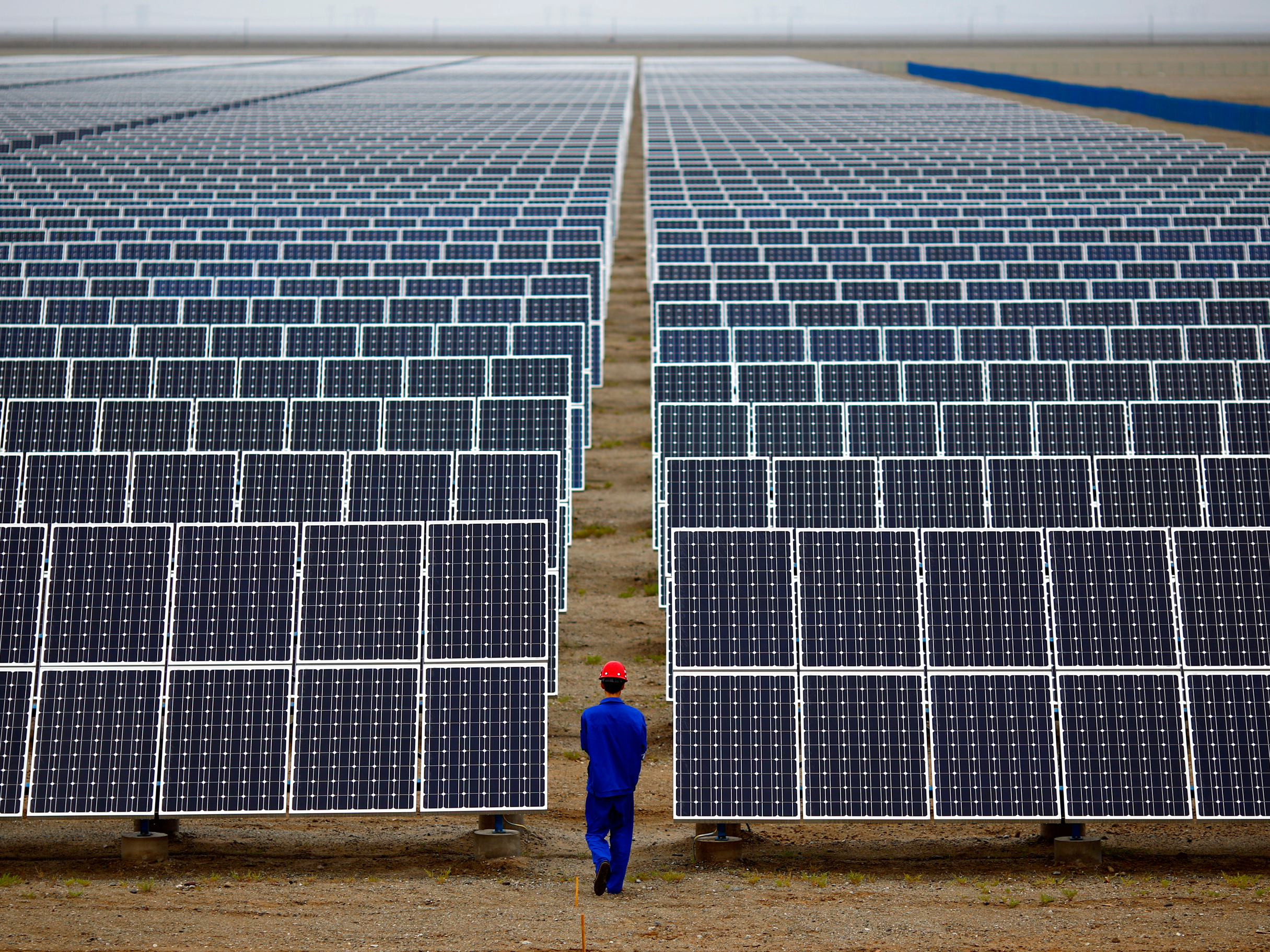
solar energy panels

The SunEdison stock kept falling through September. Then in October the company called an off-cycle conference call and lowered guidance. It also said it was going to stop making drop-down deals through 2016 and would focus on cutting costs. Investors clamored for third-party sales outside the yieldco structure.

November was chaos as more information about SunEdison’s financials hit the Street. Cash commitments were disclosed. Third-quarter earnings showed thinning margins. Things started happening really fast.

  • Analysts at CreditSights noted that SunEdison changed the classification of $700 million worth of debt from “non-recourse” to “recourse.” That meant that lenders could seek financial damages if SunEdison defaults on the debt.
  • SunEdison and Terraform Power did a major conflicts committee board shakeup, and TerraForm Power’s CEO and CFO were replaced with executives tied to SunEdison. Specifically, former SunEdison CFO Brian Wuebbles became CEO of both yieldcos and a SunEdison board member, Peter Blackmore, became Chairman of the companies.
  • SunEdison entered into a transaction with its Global YieldCo and paid off some money it owed to TerraForm Power.

But none of it helped. The stock is still trading below $4. Investors are still asking questions. UBS recently cut its price target from $14 a share to $6 a share. And now SunEdison has gone back to saying that it will in fact do drop-down transactions in 2016.

When asked about this reversal from a strong commitment to seeking third-party deals, a SunEdison spokesperson pointed Business Insider to a statement from Emmanuel Hernandez, SunEdison’s executive chairman.

He said that “the company would focus on the organic development opportunities that lie ahead in order to deliver value for shareholders.”

Good to know.

It also good to know that two TerraForm Power board members resigned three days before SunEdison announced the yieldco’s board and executive shakeup.

Both letters had basically the same language:

I am resigning from the Board of Directors of both the above referenced companies effective immediately.

The respective Conflicts Committees, as constituted before today, together with independent advisors, had been working hard and in good faith to protect the interests of the stockholders of the two companies.

As a result of today’s actions of each of the Boards, I don’t believe I will be able to do so going forward and therefore resign.

The letters were dated November 20, and disclosed in a government filing on November 27. That was the day after Thanksgiving, or Black Friday.

Make someone (un)happy, and you’ll be (un)happy too

On Tuesday, billionaire investor David Tepper, who has a stake in TerraForm Power (TERP), sent out a rare public letter to the company’s board. In it, he accused SunEdison of unloading low-grade assets onto TerraForm Power, and stacking the board with loyalists who would do its bidding.

David TepperHe cited the Vivint acquisition, among other deals, as proof of the former. His closing statement may or may not have been a warning.

As previously suggested, substantial further disclosures are incumbent on TERP so that investors can assess the full impact of the pending transactions, the relationship between TERP and its ‘Sponsor,’ and the circumstances surrounding the changes in TERP’s management and Board,” Tepper wrote in closing.

“We look forward to such disclosures and stand ready to meet and discuss any of the issues raised by this letter. In the meantime, we expect the Board and the Conflicts Committee to respect and defend the integrity of TERP’s corporate identity and the interests of its stakeholders. We reserve all rights accordingly.”

In other words, do your job protecting shareholders or we’ll do it for you.

Join the conversation about this story »

NOW WATCH: The secrets of Wall Street: slavery, terrorism, and hidden vaults

from Business Insider http://ift.tt/1OxfDtc

Posted in #UK