#USA Siilo injects $5.1M to try to transplant WhatsApp use in hospitals

//

Consumer messaging apps like WhatsApp are not only insanely popular for chatting with friends but have pushed deep into the workplace too, thanks to the speed and convenience they offer. They have even crept into hospitals, as time-strapped doctors reach for a quick and easy way to collaborate over patient cases on the ward.

Yet WhatsApp is not specifically designed with the safe sharing of highly sensitive medical information in mind. This is where Dutch startup Siilo has been carving a niche for itself for the past 2.5 years — via a free-at-the-point-of-use encrypted messaging app that’s intended for medical professions to securely collaborate on patient care, such as via in-app discussion groups and being able to securely store and share patient notes.

A business goal that could be buoyed by tighter EU regulations around handling personal data, say if hospital managers decide they need to address compliance risks around staff use of consumer messaging apps.
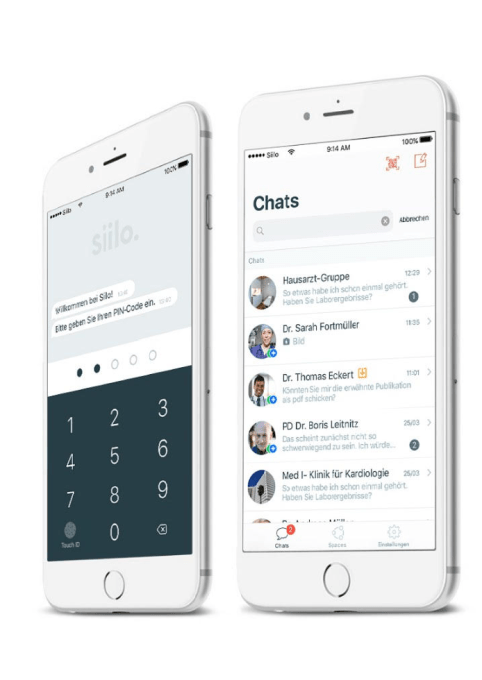
The app’s WhatsApp-style messaging interface will be instantly familiar to any smartphone user. But Siilo bakes in additional features for its target healthcare professional users, such as keeping photos, videos and files sent via the app siloed in an encrypted vault that’s entirely separate from any personal media also stored on the device.

Messages sent via Siilo are also automatically deleted after 30 days unless the user specifies a particular message should be retained. And the app does not make automated back-ups of users’ conversations.

Other doctor-friendly features include the ability to blur images (for patient privacy purposes); augment images with arrows for emphasis; and export threaded conversations to electronic health records.

There’s also mandatory security for accessing the app — with a requirement for either a PIN-code, fingerprint or facial recognition biometric to be used. While a remote wipe functionality to nix any locally stored data is baked into Siilo in the event of a device being lost or stolen.

Like WhatsApp, Siilo also uses end-to-end encryption — though in its case it says this is based on the opensource NaCl library

It also specifies that user messaging data is stored encrypted on European ISO-27001 certified servers — and deleted “as soon as we can”.

It also says it’s “possible” for its encryption code to be open to review on request.

Another addition is a user vetting layer to manually verify the medical professional users of its app are who they say they are.

Siilo says every user gets vetted. Though not prior to being able to use the messaging functions. But users that have passed verification unlock greater functionality — such as being able to search among other (verified) users to find peers or specialists to expand their professional network. Siilo says verification status is displayed on profiles.

“At Siilo, we coin this phenomenon ‘network medicine’, which is in contrast to the current old-­fashioned, siloed medicine,” says CEO and co-founder Joost Bruggeman in a statement. “The goal is to improve patient care overall, and patients have a network of doctors providing input into their treatment.”

While Bruggeman brings the all-important medical background to the startup, another co-founder, Onno Bakker, has been in the mobile messaging game for a long time — having been one of the entrepreneurs behind the veteran web and mobile messaging platform, eBuddy.

A third co-founder, CFO Arvind Rao, tells us Siilo transplanted eBuddy’s messaging dev team — couching this ported in-house expertise as an advantage over some of the smaller rivals also chasing the healthcare messaging opportunity.

It is also of course having to compete technically with the very well-resourced and smoothly operating WhatsApp behemoth.

“Our main competitor is always WhatsApp,” Rao tells TechCrunch. “Obviously there are also other players trying to move in this space. TigerText is the largest in the US. In the UK we come across local players like Hospify and Forward.

“A major difference we have very experienced in-house dev team… The experience of this team has helped to build a messenger that really can compete in usability with WhatsApp that is reflected in our rapid adoption and usage numbers.”

“Having worked in the trenches as a surgery resident, I’ve experienced the challenges that healthcare professionals face firsthand,” adds Bruggeman. “With Siilo, we’re connecting all healthcare professionals to make them more efficient, enable them to share patient information securely and continue learning and share their knowledge. The directory of vetted healthcare professionals helps ensure they’re successful team­players within a wider healthcare network that takes care of the same patient.”

Siilo launched its app in May 2016 and has since grown to ~100,000 users, with more than 7.5 million messages currently being processed monthly and 6,000+ clinical chat groups active monthly.

“We haven’t come across any other secure messenger for healthcare in Europe with these figures in the App Store/Google Play rankings and therefore believe we are the largest in Europe,” adds Rao. “We have multiple large institutions across Western-Europe where doctors are using Siilo.”

On the security front, as well flagging the ISO 27001 certification it has for its servers, he notes that it obtained “the highest NHS IG Toolkit level 3” — aka the now replaced system for organizations to self-assess their compliance with the UK’s National Health Service’s information governance processes, claiming “we haven’t seen [that] with any other messaging company”.

Siilo’s toolkit assessment was finalized at the end of Febuary 2018, and is valid for a year — so will be up for re-assessment under the replacement system (which was introduced this April) in Q1 2019. (Rao confirms they will be doing this “new (re-)assessment” at the end of the year.)

As well as being in active use in European hospitals such as St. George’s Hospital, London, and Charité Berlin, Germany, Siilo says its app has had some organic adoption by medical pros further afield — including among smaller home healthcare teams in California, and “entire transplantation teams” from Astana, Kazakhstan.

It also cites British Medical Journal research that found that of the 98.9% of U.K. hospital clinicians who now have smartphones, around a third are using consumer messaging apps in the clinical workplace. Persuading those healthcare workers to ditch WhatsApp at work is Siilo’s mission and challenge.

The team has just announced a €4.5 million (~$5.1M) seed to help it get onto the radar of more doctors. The round is led by EQT Ventures, with participation from existing investors. It says it will be using the funding to scale­ up its user base across Europe, with a particular focus on the UK and Germany.

Commenting on the funding in a statement, EQT Ventures’ Ashley Lundström, a venture lead and
investment advisor at the VC firm, said: “The team was impressed with Siilo’s vision of creating a secure global network of healthcare professionals and the organic traction it has already achieved thanks to the team’s focus on building a product that’s easy to use. The healthcare industry has long been stuck using jurassic technologies and Siilo’s real­time messaging app can significantly improve efficiency
and patient care without putting patients’ data at risk.”

While the messaging app itself is free for healthcare professions to use, Siilo also offers a subscription service to monetize the freemium product.

This service, called Siilo Connect offers organisations and professional associations what it bills as “extensive management, administration, networking and software integration tools”, or just data regulation compliance services if they want the basic flavor of the paid tier.

from Startups – TechCrunch https://ift.tt/2BYF3Ab
#USA Forward Health, the healthcare messaging app, scores $3.9M led by Stride.VC

//

Forward Health, the U.K. startup that has built an app to help healthcare professionals communicate in a secure and compliant way, has picked up $3.9 million in seed funding.

Leading the round is Stride.VC, the new VC fund from Fred Destin, formerly a Partner at Accel, and Harry Stebbings, producer of the “The Twenty Minute VC” and most recently Entrepreneur-in-Residence at VC firm Atomico.

Additional backing comes from Albion Capital, while Forward already boasts a decent array of angel investors. They include health tech founders Jay Desai from U.S. company Patient Ping, and Melissa Morris from U.K.-based Lantum.

Founded in 2016 by U.K. doctors Barney Gilbert and Lydia Yarlott, with serial entrepreneur Philip Mundy (who previously founded Goodlord), Forward Health is a messaging app and broader communications platform designed for healthcare professionals, particularly those working in hospitals.
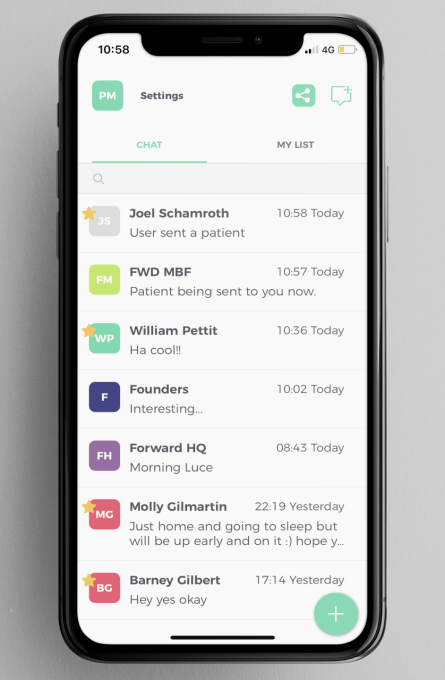
One overly simple way to think of it is as a “WhatsApp for doctors,” helping to wean healthcare professionals off of using the popular messaging app professionally, which is entirely unsuited for a regulated industry like healthcare. However, the bigger vision is to “connect healthcare systems around the world” by improving clinician-to-clinician (and potentially clinician-to-patient) communication and information-sharing with a platform that is built from the get-go to be secure, flexible and compliant.

“Healthcare communication is incredibly fragmented,” Forward Healthcare’s Mundy tells me. “This has a direct impact on how well clinicians can do their jobs and the level of care patients receive. Currently, doctors and nurses working within the NHS have to rely on an outdated and inefficient combination of pagers, landlines, switchboards and fax machines to contact each other. This 1960s infrastructure wastes huge amounts of time and can lead to critical delays in information flow”.

It is in this context that clinicians have resorted to alternative methods of communication, such as WhatsApp, which Mundy rightfully says are not fit for purpose and pose real risks.

“Any communication of this kind needs to support the exchange of highly sensitive patient information, any app used needs to be NHS digital compliant, GDPR compliant and operate within the highest levels of data security,” he explains. “WhatsApp and others don’t do this, meaning individual doctors could be liable should patient data be sent to the wrong contact or thread. Additionally, an app such as Forward is designed by and for doctors, meaning it can perform in just the right way”.

In Forward’s case, that means offering an in-app directory of healthcare professionals who work within the same hospital so that it is possible to message colleagues even if you don’t know their number, “safe exchange of information and images”, the ability to create task lists, and a way of ensuring everyone involved with a patient’s care “is on the same page and working from the same information”. The latter includes the ability for clinicians to share patient cards, akin to a mini electronic health record, on a need-to-know basis.

To that end, the Forward app is GDPR compliant, NHS IG Toolkit Certified, and meets the GMC’s confidentiality guidelines. Clinicians must have an approved NHS or Trust email address to log into the app. Over the last year it has been piloted with a community of 5,000 doctors across five partner hospitals.

In a call with Harry Stebbings — who led the round on behalf of Stride and whom I promised not to refer to as a podcaster-turned-VC (sorry, Harry, I’m a terrible person!) — he told me that Forward Health’s mission resonated with him personally due to his first-hand experience of how doctors communicate and share information in the NHS. It is quite well-known that Stebbings’ mother has MS, while more recently his father suffered a heart attack.

“I knew healthcare communication was broken when, post my father’s heart attack, they faxed his ECG scans,” he says, aghast.

When he was introduced to the Forward Health team, Stebbings says he already understood the problem. But, more so, he looks for founder-market fit and believes the Forward founders are extremely well-placed to solve this particular problem, with the right mixture of healthcare and product backgrounds.

He says that another thing that has impressed him is the bottom-up growth that the Forward app has garnered, which we both agree is a little reminiscent to how business social network Yammer originally penetrated corporations. This sees healthcare professionals download the app and sign up using their NHS email address, without the need for a central diktat. They then typically encourage colleagues to do the same, which creates further network effects. This viral growth is also benefiting from the current career path of junior doctors, who, as part of their training, move from hospital to hospital and in turn spread use of the Forward app.

Adds Mundy: “The last year has not only furthered our aims to help thousands of doctors and nurses avoid using pagers and WhatsApp, but it’s also shown us the scale of the clinical communication problem. It’s an issue at every level of healthcare, from A&E to community services, and affects all clinicians and every patient. With this capital, we’ll be able to work with even more clinicians across the UK to identify their challenges and expand our product to help solve them. We believe our current offering is just the start of what our platform is set to become”.

from Startups – TechCrunch https://ift.tt/2E1xziu

#USA Overstock’s investment arm funded blockchain for wine

//

Of all the things to add to the blockchain, wine makes a lot of sense. Given the need for provenance for every grape and barrel, it’s clear that the ancient industry could use a way to track ingredients from farm to glass. VinX, an Israeli company founded by Jacob Ner-david, is ready to give it a try.

According to a release, the plan is to create a “token-based digital wine futures platform based on the Bordeaux futures model” that lets you track wine from end to end “at a cost bearable to the industry.”

Investment banker Gil Picovsky joined Ner-david to build out the service.

“I was relating to Gil my frustrations with the way most wine is sold, and I had some early thoughts around using blockchain and tokens to radically remake the wine industry,” said Ner-david. “Together Gil and I developed the core concepts of VinX, and started to actively devote ourselves full time to VinX in November 2017.”

“VinX is democratizing the capital structure of the wine industry by bringing consumers in direct contact with producers early in the wine-making cycle,” said Ner-david. “We are riding the wave of direct-to-consumer. In addition, because we are registering all wine futures as tokens on a blockchain, we are bringing a powerful validating force that will go a long way toward reducing fraud.”

Overstock’s investment arm, Medici Ventures, is not reporting how much cash they are dumping into VinX but the company claims that “it is a seven-figure investment.”

The tool will help reduce the rate of fakery in winemaking. Experts estimate that 20 percent of all wine in the world is counterfeit. VinX will follow individual bottles from filling to drinking, ensuring a bottle is real.

Ner-david is also the co-founder of Jezreel Valley Winery, a boutique winery in Israel.

“We want to use modern technologies, including blockchain and tokening assets, in bringing consumers in direct contact with wineries around the world, humanizing the connection, and leaving more value in the hands of wineries and wine lovers,” he said.

from Startups – TechCrunch https://ift.tt/2PbhtEd

#USA Rylo scores $20 million for its clever camera tech

//

You may recall Rylo from this time last year, when the imaging startup launched a creative take on the 360 camera. The company’s been fairly quiet in the six months since it launched some new software tricks, but a new round of funding should help the company take some key steps toward spreading the gospel.

This week, Rylo announced that it has secured a $20 million Series B, led by Icon Ventures. That brings its total up to $35 million, with help from Accel Partners and Sequoia Capital. Plans for the funding are pretty much what you’d expect.

“Securing Series B funding from this excellent group of investors will allow us to maximize our potential for growth and earn significantly more market share,” CEO Alex Karpenko said in a release tied to the news. “We have come a long way since our launch one year ago, and I’m excited to continue to drive Rylo’s growth through investments in marketing, sales and retail partnerships in the coming year.”

Rylo’s camera represents an interesting piece of tech that utilizes 360 videos to create some unorthodox camera tricks like stabilizing images, following subjects and creating a number of interesting effects. The product also has solid distribution with more than 500 retail locations in the U.S., including Best Buy.

Marketing, however, is going to be a be key for the success of the $499 camera, whose initial appeal is not as immediately apparent as the likes of GoPro.

from Startups – TechCrunch https://ift.tt/2zRFzi0

#USA Former Uber exec Andrew Chapin takes the wraps off his stealth mental health startup

//

One can only imagine what it was like to work at Uber in the years leading up to Susan Fowler’s infamous blog post. Many of the company’s leaders were said to be overly competitive, sexist and inappropriate — “brilliant jerks,” as Arianna Huffington once said, — and its over-arching “move fast and break things” mentality hardly left room for employees to take a step back and reflect on how the company’s culture was impacting their mental health.

Andrew Chapin joined Uber in 2011 as one of its first hires in New York. He worked his way up to head of vehicle solutions and established Uber’s vehicle finance program, which helps drivers obtain and pay off car leases. He says the struggles within the company gave him severe anxiety, something he was all too familiar with from his stint as a commodities trader at Goldman Sachs.

“There were days when I was walking through lower Manhattan and thinking if I got hit by a car and was in the hospital for a week, it’d be better than going to work,” Chapin told TechCrunch.

At both Goldman and Uber, Chapin would go through rough patches but resisted therapy, in part because of the outlandish costs but mostly because of the hassle. Toward the end of his five-year Uber tenure, he realized the dire need for accessible and flexible tech-enabled tools to help workers endure stressful times, as well as the need to destigmatize the mental health issues prevalent within the tech industry and beyond.

In late 2016, he left Uber to build his own startup. Two years later, he’s ready to share what he’s been working on. Basis, an app meant to help people cope with anxiety, depression and other mental health issues through guided conversations via chat or video, is emerging from stealth today with a $3.75 million investment led by Bedrock. Wave Capital and Lightspeed Venture Partners have also participated in the round.

“Looking back at the Goldman experience of just kind of wallowing in this unpleasant situation, [Basis] would have been an outlet to talk through things and feel lighter,” Chapin said. “At the time, I bottled it up. In retrospect, if I had something to work me through the emotions I was dealing with, it would have been really helpful.” 

In the app, users can schedule 45-minute phone calls with unlicensed providers for $35. Because Basis works with paraprofessionals — people trained in research-backed approaches but who don’t have the same certifications as a counseling or clinical psychologist — it’s a much cheaper alternative to paying for a therapist. The startup does not give diagnoses or write prescriptions.

Chapin built the app with co-founder and chief science officer Lindsay Trent, a former research psychologist at Stanford who’d grown tired of watching trained psychologists charge outlandish fees and was hungry for an innovative solution to today’s mental health crises.

“I saw a real gap between what we knew was effective and what people actually received,” Trent told TechCrunch. “Clinicians that are charging $300 a session are not providing optimal care. It’s very frustrating for me.”

Basis provides six pathways: Work, Social, School, Finances, Relationships and Parenting. Within each, users can get same-day access to specialists who they can opt to see on a regular basis or just once.

The idea is that Basis fits into your life much like a SoulCycle class or a call with your best friend — on your terms.

from Startups – TechCrunch https://ift.tt/2OySeP0

#USA See you in Vancouver tonight

//

We’ve finalized the Vancouver micro meetup tonight. We’ll be holding it at Hootsuite HQ on 5, East 8th Ave at 7pm on October 4. Extra special thanks to the folks at Hootsuite for helping out.

You must RSVP here so we know how many are attending. I’ve already picked ten companies to pitch so if you haven’t been notified please come and support your friends.

Since there will be no booze at the event we’ll have an extra special drinkathon at 9pm at a bar of your choosing. I’m open to suggestions.

N.B. – Yes, I know that’s not Vancouver. Just wanted to see if you were paying attention.

from Startups – TechCrunch https://ift.tt/2yhvAjN

#USA Circle Invest lets you buy cryptocurrency collections

//

With Circle Invest, Circle has been trying to make it as easy as possible to get started with cryptocurrency trading. And the company wants to go one step further with collections of multiple tokens.

When it first launched, Circle Invest was pretty straightforward. You could download an app, sign up and buy Bitcoin, Bitcoin Cash, Ethereum, Ethereum Classic and Litecoin in just a few taps.

But the company then started adding more coins. And if you’re new to the cryptocurrency industry, it’s hard to understand the difference between Ethereum and Ethereum Classic if you weren’t looking at the market when the fork happened.

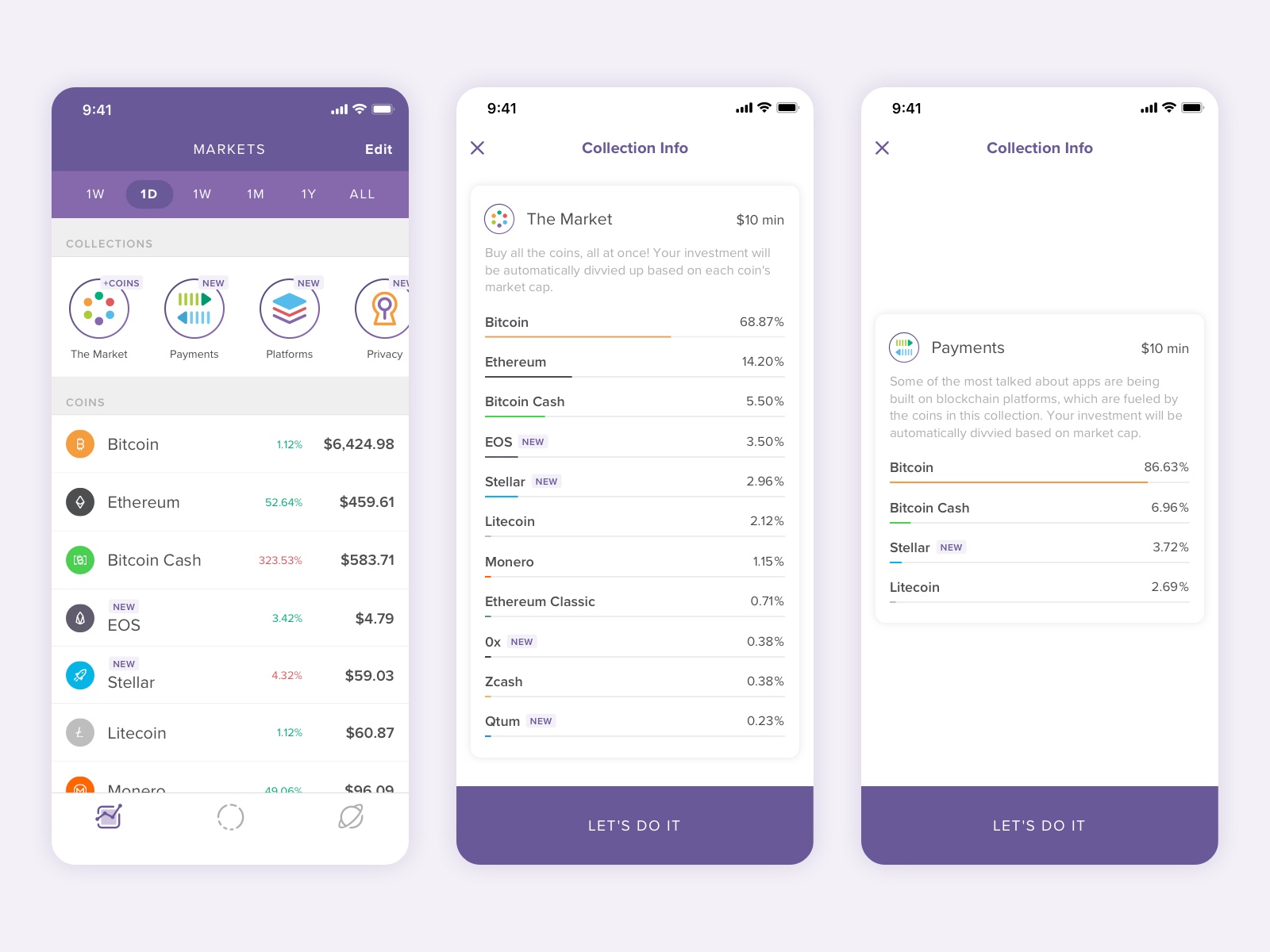
That’s why Circle introduced a feature called “buy the market”. In one tap, you can buy all the coins on Circle Invest, weighted depending on their respective market capitalization. For instance, the total market capitalization of Bitcoin is much higher than the market cap of Monero. So you’ll end up with a lot of bitcoins.

30 percent of Circle Invest users are using this feature. People who buy this package probably don’t invest as much as users who build their own portfolio, so it might not be 30 percent of Circle Invest’s transaction volume.

Coinbase recently introduced a similar feature called bundles. In just a few taps, you can purchase all the coins on Coinbase. Of course, both Coinbase and Circle Invest provide a limited selection of coins. But it’s clear that they both want to list more assets in the future.

With collections, you can buy a subset of the tokens available on Circle Invest. There are three packages for now — Platforms, Payments and Privacy. For instance, you’ll find Bitcoin, Bitcoin Cash, Stellar and Litecoin in the Payments collection. Once again, collections are weighted by market cap.

from Startups – TechCrunch https://ift.tt/2O8N5Op

#USA JFrog lands $165 M investment as valuation jumps over $1 billion

//

JFrog wants to change the way we deal with software updates. Instead of large numbered updates you have to manually download, it sees a future of continuous delivery where software is delivered as binaries and updated in the background. Investors must like that vision very much because they showered the company with a $165 million Series D investment today, which the company reports pushes its valuation past the billion dollar mark.

The round was led by Insight Venture Partners, and as part of the deal Insight’s co-founder and managing director, Jeff Horing will be joining the JFrog board. Other investors joining the round included new investors and Silicon Valley Funds, Spark Capital and Geodesic Capital, as well as existing investors Battery Ventures, Sapphire Ventures, Scale Venture Partners, Dell Technologies Capital and Vintage Investment Partners. Today’s investment pushes the total invested to-date to over $226 million.

What the company has done to justify this kind of investment is offer a series of products that enable customers to deliver code in the form of binaries. That in turn allows them to deliver updates on a regular basis in the background without disturbing the user experience. In a world of continuous delivery, this approach is essential. You couldn’t deliver multiple updates a day if you had to take down your service every time you did it.

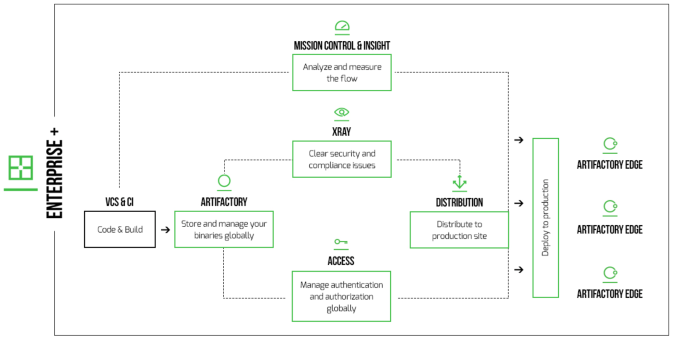
The JFrog platform is actually made up of multiple products, but the main one is JFrog Artifactory where companies can add the latest binaries (updates) and deliver them to customers in the background. It’s not unlike, GitHub, but whereas GitHub is a repository for downloading software and updates, the Artifactory is a place to deliver these updates automatically without user involvement. It also handles other DevOps functions like security, access control and distribution.

JFrog product flow

JFrog platform. Diagram: JFrog

CEO and co-founder Shlomi Ben Haim was happy to reveal that the company’s valuation had entered unicorn territory, but he wasn’t willing to share an exact number. “I don’t want to get into details, but we exceeded the billion dollar valuation. We are north of $1 billion already and we are building the company to generate the revenue to justify it,” he told TechCrunch.

He wasn’t discussing specific revenue numbers, but reports the company has a goal of a billion dollars in revenue by 2025, and he says they are working toward that. He did say they have had 500 percent revenue growth since the $50 million round in 2016, and that they tripled the number of employees to 400, while doubling the number of products they offer. They currently have 4500 customers including 70 percent of the Fortune 100.

So fair to say things are going well for the company. Ben Haim says the ultimate goal for the company is to deliver software in the background for scenarios like your operating system or your Tesla. Instead of shutting down your car or computer for the next software update, it will just happen over the air in the background. We are obviously a ways from fulfilling that vision, but investors are clearly betting on that potential.

from Startups – TechCrunch https://ift.tt/2OHyU2h

#USA JFrog lands $165 M investment as valuation jumps over $1 billion

//

JFrog wants to change the way we deal with software updates. Instead of large numbered updates you have to manually download, it sees a future of continuous delivery where software is delivered as binaries and updated in the background. Investors must like that vision very much because they showered the company with a $165 million Series D investment today, which the company reports pushes its valuation past the billion dollar mark.

The round was led by Insight Venture Partners, and as part of the deal Insight’s co-founder and managing director, Jeff Horing will be joining the JFrog board. Other investors joining the round included new investors and Silicon Valley Funds, Spark Capital and Geodesic Capital, as well as existing investors Battery Ventures, Sapphire Ventures, Scale Venture Partners, Dell Technologies Capital and Vintage Investment Partners. Today’s investment pushes the total invested to-date to over $226 million.

What the company has done to justify this kind of investment is offer a series of products that enable customers to deliver code in the form of binaries. That in turn allows them to deliver updates on a regular basis in the background without disturbing the user experience. In a world of continuous delivery, this approach is essential. You couldn’t deliver multiple updates a day if you had to take down your service every time you did it.

The JFrog platform is actually made up of multiple products, but the main one is JFrog Artifactory where companies can add the latest binaries (updates) and deliver them to customers in the background. It’s not unlike, GitHub, but whereas GitHub is a repository for downloading software and updates, the Artifactory is a place to deliver these updates automatically without user involvement. It also handles other DevOps functions like security, access control and distribution.

JFrog product flow

JFrog platform. Diagram: JFrog

CEO and co-founder Shlomi Ben Haim was happy to reveal that the company’s valuation had entered unicorn territory, but he wasn’t willing to share an exact number. “I don’t want to get into details, but we exceeded the billion dollar valuation. We are north of $1 billion already and we are building the company to generate the revenue to justify it,” he told TechCrunch.

He wasn’t discussing specific revenue numbers, but reports the company has a goal of a billion dollars in revenue by 2025, and he says they are working toward that. He did say they have had 500 percent revenue growth since the $50 million round in 2016, and that they tripled the number of employees to 400, while doubling the number of products they offer. They currently have 4500 customers including 70 percent of the Fortune 100.

So fair to say things are going well for the company. Ben Haim says the ultimate goal for the company is to deliver software in the background for scenarios like your operating system or your Tesla. Instead of shutting down your car or computer for the next software update, it will just happen over the air in the background. We are obviously a ways from fulfilling that vision, but investors are clearly betting on that potential.

from Startups – TechCrunch https://ift.tt/2OHyU2h

#USA JFrog lands $165 M investment as valuation jumps over $1 billion

//

JFrog wants to change the way we deal with software updates. Instead of large numbered updates you have to manually download, it sees a future of continuous delivery where software is delivered as binaries and updated in the background. Investors must like that vision very much because they showered the company with a $165 million Series D investment today, which the company reports pushes its valuation past the billion dollar mark.

The round was led by Insight Venture Partners, and as part of the deal Insight’s co-founder and managing director, Jeff Horing will be joining the JFrog board. Other investors joining the round included new investors and Silicon Valley Funds, Spark Capital and Geodesic Capital, as well as existing investors Battery Ventures, Sapphire Ventures, Scale Venture Partners, Dell Technologies Capital and Vintage Investment Partners. Today’s investment pushes the total invested to-date to over $226 million.

What the company has done to justify this kind of investment is offer a series of products that enable customers to deliver code in the form of binaries. That in turn allows them to deliver updates on a regular basis in the background without disturbing the user experience. In a world of continuous delivery, this approach is essential. You couldn’t deliver multiple updates a day if you had to take down your service every time you did it.

The JFrog platform is actually made up of multiple products, but the main one is JFrog Artifactory where companies can add the latest binaries (updates) and deliver them to customers in the background. It’s not unlike, GitHub, but whereas GitHub is a repository for downloading software and updates, the Artifactory is a place to deliver these updates automatically without user involvement. It also handles other DevOps functions like security, access control and distribution.

JFrog product flow

JFrog platform. Diagram: JFrog

CEO and co-founder Shlomi Ben Haim was happy to reveal that the company’s valuation had entered unicorn territory, but he wasn’t willing to share an exact number. “I don’t want to get into details, but we exceeded the billion dollar valuation. We are north of $1 billion already and we are building the company to generate the revenue to justify it,” he told TechCrunch.

He wasn’t discussing specific revenue numbers, but reports the company has a goal of a billion dollars in revenue by 2025, and he says they are working toward that. He did say they have had 500 percent revenue growth since the $50 million round in 2016, and that they tripled the number of employees to 400, while doubling the number of products they offer. They currently have 4500 customers including 70 percent of the Fortune 100.

So fair to say things are going well for the company. Ben Haim says the ultimate goal for the company is to deliver software in the background for scenarios like your operating system or your Tesla. Instead of shutting down your car or computer for the next software update, it will just happen over the air in the background. We are obviously a ways from fulfilling that vision, but investors are clearly betting on that potential.

from Startups – TechCrunch https://ift.tt/2OHyU2h