#USA Vital Labs’ app can measure changes in your blood pressure using an iPhone camera

//

If a twinkle in the eye of a venture capitalist could predict the longevity of a startup, Vital Labs is going all the way.

During a quick demo of the Burlingame, Calif.-based startup’s app, called Vitality, True Ventures partner Adam D’Augelli’s enthusiasm was potent. The company, which emerges from stealth today, is pioneering a new era of personalized cardiovascular healthcare, he said.

Vitality can read changes in a person’s blood pressure using an iPhone’s camera and graphics processing power. The goal is to replace blood pressure cuffs to become the most accurate method of measuring changes in blood pressure and eventually other changes in the cardiovascular system.

The app is still in beta testing and is expected to complete an official commercial rollout in 2019.

Here’s how it works: The technology relies on a technique called photoplethysmography. By turning on the light from a phone’s flash and placing a person’s index finger over the camera on the back of the phone, the light illuminates the blood vessels in the fingertip and the camera captures changes in intensity as blood flows through the vessels with each heartbeat. This technique results in a time-varying signal called the blood-pulse waveform (BPW). The app captures a 1080p video at 120 frames per second and processes that data in real-time using the iPhone’s graphics processing unit to provide a high-resolution version of a person’s BPW.

The startup was founded by Tuhin Sinha, Ph.D., the former technical director for the University of California, San Francisco’s Health eHeart Study. He’s been working on the app for several years.

“Part of the reason this project strikes a chord with me is because if I look at the stats of my own family, I probably only have 20 years left,” Sinha told TechCrunch. “Most people on my dad’s side of the family have passed away before 60 from cardiovascular disease.”

Prior to joining UCSF, Sinha was an instructor at Vanderbilt University and the director of the Center for Image Analysis, where he directed and developed medical image analysis algorithms.

He linked up with True Ventures in June 2015, raising a total of $1 million from the early-stage venture capital firm.

“[Sinha] saw an opportunity to improve a stagnant practice and invented a new approach that takes full advantage of today’s technologies,” True’s D’Augelli said in a statement.

Three years after that initial funding, Sinha says Vital Labs is looking to raise another round of capital with plans to create additional digital tools to advance cardiovascular health.


from Startups – TechCrunch https://ift.tt/2O0THy8

#USA SoftBank leads $35M investment in sports engagement startup Heed

//

Heed, a startup looking to create new ways for sports leagues and clubs to engage with fans, is announcing that it has raised $35 million led by SoftBank Group International.

As laid out for me by CEO Danna Rabin, the company sits at the intersection of sports and IoT — which makes sense, since it was founded by Internet of Things company AGT International and talent agency Endeavor .

“Our primary mission is to connect the young audience with sports leagues and clubs,” Rabin said. “[Those] audiences are consuming less broadcast TV, consuming less of anything linearly. Sports clubs and brands are having more and more issues connecting with and reengaging those younger audiences.”

To create that connection, Heed places sensors around the match or game venue, even potentially on players’ clothing and equipment.

For example, the team let me make a couple punches using gloves with sensors inside, which were created for the mixed martial arts league UFC. Afterwards, I could see the measured force of each of my swings. (I didn’t really have any points of comparison, but I think it’s safe to say that my numbers weren’t too impressive.)

Heed

Rabin emphasized that Heed’s real focus isn’t on building fancy hardware, but rather on the artificial intelligence it uses to take that data (which can also be drawn from video and audio footage of the match) and transform it into a general narrative that can be viewed on the Heed smartphone app.

Pointing to the UFC glove, Rabin said, “We extract, only from this sensor, 70 different data points. What’s happening is, the fusion of these data points is what creates the stories.”

Put another way, the goal is to replace the generic commentary that you often get in sports coverage and live games with unique details about how the game or match is unfolding. Those aren’t just numbers like how hard someone is punching, but also inferences about a player’s emotional state based on the data.

“One of our core promises is that it’s not editorial driven,” Rabin added. “The AI is selecting what’s interesting in a match. Of course, we have a creative team that designs the formats, the visuals, how the packaging should look like, but that’s incorporated into the technology, which is automatically selecting the moments and creating the experiences with no human interpretation.”

So does Heed aim to be a technology provider or a sports media company of its own? Well, Rabin said it didn’t make sense to simply provide the tech to individual leagues or teams.

“A specific club does not have the breadth of technologies to keep evolving,” she said. Plus, she argued that the audience isn’t looking for just a one-off site with stories about one team, but an all-around destination where they can “get a bit of everything.”

In addition to the UFC, Heed is also working with EuroLeague (the European basketball league), various soccer clubs and Professional Bull Riding. In the latter case, it’s not just creating content, but actually working with the organization to create a more automated and objective form of judging.

“By leveraging AI and IoT, HEED has developed a unique platform that is changing the way fans watch and interact with sports,” said Softbank President and CFO Alok Sama. “HEED is taking a traditionally static experience and providing fans with deeper insights into the physical and emotional aspects of the sporting event by gathering and analyzing large, complex data in real time.”

from Startups – TechCrunch https://ift.tt/2NeCf41

#USA NYC wants to build a cyber army

//

Empires rise and fall, and none more so than business empires. Whole industries that once dominated the planet are just a figment in memory’s eye, while new industries quietly grow into massive behemoths.

New York City has certainly seen its share of empires. Today, the city is a global center of finance, real estate, legal services, technology, and many, many more industries. It hosts the headquarters of roughly 10% of the Fortune 500, and the metro’s GDP is roughly equivalent to that of Canada.

So much wealth and power, and all under constant attack. The value of technology and data has skyrocketed, and so has the value of stealing and disrupting the services that rely upon it. Cyber crime and cyber wars are adding up: according to a report published jointly between McAfee and the Center for Strategic and International Studies, the costs of these operations are in the hundreds of billions of dollars – and New York’s top industries such as financial services bare the brunt of the losses.

Yet, New York City has hardly been a bastion for the cybersecurity industry. Boston and Washington DC are far stronger today on the Acela corridor, and San Francisco and Israel have both made huge impacts on the space. Now, NYC’s leaders are looking to build a whole new local empire that might just act as a bulwark for its other leading ecosystems.

Today, the New York City Economic Development Corporation (NYCEDC) announced the launch of Cyber NYC, a $30 million “catalyzing” investment designed to rapidly grow the city’s ecosystem and infrastructure for cybersecurity.

James Patchett, CEO of New York City Economic Development Corporation. (Photo from NYCEDC)

James Patchett, CEO of NYCEDC, explained in an interview with TechCrunch that cybersecurity is “both an incredible opportunity and also a huge threat.” He noted that “the financial industry has been the lifeblood of this city for our entire history,” and the costs of cybercrime are rising quickly. “It’s a lose-lose if we fail to invest in the innovation that keeps the city strong” but “it’s a win if we can create all of that innovation here and the corresponding jobs,” he said.

The Cyber NYC program is made up of a constellation of programs:

  • Partnering with Jerusalem Venture Partners, an accelerator called Hub.NYC will develop enterprise cybersecurity companies by connecting them with advisors and customers. The program will be hosted in a nearly 100,000 square foot building in SoHo.
  • Partnering with SOSA, the city will create a new, 15,000 square foot Global Cyber Center co-working facility in Chelsea, where talented individuals in the cyber industry can hang out and learn from each other through event programming and meetups.
  • With Fullstack Academy and Laguardia Community College, a Cyber Boot Camp will be created to enhance the ability of local workers to find jobs in the cybersecurity space.
  • Through an “Applied Learning Initiative,” students will be able to earn a “CUNY-Facebook Master’s Degree” in cybersecurity. The program has participation from the City University of New York, New York University, Columbia University, Cornell Tech, and iQ4.
  • With Columbia University’s Technology Ventures, NYCEDC will introduce a program called Inventors to Founders that will work to commercialize university research.
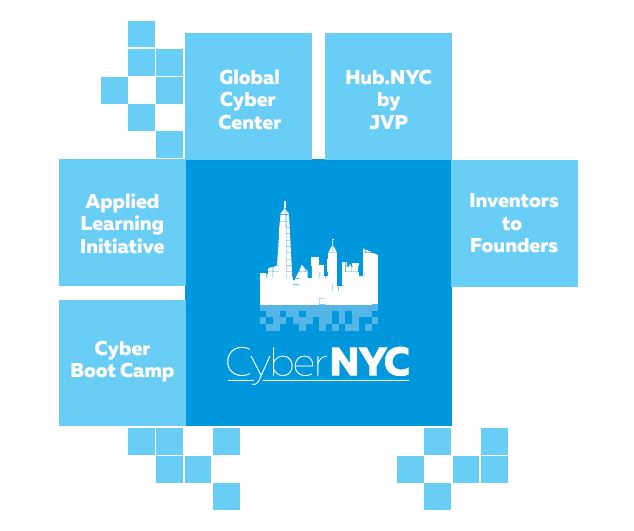
NYCEDC’s map of the NYC Cyber initiative. (Photo from NYCEDC)

In addition to Facebook, other companies have made commitments to the program, including Goldman Sachs, MasterCard, PricewaterhouseCoopers, and edX.org. Two Goldman execs, Chief Operational Risk Officer Phil Venables and Chief Information Security Officer Andy Ozment, have joined the initiative’s advisory boards.

The NYCEDC estimates that there are roughly 6,000 cybersecurity professionals currently employed in New York City. Through these programs, it estimates that the number could increase by another 10,000. Patchett said that “it is as close to a no-brainer in economic development because of the opportunity and the risk.”

From Jerusalem to New York

To tackle its ambitious cybersecurity goals, the NYCEDC is partnering with two venture firms, Jerusalem Venture Partners (JVP) and SOSA, with significant experience investing, operating, and growing companies in the sector.

Jerusalem-based JVP is an established investor that should help founders at Hub.NYC get access to smart capital, sector expertise, and the entrepreneurial experience needed to help their startups scale. JVP invests in early-, late-, and growth-stage companies focused on cybersecurity, big data, media, and enterprise software.

JVP will run Hub.NYC, a startup accelerator that will help cybersecurity startups connect with customers and mentors. (Photo from JVP)

Erel Margalit, who founded the firm in 1993, said that “If you look at what JVP has done … we create ecosystems.” Working with Jerusalem’s metro government, Margalit and the firm pioneered a number of institutions such as accelerators that turned Israel into an economic powerhouse in the cybersecurity industry. His social and economic work eventually led him to the Knesset, Israel’s unicameral legislature, where he served as an MP from 2015-2017 with the Labor Party.

Israel is a very small country with a relative dearth of large companies though, a huge challenge for startups looking to scale up. “Today if you want to build the next-generation leading companies, you have to be not only where the ideas are being brewed, but also where the solutions are being [purchased],” Margalit explained. “You need to be working with the biggest customers in the world.”

That place, in his mind, is New York City. It’s a city he has known since his youth – he worked at Moshe’s Moving IN NYC while attending Columbia as a grad student where he got his PhD in philosophy. Now, he can pack up his own success from Israel and scale it up to an even larger ecosystem.

Since its founding, JVP has successfully raised $1.1 billion across eight funds, including a $60 million fund specifically focused on the cybersecurity space. Over the same period, the firm has seen 32 successful exits, including cybersecurity companies CyberArk (IPO in 2014) and CyActive (Acquired by PayPal in 2013).

JVP’s efforts in the cybersecurity space also go beyond the investment process, with the firm recently establishing an incubator, known as JVP Cyber Labs, specifically focused on identifying, nurturing and building the next wave of Israeli cybersecurity and big data companies.

On average, the firm has focused on deals in the $5-$10 million range, with a general proclivity for earlier-stage companies where the firm can take a more hands-on mentorship role. Some of JVP’s notable active portfolio companies include Source Defense, which uses automation to protect against website supply chain attacks, ThetaRay, which uses big data to analyze threats, and Morphisec, which sells endpoint security solutions.

Opening up innovation with SOSA

The self-described “open-innovation platform,” SOSA is a global network of corporations, investors, and entrepreneurs that connects major institutions with innovative startups tackling core needs.

SOSA works closely with its partner startups, providing investor sourcing, hands-on mentorship and the physical resources needed to achieve growth. The group’s areas of expertise include cybersecurity, fintech, automation, energy, mobility, and logistics. Though headquartered in Tel Aviv, SOSA recently opened an innovation lab in New York, backed by major partners including HP, RBC, and Jefferies.

With the eight-floor Global Cyber Center located in Chelsea, it is turning its attention to an even more ambitious agenda. Uzi Scheffer, CEO of SOSA, said to TechCrunch in a statement that “The Global Cyber Center will serve as a center of gravity for the entire cybersecurity industry where they can meet, interact and connect to the finest talent from New York, the States, Israel and our entire global network.”

SOSA’s new building in Chelsea will be a center for the cybersecurity community (Photo from SOSA)

With an already established presence in New York, SOSA’s local network could help spur the local corporate participation key to the EDC’s plan, while SOSA’s broader global network can help achieve aspirations of turning New York City into a global cybersecurity leader.

It is no coincidence that both of the EDC’s venture partners are familiar with the Israeli cybersecurity ecosystem. Israel has long been viewed as a leader in cybersecurity innovation and policy, and has benefited from the same successful public-private sector coordination New York hopes to replicate.

Furthermore, while New York hopes to create organic growth within its own local ecosystem, the partnerships could also benefit the city if leading Israeli cybersecurity companies look to relocate due to the limited size of the Israeli market.

Big plans, big results?

While we spent comparatively less time discussing them, the NYCEDC’s educational programs are particularly interesting. Students will be able to take classes at any university in the five-member consortium, and transfer credits freely, a concept that the NYCEDC bills as “stackable certificates.”

Meanwhile, Facebook has partnered with the City University of New York to create a professional master’s degree program to train up a new class of cybersecurity leaders. The idea is to provide a pathway to a widely-respected credential without having to take too much time off of work. NYCEDC CEO Patchett said, ”you probably don’t have the time to take two years off to do a masters program,” and so the program’s flexibility should provide better access to more professionals.

Together, all of these disparate programs add up to a bold attempt to put New York City on the map for cybersecurity. Talent development, founder development, customer development – all have been addressed with capital and new initiatives.

Will the community show up at initiatives like the Global Cyber Center, pictured here? (Photo from SOSA)

Yet, despite the time that NYCEDC has spent to put all of these partners together cohesively under one initiative, the real challenge starts with getting the community to participate and build upon these nascent institutions. “What we hear from folks a lot of time,” Patchett said to us, is that “there is no community for cyber professionals in New York City.” Now the buildings have been placed, but the people need to walk through the front doors.

The city wants these programs to be self-sustaining as soon as possible. “In all cases, we don’t want to support these ecosystems forever,” Patchett said. “If we don’t think they’re financially sustainable, we haven’t done our job right.” He believes that “there should be a natural incentive to invest once the ecosystem is off the ground.”

As the world encounters an ever increasing array of cyber threats, old empires can falter – and new empires can grow. Cybersecurity may well be one of the next great industries, and it may just provide the needed defenses to ensure that New York City’s other empires can live another day.

from Startups – TechCrunch https://ift.tt/2DNSHbV


#USA Freetrade launches ‘zero-fee’ investment app

//

It is four months since fintech ‘unicorn’ Revolut announced its intention to add commission-free trading to its banking app, in a bid to compete with Silicon Valley’s Robinhood (although, curiously, the two companies share two investors, namely Index and DST).

However, one London startup looks to be first out of the gate this side of the pond: Freetrade, founded by Adam Dodds, is officially launching today, and offers “zero-fee” stocks and ETF trading, alongside various premium paid features.

A year in the making, Freetrade has built a bona-fide “challenger broker,” including obtaining the required license from the FCA (the U.K. regulator), rather than simply partnering with an established broker as it is understood Revolut initially plans to do. This, Dodds explained on a call, has enabled the startup to plug directly into the capital markets “piping,” with as few intermediaries as possible. It means Freetrade can execute trades on its own behalf and ultimately be much more in control of its own destiny. It should also help the startup maintain a lower cost-base as the app scales.

The fintech has begun to onboard its 60,000-strong waitlist as of today, after a prolonged period in private beta. During that time, the company has run a number of private equity crowdfunding campaigns, shunning venture capital entirely. Asked why Freetrade chose not to raise VC money, Dodds says “the short answer is, we didn’t have to”.

“We got our start with a modest crowdfunding campaign for £100,000 in 2016. That was the seed that grew our community and waiting list to over 60,000 people. To date, we’ve raised over £4 million from our community to fund the business and from our point of view, there couldn’t be a better way. Our investors care so much about the business – they spread the word to everyone they know, they give us feedback on the product, and of course, they are our customers too!”.

Dodds says that many startups worry about getting the first 1,000 customers to love the product. In contrast, Freetrade “has over 3,000 [customers] that already believe in it so much they invested their own money to make it a reality”.

At launch, Freetrade lets you invest in U.K. stocks and ETFs, but will soon add U.S. stocks, too. Trades are “fee-free” if you are happy for your buy or sell trades to execute at the close of business each day. If you want to execute immediately, the startup charges a very low £1 per trade, and will soon add an all-inclusive monthly paid subscription to the app.

The idea, Dodds tells me, is to lower the price of entry so that anybody can begin putting together their own investment portfolio, no matter how small to begin with.

“The first thing to understand is that the commissions legacy stockbrokers charge are completely detached from the actual cost of making trades. They charge what they can get away with,” he says. “The lack of competition has allowed an oligopoly to settle in where all the legacy online brokers charge around £10 to make a trade.

“What we offer is a free option to start investing in real shares and exchange-traded funds (ETFs), where you don’t need to worry about any fees or commissions or timing your orders as free orders are filled at the end of the day. Or you can pay £1 for Instant orders that are filled immediately when the market is open. We’ll also offer a paid subscription tier that includes all our services, including instant execution and ISAs (tax-free account) for £10 a month”.

But how does this all compare to what Revolut has planned and how will Freetrade compete? Dodds wouldn’t be drawn on too many specifics, but reiterated that his startup has “built a new FCA-authorised financial institution from the ground up” and has now launched what he describes as the U.K.’s “first modern stockbroker”.

“Revolut seems to be burning masses of VC cash in a land grab for every vertical in fintech. I’m sure they’ll launch something to compete with us at some point, but we’re singularly focused on making the absolute best investment app out there and building a sustainable business,” he says.

from Startups – TechCrunch https://ift.tt/2QmauZ2

#USA Lingokids scores $6M Series A for its English language learning platform

//

Lingokids, the Madrid, Spain-based (and U.S. incorporated) edtech startup that helps children to learn a second language, has bolstered its balance sheet. The company has raised $6 million in Series A funding, and been awarded a $1.3 million grant from the European Union’s taxpayer funded H2020 programme,

Leading the Series A is HV Holtzbrinck Ventures, with participation from existing investors JME Venture Capital, Sabadell Ventures, Big Sur Ventures, and Gwynne Shotwell (President and COO of SpaceX). A number of new investors joined, too, including Silicon Valley ed-tech investor Reach Capital, Athos Capital, and All Iron Ventures. It brings total funding for Lingokids to over $11 million in the last year.

Meanwhile, I’m told a lot has happened since the startup’s last funding round a year ago. The team has grown to 40-plus employees, and the platform now counts a user base of over 7 million registered families around the world in 180 countries.

Notably — and presumably after finding market fit — Lingokids has also decided to focus only on English language learning (it had previously ventured into simplified Chinese and had plans to add Spanish). However, its central proposition remains the same.

The subscription-based platform teaches English to children ages 2 to 8 through a series of activities, games, and songs that adapt in difficulty to each child’s level. This, Lingokids maintains, allows for a fun and personalized learning experience, with an emphasis placed on parental involvement, which is key to language learning outcomes.

To that end, Lingokids says it will use the new capital for three main purposes: accelerating growth, acquiring new talent, and developing new features for the app. This includes plans to offer an “even more personalized experience for students and to increase parental involvement in the learning process​,” which will see the startup revamp the app’s parent section, and provide new types of interactive content formats. The platform will also add improved speech recognition features.

“There is a growing interest in English language learning in early childhood, with market figures suggesting that at least 500 million children under the age of 8 will be learning English by 2020,” says Cristobal Viedma, Lingokids founder and CEO, in a statement​. “We will continue to satisfy this demand and tackle English literacy around the world by offering high quality educational content at an affordable price.”

from Startups – TechCrunch https://ift.tt/2P4SGRU

#USA Why Blissfully decided to go all in on serverless

//

Serverless has become a big buzzword of late, and with good reason. It has the potential to completely alter how developers write code. They can simply write a series of event triggers, while letting the cloud vendor worry about providing whatever amount of compute resources are required to complete the job. It represents a huge shift in how programs are developed, but it’s been difficult to find companies who were built from the ground up using this methodology because it’s fairly new.

Blissfully, a startup that helps customers manage their Software as a Service usage inside their companies, is one company that decided to do just that. Aaron White, co-founder and CTO, says that when he was building early versions of Blissfully, he found he needed quick bursts of compute power to deliver a list of all the SaaS products an organization is using.

He figured he could set aside a bunch of servers to provide that burst of power as needed, but that would have required a ton of overhead on his part to manage. At this point, he was a lone programmer trying to prove his SaaS management idea was even possible. As he looked at the pros and cons of serverless versus traditional virtual machines, he began to see serverless as a viable approach.

What he learned along the way was that serverless offers many advantages to a company with a bursty approach like Blissfully, scaling up and down as needed. But it isn’t perfect and there are issues around management and tooling and handling the pros and cons of that scaling ability that he had to learn about on the fly, especially coming in as early as he did with this approach.

Serverless makes sense

Blissfully is a service where serverless made a lot of sense. It wouldn’t have to manage or pay for servers it wasn’t using. Nor would it have to worry about the underlying infrastructure at all. That would be up to the cloud provider, and it would only pay for the bursts as they happened.

Serverless is actually a misnomer in that it doesn’t mean that there are no servers. It actually means that you don’t have to set up a servers in order to run your program, which is a pretty mind-blowing transformation. In traditional programming you have to write your code and set up all the underlying hardware ahead of time, whether it’s in your data center or in the cloud. With serverless, you just write the code and the cloud provider handles all of that for you.

The way it works in practice is that programmers set up a series of event triggers, so when a certain thing happens, the cloud provider sees this and provides the necessary resources on demand. Most of the cloud vendors are offering this type of service, whether AWS Lambda, Azure Functions or Google Functions.

At this point, White began to think about serverless as a way of freeing him from thinking about managing and maintaining infrastructure and all that entailed. “I started thinking, let’s see how far we can take this. Can we really we do absolutely everything serverless, and if so that reduces a ton of traditional DevOps-style work you have to do in practice. There’s still plenty, but that was the thinking at the beginning,” he said.

Overcoming obstacles

But there were issues, especially getting into serverless as early as he did. For starters, White needed to find developers who could work in this fashion, and in 2016 when it launched there weren’t a large number of people out there with  serverless skills. White said he wasn’t looking for direct experience so much as people who were curious to learn and were flexible enough to deal with new technology, regardless of how Blissfully implemented that.

Once he figured out the basics, he needed to think about how this would work structurally. “Part of the challenge is figuring out where do you draw the boundaries between different serverless functions? How do you think about how much you want to overload the capability of one function versus another? How do you want to split it up? You could go way too specific, and you can of course, go way too broad. So there’s a lot of judgement calls to be made in terms of how you want to split your code base to work in this way,” he said.

The other challenge he faced going with a serverless approach so early was a dearth of tooling around it. White found Serverless, Inc right way, which helped him with a basic framework for developing, but he lacked good logging tools and says that the company still struggles with this even now. “DevOps doesn’t go away. This is still running on a server somewhere (even if you don’t control that) and you will run into issues.” One such issue he calls a “cold start issue.”

Getting the resources right

Blissfully uses AWS Lambda, and as their customers require resources, it isn’t as though Amazon has a set of dedicated resources set aside waiting for such an event. If it needs to start servers cold, that could result in latency. To compensate for that, Blissfully runs a job that pings Lambda continually, so that it’s always ready to run the actual application, and there isn’t a lag time related to starting from scratch.

The other issue could be the opposite problem. You can scale much faster than you’re ready to deal with and that can be a problem for a small team. He says in that case, you want to put a limiter on the speed of the calls so you don’t end up spending more than you can afford, and it doesn’t scale beyond your team’s ability to manage it, “I think, in some ways, this actually accelerates you running into problems where you would normally be larger scale before you really had to think about them,” White said.

The other piece is that once Lambda gets everything going, it can move data faster than your external APIs can handle, and that could require limiters to actually slow things down. “I never had that problem in the past where I was provisioning so many computational resources that Google was yelling at me for being too fast. Being too fast for Google takes a lot of effort, but it doesn’t take a lot of effort with Lambda. When it does decide to spool up whatever resources, you can do some serious outbound damaged to other APIs.” That meant he and his team actually had to think very early on about building sophisticated rate limiting schemes.

As for costs, White estimates that his costs are much lower now that he has the service built and in place. “Our costs are so low right now, and far lower than if we had server-based infrastructure. Our computational pattern is very bursty.” That’s because it re-parses the SaaS database once a day or when the customer first signs up, and in between, usage is fairly low beyond interacting with the data.

“So for us that was perfect for serverless because I don’t really need to keep capacity around that would be pure waste.”

from Startups – TechCrunch https://ift.tt/2Itx7Ih

#USA Why Blissfully decided to go all in on serverless

//

Serverless has become a big buzzword of late, and with good reason. It has the potential to completely alter how developers write code. They can simply write a series of event triggers, while letting the cloud vendor worry about providing whatever amount of compute resources are required to complete the job. It represents a huge shift in how programs are developed, but it’s been difficult to find companies who were built from the ground up using this methodology because it’s fairly new.

Blissfully, a startup that helps customers manage their Software as a Service usage inside their companies, is one company that decided to do just that. Aaron White, co-founder and CTO, says that when he was building early versions of Blissfully, he found he needed quick bursts of compute power to deliver a list of all the SaaS products an organization is using.

He figured he could set aside a bunch of servers to provide that burst of power as needed, but that would have required a ton of overhead on his part to manage. At this point, he was a lone programmer trying to prove his SaaS management idea was even possible. As he looked at the pros and cons of serverless versus traditional virtual machines, he began to see serverless as a viable approach.

What he learned along the way was that serverless offers many advantages to a company with a bursty approach like Blissfully, scaling up and down as needed. But it isn’t perfect and there are issues around management and tooling and handling the pros and cons of that scaling ability that he had to learn about on the fly, especially coming in as early as he did with this approach.

Serverless makes sense

Blissfully is a service where serverless made a lot of sense. It wouldn’t have to manage or pay for servers it wasn’t using. Nor would it have to worry about the underlying infrastructure at all. That would be up to the cloud provider, and it would only pay for the bursts as they happened.

Serverless is actually a misnomer in that it doesn’t mean that there are no servers. It actually means that you don’t have to set up a servers in order to run your program, which is a pretty mind-blowing transformation. In traditional programming you have to write your code and set up all the underlying hardware ahead of time, whether it’s in your data center or in the cloud. With serverless, you just write the code and the cloud provider handles all of that for you.

The way it works in practice is that programmers set up a series of event triggers, so when a certain thing happens, the cloud provider sees this and provides the necessary resources on demand. Most of the cloud vendors are offering this type of service, whether AWS Lambda, Azure Functions or Google Functions.

At this point, White began to think about serverless as a way of freeing him from thinking about managing and maintaining infrastructure and all that entailed. “I started thinking, let’s see how far we can take this. Can we really we do absolutely everything serverless, and if so that reduces a ton of traditional DevOps-style work you have to do in practice. There’s still plenty, but that was the thinking at the beginning,” he said.

Overcoming obstacles

But there were issues, especially getting into serverless as early as he did. For starters, White needed to find developers who could work in this fashion, and in 2016 when it launched there weren’t a large number of people out there with  serverless skills. White said he wasn’t looking for direct experience so much as people who were curious to learn and were flexible enough to deal with new technology, regardless of how Blissfully implemented that.

Once he figured out the basics, he needed to think about how this would work structurally. “Part of the challenge is figuring out where do you draw the boundaries between different serverless functions? How do you think about how much you want to overload the capability of one function versus another? How do you want to split it up? You could go way too specific, and you can of course, go way too broad. So there’s a lot of judgement calls to be made in terms of how you want to split your code base to work in this way,” he said.

The other challenge he faced going with a serverless approach so early was a dearth of tooling around it. White found Serverless, Inc right way, which helped him with a basic framework for developing, but he lacked good logging tools and says that the company still struggles with this even now. “DevOps doesn’t go away. This is still running on a server somewhere (even if you don’t control that) and you will run into issues.” One such issue he calls a “cold start issue.”

Getting the resources right

Blissfully uses AWS Lambda, and as their customers require resources, it isn’t as though Amazon has a set of dedicated resources set aside waiting for such an event. If it needs to start servers cold, that could result in latency. To compensate for that, Blissfully runs a job that pings Lambda continually, so that it’s always ready to run the actual application, and there isn’t a lag time related to starting from scratch.

The other issue could be the opposite problem. You can scale much faster than you’re ready to deal with and that can be a problem for a small team. He says in that case, you want to put a limiter on the speed of the calls so you don’t end up spending more than you can afford, and it doesn’t scale beyond your team’s ability to manage it, “I think, in some ways, this actually accelerates you running into problems where you would normally be larger scale before you really had to think about them,” White said.

The other piece is that once Lambda gets everything going, it can move data faster than your external APIs can handle, and that could require limiters to actually slow things down. “I never had that problem in the past where I was provisioning so many computational resources that Google was yelling at me for being too fast. Being too fast for Google takes a lot of effort, but it doesn’t take a lot of effort with Lambda. When it does decide to spool up whatever resources, you can do some serious outbound damaged to other APIs.” That meant he and his team actually had to think very early on about building sophisticated rate limiting schemes.

As for costs, White estimates that his costs are much lower now that he has the service built and in place. “Our costs are so low right now, and far lower than if we had server-based infrastructure. Our computational pattern is very bursty.” That’s because it re-parses the SaaS database once a day or when the customer first signs up, and in between, usage is fairly low beyond interacting with the data.

“So for us that was perfect for serverless because I don’t really need to keep capacity around that would be pure waste.”

from Startups – TechCrunch https://ift.tt/2Itx7Ih

#USA Why Blissfully decided to go all in on serverless

//

Serverless has become a big buzzword of late, and with good reason. It has the potential to completely alter how developers write code. They can simply write a series of event triggers, while letting the cloud vendor worry about providing whatever amount of compute resources are required to complete the job. It represents a huge shift in how programs are developed, but it’s been difficult to find companies who were built from the ground up using this methodology because it’s fairly new.

Blissfully, a startup that helps customers manage their Software as a Service usage inside their companies, is one company that decided to do just that. Aaron White, co-founder and CTO, says that when he was building early versions of Blissfully, he found he needed quick bursts of compute power to deliver a list of all the SaaS products an organization is using.

He figured he could set aside a bunch of servers to provide that burst of power as needed, but that would have required a ton of overhead on his part to manage. At this point, he was a lone programmer trying to prove his SaaS management idea was even possible. As he looked at the pros and cons of serverless versus traditional virtual machines, he began to see serverless as a viable approach.

What he learned along the way was that serverless offers many advantages to a company with a bursty approach like Blissfully, scaling up and down as needed. But it isn’t perfect and there are issues around management and tooling and handling the pros and cons of that scaling ability that he had to learn about on the fly, especially coming in as early as he did with this approach.

Serverless makes sense

Blissfully is a service where serverless made a lot of sense. It wouldn’t have to manage or pay for servers it wasn’t using. Nor would it have to worry about the underlying infrastructure at all. That would be up to the cloud provider, and it would only pay for the bursts as they happened.

Serverless is actually a misnomer in that it doesn’t mean that there are no servers. It actually means that you don’t have to set up a servers in order to run your program, which is a pretty mind-blowing transformation. In traditional programming you have to write your code and set up all the underlying hardware ahead of time, whether it’s in your data center or in the cloud. With serverless, you just write the code and the cloud provider handles all of that for you.

The way it works in practice is that programmers set up a series of event triggers, so when a certain thing happens, the cloud provider sees this and provides the necessary resources on demand. Most of the cloud vendors are offering this type of service, whether AWS Lambda, Azure Functions or Google Functions.

At this point, White began to think about serverless as a way of freeing him from thinking about managing and maintaining infrastructure and all that entailed. “I started thinking, let’s see how far we can take this. Can we really we do absolutely everything serverless, and if so that reduces a ton of traditional DevOps-style work you have to do in practice. There’s still plenty, but that was the thinking at the beginning,” he said.

Overcoming obstacles

But there were issues, especially getting into serverless as early as he did. For starters, White needed to find developers who could work in this fashion, and in 2016 when it launched there weren’t a large number of people out there with  serverless skills. White said he wasn’t looking for direct experience so much as people who were curious to learn and were flexible enough to deal with new technology, regardless of how Blissfully implemented that.

Once he figured out the basics, he needed to think about how this would work structurally. “Part of the challenge is figuring out where do you draw the boundaries between different serverless functions? How do you think about how much you want to overload the capability of one function versus another? How do you want to split it up? You could go way too specific, and you can of course, go way too broad. So there’s a lot of judgement calls to be made in terms of how you want to split your code base to work in this way,” he said.

The other challenge he faced going with a serverless approach so early was a dearth of tooling around it. White found Serverless, Inc right way, which helped him with a basic framework for developing, but he lacked good logging tools and says that the company still struggles with this even now. “DevOps doesn’t go away. This is still running on a server somewhere (even if you don’t control that) and you will run into issues.” One such issue he calls a “cold start issue.”

Getting the resources right

Blissfully uses AWS Lambda, and as their customers require resources, it isn’t as though Amazon has a set of dedicated resources set aside waiting for such an event. If it needs to start servers cold, that could result in latency. To compensate for that, Blissfully runs a job that pings Lambda continually, so that it’s always ready to run the actual application, and there isn’t a lag time related to starting from scratch.

The other issue could be the opposite problem. You can scale much faster than you’re ready to deal with and that can be a problem for a small team. He says in that case, you want to put a limiter on the speed of the calls so you don’t end up spending more than you can afford, and it doesn’t scale beyond your team’s ability to manage it, “I think, in some ways, this actually accelerates you running into problems where you would normally be larger scale before you really had to think about them,” White said.

The other piece is that once Lambda gets everything going, it can move data faster than your external APIs can handle, and that could require limiters to actually slow things down. “I never had that problem in the past where I was provisioning so many computational resources that Google was yelling at me for being too fast. Being too fast for Google takes a lot of effort, but it doesn’t take a lot of effort with Lambda. When it does decide to spool up whatever resources, you can do some serious outbound damaged to other APIs.” That meant he and his team actually had to think very early on about building sophisticated rate limiting schemes.

As for costs, White estimates that his costs are much lower now that he has the service built and in place. “Our costs are so low right now, and far lower than if we had server-based infrastructure. Our computational pattern is very bursty.” That’s because it re-parses the SaaS database once a day or when the customer first signs up, and in between, usage is fairly low beyond interacting with the data.

“So for us that was perfect for serverless because I don’t really need to keep capacity around that would be pure waste.”

from Startups – TechCrunch https://ift.tt/2Itx7Ih

#USA Why Blissfully decided to go all in on serverless

//

Serverless has become a big buzzword of late, and with good reason. It has the potential to completely alter how developers write code. They can simply write a series of event triggers, while letting the cloud vendor worry about providing whatever amount of compute resources are required to complete the job. It represents a huge shift in how programs are developed, but it’s been difficult to find companies who were built from the ground up using this methodology because it’s fairly new.

Blissfully, a startup that helps customers manage their Software as a Service usage inside their companies, is one company that decided to do just that. Aaron White, co-founder and CTO, says that when he was building early versions of Blissfully, he found he needed quick bursts of compute power to deliver a list of all the SaaS products an organization is using.

He figured he could set aside a bunch of servers to provide that burst of power as needed, but that would have required a ton of overhead on his part to manage. At this point, he was a lone programmer trying to prove his SaaS management idea was even possible. As he looked at the pros and cons of serverless versus traditional virtual machines, he began to see serverless as a viable approach.

What he learned along the way was that serverless offers many advantages to a company with a bursty approach like Blissfully, scaling up and down as needed. But it isn’t perfect and there are issues around management and tooling and handling the pros and cons of that scaling ability that he had to learn about on the fly, especially coming in as early as he did with this approach.

Serverless makes sense

Blissfully is a service where serverless made a lot of sense. It wouldn’t have to manage or pay for servers it wasn’t using. Nor would it have to worry about the underlying infrastructure at all. That would be up to the cloud provider, and it would only pay for the bursts as they happened.

Serverless is actually a misnomer in that it doesn’t mean that there are no servers. It actually means that you don’t have to set up a servers in order to run your program, which is a pretty mind-blowing transformation. In traditional programming you have to write your code and set up all the underlying hardware ahead of time, whether it’s in your data center or in the cloud. With serverless, you just write the code and the cloud provider handles all of that for you.

The way it works in practice is that programmers set up a series of event triggers, so when a certain thing happens, the cloud provider sees this and provides the necessary resources on demand. Most of the cloud vendors are offering this type of service, whether AWS Lambda, Azure Functions or Google Functions.

At this point, White began to think about serverless as a way of freeing him from thinking about managing and maintaining infrastructure and all that entailed. “I started thinking, let’s see how far we can take this. Can we really we do absolutely everything serverless, and if so that reduces a ton of traditional DevOps-style work you have to do in practice. There’s still plenty, but that was the thinking at the beginning,” he said.

Overcoming obstacles

But there were issues, especially getting into serverless as early as he did. For starters, White needed to find developers who could work in this fashion, and in 2016 when it launched there weren’t a large number of people out there with  serverless skills. White said he wasn’t looking for direct experience so much as people who were curious to learn and were flexible enough to deal with new technology, regardless of how Blissfully implemented that.

Once he figured out the basics, he needed to think about how this would work structurally. “Part of the challenge is figuring out where do you draw the boundaries between different serverless functions? How do you think about how much you want to overload the capability of one function versus another? How do you want to split it up? You could go way too specific, and you can of course, go way too broad. So there’s a lot of judgement calls to be made in terms of how you want to split your code base to work in this way,” he said.

The other challenge he faced going with a serverless approach so early was a dearth of tooling around it. White found Serverless, Inc right way, which helped him with a basic framework for developing, but he lacked good logging tools and says that the company still struggles with this even now. “DevOps doesn’t go away. This is still running on a server somewhere (even if you don’t control that) and you will run into issues.” One such issue he calls a “cold start issue.”

Getting the resources right

Blissfully uses AWS Lambda, and as their customers require resources, it isn’t as though Amazon has a set of dedicated resources set aside waiting for such an event. If it needs to start servers cold, that could result in latency. To compensate for that, Blissfully runs a job that pings Lambda continually, so that it’s always ready to run the actual application, and there isn’t a lag time related to starting from scratch.

The other issue could be the opposite problem. You can scale much faster than you’re ready to deal with and that can be a problem for a small team. He says in that case, you want to put a limiter on the speed of the calls so you don’t end up spending more than you can afford, and it doesn’t scale beyond your team’s ability to manage it, “I think, in some ways, this actually accelerates you running into problems where you would normally be larger scale before you really had to think about them,” White said.

The other piece is that once Lambda gets everything going, it can move data faster than your external APIs can handle, and that could require limiters to actually slow things down. “I never had that problem in the past where I was provisioning so many computational resources that Google was yelling at me for being too fast. Being too fast for Google takes a lot of effort, but it doesn’t take a lot of effort with Lambda. When it does decide to spool up whatever resources, you can do some serious outbound damaged to other APIs.” That meant he and his team actually had to think very early on about building sophisticated rate limiting schemes.

As for costs, White estimates that his costs are much lower now that he has the service built and in place. “Our costs are so low right now, and far lower than if we had server-based infrastructure. Our computational pattern is very bursty.” That’s because it re-parses the SaaS database once a day or when the customer first signs up, and in between, usage is fairly low beyond interacting with the data.

“So for us that was perfect for serverless because I don’t really need to keep capacity around that would be pure waste.”

from Startups – TechCrunch https://ift.tt/2Itx7Ih

#USA Why Blissfully decided to go all in on serverless

//

Serverless has become a big buzzword of late, and with good reason. It has the potential to completely alter how developers write code. They can simply write a series of event triggers, while letting the cloud vendor worry about providing whatever amount of compute resources are required to complete the job. It represents a huge shift in how programs are developed, but it’s been difficult to find companies who were built from the ground up using this methodology because it’s fairly new.

Blissfully, a startup that helps customers manage their Software as a Service usage inside their companies, is one company that decided to do just that. Aaron White, co-founder and CTO, says that when he was building early versions of Blissfully, he found he needed quick bursts of compute power to deliver a list of all the SaaS products an organization is using.

He figured he could set aside a bunch of servers to provide that burst of power as needed, but that would have required a ton of overhead on his part to manage. At this point, he was a lone programmer trying to prove his SaaS management idea was even possible. As he looked at the pros and cons of serverless versus traditional virtual machines, he began to see serverless as a viable approach.

What he learned along the way was that serverless offers many advantages to a company with a bursty approach like Blissfully, scaling up and down as needed. But it isn’t perfect and there are issues around management and tooling and handling the pros and cons of that scaling ability that he had to learn about on the fly, especially coming in as early as he did with this approach.

Serverless makes sense

Blissfully is a service where serverless made a lot of sense. It wouldn’t have to manage or pay for servers it wasn’t using. Nor would it have to worry about the underlying infrastructure at all. That would be up to the cloud provider, and it would only pay for the bursts as they happened.

Serverless is actually a misnomer in that it doesn’t mean that there are no servers. It actually means that you don’t have to set up a servers in order to run your program, which is a pretty mind-blowing transformation. In traditional programming you have to write your code and set up all the underlying hardware ahead of time, whether it’s in your data center or in the cloud. With serverless, you just write the code and the cloud provider handles all of that for you.

The way it works in practice is that programmers set up a series of event triggers, so when a certain thing happens, the cloud provider sees this and provides the necessary resources on demand. Most of the cloud vendors are offering this type of service, whether AWS Lambda, Azure Functions or Google Functions.

At this point, White began to think about serverless as a way of freeing him from thinking about managing and maintaining infrastructure and all that entailed. “I started thinking, let’s see how far we can take this. Can we really we do absolutely everything serverless, and if so that reduces a ton of traditional DevOps-style work you have to do in practice. There’s still plenty, but that was the thinking at the beginning,” he said.

Overcoming obstacles

But there were issues, especially getting into serverless as early as he did. For starters, White needed to find developers who could work in this fashion, and in 2016 when it launched there weren’t a large number of people out there with  serverless skills. White said he wasn’t looking for direct experience so much as people who were curious to learn and were flexible enough to deal with new technology, regardless of how Blissfully implemented that.

Once he figured out the basics, he needed to think about how this would work structurally. “Part of the challenge is figuring out where do you draw the boundaries between different serverless functions? How do you think about how much you want to overload the capability of one function versus another? How do you want to split it up? You could go way too specific, and you can of course, go way too broad. So there’s a lot of judgement calls to be made in terms of how you want to split your code base to work in this way,” he said.

The other challenge he faced going with a serverless approach so early was a dearth of tooling around it. White found Serverless, Inc right way, which helped him with a basic framework for developing, but he lacked good logging tools and says that the company still struggles with this even now. “DevOps doesn’t go away. This is still running on a server somewhere (even if you don’t control that) and you will run into issues.” One such issue he calls a “cold start issue.”

Getting the resources right

Blissfully uses AWS Lambda, and as their customers require resources, it isn’t as though Amazon has a set of dedicated resources set aside waiting for such an event. If it needs to start servers cold, that could result in latency. To compensate for that, Blissfully runs a job that pings Lambda continually, so that it’s always ready to run the actual application, and there isn’t a lag time related to starting from scratch.

The other issue could be the opposite problem. You can scale much faster than you’re ready to deal with and that can be a problem for a small team. He says in that case, you want to put a limiter on the speed of the calls so you don’t end up spending more than you can afford, and it doesn’t scale beyond your team’s ability to manage it, “I think, in some ways, this actually accelerates you running into problems where you would normally be larger scale before you really had to think about them,” White said.

The other piece is that once Lambda gets everything going, it can move data faster than your external APIs can handle, and that could require limiters to actually slow things down. “I never had that problem in the past where I was provisioning so many computational resources that Google was yelling at me for being too fast. Being too fast for Google takes a lot of effort, but it doesn’t take a lot of effort with Lambda. When it does decide to spool up whatever resources, you can do some serious outbound damaged to other APIs.” That meant he and his team actually had to think very early on about building sophisticated rate limiting schemes.

As for costs, White estimates that his costs are much lower now that he has the service built and in place. “Our costs are so low right now, and far lower than if we had server-based infrastructure. Our computational pattern is very bursty.” That’s because it re-parses the SaaS database once a day or when the customer first signs up, and in between, usage is fairly low beyond interacting with the data.

“So for us that was perfect for serverless because I don’t really need to keep capacity around that would be pure waste.”

from Startups – TechCrunch https://ift.tt/2Itx7Ih