#USA Bird hits 10 million scooter rides

//

Bird just announced 10 million scooter rides since launching about one year ago. If this story sounds familiar to you, it’s probably because Bird competitor Lime earlier today announced it surpassed 11.5 million rides across its shared bikes and scooters.

Bird, which launched last September in Santa Monica, Calif., currently operates in 100 cities and has over two million unique riders, Bird founder and CEO Travis VanderZanden told TechCrunch. But Bird’s first year of operations has been full of ups and downs.

Many of the downs have been around regulatory issues. Bird faced, and overcame them, in Santa Monica but failed in San Francisco.

“I think anytime you’re doing something new that the cities haven’t contemplated before, there always seems to be gray area on where you fit in in the regulatory environment,” VanderZanden said. “Cities hadn’t thought about electric scooters and electric scooter sharing. We collaborated very closely with the cities we’re in now.”

Although San Francisco did not grant an operating permit to Bird — the city gave them to Scoot and Skip — VanderZanden stressed that “San Francisco is one city. We’re in 100 cities.”

He also said Bird is not looking to appeal the decision in San Francisco. Lime, however, is in engaging in the appeals process.

As Bird enters its second year of operations, the name of the game is to double down on its efforts with cities and building out its government tech platform. Bird is also looking into manufacturing its own scooters to provide more durability to its customers and differentiate itself from other scooters on the market.

“We’ve been investing heavily in that area,” VanderZanden said. “You’ll start to see new vehicles coming from us soon.”

He added, “we want to keep building vehicles that are more ruggedized but also vehicles that have new features for the riders as well.”

And Bird definitely has the funds to do that. To date, Bird has raised $415 million in funding for shared electric scooters.

from Startups – TechCrunch https://ift.tt/2OFAmij

#USA MariaDB acquires Clusterix

//

MariaDB, the company behind the eponymous MySQL drop-in replacement database, today announced that it has acquired Clusterix, which itself is a MySQL drop-in replacement database, but with a focus on scalability. MariaDB will integrate Clusterix’s technology into its own database, which will allow it to offer its users a more scalable database service in the long run.

That by itself would be an interesting development for the popular open source database company. But there’s another angle to this story, too. In addition to the acquisition, MariaDB also today announced that cloud computing company ServiceNow is investing in MariaDB, an investment that helped it get to today’s acquisition. ServiceNow doesn’t typically make investments, though it has made a few acquisitions. It is a very large MariaDB user, though, and it’s exactly the kind of customer that will benefit from the Clusterix acquisition.

MariaDB CEO Michael Howard tells me that ServiceNow current supports about 80,000 instances of MariaDB. With this investment (which is actually an add-on to MariaDB’s 2017 Series C round), ServiceNow’s SVP of Development and Operations Pat Casey will join MariaDB’s board.

Why would MariaDB acquire a company like Clusterix, though? When I asked Howard about the motivation, he noted that he’s now seeing more companies like ServiceNow that are looking at a more scalable way to run MariaDB. Howard noted that it would take years to build a new database engine from the ground up.

“You can hire a lot of smart people individually, but not necessarily have that experience built into their profile,” he said. “So that was important and then to have a jumpstart in relation to this market opportunity — this mandate from our market. It typically takes about nine years, to get a brand new, thorough database technology off the ground. It’s not like a SaaS application where you can get a front-end going in about a year or so.

Howard also stressed that the fact that the teams at Clusterix and MariaDB share the same vocabulary, given that they both work on similar problems and aim to be compatible with MySQL, made this a good fit.

While integrating the Clusterix database technology into MariaDB won’t be trivial, Howard stressed that the database was always built to accommodate external database storage engines. MariaDB will have to make some changes to its APIs to be ready for the clustering features of Clusterix. “It’s not going to be a 1-2-3 effort,” he said. “It’s going to be a heavy-duty effort for us to do this right. But everyone on the team wants to do it because it’s good for the company and our customers.

MariaDB did not disclose the price of the acquisition. Since it was founded in 2006, though, the Y Combinator-incubated Clusterix had raised just under $72 million, though. MariaDB has raised just under $100 million so far, so it’s probably a fair guess that Clusterix didn’t necessarily sell for a large multiple of that.


from Startups – TechCrunch https://ift.tt/2MODt5v

#USA Hear about the keys to local investing at Startup Battlefield Africa with Omobola Johnson and Lexi Novitske

//

Omobola Johnson (Image: Flickr/World Economic Forum under a CC BY-NC-SA 2.0

TechCrunch Startup Battlefield is returning to Africa in December, this time in Lagos, Nigeria. We will have a day-long program full of our flagship Battlefield competition highlighting the best startups that Africa has to offer.

Not only that, we’ll have panel discussions designed to explore the continent’s rapidly developing technological infrastructure on the continent. To wit, I’m excited to announce the first two speakers who will don our stage with direct knowledge about investing Silicon Valley money in the local ecosystem.

Omobola Johnson is a senior partner at TLcom Capital and the former minister of communication technology for Nigeria. Her vast knowledge about the startup investing landscape comes from her 25-year tenure at Accenture where she served as the managing director.

As ICT minister, she focused on the execution of the National Broadband Plan, as well as promoting government interest in local venture capital through the development of a fund and a network of startup incubators. And at Accenture, she advised numerous startups in various industries on how to become competitive and help to strengthen the tech landscape.

Lexi Novitske

Lexi Novitske is the principal investment officer for Singularity Investments where she is responsible for managing investments in the firm’s Africa portfolio.

Novitske moved to Africa from the United States, having identified a unique approach to providing African startups with the capital necessary to thrive. Big surprise: It’s not just about writing a check and hoping for returns. It’s about understanding the complexities of the environment, modifying Western attitudes about business and working hard with your companies to ensure the best outcomes.

Johnson and Novitske are just the beginning of what we have to offer at Battlefield Africa technology. Stay tuned for more announcements of great speakers and get your tickets before they sell out.

from Startups – TechCrunch https://ift.tt/2DevPBY

#USA Lime hits 11.5 million bike and scooter rides

//

Bike and scooter company Lime recently hit 11.5 million rides, a couple of months after it surpassed six million rides. This milestone comes just 14 months after Lime deployed its first bikes.

Today, Lime is in more than 100 markets throughout the U.S. and Europe. Last December, Lime brought its bikes to a number of European cities and in June, Lime brought its scooters to Paris. By the end of this year, Lime plans to launch in an additional 50 cities.

The rise of shared personal electric vehicles has also led to a new type of side hustle for some people. Through Lime’s Juicer program, which enables anyone to make money from charging scooters overnight, the company has paid out millions of dollars to those workers.

Lime has raised $467 million in funding, with its most recent round coming in at $335 million. The round, led by GV, included participation from Uber.

from Startups – TechCrunch https://ift.tt/2MQwcSW

#USA Curve, the all-your-cards-in-one app, adds ‘zero fees’ when spending abroad

//

Curve, the London fintech that lets you consolidate all of your bank cards into a single Curve card and app to make it easier to manage your spending, has always faced a slight awareness problem. Even though nobody else does what Curve does — the product is innovative on a multiple fronts, such as its “financial time travel” feature — it is also the kind of proposition that not everybody gets until they’ve signed up and started using it. Once they do, however, they tend to stick around. I’m told retention rates are way above industry average at 70 percent.

Three years since launch and much further along in the roadmap, the sum of its parts is beginning to make Curve a much easier sell. Not least because any company that wants to create “one card to rule them all” needs to have multiple bases covered if it is going to convince you to leave your other debit and credit cards at home. One of those, of course, is low FX fees when spending abroad. Or, better still, zero fees.

Enter the latest update from Curve, which introduces the “real exchange rate, with no hidden fees”. Up until now, Curve offered a better exchange rate and fee structure than most high street banks (around 1-2 percent on top of MasterCard’s competitive exchange rate), but it wasn’t up there with the very best on the market, such as the likes of Revolut, Starling, TransferWise, Monzo or Tandem, depending on use case and your penchant for convenience over price.

To that end, the fintech startup has spent the last six months re-engineering the platform’s money exchange piping to be able to compete much harder in currency conversion and at the point of purchase.

“Our zero FX proposition is built on the foundations of the innovative technology at the heart of Curve, enabling us to perform FX swaps on top of any card that you have loaded into your Curve wallet without the user needing to do anything special and with the transaction showing in the underlying cards native currency,” Curve CTO Matt Collinge tells me. “We are essentially adding a wrapper of convenient ‘fintechness’ to existing bank and credit cards”.

The new “zero fee” pricing is fairly straight-forward but there are some caps and different limitations depending on if you have the blue free Curve card or the black paid-for one. The pricing changes slightly from November, too.

The company broke down the terms as follows:

Blue Curve card users:

– Spend Abroad: 0% fee and access to the Real Exchange Rate on spend in over 150+ supported foreign currencies worldwide. Initial cap of up to £500 per rolling month, and 1% fee thereafter (in November this will become 2% thereafter).
– ATM Extractions Abroad: £200 at 0% fee, 2% or £2 per transaction thereafter (whichever is greater).
– Weekend Spend Abroad: as the currency market is closed, we need to charge a 0.5% markup on Euros and US Dollars and 1% markup for all other supported currencies (in November this becomes 0.5% fee for Euros and US dollars, 1.5% fee for all other currencies).

Black Curve card users:

– Spend Abroad: 0% fee and access to the Real Exchange Rate on spend in over 150+ supported foreign currencies worldwide, for an unlimited amount per rolling year – subject to a generous Fair Use Policy of £15,000 and 1% fee thereafter (in November this will become 2% thereafter).
– ATM Extractions Abroad: £400 ATM at 0 fee, 2% or £2 per transaction thereafter (whichever is greater).
– Weekend Spend Abroad: as the currency market is closed, we need to charge a 0.5% markup on Euros and US Dollars and 1% markup for all other supported currencies (in November this becomes 0.5% fee for Euros and US dollars, 1.5% fee for all other currencies).

In a call, Curve founder and CEO Shachar Bialick explained that the £500 per month zero fee cap for blue Curve card users is informed by research the startup did that showed that over 80 percent of traveling customers spend less than £500 abroad per month. The extra fees also kick in after to ensure Curve doesn’t lose money — there is in-built currency risk when attempting to give customers the real exchange rate in real-time — and is able to build a sustainable business in the long run. Likewise, the weekend bump is pretty standard and is a strategy also employed by Revolut, for example. With that said, for more frequent travellers, Bialick’s advice was that they should apply for the paid-for black Curve card, which also brings increased cash-back.

Aside from “zero fees,” there are other advantages to using Curve when spending abroad or in a foreign currency, according to the Curve founder. Since the Curve card acts as a conduit to your other bank cards (similar to the way mobile wallets like Apple Pay work), you are effectively turning all of your debit and credit cards into zero fee currency exchange. And you don’t need to top up or decide in advance how much foreign currency to convert or worry about transferring it back if you under spend on your trip. In addition, Curve supports 150 global currencies (as a comparison, Revolut supports 24 currencies).

But more than anything, Bialick hopes the headline of “zero fees” will shut down one potential reason not to go ‘full Curve’ for all of your everyday spending. His feeling is that once prospective users realise it competes very aggressively on FX, which is how a lot of challenger banks have attracted customers, they’ll want to give Curve a try and ditch their other cards in the process. Only then will they appreciate Curve’s fintech convergence proposition.

from Startups – TechCrunch https://ift.tt/2QKODLO


#USA Lime is pissed at San Francisco for denying it an e-scooter permit, claims ‘unlawful bias’

//

Lime is waging a war against the San Francisco Municipal Transporation Agency (SFMTA), claiming that the organization acted with “unlawful bias” and “sought to punish Lime” when it chose not to award the e-scooter and dockless bike startup a permit to operate in San Francisco last month.

Lime has sent an appeal to the SFMTA, requesting an “unbiased hearing officer” reevaluate its application to participate in the city’s 12-month pilot program for e-scooter providers.

San Francisco’s permit process came as a result of Lime and its competitors, Bird and Spin, deploying their scooters without permission in the city this March. As part of a new city law, which went into effect in June, scooter startups are not able to operate in San Francisco without a permit.

Lyft, Skip, Spin, Lime, Scoot, ofo, Razor, CycleHop, USSCooter and Ridecell all applied for said permit in June; the SFTMA only awarded permits to Scoot and Skip.

Lime thinks the selection process was unfair and that because it deployed scooters in the city without asking permission — the Uber model of expansion — SFMTA intentionally rejected its application despite its qualifications.

“The SFMTA ignored the fact that Scoot’s price is twice that of other applicants, including Lime, and that Scoot declined to offer any discounted cash payment option to low-income users, as required by law,” Lime wrote in a statement today. “SFMTA inexplicably avoided inclusion of these factors as evaluation criteria and instead deemed Scoot “satisfactory” because they ‘agreed to comply.’”

When Lime learned of its rejection on Aug. 30, CEO Toby Sun said he was disappointed and planned to appeal the decision.

San Franciscans deserve an equitable and transparent process when it comes to transportation and mobility. Instead, the SFMTA has selected inexperienced scooter operators that plan to learn on the job, at the expense of the public good … The SFMTA’s handling of the dockless bike and scooter share programs has lacked transparency from the beginning. We call on the Mayor’s Office and Board of Supervisors to hold the SFMTA accountable for a flawed permitting process. As a San Francisco-based company, this is where we live and work. We want to serve this community.”

Though Lime wasn’t able to successfully sway San Francisco authorities, it was given permission to operate in Santa Monica last month alongside Bird, Lyft and JUMP Bikes.

E-scooters are expected to return to the streets of San Francisco on Oct. 15.

from Startups – TechCrunch https://ift.tt/2Dd6Vmh

#USA Wove raises $9M to help companies form strategic marketing partnerships

//

After rebranding earlier this year and scrapping pretty much their whole mobile ads business, Wove, formerly known as TapFwd, has a fresh plan to disrupt the marketing industry.

Co-founders Eddie Siegel and Alex Wasserman have built what they call a brand collaboration network, a new way for companies to form marketing partnerships with similar brands. They say sourcing and closing a deal with another company on Wove is as easy as sending a Facebook friend request.

“Marketers don’t want to sell data with each other and they don’t want to share data with each other,” Siegel told TechCrunch. “They want to grow their core business and leverage their data assets without having to share it with another company, and they need a third party network to form these partnerships.”

With the launch of their latest product comes new money: Wove has raised $9 million in a round led by August Capital, with participation from new investors Origin Ventures, Walmart’s SVP of U.S. e-commerce Anthony Soohoo, Canaan Partners general partner Deepak Kamra and existing investors Partech Partners, Angel Pad and Tekton Ventures. Partech previously led TapFwd’s $3 million seed round.

To develop a marketing partnership with Wove, a company has to sign up and pay an annual fee. Once you have an account, Wove will make recommendations of companies — other Wove users — to work with based on their market and/or customer demographic. When a pair of companies express mutual interest, Wove handles the execution and measures the effectiveness of the partnership with its suite of digital tools built into the platform.

Here’s an example of a hypothetical partnership born out of Wove: A dog-walking startup like Wag logs onto Wove and is matched with Ollie, a dog food startup. The pair agree to set up a short-term promotion, providing discounts to Ollie customers if they set up a Wag account and vice versa. Wove then negotiates the terms of the partnership, develops the promotional materials and ultimately determines how well that partnership bolstered the businesses. 

The idea for this marketing matchmaking service came, Siegel says, from TapFwd’s customers.

“We got here because our customers pulled us over here,” Siegel said. “This originally grew as a pretty organic side project and now we are catching up to the customer demand. We have a lot more demand than we can service.”

With the $9 million investment, the San Francisco-based startup, which counts HotelTonight, Turo and Winc as customers, plans to scale its engineering team.

August Capital’s Howard Hartenbaum has joined the startup’s board of directors as part of the round.

from Startups – TechCrunch https://ift.tt/2D9NxXe

#USA Ghostery revamps its privacy-focused mobile browsers

//

Ghostery is launching new versions of its browsers for iOS and Android. In fact, Director of Product Jeremy Tillman said this is the first big update to Ghostery’s mobile browsers in several years.

It’s not that mobile wasn’t a priority for the team before this, but Tillman said, “In our previous company, we didn’t have a ton of resources — we always had to choose which thing to work on.” Apparently that changed last year with Ghostery’s acquisition by German browser company Cliqz.

The first big launch after the acquisition was Ghostery 8, the latest version of the team’s privacy-focused extension for desktop browsers. Next up: Bringing those features over to mobile.

Tillman said the goal was to create “a browser that can go toe-to-toe with Chrome” while also incorporating Ghostery’s privacy protection capabilities. Those capabilities include the ability to block different kinds of ad tracking by category (tracking for advertising, adult advertising and site analytics are turned on by default).

There’s also a built-in ad blocker, and Ghost Search, a privacy-focused search engine based on Cliqz technology that does not store any personally identifiable information. (If you’re not satisfied with the Ghost Search results, you can also see results from other search engines.) The presentation is different from a standard search engine, with three “dynamic result cards” that surface content as soon as you start entering search terms. And there’s Ghostery Tab, a home screen that highlights your favorite or most visited sites, as well as the latest news stories.

The Android version includes additional features, including AI-powered anti-tracking and “smart blocking” that’s supposed to improve page performance.

Tillman described the result as “a cleaner, faster, safer mobile browsing experience.” He also said that moving forward, Ghostery will be working to provide “an ecosystem of products” that “protect our users wherever they’re interacting with the Internet.”

The launch comes as the big Internet platforms face growing scrutiny over how they handle user data. Tillman argued that by simply giving consumers a more privacy-friendly alternative, “We’re sort of collectively negotiating a better Internet for them” — and he’s hoping Ghostery can be more involved as publishers try to find alternatives to advertising.

“Our goal isn’t to, say, topple Google and Facebook, but to provide that alternative to those that want it — both for content creators but also for users themselves,” he said.

from Startups – TechCrunch https://ift.tt/2OCasvO

#USA Fresh out of Y Combinator, Leena AI scores $2M seed round

//

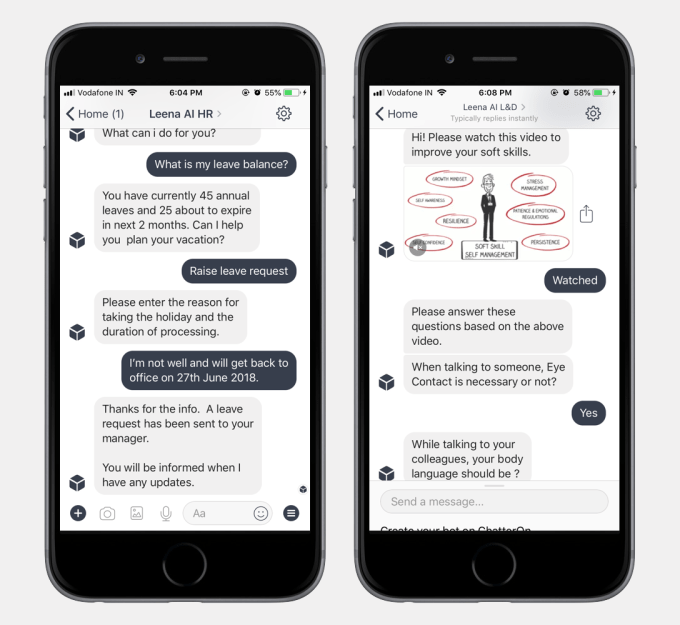
Leena AI, a recent Y Combinator graduate focusing on HR chatbots to help employees answer questions like how much vacation time they have left, announced a $2 million seed round today from a variety of investors.

Company co-founder and CEO Adit Jain says the seed money is about scaling the company and gaining customers. They hope to have 50 enterprise customers within the next 12-18 months. They currently have 16.

We wrote about the company in June when it was part of the Y Combinator Summer 2018 class. At the time Jain explained that they began in 2015 in India as a company called Chatteron. The original idea was to help others build chatbots, but like many startups, they realized there was a need not being addressed, in this case around HR, and they started Leena AI last year to focus specifically on that.

As they delved deeper into the HR problem, they found most employees had trouble getting answers to basic questions like how much vacation time they had or how to get a new baby on their health insurance. This forced a call to a help desk when the information was available online, but not always easy to find.

Jain pointed out that most HR policies are defined in policy documents, but employees don’t always know where they are. They felt a chatbot would be a good way to solve this problem and save a lot of time searching or calling for answers that should be easily found. What’s more, they learned that the vast majority of questions are fairly common and therefore easier for a system to learn.

Employees can access the Leena chatbot in Slack, Workplace by Facebook, Outlook, Skype for Business, Microsoft Teams and Cisco Spark. They also offer Web and mobile access to their service independent of these other tools.

Photo: Leena AI

What’s more, since most companies use a common set of backend HR systems like those from Oracle, SAP and NetSuite (also owned by Oracle), they have been able to build a set of standard integrators that are available out of the box with their solution.

The customer provides Leena with a handbook or a set of policy documents and they put their machine learning to work on that. Jain says, armed with this information, they can convert these documents into a structured set of questions and answers and feed that to the chatbot. They apply Natural Language Processing (NLP) to understand the question being asked and provide the correct answer.

They see room to move beyond HR and expand into other departments such as sales or customer service that could also take advantage of bots to answer a set of common questions. For now, as a recent YC graduate, they have their first bit of significant funding and they will concentrate on building HR chatbots and see where that takes them.

from Startups – TechCrunch https://ift.tt/2QDt2F8

#USA Fresh out of Y Combinator, Leena AI scores $2M seed round

//

Leena AI, a recent Y Combinator graduate focusing on HR chatbots to help employees answer questions like how much vacation time they have left, announced a $2 million seed round today from a variety of investors.

Company co-founder and CEO Adit Jain says the seed money is about scaling the company and gaining customers. They hope to have 50 enterprise customers within the next 12-18 months. They currently have 16.

We wrote about the company in June when it was part of the Y Combinator Summer 2018 class. At the time Jain explained that they began in 2015 in India as a company called Chatteron. The original idea was to help others build chatbots, but like many startups, they realized there was a need not being addressed, in this case around HR, and they started Leena AI last year to focus specifically on that.

As they delved deeper into the HR problem, they found most employees had trouble getting answers to basic questions like how much vacation time they had or how to get a new baby on their health insurance. This forced a call to a help desk when the information was available online, but not always easy to find.

Jain pointed out that most HR policies are defined in policy documents, but employees don’t always know where they are. They felt a chatbot would be a good way to solve this problem and save a lot of time searching or calling for answers that should be easily found. What’s more, they learned that the vast majority of questions are fairly common and therefore easier for a system to learn.

Employees can access the Leena chatbot in Slack, Workplace by Facebook, Outlook, Skype for Business, Microsoft Teams and Cisco Spark. They also offer Web and mobile access to their service independent of these other tools.

Photo: Leena AI

What’s more, since most companies use a common set of backend HR systems like those from Oracle, SAP and NetSuite (also owned by Oracle), they have been able to build a set of standard integrators that are available out of the box with their solution.

The customer provides Leena with a handbook or a set of policy documents and they put their machine learning to work on that. Jain says, armed with this information, they can convert these documents into a structured set of questions and answers and feed that to the chatbot. They apply Natural Language Processing (NLP) to understand the question being asked and provide the correct answer.

They see room to move beyond HR and expand into other departments such as sales or customer service that could also take advantage of bots to answer a set of common questions. For now, as a recent YC graduate, they have their first bit of significant funding and they will concentrate on building HR chatbots and see where that takes them.

from Startups – TechCrunch https://ift.tt/2QDt2F8