#USA Tandem CEO will tell you why building a bank is hard at Disrupt Berlin

//

Challenger banks, neobanks or digital-only banks… Whatever we choose to call them, Europe — and the U.K. in particular — has more than its fair share of bank upstarts battling it out for a slice of the growing fintech pie. One of those is Tandem, co-founded by financial technology veteran Ricky Knox, who we’re excited to announce will join us at TechCrunch Disrupt Berlin.

Tandem — or the so-called “Good Bank” — has been on quite a journey this year. Most recently the bank launched a competitive fixed savings product, pitting it against a whole host of incumbent and challenger banks. It followed the launch of the Tandem credit card in February, which competes well on cash-back and FX rates when spending abroad.

Both products are part of a wider strategy where, like many other consumer-facing fintechs, Tandem wants to become your financial control centre and connect you to and offer various financial services. These are either products of its own or through partnerships with other fintech startups and more established providers.

At the heart of this is the Tandem mobile app, which acts as a Personal Finance Manager (PFM), including letting you aggregate your non-Tandem bank account data from other bank accounts or credit cards you might have, in addition to managing any Tandem products you’ve taken out. The company recently acquired fintech startup Pariti to beef up its account aggregation features.

However, what makes Tandem’s recent progress all the more interesting is that it comes after a definite bump in the road last year. This saw the company temporarily lose its banking license and forced to make lay-offs following the partial collapse of a £35 million investment round from department store House of Fraser, due to restrictions on capital leaving China. The remedy was further investment from existing backers and the bold move to acquire Harrods Bank, the banking arm of the U.K.’s most famous luxury department store.

As you can see, there is plenty to talk about. And some. So, why not grab your ticket to Disrupt Berlin to listen to the Tandem story. The conference will take place on November 29-30.

In addition to fireside chats and panels, like this one, new startups will participate in the Startup Battlefield Europe to win the highly coveted Battlefield cup.


Ricky Knox

CEO & Co-Founder, Tandem

Ricky is a serial investor and entrepreuner. He has built five technology disruptors in fintech and telecoms, each of which also does a bit of good for the world.

Before Tandem he founded Azimo and Small World, two remittance businesses, and is managing partner of Hexagon Partners, a private equity firm. He built Tandem to be a digital bank that helps improve customers’ lives with money.

Ricky has a first class degree from Bristol University and an MBA from INSEAD.

from Startups – TechCrunch https://ift.tt/2pjhH0z

#USA ‘Brotopia’ inspired OODA Health to raise its $40.5M round only from firm’s with female partners

//

It’s never particularly easy to raise a round of venture capital — but I think most experienced founders will tell you its not quite as bad the second or third time around, when you’ve got some experience under your belt and a track record to present to VCs.

It helps if you’re male too, at least according to all the data out there on the gender funding gap in VC.

The leadership team at OODA Health, a startup developing technology to make the U.S. healthcare payment system more efficient, is both male and experienced. But unlike most companies of that nature, OODA decided to raise money for the business only from VC firms that have at least one female leader, a solution to one of tech’s greatest problems that is oft suggested and rarely executed.

“‘Brotopia’ really hit me hard,” OODA Health co-founder and CEO Giovanni Colella told TechCrunch.

Colella is the founder and former CEO of Castlight Health, which raised nearly $200 million in VC funding before going public on the NYSE in 2014. Co-founder and COO Seth Cohen is Castlight’s former VP of sales and alliances and co-founder and CTO Usama Fayyad is the former global chief data officer at Barclays and Yahoo .

The trio ultimately landed on lead investors Annie Lamont of Oak HC/FT and Emily Melton of DFJ, both of which have joined the company’s board of directors.

We have a responsibility of setting an example,” Colella said. “There is no machismo in what we’ve done. We are not better than you because we did it. We were blessed. We had more investors that wanted to invest than we could accommodate.”

Though the company’s c-suite is occupied by men, Cohen and Colella were quick to clarify that the rest of their founding team, head of operations Julie Skaff, head of product Sophie Pinkard and director of product strategy Midori Uehara, are women.

The team began working on OODA Health last year after Colella and Cohen agreed to build something that would upend the healthcare industry. Healthcare, they realized, is at least 20 years behind the advances in financial tech.

The pair said their real aha moment was when they learned even insurance companies — the real laggards — are ready to be rid of the slow, futile billing and payment methods that accompany any and every doctor and hospital visit.

“The idea of submitting a claim and not knowing when you are going to get reimbursed or get a bill, that has been the same for decades,” Cohen told TechCrunch. “Imagine, today, if you took a Visa card and you went to a restaurant … and then a month later received a bill, that’s how healthcare works.”

If OODA has their way, paying for a doctor’s visit will be more like paying for a hotel. You’re told upfront what you owe and you work exclusively with the insurance company to make that payment. And in this idyllic future, you won’t receive an “explanation of benefits” notice in the mail as well as a bill and subsequently fall into a downward spiral of confusion, stress and frustration.

Headquartered in San Francisco, OODA has teamed with several big-name insurance providers, including Anthem, Blue Cross Blue Shield of Arizona, Blue Shield of California, Zaffre Investments, Dignity Health and Hill Physicians to make this happen.

As far as lifting up women in VC, that’s purely been a side benefit of the overall operation.

“At the end of the day, we found two of the best investors to back us,” Cohen said.

from Startups – TechCrunch https://ift.tt/2NqnjVd

#USA Vegan meal delivery startup Allplants is served £7.5M Series A funding

//

Allplants, a London-based startup that delivers ready-made “plant-based” meals (that’s vegan, to you and me), has raised £7.5 million in Series A funding. The round is led by VC firm Octopus Ventures, which was an early backer in healthy snack delivery company Graze.

Additional investors in the round include existing backer Felix Capital (which I’m told has doubled its seed investment), Swedish VC firm Otiva, unnamed partners at VerlInvest (who are participating in a personal capacity), David Milner (ex-CEO Tyrells), Simon Nixon (founder of MoneySupermarket), and video blogger Jack Harries. Allplants reckons it is the U.K.’s largest Series A round for a vegan company.

Based on the premise that switching to a plant-based diet is the most impactful way to reduce our environmental footprint (and improve health), Allplants has developed a delivery service that wants to make it “effortlessly easy to eat more plants”. Specifically, either as a one-off or on a subscription basis, it delivers healthy, chef-made, vegan meals, for you to reheat at home.

They are “quick frozen” to lock in freshness and the idea is that you receive six meals at a time, to serve one or two people each, making the model more scalable and delivery more cost-effective. When your food is delivered you store it in your own freezer and cook/eat as needed, before your next order.

Since being founded in 2017 by brothers Jonathan and Alex Petrides, Allplants says it has served over 250,000 meals nationwide to plant-inspired foodies and built a “movement” with over 70,000 online fans. Notably, the company is a B-Corp, promising to do good by people and the planet.

Meanwhile, Allplants says it will use the investment to develop a broader range of ready-to-eat food, accelerate the growth of its community, further grow its North London-based 40-plus team, and expand the capacity of its production kitchen, which will operate on renewable and waste-created energy.

Adds Allplants’ Jonathan Petrides: “Most allplants customers aren’t veggie or vegan, they’re curious and hunting for convenient, healthy ways to boost their busy lives. This investment well help us fuel the plant-based movement forward”.

from Startups – TechCrunch https://ift.tt/2xvGtOG

#USA Committed to privacy, Snips founder wants to take on Alexa and Google, with blockchain

//

Earlier this year we saw the headlines of how the users of popular voice assistants like Alexa and Siri and continue to face issues when their private data is compromised, or even sent to random people. In May it was reported that Amazon’s Alexa recorded a private conversation and sent it to a random contact. Amazon insists its Echo devices aren’t always recording, but it did confirm the audio was sent.

The story could be a harbinger of things to come when voice becomes more and more ubiquitous. After all, Amazon announced the launch of Alexa for Hospitality, its Alexa system for hotels, in June. News stories like this simply reinforce the idea that voice control is seeping into our daily lives.

The French startup Snips thinks it might have an answer to the issue of security and data privacy. Its built its software to run 100% on-device, independently from the cloud. As a result, user data is processed on the device itself, acting as a potentially stronger guarantor of privacy. Unlike centralized assistants like Alexa and Google, Snips knows nothing about its users.

Its approach is convincing investors. To date, Snips has raised €22 million in funding from investors like Korelya Capital, MAIF Avenir, BPI France and Eniac Ventures. Created in 2013 by 3 PhDs, and now employing more than 60 people in Paris and New York, Snips offers its voice assistant technology as a white-labelled solution for enterprise device manufacturers.

It’s tested its theories about voice by releasing the result of a consumer poll. The survey of 410 people found that 66% of respondents said they would be apprehensive of using a voice assistant in a hotel room, because of concerns over privacy, 90% said they would like to control the ways corporations use their data, even if it meant sacrificing convenience.

“Сonsumers are increasingly aware of the privacy concerns with voice assistants that rely on cloud storage — and that these concerns will actually impact their usage,” says Dr Rand Hindi, co-founder and CEO at Snips. “However, emerging technologies like blockchain are helping us to create safer and fairer alternatives for voice assistants.”

Indeed, blockchain is very much part of Snip’s future. As Hindi told TechCrunch in May, the company will release a new set of consumer devices independent of its enterprise business. The idea is to create a consumer business that will prompt further enterprise development. At the same time, they will issue a cryptographic token via an ICO to incentivize developers to improve the Snips platform, as an alternative to using data from consumers. The theory goes that this will put it at odds with the approach used by Google and Amazon, who are constantly criticised for invading our private lives merely to improve their platforms.

As a result Hindi believes that as voice-controlled devices become an increasingly common sight in public spaces, there could be a significant shift in public opinion about how their privacy is being protected.

In an interview conducted last month with TechCrunch, Hindi told me the company’s plans for its new consumer product are well advanced, and will be designed from the beginning to be improved over time using a combination of decentralized machine learning and cryptography.

By using blockchain technology to share data, they will be able to train the network “without ever anybody sending unencrypted data anywhere,” he told me.

And ‘training the network” is where it gets interesting. By issuing a cryptographic token for developers to use, Hindi says they will incentivize devs to work on their platform and process data in a decentralized fashion. They are starting from a good place. He claims they already have 14,000 developers on the platform who will be further incentivized by a token economy.

“Otherwise people have no incentive to process that data in a decentralized fashion, right?” he says.

“We got into blockchain because we’re trying to find a way to get people to participate in decentralized machine learning. We’ve been wanting to get into consumer [devices] for a couple of years but didn’t really figure out the end goal because we had always had this missing element which was: how do you keep making it better over time.”

“This is the main argument for Google and Amazon to pretend that you need to send your data to them, to make the service better. If we can fix this [by using blockchain] then we can offer a real alternative to Alexa that guarantees Privacy by Design,” he says.

“We now have over 14000 developers building for us and that’s really completely organic growth, zero marketing, purely word of mouth, which is really nice because it shows that there’s a very big demand for decentralized voice assistance, effectively.”

It could be a high-risk strategy. Launching a voice-controlled device is one thing. Layering it with applications produced by developed supposedly incentivized by tokens, especially when crypto prices have crashed, is quite another.

It does definitely feel like a moonshot idea, however, and we’ll really only know if Snips can live up to such lofty ideals after the launch.

from Startups – TechCrunch https://ift.tt/2NnQYhY

#USA Inside the pay-for-post ICO industry

//

In a world where nothing can be trusted and fake news abounds, ICO and crypto teams are further muddying the waters by trying – and often failing – to pay for posts. While bribes for blogs is nothing new, sadly the current crop of ICO creators and crypto projects are particularly interested in scaling fast and many ICO CEOs are far happier with scammy multi-level marketing tricks than real media relations.

The worst part of this spammy, scammy ecosystem is the service providers. A new group of media organizations are appearing where pay-to-post is the norm rather than the rare exception. I’ve been looking at these groups for a while now and recently found a few egregious examples.

But first some background.

Oh yeah, Mr. Smart Guy? How do I get press?

Say you’re trying to publicize a startup. You’ve emailed all the big names in the industry and the emails have gone unanswered. Your product is about to flounder on the market without users and you can’t get any because, in perfect chicken-or-egg fashion, you can’t get funding without users and you can’t get users without funding. So isn’t it a good idea to pay a few dollars for a little press?

No.

And isn’t most PR just pay-for-post anyway?

No.

PR people are consummate networkers and are paid to reach out to media on your behalf and their particular set of skills, honed over long careers, are dedicated to breaking down the forcefield between the journalist and the outside world. They are your surrogate hustlers, dedicated to getting you more exposure. A good PR person is worth their weight in gold. They can call up a popular journalist and make a simple pitch: “This cool new thing is happening. Can I put you in touch?”

If a journalist’s mission is to afflict the comfortable and comfort the afflicted, a good PR person makes the comfortable look slightly afflicted in order to give the journalist a better story. Also, like velociraptors, they are tenacious and will follow up multiple times on your behalf.

A bad PR person, on the other hand, will cold-call hundreds of journalists and read a script that is half the length of Moby Dick. They produce little more than spam and their efforts begin and end with pressing the “Send” button. It’s also interesting to note that many bad PR people, of late, have found new life as ICO specialists.

Now meet the pay-for-post hucksters. As I wrote before, there is now a subset of the PR world that offers to get your press release or story on the top of various websites for the low, low price of between $500 and $13,000. For example, one set of hucksters created a small business selling posts on Harvard.edu by creating garbage WordPress blogs and posting press releases to increase SEO coverage. Further, I received a document that outlined the prices for placement in various blogs including this one. While it is impossible to buy a post on TechCrunch this way, it doesn’t stop many from trying.

What’s the difference between that price list and the job a PR person will do for you? The difference is trust. A pay-for-post huckster is dependent on convincing poorly paid freelance writers to add links and other dross to their posts in order to get a “placement.” I get requests like this almost every day and almost all the journalists I talked to reported the same.

Some entrepreneurs are savvy enough to avoid these scams. Even more aren’t.

“I’ve never paid since I think it’s almost always a waste of money but I’ve been offered this type of coverage many times,” said Rick Ramos, of HealthJoy.com. “The last offer was for Kathy Ireland’s Worldwide Business… A TV show that I’ve never heard of in my life. I’ve also been approached by niche publications like InsuranceOutlook and HealthCareTechOutlook that want $3,000 for a ‘reprint branding package.’ A quick Alexa.com search shows their rank as 1,725,207 and 1,054,501 globally. I think I get pitched at least every six months for one of these types of packages.

Unfortunately, many of these organizations hide their request for payment until the last minute. That said, how do you know when it’s someone selling pay-for-play vs. a real editor? It’s usually obvious.

“It’s usually pretty easy to sniff out based on their email blast. It’s pretty untargeted with no reference to what your company does or how it related to a story. Some people are up front about the payment but others want a ’15 min call to discuss.’ A quick LinkedIn search always shows them as a sales person versus a reporter or editor,” said Ramos.

It’s getting worse

This is a document I received from a company attempting an ICO. This sort of menu was quite uncommon until fairly recently when the “on-demand” economy melded with PR scammers. The completeness of the document is unique – you could feasibly plan your own PR efforts just by reaching out to journalists who work at all of these places. But you’ll also note that each spot has its own price, often in the low hundreds of dollars, which means that those spots are mostly pay-for-play anyway.


ICOLists by on Scribd


No PR company can promise coverage. In fact, many pay-for-play folks mention this in their communications, hiding it in plain sight. This snippet of text appeared in a contract for work from one of the pay-for-play providers. In short, you’re paying for something they cannot guarantee to get. Interestingly, the PR company below calls their product an IO – an insertion order – which is language used in ad sales. Further, they take great pains in explaining that it is almost impossible to achieve what they promise.
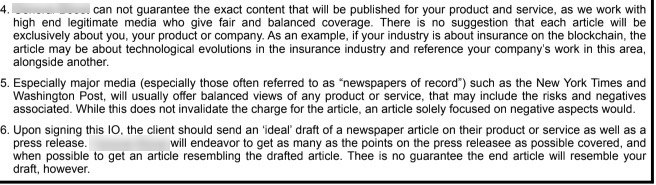
None of the pay-for-post folks I mentioned here would respond to my requests for comment.

Counter-point: Journalists are also at fault
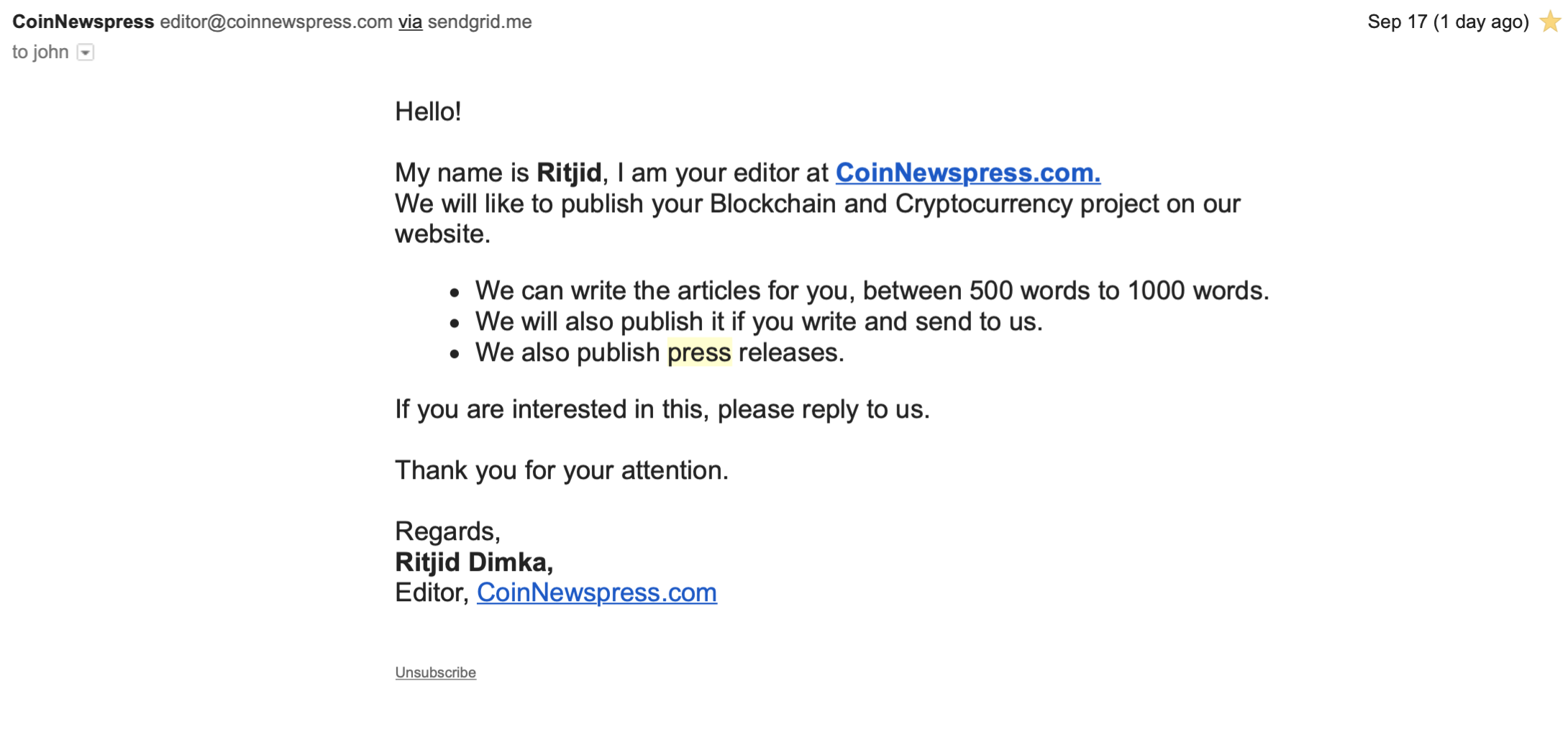
Journalists should never expect money for coverage.

Yet many do.

“Lately I have worked on a number of blockchain technology pieces and I have encountered a wide variety of these asks,” said Brittany Whitmore, CEO at Exvera Communications. “A lot of the new, smaller blockchain-focused outlets seem to do a lot of pay-to-play, likely trying to capitalize on the ICO gold rush. The strangest request that I received was that the outlet would do a an article about the news for free but only if we paid them over $1,000 to promote the article with ads. I did not proceed.”

In one very detailed article on The Outline, Jon Christian explored this world and found that many writers received small sums for a single brand mention in a story, a sort of SEO flogging that rarely helps. He wrote:

An unpaid contributor to the Huffington Post, also speaking on condition of anonymity because, in his words, “I would be pretty fucked if my name got out there,” said that he has included sponsored references to brands in his articles for years, in articles on the Huffington Post and other sites, on behalf of six separate agencies. Some agencies pay him directly, he said, in amounts that can be as small as $50 or $175, but others pay him through an employee’s personal PayPal account in order to obfuscate the source of the funds. In a statement, Huffington Post said “Using the HuffPost Contributors Network to self-publish paid content violates our terms of use. Anyone we discover to be engaging in such abuse has their post removed from the site and is banned from future publication.”
The Huffington Post writer also described specific brands he’d written about on behalf of one of the agencies, which ranged from a popular ride-hailing app, to a publicly-traded site for booking flights and hotels, to a large American cell phone service provider.
“This is a classic example of payola,” he said of the brand mentions, invoking a term that’s been used to describe radio DJs who accept payments from record companies in order to play certain artists on the air.

Further, many influencers – folks who sell their Internet fame to the highest bidder – masquerade as journalists, asking for outrageous sums to flog an ICO on their YouTube channel or Instagram page. Pay-for-play services can also put out organic content like this in hopes of appearing in the news.

The rule of thumb? Paid posts and native advertising are not journalism. Ultimately, journalists who charge for coverage are marketers. No one at any reputable news organization will ask for cash but, sadly, there are a number of disreputable news organizations making the rounds.

ICO spamming/Don’t do it

All this still doesn’t answer the question: Should you pay-to-post?

“The short answer is no,” said Kevin Bourke of BourkePR. “I get asked all the time, and in fact, turned down another request just today. And I advise my clients to decline these offers as well.”

Pay-for-post disrupts journalism in a way that should be familiar and desirable to any modern-day entrepreneur. Middlemen are being knocked out everywhere and brands are approaching consumers from every angle including native ads in Instagram and Twitter. But the value of coverage – real coverage – from a journalists perspective is the opportunity to explain complex ideas to a ready audience. While posting a picture of a blockchain on Facebook and hoping for clicks is one strategy, explaining your views, opinions, and insights is far more important even if you approach it from a mercenary position.

“When you start paying for placement, you remove objectivity and credibility, and in my opinion, this is the reason you look for coverage of your company/products in the first place. That’s what influences readers/viewers. But I understand the temptation for startups. You come to believe that ‘all visibility is good visibility.’ I just can’t agree with that,” said Bourke. “I see the trend toward paid placements (now called sponsored content), paid awards and I can’t stand it – especially with the trade show awards in high tech. They’ve completely devalued the Best of Show awards in so many cases. Typically, only the big companies with budgets can afford them, so many of the smaller guys with no money but amazing products get left out. I understand that the publishing industry needs to figure out new revenue streams – these are very difficult times for them. But they need to figure out smarter business models and maintain the integrity of editorialized content, built on the opinions and perspectives of journalists and influencers.”

from Startups – TechCrunch https://ift.tt/2QLgHiq


#USA Rent the Runway opens physical store in San Francisco

//

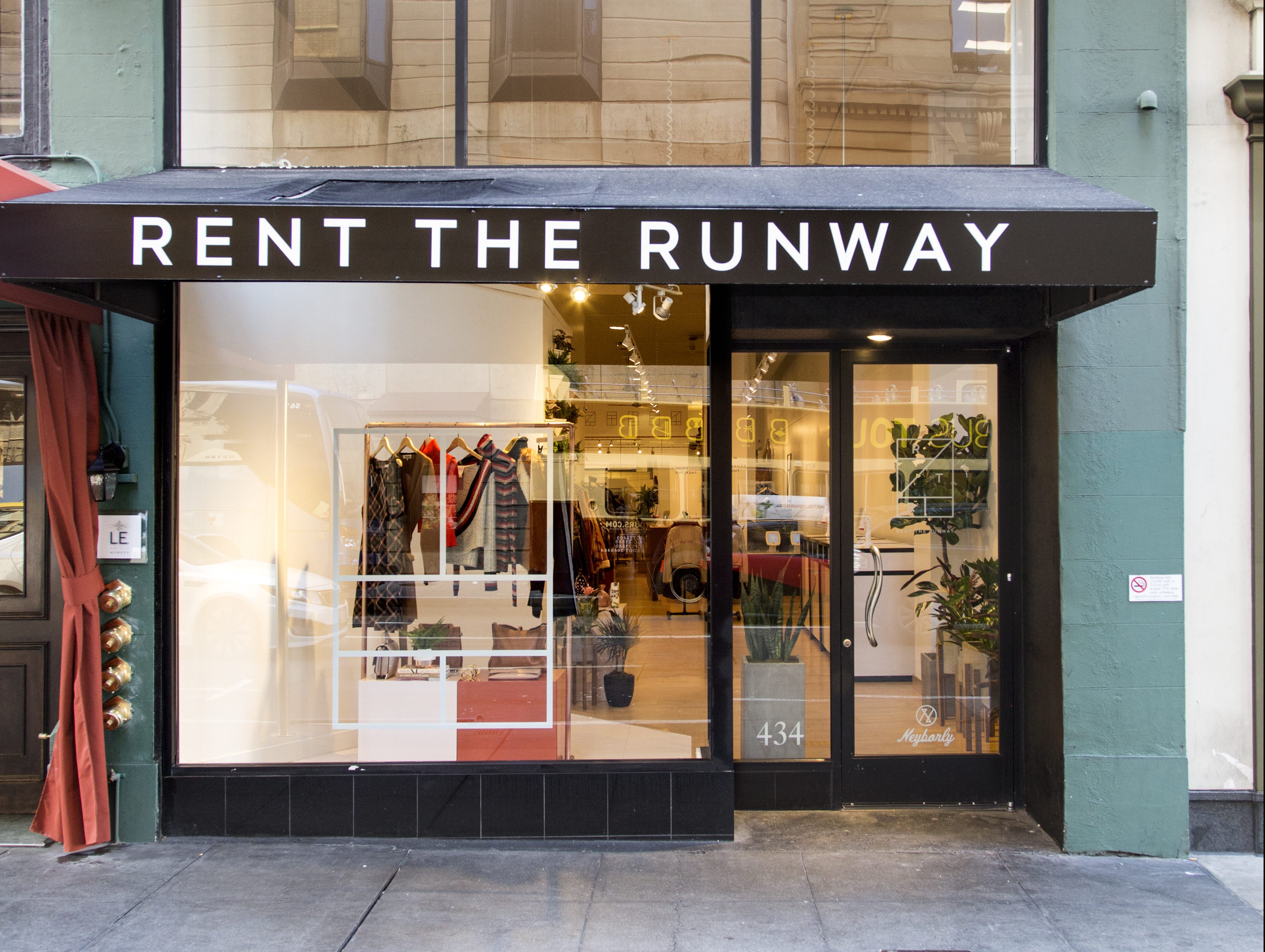
Rent the Runway, the fashion startup that began as a rental service for special occasions and has since evolved over the last couple of years into a service for people also looking to spice up their everyday wear, just opened up its fifth physical, standalone location. The new location, in downtown San Francisco, enables Rent the Runway members to try on clothes, rent and return them.

Rent the Runway’s launch of a standalone brick-and-mortar location in San Francisco comes after it first opened up a location inside Neiman Marcus. With a standalone location, the company is able to offer longer hours for its members. Instead of opening at 10 a.m. and closing at 7 p.m., Rent the Runway can now stay open from 9 a.m. – 8 p.m. Monday through Friday. It also, of course, has weekend hours.

Thanks to some technology Rent the Runway developed within the last year, it has essentially “legalized shoplifting” for its members, Rent the Runway COO Maureen Sullivan told me yesterday ahead of the store’s launch. Toward the front of the store, there’s a self-return process that enables anyone to quickly return their items. A little farther back in the store, there’s a handful of self-checkout kiosks that let members quickly scan their items and leave.

Since its launch about nine years ago, Rent the Runway has launched two additional product offerings. In addition to its standard Reserve product, a one-time rental, Rent the Runway now offers two subscription products. The first is called Unlimited, which lets members rent four items at a time on a constant rotation (meaning you can swap them out as much as you want) for $159 a month.

The second is called Update, which lets you rent just four items for the whole month for $89 per month. In the event someone really likes what they’ve rented, they always have the option to purchase the item at anywhere from 10 percent to 75 percent off. Today, the subscription products make up 50 percent of Rent the Runway’s revenue, with San Francisco as the third largest subscription market.

In the nine years or so Rent the Runway has been around, a number of other services have cropped up around fashion. Stitch Fix, which went public last November, and Trunk Club by Nordstrom are two of the big ones. But what differentiates Rent the Runway from the likes of Stitch Fix is that, “they’re trying to get you to buy stuff,” Sullivan said. “You’re still buying things that accumulate in your closet.”

The vision with Rent the runway is to get to the point where 50 percent of your closet is rented, and therefore less cluttered. Rent the Runway, for example, has some customers who wear rented clothes 120 days out of the year.

Rent the Runway currently partners with over 500 brands, and operates as a new type of distribution channel for them. What Rent the Runway offers for brands is marketing and discovery, and customer data.

Down the road, Rent the Runway does envision getting into men’s clothing Sullivan said, but right now, there’s “unprecedented growth” in women’s clothing, so that’s where the focus will be for now.

Back in August, Rent the Runway partnered with Temasek for a $200 million credit facility. Before that deal, Rent the Runway had raised more than $200 million from traditional investors like KPCBC, Highland Capital, Bain Capital, TCV and others.

from Startups – TechCrunch https://ift.tt/2QCVQxA

#USA Spire Health Tags are now on Apple’s shelves

//

Spire’s Health Tags, the dark and tiny devices you stick on your clothes to gather all sorts of health data from your steps, heartbeat and stress levels is now available at your local Apple Store.

The company started out with a breath tracking device to detect when you are feeling tense and help calm you down. But four years in and its now all about the wearable “tags” you stick on items of clothing like your pants or sports bra.

Yes, yes, there are lots of gadgets out there to gather similar information — the Apple Watch will now even detect if you have a fall or something is wrong with your heart — but the Spire health tag is nothing like a Fitbit or Apple Watch, according to the company. For one, there’s zero need to charge the device. One tag’s battery will last a year and a half before dying out. They’re also machine washable. You just pick a few outfits and stick a tag on each of them.

Of course a few other startups out there are working on making smart, washable, data-gathering clothes. Enflux makes the clothing and then sews in the motion sensor to tell you if you are lifting correctly. Vitali is a “smart” bra with a built-in sensor to detect stress. Then there’s OmSignal, which makes body-hugging workout clothes that gather “medical-grade biometric data to achieve optimal health.” But these tiny health tags are different in that they allow you to choose the clothes you want to adhere the monitor to.

Like Spire’s first product, the Stone, which earned more than $8 million in sales, according to the company, the tags will also pick up on times of stress and help calm you down through a series of breaths and focus on the app.

“Continuous health data will revolutionize health and wellness globally, but early incarnations have been hampered by poor user experiences and a focus on the hardware over the outcomes that the hardware can create,” Spire’s founder Jonathan Palley said. “By making the device ‘disappear’, we believe Health Tag is the first product to unlock the potential.”

Spire’s Health Tags will be sold in Apple Stores as a three-pack for $130, six-pack for $230 and an eight-pack for $300, with additional pack sizes available on the company’s website.

from Startups – TechCrunch https://ift.tt/2OzI9OA

#USA The Gap Table: Women own just 9% of startup equity

//

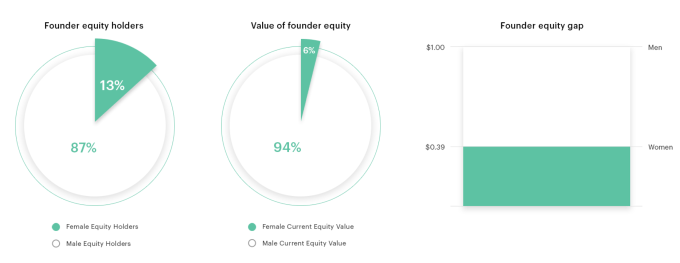
Even bigger than the salary gap that sees women earn $.82 on the dollar is the equity gap. A new study from Carta and the ex-Twitter female investor group #Angels reveals that women make up 35 percent of startup equity-holding employees, yet own just 20 percent of the equity. That means they own just $0.47 for every $1 that men own. Even worse, women account for 13 percent of startup founder but just 6 percent of founder equity — or merely $0.39 on the dollar.

Combined, that means only 9 percent of founder and employee startup equity is owned by women.

“This is not just about wealth” says #Angels’ Chloe Sladden. “Wealth from successful exits goes on to shape the entire industry. It’s about who has power and who gets to decide what gets funded.” #Angels’ Jessica Verrilli notes that “Having this data is going to  be a watershed moment and catalyze more urgency to address this underrepresentation.”

The study by cap table management tool Carta (formerly eShares) looked at a subset of its privately held company customers including roughly 180,000 employees, 15,000 founders, and 6,000 companies encompassing $45 billion in equity value.

#Angels’ Jana Messerschmidt explains that the gap table spotlights how women aren’t being hired for early engineering and leadership poisitions. These roles often get the lion’s share of equity, and when women are hired for sales, marketing, and HR jobs, “those folks are getting less equity because they are joining later and we have a hypothesis of how those roles are valued differently.” Sladden reminds founders to focus on diversity from day one. “Don’t push this off as something you’ll fix down the road as you’re facing all the other challenges.”

Once a successful startup gets acquired or IPOs and paper money turns into cash, tech workers often reinvest their winnings into more startups as angels, fund LPs, or by starting their own venture firm. If only men are getting enough equity to make those downstream investments, their biases could further unbalance the gender breakdown of the tech industry. The #Angels say they’ve found this translates into fewer fundraising term sheets and bargaining power for female founders when they come to the Sand Hill Road boy’s club for venture capital.

Beyond more diverse hiring, the #Angels believe it’s critical that the industry dymystify equity so more women know how to exercise stock options and score tax advantages for maximum gain. “You shouldn’t need to have an MBA to know the importance of equity and how to negotiate for it” says Sladden. Better financing avenues for those women who need up-front capital to exercise their stock options could also ensure it’s not just those who already have money who can make money through equity.

Sladden concludes, “We hope this is going to start a movement. We hope that CEOs will start to measure it and talk about it.”

from Startups – TechCrunch https://ift.tt/2xCxYBJ

#USA Lyft hits 1 billion rides a couple of months after Uber hit 10 billion trips

//

Today marks a big milestone for Lyft — one billion rides. That’s a milestone Uber hit in December 2015. Uber has since grown to 10 billion trips completed — including Eats deliveries — as of this past July. Uber, of course, had a bit of head start given it launched in 2009 while Lyft first launched in 2012.

This milestone for Lyft comes about a year after it announced it was completing one million rides a day. To celebrate it, Lyft employees are surprising 3,500 drives with a free tank of gas.

Earlier this month, Lyft officially entered the scooter sharing space when it launched electric scooters in Denver, Colo. Lyft has since deployed its scooters in Santa Monica, Calif. as part of the city’s pilot program. Lyft’s entrance into scooters came close after its acquisition of bike-share company Motivate. We’ll be watching closely to see how Lyft’s additional modes of transportation impacts number of trips completed.

from Startups – TechCrunch https://ift.tt/2D4mZqq

#USA Framer X design tool steps in the ring with InVision, Adobe, and Sketch

//

Design tools are becoming increasingly important to just about every brand out there. Today, a new entrant joins the race.

Framer X, a revamped version of three-year-old Framer, was founded by Koen Bok and Jorn van Dijk after the duo sold design software Sofa to Facebook in 2011. Framer X is a rich, React-based design tool that lets any designer draw out their interface components and instantly send them over to the engineering team for collaboration.

The key here is reusability and fidelity. With Framer X, engineers can send over existing components that are in production and let designers move forward from there. Conversely, designers aren’t sending developers a facsimile of a button or icon but the actual SVG code behind that component.

Framer X also allows users to collect components and other design items as a package within the Framer X store, so that they’re easily accessible during the design process. Framer X offers a public Framer X Store where casual designers can build off of the experience of advanced designers who’ve uploaded components to the store.

The company also allows enterprises to launch their own private store for use within the organization.

Framer costs $15/month for users, and private Framer X stores for the enterprise are priced flexibly based on the size of the organization.

Framer now joins a competitive landscape, which includes the likes of InVision, Adobe, and Sketch .

The company says it has around 50,000 monthly active users, with 200 companies (including Google, Facebook and Dropbox) using the product. Framer has raised $9 million to date from Greylock, Foundation Capital, Designer Fund, and Accel Europe.

from Startups – TechCrunch https://ift.tt/2xtslW9