
#USA How Jyve secretly raised $35M & built a $400M retail gig economy

//

What if instead of just accepting Uber rides, gig workers could pick from higher paying skilled tasks around town like stocking shelves, checking inventory, or driving a forklift at a local grocer? When they work quickly and accurately or learn new trades, they get to choose between more complex jobs. That’s the idea that’s racked up $400 million in staffing contracts for Jyve, an on-demand labor platform that’s coming out of stealth today after 3.5 years.

“I believe the skill economy is way bigger than the gig economy” says CEO Brad Oberwager. He sees Uber driving as just the low-expertise beginning of a massive new job type where people with specializations or experience are efficiently matched to retail work. Jyve’s secret sauce is the work quality review system built into its app for managers and stores that lets it know who got the job done right and deserves even better opportunities.
Jyve’s potential to become the skilled labor marketplace has quietly attracted $35 million in funding across a seed and Series A round raised over the past few years led by SignalFire and joined by Crosscut Ventures and Ridge Ventures. “Jyve is one of the fastest-growing companies we’ve seen, having already reached $400 million in bookings in three short years” writes Chris Farmer, CEO of SignalFire. “They are creating a new economic class.”

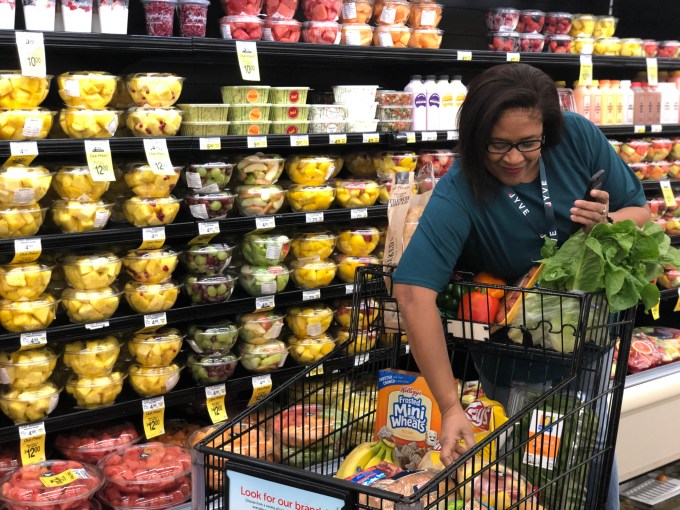
It’s all because Safeway hasn’t touched a bag of Doritos in 50 years, CEO Brad Oberwager tells me. Grocery stores have long outsourced the shelving and arrangement of products to the big brands that make them, which is why the retail consumer packaged good industry employs 10 million people in the US, or over 10% of the country’s workforce. But instead of relying on one person to drive goods to the store, load them in, and shelve them, Jyve can divide those tasks up and match them to neraby people with sufficient skills to cut costs.

“Retail isn’t dying, it’s changing, and brands that are thriving are the ones investing in their in-store experience as well as owning their e-commerce initiatives,” observed Brad Oberwager, CEO and founder of Jyve. “The question we must ask then is how do we fill this labor shortage and also enable people to refine special skills that are multi-dimensional and rewarding.”
Oberwager knows the tribulations of grocery shelving well. He built online drugstore More.com before the dot com boom, then started making his own food products. He created True Fruit Cups, one of the country’s largest importer of grapefruit, and founded and sold his Bare apple chips company. Competing for shelf space with big brands paying workers to setup elaborate displays in grocers, he saw a chance to reimagine retail labor.

But it was when his daughter got sick and he realized the surgeon who performed the operation was essentially a high-skilled mercenary that he seized on the opportunity beyond grocers. “He walks in, does the surgery, walks out. He’s a gig worker, but it’s a skill I’m willing to pay a lot for” says Oberwager.
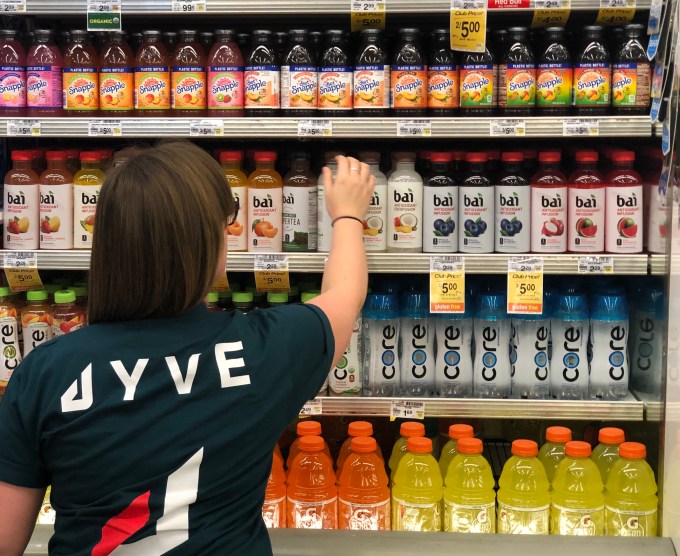
He created Jyve to aggregate the demand from different stores and the skills from different workers. When somene signs up for Jyve, they start with easier tasks like moving boxes in the backroom. If they do that well, they could unlock higher paying shelf stocking and display arrangement, then product ordering and brand abassadorship. At each step, they take photos and leave comments about their work that are reviewed by a combination of store and brand managers, as well as Jyve’s machine vision algorithms and human quality control team. It can quickly tell if someone puts the Cheerios box on the shelf the wrong way, and won’t give them public-facing tasks if they don’t improve

“70% of our market managers were originally drivers, and they become w2 workers” Oberwager says proudly. Jyve even makes it easy for brands and retailers to hire its top giggers for full-time jobs. Why would the startup allow that? “I want to put it on  billboard, “Work hard, get promoted” he tells me. The fact that Oberwager’s last name could be interpreted as “higher wages” in German makes Jyve seem like his destiny.

Keeping work quality up to snuff will be a challenge, but by dangling higher wages, Jyve aligns its incentives with its workers. The bigger hurdle may be convincing big brands and retail institutions to change the way they’ve done staffing forever. Oberwager professes that it takes a long time to onboard, but also a long time to offboard so it could build a solid moat if it’s the first to win this market. Jyve is now in over 1200 cities across the US, and a real-time map showed a plethora of gigs available around San Francisco during the demo.

Oberwager admthat the unskilled gig economy is “a little dehumanizing. It makes people a cog in a machine.” But he hopes each “Jyver” as he calls them can become more like a circuit – a complex machine of its own that powers something bigger.

from Startups – TechCrunch https://tcrn.ch/2R9MF6Q

#USA How Jyve secretly raised $35M & built a $400M retail gig economy

//

What if instead of just accepting Uber rides, gig workers could pick from higher paying skilled tasks around town like stocking shelves, checking inventory, or driving a forklift at a local grocer? When they work quickly and accurately or learn new trades, they get to choose between more complex jobs. That’s the idea that’s racked up $400 million in staffing contracts for Jyve, an on-demand labor platform that’s coming out of stealth today after 3.5 years.

“I believe the skill economy is way bigger than the gig economy” says CEO Brad Oberwager. He sees Uber driving as just the low-expertise beginning of a massive new job type where people with specializations or experience are efficiently matched to retail work. Jyve’s secret sauce is the work quality review system built into its app for managers and stores that lets it know who got the job done right and deserves even better opportunities.

Jyve’s potential to become the skilled labor marketplace has quietly attracted $35 million in funding across a seed and Series A round raised over the past few years led by SignalFire and joined by Crosscut Ventures and Ridge Ventures. “Jyve is one of the fastest-growing companies we’ve seen, having already reached $400 million in bookings in three short years” writes Chris Farmer, CEO of SignalFire. “They are creating a new economic class.”

It’s all because Safeway hasn’t touched a bag of Doritos in 50 years, CEO Brad Oberwager tells me. Grocery stores have long outsourced the shelving and arrangement of products to the big brands that make them, which is why the retail consumer packaged good industry employs 10 million people in the US, or over 10% of the country’s workforce. But instead of relying on one person to drive goods to the store, load them in, and shelve them, Jyve can divide those tasks up and match them to neraby people with sufficient skills to cut costs.

“Retail isn’t dying, it’s changing, and brands that are thriving are the ones investing in their in-store experience as well as owning their e-commerce initiatives,” observed Brad Oberwager, CEO and founder of Jyve. “The question we must ask then is how do we fill this labor shortage and also enable people to refine special skills that are multi-dimensional and rewarding.”

Oberwager knows the tribulations of grocery shelving well. He built online drugstore More.com before the dot com boom, then started making his own food products. He created True Fruit Cups, one of the country’s largest importer of grapefruit, and founded and sold his Bare apple chips company. Competing for shelf space with big brands paying workers to setup elaborate displays in grocers, he saw a chance to reimagine retail labor.

But it was when his daughter got sick and he realized the surgeon who performed the operation was essentially a high-skilled mercenary that he seized on the opportunity beyond grocers. “He walks in, does the surgery, walks out. He’s a gig worker, but it’s a skill I’m willing to pay a lot for” says Oberwager.

He created Jyve to aggregate the demand from different stores and the skills from different workers. When somene signs up for Jyve, they start with easier tasks like moving boxes in the backroom. If they do that well, they could unlock higher paying shelf stocking and display arrangement, then product ordering and brand abassadorship. At each step, they take photos and leave comments about their work that are reviewed by a combination of store and brand managers, as well as Jyve’s machine vision algorithms and human quality control team. It can quickly tell if someone puts the Cheerios box on the shelf the wrong way, and won’t give them public-facing tasks if they don’t improve

“70% of our market managers were originally drivers, and they become w2 workers” Oberwager says proudly. Jyve even makes it easy for brands and retailers to hire its top giggers for full-time jobs. Why would the startup allow that? “I want to put it on  billboard, “Work hard, get promoted” he tells me. The fact that Oberwager’s last name could be interpreted as “higher wages” in German makes Jyve seem like his destiny.

Keeping work quality up to snuff will be a challenge, but by dangling higher wages, Jyve aligns its incentives with its workers. The bigger hurdle may be convincing big brands and retail institutions to change the way they’ve done staffing forever. Oberwager professes that it takes a long time to onboard, but also a long time to offboard so it could build a solid moat if it’s the first to win this market. Jyve is now in over 1200 cities across the US, and a real-time map showed a plethora of gigs available around San Francisco during the demo.

Oberwager admthat the unskilled gig economy is “a little dehumanizing. It makes people a cog in a machine.” But he hopes each “Jyver” as he calls them can become more like a circuit – a complex machine of its own that powers something bigger.

from Startups – TechCrunch https://tcrn.ch/2R9MF6Q

#USA After an abrupt shutdown, Munchery’s small business vendors are the ones picking up the bill

//

Munchery’s vendors claim the food delivery startup took advantage of them in its final hours, knowingly allowing them to continue making deliveries it couldn’t pay for.

Earlier this week, Munchery surprised customers with an email announcing it would cease operations, effective immediately. It did not, however, notify any of its vendors of the news, according to the owners of several small San Francisco-based businesses, who told TechCrunch they are owed thousands in overdue Munchery payments.

Charles Farriér, the owner of Crumble & Whisk Patisserie, is waiting on a $1,700 payment from Munchery. Lenore Estrada of Three Babes Bakeshop said she’s owed more than $20,000. Melissa Cohen of Salty Sweet Cookies, Jennifer Roy of Dandelion Chocolate and Jennifer Nguyen of Native Baking Co. are expecting a total of $16,417.50.

Munchery was founded in 2010 by former chief executive officer Tri Tran and Conrad Chu, who have both since left the company. It had raised a total of $125 million in venture capital funding, reaching a valuation of $300 million at its peak. Supported by notable Silicon Valley investors, including Greycroft, Menlo Ventures and Sherpa Capital, the high-flying startup failed to deploy capital efficiently, then crumbled. 

Now, three days after its sudden announcement, several vendors are waiting anxiously for their final invoice checks, and say they weren’t notified of Munchery’s end, nor has the business responded to persistent requests for explanations.

Munchery has not responded to multiple requests for comment from TechCrunch . As of Thursday morning, Munchery had not officially filed for bankruptcy in the Federal Court or in the Superior Court of San Francisco.

Munchery chief executive officer James Beriker joined the startup in 2016.

Gone without a trace

Days before Christmas, Farriér was told to slow down production of his artisan cheesecakes, which he had been servicing to Munchery for three years.

Munchery provided prepared meals to residents in San Francisco, Los Angeles, Seattle and New York. In addition to preparing ingredients in-house in its South San Francisco headquarters, the startup also partnered with local businesses, like Crumble & Whisk, whose baked goods were included with its meals.

Unlike the other business owners TechCrunch spoke with, Farriér said he had caught on to Munchery’s financial struggles after multiple late payments, and was on the verge of ending his relationship with the business entirely. Little did he know they were just weeks away from an implosion, that, according to sources, even some Munchery employees weren’t aware of until 24 hours before the end of business announcement was sent to customers.

Charles Farriér, the owner of San Francisco-based bakery Crumble & Whisk Patisserie.

“Today, with a heavy heart, we’re reaching out to announce that Munchery is closing its doors,” the business wrote in an email signed “Team Munchery.” “More than anything, we want to say thank you. Thank you for all of the love and support you have shown us over the years, for sharing us with your friends and family, and for including us in your special life moments.”

Beriker, who joined the startup as CEO in November 2016 after a four-year stint as the chief executive of recruitment firm Simply Hired, was missing from the signature of the email. Beriker has gone dark, opting not to respond to media requests, as well as emails and phone calls from vendors looking for payment.

“Munchery ran into a wall rather than planning to shut down in an orderly fashion,” Munchery vendor Lenore Estrada told TechCrunch.

When Farriér heard the news on Monday, he went to Munchery’s headquarters seeking his final payment. To his surprise, no one, except another aggravated vendor, was there. The $1,700 Farriér is owed may be equivalent to the cost of a dinner with colleagues for some Silicon Valley entrepreneurs, but for him, it’s meant being forced to take out a loan to pay his employees.

“They just expect us to sit back and take it but we need that money to keep our businesses afloat,” Farriér told TechCrunch. “It may be pennies to them but it’s money to us, we cannot stay afloat without being paid. It hurt my business; I had to take out a loan; I had to tell my staff I couldn’t pay them this week.”

Farriér has worked with a number of tech-enabled food delivery platforms, including Good Eggs and Sprig, which similarly went out of business in May 2017. Contrary to how Munchery has handled its sudden ending, however, Sprig, he said, ensured all vendors were paid the same day the startup notified them that it would cease operations.

“The sad part about this whole situation is [Munchery] didn’t even have the courtesy or the respect to let the vendors know,” Farriér added. “It’s a real slap in the face.”

Bakers await payments

Estrada of Three Babes Bakeshop said she’s heard nothing from Munchery about its shutdown or the $20,000 owed her. Cohen, Roy and Nguyen similarly told TechCrunch they’ve attempted to reach out to Munchery, to no avail.

Dandelion Chocolate owner Jennifer Roy says Munchery owes her $6,000.

“The thing that’s really baffling to me is why they didn’t call it earlier,” Estrada told TechCrunch. “When I was there [Tuesday], there was a truck leaving with food that had been donated. Munchery ran into a wall rather than planning to shut down in an orderly fashion. That’s just crazy, as I’m sure they knew how much runway they had.”

Estrada and Nguyen said Munchery had standing orders with both Three Babes Bakery and Native Baking Co. Three Babes had planned to make their delivery Tuesday, one day after Munchery announced they were going out of business. Munchery never canceled the standing order. Native Baking Co. completed their standing order delivery Monday morning, the same day Munchery said it would cease operations.

“I’ve been hounding them to pay me for old invoices for the whole month of January,” Nguyen told TechCrunch. “During the holidays, we are so busy, so as a small business owner I wasn’t totally on top of keeping up with [payments]. I just thought I will get to January, then I will deal with it.”

Nguyen ultimately learned of Munchery’s shut down Tuesday morning from an article in the San Francisco Chronicle.

Munchery, as mentioned, had raised roughly $125 million in VC funding across rounds that closed in 2013, 2014 and 2015. Munchery didn’t raise any capital under Beriker, who was appointed amid reports the business had been struggling to improve its margins, aside from a $5 million financing in 2017.

“For a company that had raised so much money, it’s shocking to me that the CEO and the board weren’t more on top of calling it with enough time to pay their vendors,” Estrada added. “I personally will go without pay to pay my employees because of this situation. Will the Munchery CEO be doing the same? Most likely not.”

According to a 2016 report from Bloomberg, Munchery was making way too much food — much of which was thrown out — and was spending “hundreds of thousands of dollars” distributing discount flyers. For what it’s worth, Munchery told TechCrunch at the time of those reports that its “customer base and revenue [were] growing” and that it was profitable in San Francisco and “contribution margin positive” in its three other markets.

This was, however, before Munchery laid off 257 employees, or 30 percent of its workforce, and shut down its Seattle, Los Angeles and New York operations. In May 2018, at the time of the layoffs, the company said it planned to double down on the San Francisco market, “achieve profitability” and “build a long-term, sustainable business.”

“This feels like these guys locked the doors and ran off to another country,” Munchery vendor Jennifer Nguyen told TechCrunch.

Why Munchery and CEO James Beriker decided not to communicate its demise with vendors is unclear, as is what ultimately forced it to shutter so suddenly. What is clear is that Munchery ran into a brick wall and fast, left without enough cash to settle even its smallest debts.

“This feels like these guys locked the doors and ran off to another country,” Nguyen said. “I only have a couple of employees and I want to pay them. Nine-grand isn’t much to a giant company, but it makes a huge difference at our company. It feels as if we’ve been taken advantage of by the big guy and it sucks.”

Of the five businesses that spoke to TechCrunch, Munchery owes nearly $40,000 in overdue bills. What’s next? Munchery will inevitably officially file for bankruptcy and the small business owners — collateral damage of a startup that failed to overcome the brutal economics of the central kitchen model — will go without payment.

“I basically mean nothing to [Munchery],” Farriér said. “I’m just there to make sure [them] look good on paper. I’m just a number to [them].”

from Startups – TechCrunch https://tcrn.ch/2CKgshr

#USA Trust & Will closes first electronic will in the US (plus $2m investment)

//

No one likes to think about death (least of all startup founders), but wills, trusts and estate planning are crucial for ensuring that your material assets get passed to whatever people or organizations you care about. Yet, few processes are more paper-driven than the legal process of getting your affairs in order.

Finally, the estate planning industry itself is getting its digital affairs in order. San Diego-based Trust & Will, a startup that guides users through the process of creating legal guardians, wills and trusts, partnered with Boston-based Notarize to execute the first digital will for Cory McCormick, a police officer in Nevada. Nevada is the only state today that allows for digital wills, although the legal community is increasingly exploring whether computers are here to stay.

Trust & Will also announced that they have closed on a combined $2 million in funding led by Revolution’s Rise of the Rest seed fund, which includes $500,000 in pre-seed from TechStars and others. The startup was founded by Cody Bardo along with Daniel Goldstein and Brian Lamb.

From a product perspective, estate planning faces the same challenges as most consumer-oriented fintech startups: there is an incredibly high cost to acquire customers. Plus, unlike credit cards or budgeting, most of us aren’t thinking about how we are going to die every single day, and so the company has to reach users at precisely the moment they are starting to think about planning their estates.

What Bardo and his team have learned over time is that new mothers are one of the key demographics for their business. One of the big challenges with having children is setting up legal guardian status for children, a legal process that, like wills, is almost exclusively based on paper. So Trust & Wills launched a new product called Guardian that allows parents to get that paperwork in order for $39.

Trust & Will’s Guardian product asks single questions to make it easy for users to choose the options they’re most comfortable with.

The goal is that by drawing parents into thinking about legal guardianship, a broader conversation about estate planning and inheritance can take place.

While estate planning has certainly seen its share of startups over the past few years including companies like Willing, Bardo’s vision for the future is competing with traditional trust asset management behemoths like State Street and Northern Trust. “We are trying to take market share by targeting digital-first customers,” Bardo said, “We can transition and evolve into a modern trust banking platform.”

In trust management and banking, fees are taken on the assets under management, rather than straight fees for services. Trust & Will believes that with all digital processes and a renewed focus on fees, it can offer a much better product with significantly lower fees than incumbents.

I talked a bit about a bankruptcy non-profit startup last week. The lesson from all of this is that there remains huge swaths of the economy that don’t have well-designed products, or aren’t even digital in the first place.

In addition to Rise of the Rest’s seed fund and TechStars, Trust & Will was funded by Western Technology Investment, Haolgen Ventures, Luma Launch, and angels.

Share your feedback on your startup’s attorney

My colleague Eric Eldon and I are reaching out to startup founders and execs about their experiences with their attorneys. Our goal is to identify the leading lights of the industry and help spark discussions around best practices. If you have an attorney you thought did a fantastic job for your startup, let us know using this short Google Forms survey and also spread the word. We will share the results and more in the coming weeks.

Stray Thoughts (aka, what I am reading)

Short summaries and analysis of important news stories

Palantir CEO lashes out over Silicon Valley’s anti-defense stance

Alex Karp, the long-time CEO of Palantir, condemned anti-defense tech employees on CNBC. He’s referring to the protests over projects like Google’s Pentagon contract which have withered under sustained protest from Bay Area opponents of the defense industry. Palantir obviously gets huge dollars from defense budgets, and so this isn’t surprising, but it is interesting how Karp frames the debate: “That is a loser position. It is not intelligible. It is not intelligible to the average person. It’s academically not sustainable. And I am very happy we’re not on that side of the debate.”

Meanwhile in Wired, David Samuels argues that Big Tech = Big Brother and the right to privacy is dying quickly as big data merges with the national security apparatus. That’s probably a world that suits Palantir just fine.

Tencent gets to publish a video game while Microsoft can’t get people to Bing

China has cracked down on Microsoft, blocking access to Bing. Despite the hardi-har-har of the announcement (did anyone notice that Bing was unavailable?), the reality is that even a relatively unpopular search engine is no longer safe from Beijing’s censors. Meanwhile, after months of delays in video game licenses, China’s administration has approved two new video games from Tencent. Tencent stock has been hammered over the freeze, and this bit of thaw may push the stock into more positive territory.

Google fights hackers

Not surprising for sure, but the Wall Street Journal has an interesting profile of an elite unit within Google that works to fight off hackers targeting its systems. From the article: “The 27-person team tracks more than 200 hacker groups that pose a threat to Google and its users, analyzing hacking techniques and clues to the groups’ identities to head off attacks.” At Google scale, this makes absolute sense, but how do early-stage startups protect their systems from advanced persistent threats? That to me remains a very important open question in cybersecurity.

What’s next & obsessions

from Startups – TechCrunch https://tcrn.ch/2HvvKw4

#USA Postmates brings on two new execs from Pinterest

//

Postmates has made two new hires, both of which hail from Pinterest, in the form of Eric Edge and Andreas Lieber.

Edge joins Postmates as the SVP of Brand & Communications while Lieber joins as SVP of business development and corporate development.

Both come to Postmates from Pinterest where they served as Head of Global Marketing Communications and Head of Consumer Business Development respectively.

“Postmates has a deep understanding of its own business metrics and how to optimize them,” said Lieber. “In the Bay Area, you’ll see different variations of that understanding across companies. But what I saw in terms of level of diligence and understanding what drives the business and how to grow it was really attractive to me.”

In September, Postmates raised $300 million at a reported valuation of $1.2 billion. As part of the announcement, Postmates revealed that it is profitable in 90 percent of its markets and that gross margins improved to nearly 50 percent.

“The biggest challenge for Postmates is to continue to differentiate in a very busy space,” said Edge. “Postmates has become a brand that is synonymous with on-demand. It’s being used as a verb. So as far as being integrated into people’s lifestyle, we’re far ahead of the competition on that.”

Both Edge and Lieber will report directly to CEO Bastian Lehmann .

This past year, Postmates added 250 new cities to the service, bringing the total to 575 cities. The company also said it completed 5 million deliveries since launch.

from Startups – TechCrunch https://tcrn.ch/2TgRehL

#USA Verizon’s unlimited data carrier Visible starts selling iPhones, announces Android compatibility

//

When Verizon stealthily launched a new startup called Visible last year, it operated under a bring-your-own-device model — to sign up, you needed to already have an unlocked iPhone, and Visible would send you a new SIM card.

Today, however, Visible is announcing that it’s partnering with Affirm and Apple to sell iPhones with 0 percent APR financing. It’s also launching Android compatibility in beta testing (the carrier was iOS-only until now), and is selling Samsung Galaxy S9 and S9+ devices.

Visible is one of several attempts by companies large and small to rethink the wireless carrier model. In this case, the service is backed by Verizon (which owns TechCrunch) and uses Verizon’s 4G LTE network, but it says it operates as an independent startup.

As for what Visible is actually offering, you pay $40 a month for unlimited text, voice, data and hotspot usage at speeds of up to 5 Mbps. There’s no contract, no extra fees and you manage everything through an app on your phone.

Now, on top of that, Visible is selling 11 different iPhone models, along with two different Samsung Galaxy models. You can either pay the full price upfront or sign up for financing from Affirm — which, again, has a 0 percent APR and, for some consumers, won’t require a downpayment.

The company says there are no hidden fees (like an activation, SIM card kit or restocking fee) either. When asked how Visible is able to offer this kind of pricing, a spokesperson pointed to the company’s “all digital business model” — it has lower costs because it’s not paying for physical infrastructure like stores.

In addition, Visible is introducing a new program called Visible Protect, which covers you (and provides access to Apple Care) in cases of loss, theft or hardware damage after the manufacturer’s warranty expires. To do this, it’s partnering with Assurant. Pricing starts at $10 per month.

“Above anything else, service, quality of product, and simplicity are what matter most,” said Visible CEO Miguel Quiroga in a statement. “From the start of our business, we wanted to set a new bar for the way things are done by re-defining and evolving wireless and the overall retail experience. With every new offering, including our 0% [APR] financing, no fees for device purchase, and Visible Protect, we will advance our mission of removing complicated barriers for all consumers.”

from Startups – TechCrunch https://tcrn.ch/2CFJui0

#USA Humio raises $9M Series A for its real-time log analysis service

//

Humio, a startup that provides a real-time log analysis service for on-premises and cloud infrastructures, today announced that it has raised a $9 million Series A round led by Accel. It previously raised its seed round from WestHill and Trifork.

The company, which has offices in San Francisco, the U.K. and Denmark, tells me that it saw a 13x increase in its annual revenue in 2018. Current customers include Bloomberg, Microsoft and Netlify .

“We are experiencing a fundamental shift in how companies build, manage and run their systems,” said Humio CEO Geeta Schmidt. “This shift is driven by the urgency to adopt cloud-based and microservice-driven application architectures for faster development cycles, and dealing with sophisticated security threats. These customer requirements demand a next-generation logging solution that can provide live system observability and efficiently store the massive amounts of log data they are generating.”

To offer them this solution, Humio raised this round with an eye toward fulfilling the demand for its service, expanding its research and development teams and moving into more markets across the globe.

As Schmidt also noted, many organizations are rather frustrated by the log management and analytics solutions they currently have in place. “Common frustrations we hear are that legacy tools are too slow — on ingestion, searches and visualizations — with complex and costly licensing models,” she said. “Ops teams want to focus on operations — not building, running and maintaining their log management platform.”

To build this next-generation analysis tool, Humio built its own time series database engine to ingest the data, with open-source tools like Scala, Elm and Kafka in the backend. As data enters the pipeline, it’s pushed through live searches and then stored for later queries. As Humio VP of Engineering Christian Hvitved tells me, though, running ad-hoc queries is the exception, and most users only do so when they encounter bugs or a DDoS attack.

The query language used for the live filters is also pretty straightforward. That was a conscious decision, Hvitved said. “If it’s too hard, then users don’t ask the question,” he said. “We’re inspired by the Unix philosophy of using pipes, so in Humio, larger searches are built by combining smaller searches with pipes. This is very familiar to developers and operations people since it is how they are used to using their terminal.”

Humio charges its customers based on how much data they want to ingest and for how long they want to store it. Pricing starts at $200 per month for 30 days of data retention and 2 GB of ingested data.

from Startups – TechCrunch https://tcrn.ch/2G0BIlY

#USA Meet the startups in Alchemist’s 20th cohort

//

Yesterday, enterprise tech accelerator Alchemist announced a fresh $2.5 million in venture capital funding. Today, it presented its latest cohort of startups, 19 in total, to a jam-packed audience of investors.

Alchemist invests $36,000 in companies with a revenue stream that come from enterprises, not consumers, with a bent toward technical founders. Its 20th cohort included a mental health startup, a construction tech business, a fintech company and more. Here’s a quick look at the startups that just completed its six-month program:

Cruz Foam: Makes compostable packaging “from the ocean for the ocean.” Instead of using finite petroleum-based materials, Cruz Foam transforms waste into a structural foam that is at-home compostable. The startup counts Pepsi among its first customers. Cruz Foam is working with the beverage maker on a sustainable packaging project.

Bobly: Gathers real-time information that helps businesses better understand their customers through a gamified software product.

DeepBench: The MIT tech startup’s software enables companies to create their own network of knowledge experts, with a mission to “unlock the world’s knowledge by reducing the cost of finding and matching experts.”

dumpling: Empowers gig workers to run their own “highly personal” grocery delivery businesses. Dumpling says they make $8 in revenue on each order and is active in 24 states. The startup is led by Nate D’Anna, the former director of corporate development at Cisco.

Ejenta: Allows health providers to remotely monitor patients from their homes using technology developed by NASA intended to monitor astronauts. Ejenta is currently working with health providers across the U.S. Ejenta charges health providers a per patient, per month subscription fee that’s 100 percent reimbursable by Medicare.

IoTrek: Leverages artificial intelligence and IoT to improve the productivity of construction job sites. The startup says it has raised $500,000 in funding so far from European and Indian investors.

AirBoard: Developer of “the world’s most powerful drone” for the agricultural industry. AirBoard’s drone is the size of two Toyota Prius cars and will focus initially on automated agtech pesticide spraying.

Walrus Security: Founded by Michael Walfish, a former professor of computer science at New York University, Walrus Security ensures digital payments are transferred safely. Walrus has already landed backing from some high-profile angels, including Alex Roetter, the former SVP of engineering at Twitter and the president of Kitty Hawk.

Insera Health: Developer of a voice-enabled app that collects a patient’s medical history to improve medical encounters. Insera says this improves the experiences for patients and doctors, with better communication and outcomes.

Laava Tech: Decreasing energy consumption for indoor farmers with proprietary LED lighting and a Light as a Service (LaaS) business model.

Oberon Global: Helps conduct and manage compliant token sales. Oberon provides a secure investor onboarding platform for funds, as well as companies raising money under Regulation D 506(b) and 506(c).

Autify (formerly known as Behivee): Automates software testing with artificial intelligence.

PenguinSmart: Initially focused on the China market, PenguinSmart provides an AI-assist rehab support service for speech and language therapy. The startup is led by Amy Kwok, a speech-language pathologist.

Rosalyn Inc: A proctoring platform that uses AI and computer vision to make exams secure and scalable. The startup says it reduces overhead and lets companies scale up their certification process while reducing fraud.

Gridline AI (formerly known as Solisite): Helps property owners turn roofs from liabilities into assets by reducing roofing costs and generating additional income for commercial real estate.

Tangent: Is using AI to provide high-quality content for marketing campaigns. The AI-enabled platform develops personalized images for the fashion e-commerce industry. Expects $600,000 in revenue by the end of Q4 2019.

Foresight Mental Health: Delivers end-to-end mental healthcare with a tech-enabled platform that develops treatment plans, provides a real-time tracker of symptoms and more. The company plans to open a brick-and-mortar location in San Francisco in 2019.

Bitesize: A B2B messaging platform that lets companies speak directly with customers via SMS.

Digify: A document security service that provides insights and protection to users sharing documents online.

from Startups – TechCrunch https://tcrn.ch/2Ta0hAN

#USA Hola Code tackles the real migration crisis

//

After spending eight months in an immigration facility in the United States, Abimael Hernandez made the tough decision to return to Mexico.

He had spent 14 years in Florida and was leaving behind his wife and three children to return to Mexico so he could go through the process of returning to the United States legally.

Hernandez didn’t want to live in fear of being pulled over by police; he longed to own a car in his name and he didn’t want his immigration status to be illegal any longer.  

Upon his return to Mexico, Hernandez had worked in construction, call centers and sold CDs before finally being given an opportunity that made a return to the United States less appealing. Hernandez now works as a software developer at Ignite Commerce in Mexico and has integrated well into the country that he at first struggled to identify as home.

Hernandez’s struggle to adjust and adapt to life in a new country mirrors that of other migrants who are returning to Mexico. And ongoing U.S. government attempts to put an end to the DACA program instituted under President Barack Obama, an initiative which protected as many as 800,000 unauthorized migrants that had come to the United States as children, are pushing many others along the same path.

For the people facing an increasingly hostile environment for migrants who choose — or are forced — to return to Latin America, little support awaits.

What tends to lie in store for these deportees and returnees in Mexico is usually low-paying service employment. For those with an undocumented status especially, no collateral in Mexico leads to problems in accessing finances, whilst having spent the majority of their lives in the United States, barriers in the Spanish language mean some returnees fail to be accepted into the Mexican education system. 

Though there are some government initiatives aimed at supporting deportees by providing shelter and food, this usually bilingual cohort is prone to unemployment, as well as the mental struggle assigned to the frustrations of reintegrating into a country with which many can’t identify.

It is the hardship of reintegration that inspired the foundation of Hola Code, the only Mexican startup of its kind that currently runs in the country. Founded by CEO Marcela Torres just last year, Hola Code is coined as hackers without borders and is a startup that offers a coding bootcamp for migrants, ensuring that this young generation, new to Mexico, does not slip under the radar.

Geared at supporting the integration of deportees, the startup is prepping Mexicans to enter into a high-demand sector through an intensive five-month software development training program that gives the students qualification, even though many have started from scratch.

‘‘We don’t know of any social enterprises or even regular startups that are actually tackling migration in Mexico,’’ Torres recently told TechCrunch. Although migration and deportations continue to make headlines, it appears that Hola Code might be the only Mexican startup trying to do anything about it.

Backed by San Francisco-based Hack Reactor, the Mexican organization costs nothing until graduates have secured a full-time job, and pays their students a monthly stipend without any bureaucratic red tape.

Collectively venturing into Mexican society with peers in a similar position, most Hola Code students also don’t plan to return to the United States and want to use their skill set in the ever-growing Mexican tech ecosystems. For former student Hernandez, he remains grateful for the support network that Hola Code became for him.

‘‘If Mexico had more opportunities like Hola Code I think returnees would definitely think about not going back to the United States and other countries,’’ he said.

The question now remains as to how international policies will continue to affect Latin American families in the future.

‘‘You create the program in the hopes that one day that you will run out of work,’’ CEO and co-founder Marcela Torres ambitiously explained.

MISSION, TX – JUNE 12: A Central American immigrant stands at the U.S.-Mexico border fence after crossing into Texas on June 12, 2018 near Mission, Texas. U.S. Customs and Border Protection (CBP) is executing the Trump administration’s zero tolerance policy towards undocumented immigrants. U.S. Attorney General Jeff Sessions also said that domestic and gang violence in immigrants’ country of origin would no longer qualify them for political-asylum status. (Photo by John Moore/Getty Images)

The bittersweet reality is that Hola Code has, in fact, blossomed within the past year, with now more than 400 monthly applications from Mexicans and Central American migrants that are seeking refuge in the country. Although the organization celebrates the achievements of their alumni, who tend to quickly ascend into well-paid tech jobs across Mexico, the coding bootcamp is never short of work, and is now looking to open an office in Tijuana to be closer to the border.

The journey for the startup’s female founder, one of a small number of women in Mexican tech leadership, has also not been an easy feat.

‘‘It’s very difficult for a woman that has designed a business plan and has ideas to be taken seriously,’’ Torres explains. ‘‘It took me a long time to find the original investors that would believe in my idea and in my capacity, as well, to run the organization because this is the first startup that I have executed.’’

The cultural burdens that still exist in Mexico is a reality that deters many women from entering into the entrepreneurial scene within the country. From finding investors to promoting an idea, it is the issue of being taken seriously that is most effective at stalling Mexico’s female entrepreneurs.

‘‘I think that it’s important for younger women to start seeing us out there trying to take risks and thinking that they can do it as well. Even if they’re not successful, that it’s something that is available and achievable for them.’’

Confronted by her own hurdles in becoming the tech leader of Hola Code today, however, her organization does much more than just in-depth coding. From encouraging young Mexican women to leap into business and tech, to helping each student find a job, Torres speaks of the hope, security and routine that every Hola Coder gathers as they become immersed in Mexican life through this community.

‘‘Helping them navigate the expectations of how to start a career in tech is one of the things that we work on and therefore it means that they develop the right skill set, and once they finish the program, to be able to successfully jump into big areas such as banking.’’

MCALLEN, TX – JUNE 12: Central American asylum seekers wait for transport while being detained by U.S. Border Patrol agents near the U.S.-Mexico border on June 12, 2018 in McAllen, Texas. The group of women and children had rafted across the Rio Grande from Mexico and were detained before being sent to a processing center for possible separation. Customs and Border Protection (CBP) is executing the Trump administration’s “zero tolerance” policy towards undocumented immigrants. U.S. Attorney General Jeff Sessions also said that domestic and gang violence in immigrants’ country of origin would no longer qualify them for political asylum status. (Photo by John Moore/Getty Images)

Former student Miriam Alvarez is now a software engineer for SegundaMano. Growing up in the United States, Mexican Universities did not accept her U.S. documents and she too began working in a call center before hearing about the project, applying just days before the application deadline. ‘‘It’s OK to not know everything, but you should always be open to trying new things and learning something new,’’ Alvarez said, speaking of the broader messages that Hola Code delivers.

The overwhelming lessons that all Hola Code’s alumni praise is how the bootcamp delivers more than just coding, but also important life skills that allow for the transition to Mexico to be easier. Through reasoning and problem solving, many are grateful for the structure and direction that Hola Code provides Mexicans new to the country.

Though many of their students had joined Hola Code feeling “American,” the values that the group provides adds to the larger picture of Mexico’s growing tech scenes.

‘‘The biggest challenge for the tech sector in the country is access to human capital and the second one is retaining the talent.’’ By fine-tuning the country’s coding talent pools with bicultural young developers that speak English, Spanish and also JavaScript, the organization contributes to growing tech hubs such as Tijuana, Guadalajara and Mexico City, which are increasingly gaining global attention.

Hola Code is one of just a few life-changing organizations filling the gap in an immigration story that is seldom covered by the media.

Providing social mobility to people that have been forced to return through education, employment and exposure to tech pioneers, Hola Code’s alumni are spreading the message of integration through education far and wide across the globe.

As long as the fragility of migration continues to be tested, however, Torres and her team have work to do in their mission to produce Mexico’s next pioneering coding generation.

from Startups – TechCrunch https://tcrn.ch/2Mr9ZMB

#USA Sherpa, a Spanish voice assistant, expands Series A to $15M as it passes 5M users

//

When we think of the AI platforms that are shaping how we use voice to interact with phones, home devices and other services, we tend to think of Amazon’s Alexa, Apple’s Siri, Google and Microsoft’s Cortana. But there are other players that may prove to have a compelling value proposition of their own. Sherpa.ai, a voice assistant out of Spain that also provides predictive recommendations with a focus on the Spanish language, today is announcing that it has expanded its Series A by $8.5 million to $15 million as it passes 5 million active users of its app.

Investors include Mundi Ventures, a Spanish VC fund focused on AI, and Alex Cruz, the chairman and CEO of British Airways.

In a still-heated tech climate where startups are raising tens and sometimes hundreds of millions of dollars in rounds that sometimes happen only months apart, Sherpa’s Series A has been a comparatively slow burn: the startup first announced a Series A of $6.5 million nearly three years ago.

Apart from the fact that European startups do tend to raise and spend more conservatively, Xabi Uribe-Etxebarria, the startup’s founder and CEO, says that it chose to extend this Series A now while it’s still working on closing its Series B for later this year, which will be in the region of $20 million, which will include new investors and likely more detail on how it plans to evolve the business.

“We’re announcing several agreements with big OEMs in the next few months,” he said. “I spoke with our investors and they thought it would be better to get a small amount of capital now to launch those deals to use the momentum to get a better valuation on our Series B.”

The company is already working with Porsche to bring its assistant and recommendation service into its vehicles, and Uribe-Etxebarria said future partnerships, along a similar B2B2C model, will be with “other automakers, telcos and other device manufacturers of smart speakers and PCs.” From what I have heard, Sherpa has been approached by a number of others that have been building voice assistants, as well as the companies building the hardware and other objects that will be housing them. Uribe-Etxebarria would not comment, except to say that he is under NDA with several companies.

Sherpa.ai has experienced tremendous growth and is poised to become the most advanced conversational and predictive AI OS in the industry,” said Rajeev Singh-Molares, partner at Mundi Ventures and former president of Alcatel-Lucent Asia-Pacific, in a statement. “Sherpa has shown phenomenal potential and amazing growth since the first close of the Series A. By increasing our investment in this company, we are able to accelerate Sherpa.ai on its journey.”

Scale isn’t everything

At a time when Amazon’s Alexa alone has passed the 100 million-mark in terms of devices that have been sold that are powered by its voice assistant, and Google, Microsoft and Apple appear to be quickly playing catch-up by integrating into a number of third-party and their own devices themselves, Uribe-Etxebarria says he believes Sherpa stands apart from these for a couple of reasons.

One is the spectre of competition, and possibly the history of how things played out in mobile, where carriers really lost their way with users and value-added services with the rise of apps.

“The companies we are working with don’t always want agreements with companies that also compete with them,” he said. “Take the telco we’re working with. It has its own video and music offerings, its own retail operation. At the end, they would be competing with the likes of Apple or Amazon, so they don’t want to give them access to their users. Car manufacturers might feel the same way.”

The second reason, he says, has to do with Sherpa’s technology.

When the company launched several years ago, voice-based personal assistants were still relatively new, and all the biggies were launching in English. These days, they all have Spanish versions, so this is no longer a unique selling point. (Of the company’s 5 million users, between 80-90 percent of those are using Sherpa’s Spanish content.) And even if it were, Sherpa’s basic speech recognition and text-to-speech are powered by third-party technology, which Uribe-Etxebarria calls “commodities.”

What is more unique, he says, is the company’s predictive recommendations, which is built in-house by his team of natural language and other AI specialists. It covers more than 30 different specialist categories, spanning areas like automotive, entertainment, news, travel and so on, and analyzes 100,000 parameters per user to be able to predict what information a user needs before a question is even asked, whether it’s news or whatever it is that you first do with your phone when you wake up, which emails you will need to see first or what you might want to know when you arrive at a particular location.

“This is what our competitors are very interested in,” he said. “We are at least two or three years ahead of others on this front.”

Sherpa had a significant boost across the Spanish-speaking world when Samsung hooked up with the company to preload the app on all of its devices sold across those countries. That changed after Samsung launched Bixby, its own assistant, but Uribe-Etxebarria said that their partnership is not quite over yet.

“We are still speaking because Bixby can be improved a lot,” he said.

from Startups – TechCrunch https://tcrn.ch/2B0bOfb