#USA Dreaming of Mars, the startup Relativity Space gets its first launch site on Earth

//

3D-printing the first rocket on Mars.

That’s the goal Tim Ellis and Jordan Noone set for themselves when they founded Los Angeles-based Relativity Space in 2015.

At the time they were working from a WeWork in Seattle, during the darkest winter in Seattle history, where Ellis was wrapping up a stint at Blue Origin . The two had met in college at USC in their jet propulsion lab. Noone had gone on to take a job at SpaceX and Ellis at Blue Origin, but the two remained in touch and had an idea for building rockets quickly and cheaply — with the vision that they wanted to eventually build these rockets on Mars.

Now, more than $35 million dollars later, the company has been awarded a multi-year contract to build and operate its own rocket launch facilities at Cape Canaveral Air Force Station in Florida.

That contract, awarded by The 45th Space Wing of the Air Force, is the first direct agreement the U.S. Air Force has completed with a venture-backed orbital launch company that wasn’t also being subsidized by billionaire owner-operators.

By comparison, Relativity’s neighbors at Cape Canaveral are Blue Origin (which Jeff Bezos has been financing by reportedly selling $1 billion in shares of Amazon stock since 2017); SpaceX (which has raised roughly $2.5 billion since its founding and initial capitalization by Elon Musk); and United Launch Alliance, the joint venture between the defense contracting giants Lockheed Martin Space Systems and Boeing Defense.

Like the other launch sites at Cape Canaveral, Launch Complex 16, where Relativity expects to be launching its first rockets by 2020, has a storied history in the U.S. space and missile defense program. It was used for Titan missile launches, the Apollo and Gemini programs and Pershing missile launches.

From the site, Relativity will be able to launch its first designed rocket, the Terran 1, which is the only fully 3D-printed rocket in the world.

That rocket can carry a maximum payload of 1,250 kilograms to a low earth orbit of 185 kilometers above the Earth. Its nominal payload is 900 kilograms of a Sun-synchronous orbit 500 kilometers out, and it has a 700 kilogram high-altitude payload capacity to 1,200 kilometers in Sun-synchronous orbit. Relativity prices its dedicated missions at $10 million, and $11,000 per kilogram to achieve Sun-synchronous orbit.

If the company’s two founders are right, then all of this launch work Relativity is doing is just a prelude to what the company considers to be its real mission — the advancement of manufacturing rockets quickly and at scale as a test run for building out manufacturing capacity on Mars.

“Rockets are the business model now,” Ellis told me last year at the company’s offices at the time, a few hundred feet from SpaceX. “That’s why we created the printing tech. Rockets are the largest, lightest-weight, highest-cost item that you can make.”

It’s also a way for the company to prove out its technology. “It benefits the long-term mission,” Ellis continued. “Our vision is to create the intelligent automated factory on Mars… We want to help them to iterate and scale the society there.”

Ellis and Noone make some pretty remarkable claims about the proprietary 3D printer they’ve built and housed in their Inglewood offices. Called “Stargate,” the printer is the largest of its kind in the world and aims to go from raw materials to a flight-ready vehicle in just 60 days. The company claims that the speed with which it can manufacture new rockets should pare down launch timelines by somewhere between two and four years.

Another factor accelerating Relativity’s race to market is a long-term contract the company signed last year with NASA for access to testing facilities at the agency’s Stennis Space Center on the Mississippi-Louisiana border. It’s there, deep in the Mississippi delta swampland, that Relativity plans to develop and quality control as many as 36 complete rockets per year on its 25-acre space.

All of this activity helps the company in another segment of its business: licensing and selling the manufacturing technology it has developed.

“The 3D factory and automation is the other product, but really that’s a change in emphasis,” says Ellis. “It’s always been the case that we’re developing our own metal 3D printing technology. Not only can we make rockets. If the long-term mission is 3D printing on Mars, we should think of the factory as its own product tool.”

Not everyone agrees. At least one investor I talked to said that in many cases, the cost of 3D printing certain basic parts outweighs the benefits that printing provides.

Still, Relativity is undaunted.

But first, the company — and its competitors at Blue Origin, SpaceX, United Launch Alliance and the hundreds of other companies working on launching rockets into space again — need to get there. For Relativity, the Canaveral deal is one giant step for the company, and one great leap toward its ultimate goal.

“This is a giant step toward being a launch company,” says Ellis. “And it’s aligned with the long-term vision of one day printing on Mars.”

from Startups – TechCrunch https://tcrn.ch/2T5zQMR


#USA Pro.com raises $33M for its home improvement platform

//

Pro.com is basically a general contractor for the age of Uber and Prime Now. While the company started out as a marketplace for hiring home improvement professionals, it has now morphed into a general contractor and serves Denver, Phoenix San Francisco, San Jose and Seattle. Today, Pro.com announced that it has raised a $33 million Series B round led by WestRiver Group, Goldman Sach and Redfin. Previous investors DFJ, Madrona Venture Group, Maveron and Two Sigma Ventures also participated.

WestRiver founder Erik Anderson, Redfin CEO Glenn Kelman and former Microsoft exec Charlotte Guyman are joining the Pro.com board.

“Many of Redfin’s customers struggle to get professional renovation services, so we know firsthand that Pro.com’s market opportunity is massive,” writes Redfin’s Kelman. “Pro.com and Redfin share a commitment to combining technology and local, direct services to best take care of customers.”

The company tells me that the round caps off a successful 2018, where Pro.com saw its job bookings grow by 275 percent over 2017, a number that was also driven by its expansion beyond the Seattle market (as well as the good economic climate that surely helped in driving homeowners to tackle more home improvement projects). The company now has 125 employees.

With this funding round, Pro.com has now raised a total of $60 million. It’ll use the funding to enter more markets, with Portland, Oregon being next on the list, and expand its team as it goes along.

It’s no secret that the home improvement market could use a bit of a jolt. The market is extremely local and fragmented — and finding the right contractor for any major project is a long and difficult process, where the outcome is never quite guaranteed. The process has enough vagueries that many people never get around to actually commissioning their projects. Pro.com wants to change that with a focus on transparency and technology. That’s a startup that’s harder to scale than the marketplace the company started out with, but it also gives the company a chance to establish itself as one of the few well-known brands in this space.

from Startups – TechCrunch https://tcrn.ch/2TUKWE8

#USA Squad is the new screensharing chat app everyone will copy

//

Squad could be the next teen sensation because it makes it easy to do nothing… together. Spending time with friends in the modern age often means just being on your phones next to each other, occasionally showing off something funny you found. Squad lets you do this even while apart, and that way of punctuating video chat might make it the teen girl “third place” like Fortnite is for adolescent boys.

With Squad, you fire up a video chat with up to six people, but at any time you can screenshare what you’re seeing on your phone instead of showing your face. You can browse memes together, trash talk about DMs or private profiles, brainstorm a status update, co-work on a project or get consensus on your Tinder swipe. It’s deceptively simple, but remarkably alluring. And it couldn’t have happened until now.

How Squad screensharing looks

Squad takes advantage of Apple’s ReplayKit for screensharing. While it was announced in 2015, it wasn’t until June 2018’s iOS 12 that ReplayKit became stable and easy enough to be built into a consumer app for teens. Meanwhile, plus-size screens and speedy LTE and upcoming 5G networks make screensharing watchable. And with Instagram aging and Snapchat shrinking, there’s demand for a more intimately connected social network.

Squad only launched its app last week, but droves of Facebook and Snap employees have signed up to spy on and likely copy the startup, co-founder and CEO Esther Crawford tells me. Screensharing would fit well in group video chat startup Houseparty too. To fuel its head start, Squad has the $2.2 million it raised before it pivoted away from Molly, the team’s previous App where people can make FAQs about themselves. That cash came from betaworks, Y Combinator, #BUILTBYGIRLS, Basis Set Ventures, Jesse Draper, Gary Vaynerchuk, Niv Dror, and [Disclosure: former TechCrunch editor] Alexia Bonatsos. Next, Squad wants to let people tune in to screenshares via URL to unlock a new era of Live broadcasting, and equip other apps with the capability through a Squad SDK.

“People under 24 do video chat way different than people 25 and above” says Crawford. Adding screensharing is “an excuse for hanging out.”

Serious ideas are preludes to toys

Screensharing has long been common in enterprise communication apps like Webex, Zoom and Slack. I even called a collaborative browsing and desktop screensharing app my favorite project from Facebook’s 2011 college hackathon. But we don’t just use our screens for work any more. Teens and young adults live on the digital plane, navigating complex webs of friendships, entertainment and academia through their phones. Squad makes those experiences social — including the “social” networks we often scroll through in isolation. Charles and Ray Eames said “Toys are preludes to serious ideas,” but this time, it is happening in reverse.

Squad co-founders from left: Ethan Sutin, Esther Crawford

“The idea came from a combination of things — a pain we were experiencing as a team,” Crawford recalls. My development team is constantly sending each other screenshots and screen recordings. It seemed ridiculous that I can’t just show you what’s on my screen. It was a business use case internally.” But then came the wisdom of a 13-year-old. “My daughter over the summer was bugging me. ‘Why can’t I just show what’s on my screen with my friends?’ I said I think it’s not technically possible.” That’s when Crawford discovered advances in ReplayKit meant it suddenly was possible.

Crawford had already seen this cycle of tool to toy before, as she was an early YouTuber. Back in the mid-2000s, people thought of YouTube as a place to host videos about eBay listings, professional presentations or dating profile supplements. “They couldn’t imagine that if you let people just reliably and easily upload video content, there’d be all these creative enterprises.”

Use cases for Squad

After stints in product marketing at Coach.com and Stride Labs, she built Estherbot — a chatbot version of herself that let people learn about her. Indeed, 50,000 people ended up trying it, convincing her people needed new ways to reveal themselves to friends. She met Ethan Sutin through the project and together they co-founded FAQ app Molly before it fizzled out and was shut down. “Molly wasn’t working; it had high initial engagement sessions, but then they would drop off. Maybe it’s not the right time for the augmented version of you,” noted Crawford.

Crawford and Sutin pivoted Molly into Squad to keep exploring new formats for vulnerability. “What excited Ethan and I was this mission to help people feel less lonely.”

Alone, together

Squad recommends apps to screenshare

Squad worked, thanks to a slick way to activate screensharing. The app launches to the selfie camera similar to Snapchat, but with a + button for inviting friends to a video call. Tap the screenshare button at the bottom, select Squad and start the broadcast. To guide users toward the best screensharing experiences, a menu of apps emerges encouraging users to open Instagram, TikTok, Bumble, their camera roll and others.

People can bounce back and forth between screensharing and video chat, and tap a friend’s window to view it full-screen. And when they want another friend to see what they’re seeing, Squad goes viral. One concern is that Squad breaks privacy controls. You could have friends show you someone’s Instagram profile you’re blocked by or aren’t allowed to see. But the same goes for hanging out in person, and this is one reason Squad doesn’t let you download videos of your chats and is considering screenshot warnings.

What’s so special about Squad is that it lacks the intensity of traditional video chat, where you constantly feel pressured to perform. You can fire up a chat room, and then go back to phoning as you please with your screen displayed instead of your blank face (though the Android version in beta offers picture-in-picture so you can show your mug and the screen).

“There’s no picture-in-picture on iOS, but younger users don’t even really care. I can point it at the bed and you can tell me when there’s something to look at,” Crawford tells me. A few people, alone in their houses, video chatting without looking at each other, still feel a sense of togetherness.

The future of Squad could grant that feeling to a massive audience of a celebrity or influencer. The startup is working on shareable URLs that creators could post on other social networks like Twitter or Facebook that their fans could click to watch. Tagging along as Kylie Jenner or Ninja play around on their phone could bring people closer to their heroes while serving as a massive growth opportunity for Squad. Similarly, colonizing other apps with an SDK for screensharing could allow Squad to recruit their users.

Squad makes starting a screenshare easy

The startup will face stiff technical challenges. Lag or low video quality destroy the feeling of delight it delivers, Crawford admits, so the team is focused on making sure the app works well even in rural areas like middle America where many early users live. But the real test will be whether it can build a new social graph upon the screensharing idea if already popular apps build competing features. Gaming tools like Discord and Twitch already offer web screensharing, and I suggested Facebook should bring the feature to Messenger when in late-2017 it launched in its Workplace office collaboration app.

Helping a friend choose when to swipe right on Tinder via Squad

In June I wrote that Instagram and Snapchat would try to steal the voice-activated visual effects at the center of an app called Panda. Snapchat started testing those just two months later. Instagram’s whole Stories feature was cloned from Snapchat, and it also cribbed Q&A Stories from Polly. Overshadowed, Panda and Polly have faded from the spotlight. With Facebook and Snap already sniffing around Squad, it’s quite possible they’ll try to copy it. Squad will have to hope first-mover advantage and focus can defeat a screensharing feature bolted on to apps with hundreds of millions or even billions of users.

But regardless of who delivers this next phase of sharing, it’s coming. “Everyone knows that the content flooding our feeds is a filtered version of reality. The real and interesting stuff goes down in DMs because people are more authentic when they’re 1:1 or in small group conversations,” Crawford wrote.

Perhaps there’s no better antidote to the poison of social media success theater that revealing that beyond the Instagram highlights, we’re often just playing around on our phones. Squad might not be glamorous, but it’s authentic and a lot more fun.

from Startups – TechCrunch https://tcrn.ch/2syjEYI

#USA Index has backed Immersive Games Lab, a new startup from founder of Tough Mudder

//

Immersive Games Lab, a new venture from Tough Mudder co-founder and Chairman Will Dean, has picked up around £2.5 million in seed funding, TechCrunch has learned. According to sources, London-based Index Ventures has led the round.

In a call confirming the close, Dean told me Sweet Capital, and JamJar Investments (the VC fund set up by the 3 Innocent Drinks founders) also participated.

Developing the “next generation” of immersive group gaming, Immersive Games Lab describes itself as “part indoor theme park, part video game, part escape room” and says it will launch a new breed of “captivating group experiences” in London in early 2019.

Little else is known regarding what Immersive Games Lab’s first experience will be, although Dean told me it will be sold in retail spaces, in ticket form, and will be a blend of technology and in-person group activity. It is currently being prototyped and tested in a warehouse in North London.

More broadly, he said the idea of creating a new kind of immersive gaming experience is partly based on the sentiment that we spend too much screen time on our devices, consuming social media in a way that isn’t always good for our mental health.

His previous and hugely successful venture Tough Mudder was all about creating a new, fun experience around exercise — and ultimately helping people become more physically active. Dean says he is keen for Immersive Games Lab to also make a positive dent on people’s lives.

The new venture also builds nicely on Dean’s track record building an experience and community-led consumer proposition — and the type of go-to market strategy that requires. Which is undoubtedly what caught the interest of Index and other investors, in what I understand was an oversubscribed round.

Immersive Games Lab’s other co-founder is David Spindler, who also played a key role at Tough Mudder.

from Startups – TechCrunch https://tcrn.ch/2FFQQFf

#USA Former Facebook engineer picks up $15M for AI platform Spell

//

In 2016, Serkan Piantino packed up his desk at Facebook with hopes to move on to something new. The former Director of Engineering for Faceboook AI Research had every intention to keep working on AI, but quickly realized a huge issue.

Unless you’re under the umbrella of one of these big tech companies like Facebook, it can be very difficult and incredibly expensive to get your hands on the hardware necessary to run machine learning experiments.

So he built Spell, which today received $15 million in Series A funding led by Eclipse Ventures and Two Sigma Ventures.

Spell is a collaborative platform that lets anyone run machine learning experiments. The company connects clients with the best, newest hardware hosted by Google, AWS and Microsoft Azure and gives them the software interface they need to run, collaborate, and build with AI.

“We spent decades getting to a laptop powerful enough to develop a mobile app or a website, but we’re struggling with things we develop in AI that we haven’t struggled with since the 70s,” said Piantino. “Before PCs existed, the computers filled the whole room at a university or NASA and people used terminals to log into a single main frame. It’s why Unix was invented, and that’s kind of what AI needs right now.”

In a meeting with Piantino this week, TechCrunch got a peek at the product. First, Piantino pulled out his MacBook and opened up Terminal. He began to run his own code against MNIST, which is a database of handwritten digits commonly used to train image detection algorithms.

He started the program and then moved over to the Spell platform. While the original program was just getting started, Spell’s cloud computing platform had completed the test in under a minute.

The advantage here is obvious. Engineers who want to work on AI, either on their own or for a company, have a huge task in front of them. They essentially have to build their own computer, complete with the high-powered GPUs necessary to run their tests.

With Spell, the newest GPUs from NVIDIA and Google are virtually available for anyone to run their test.

Individual users can get on for free, specify the type of GPU they need to compute their experiment, and simply let it run. Corporate users, on the other hand, are able to view the runs taking place on Spell and compare experiments, allowing users to collaborate on their projects from within the platform.

Enterprise clients can set up their own cluster, and keep all of their programs private on the Spell platform, rather than running tests on the public cluster.

Spell also offers enterprise customers a ‘spell hyper’ command that offers built-in support for hyperparameter optimization. Folks can track their models and results and deploy them to Kubernetes/Kubeflow in a single click.

But, perhaps most importantly, Spell allows an organization to instantly transform their model into an API that can be used more broadly throughout the organization, or or used directly within an app or website.

The implications here are huge. Small companies and startups looking to get into AI now have a much lower barrier to entry, whereas large traditional companies can build out their own proprietary machine learning algorithms for use within the organization without an outrageous upfront investment.

Individual users can get on the platform for free, whereas enterprise clients can get started for $99/month per host you use over the course of a month. Piantino explains that Spell charges based on concurrent usage, so if the customer has 10 concurrent things running, the company considers that the ‘size’ of the Spell cluster and charges based on that.

Piantino sees Spell’s model as the key to defensibility. Whereas many cloud platforms try to lock customers in to their entire suite of products, Spell works with any language framework and lets users plug and play on the platforms of their choice by simply commodifying the hardware. In fact, Spell doesn’t even share with clients which cloud cluster (Microsoft Azure, Google, or AWS) they’re on.

So, on the one hand the speed of the tests themselves goes up based on access to new hardware, but, because Spell is an agnostic platform, there is also a huge advantage in how quickly one can get set up and start working.

The company plans to use the funding to further grow the team and the product, and Piantino says he has his eye out for top-tier engineering talent as well as a designer.

from Startups – TechCrunch https://tcrn.ch/2APWcdM

#USA On-demand workspace platform Breather taps new CEO

//

Breather’s new CEO Bryan Murphy / Breather Press Kit

Breather, the platform that provides on-demand private workspace, announced today that it has appointed Bryan Murphy as its new CEO.

Before joining Breather, Murphy was the founder and President of direct-to-consumer mattress startup, Tomorrow Sleep. Prior to Tomorrow Sleep, Murphy held posts as an advisor to investment firms and as an executive at eBay after the company acquired his previous company, WHI Solutions – an e-commerce platform for aftermarket auto parts – where Murphy was the co-founder and CEO.

Breather believes Murphy’s extensive background scaling e-commerce and SaaS platforms, as well as his experience working with incumbents across a number of traditional industries, can help it execute through its next stage of global growth.

Murphy is filling the vacancy left by co-founder and former CEO Julien Smith, who stepped down as chief executive this past September, just three months after the company completed its $45 million Series C round, which was led by Menlo Ventures and saw participation from RRE Ventures, Temasek Holdings, Ascendas-Singbridge, and Caisse de Depot et Placement du Quebec.

In a past statement on his transition, Smith said: “As I reflect on my strengths and consider what it will take for the company to reach its full potential, I realize bringing on an executive with experience scaling a company through the next level of growth is the best thing for the business.”

Smith, who remains with the company as Chairman of the Board, believes Murphy more than fits the bill. “Bryan’s record of scaling brands in competitive markets makes him an ideal leader to support this momentum, and I’m excited to see where he takes us next,” Smith said.

In a conversation with TechCrunch, Murphy explained that Breather’s next growth phase will ultimately come down to its ability to continue the global expansion of its network of locations and partner landlords while striking the optimal balance between rental economics and employee utility, productivity and performance. With new spaces and ramped marketing efforts, Murphy and the company expect 2019 to be a big year for Breather – “I think this year, you’re going to start hearing a lot about Breather and it really being in a leadership role for the industry.”

Breather’s workspace at 900 Broadway in New York City is one of 500+ network locations accessible to users.

On Breather’s platform, users are currently able to access a network of over 500 private workspaces across ten major cities around the world, which can be booked as meeting space or short-term private office space.

Meeting spaces can be reserved for as little as 30 minutes, while office space can be booked on a month-to-month basis, providing businesses with financial flexibility, private and more spacious alternatives to coworking options, and the ability to easily change offices as they grow. For landlords, Breather allows property owners to generate value from underutilized space by providing a turnkey digital booking system, as well as expertise in the short-term rental space.

Murphy explained to TechCrunch that part of what excited him most about his new role was his belief in Breather’s significant product-market fit and the immense addressable market that he sees for flexible workspaces longer-term. With limited penetration to date, Murphy feels the commercial office space industry is in just the third inning of significant transformation. 

Murphy believes that long-term growth for Breather and other flexible space providers will be driven by a heightened focus on employee flexibility and wellness, a growing number of currently underserved companies whose needs fall between coworking and traditional direct leasing, and the need for landlords to support a wider variety of office space options as workforce demographics and behaviors shift. 

Murphy believes that the ease, flexibility and unlocked value Breather provides puts the platform in a great position to win share.

“Breather has built a remarkable commercial real estate e-commerce and services platform that offers one-click access to over 500 workspaces around the world,” said Murphy in a press release. “To our customers, having access to workspace that is turnkey, affordable, beautiful, productive and that can flex up and down based on needs is a total game changer.”

To date, Breather has served over 500,000 customers and has raised over $120 million in investment.

from Startups – TechCrunch https://tcrn.ch/2APWaCG

#USA Alation announces $50M Series C investment as data catalog biz takes off

//

Alation, a startup that helps crawl a company’s databases in order to build a data search catalogue, announced a $50 million Series C investment today.

The round was led by Sapphire Ventures and Salesforce Ventures. Existing investors Costanoa Ventures, DCVC (Data Collective), Harmony Partners and Icon Ventures also participated. Today’s investment brings the total raised to $82 million, according to Crunchbase data.

The participation of Sapphire Ventures, originally launched by SAP, and Salesforce Ventures, the venture arm of Salesforce, is particularly telling. One of the issues these enterprise software companies face when they go inside large enterprises is helping customer access and understand data wherever it lives. It’s one of the reasons that Salesforce bought Mulesoft for $6.5 billion last year.

This is a problem that employees face, as well. It’s simply inefficient to query multiple databases manually, or to even know what databases exist inside a large organization. Alation uses out-of-the-box connectors to connect to common data sources like Oracle, Redshift, Teradata, Spark and Tableau to create a centralized data catalog.

With that catalog in place, employees can search just as they would with any enterprise search engine with the notable difference that this tool is focussed strictly on structured data inside of supported data sources.

The company goes beyond pure matching to find the data an employee is searching for. Company CEO and co-founder Satyen Sangani says they also use a method to analyze usage to display the most likely result. “What differentiates us in particular is that we look at the logs of how people are using that information,” he explained. This is analogous to how Google uses the PageRank algorithm to measure the popularity of a page based on the number of times people link to a page.

Alation catalog page. Screenshot: Alation

It is certainly not alone in the space with competitors like Alteryx and Informatica, but Alation’s approach seems to be resonating. Sangani reports triple-digit growth 4 years running. The company has soared from 89 employees at the end of last year to around 200 today. It boasts 100 large enterprise customers in production including names like BMW, Hilton, American Express and Salesforce (whose investment arm, Salesforce Ventures, notably also helped lead today’s round).

As the company grows rapidly, Sangani says he wants the capital in place to help fuel the increasing interest. The size and scope of his customers means that he will need to hire not just engineers to keep developing the product and building new connectors, but customer support and sales and marketing. In all, he expects add between 100 and 200 employees in the next year.

He also wants to continue building out partnerships. As an example, Teradata is an authorized reseller, and has helped sell the product in global markets where a startup like Alation might lack the resources to enter.

The company, which is based in in Redwood City, California, launched in 2012 and released the first version of the product in 2014. Its most recent round prior to today was a $23 million Series B in 2017.

from Startups – TechCrunch https://tcrn.ch/2FHePUv

#USA German HR and recruiting platform Personio raises $40M Series B led by Index

//

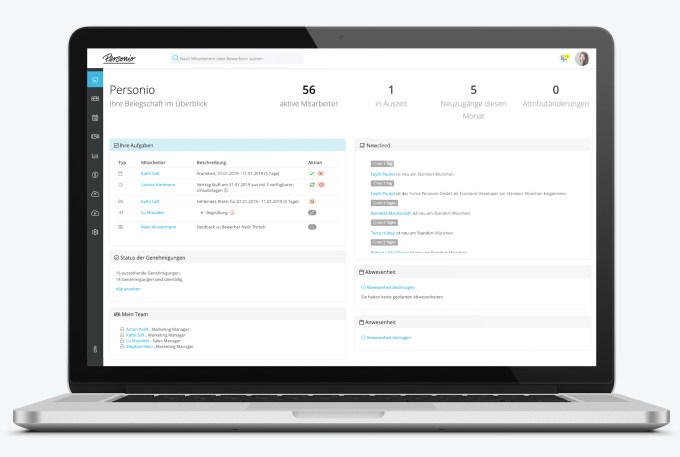
Personio, the German HR and recruiting platform, has raised $40 million in a Series B funding. Leading the round is London-based Index Ventures, with participation from existing investors Northzone and Rocket Internet’s Global Founders.

Founded in 2015, Munich-based Personio has set out to build a “HR operating system” for small and medium-sized companies (SMEs) ranging from 10 and 2,000 employees. The cloud-based software is designed to power all of a company’s HR and recruiting processes, either via the product’s own core functionality or through its ability to integrate with third-party software.

“We believe in the benefit of a holistic HR solution that covers the entire employee life-cycle, while its functionalities need to adapt to individual customer requirements and processes,” Personio co-founder and CEO Hanno Renner tells me.

“That being said, we distinguish between the bread-and-butter HR activities which every company needs to do (e.g. recruiting, on boarding, time off management, payroll etc.) and those that are either industry-specific or rather nice-to-haves”.

Examples of the latter include hardware-based time tracking, and employee engagement, respectively. “We focus our efforts on providing a best-in-class experience for what we consider bread-and-butter HR,” adds Renner. “For more specific requirements, we let our customers choose from a growing number of integrated vertical solutions based on their needs. Data will be synced so Personio acts as the system of record for all HR information and information only needs to be entered once”.

In addition to “out of the box” third-party software integrations, Personio’s claim to offer a HR operating system is backed up by the company’s open API, which is designed to cover various use cases where accessing data that is stored in Personio can add further value to customers. This includes building something as simple as a Slack bot using Personio data, to connecting Personio to a company’s data-warehouse or deeper integrations with internal systems.

More broadly, Renner says this holistic approach, coupled with Personio’s workflow automation that aims to cut down on time wasted on repetitive tasks, is not only resonating with HR managers and recruiters who typically use the product for several hours per day, but is also finding use with managers, executives and other employees. The end result is that HR and recruitment processes can become much more distributed across a company.

To that end, Personio says its Series B funding will be used to help the company attempt to become Europe’s leading provider of human resources software for SMEs. It boasts more than 1,000 clients in 35 countries, seeing over 150,000 employees and several hundred thousand applicants currently being managed within Personio.

“We believe that now is the right timing to actively expand into further regions and the funding as well as Index expertise will certainly help making that move successful,” adds the Personio CEO. “Apart from that, we consider ourselves a product-driven company and hence want to continue to strongly invest into building the best product for our customers which will mean significantly growing our product & engineering team and potentially even opening a new office to facilitate hiring”.

from Startups – TechCrunch https://tcrn.ch/2RzJWIO

#USA Sources: Email security company Tessian is closing in on a $40M round led by Sequoia Capital

//

Continuing a trend that VCs here in London tell me is seeing an increasing amount of deal-flow in Europe attract the interest of top-tier Silicon Valley venture capital firms, TechCrunch has learned that email security provider Tessian is the latest to raise from across the pond.

According to multiple sources, the London-based company has closed a Series B round led by Sequoia Capital. I understand that the deal could be announced within a matter of weeks, and that the round size is in the region of $40 million. Tessian declined to comment.

Founded in 2013 by three engineering graduates from Imperial College — Tim Sadler, Tom Adams and Ed Bishop — Tessian is deploying machine learning to improve email security. Once installed on a company’s email systems, the machine learning tech analyses an enterprise’s email networks to understand normal and abnormal email sending patterns and behaviours.

Tessian then attempts to detect anomalies in outgoing emails and warns users about potential mistakes, such as a wrongly intended recipient, or nefarious employee activity, before an email is sent. More recently, the startup has begun addressing in-bound email, too. This includes preventing phishing attempts or spotting when emails have been spoofed.

Meanwhile, Tessian (formerly called CheckRecipient) raised $13 million in Series A funding just 7 months ago in a round led by London’s Balderton Capital. The company’s other investors include Accel, Amadeus Capital Partners, Crane, LocalGlobe, Winton Ventures, and Walking Ventures.

from Startups – TechCrunch https://tcrn.ch/2RvyBJL

#USA Driving down the cost of preserving genetic material, Acorn Biolabs raises $3.3 million

//

Acorn Biolabs wants consumers to pay them to store genetic material in a bet that the increasing advances in targeted genetic therapies will yield better healthcare results down the line.

The company’s pitch is to “Save young cells today, live a longer, better, tomorrow.” It’s a gamble on the frontiers of healthcare technology that has managed to net the company $3.3 million in seed financing from some of Canada’s busiest investors.

For the Toronto-based company, the pitch isn’t just around banking genetic material — a practice that’s been around for years — it’s about making that process cheaper and easier.

Acorn has come up with a way to collect and preserve the genetic material contained in hair follicles, giving its customers a way to collect full-genome information at home rather than having to come in to a facility and getting bone marrow drawn (the practice at one of its competitors, Forever Labs) .

“We have developed a proprietary media that cells are submerged in that maintains the viability of those cells as they’re being transported to our labs for processing,” says Acorn Biolabs chief executive Dr. Drew Taylor.

“Rapid advancements in the therapeutic use of cells, including the ability to grow human tissue sections, cartilage, artificial skin and stem cells, are already being delivered. Entire heart, liver and kidneys are really just around the corner. The urgency around collecting, preserving and banking youthful cells for future use is real and freezing the clock on your cells will ensure you can leverage them later when you need them,” Taylor said in a statement.

Typically, the cost of banking a full genome test is roughly $2,000 to $3,000, and Acorn says they can drop that cost to less than $1,000. Beyond the cost of taking the sample and storing it, Acorn says it will reduce to roughly $100 a year the fees to store such genetic materials.

It’s important to note that healthcare doesn’t cover any of this. It’s a voluntary service for those neurotic enough or concerned enough about the future of healthcare and their potential health. 

There’s also no services that Acorn will provide on the back end of the storage… yet.

What people do need to realize is that there is power with that data that can improve healthcare. Down the road we will be able to use that data to help people collect that data and power studies,” says Taylor. 

The $3.3 million the company raised came from Real Ventures, Globalive Technology, Pool Global Partners and Epic Capital Management and other undisclosed investors.

“Until now, any live cell collection solutions have been highly expensive, invasive and often painful, as well as being geographically limited to specialized clinics,” said Anthony Lacavera, founder and chairman at Globalive. “Acorn is an industry-leading example of how technology can bring real innovation to enable future healthcare solutions that will have meaningful impact on people’s wellbeing and longevity, while at the same time — make it easy, affordable and frictionless for everyone.”

from Startups – TechCrunch https://tcrn.ch/2MgOEoU