#USA The state of seed

//

“There’s an implosion of early-stage VC funding, and no one’s talking about it,” was the headline of a viral article posted on this site in late 2017. Venture capitalists are deploying more capital than ever, the author explained, yet the number of deals for early-stage startups has taken a nosedive.

Roughly one year later, little has changed. Seed activity for U.S. startups has declined for the fourth straight year, according to venture data provider CB Insights, as median deal sizes increased at every stage of venture capital. In 2018, seed activity as a percentage of all deals shrank from 31 percent to 25 percent — a decade low — while the share and size of late-stage deals swelled to record highs. Total annual global VC funding, for its part, shot up 21 percent to $207 billion as deal activity only increased by 10 percent to 14,247 transactions.

The median U.S. seed deal was the highest on record in the fourth quarter of 2018, growing to $2.1 million after kicking off the year at an average of $1.7 million. Early-stage financings — i.e. Series A and Series B fundings — experienced the same trend, expanding to a median of $8 million in Q4, a significant increase from the $5.5 million median recorded in the first quarter of 2017.

The decline in seed deals and the simultaneous increase in deal size began in 2012, and is far from an anomaly at this point. What’s caused the end of seed investing as we know it? A record amount of dry powder in the venture ecosystem has pushed VCs downstream, where they can deploy large sums of capital in more mature companies. Even firms specializing in seed investments are muscling their way into Series A deals. Many seed firms have grown up and become more strategic in their bets, often opting to invest in startups that have found product/market fit rather than those still at the idea stage, despite the fact that historically, idea-stage companies were the target of seed financings. Fortunately, pre-seed, a newer stage of investing consisting of investments of around $500,000, has emerged to support those projects.

Not only are deals fewer and fatter, but companies earning seed investments are older, too. In 2016, for example, companies raising seed deals were older than the median age of a company raising a Series A deal 10 years ago, and Series A companies were older than the median age of Series B companies a decade prior, too.

Fundraising activity suggests deal sizes will only continue to inflate, rather than adjust. Firms in the $100 million to $500 million range are currently the most active fundraisers, and if you pay any attention to the tech press, you know there’s no shortage of fresh billion-dollar funds. Investors at those funds aren’t able to deploy small bits of capital into early-stage startups — not only because the return on the investment isn’t meaningful, but they don’t have the time to devote to those projects, which typically require more support and oversight than their late-stage counterparts.

One thing could send deal sizes back to their normal ranges, however, and that’s the market downturn many VCs are expecting in 2019. Median deal sizes shrank during the Great Recession in 2008, and investors tend to turn away from riskier bets when market conditions grow cold. That means, in a bear market, more attention will be paid to stable, later-stage businesses while early-stage companies are left to their own devices.

from Startups – TechCrunch https://tcrn.ch/2C7qKri

#USA E-scooter startup Bird is raising another $300M

//

Electric scooter startup Bird is said to be nearing a deal to extend its Series C funding with an additional $300 million led by cross-over investor Fidelity, according to an Axios report. Bird declined to comment.

Fidelity has not previously invested in Bird and is reportedly doing so at a flat pre-money valuation of $2 billion, which Bird earned with a $300 million Sequoia-led financing in June. Santa Monica-based Bird has raised more than $400 million in venture capital funding to date from investors, including Accel, CRV, Greycroft, Index Ventures, Upfront Ventures, Craft Ventures and Tusk Ventures.

The investment comes at a time when many investors are losing faith in scooter startups’ claims to be the solution to the problem of last-mile transportation, as companies in the space display poor unit economics, faulty batteries and a general air of undependability. Lime, Bird’s biggest e-scooter competitor, has at least expanded its suite of micro-mobility offerings from bikes and scooters to LimePods, a line of shareable vehicles available in Seattle, to peak investor interest. San Francisco-based Lime has been seen pitching to investors in Silicon Valley recently, too, with reports indicating it’s looking for a $400 million investment at a $3 billion valuation — more than three times the valuation it garnered with a $335 million round in July.

from Startups – TechCrunch https://tcrn.ch/2H0Yxbu

#USA Daily Crunch: Well Facebook, you did it again

//

The Daily Crunch is TechCrunch’s roundup of our biggest and most important stories. If you’d like to get this delivered to your inbox every day at around 9am Pacific, you can subscribe here:

1. Facebook is the new crapware 

Well Facebook, you did it again. Fresh off its latest privacy scandal, the troubled social media giant has inked a deal with Android to pre-install its app on an undisclosed number of phones and make the software permanent. This means you won’t be able to delete Facebook from those phones. Thanks, Facebook.

2. The world’s first foldable phone is real 

Chinese company Royole has beaten Samsung to the market and has been showing off a foldable phone/tablet this week at CES. While it’s not the most fluid experience, the device definitely works at adapting to your needs.

3. CES revokes award from female-founded sex tech company

Outcries of a double-standard are pouring out of CES after the Consumer Tech Association revoked an award from a company geared toward women’s sexual health.

4. Everything Google announced at CES 2019 

Google went all in on the Assistant this year at CES. The company boasted that the voice-enabled AI will make its way onto a billion devices by the end of the month — up from 400 million last year. But what’s most exciting is the expanded capabilities of Google’s Assistant. Soon you’ll be able to check into flights and translate conversations on the fly with a simple “Hey Google.”

5. Rebranding WeWork won’t work 

The company formerly known as WeWork has rebranded to the We Company, but its new strategy has the potential to plunge the company further into debt.

6. Despite promises to stop, US cell carriers are still selling your real-time phone location data

Last year a little-known company called LocationSmart came under fire after leaking location data from AT&T, Verizon, T-Mobile and Sprint users to shady customers. LocationSmart quickly buckled under public scrutiny and promised to stop selling user data, but few focused on another big player in the location tracking business: Zumigo.

7. The best and worst of CES 2019 

From monster displays to VR in cars, we’re breaking down the good, the bad and the ugly from CES 2019.

from Startups – TechCrunch https://tcrn.ch/2C9mYh9

#USA Bowery Valuation raises $12 million more to automate the real estate appraisal process

//

Bowery Valuation, a New York-based company that we told you about last year, has raised $12 million in Series A funding for its tech-enabled real estate appraisal platform. The 3.5-year-old company raised the capital from Corigin Ventures, Camber Creek, Navitas Capital, Fika Ventures and Builders.

Bowery caught our attention initially because, like a lot of real estate technology companies, it’s tackling some clunky processes that you might imagine would have been solved long ago. For example, its mobile app enables appraisers to tick off items, rather than write everything down. It automatically pulls in public record data so that appraisers needn’t surf the web to find what they need. It enables passive databasing, meaning that rental and sales comps that are often lost today can be found via a map-based search. It also uses natural language generation to help its appraiser clients produce reports.

What has changed since we last talked: the company was beginning to sell a white-label version of its app to customers, and it has since shifted toward focusing its entire product and engineering team on its own internal software.

It has also expanded its footprint more slowly than it thought it might. Though the company is currently licensed and working throughout New York, New Jersey, Pennsylvania and Connecticut, it hasn’t reached numerous farther-flung cities that continue to remain in its sights, including L.A. and Chicago.

Both are “still our first two choices for expansion,” says co-founder and CEO Noah Isaacs, adding that Bowery’s goal is now to “be in at least one of those two markets within the next nine to 12 months, with the other to follow shortly. We held off on expanding into new geographies prematurely, as we felt we had a lot more room to grow just in the tri-state area.” (Isaacs says the company has more than tripled its customer base and revenue since we last talked with the company last March.)

Though Bowery today focuses on multi-family and mixed-use assets, it also plans to expand to other commercial properties this year, says Isaacs.

Isaacs and his best childhood friend, John Meadows, founded Bowery in 2015 after working together at the same appraisal firm in New York and seeing plenty about the business on which they could improve. After bringing aboard as CTO Cesar Devars, a Princeton grad who’d studied economics and worked on several startups after graduating, the three got to work, applying and gaining acceptance shortly afterward to MetaProp NYC, a local accelerator program that focuses exclusively on real estate.

Bowery, where Meadows and Isaacs are co-CEOs, has since raised $18.8 million altogether, including from real estate giant Cushman & Wakefield.

from Startups – TechCrunch https://tcrn.ch/2AAHlnq

#USA Report: Self-driving car startup Aurora is raising capital at a $2B valuation

//

Early last year, LinkedIn co-founder and prolific venture capital investor Reid Hoffman called Chris Urmson “the Henry Ford of autonomous vehicles (AV).” The vote of confidence and big check from Hoffman, coupled with a team of deeply knowledgable AV entrepreneurs, has catapulted his company, Aurora Innovation, squarely into “unicorn” territory.

Aurora, the developer of a full-stack self-driving software system for automobile manufacturers, is raising at least $500 million in equity funding at more than a $2 billion valuation in a round expected to be led by new investor Sequoia Capital, according to a Recode report. A $500 million financing would bring Aurora’s total raised to date to $596 million and would provide a 4x increase to its most recent valuation.

The company, founded in 2016, raised a $90 million Series A last February from Hoffman’s Greylock Partners and Index Ventures . Hoffman and Index general partner Mike Volpi joined Aurora’s board as part of the deal. Greylock and Index are Aurora’s only existing investors, per PitchBook data. The young business has a lean cap table often characteristic of startup’s led by experienced entrepreneurs able to secure financing deals briskly from top VCs.

Aurora’s C-suite is chock-full of veteran AV workers. Urmson, for his part, formerly headed up the self-driving vehicles program at Google, now known as Waymo. Chief technology officer Drew Bagnell was head of perception and autonomy at Uber and Sterling Anderson, Aurora’s chief product officer, directed the autopilot program at Tesla from 2015 to 2016.

“Between these three co-founders, they have been thinking and working collectively in robotics, automation automotive products for over 40 years,” Hoffman wrote in a blog post announcing Aurora’s Series A funding.

In addition to the high-caliber of the founding team, Aurora’s collaborative approach to building self-driving cars has attracted investors, too. The company has partnered with a number of automotive retailers to integrate its technology into their vehicles and make self-driving cars a “practical reality.” Currently, Aurora counts Volkswagen, Hyundai and Chinese manufacturer Byton as partners. 

2018 was a banner year for VC investment in U.S. autonomous vehicle startups. In total, investors poured $1.6 billion across 58 deals, nearly doubling 2017’s high of $893 million. Around the world, AV startups secured $3.41 billion, on par with the $3.48 billion invested in 2017, per PitchBook.

Though we are just days into 2019, LiDAR technology developer AEye has completed a previously announced $40 million Series B. The Pleasanton, Calif.-headquartered company raised the funds from Taiwania Capital, Kleiner Perkins, Intel Capital, Airbus Ventures and Tychee Partners. And last week, Sydney-based Baraja, another LiDAR startup, brought in a $32 million Series A from Sequoia China, Main Sequence Ventures’ CSIRO Innovation Fund and Blackbird Ventures.

from Startups – TechCrunch https://tcrn.ch/2FiYqFN

#USA Managed By Q ends 2018 with a fresh $25 million in funding

//

Managed By Q, the office management platform that launched back in 2013, has today revealed that it raised an additional $25 million as a part of its Series C, led by existing investors RRE and Google Ventures, with participation from new investors DivCo West, Oxford Properties and others. The fresh capital brings the total round to $55 million.

Managed By Q launched as a all-encompassing platform for office management, offering IT support, supply inventory management, cleaning, and equipment repair. Since, the company has added a full-fledged marketplace, allowing office managers to choose vendors for various needs around the office.

But for 2019, the company is focused on tools and services.

“We want to spend 2019 putting even greater focus on the tools used by our vendors and workplace management teams, like task management tools,” said cofounder and CEO Dan Teran . “We want to build the first set of collaboration tools for the workplace team, the same way that designers use InVision and engineers use GitHub and salespeople use Salesforce. Something purposely built for the workplace team.”

Teran described tools that would allow for employee requests, work orders, task management, inventory management and budgeting to all live on the same platform.

The company hasn’t shared much by way of revenue or customer growth, but Teran told TechCrunch that the marketplace business has been doubling since it launched and is on track to continue on that trajectory. He also wrote in a company blog post that Managed by Q’s top five vendor partners have done over $1 million in business on the Managed By Q platform, and more than 30 partners will have earned over $100K on the platform in 2018.

The NY-based startup also brokered a partnership with Staples to provide office supplies to clients, and acquired Hivy and NVS to further fill out their office management suite of products.

Managed By Q has raised a total of $128.25 million, according to CrunchBase.

from Startups – TechCrunch https://tcrn.ch/2Fguwmd

#USA Women’s co-working space The Wing adjusts membership policy to allow all genders

//

The Wing opened its doors to entrepreneurial women in New York City in 2016 with the support of about $2.5 million in seed funding, marketing itself as a place for women of diverse backgrounds to meet and do work. Now, as it officially amends its membership policy to allow all genders — yes, men included — it will have to work harder to stay true to its promise and purpose: to create a feminist co-working empire.

In two years, The Wing built a committed social media following and launched an in-house magazine and an online store offering merchandise adorned with third-wave feminist catchphrases. It established additional co-working spaces in New York, Washington, DC and San Francisco and entered into financial agreements with high-profile venture capitalists. Just three weeks ago, The Wing company announced a $75 million Sequoia-led Series C funding that more than doubled the New York-based female-founded startup’s previous valuation to $375 million, according to PitchBook.

While The Wing grew its community of female-identifying members to more than 6,000, debates surrounding its anti-male doctrine sprang up on and off the internet. Men aren’t allowed in The Wing — is that legal? Many questioned. No, probably not. Why? Because as much as The Wing disguises itself as a social club, it’s technically too large to benefit from laws that actually permit those sorts of groups to practice gender discrimination, according to a Jezebel report. So yes, male-only social clubs were able to thrive for decades because they were lean — small enough to legally discriminate. Still, there’s no reason The Wing needed to bar men from accessing its properties and resources, other than the fact that there have been protected male safe-havens promoting business and entrepreneurship for a very long time, while female-focused rooms of that sort have been few and far between.

Thought pieces were written, Tweets were sent and the New York City Commission on Human Rights opened a “commission-initiated investigation,” which is still ongoing, according to The Wing. Then a man by the name of James Pietrangelo filed a $12 million lawsuit against The Wing alleging its “illegal discrimination against men … was/is egregious: brazen, flagrant, intentional, willful, wanton, actually malicious, motivated by evil and ill-will, deliberately oppressive, outrageous, and willfully and callus disregardful of the rights of men.”

Pietrangelo takes issue with essentially every piece of The Wing’s DNA: its slogans, decor, schemes and employees. “The Wing’s brazen attitude towards the law and the civil rights of men can be summed up by one of The Wing’s own favorite slogans: “Girls Doing Whatever The F*ck They Want,” the lawsuit states.

“Of the 53 corporate and/or front-of-the-house positions, identified on the wing’s About page of its website, all 53 are women — arguably a statistical impossibility if the wing is not discriminating based on sex and/or gender-identity,” it continues.

Now, The Wing says it’s altered its membership policy to allow access to anyone, as first reported by Insider. The company, however, said the transition has been planned for some time and is not a result of the ongoing lawsuit: “The membership policy was codified and adopted before the lawsuit,” a spokesperson for The Wing told TechCrunch.

Keychains for sale on The Wing’s online shop.

“Gender identity and gender presentation are two distinct concepts and do not always align,” co-founder and chief executive Audrey Gelman wrote in a letter to members announcing the policy amendment. “To that end, we’ve made some internal updates and adopted written membership policies to ensure that our staff is trained not to make assumptions about someone’s identity based on how they present, or to ask prospective members or guests to self-identify. We initiated these trainings and policies so that we can continue to build a community that reflects our values and pushes us all to be more inclusive.”

As for how new membership policies will change The Wing’s female-friendly environment and community of women, that’s to be determined. The company is still figuring out just how it will ensure any new members believe and respect its mission of promoting women.

Ultimately, The Wing’s decision to open up membership is good business. Given that it is a space meant for entrepreneurs to get work done, it makes sense that it would be inclusive of all genders, as women and non-binary folk often build businesses with cisgender males, too. The Riveter, another female-focused co-working startup, has allowed men in from the very beginning for that very reason.

“I don’t think the future is female, I think the future is fluid,” The Riveter founder and CEO Amy Nelson told TechCrunch last month. “Gender is becoming an outdated idea but at the same time, it’s important to think of women when we build these spaces … There is a lot of value to women’s only spaces but our take on it is we want to redefine the future of work for women and we want everyone to be part of it.”

Despite demonstrating a certain brand of millennial feminism that isn’t inclusive or appealing to all, The Wing has been very blatant about its diversity and inclusion efforts since its beginning. Sure, it’s learned and adapted along the way, but considering the dearth of attempts in Silicon Valley to create safe spaces for women or to fund women’s businesses, The Wing’s efforts to promote women should be encouraged rather than torn down.

from Startups – TechCrunch https://tcrn.ch/2SIU1jo

#USA WeWork rebranding won’t work

//

The company formerly known as WeWork has rebranded as the We Company — although a better name for its network of on-demand office spaces for the newly incorporated and nominally employed, co-living spaces for the same easyJet-set and educational and coding services could be “House of Cards.”

News of the rebranding (first reported via Fast Company) comes on the heels of reports that the company would no longer be receiving a planned $16 billion golden parachute to escape a soon-to-be-sinking real estate market investment from longtime backer Masayoshi Son’s SoftBank and his SoftBank Vision Fund.

WeWork, which lost $1.2 billion over the first three quarters of 2018 according to an FT report, is rebranding to shift attention from its real estate play to a broader blend of living and educational services that now comprise the three pillars of its business (to be clear, the largest pillar is its real estate properties).

The knock against the company has always been that it was a real estate investment masquerading as a tech company (a case which FT made magisterially last year).

In the blog post, WeWork chief executive Adam Neumann laid out the company’s new strategy, which divides the company into three different business lines: WeWork (real estate), WeLive (its co-living spaces) and WeGrow (for education).

For the We Company to succeed, a few things need to happen. Revenue needs to rebalance to the WeLive and WeGrow businesses quickly and it needs to grow its services even more aggressively. And the result of each needs to be actual profitability.

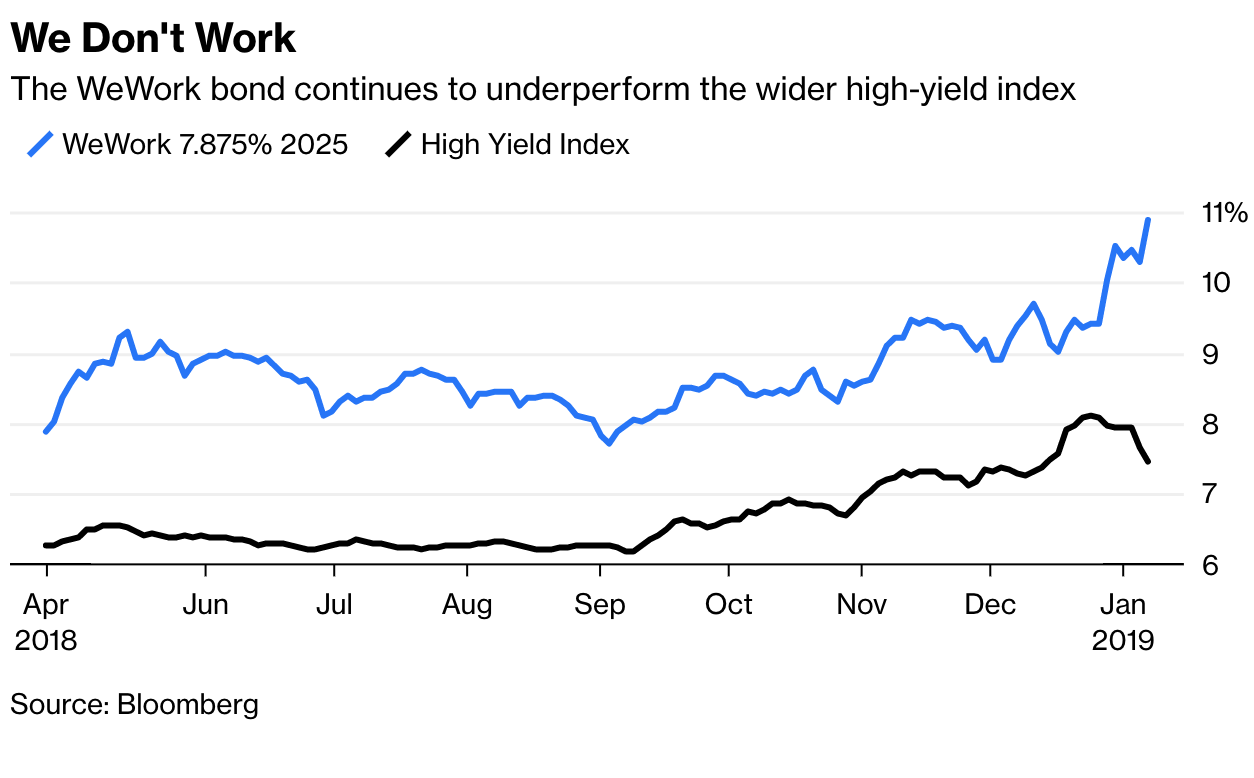
There aren’t a lot of really hard metrics to gauge the company’s current performance. But the good people at Bloomberg did uncover actual financial data on the company’s debt, which is underperforming compared to industry benchmarks.

Neumann said the original vision of the company was an all-encompassing network of offerings that would help customers bank, shop, live and play. That’s a mighty goal worthy of a Vision Fund, but its vision may turn out to be a fever dream if the indicators are right and the worldwide slide into recession finally happens.

from Startups – TechCrunch https://tcrn.ch/2TBCXvD

#USA Daily Crunch: The age of quantum computing is here

//

The Daily Crunch is TechCrunch’s roundup of our biggest and most important stories. If you’d like to get this delivered to your inbox every day at around 9am Pacific, you can subscribe here:

1. IBM unveils its first commercial quantum computer

The 20-qubit system combines the quantum and classical computing parts it takes to use a machine like this for research and business applications into a single package. While it’s worth stressing that the 20-qubit machine is nowhere near powerful enough for most commercial applications, IBM sees this as the first step towards tackling problems that are too complex for classical systems.

2. Apple’s trillion-dollar market cap was always a false idol

Nothing grows forever, not even Apple. Back in August we splashed headlines across the globe glorifying Apple’s brief stint as the world’s first $1 trillion company, but in the end it didn’t matter. Fast-forward four months and Apple has lost more than a third of its stock value, and last week the company lost $75 billion in market cap in a single day.

3. GitHub Free users now get unlimited private repositories

Starting today, free GitHub users will now get unlimited private projects with up to three collaborators. Previously, GitHub had a caveat for its free users that code had to be public if they didn’t pay for the service.

Photo credit: Chesnot/Getty Images

4. Uber’s IPO may not be as eye-popping as we expected

Uber’s public debut later this year is undoubtedly the most anticipated IPO of 2019, but the company’s lofty valuation (valued by some as high as $120 billion) has some investors feeling uneasy.

5. Amazon is getting more serious about Alexa in the car with Telenav deal

Amazon has announced a new partnership with Telenav, a Santa Clara-based provider of connected car services. The collaboration will play a huge role in expanding Amazon’s ability to give drivers relevant information and furthers the company’s mission to bake Alexa into every aspect of your life.

6. I used VR in a car going 90 mph and didn’t get sick

The future of in-vehicle entertainment could be VR. Audi announced at CES that it’s rolling out a new company called Holoride to bring adaptive VR entertainment to cars. The secret sauce here is matching VR content to the slight movements of the vehicle to help those who often get motion sickness.

7. Verizon and T-Mobile call out AT&T over fake 5G labels

Nothing like some CES drama to start your day. AT&T recently shared a shady marketing campaign that labeled its 4G networks as 5G and rivals Verizon and T-Mobile are having none of it.

from Startups – TechCrunch https://tcrn.ch/2TByMQt

#USA Scape Technologies raises $8M to let machines visually understand their surroundings

//

Scape Technologies, a London-based computer vision startup, is de-cloaking today to announce that it has raised $8 million in seed fund and launching the first iteration of its “Visual Positioning Service,” which lets developers build apps that require location accuracy far beyond the capabilities of GPS alone.

The technology will initially target augmented reality apps, but can also be used to power applications in mobility, logistics and robotics. More broadly, Scape wants to enable any machine equipped with a camera to understand its surroundings.

Backing the round is LocalGlobe, Mosaic Ventures, Fly Ventures, and company builder Entrepreneur First. Scape Technologies was a member of EF cohort 7, which pitched at EF’s London demo day almost two years ago. The startup has remained pretty stealthy ever since. Until now, that is.

“There is a huge amount hype in the AR space right now which is why we’ve been working for the last two years in stealth, taking our time to make sure our technology is accurate, robust and scalable,” Scape Technologies co-founder and CEO Edward Miller tells TechCrunch. “We set out on a mission to build a new type of infrastructure, to allow computers to safely interpret and navigate the world, using only a camera. To make this possible, we’ve built what we refer to as our ‘Vision Engine’, which lies at the heart of everything we do at Scape”.

Miller describe’s Scape’s “Vision Engine” as a large-scale mapping pipeline that creates 3D maps from ordinary images and video. Camera devices can then query the Vision Engine using the startup’s newly launched Visual Positioning Service API to determine their exact location with far greater precision than GPS can ever provide. Starting today, the Visual Positioning Service is available within London for select partners via Scape’s SDK.

The fact that Scape’s 30 person-plus team has been able to build a detailed 3D map of London is slightly head-scratching, and that’s before factoring in the machine learning and computer vision technology required to enable machines to reference that map to accurately pinpoint “hyper location”. Miller declines to go into much detail on record with regards to how the young company was able to pull off such a large mapping exercise, for fear of giving away too much of the startup’s secret sauce.

However, it is noteworthy that Miller was one of the U.K.’s first Street View photographers, giving him a unique insight into how a company like Google can build maps at scale. He also has a background in interactive imagery, having been involved in VR projects for companies such as ESPN, UEFA and Jaguar. Scape’s other co-founder and CTO Huub Heijnen was previously a researcher in the field of robotics, where he was involved in teaching multi-legged robots how to learn to walk. “It’s pretty hardcore,” says Miller of his co-founder’s previous work.

Teaching a computer to “see” the world with a camera is no small task, either. Whereas humans might see a photograph and recognise in it a car or a building, a computer only sees a bunch of ones and zeros. The role of computer vision to interpret these ones and zeros into something meaningful.

“We’ve had to make significant technological breakthroughs to allow computers to recognise their location accurately, quickly and in varying weather conditions,” explains Miller. “Most importantly, we’ve invested significant efforts in ensuring our Visual Engine is scalable. The world is a big place and we can’t afford to rely on a system that can’t grow with demand. Unlike other approaches, Scape’s Vision Engine scales horizontally to 100s of servers at a time, so we can provide our Visual Positioning Service within areas the size of an entire city”.

More ambitious still, enabling accurate location is “just the beginning”. Over the next 5 years, Scape plans to develop what it calls “ubiquitous spatial intelligence,” which will allow devices to understand where they are and what is around them, using only a camera. The thinking is that with exponential growth in IoT and wearables, the world is becoming increasingly augmented with physical hardware designed to live and operate amongst us.

“With new industries like augmented reality and self-driving cars on the rise, it’s vital that these new types of computers understand with extreme precision where they are and what’s around them,” cautions Scape’s CEO.

from Startups – TechCrunch https://tcrn.ch/2TExhRL