#USA Ledger announces next-generation cryptocurrency hardware wallet

//

French startup Ledger unveiled its new hardware wallet to manage your cryptocurrencies. The Ledger Nano X is a Bluetooth-enabled wallet, which means that you’ll be able to send and receive tokens from your phone.

The previous version of the device required you to plug the key to your computer using a microUSB cable in order to execute an order. Switching to Bluetooth and opening it up to smartphones is the next logical step.

Ledger is going to launch a full-fledged mobile app called Ledger Live. You’ll find the same features as the ones in the desktop app. You’ll be able to install new apps, check your balances and manage transactions.

The app will be available on January 28th and existing Ledger users will be able to check their balances in read-only mode thanks to public addresses (in case you’re not using Spot). Ledger has sold 1.5 million Ledger Nano S so far. And it sounds like other companies will be able to build mobile apps that work with your Nano X.

The Nano X looks more or less like the Nano S. It’s a USB key-shaped device with a screen and a couple of buttons. The screen is now slightly bigger.

One of the main issues with the Nano S is that you were limited to 18 different cryptocurrencies. You can now store up to 100 different crypto assets on the Nano X — the device supports 1,100 different tokens overall.

Just like other Ledger devices, the private keys never leave your Ledger wallet. It means that even if your computer or mobile phone get hacked, hackers won’t be able to grab your crypto assets.

The company is presenting the new device at CES, I’ll try to play with it to see how it works when it comes to pairing, battery life, etc.

from Startups – TechCrunch https://tcrn.ch/2AwRkKO

#USA Fitness marketplace ClassPass acquires competitor GuavaPass

//

ClassPass, the five-year-old fitness marketplace startup with $239 million in financing, is acquiring competitor GuavaPass, which was founded by Rob Pachter and Jeffrey Liu in 2015.

ClassPass is in the midst of an expansion sprint, both domestically and internationally. The company is hyper-focused on Asian markets, where GuavaPass had carved out its own place with 75 studio partners across 11 cities, including Abu Dhabi, Bnagkok, Beijing, Dubai, Hong Kong, Jakarta, Kuala Lumpur, Manila, Mumbai, Shanghai and Singapore.

The financial terms of the deal were not disclosed.

This is not ClassPass’s first acquisition. In 2014, ClassPass acquired competitor FitMob. But CEO Fritz Lanman says that this is less about competition and more about opportunity.

“The GuavaPass founders reached out to us,” he told TechCrunch. “They said that they were raising more money and had some options developing but that they felt they could continue working on their original mission as a part of ClassPass. They are really missionaries for the space.”

ClassPass will be bringing on about half of the GuavaPass team as part of the acquisition. However, Lanman doesn’t expect to do many acquisitions in the future, saying that “acquisition isn’t a part of the company’s expansion strategy.”

Alongside regularly planned expansion, the acquisition now puts ClassPass in more than 80 markets across the 11 countries, with plans to expand to 50 new cities in 2019.

from Startups – TechCrunch https://tcrn.ch/2Az4lU2

#USA A further £18M funding lands on Gousto’s plate

//

Gousto, the U.K. cook-at-home meal kit service that competes most directly with HelloFresh, has raised a further £18 million in funding. The round is backed by Instagram “health influencer” Joe Wicks, along with existing investors Unilever Ventures, Hargreave Hale, BGF Ventures, MMC Ventures, and Angel CoFund.

The new funding brings the total raised by Gousto to £75 million since being founded in 2012, and follows a £28.5 million fund raise last March, which it used to invest in its machine learning and factory automation.

The startup also recently launched a customer-facing AI recipe recommendation tool, through which half of customer orders are now placed. Gousto says it will continue to prioritize the majority of its investment in technology to accelerate growth.

In a call, Gousto founder and CEO Timo Boldt told me the startup is now delivering over 1.5 million meals a month to customers, and is seeing 170 percent year-on-year growth. However, he declined to break out specific customer numbers, monthly active or otherwise.

Noteworthy, Gousto says two-thirds of customers are families, and Boldt says this proves that a meal kit service that offers the right mixture of choice, personalization and, crucially, price point, can become a viable alternative to the weekly grocery shop for busy families.

The thinking behind meal kit services more generally is that because they send you correctly portioned fresh ingredients matched to each recipe, you save money by only buying what is needed.

Meanwhile, the services themselves have the potential to run a lot more efficiently than a national grocery store chain’s offline or online offering, including throwing significantly less food away.

To that end, Boldt says that Gousto offers more choice to customers than competitors and is further ahead in terms of driving factory and logistics efficiencies through the use of automation and data. The meal kit service offers over 30 weekly recipes and delivers 7 days per a week. It also claims the shortest lead time of 3 days, and the lowest price point, starting at £2.98 per meal.

The investment in Gousto by “body coach” Joe Wicks is also worth noting, as the startup places more emphasis on healthy eating. The pair had already announced they are working together and this month will launch a co-branded range of nutritious meal kits. This will see a minimum of four new Wicks-branded recipes offered per week, including Joe’s Veggie Spag Bol’ and Satay Chicken Lettuce Wraps, along with Herby Crusted Fish, Root Veg Chips & Peas, and 10-Min Nifty Veggie Noodles.

Cue statement from Wicks: “It was clear from when I first approached Gousto that they were a purpose driven business, with a passion for getting more people cooking and in turn improving the health of the nation. As a customer before becoming an investor, I know that Gousto is having a lasting and hugely positive impact on the way families consume and eat food. I’m delighted to join forces and offer my knowledge to a company who has brought huge and much-needed innovation to an industry”.

from Startups – TechCrunch https://tcrn.ch/2C182lf

#USA Hire faster, work happier: Startups target employment with AI and engagement tools

//

If you have a job today, there’s a good chance you personally reached out to your employer and interviewed with other humans to get it. Now that you’ve been there a while, it’s also likely the workday feels more like a long slog than the fulfilling career move you had envisioned.

But if today’s early-stage startups have their way, your next employment experience could be quite different.

First, forget the networking and interview gauntlet. Instead, let an AI-enabled screening program reach out about a job you don’t seem obviously qualified to do. Or, rather than talk to a company’s employees, wait for them to play some online games instead. If you play similarly, they may decide to hire you.

Once you have the job, software will also make you more efficient and happier at your work.

An AI-driven software platform will deliver regular “nudges,” offering customized suggestions to make you a more effective worker. If you’re feeling burned out, head online to text or video chat with a coach or therapist. Or perhaps you’ll just be happier in your job now that your employer is delivering regular tokens of appreciation.

Those are a few of the ways early-stage startups are looking to change the status quo of job-seeking and employment. While employment is a broad category, an analysis of Crunchbase funding data for the space shows a high concentration of activity in two key areas: AI-driven hiring software and tools to improve employee engagement.

Below, we look at where the money’s going and how today’s early-stage startups could play a role in transforming the work experience of tomorrow.

Artificial intelligence

To begin, let us reflect that we are at a strange inflection point for AI and employment. Our artificially intelligent overlords are not smart enough to actually do our jobs. Nonetheless, they have strong opinions about whether we’re qualified to do them ourselves.

It is at this peculiar point that the alchemic mix of AI software, recruiting-based business models and venture capital are coming together to build startups.

In 2018, at least 43 companies applying AI or machine learning to some facet of employment have raised seed or early-stage funding, according to Crunchbase data. In the chart below, we look at a few startups that have secured rounds, along with their backers and respective business models:
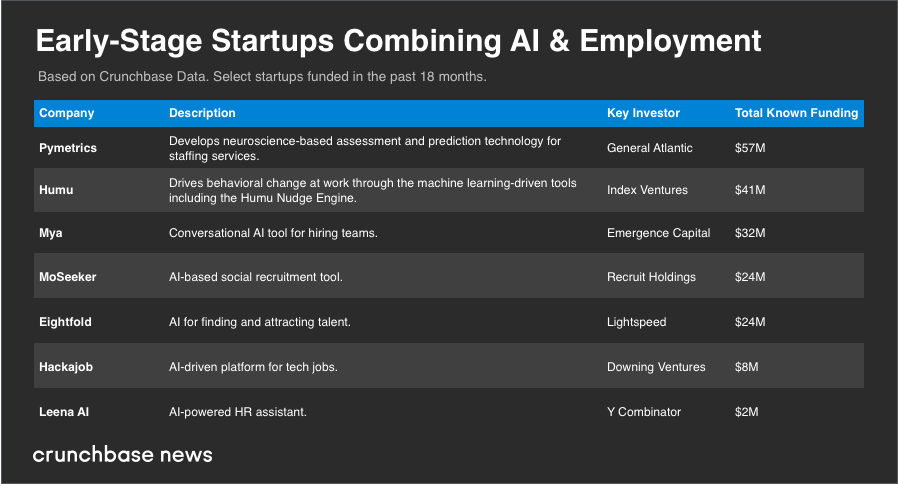
At present, even AI boosters don’t tout the technology as a cure-all for troubles plaguing the talent recruitment space. While it’s true humans are biased and flawed when it comes to evaluating job candidates, artificially intelligent software suffers from many of the same bugs. For instance, Amazon scrapped its AI recruiting tool developed in-house because it exhibited bias against women.

That said, it’s still early innings. Over the next few years, startups will be actively tweaking their software to improve performance and reduce bias.

Happiness and engagement

Once the goal of recruiting the best people is achieved, the next step is ensuring they stay and thrive.

Usually, a paycheck goes a long way to accomplishing the goal of staying. But in case that’s not enough, startups are busily devising a host of tools for employers to boost engagement and fight the scourge of burnout.

In the chart below, we look at a few of the companies that received early-stage funding this year to build out software platforms and services aimed at making people happier and more effective at work:
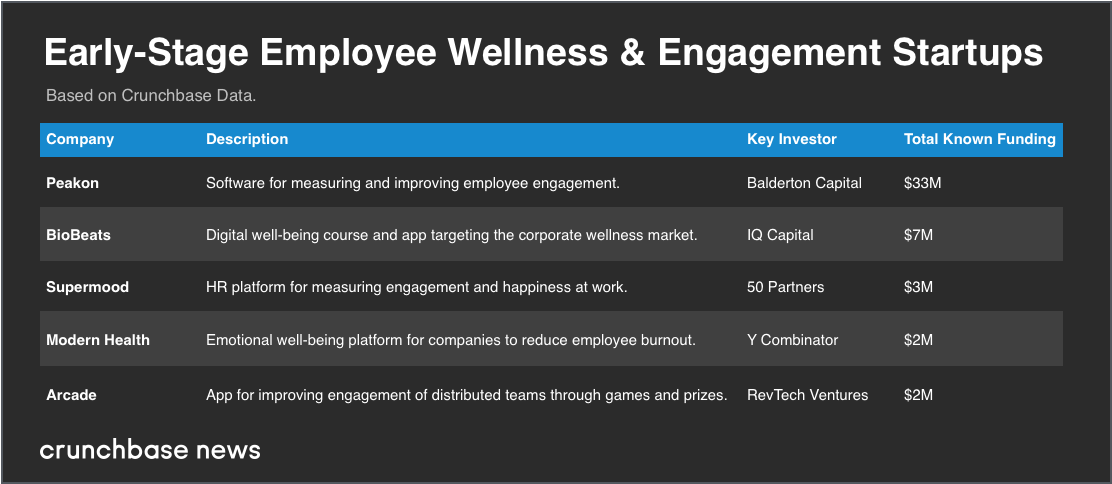
The most heavily funded of the early-stage crop looks to be Peakon, which offers a software platform for measuring employee engagement and collecting feedback. The Danish firm has raised $33 million to date to fund its expansion.

London-based BioBeats is another up-and-comer aimed at the “corporate wellness” market, with digital tools to help employees track stress levels and other health-related metrics. The company has raised $7 million to date to help keep those stress levels in check.

Early-stage indicators

Early-stage funding activity tends to be an indicator of areas with somewhat low adoption rates today that are poised to take off dramatically. For employment, that means we can likely expect to see AI-based recruitment and software-driven engagement tools become more widespread in the coming years.

What does that mean for job seekers and paycheck toilers? Expect to spend more of your time interfacing with intelligent software. Apparently, it’ll make you more employable, and happier, too.

from Startups – TechCrunch https://tcrn.ch/2AxWXbm


#USA Startups Weekly: VCs celebrate the new year the only way they know how

//

Venture capitalists swore in the new year the only way they know how… by submitting SEC paperwork for new funds! insert party hat/confetti emoji here.

As many of us brainstormed our New Year’s resolutions and let our hangovers wear off, several firms began this week what for some is a long and arduous process of raising a VC fund and for others is as simple as a few phone calls to LPs. What else happened this week? Pokémon GO creator Niantic secured $190 million, Mary Meeker announced the name of her fund and a whole bunch of people played with Popsugar’s somewhat sketchy twinning app.

Fresh funds:

Mary Meeker will raise up to $1.5 billion for Bond, her new VC fund. Union Square Ventures raised $429 million across two new funds. Lightspeed Venture partners announced a $560 million China fund. And biotech firm Atlas Venture brought in $250 million.

AR startups are failing:

TechCrunch’s Lucas Matney takes a look at struggling augmented reality startups and questions some of the larger players, from Magic Leap to Snap and Niantic. And speaking of Niantic, the Pokémon GO developer closed a $190 million funding round this week at a $3.9 billion valuation.

Indian startups start the year off strong:

Startups based in India raised more than $10 billion in 2018, per Venture Beat, a record amount of capital for the country. Already this year one company has closed a round larger than $100 million. CarDekho, an online marketplace for car sales in India, has pulled in a new $110 million Series C funding round this week to push deeper into financial services and insurance.

Future tech:

Boom Supersonic, which is building and designing what it calls the “world’s first economically viable supersonic airliner,” announced a $100 million Series B funding round led by Emerson Capital. Other investors include Y Combinator’s Continuity Fund, Caffeinated Capital, SV Angel, Sam Altman, Paul Graham, Ron Conway, Michael Marks and Greg McAdoo.

A startup disrupting the … bottled water business:

FloWater has raised $15 million for its reusable water bottle refilling stations to produce purified water. Bluewater, a Swedish company that sells water purifiers, among other things, led the round.

VC subsidized vending machines:

Vengo makes wall-mounted mini-vending machines the size of large picture frames that it then sells to vending machine distributors, asking for a small fee per month in exchange for access to its software. Now it has $7 million to build out its business.

A VC gets a second chance:

After SpaceX filed more SEC paperwork as part of its $500 million upcoming fundraise, TechCrunch’s Connie Loizos noticed a familiar name on the document: Steve Jurvetson. Jurvetson is a longtime board member of both Tesla and SpaceX, but after he left DFJ, the venture capital firm he co-founded, in 2017 amid questions about his personal conduct, there was uncertainty around whether he would keep those director positions. Well, it looks like Elon Musk is standing by Jurvetson.

And finally, are you smarter than a TechCrunch reporter?

Let this test decide.


Want more TechCrunch newsletters? Sign up here.

from Startups – TechCrunch https://tcrn.ch/2RquGNR

#USA Engineers can now reverse-engineer 3D models

//

A system that uses a technique called constructive solid geometry (CSG) is allowing MIT researchers to deconstruct objects and turn them into 3D models, thereby allowing them to reverse-engineer complex things.

The system appeared in a paper entitled “InverseCSG: Automatic Conversion of 3D Models to CSG Trees” by Tao Du, Jeevana Priya Inala, Yewen Pu, Andrew Spielberg, Adriana Schulz, Daniela Rus, Armando Solar-Lezama, and Wojciech Matusik.

“At a high level, the problem is reverse engineering a triangle mesh into a simple tree. Ideally, if you want to customize an object, it would be best to have access to the original shapes — what their dimensions are and how they’re combined. But once you combine everything into a triangle mesh, you have nothing but a list of triangles to work with, and that information is lost,” said Tao Du to 3DPrintingIndustry. “Once we recover the metadata, it’s easier for other people to modify designs.”

The process cuts objects into simple solids that can then be added together to create complex objects. Because 3D scanning is imperfect, the creation of mesh models of various objects rarely leads to a perfect copy of the original. Using this technique, individual parts are cut away, analyzed and reassembled, allowing for a more precise scan.

“Further, we demonstrated the robustness of our algorithm by solving examples not describable by our grammar. Finally, since our method returns parameterized CSG programs, it provides a powerful means for end-users to edit and understand the structure of 3D meshes,” said Du.

The system detects primitive shapes and then modifies them. This allows it to recreate almost any object with far better accuracy than in previous versions of the software. It’s a surprisingly cool way to begin hacking hardware in order to understand it’s shape, volume and stability.


from Startups – TechCrunch https://tcrn.ch/2sjJb81

#USA Boom Supersonic nabs $100M to build its Mach-2.2 commercial airliner

//

One Denver-based startup’s long-shot bid to move today’s commercial jets beyond supersonic speeds just got a big injection of cash.

Boom Supersonic, which is building and designing what it calls the “world’s first economically viable supersonic airliner,” announced today that they’ve closed a $100 million Series B funding round led by Emerson Capital. Other investors include Y Combinator Continuity, Caffeinated Capital, SV Angel, Sam Altman, Paul Graham, Ron Conway, Michael Marks and Greg McAdoo.

The startup has raised around $140 million to date.

“Today, the time and cost of long-distance travel prevent us from connecting with far-off people and places,” said Boom CEO Blake Scholl in a statement. “Overture fares will be similar to today’s business class—widening horizons for tens of millions of travelers. Ultimately, our goal is to make high-speed flight affordable to all.”

Alongside the fund raise, Boom is further detailing its plans to begin testing its Mach-2.2 commercial airliner this year. The company is aiming to launch a 1:3 scale prototype of its planned Overture airliner this year called the XB-1. The two-seater plane will serve to validate the technologies being built for the full-sized jet.

The startup’s supersonic Overture jet will hold 55 passengers, and the team hopes that the costs of flying more than double the speed of sound will be comparable to today’s business class ticket prices. The company already has pre-orders from Virgin Group and Japan Airlines for 30 airliners .

$100 million may seem like a lot of money, but the development costs for lengthy projects like these can quickly race towards the billions of dollar suggesting that if they carry out their mission, they’re going to need a whole lot more.

from Startups – TechCrunch https://tcrn.ch/2CQmu19

#USA FloWater just raised $15 million to put bottled water out of business

//

FloWater, an eight-year-old, Burlingame, Calif.-based company whose reusable water bottle refilling stations produce purified water, has raised $15 million in its first major round of funding. Bluewater, a Swedish company that sells water purifiers, among other things, led the round.

FloWater caters to schools, colleges, fitness centers, hotels and offices, and, in the words of CEO Rich Razgaitis, set out to address four environmental concerns from the outset: obesity in the U.S., which has been tied in part to the rise of sugary, carbonated beverages; the nearly 40 billion single-use plastic water bottles that are used and tossed aside every year; the millions of barrels of oil and hundreds of millions of pounds of CO2 byproduct waste used to create and transport bottled water; and the toxins in single-use plastic bottles, including endocrine-disrupting chemicals.

It has a pretty compelling case to make, in short, as other purveyors of refilling stations would surely argue, and which clearly persuaded 13 investors altogether (according to a new SEC filing) to write checks to the company.

And it all started with an $18,600 bank loan, according to the company’s founder, Wyatt Taubman, who remains on the company’s board but stepped aside as head honcho in 2015 and has since founded a cold-pressed juice company.

Per his LinkedIn, Taubman, says he used that bank loan to launch a pilot refill station, before shaking $125,000 out of friends and family, and taking out a second, $62,000 loan to launch additional refill stations. The company later raised $950,000 from the Tech Coast Angels and the Hawaii Angels, hired Razgaitis, redesigned the look of its product and, in 2016, raised $2.6 million in Series A funding.

FloWater customers include Google, Airbnb, Specialized Bikes and, somewhat ironically, Red Bull.

It says its stations are now in nearly 50 states.

from Startups – TechCrunch https://tcrn.ch/2RvURmb

#USA Trading app Robinhood is stealthily recruiting ahead of planned UK launch

//

Robinhood, the U.S.-based “zero-fee” stock trading app and cryptocurrency exchange, is stealthily recruiting for a new London office ahead of plans to eventually launch in the U.K., TechCrunch has learned.

According to sources within London’s thriving fintech industry, Robinhood is hiring for multiple U.K. positions. These span recruitment, operations, marketing and PR, and customer support. Notably, the company is also seeking people in compliance, and product, including product design.

In other words, significant localisation and local product market fit appears to be the intention. Compliance is also an important part of Robinhood’s future U.K. regulatory requirements as it applies to local regulator the FCA for the appropriate licenses. Robinhood declined to comment on its U.K. plans.

Meanwhile, news that Robinhood is stealthily recruiting ahead of a planned U.K. launch is interesting in the context of local fintech startups who have launched or announced their own fee-free trading offerings.

Launched late last year, London-based Freetrade has built a bona-fide “challenger broker,” including obtaining the required license from the FCA, rather than simply partnering with an established broker. The app lets you invest in U.K. stocks and ETFs, but will soon add U.S. stocks, too. Trades are “fee-free” if you are happy for your buy or sell trades to execute at the close of business each day. If you want to execute immediately, the startup charges a low £1 per trade.

In June last year, Revolut, also headquartered in London, announced its intention to add commission-free trading to its banking app, in what was seen as a bid to compete with Robinhood. So far, no product has surfaced, although I’m told that we should see trading added to Revolut in Q1 this year.

What’s intriguing about the Revolut-Robinhood comparisons is that the two companies share a number of investors, namely Index and DST. Both companies have incredibly high valuations, too, and, depending on respective burn rates, quite deep pockets.

Co-founded by Baiju Bhatt and Vlad Tenev (pictured above), Robinhood claims 6 million accounts and is valued at $5.6 billion, having raised a total to date of $539 million. It has around 300 employees across its HQ in Menlo Park, California and its regional HQ in Lake Mary, Florida.

Revolut claims 3.5 million users, and at its last funding round was valued at $1.7 billion. The fintech has raised a total of $340 million, and has a headcount of 600 in London and across its various regional offices.

from Startups – TechCrunch https://tcrn.ch/2Awyljs

#USA Moesif raises $3.5M seed round to provide insight into API usage

//

Today, many companies provide developer access to their services via APIs. Moesif, a San Francisco startup, wants to help these companies gain insight into their customer’s API usage patterns. Today, the company announced a $3.5 million seed round.

The investment was led by Merus Capital with participation by Heavybit, Fresco Capital and Zach Coelius, who sold his startup, Cruise Automation, to General Motors for $1 billion in 2016.

Moesif co-founder and CEO Derric Gilling says Moesif is akin to Mixpanel or Google Analytics, except instead of tracking web or mobile analytics, it looks at API usage. “As more and more companies are using and creating these APIs, there comes a point where you need to understand how your customers are using them, any problems they are running into and how do you actually decrease developer churn.”

Heat map showing API usage by region. Screenshot: Moesif

The company is aiming at two primary types of users. First of all, there are developers who can use the monitoring features to understand when there are issues with the API. These folks have access to the free tier.

Moesif also targets business units like product management, sales and marketing, who use the tool to understand who’s using the API, how often, and with machine learning, understand who is likely to stop using the product based on how they are using it. The tool can tie into other business systems like Mailchimp or a CRM tool to get a more complete picture of customers as they use the API.

The product was released last year and Gilling says his company already has 2000 customers, which includes both the free and pay tiers. He said they have had particular success with SaaS and FinTech companies, both of which make heavy use of APIs. Customers include PowerSchool, Schwab and InsideSales.

While the company currently consists of the three founders, flush with the seed investment, it intends to hire around 10 people in the next six months including a VP of engineering, additional developers and sales and marketing folks.

Moesif was founded in 2016, and the three founders went through the Alchemist Accelerator last year.

from Startups – TechCrunch https://tcrn.ch/2TvvLBj