#USA Challenger bank Monzo has quietly begun working on a U.S. launch

//

Monzo, the U.K. challenger bank with more than a million customers and a unicorn valuation to boot, has quietly began working on a U.S. launch, TechCrunch has learned.

According to multiple sources, the fintech startup has set up a small team to begin laying the ground work to bring a version of Monzo to North America, which will initially be powered by a U.S. banking partner while Monzo works on the necessarily regulatory licenses to go it alone.

The plan, which could still be subject to change, is for Monzo to create a “lite” version of its product for U.S. customers, much in the same was as it first launched in the U.K. with a pre-paid debit card before eventually offering a fully fledged bank account.

The thinking, according to one person familiar with the company’s strategy, is that this will enable Monzo to build up a U.S. customer base and iterate its product for the U.S. market in parallel with the challenger bank’s federal charter bank application.

I understand that the plan is for the initial Monzo U.S. product to offer in-app signup, the trademark “hot coral” Monzo debit card, an account and routing number, the ability to make and accept payments, ATM withdrawals, and realtime transaction notifications. In other words, many of the same features that has endeared Monzo with U.K. customers.

Contacted by TechCrunch, a Monzo spokesperson provided the following statement:

We’re really excited about international expansion over the coming months and years. After all, it’s hard to build a bank for a billion people in the UK alone!

However, we don’t have anything specific to share at this stage about those plans. When we do, we’ll be sure to tell the world.

Meanwhile, news that Monzo has begun executing U.S. expansion plans isn’t entirely surprising, even it appears to be happening significantly faster than previously thought.

Co-founder and CEO Tom Blomfield has openly talked about his ambition to bring Monzo to the U.S. one day and the London-based challenger bank boasts an array of U.S. investors. They include most recently General Catalyst, along with the likes of Thrive Capital, Goodwater Capital, Stripe, Michael Moritz, and Instagram co-founder Kevin Systrom.

The fintech company also recently opened a Las Vegas office, from which it offers twilight hours customer support for U.K. customers. Or at least that is the party line. Now it appears that Las Vegas could soon have Monzo customers closer to home to keep happy, too.

from Startups – TechCrunch https://tcrn.ch/2TuuhY0

#USA Pokémon GO creator Niantic closes $190M funding round

//

Mobile AR gaming startup Niantic has closed a $190 million round of funding according to newly filed SEC docs.

The filing comes after a WSJ report last month suggested the company was in the process of closing a $200 million raise from investors, including IVP, aXiomatic Gaming and Samsung, at a $3.9 billion valuation. The round closed shortly after that report on December 20 according to the new documents.

With the close of this round, Niantic has now raised more than $415 million to date. The startup’s other investors include Founders Fund, Spark Capital and Alsop Louie Partners, among others. The filing details that there were 26 investors in this funding round.

The new influx of cash comes as the creator of Pokémon GO prepares to release its next major title, Harry Potter: Wizards Unite. The augmented reality game does not have a release date yet, but is expected to launch this year.

from Startups – TechCrunch https://tcrn.ch/2F7LylS

#USA Scratch 3.0 is now available

//

The only kids programming language worth using, Scratch, just celebrated the launch of Scratch 3.0, an update that adds some interesting new functionality to the powerful open source tool.

Scratch, for those without school aged children, is a block-based programming language that lets you make little games and “cartoons” with sprites and animated figures. The system is surprisingly complex and kids have created things like Minecraft platformers, fun arcade games, and whatever this is.

The new version of scratch includes extensions that allow you to control hardware as well as new control blocks.

Scratch 3.0 is the next generation of Scratch – designed to expand how, what, and where you can create with Scratch. It includes dozens of new sprites, a totally new sound editor, and many new programming blocks. And with Scratch 3.0, you are able to create and play projects on your tablet, in addition to your laptop or desk computer.

Scratch is quite literally the only programming “game” my kids will use again and again and it’s an amazing introduction for kids as young as pre-school age. Check out the update and don’t forget to share your animations with the class!

from Startups – TechCrunch https://tcrn.ch/2CNqDmq

#USA Daily Crunch: AR Startups face an uneasy future in 2019

//

The Daily Crunch is TechCrunch’s roundup of our biggest and most important stories. If you’d like to get this delivered to your inbox every day at around 9am Pacific, you can subscribe here:

1. Magic Leap and other AR startups have a rough 2019 ahead of them 

2018 was supposed to be the year where the foundation of AR was set to expand, but now it looks like momentum has been sucked out of the industry’s heavy hitters.

2. Sorry I took so long to upgrade, Apple 

Apple missed Wall Street’s Q1 sales projections yesterday and the company blamed faltering sales in China for the reason behind the drop. But let’s not kid ourselves; anyone who has an iPhone now is part of the problem. As essential as these devices have become to our lives, it’s too hard for many consumers around the world to justify spending more than $1,000 for a new phone.

BERND THISSEN/AFP/Getty Images

3. China’s lunar probe makes history by successfully soft-landing on the far side of the moon

China crossed a major milestone in space exploration last night by becoming the first country to land a probe on the far side of the moon. Named after the Chinese moon goddess, Chang’e 4 will use a low-frequency radio to survey the terrain of the moon.

4. Mary Meeker targets $1.25B for debut fund, called Bond

With Bond, Meeker is set to be the first woman to raise a $1 billion-plus VC fund.

5. Money is no object: China’s Luckin sets sights on rivaling Starbucks 

Caffeinated drinks are taking off in the tea-drinking nation. Luckin, which is only a year old, has announced an ambitious plan to topple Starbucks and expand to 6,000 stores by 2022.

6. 10 predictions on the future of gaming in 2019 

Will the gaming industry clutch up in 2019?

7. Segway unveils a more durable electric scooter and autonomous delivery bot 

Segway’s Model Max scooter is designed to help services like Bird and Lime reduce their respective operating and maintenance costs, while its new Loomo delivery bot is made for autonomous deliveries for food, packages and other items.

from Startups – TechCrunch https://tcrn.ch/2LQGFPb

#USA Go-Jek extends ride-hailing service to the rest of Singapore

//

After a limited rollout, Go-Jek said today that it will extend its ride-hailing service to all of Singapore tomorrow while continuing its beta phase. The Indonesian-based company began offering rides in Singapore at the end of November, but only for passengers riding to and from certain areas. It http://bit.ly/2Roif56 dynamic pricing there, which increases prices during peak times, a few days ago.

“We continue to welcome feedback from driver-partners and riders during this enhanced beta phase, as we work to fine-tune the app and create the best experience for our users,” the company said in a statement.

After Uber exited from Southeast Asia earlier this year by selling its local business to Grab, Go-Jek became Grab’s main rival. Uber still maintains a presence in the region, however, thanks to its 27.5 percent stake in Grab.

There is currently a waiting list for Go-Jek in Singapore, with customers of DBS/POSB being given priority.

When asked about how long new users need to wait, a Go-Jek spokesperson said in a statement that the time depends on supply and demand. “The response from the driver community since we opened pre-registration has been overwhelming with tens of thousands of drivers signing up via the pre-registration portal. While we can’t disclose figure at this moment, we are confident we can meet consumer expectations during the beta service period.”

from Startups – TechCrunch https://tcrn.ch/2GRNQIb

#USA NYSE operator’s crypto project Bakkt brings in $182M

//

The Intercontinental Exchange’s (ICE) cryptocurrency project Bakkt celebrated New Year’s Eve with the announcement of a $182.5 million equity round from a slew of notable institutional investors. ICE, the operator of several global exchanges, including the New York Stock Exchange, established Bakkt to build a trading platform that enables consumers and institutions to buy, sell, store and spend digital assets.

This is Bakkt’s first institutional funding round; it was not a token sale. Participating in the round are Horizons Ventures, Microsoft’s venture capital arm (M12), Pantera Capital, Naspers’ fintech arm (PayU), Protocol Ventures, Boston Consulting Group, CMT Digital, Eagle Seven, Galaxy Digital, Goldfinch Partners and more.

Bakkt is currently seeking regulatory approval to launch a one-day physically delivered Bitcoin futures contract along with physical warehousing. The startup initially planned for a November 2018 launch, but confirmed this morning an earlier CoinDesk report that it was delaying the launch to “early 2019” as it awaits permission from the Commodity Futures Trading Commission. Along with the funding, crypto news blog The Block Crypto also reports Bakkt has hired Balaji Devarasetty, a former vice president at Vantiv, as its head technology.

ICE’s crypto project was first announced in August and is led by chief executive officer Kelly Loeffler, ICE’s long-time chief communications and marketing officer. Bakkt quickly inked partnerships with Microsoft, which provides cloud infrastructure to the service, and Starbucks, to develop “practical, trusted and regulated applications for consumers to convert their digital assets into U.S. dollars for use at Starbucks,” Starbucks vice president of payments Maria Smith said in a statement at the time.

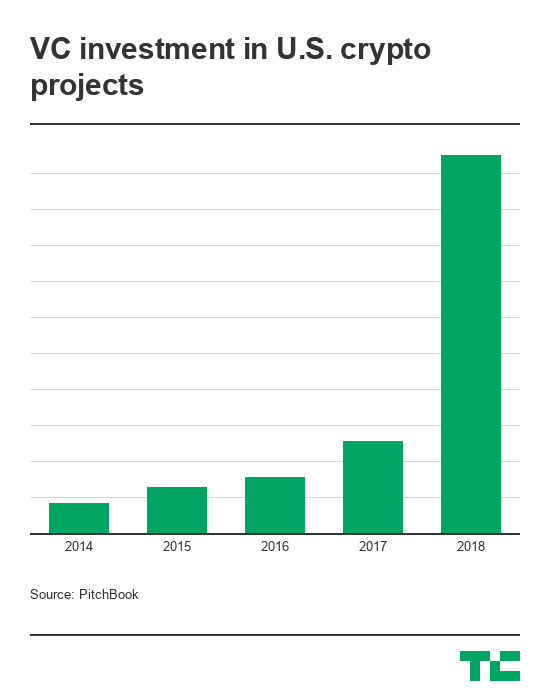
Many Bitcoin startups floundered in 2018, despite record amounts of venture capital invested in the industry. This was as a result of failed initial coin offerings, an inability to scale following periods of rapid growth and the falling price of Bitcoin. Still, VCs remained bullish on Bitcoin and blockchain technology in 2018, funneling a total of $2.2 billion in U.S.-based crypto projects — a nearly 4x increase year-over-year. Around the globe, investment hit a high of $4.6 billion — a more than 4x increase from last year, according to PitchBook.

“Notably, 2018 was the most active year for crypto in its brief ten-year history,” Loeffler wrote. “This was evidenced by rising investment in distributed ledger technology and digital assets, as well as by blockchain network metrics such as daily bitcoin transaction value and active addresses. Yet, these milestones tend to be overshadowed by the more narrow focus on bitcoin’s price, which has been seen by some, as a proxy for the potential of the technology.”

Today, the price of Bitcoin is hovering around $3,700 one year after a historic run valued the cryptocurrency at roughly $20,000. The crash caused many to dismiss Bitcoin and its underlying technology, while others remained committed to the tech and its potential for complete financial disruption. A project like Bakkt, created in-house at a respected financial institution with support from noteworthy businesses, is a logical bet for crypto and traditional private investors alike.

“The path to developing new markets is rarely linear: progress tends to modulate between innovation, dismissal, reinvention, and, finally, acceptance,” Loeffler added. “Each step, whether part of discovery or adversity, ultimately strengthens the product. Twenty years ago, it was controversial to suggest that commodities or bonds could trade electronically on a screen, and many steps were required for that evolution to play out.”

from Startups – TechCrunch https://tcrn.ch/2SwbdZo

#USA NYSE operator’s crypto project Bakkt brings in $182M

//

The Intercontinental Exchange’s (ICE) cryptocurrency project Bakkt celebrated New Year’s Eve with the announcement of a $182.5 million equity round from a slew of notable institutional investors. ICE, the operator of several global exchanges, including the New York Stock Exchange, established Bakkt to build a trading platform that enables consumers and institutions to buy, sell, store and spend digital assets.

This is Bakkt’s first institutional funding round; it was not a token sale. Participating in the round are Horizons Ventures, Microsoft’s venture capital arm (M12), Pantera Capital, Naspers’ fintech arm (PayU), Protocol Ventures, Boston Consulting Group, CMT Digital, Eagle Seven, Galaxy Digital, Goldfinch Partners and more.

Bakkt is currently seeking regulatory approval to launch a one-day physically delivered Bitcoin futures contract along with physical warehousing. The startup initially planned for a November 2018 launch, but confirmed this morning an earlier CoinDesk report that it was delaying the launch to “early 2019” as it awaits permission from the Commodity Futures Trading Commission. Along with the funding, crypto news blog The Block Crypto also reports Bakkt has hired Balaji Devarasetty, a former vice president at Vantiv, as its head technology.

ICE’s crypto project was first announced in August and is led by chief executive officer Kelly Loeffler, ICE’s long-time chief communications and marketing officer. Bakkt quickly inked partnerships with Microsoft, which provides cloud infrastructure to the service, and Starbucks, to develop “practical, trusted and regulated applications for consumers to convert their digital assets into U.S. dollars for use at Starbucks,” Starbucks vice president of payments Maria Smith said in a statement at the time.

Many Bitcoin startups floundered in 2018, despite record amounts of venture capital invested in the industry. This was as a result of failed initial coin offerings, an inability to scale following periods of rapid growth and the falling price of Bitcoin. Still, VCs remained bullish on Bitcoin and blockchain technology in 2018, funneling a total of $2.2 billion in U.S.-based crypto projects — a nearly 4x increase year-over-year. Around the globe, investment hit a high of $4.6 billion — a more than 4x increase from last year, according to PitchBook.

“Notably, 2018 was the most active year for crypto in its brief ten-year history,” Loeffler wrote. “This was evidenced by rising investment in distributed ledger technology and digital assets, as well as by blockchain network metrics such as daily bitcoin transaction value and active addresses. Yet, these milestones tend to be overshadowed by the more narrow focus on bitcoin’s price, which has been seen by some, as a proxy for the potential of the technology.”

Today, the price of Bitcoin is hovering around $3,700 one year after a historic run valued the cryptocurrency at roughly $20,000. The crash caused many to dismiss Bitcoin and its underlying technology, while others remained committed to the tech and its potential for complete financial disruption. A project like Bakkt, created in-house at a respected financial institution with support from noteworthy businesses, is a logical bet for crypto and traditional private investors alike.

“The path to developing new markets is rarely linear: progress tends to modulate between innovation, dismissal, reinvention, and, finally, acceptance,” Loeffler added. “Each step, whether part of discovery or adversity, ultimately strengthens the product. Twenty years ago, it was controversial to suggest that commodities or bonds could trade electronically on a screen, and many steps were required for that evolution to play out.”

from Startups – TechCrunch https://tcrn.ch/2SwbdZo

#USA Samsara banks $100M at a $3.6B valuation for its internet-connected sensors

//

Sensor data platform Samsara confirmed this morning that it had closed a new round of funding from existing investors Andreessen Horowitz and General Catalyst that values the startup at $3.6 billion.

The news was first reported by Cheddar, which spotted a filing with the state of Delaware on December 21 disclosing Samsara’s intent to raise a $100 million round at more than double the valuation it garnered upon its $50 million Series D this March.

“Our growth comes from bringing transformational new technologies to solve the problems of operational businesses, a massive segment of the economy that has long been underserved by the technology industry,” wrote Kiren Sekar, Samsara’s vice president of marketing and products, in the funding announcement. “Today, the advent of inexpensive sensors, high-bandwidth wireless connectivity, smartphones, and cloud computing enable these businesses to fully reap the benefits of 21st century technology.”

Founded in 2015, Samsara supports the transportation, logistics, construction, food production, energy and manufacturing industries with its internet-connected sensor systems, which helps businesses collect data and derive insights to improve the efficiency of physical operations.

The company’s co-founders are Sanjit Biswas and John Bicket, who previously launched Meraki, an enterprise Wi-Fi startup acquired by Cisco in an all-cash $1.2 billion deal in 2012.

Samsara’s latest financing brings the company’s total raised to $230 million. According to PitchBook, Andreessen Howoritz and General Catalyst are the only two private investors in the company, with Marc Andreessen and Hemant Taneja of General Catalyst representing the venture capital firms as lead investors on several Samsara deals.

San Francisco-based Samsara says revenue grew 250 percent in 2018 as its customer base swelled to 5,000. As for how it will deploy the new capital, the company plans to hire 1,000 employees, double down on AI and computer vision technology and open its first East Coast office in Atlanta.

The startup has yet to spend a dime of its last financing round, evidence it, like many other venture-funded startups, is probably pulling in capital before a market downturn strikes the industry and makes it increasingly difficult to raise hefty sums at impressive valuations.

“While the company already had a healthy balance sheet – we hadn’t dipped into our previous round of funding – the new capital enables us to accelerate long-term product investments and expand into new markets while continuing to maintain a strong balance sheet over the long term,” wrote Sekar.

from Startups – TechCrunch https://tcrn.ch/2ERcbLz

#USA Private equity buyouts have become viable exit options — even for early-stage startups

//

About 13 years ago I faced an excruciating decision: whether to sell my company, Pinnacle Systems, to a private equity firm or to another large public company. I felt that both suitors would treat my employees well (and I negotiated hard to make sure that was the case), and both offered a good asking price well above our value on NASDAQ.

After raising what at the time felt like my first child, born in my living room and nurtured into a publicly traded entity, I was ready for it to take its next step and for me to take mine. I ultimately opted for the strategic sale, but I left the process intrigued by what was already an evolving dynamic between private equity firms and tech exits.

In years past, stigma often accompanied private equity sales. I know I felt that way, even under strong deal terms. Plus, private equity exits were only available to companies generating substantial annual revenues and often profits, making this exit option inaccessible for many startups. Today, private equity buyout firms can provide a solid (and on occasion excellent) exit route — as well as an increasingly common one, accounting for 18.5 percent of VC-backed exits in 2017.

Private equity firms are investing in a broad array of technology companies, including highly valued unicorns, but also early- to mid-stage profitable and unprofitable companies that a few years ago would have been unable to secure interest from these buyout firms.

In addition, the lines between venture capital and private equity are increasingly blurring, with more private equity investments in tech, and several-late stage VC firms creating large, billion-dollar plus late-stage growth funds. Further blurring the lines, some of the late-stage VC firms are taking controlling interests in startups, a strategy typically associated with private equity. Recently, one of our portfolio companies received an investment from a late-stage VC firm that acquired a majority stake by providing liquidity to some existing shareholders and investing in the company, utilizing a strategy typically associated with PE buyout firms.

The rise of private equity buyouts within the tech sector presents a viable exit option for founders, given the reality that most startups won’t ultimately IPO. (According to PitchBook, only 3 percent of venture-backed companies in the last decade eventually went public.)

If an IPO is not a realistic long-term option, the remaining primary exit option has typically been a sale to another company (a strategic buyer, in venture parlance). However, in the past few years, private equity firms have become aggressive buyers of private companies, sometimes bidding as high as or higher than strategic buyers. With one of my portfolio companies, a private equity buyer placed the second highest bid ahead of all but one strategic buyer and helped raise the final price from the strategic buyer just by being in the bidding process.

Founders who find themselves in negotiations with strategic buyers should also reach out to PE firms to optimize the outcome. Silver Lake, Francisco Partners, Thoma Bravo and Vista are a few technology-focused PE firms, and PitchBook’s annual liquidity report lists other firms. Vista has been especially active, acquiring many technology companies, including Infoblox, Lithium and Marketo. Not all PE firms are the same, just like not all VCs and strategic buyers are the same.

Years ago, when private equity buyouts were typically only large deals, new management teams were almost always brought in to tweak the edges of already successful companies. Today, each private equity firm has its own strategy — some only buy large profitable companies, others focus on mid-size acquisitions and some only buy early-stage (typically unprofitable) companies, which brings us to the next point.

Even early-stage startups can explore a PE exit, especially if things are not going well

While most readers are familiar with private equity buyers at later stages, what’s new is the emergence of PE activity at early stages. These firms acquire majority stakes in startups that have only raised early-stage investments but are having trouble scaling or raising the next round.

After a buyout, these private equity firms typically provide value by adding the missing elements, such as marketing or sales know-how, in order to kick-start the business and achieve scale. Their goal is to increase the value of the underlying asset by augmenting founder teams with the buyout firm’s own operational experts, sometimes combining newly acquired assets with already existing assets to create a stronger whole, or doubling-down on promising products (while shedding less promising offerings) to unlock potential.

Typically, these PE firms then sell the company to another company (usually a strategic buyer) for greater value. In some cases, these early-stage PE firms sell to another PE buyout firm further up market. In some of these acquisitions, founders can maintain minority ownership in the company (though not a controlling stake), which they can carry through to their “next exit.”

Unlike PE buyouts at later stages, PE buyouts at the earlier stages are not usually high-value exits; they are mostly an avenue to provide the founders some return for their hard work, rather than the disappointing returns they can expect from an acqui-hire or, even worse, a shutdown. If negotiated correctly, a private equity deal can give founders an opportunity to play another hand to the next exit.

Few founders create companies in order to flip them. Strong entrepreneurs create companies to transform their missions into reality and positively impact the world. Steve Jobs said, “I’m convinced that about half of what separates the successful entrepreneurs from the non-successful ones is pure perseverance.” An acquisition — particularly to private equity — may not have been the original goal, but it may fuel the continued pursuit of the founder’s mission. Or, perhaps it will enable the pursuit of a new and worthy mission.

from Startups – TechCrunch https://tcrn.ch/2LCv72a

#USA Venture capital, global expansion, blockchain and drones characterize African tech in 2018

//

2018 saw Africa’s tech sector become more dynamic and international. VC firms on the continent multiplied. There were numerous investment rounds. And startups pursued acquisitions and global expansion. Here’s a snapshot of the news that shaped African tech over the last year.  

Surge in VC funds

A notable 2018 trend was Africa’s VC landscape becoming more African, with an increasing number of investment funds headquartered on the continent and run by locals, according to Crunchbase data released in this TechCrunch exclusive.

Drawing on its database and primary source research, Crunchbase identified 51 viable Africa-focused VC funds globally with at least 7-10 investments in African startups from seed to series stage.

Of the 51 funds, 22 (or 43 percent) were headquartered in Africa and managed by Africans. Of those 22, nine (or 41 percent) were formed since 2016 and nine were Nigerian.
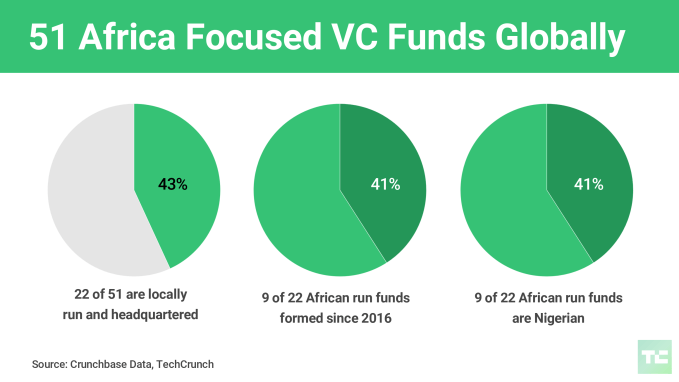
Four of the nine Nigeria-based funds were formed within the last year: Microtraction, Neon Ventures, Beta.Ventures and CcHub’s Growth Capital fund.

The Crunchbase study also tracked more Africans in top positions at outside funds and the rise of homegrown corporate venture arms.

One of those entities with a corporate venture arm, Naspers, announced a $100 million fund named Naspers Foundry to invest in South African tech startups. This was part of a $300 million (4.6 billion Rand) commitment by the South African media and investment company to support South Africa’s tech sector overall, as reported here at TechCrunch.

Another DFI came on the scene when France announced a $76 million African startup fund administered by the French Development Agency, AFD. TechCrunch got the skinny on how it will work here.

Investment and expansion

If African VC investment headlines were scarce a decade ago, in 2018 we became overwhelmed with them. This was largely a result of several recently closed Africa funds — TLcom’s $40 million, Partech’s $70 million, TPG’s 2 billion — beginning to deploy that capital.

In March, Nigerian consumer data analytics firm Terragon raised $5 million from TLcom. Kenyan business enterprise software company Africa’s Talking raised $8.6 million in a round led by IFC.

Investment startup Piggybank.ng closed $1.1 million in seed funding and announced a new product — Smart Target, for traditional savings groups. Trucking Logistics company Kobo360 raised two rounds, for a total of $7.2 million. Kenya-based agtech supply chain startup Twiga Foods raised $10 million. B2B retail supply chain Sokowatch closed a $2 million seed round led by 4DX ventures.
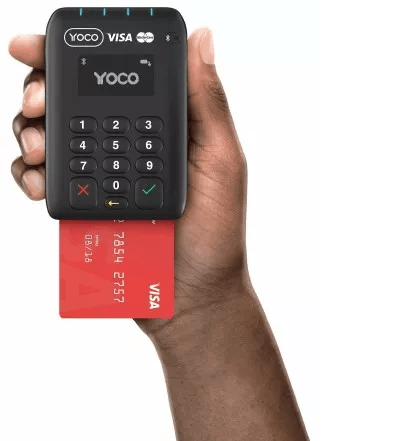
White-label lending startup Mines.io secured a $13 million Series A round. South African SME payment venture Yoco raised $16 million. Paga Payments added $10 million in fresh funding.

And then there were the three huge raises of the year. Kenyan digital payment company Cellulant hauled in $37.5 million in a Series C round led by TPG Growth. South African lending startup Jumo raised $52 million led by Goldman Sachs. And just this month, The Carlyle Group invested $40 million in Africa-focused online travel site Wakanow.com.  

Acquisitions and expansion

In 2018, African tech demonstrated it can travel, as several digital companies expanded on the continent and abroad. In May, MallforAfrica and DHL launched MarketPlaceAfrica.com, a global e-commerce site for select African artisans to sell wares to buyers in any of DHL’s 220 delivery countries.

Paga announced plans to expand in Africa and internationally, with an eye on Ethiopia, Mexico and the Philippines, CEO Tayo Oviosu told TechCrunch. Kobo360 is moving into in new markets — Ghana, Togo and Cote D’Ivoire.

On the back of its $52 million round, Jumo said it would expand in Asia and started by opening an office in Singapore.

On the acquisition front, Terragon bought Asian mobile marketing company Bizense in a cash and stock deal. The company is exploring greater growth opportunities in Latin America and Southeast Asia, CEO Elo Umeh told TechCrunch.

TPG Growth acquired a majority stake (of an undisclosed value) in Africa entertainment content company TRACE. After previous investments, Naspers acquired  96 percent of Southern African e-commerce venture Takealot.

And in December, California-based Emergent Technology Holdings acquired Ghanaian fintech payment company InterpayAfrica.

Partnerships

Collaboration between local tech firms and big global names continued in 2018. Liquid Telecom and Microsoft continued their partnership to offer connectivity cloud services such as Microsoft’s Azure, Dynamics 365 and Office 365 to select startups and hubs. This is part of Liquid Telecom’s strategy to go long on Africa’s startups as its future clients and the continent’s next big companies.

Facebook teamed up with Nigerian tech hub CcHub to launch its NG_Hub high-tech incubator.

Blockchain

As crypto fever gripped many leading economies in 2018, Africa was shaping its own blockchain narrative — one more grounded in utility than speculation. 500 Startups-backed SureRemit launched a crypto token product aimed at disrupting Africa’s multi-billion-dollar remittance market and raised $7 million in an ICO. South African payments venture Wala and solar energy startup Sun Exchange also had ICOs.

For blockchain as a platform, agtech startups Twiga Foods and Hello Tractor partnered with IBM Research to use the digital ledger tech to advance small-scale farmers and agriculture on the continent.

Ride-hail boda bodas

Ride-hail tech expanded into the continent’s frequently used motorcycle taxi market. Uber entered the three-wheeled tuk tuk moto taxi market in Tanzania in March and Uber and Taxify launched motorcycle passenger services in East Africa, including Kenya and Uganda.

Fails

Last year saw Y Combinator-backed VOD startup Afrostream shutter. In February 2018, Nigerian e-commerce startup Konga — backed by VC — was sold in a distressed acquisition. There were high expectations for Konga and its much-liked founder Sim Shagaya. I made the case that Konga’s acquisition was one of Africa’s first big startup fails that flew under the radar.

Drones

TechCrunch did a deep dive into Africa’s drone scene, talking to several experts and looking at emerging use cases across delivery services, agtech and surveying. On the regulatory side, several countries — Rwanda, Tanzania, South Africa, Zambia and Malawi — are doing some interesting things around regulation and creating drone-testing corridors for global players.

TechCrunch and Africa

In 2018 TechCrunch did more with Africa than any previous year. In addition to more content, there was a market engagement trip to Ghana and Nigeria, with meet-and-greets at Impact Hub, MEST Accra and Lagos, and CcHub.
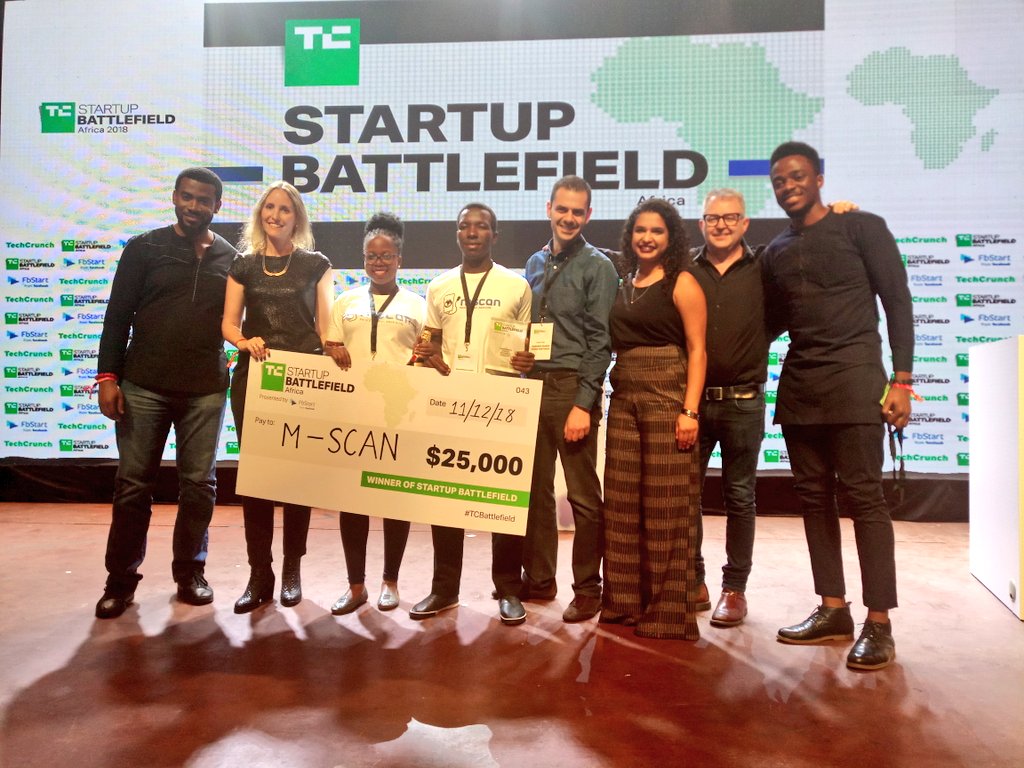
TechCrunch also had its first Africa panel on Disrupt SF’s main stage, an Africa session at Disrupt Berlin and held the second Startup Battlefield Africa in December in Nigeria.

Fifteen startups competed in Lagos in front of a Pan-African and global crowd. South African virtual banking startup Bettr was runner-up. Ultra-affordable ultrasound startup M-Scan from Uganda was the winner.

More Africa-related stories @TechCrunch

African tech around the ‘net  

from Startups – TechCrunch https://tcrn.ch/2GJfEyz