Malta, the renewable energy storage project born in Alphabet’s moonshot factory X, is now on its own and flush with $26 million from a Series A funding round led by Breakthrough Energy Ventures .
Concord New Energy Group and Alfa Laval also invested in the round.
Project Malta launched last year in Alphabet’s X (formerly Google X) with an aim to build energy storage facilities that can support full-scale power grids. The independent company spun out of Alphabet is now called Malta Inc.
Malta Inc has developed a system designed to keep power generated from renewable energy or fossil fuels in reserve for longer than lithium-ion batteries. The electro-thermal storage system first captures energy generated from wind, solar, or fossil generators on the grid. The collected electricity drives a heat pump, which converts the electrical energy into thermal energy. The heat is stored in molten salt, while the cold is stored in a chilled antifreeze liquid. A heat engine is used to convert the energy back to electricity for the grid when it’s needed.
The system can store electricity for days or even weeks, Malta says.
Malta is going to use the funds to work with industry partners to turn the detailed designs developed and refined at X into industrial-grade machinery for its first pilot system.
BEV, the lead investor in Malta’s Series A round, was created in 2016 by the Breakthrough Energy Coalition, an investor group that includes Microsoft co-founder Bill Gates, John Doerr, chairman of venture firm Kleiner Perkins Caufield & Byers, Alibaba founder Jack Ma, Amazon founder and CEO Jeff Bezos, and SAP co-founder Hasso Plattner.
from Startups – TechCrunch https://tcrn.ch/2EJq7rK
Malta, the renewable energy storage project born in Alphabet’s moonshot factory X, is now on its own and flush with $26 million from a Series A funding round led by Breakthrough Energy Ventures .
Concord New Energy Group and Alfa Laval also invested in the round.
Project Malta launched last year in Alphabet’s X (formerly Google X) with an aim to build energy storage facilities that can support full-scale power grids. The independent company spun out of Alphabet is now called Malta Inc.
Malta Inc has developed a system designed to keep power generated from renewable energy or fossil fuels in reserve for longer than lithium-ion batteries. The electro-thermal storage system first captures energy generated from wind, solar, or fossil generators on the grid. The collected electricity drives a heat pump, which converts the electrical energy into thermal energy. The heat is stored in molten salt, while the cold is stored in a chilled antifreeze liquid. A heat engine is used to convert the energy back to electricity for the grid when it’s needed.
The system can store electricity for days or even weeks, Malta says.
Malta is going to use the funds to work with industry partners to turn the detailed designs developed and refined at X into industrial-grade machinery for its first pilot system.
BEV, the lead investor in Malta’s Series A round, was created in 2016 by the Breakthrough Energy Coalition, an investor group that includes Microsoft co-founder Bill Gates, John Doerr, chairman of venture firm Kleiner Perkins Caufield & Byers, Alibaba founder Jack Ma, Amazon founder and CEO Jeff Bezos, and SAP co-founder Hasso Plattner.
from Startups – TechCrunch https://tcrn.ch/2EJq7rK
When founder Bobby Farahi met Shaudi “Shoddy” Lynn, it was at a rave in L.A. Farahi has said he was immediately drawn to the fashion sense of Lynn, who was a DJ at the time; she, meanwhile, might have appreciated the business acumen of Farahi, who had already sold a broadcast monitoring service called Multivision to a rival company.
As Farahi told Inc. magazine several years ago, the couple, now married, decided to try their hand at business together, calling it Dolls Kill and selling foxtail keychains before eventually evolving the brand into an online boutique that sells edgy, risqué clothes and accessories from companies like Killstar and Motel, both in the U.K., as well as makeup from another London company called Skinnydip.
Shoppers like what they see, seemingly. Back in 2014, Inc. reported, Dolls Kill, which is based in San Francisco, generated $7.6 million in sales. It was enough to elicit the attention of the consumer-focused venture firm Maveron, which wrote the company a check for $5 million. Now, shows an SEC filing, seven-year-old Dolls Kill is raising $15 million in new equity funding, and it has secured at least $10.7 million toward that end.
Some of that capital is seemingly being used to test out offline stores. Dolls Kill already has one brick-and-mortar store in San Francisco’s famous Haight neighborhood. In August, the company opened a second concept store in a 6,000-square-foot space on Fairfax Avenue in Los Angeles.
Dolls Kill is sometimes likened to Nasty Gal, founded in 2006 by Sophia Amoruso. Nasty Gal had filed for bankruptcy protection in 2016 after raising tens of millions of dollars from investors and reportedly spending heavily on marketing; two storefronts in L.A.; a downtown L.A. headquarters that quadrupled the size of an earlier HQ; and a fulfillment center in Kentucky.
At the time, industry analyst Richie Siegel told the L.A. Times that a central challenge to the company’s growth was Nasty Gal’s target market, suggesting that there is a ceiling to the number of women to whom a brand like Nasty Gal appeals. The company, since acquired by British online retailer Boohoo, continues as an online business only.
from Startups – TechCrunch https://tcrn.ch/2Af0NGl
There are few things in this world more difficult than launching a successful startup. It takes talent, know-how, money and a hell of a lot of good timing and luck. And even with all of those magical components in place, the odds may still be against you.
At TechCrunch, we take pride at covering the best and brightest of the startup world. But while covering the startup world is one of the most exciting and fulfilling parts of our job, death is a part of any lifecycle. Sadly, not all startups that burn bright ultimately make it. In fact, most don’t.
As we wrap up this year and look forward to the next, let’s take a moment to remember some of those startups we lost in 2018.
Airware created a cloud software system to help construction companies, mining operations and other enterprise customers use drones to inspect equipment for damage. It also tried to build its own drones but found that it couldn’t compete with giants like China’s DJI.
The shutdown appears to have been very sudden, coming just four days after Airware opened a Tokyo office, with an investment and partnership from Mitsubishi. In a statement, the company said, “Unfortunately, the market took longer to mature than we expected. As we worked through the various required pivots to position ourselves for long-term success, we ran out of financial runway.”
Blippar was one of the early pioneers in augmented reality, but unfortunately the AR market has yet to live up to the hopes for mainstream adoption. And despite raising a funding round earlier this year, the startup was apparently losing money quickly as it searched for new customers.
Not helping matters was some shareholder drama, where an emergency influx of $5 million was blocked by Khazanah, a strategic investment fund from the Malaysian government. In a blog post, the company said this was “an incredibly sad, disappointing, and unfortunate outcome.”
One of the major casualties of the FAA’s ban on smart luggage, this New York-based startup was forced to close its doors in May. CEO Tomi Pierucci was extremely outspoken when airlines started to enforce the new rules early this year, calling the news “an absolute travesty.”
From the standpoint of Bluesmart, he was right. The startup went all-in on connected luggage, and ultimately found it impossible to adapt when battery packs were no longer allowed on flights. The startup ended all sales and manufacturing, selling what was left of its tech, designs and IP to luggage giant TravelPro.
Things came crumbling down for San Francisco-based Doughbies in July, when the 500 Startups-backed, same-day cookie delivery service announced it was shutting down immediately. But it wasn’t because the startup ran out of money. Doughbies was actually profitable. Rather, its founders, Daniel Conway and Mariam Khan, just wanted to move onto something new.
TechCrunch’s Josh Constine argued at the time that Doughbies really didn’t need venture backing and that pressure to deliver adequate returns may have weighed more heavily on Doughbies than it was willing to admit. RIP Doughbies.
Like many failed startups before it, San Francisco-based Lantern was forced to shutter operations after an acquisition deal fell through. The mental health startup, founded by Nicholas Bui LeTourneau and Alejandro Foung, had raised millions in venture capital funding from the University of Pittsburgh Medical Center’s venture arm, Mayfield and SoftTechVC, but failed to follow through on its promise.
What was that promise? To offer personalized tools to deal with stress, anxiety and body image based on cognitive behavioral therapy techniques via a mobile application. Despite being an early mover in a now overly-crowded field of mental wellness apps, Lantern wasn’t able to find enough customers to survive.
Smart security camera maker Lighthouse AI had a promising product with a natural language processing system that allowed users to navigate their footage. But it also faced a crowded market, and it seems consumers didn’t embrace the product. The company announced this month that it’s winding down.
“I am incredibly proud of the groundbreaking work the Lighthouse team accomplished – delivering useful and accessible intelligence for our homes via advanced AI and 3D sensing,” wrote CEO Alex Teichman. “Unfortunately, we did not achieve the commercial success we were looking for and will be shutting down operations in the near future.”
Mayfield Robotics (2015-2018)
Total Raised: N/A
Mayfield, which was originally part of Bosch, created the adorable home robot Kuri. However, it announced in July that it would stop manufacturing Kuri, and followed with an announcement that it would cease operations altogether.
“Our team is beyond disappointed,” the company said in a blog post. “Together we’ve spent the past four years designing and building not just Kuri, but also an equally incredible company culture and spirit.”
A major player in industrial robotics, Rethink was founded by iRobot cofounder Rod Brooks and former MIT CSAIL staff researcher, Ann Whittaker. The Boston area startup grew into one of the most important players in both the collaborative and educational robotics space, courtesy of creations like Baxter and Sawyer.
Ultimately, however, the company served as yet another testament to just how difficult it is to launch a robotics startup. Even with brilliant minds and nearly $150 million in funding, the company couldn’t turn enough profit to stay afloat. A last-minute planned acquisition fell through, and Rethink was forced to close up shop in October.
Startup stories don’t come more film ready than this. Even before it officially closed its doors, Theranos was set to be the subject of a book, documentary and an Adam McKay directed feature film starring Jennifer Lawrence as founder Elizabeth Holmes. Holmes founded the company in 2003, promising a breakthrough in blood testing. By age 31, she became the world’s youngest self-made billionaire.
Theranos would go on to raise $1.4 billion, with a $10 billion valuation at its peak. In 2015, medical professionals began to mount criticism against the company’s methods. The following year, the SEC began investigating Theranos, ultimately charging it with “massive fraud.” In September, the company finally called it quits, with Holmes agreeing to pay a $500,000 penalty, while being barred from serving as an officer or director of a public company for 10 years.
NEW YORK, NY – MAY 06: Co-Founder and CEO of Shyp, Kevin Gibbons speaks onstage during TechCrunch Disrupt NY 2015 – Day 3 at The Manhattan Center on May 6, 2015 in New York City. (Photo by Noam Galai/Getty Images for TechCrunch)
A $250 million valuation and capital from some of the best investors (Kleiner Perkins, Slow Ventures) failed to keep on-demand shipping startup Shyp from dissolving. The San Francisco-based startup raised multiple rounds of venture capital amid a major hype cycle for on-demand shipping companies but wasn’t able to scale successfully beyond the Bay Area.
“To this day, I’m in awe of the vigor the team possessed in tackling a 200-year-old industry,” CEO Kevin Gibbon wrote at the time. “But, growth at all costs is a dangerous trap that many startups fall into, mine included.”
Over the past few years, Telltale Games seemed to reinvent adventure gaming, adapting big franchises like The Walking Dead, Game of Thrones and Batman into episodic stories where players’ choices seemed to have real weight. It even partnered with Netflix to bring a version of “Minecraft: Story Mode” to the streaming service.
But it seems the company has had longstanding business issues, with 90 employees laid off in November 2017, then another 250 let go in September of this year. Although a skeleton crew remained employed to finish the work for Netflix, it looks like Telltale is dead. And the fact that those employees were let go without severance seems to reinforce an earlier report of toxic management.
from Startups – TechCrunch https://tcrn.ch/2QMklfs
Captiv8, a company offering tools for brands to manage influencer marketing campaigns, has released its 2018 Fraud Influencer Marketing Benchmark Report. The goal is to give marketers the data they need to spot fake followers — and thus, to separate the influencers with a real following from those who only offer the illusion of engagement.
The report argues that that this a problem with a real financial impact (it’s something that Instagram is working to crack down on), with $2.1 billion spent on influencer marketing on Instagram in 2017 and 11 percent of the engagement coming from fraudulent accounts.
“For influencer marketing to truly deliver on its transformative potential, marketers need a more concrete and reliable way to identify fake followers and engagement, compare their performance to industry benchmarks, and determine the real reach and impact of social media spend,” Captiv8 says.
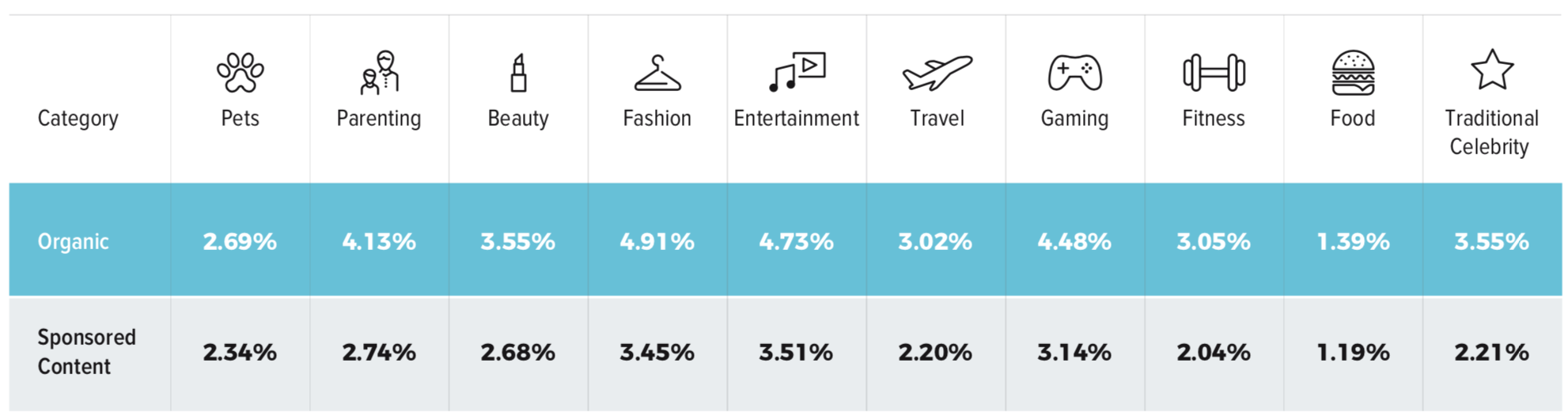
So the company looked at a range of marketing categories (pets, parenting, beauty, fashion, entertainment, travel, gaming, fitness, food and traditional celebrity) and randomly selected 5,000 Instagram influencer accounts in each one, pulling engagement from August to November of this year.
The idea is to establish a baseline for standard activity, so that marketers can spot potential red flags. Of course, everyone with a significant social media audience is going to have some fake followers, but Captiv8 suggests that some categories have a higher rate of fraud than others — fashion was the worst, with an average of 14 percent of fake activity per account, to compared to traditional celebrity, where the average was just 4 percent.
So what should you look out for? For starters, the report says that the average daily change in follower counts for an influencer is 1.2 percent, so be on the look out for shifts that are significantly larger.
The report also breaks down the average engagement rate for organic and sponsored content by category (ranging from 1.19 percent for sponsored content in food to 3.51 percent in entertainment), and suggests that a lower engagement rate “shows a high probability that their follower count is inflated through bots or fake followers.”
Conversely, it says it could also be a warning sign if a creator’s audience reach or impressions per user is higher than the industry benchmarks (for example, image posts in fashion have an average audience reach of 23.69 percent, with 1.32 impressions per unique user).
There’s been plenty of fanfare surrounding Uber and Lyft’s initial public offerings — slated for early 2019 — since the two companies filed confidential IPO paperwork with the U.S. Securities and Exchange Commission in early December. On top of that, public and private investors have had plenty to say about Slack and Pinterest’s rumored 2019 IPOs but those aren’t the only “unicorn” exits we should expect to witness in the year ahead.
Using its proprietary company rating algorithm, data provider CB Insights ranked five billion dollar companies most likely to perform IPOs next year in its latest tech IPO report. The algorithm analyzes non-traditional public signals, including hiring activity, web traffic and mobile app data to make its predictions. These are the startups that topped their list.
Peloton
Peloton Co-Founder and CEO John Foley speaks onstage during TechCrunch Disrupt SF 2018 on September 6, 2018 in San Francisco, California. (Photo by Kimberly White/Getty Images for TechCrunch).
Peloton, dubbed the “Netflix of fitness,” has raised nearly $1 billion in venture capital funding in the six years since it was founded by John Foley, most recently raising $550 million at a $4 billion valuation. The manufacturer of tech-enabled exercise equipment is more than doubling in size every year and is “weirdly profitable,” an unusual characteristic for a venture-backed business of its age. Headquartered in New York, Peloton doesn’t have any public IPO plans, though Foley recently told The Wall Street Journal that 2019 “makes a lot of sense” for its stock market debut.
Cloudflare co-founder and CEO Matthew Prince appears on stage at the 2014 TechCrunch Disrupt Europe/London. (Photo by Anthony Harvey/Getty Images for TechCrunch)
Cybersecurity unicorn Cloudflare is likely to transition to the public markets in the first half of 2019 in what is poised to be a strong year for IPOs in the security industry. The web performance and security platform is said to be preparing for an IPO at a potential valuation of more than $3.5 billion after last raising capital in 2015 at a $1.8 billion valuation. Since it was founded in 2009, the San Francisco-based company has raised just north of $250 million in VC funding. CrowdStrike, another security unicorn, is also on track to go public next year and it wouldn’t be surprising to see Illumio and Lookout make the jump to the public markets as well.
San Jose-based Zoom Video Communications has reportedly tapped Morgan Stanley to lead its upcoming IPO.
Zoom, a provider of video conferencing services, online meeting and group messaging tools that’s raised $160 million in VC cash to date, is eyeing a multi-billion IPO in 2019 and has reportedly hired Morgan Stanley to lead the offering. Founded in 2011, the company most recently brought in a $100 million Series D financing, entirely funded by Sequoia, at a $1 billion valuation in early 2017. Based in San Jose, Zoom is hoping to garner a valuation significantly larger than $1 billion when it IPOs, according to Reuters.
Select investors: Sequoia, Emergence Capital Partners, Horizons Ventures
Rubrik
Data management company Rubrik co-founder and CEO Bipul Sinha.
Data management company Rubrik has quietly made moves indicative of an impending IPO. The startup, which provides data backup and recovery services for businesses across cloud and on-premises environments, hired former Atlassian chief financial officer Murray Demo as its CFO earlier this year, as well as its first chief legal officer, Peter McGoff. Palo Alto-based Rubrik was valued at over of $1 billion with a $180 million funding round in 2017. The company has raised nearly $300 million to date.
Medallia, a customer experience management platform that’s nearly two decades old, may finally become a public company in 2019. The San Mateo-based company, which has been rumored to be planning an IPO for several years, hired a new CEO this year and reported $250 million in GAAP revenue for the year ending Jan. 31, 2018, according to Forbes. Medallia hasn’t raised capital since 2015, when it secured a $150 million funding deal at a $1.2 billion valuation. It has raised a total of just over $250 million.
HQ’s expansion beyond trivia emerges from beta tonight, but the question is whether it’s different and accessible enough to revive the startup’s growth. HQ Words opens to everyone with today’s 6:30pm pacific broadcast within the HQ Trivia app after several weeks of closed beta testing of the Wheel Of Fortune-style game. The launch will be the first big move of Rus Yusupov now that’s been officially renamed CEO a week after the tragic death of fellow co-founder and former CEO Colin Kroll, HQ confirms to TechCrunch.
“Intermedia Labs introduced the world to a category defining product, HQ Trivia. Once again, with HQ Words, Intermedia Labs is poised to captivate the world with a revolutionary experience that will bring people together in new ways around live mobile video” Yusupov tells us. “HQ Words is the most interactive experience we’ve ever made.”
Kroll’s passing comes at a tough time for HQ. Its daily player count has declined since it became a phenomenon a year ago. The novelty has begun to wear off, and with so many experienced trivia whizzes, cash jackpots are often split between enough people that winners only get a few bucks. Interrupting your days or nights to play at a particular time can be inconvenient compared to the legions of always-available other games. Yusupov, who was HQ’s CEO until Kroll took over in September, will have to figure out what will attract casual crosswords players and those who flocked to Zynga’s Words With Friends — the kind of disruptive thinking Kroll excelled at.
“Colin and I shared many incredible life moments over the last 7 years. We embarked on an incredible journey co-founding two breakthrough companies together – and the lessons we learned at Vine and HQ will continue to have a big impact on me. Like many relationships, we’ve also had our challenges – but it was during these challenging times that Colin’s kind soul and big heart would truly shine” Yusupov wrote in a statement about his co-founder that was originally published by Digiday in a touching memorial post. Between building Vine and HQ together, the pair have reimagined mobile entertainment, giving millions a chance to show off their wits and creativity. “He had this incredible ability to make everyone feel special. He listened well. He thought deeply. But above all, he cared about people more than work. The driving force behind his innovations was the positive impact they would have on people and world. Colin’s innovations and inventions have changed many people’s lives for the better and will continue to impact the world for years to come.”
HQ Trivia’s co-founder and former CEO Colin Kroll passed away earlier this month
How To Play HQ Words
In HQ Words, players compete live to solve word puzzles by correctly choosing what letters are hidden. You can find the game inside the existing HQ Trivia iOS and Android apps. Host Anna Roisman pluckily provides a clue and then dispenses hints as the 25-second timer for each puzzle counts down. If the clue is “gemstone” and you’re shown “_ _ _ m _ _ _”, you’ll have to tap D, I, A, O, and N in any order. Choose three wrong letters or fail to fill out the words and you lose. You’ll spin a wheel before the game starts to get one letter that’s automatically revealed each round.
Make it through ten rounds and you and other winners get a cut of the cash prize, with the three who solved the puzzles fastest scoring a bigger chunk of the jackpot. The startup earns money through selling you extra lives inside Words, though it will probably feature sponsored games and product placement like Trivia does to pull in marketing dollars. Words will go live daily at 6:30pm pacific after Trivia’s 6:00 game, so you can turn it into HQ hour with family and friends.
HQ Words is much more frenetic than Trivia. Rather than picking a single answer, you have to rapidly tap letters through a combination of educated and uneducated guesses. That means it really does feel more interactive since you’re not sitting for minutes with just a sole answer tap to keep you awake. And because it doesn’t require deep and broad trivia knowledge, Words could appeal to a wider audience. The spinner also adds an element of pure luck, as a weaker player who gets to auto-reveal a vowel might fare better than a wiser player who gets stuck with a “Z” like I always seem to.
Fill In The Blank
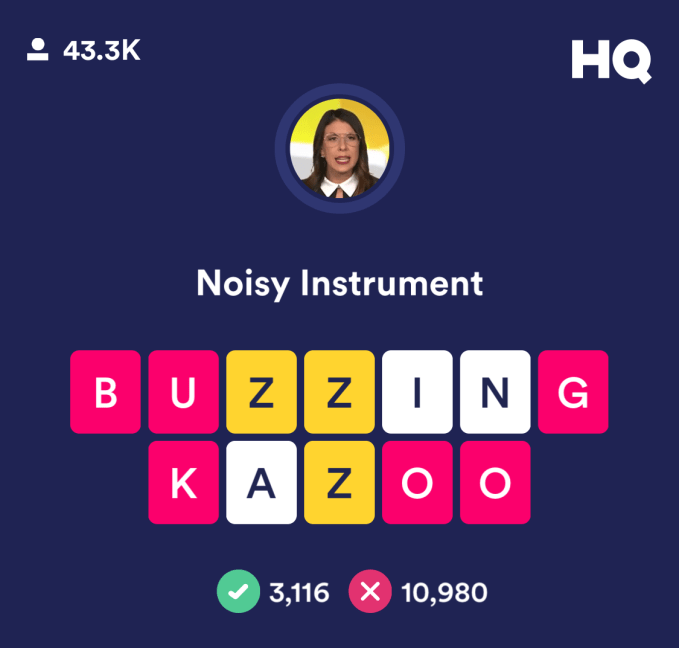
The concern is that at its core, Words is still quite similar to Trivia. They’re both real-time, elimination round-based knowledge games played against everyone for money. Both at times feel like they use cheap tricks to eliminate you. A recent Words puzzle asked you to name a noisy instrument, but the answer wasn’t “kazoo” but “buzzing kazoo” — something I’m not sure anyone has ever formally called it. Given the faster pace of interaction, even tiny glitches or moments of lag can be enough to make you lose a round. An HQ Words beta game earlier this week failed to show some users the keyboard, causing mass elimination. The pressure to get HQ’s engineering working flawlessly has never been higher.
HQ originally agreed to let TechCrunch interview Kroll about what makes Words different enough to change the startup’s momentum. Yusupov was supposed to fill in after Kroll was sadly found dead last Friday of an apparent drug overdose. He later declined to talk or provide written responses. That’s understandable during this time of mourning and transition. But HQ will still need to build an answer into its app. Meanwhile, Chinese clones and US competitors have begun co-opting the live video quiz idea. Facebook has even built a game show platform for content makers to create their own.
HQ could benefit from a better onboarding experience that lets people play a sample game solo to get them hooked and tide them over until the next scheduled broadcast. Mini-games or ways to play along after you’re eliminated could boost total view time and the value of brand sponsorships. A “quiet mode” that silences the between-round chatter and distills HQ to just the questions and puzzles might make it easier to play while multi-tasking. Head-to-head versions of Trivia and Words might help HQ feel more intimate, and there’s an opportunity to integrate peer-to-peer gambling like ProveIt trivia. And branching out beyond knowledge games into more social or arcade-style titles would counter the idea that HQ is just for brainiacs.
Around the height of HQ’s popularity it raised a $15 million funding round at a $100 million valuation. That seems justified given HQ will reportedly earn around $10 million in revenue this year. Gamers are fickle, though, and today’s Fortnite can wind up tomorrow’s Pokemon Go — a flash in the pan that fizzles out. Words is a great bridge to a world outside of Trivia, but HQ must evolve not just iterate.
from Startups – TechCrunch https://tcrn.ch/2EL83O1
A Juul is not a cigarette. It’s much easier than that. Through devilishly slick product design I’ll discuss here, the startup has massively lowered the barrier to getting hooked on nicotine. Juul has dismantled every deterrent to taking a puff.
The result is both a new $38 billion valuation thanks to a $12.8 billion investment from Marlboro Cigarettes-maker Altria this week, and an explosion in popularity of vaping amongst teenagers and the rest of the population. Game recognize game, and Altria’s game is nicotine addiction. It knows it’s been one-upped by Juul’s tactics, so it’s hedged its own success by handing the startup over a tenth of the public corporation’s market cap in cash.
Juul argues it can help people switch from obviously dangerous smoking to supposedly healthier vaping. But in reality, the tiny aluminum device helps people switch from nothing to vaping…which can lead some to start smoking the real thing. A study found it causes more people to pick up cigarettes than put them down.
Photographer: Gabby Jones/Bloomberg via Getty Images
How fast has Juul swept the nation? Nielsen says it controls 75 percent of the U.S. e-cigarette market up from 27 percent in September last year. In the year since then, the CDC says the percentage of high school students who’ve used an e-cigarette in the last 30 days has grown 75 percent. That’s 3 million teens or roughly 20 percent of all high school kids. CNBC reports that Juul 2018 revenue could be around $1.5 billion.
The health consequences aside, Juul makes it radically simple to pick up a lifelong vice. Parents, regulators, and potential vapers need to understand why Juul works so well if they’ll have any hope of suppressing its temptations.
Shareable
It’s tough to try a cigarette for the first time. The heat and smoke burn your throat. The taste is harsh and overwhelming. The smell coats your fingers and clothes, marking you as smoker. There’s pressure to smoke a whole one lest you waste the tobacco. Even if you want to try a friend’s, they have to ignite one first. And unlike bigger box mod vaporizers where you customize the temperature and e-juice, Juul doesn’t make you look like some dorky hardcore vapelord.
Juul is much more gentle on your throat. The taste is more mild and can be masked with flavors. The vapor doesn’t stain you with a smell as quickly. You can try just a single puff from a friend’s at a bar or during a smoking break with no pressure to inhale more. The elegant, discrete form factor doesn’t brand you as a serious vape users. It’s casual. Yet the public gesture and clouds people exhale are still eye catching to trigger the questions, “Whats that? Can I try?”
And perhaps most insidiously, vaping seems healthier. A lifetime of anti-smoking ads and warning labels drilled the dangers into our heads. But how much harm could a little vapor do?
A friend who had never smoked tells me they burn through a full Juul pod per day now. Someone got him to try a single puff at a nightclub. Soon he was asking for drag off of strangers’ Juuls. Then he bought one and never looked back. He’d been around cigarettes at parties his whole life but never got into them. Juul made it too effortless to resist.
Concealable
Lighting up a cigarette is a garish activity prohibited in many places. Not so with discretely sipping from a Juul.
Cigarettes often aren’t allowed to be smoked inside. Hiding it is no easy feat and can get you kicked out. You need to have a lighter and play with fire to get one started. They can get crushed or damp in your pocket. The burning tip makes them unruly in tight quarters, and the bud or falling ash can damage clothing and make a mess. You smoke a cigarette because you really want to smoke a cigarette.
Public establishments are still figuring out how to handle Juuls and other vaporizers. Many places that ban smoking don’t explicitly do the same for vaping. The less stinky vapor and more discrete motion makes it easy to hide. Beyond airplanes, you could probably play dumb and say you didn’t know the rules if you did get caught. The metal stick is hard to break. You won’t singe anyone. There’s no mess, need for an ashtray, or holes in your jackets or couches.
As long as your battery is charged, there’s no need for extra equipment and you won’t draw attention like with a lighter. Battery life is a major concern for heavy Juulers that smokers don’t have worry about, but I know people who now carry a giant portable charger just to keep their Juul alive. But there’s also a network effect that’s developing. Similar to iPhone cords, Juuls are becoming common enough that you can often conveniently borrow a battery stick or charger from another user.
And again, the modular ability to take as few or as many puffs as you want lets you absent-mindedly Juul at any moment. At your desk, on the dance floor, as you drive, or even in bed. A friend’s nieces and nephews say that they see fellow teens Juul in class by concealing it in the cuff of their sleeve. No kid would be so brazen as to try smoke in cigarette in the middle of a math lesson.
Distributable
Gillette pioneered the brilliant razor and blade business model. Buy the sometimes-discounted razor, and you’re compelled to keep buying the expensive proprietary blades. Dollar Shave Club leveled up the strategy by offering a subscription that delivers the consumable blades to your door. Juul combines both with a product that’s physically addictive.
When you finish a pack of cigarettes, you could be done smoking. There’s nothing left. But with Juul you’ve still got the $35 battery pack when you finish vaping a pod. There’s a sunk cost fallacy goading you to keep buying the pods to get the most out of your investment and stay locked into the Juul ecosystem.
(Photo by Scott Olson/Getty Images)
One of Juul’s sole virality disadvantages compared to cigarettes is that they’re not as ubiquitously available. Some stores that sells cigs just don’t carry them yet. But more and more shops are picking them up, which will continue with Altria’s help. And Juul offers an “auto-ship” delivery option that knocks $2 off the $16 pack of four pods so you don’t even have to think about buying more. Catch the urge to quit? Well you’ve got pods on the way so you might as well use them. Whether due to regulation or a lack of innovation, I couldn’t find subscription delivery options for traditional cigarettes.
And for minors that want to buy Juuls or Juul pods illegally, their tiny size makes them easy to smuggle and resell. A recent South Park episode featured warring syndicates of fourth-graders selling Juul pods to even younger kids.
Dishonorable
Juul co-founder James Monsees told the San Jose Mercury News that “The first phase is proving the value and creating a product that makes cigarettes obsolete.” But notice he didn’t say Juul wants to make nicotine obsolete or reduce the number of people addicted to it.
Juul co-founder James Monsees
If Juul actually cared about fighting addiction, it’d offer a regimen for weaning yourself off of nicotine. Yet it doesn’t sell low-dose or no-dose pods that could help people quit entirely. In the US it only sells 5% and 3% nicotine versions. It does make 1.7% pods for foreign markets like Israel where that’s the maximum legal strengths, though refuses to sell them in the States. Along with taking over $12 billion from one of the largest cigarette companies, that makes the mission statement ring hollow.
Juul is the death stick business as usual, but strengthened by the product design and virality typically reserved for Apple and Facebook.
from Startups – TechCrunch https://tcrn.ch/2T64pRQ
The story of the game Star Citizen and Cloud Imperium, the company developing it, is almost too ludicrous to believe: a crowdfunding effort to create a space sim of unparalleled size and realism, raising hundreds of millions, with backers paying thousands for ships and gear in a game that’s years from release. Yet it’s real enough that it just pulled in $42 million in private funding to help bring it closer to release.
Star Citizen began as the brainchild of Chris Roberts, architect of the Wing Commander series and other well-received space games. His idea was to crowdfund the team’s next game, and did so in 2012; the money started rolling in, and it never really stopped. Nor has the game ceased to grow in its ambitions, adding things like entire planets to the lineup that seem, on their face, somewhat insane.
There’s no shortage of histories of the game and its developers out there, so for our purposes let it suffice to say that over the last six years the company has raised $211 million, the vast majority of which comes from gamers “pledging” anywhere from a few bucks to thousands of dollars for all manner of things related to the title. Early access to builds, exclusive ships, testing new content, etc.
A huge amount of work has been done on the game, so this isn’t just a colossal con, though there are plenty who think the game, and its first-person shooter counterpart Squadron 42, can’t possibly ever fulfill its ambitions and justify the money people have put into it.
That doesn’t seem to be the opinion of Clive Calder, founder of Zomba and producer in a variety of entertainment formats, whom Roberts met during a clandestine campaign to solicit funding.
Roberts, who writes the story in one of his candid messages to the project’s fanbase, had decided a while back that he didn’t want to use pledged funds for marketing purposes — at least not the kind of marketing blitz AAA games tend to require for a successful global release. So he went looking for investment, and found Calder, with whom he “got on like a house on fire.”
Calder’s family office agreed to invest $46 million for a 10 percent stake in Cloud Imperium, which all told puts it near a half-billion valuation. One may very well question the sanity of such a valuation for a company that has not yet shipped an actual product — working prototypes, sure, but not a completed game — but hell, at least they’re making something people are excited about. That’s got to be worth a couple bucks.
Cloud Imperium gains two new board members from outside, though Roberts, who commands the kind of loyalty that only decades in an industry can create, was quick to point out that “control of the company and the board still firmly stays with myself as Chairman, CEO and majority shareholder.”
In another act of not exactly radical but not legally required transparency, the company also posted an outline of the company’s financials over the last 6 years. Unsurprisingly, the company has been investing most of its cash into game development in the form of salaries, contracts, and overhead; a non-trivial amount has gone towards “publishing operations, community, events and marketing,” which with a game as community-focused as Star Citizen is not surprising.
The company has grown steadily, adding a hundred people a year or so to a present size of 464 — which is the kind of size you’d expect on a AAA game like Assassin’s Creed or Red Dead Redemption. Even more would be added on as temporary artists, actors, and so on.
I’m sure it has escaped no one that pledges appear to have peaked, though if they remain steady then the company can clearly the company will have enough to continue operations if it doesn’t expand. But one does also see perhaps a secondary motive in seeking investment from outside the community. At some point people are going to want a game.
To that end Squadron 42, at least, is scheduled for release in Q2 2020 — though backers and critics will both chuckle a little at the idea that Cloud Imperium will be able to hit those goals. The games, infamously, were originally slated for release long ago. But the scope of the project has grown since its conception and although some no doubt would rather be playing the completed game today, they may very well find that good things come to those who wait. And wait. And wait…
from Startups – TechCrunch https://tcrn.ch/2QJzmyt
If you’ve ever found yourself lugging a big suitcase from meeting to meeting, a startup called Bounce could make your life easier. Using Bounce, you’ll be able to pay for short-term storage at hotels, dry cleaners and other local businesses.
The San Francisco-based startup is announcing that it has raised $1.2 million in seed funding from investors including Structured Capital managing partner Jillian Manus, Seabed VC, Airbnb general counsel Rob Chesnut and Canadian entrepreneur Michael Hyatt.
CEO Cody Candee (pictured above with his co-founder and CTO Aleksander Rendtslev) said he’s actually not someone who owns a lot of stuff himself, but he realized that “people are constantly planning their days and planning their lives around the things that they own,” whether that’s running home to drop something off or heading straight to your hotel from the airport because you need to get rid of your luggage.
So Bounce has already signed up more than 100 locations across New York, San Francisco, Washington DC and Chicago, and it says they’ve has been used to store tens of thousands of bags. You currently browse these locations through the Bounce website, but Candee said an iOS app launch is imminent.
Apparently Bounce vets its locations, partly to ensure that they have secure storage areas and that their posted store hours are accurate — so that you don’t rush to the store to pick something up before closing, only to discover that everyone left early. Candee added that the most common use cases include travelers who have checked out of their hotels, people attending events (I once tried to carry my gym bag into Madison Square Garden and I will never do that again) and salespeople who are hopping from meeting to meeting.
There are other companies that appear to have a similar idea — for example, Vertoe was part of winter class at Techstars NYX — but Candee said that competitors are mostly “attacking just the luggage storage space,” which he suggested is “relatively easy to build.”
In contrast, he said, “The way we see it is, we’re really building a tech platform and basically thinking about these broader use cases.” In fact, he said Bounce is already testing out a system where items are transported by local couriers between different storage locations.
“We’re thinking about what could be built on top of that platform,” Candee said. “A drycleaner could come on our platform and they could basically say, ‘Hey, drop your clothes off’ and then Bounce it back to wherever that user is.”
from Startups – TechCrunch https://tcrn.ch/2LBHxrb
















 “Intermedia Labs introduced the world to a category defining product, HQ Trivia. Once again, with HQ Words, Intermedia Labs is poised to captivate the world with a revolutionary experience that will bring people together in new ways around live mobile video” Yusupov tells us. “HQ Words is the most interactive experience we’ve ever made.”

 HQ could benefit from a better onboarding experience that lets people play a sample game solo to get them hooked and tide them over until the next scheduled broadcast. Mini-games or ways to play along after you’re eliminated could boost total view time and the value of brand sponsorships. A “quiet mode” that silences the between-round chatter and distills HQ to just the questions and puzzles might make it easier to play while multi-tasking. Head-to-head versions of Trivia and Words might help HQ feel more intimate, and there’s an opportunity to integrate peer-to-peer gambling like