#USA Layer1 wants to thrive in the age of the crypto crash

//

A year ago, crypto was reaching ever new highs, and I was talking about whether ICOs would supplant the VC funding round and warning about Kim Jong Un’s crypto trading operations.

And then the world turned upside down.

Crypto prices are near rock bottom prices, with Bitcoin hanging around $4,000 and Ethereum around $113, down from their highs earlier this year of around $16,600 and $1,400 respectively.

While that has put a dampener on the enthusiasm of a lot of cryptocurrency retail investors, the bigger question is how do institutional players work through this market? What’s the strategy for finding value in this technology sector long-term?

I chatted with Alexander Liegl, who may just have at least part of the answer. He’s the founder of Layer1, which announced a $2.1 million fundraise this week from Peter Thiel, Digital Currency Group, and Jeffrey Tarrant.

Liegl saw a huge challenge in the blockchain and cryptocurrency spaces: too many good ideas and not enough developers working on product development work. So he decided to create an “activist fund for cryptocurrencies” that would “take concentrated bets on protocols that we think have a need in this world.” Layer1 then supplies developers and other experts to provide “infrastructure and support,” he explained. “An operating entity like us can have a lot of influence in moving the needle.” He describes Layer1 as “a combination of Polychain and Blockstreet” and “the Rocket Internet of crypto.”

That might sound vaguely similar to ConsenSys, the loosely-coupled group of startups and infrastructure engineers trying to build out Ethereum which has run into very hard times recently. Unlike ConsenSys, which was founded by Ethereum co-founder Joe Lubin and is directly focused on that ecosystem, Layer1 isn’t wedded to one blockchain or ecosystem, and instead selects a single project at a time through a mix of financial analysis and thesis development.

With capital in the bank, Layer1 has backed Grin as its first cryptocurrency. Grin is designed to be a completely private and censorship-resistant transaction medium, and Liegl says that “conceptually it really reconciles with our view in the space.” He particularly liked that Grin has an anonymous founder like Bitcoin, since no founder controls the governance of the project. Grin is intending to publicly launch in mid-January.

I asked Liegl how he was responding to the crypto crunch this year in the markets, and he considered it far more of an opportunity than a detriment to his work. “I’m really pumped about all of this,” he explained. “a lot of the bad actors have to be flushed out.” He noted that the low of the bear market may not be reached yet, but that Layer1 was in a good position to take advantage of the timing. “We raised the newest dollars, so we are not suffering from any of these ICO-induced problems,” he said.

Liegl, who graduated from Stanford in 2015 and briefly worked at Stanford’s endowment, has certainly seen the vagaries of the cryptocurrency markets. He learned about Bitcoin during its first popular run-up in 2013, even convincing his parents to invest in the budding project.

Now, he has his eyes set on Grin, and then additional projects. He thinks Layer1 will invest in a new project roughly every 6-9 months, which will accelerate over time with additional capital.

While these “platform” models have struggled a bit in the venture world, I think it’s reasonable that blockchain projects, which often suffer from a lack of attention from developers and end uses, could use a strong engineering and popularization boost. Layer1 isn’t the first in the blockchain world to take this approach nor I am sure will it be the last, but it might be just the ticket forward for a world that has struggled to pay its employees and bills in a crash.

from Startups – TechCrunch https://tcrn.ch/2PTl0Xi

#USA CherryHome raises $5.2M to apply AI to home care cameras, detecting behavior changes

//

A new startup using AI to look after elderly people at home has raised a new round of funding to apply its platform to detect changes in gait or behavior, falls or stumbles. In other words, it could start to predict changes in long-term health.

CherryHome, the home AI security system created by startup Cherry Labs, has raised $5.2 million in funding from GSR Ventures to drive the technology’s use for in-home senior care. CherryHome uses its proprietary computer vision algorithms to interpret camera data into virtual “skeletons.” These are used by the AI to understand and analyze home events and people’s behaviors, such as how someone might develop a limp over time, for instance.

The startup competes with Safely You, which sends alerts in response to very obvious falls; Nest and Lighthouse, which tend to only offer very basic AI over its imaging; and Amazon’s Ring, which only offers outdoor security.

With CherryHome, all information is processed locally, so the video doesn’t leave the house, while the senior citizen is replaced in the video with a virtual “stick-person” to preserve their privacy. This last aspect, in particular, is a really good idea.

With this new round of funding, CherryHome has signed pilot deals with TheraCare in-home care-giving service and TriCura, a tech ecosystem for care agencies. Both are based in the Bay Area.

Max Goncharov, CEO and co-founder of CherryHome says: “Understanding human behavior has a long list of applications, from home security to in-home senior care to the overall goal of making smart homes totally autonomous. But improving senior care is arguably one of the most important areas for technological improvement.” He says seniors currently make up 15 percent of the U.S. population, and by 2030, one in five Americans will be of retirement age. Several studies show the majority of those people wish to remain at home, as opposed to moving into an assisted-living facility.

from Startups – TechCrunch https://tcrn.ch/2T3zpSq

#USA Spot is a cryptocurrency app to control all your wallets and exchange accounts

//

Meet Spot, a beautifully-designed mobile app to control your cryptocurrencies. Spot looks like a portfolio tracking app. But the company has built a strong foundation to add more features in the coming months. Spot wants to be your unique gateway to the world of cryptocurrencies.

“Spot’s vision isn’t to build a portfolio tracker — we went a bit overboard with this feature,” co-founder and CEO Edouard Steegmann told me. “Eventually, we want to become the app to manage all your cryptos, a sort of Revolut but with a crypto DNA.”

When you first install the app, you can connect it to your existing wallets by adding public addresses. Even if you store your tokens on a hardware wallet, Spot can read the public details of your wallet to show them in the app.

“We have our own nodes on Ethereum, Bitcoin, Litecoin, Stellar and others to recover the amount on your wallet,” Steegmann said. Data is also cross-checked with third-party services to make sure that everything is fine.

Spot also lets you connect to an exchange account using API keys. Right now, the app supports Binance, Kraken, Bitfinex and Poloniex, but the company already plans to add more exchanges.

The app then gives you a detailed overview of your holdings across all services and wallets. You can see detailed charts, discover which token is performing better than the rest. It’s also one of the most well-designed mobile app I’ve seen this year — animations and interactions are gorgeous.

But Spot doesn’t rely on an API to get pricing information for each token. “We’ve rebuilt CoinMarketCap from the ground up, and we’re one of few companies that have done it,” Steegmann said. The company stores pricing information for dozens of tokens across 150 exchanges. That’s a lot of pairings.

If you tap on the Spot logo at the top of the app, you can see the maximum value of your portfolio if you cash out on exchanges with the highest prices for your tokens. The company makes sure that there’s enough volume to show you coherent prices.

Spot thinks that controlling your own data is too important to rely on API calls. When you have your own data, you don’t have any API rate limits, you don’t have a major dependency and you can scale more calmly.

Up next, you’ll be able to trade directly in the app. The company isn’t going to build its own exchange, but you can expect to buy and sell tokens on a third-party exchange without having to visit the website.

“We think that many things will be tokenized and that there’s no user-friendly interface to transfer, receive, buy and sell,” Steegmann said.

The company raised a $1.2 million round (€1.056 million to be exact) from Kima Ventures and business angels, including Eric Larchevêque and Thomas France from Ledger, Jean-Daniel Guyot, Thibaud Elzière, Eduardo Ronzano, Nicolas Steegmann, Sébastien Lucas and Nicolas Debock.

Disclosure: I own small amounts of various cryptocurrencies.

from Startups – TechCrunch https://tcrn.ch/2Sa4dRK

#USA Join us in Las Vegas during CES

//

We will be holding a small event during CES in Las Vegas and we want to see you! We’re looking to meet some cool hardware and crypto startups so the good folks at Work In Progress have opened up their space to us and 200 of you all to hold a meetup and pitch-off.

The event will be held at Work In Progress, 317 South 6th Street on Wed, January 9, 2019 between 6:00 PM – 9:00 PM PST.

There are only 200 tickets so if you want to come please pick one up ASAP. The meetup is open to everyone so head over if you’d like to talk tech. You can pick up a ticket here.

If you’d like to pitch at the event I’ll be picking ten companies who will have three minutes to pitch without slides. Since this is a hardware event I recommend bringing a few of your items to show off. If you’d like to pitch, fill this out and I will contact those who will be coming up on stage.

See you in the Big Easy!

from Startups – TechCrunch https://tcrn.ch/2V2njen

#USA Zynga to acquire Small Giant Games, the maker of Empires & Puzzles, for $700M

//

Social game developer Zynga has entered into an agreement to acquire Small Giant Games, the startup behind the popular mobile game Empires & Puzzles, in a deal expected to total $700 million.

Zynga, which has tumbled since its 2011 Nasdaq initial public offering, will initially acquire 80 percent of Small Giant Games for $560 million, composed of $330 million in cash and $230 million of unregistered Zynga common stock. Zynga will fund part of the transaction with a $200 million credit facility.

“We’ve been impressed by the quality and momentum of Empires & Puzzles as we add another Forever Franchise into Zynga’s portfolio,” Zynga chief executive officer Frank Gibeau said in a statement. “Small Giant has created an innovative game that delivers a unique player experience that engages over the long term.”

The deal is expected to close on January 1. Zynga will purchase the remaining 20 percent of Small Giant over the next three years “at valuations based on specified profitability goals.”

Helsinki-based Small Giant Games had raised $52 million in equity funding from EQT Ventures, Creandum, Spintop Ventures, Profounders and others since it was founded in 2013. The company reported $33 million of revenue for Empires & Puzzles, its most popular game, 10 months after its launch in 2017. Small Giant, which is also behind Alliance Wars and Season 2: Atlantis, says they exceeded 2017’s revenue just four months into 2018.

“Our studio was founded on the idea that small, skillful teams can accomplish giant things, and I am confident that partnering with Zynga is the right next step in our evolution,” Small Giant CEO Timo Soininen said in a statement. “We will now operate as a separate studio within Zynga, maintaining our identity, culture and creative independence. By leveraging the expertise and support from the wider Zynga team, we will amplify the reach of Empires & Puzzles and the new games in our development pipeline.”

Zynga, founded in 2007, is the developer of FarmVille, Zynga Poker, Words with Friends and several other mobile games. The company reported revenues of $248.88 million for the quarter ended September 2018, failing to meet analyst estimates.

Zynga expects to bring in $243 million in revenue in the fourth quarter of 2018.

from Startups – TechCrunch https://ift.tt/2EFTxHs

#USA Earnin raises $125M to help workers track and cash out wages in real time

//

Before Ram Palaniappan founded Earnin, he developed a system for employees at a payments company called UniRush, where he spent eight years as president. If you needed money before payday, he would write you a check from his checking account and when payday rolled around, employees would reimburse him.

Despite being paid what Palaniappan thought were fair wages, his workers often found themselves in a bind, needing access to wages they couldn’t expect to see in their own bank accounts for days.

“This is such a core pain point,” Palaniappan told TechCrunch. “Over three-fourths of the country live paycheck to paycheck … It’s an issue of fairness. We all have gotten used to getting paid every two weeks, but most employees would rather be paid before they work.”

Palaniappan decided to transform what he had been doing as a favor to employees into a real business with Earnin (formerly known as Activehours), a startup that helps hourly, gig and salary workers track their earnings and transfer them to their checking accounts in real time using a mobile application. Today, the company is announcing a $125 million Series C funding from top-tier investors DST Global, Andreessen Horowitz, Spark Capital, Matrix Partners, March Capital Partners, Coatue Management and Ribbit Capital. Palaniappan declined to disclose the valuation.

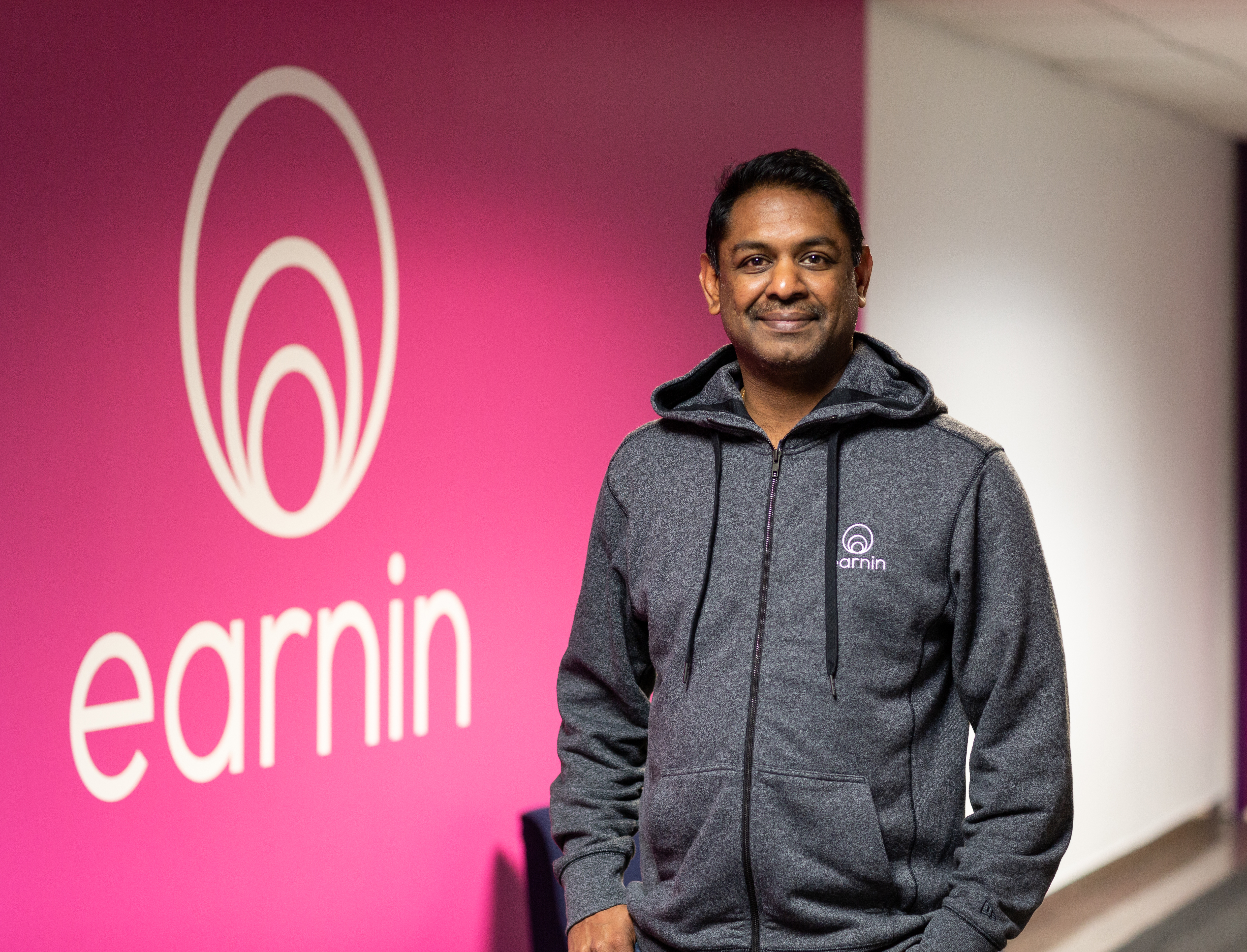
Earnin founder and chief executive officer Ram Palaniappan

Here’s how it works: An employee signs up on the Earnin app and connects their bank account. Earnin infers the person’s pay cycle and debits their account the amount they’ve borrowed on their payday. Earnin charges no fees or interest; instead, it operates on a pay it forward revenue model some would balk at. Earnin users have the option to “tip” the app after each transaction and that tip, in turn, is used to fund the next user’s withdrawal. If a user tips more than Earnin thinks is reasonable for the given withdrawal, it will notify the user and give them the option to dial back the tip amount.

What the company has found is that users are usually more than happy to contribute to the Earnin community of workers.

“So often, people are trying to help each other out,” Palaniappan said. “That’s the most powerful piece — how much support the community is providing to each other.”

Earnin was launched in 2014 and has previously raised $65 million in venture capital funding. With the latest investment, it will expand its engineering and product teams across its offices in Palo Alto — where it’s headquartered — as well as in Cincinnati and Vancouver.

The app, often among the App Store’s top 10 financial apps, has more than 1 million downloads, the company says, and is used by employees at more than 50,000 companies — many of which check the app every day. Palaniappan says its users are working more than 15 million hours per week. If each user works an estimated 40 hours per week, that means the app has roughly 375,000 weekly active users.

He added that the startup’s growth in the last four years has been “quite remarkable.” Given the investor support it’s received, it’s likely to step into “unicorn” territory soon. Ribbit Capital, for example, is a leading fintech investing firm with capital invested in Coinbase, Revolut, Gusto, Wealthfront, NuBank, Brex and more.

from Startups – TechCrunch https://ift.tt/2SZ7hjr

#USA Boosted nabs $60M as the electric skateboard maker looks to build something new

//

Boosted has scored some serious cash as it looks to move beyond the world of electric skateboards to conquer new forms of personal transportation.

The startup announced today that it has closed a $60 million round of Series B funding co-led by Khosla Ventures and iNovia Capital. Stanford’s StartX and Bay Meadows also participated in the round. Boosted has now raised north of $70 million.

The company founded in 2012 is the most recognizable name in the quickly crowding field of electric skateboards, but Boosted is now looking to grow its ambitions to new personal transportation verticals in the “light vehicle type” category.

So, does this mean Boosted is building a scooter?

Well, that certainly seems like a serious possibility, though we mainly just have a statement from Khosla Ventures partner Samir Kaul to go off of at the moment.

“From day one, Boosted has been built as a scalable light electric vehicle company that can expand its portfolio to all kinds of vehicle form factors, including perfecting the vehicle types we see on the street today, and introducing others that are more novel,” Kaul wrote in a release. “We’re very much looking forward to 2019 and sharing what is coming next..”

The company’s bread-and-butter has long been their longboards, but they switched things up a little bit this year when they introduced the $749 Boosted Mini S. The shortboard shrunk the company’s form factor but more critically lowered the cost of entry to their line of products.

The company also pushed further into the high-end with the $1,599 Boosted Stealth. More interestingly, the new line of hardware started being built entirely in-house. The wheels, the decks and the trucks are all Boosted-built.

With $60 million in fresh funding, investors are obviously channeling some of their newfound excitement in bike and scooter transportation platforms into the Boosted brand. While the on-demand platforms have largely been the ones gathering venture cash to date, Boosted has developed a pretty solid brand name for itself in the electric skateboard space, one that can probably step into new vehicle verticals with a certain level of prestige already attached.

from Startups – TechCrunch https://ift.tt/2Cpcagr

#USA Juul Labs gets $12.8 billion investment from Marlboro maker Altria Group

//

After a long year fighting underage use of its products, Juul Labs has today struck a deal with Altria Group, the owners of Philip Morris USA and makers of Marlboro cigarettes.

The deal values Juul at $38 billion, according to Bloomberg, and injects the company with a fresh $12.8 billion in exchange for a 35 percent stake in Juul Labs.

Here’s what Juul Labs CEO Kevin Burns had to say in a prepared statement:

We understand the controversy and skepticism that comes with an affiliation and partnership with the largest tobacco company in the US. We were skeptical as well. But over the course of the last several months we were convinced by actions, not words, that in fact this partnership could help accelerate our success switching adult smokers. We understand the doubt. We doubted as well.

He goes on to explain the strict criteria Juul Labs had for a potential investor, particularly one from the Big Tobacco space. For one, Altria entered into a standstill agreement that limits the company’s ownership in Juul to 35 percent. Altria must also use its database and its distribution network to get the message of Juul out to current smokers.

For the past year, many have seen Juul as a dangerous toy for teenagers. In November, FDA Commissioner Scott Gottlieb announced new measures for the e-cig industry meant to keep the products out of the hands of teens. One of those measures includes restricting the sale of flavored non-combustible tobacco products beyond the usual cigarette flavors of tobacco and menthol.

But after nearly a year of playing defense, this new deal marks a bit of an offensive push from Juul Labs. The company has always stressed that its main goal is to give smokers a meaningful alternative to combustible cigarettes. Partnering with Big Tobacco may not seem like the best way to do that, optically speaking. But Altria has agreed to a few measures that would get information about Juul into the hands of actual smokers, including:

  • providing Juul with access to its retail shelf space, meaning that Juul’s tobacco and menthol products will be merchandized right alongside Altria combustible cigarettes
  • Altria will include direct communications about Juul to adult smokers through cigarette pack inserts and mailings via Altria companies’ databases
  • Altria will support Juul via its logistics and distribution networks, as well as its sales team which works with more than 230,000 retail locations

In the release, Altria said that part of the reason for the investment is simply that the organization understands change is coming to the tobacco industry.

Howard Willard, Altria’s Chairman and Chief Executive Officer, had this to say in a prepared statement:

We are taking significant action to prepare for a future where adult smokers overwhelmingly choose non-combustible products over cigarettes by investing $12.8 billion in JUUL, a world leader in switching adult smokers. We have long said that providing adult smokers with superior, satisfying products with the potential to reduce harm is the best way to achieve tobacco harm reduction. Through JUUL, we are making the biggest investment in our history to achieve that goal. We strongly believe that working with JUUL to accelerate its mission will have long-term benefits for adult smokers and our shareholders.

Altria has made a few big moves lately, including acquiring a 45 percent stake in cannabis company Cronos earlier this month. The company also announced this month that it would discontinue its own e-cig products, including all MarkTen and Green Smoke e-vapor products, and VERVE oral nicotine products.

“This decision is based upon the current and expected financial performance of these products, coupled with regulatory restrictions that burden Altria’s ability to quickly improve these products,” read the press release. “The company will refocus its resources on more compelling reduced-risk tobacco product opportunities.”

Now we know that those opportunities look like an extra-long thumb drive called Juul.

from Startups – TechCrunch https://ift.tt/2EztD7g

#USA Gamelearn closes $5M Series A to develop video games for corporate training

//

Gamelearn, which develops video games to deliver corporate training, has scored $5 million in Series A funding. Participating in the new financing round is previous backer Kibo Ventures, along with Oak3Capital, All Iron Ventures, UL Invest, and Inveready.

The Madrid-based startup says that will use the new capital to boost the company’s production of “serious games” and reinforce its international presence. It currently has customer base of 2,000 clients, spanning 50 countries. Those clients include LG, Thyssen Krupp, UPS, Hyundai, P&G, KPMG, Tetrapak, and Merck&Co.

Founded in 2007, Gamelearn is attempting to shake up the corporate training industry via its in-house developed game-based learning solutions and gamification for corporations. Its video games and simulators are designed to “train, communicate, inform, raise awareness and engage” employees. The company’s founders are Ibrahim Jabary, Mai Apraiz and Eduardo Monfort, each of whom has experience in corporate training.

Their take is that the startup’s bespoke video games and simulators can be used to meet a plethora of corporate needs, such as internal communication, digital transformation, management of change, leadership training, negotiation, time management, customer service, product training, project management or compliance.

“Corporate training is boring and non-engaging,” Gamelearn co-founder Mai Apraiz tells me. “Only 30 percent of e-learning courses are completed, meaning 3 out of 4 dollars invested in e-learning are wasted by corporations around the world. We create fun and engaging training experiences that allow our clients to achieve a 93 percent completion rate”.

Apraiz says these experiences are delivered through high-quality content, gamification, and simulation in a single product, which, she claims, no other company does. “The quality of our games is the best in the market. You can compare our products by checking our competitors’ websites against our own. That’s why we are the most awarded game-based learning company in the world”.

Proof that European tech companies are increasingly thinking globally, including pan-European, Gamelearn not only sells its products globally, but offers “Customer Success” support in 4 different languages, and the startup’s games are translated into a dozen different languages.

On Gamelearn’s business model, Apraiz says the company sells licenses to play its games on the Gamelearn platform or on other commercial Learning Management Systems that it integrates with. “We sell projects as well as subscriptions,” she adds.

from Startups – TechCrunch https://ift.tt/2PQyD9E

#USA Square Roots is bringing more transparency to its produce

//

If you’re concerned about what you eat, there’s a good chance you’ve looked at the food in the supermarket, or in your fridge, and wondered where it actually comes from. Now urban farming incubator Square Roots is introducing a new way for you to check full history of the produce that you’re about to purchase.

To do so, you just scan the QR code or type in the lot number that the company says will be included in the packaging of all its produce moving forward. Either way, you’ll be taken to to what Square Roots calls a Transparency Timeline. You can actually try this out on the QR codes included in the announcement — the timelines show where and when the produce was planted, grown and harvested, and when it were delivered to the store.

To do this, Square Roots says it’s taking advantage of its indoor growing system, which involves refurbished, climate-controlled shipping containers, as well as “software that enables us to monitor and control every aspect of the process” — that’s supposed to help the farmers who are being trained at Square Roots, but apparently it gives the company data that it can package for consumers too.

Square Roots Transparency Timeline

In the announcement, Kimbal Musk (who founded Square Roots with Tobias Peggs) laid out the reasoning behind the Transparency Timeline:

Consumers across the world are demanding greater transparency into where and how their food is grown — and with good reason. As mentioned above, this past Thanksgiving, another ecoli outbreak resulted in the recall of all romaine lettuce grown in the US. This was the third such outbreak in the last two years. It put millions of consumers at major risk of foodborne illnesses. The situation was compounded by opaque supply chains in the Industrial Food System, making it ridiculously difficult to accurately trace the source of guilty pathogens. To their credit, the big lettuce producers did eventually react, and agreed to start labeling their products with a mark of the state in which their products are grown. But that’s not enough. Consumers demand — and deserve — to know more.

Musk acknowledged that some companies are trying to use blockchain technology to introduce more transparency to the food supply chain, but he suggested that the results have been “underwhelming,” and that the solution is more straightforward: “What people want to know, simply, is where and how was my food grown and who grew it? With that information, they can make their own informed choices about whether to trust the food and whether to buy it.”

Square Roots produce is only sold in select New York City locations, so the rest of you probably won’t get a chance to try this out in your own supermarket anytime soon. But it sounds like Musk has expansion plans, and he said, “As we scale, we will keep building local farms in the same neighborhood as the consumers — so we can always own the supply chain end to end.”

from Startups – TechCrunch https://ift.tt/2SbVUVB