#USA The Wing gets $75M from Sequoia, Airbnb

//

The Wing, the owner of several co-working spaces and social clubs designed for women, has garnered the support of Sequoia Capital in its latest funding round.

The startup has announced a $75 million Series C led by the storied venture capital firm, with support from Airbnb and Upfront Ventures, as well as existing investors NEA and WeWork.

Headquartered in New York, The Wing was founded by Audrey Gelman and Lauren Kassan in 2015. To date, the pair have raised $117.5 million, including a $32 million Series B in November 2017 led by WeWork, a co-working giant presumably interested in an eventual acquisition of its female-friendly counterpart.

A spokesperson for The Wing declined to disclose its valuation.

The Wing has 6,000 members across locations in New York, Washington, DC and San Francisco — where it first opened its doors just two months ago. The company has additional spots slated to open in West Hollywood, Chicago, Boston, London, Toronto and Paris in 2019. Memberships at the workspaces, which are complete with feminist imagery, conference rooms, a cafe, library, lactation room, beauty room, showers and more, are $215 apiece.

The Wing’s staff is majority female and its spaces are designed by female architects. It’s not surprising the investors behind its latest fundraise are mostly women, too.

As part of the Series C funding, Sequoia partner Jess Lee and Upfront partner Kara Nortman have joined The Wing’s board of directors. Lee, in a statement, said the funding would assist The Wing in bringing its physical community of career-oriented women into the digital realm.

Earlier this year, the company launched a mobile application for its members to stay connected with each other and to RSVP to Wing events.

“This investment will enable us to further The Wing’s mission and scale to new heights both offline and online,” Gelman, The Wing’s chief executive officer, said in a statement.

“The Wing’s mission is the advancement of women through community, and we could not be more excited to partner with such a powerful community of women who lead their fields in tech, Hollywood, policy, and sports. This round is proof positive that women can be on both sides of the table.”

Also participating in the financing are actress Kerry Washington, producer Katie McGrath, former White House senior advisor Valerie Jarrett, and two of the TIME’S UP Legal Defense co-founders Robbie Kaplan and Hilary Rosen. U.S. Women’s National Soccer Team players Alex Morgan, Megan Rapinoe, Meghan Klingenberg and Becky Sauerbrunn also provided capital to The Wing.

Airbnb, for its part, has not previously invested in The Wing and is not an active investor in startups. It’s unclear what sort of partnership may be brewing between the home-sharing “unicorn” and the feminist co-working space. In a statement provided to TechCrunch, Airbnb CEO Brian Chesky said he was “incredibly inspired” by The Wing and was “thrilled to support them.”

According to a report from The Information published Tuesday, Airbnb is in talks to lead a $75 million investment in a startup called Lyric, which transforms apartment buildings into hotels for travelers. That, coupled with its contribution to The Wing’s funding round, could mean Airbnb is foraying into the business of startup investing.

from Startups – TechCrunch https://ift.tt/2CohfWd

#USA Flux raises $7.5M Series A to bring its digital receipts platform to more banks and merchants

//

Flux, the London fintech that has built a technology platform for banks and merchants to power itemised digital receipts and a lot more, has raised $7.5 million in Series A funding. The round is led by VC firm e.ventures (which has previously backed the likes of Farfetch, Sonos and Groupon), with participation from existing investors PROfounders, and Anthemis.

Founded in 2016 by former early employees at Revolut, Flux bridges the gap between the itemised receipt data captured by a merchant’s point-of-sale (POS) system and what little information typically shows up on your bank statement or mobile banking app. Off the back of this, it can also power loyalty schemes and card-linked offers, as well as give merchants much deeper POS analytics via aggregated and anonymised data on consumer behaviour, such as which products are selling best in unique baskets.

On the banking side, Flux is currently available through Barclays (via Barclays Launchpad), challenger bank Starling, and for a small alpha group of Monzo customers. Once banking customers link their account to the service, Flux delivers digital receipts (and where available rewards and loyalty) for transactions at Flux retailer partners.

To that end, merchant partnerships include Costa Coffee, EAT, pod and itsu. Flux also recently announced that Pure is joining the service.

“Our mission has always been to liberate the world’s receipt data because by doing this we can enrich trillions of experiences globally,” Flux co-founder and CEO Matty Cusden-Ross tells me.

“The information on a receipt is used all the time in everyday life, from budgeting to loyalty to expensing but today these all require manual steps. We see a future in which all of these manual processes become seamless experiences, simplifying and enriching people’s lives. Our focus today is on establishing a standard, the Flux platform, to make this a reality within the U.K. before expanding to our first international market”.

Of course, Flux’s attempts to become a standard for the interchange of item level digital receipt data — and the proprietary platform that powers that standard — has always faced a chicken and egg problem: It needs bank integrations to sign up merchants and it needs merchant integrations to sign up banks. Cracking this problem has clearly started to gather momentum, something that hasn’t gone unnoticed by investors.

“We’ve transitioned from having to prove it’s possible to now scaling and that’s a great feeling,” says Cusden-Ross. “The aim for this round is to continue making Flux the gold standard for anything that touches receipt data, [ensuring] Flux remains super easy to use for everyone — consumers, banks and retailers. What this means is going fully live across some of the largest U.K. retail banks as well as ramping our up our live merchants”.

(Related, I understand that Flux has already begun integrating with one of the major U.K. supermarkets and an “international fast food chain,” amongst other unannounced partnerships.)

“Creating a real-time platform that handles massive data volumes is hard, but we’ve cracked it,” adds the Flux CEO. “We’re investing heavily in bringing on the best engineers to continue scaling in a big way. Having figured out the recipe for working with banks and retailers quickly, it’s now all about growing as fast as possible”.

from Startups – TechCrunch https://ift.tt/2S4apum

#USA PixelMe raises $1.3 million for its retargeting URL shortener

//

Meet PixelMe, a new software-as-a-service startup that wants to help marketers retarget customers using an URL shortener. The company just raised a $1.3 million at a $4 million pre-money valuation — investors now own 22 percent of the company.

PixelMe is taking a Buffer approach by sharing many behind-the-scene details of the company’s journey. You can even download the pitch deck, the term sheet and the cap table after this round.

The team realized that many people have been using URL shortener to include tracking parameters (UTMs) to track which campaign is working. PixelMe is taking this concept one step further by letting users embed one or multiple retargeting pixels when you follow a PixelMe link.

It means that you can add tracking pixels from Adwords, Facebook or Twitter for instance and leverage that to display relevant ads on Facebook, Twitter or Google later.

If you run your own store or website, you might not see the point of that as you can include all the tracking pixels you want on your website (as long as you remain GDPR compliant). But PixelMe lets you retarget users even if you promote an Amazon page for instance.

And the company claims that it complies with GDPR and works with Safari’s Intelligent Tracking Prevention feature in its pitch deck.

So far, PixelMe has attracted 10,000 users who have generated $130,000 in revenue. The company reached $10,000 in monthly recurring revenue after 12 months and without raising any money.

Serena Capital is leading the round with €880,000. Kima Ventures is investing €50,000. Thomas Rebaud, Christophe Chausson, Stan Massueras, Manuel Jaffrin, Edouard Dessain-Gelinet, Gregory Gazagne are all investing between €10,000 and €15,000.

from Startups – TechCrunch https://ift.tt/2PNZQcO

#USA Uber to resume autonomous vehicle testing months after fatal accident

//

Uber has been granted permission by the state of Pennsylvania to reinstate tests of its autonomous vehicles, as first reported by Reuters.

A spokesperson for Uber confirmed to TechCrunch that the ride-hailing giant received a letter of authorization from the Pennsylvania Department of Transportation and clarified that the company has not yet resumed self-driving operations.

Uber halted testing of its self-driving cars following a fatal accident in Tempe, Arizona this March that left a pedestrian dead. An autonomous Uber SUV accompanied by a safety driver was driving northbound when it struck a woman, who was taken to the hospital where she later died as a result of her injuries.

Investigators later determined the driver, Rafaela Vasquez, had looked down at a phone 204 times during a 43-minute test drive, according to a 318-page police report released by the Tempe Police Department.

In the aftermath of the accident, Uber paused all of its AV testing operations in Pittsburgh, Toronto, San Francisco and Phoenix.

Moving forward, Uber will test its self-driving cars more cautiously, per a recently released Uber safety report. The company will require that two employees are in the front seat of its cars at all times, that an automatic braking system is enabled and that its safety employees are more strictly monitored.

Uber, which first began developing its autonomous vehicle fleet in 2015 and initiated tests the following year, confidentially filed for an initial public offering two weeks ago. The company, currently valued at $72 billion, is expected to debut at a valuation as high as $120 billion early next year.

from Startups – TechCrunch https://ift.tt/2EBWloL

#USA Rothy’s just landed $35 million from Goldman Sachs to sell more of its popular ballet flats

//

Rothy’s, a three-year-old, San Francisco-based company that makes a variety of colorful flats for women, has some more walking-around money today. According to Bloomberg, the company just closed on $35 million in funding from Goldman Sachs’ asset management unit.

The round brings the young company’s total funding to $42 million, including an early $5 million investment from Lightspeed Venture Partners, and $2 million in convertible notes, including from Finn Capital Partners, M13 and Grace Beauty Capital.

Goldman’s interest in the company isn’t surprising. Rothy’s doesn’t disclose how many pairs of shoes it has sold, but the company tells Bloomberg that it expects to see slightly more than $140 million in revenue this year, and, as the outlet surmises from some back-of-the-napkin math, that equates to roughly 1.4 million pairs of shoes sold.

Judging by its enthusiastic consumer base — it has 161,000 Instagram followers, for example — many of those are likely women who own multiple pairs, too.

What they love about the shoes, seemingly: their style, in large part. On this front, it helps that some fashion icons have gravitated toward the shoes, including actress-turned-Duchess of Sussex, Meghan Markle, who has been photographed in Rothy’s.

The company is also selling eco-conscious comfort by making the shoes out of recycled materials that include water bottles. Because of their constitution, they are also machine washable, yet another selling point.

Yet where Rothy’s has really shined is in marketing, including spending hugely on Facebook and to a lesser extent, Instagram and other social media platforms. Indeed, the company has been recognized repeatedly (including by us) for its shoes seeming ubiquity online. Though these platforms have grown more crowded in the short time since Rothy’s launched, it spent big on marketing from the outset — it flooded the zone, so to speak — and that campaign has seemingly paid off for the startup.

Today, the company, which runs its own 100,000-square-foot factory in China and employs roughly 500 people — including 50 people in the Bay Area — is selling four types of shoes, including its two best-known silhouettes — a $125 rounded flat shoe and a $145 pointed flat — along with loafers and, more newly, sneakers that are reminiscent of Van’s iconic shoes. 

Somewhat ironically, one of the biggest threats to Rothy’s ongoing rise — other than fickle shoppers — is companies that are beginning to copy Rothy’s designs, reports Bloomberg.

The company says, for instance, that it is currently suing at least one outfit, a Virginia-based company, for selling a shoe that looks to Rothy’s alarmingly like one of its own productions.

from Startups – TechCrunch https://ift.tt/2UV2AZK

#USA Coinbase lets you convert one cryptocurrency into another

//

It’s hard to believe that you still had to convert your BTC into USD in order to buy ETH on Coinbase. The company is finally adding direct cryptocurrency-to-cryptocurrency conversions.

The feature works with Bitcoin (BTC), Ethereum (ETH), Ethereum Classic (ETC), Litecoin (LTC), 0x (ZRX) and Bitcoin Cash (BCH). It is only available to U.S. customers for now, but the company plans to roll out the feature to other countries too.

Let’s look at the fees more closely. If you live in Europe or the U.S., every time you buy or sell cryptocurrencies using USD or EUR, you pay at least 1.49 percent in fees on top of the spread (the difference between the highest selling price and the lowest purchasing price). Fees are even higher if you’re using a credit or debit card.

Coinbase says that the spread between a fiat currency and a cryptocurrency should be around 0.5 percent but may vary depending on the trading pair and the order queue.

If you buy or sell less than 200 USD or equivalent, fees get much more expensive. For instance, a $10 order will generate $0.99 in fees, or 9.9 percent. Customers pay 3 percent in fees for a $100 order.

But the good news is that it’s a completely different story with token-to-token transactions. Coinbase doesn’t charge you any markup fee — but there’s some inevitable spread. And with some obscure trading pairs (exchanging ZRX for BCH for instance), you might end up paying around 1 percent in spread. Still, it’s a much better user experience for those who just want to trade on Coinbase.

Without even mentioning other exchanges, Coinbase Pro users have been able to trade between multiple cryptocurrencies for a long time. But Coinbase is still the entry gate for many new cryptocurrency users.

from Startups – TechCrunch https://ift.tt/2BsSuGN

#USA At cobotics startup Formant, ex-Googlers team up humans & machines

//

Our distinct skillsets and shortcomings mean people and robots will join forces for the next few decades. Robots are tireless, efficient, and reliable, but in a millisecond through intuition and situational awareness, humans can make decisions machine can’t. Until workplace robots are truly autonomous and don’t require any human thinking, we’ll need software to supervise them at scale. Formant comes out of stealth today to “help people speak robot” says co-founder and CEO Jeff Linnell. “What’s really going to move the needle in the innovation economy is using humans as an empowering element in automation.”

Linnell learned the grace of uniting flesh and steel while working on the movie Gravity. “We put cameras and Sandra Bullock on dollies” he bluntly recalls. Artistic vision and robotic precision combined to create gorgeous zero-gravity scenes that made audiences feel weightless. Google bought his startup Bot & Dolly, and Linnell spent 10 years there as a director of robotics while forming his thesis.

Now with Formant, he wants to make hybrid workforce cooperation feel frictionless.

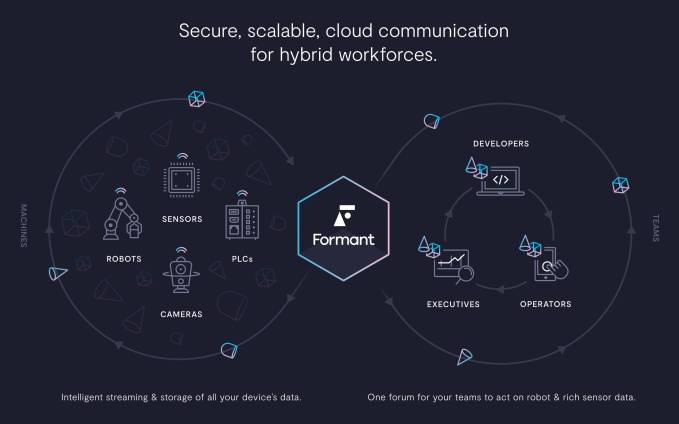
The company has raised a $6 million seed round from SignalFire, a data driven VC fund with software for recruiting engineers. Formant is launching its closed beta that equips businesses with cloud infrastructure for collecting, making sense of, and acting on data from fleets of robots. It allows a single human to oversee 10, 20, or 100 machines, stepping in to clear confusion when they aren’t sure what to do.

“The tooling is 10 years behind the web” Linnell explains. “If you build a data company today, you’ll use AWS or Google Cloud, but that simply doesn’t exist for robotics. We’re building that layer.”

A Beautiful Marriage

“This is going to sound completely bizarre” Formant co-founder and CTO Anthony Jules warns me. “I had a recurring dream [as a child] in which I was a ship captain and I had a little mechanical parrot on my should that would look at situations and help me decide what to do as we’d sail the seas trying to avoid this octopus. Since then I knew that building intelligent machines is what I do in this world.”

So he went to MIT, left a robotics PhD program to build a startup called Sapient Corporation that he built into a 4000-employee public company, and worked on the Tony Hawk video games. He too joined Google through an acquisition, meeting Linnell after Redwood Robotics where he was COO got acquired. “We came up with some similar beliefs. There are a few places where full autonomy will actually work, but it’s really about creating a beautiful marriage of what machines are good at and what humans are good at” Jules tells me

Formant now has SAAS pilots running with businesses in several verticals to make their “robot-shaped data” usable. They range from food manufacturing to heavy infrastructure inspection to construction, and even training animals. Linnell also foresees retail increasingly employing fleets of robots not just in the warehouse but on the showroom floor, and they’ll require precise coordination.

What’s different about Formant is it doesn’t build the bots. Instead, it builds the reins for people to deftly control them.

First, Formant connects to sensors to fill up a cloud with Lidar, depth imagery, video, photos, log files, metrics, motor torques, and scalar values. The software parses that data and when something goes wrong or the system isn’t sure how to move forward, Formant alerts the human ‘foreman’ that they need to intervene. It can monitor the fleet, sniff out the source of errors, and suggest options for what to do next.

For example, “when an autonomous digger encounters an obstacle in the foundation of a construction site, an operator is necessary to evaluate whether it is safe for the robot to proceed or stop” Linnell writes. “This decision is made in tandem: the rich data gathered by the robot is easily interpreted by a human but difficult or legally questionable for a machine. This choice still depends on the value judgment of the human, and will change depending on if the obstacle is a gas main, a boulder, or an electrical wire.”

Any single data stream alone can’t reveal the mysteries that arise, and people would struggle to juggle the different feeds in their minds. But not only can Formant align the data for humans to act on, it can also turn their choices into valuable training data for artificial intelligence. Formant learns, so next time the machine won’t need assistance.

The industrial revolution, continued

With rockstar talent poached from Google and tides lifting all automated boats, Formant’s biggest threat is competition from tech giants. Old engineering companies like SAP could try to adapt to new real-time data type, yet Formant hopes to out-code them. Google itself has built reliable cloud scaffolding and has robotics experience from Boston Dynamics plus buying Linnell’s and Jules’ companies. But the enterprise customization necessary to connect with different clients isn’t typical for the search juggernaut.

Linnell fears that companies that try to build their own robot management software could get hacked. “I worry about people who do homegrown solutions or don’t have the experience we have from being at a place like Google. Putting robots online in an insecure way is a pretty bad problem.” Formant is looking to squash any bugs before it opens its platform to customers in 2019.
With time, humans will become less and less necessary, and that will surface enormous societal challenges for employment and welfare. “It’s in some ways a continuation of the industrial revolution” Jules opines. “We take some of this for granted but it’s been happening for 100 years. Photographer — that’s a profession that doesn’t exist without the machine that they use. We think that transformation will continue to happen across the workforce.”

from Startups – TechCrunch https://ift.tt/2UUfnf5

#USA SpaceX said to be raising $500m to help fund internet service

//

SpaceX is raising $500 million at a valuation of $30.5 billion, according to a WSJ report citing people familiar with the matter. The company is said to be raising the capital in part to help fund its ambitious Starlink internet service project.

According to the announced plan, SpaceX intends to launch 11,000 satellites to plaster the globe with internet connectivity. So far, SpaceX has launched just two prototype satellites even though earlier reports stated SpaceX, at one time, projected it would have 400 satellites in orbit by the end of 2018.

If this funding goes through, it will bring SpaceX’s total amount raised to about $2.5 billion of equity funding, according to Dow Jones VentureSource. Last month, SpaceX raised $250 million through a high-yield loan sale.

The WSJ reports that for this equity round SpaceX turned to existing investors and new investor Baillie Gifford & Co, a large investor in Musk’s Tesla. The report stats that SpaceX and the investors have agreed to the financing terms but the money has yet to be sent.

from Startups – TechCrunch https://ift.tt/2CkPduE

#USA Sphero is finished making Star Wars products

//

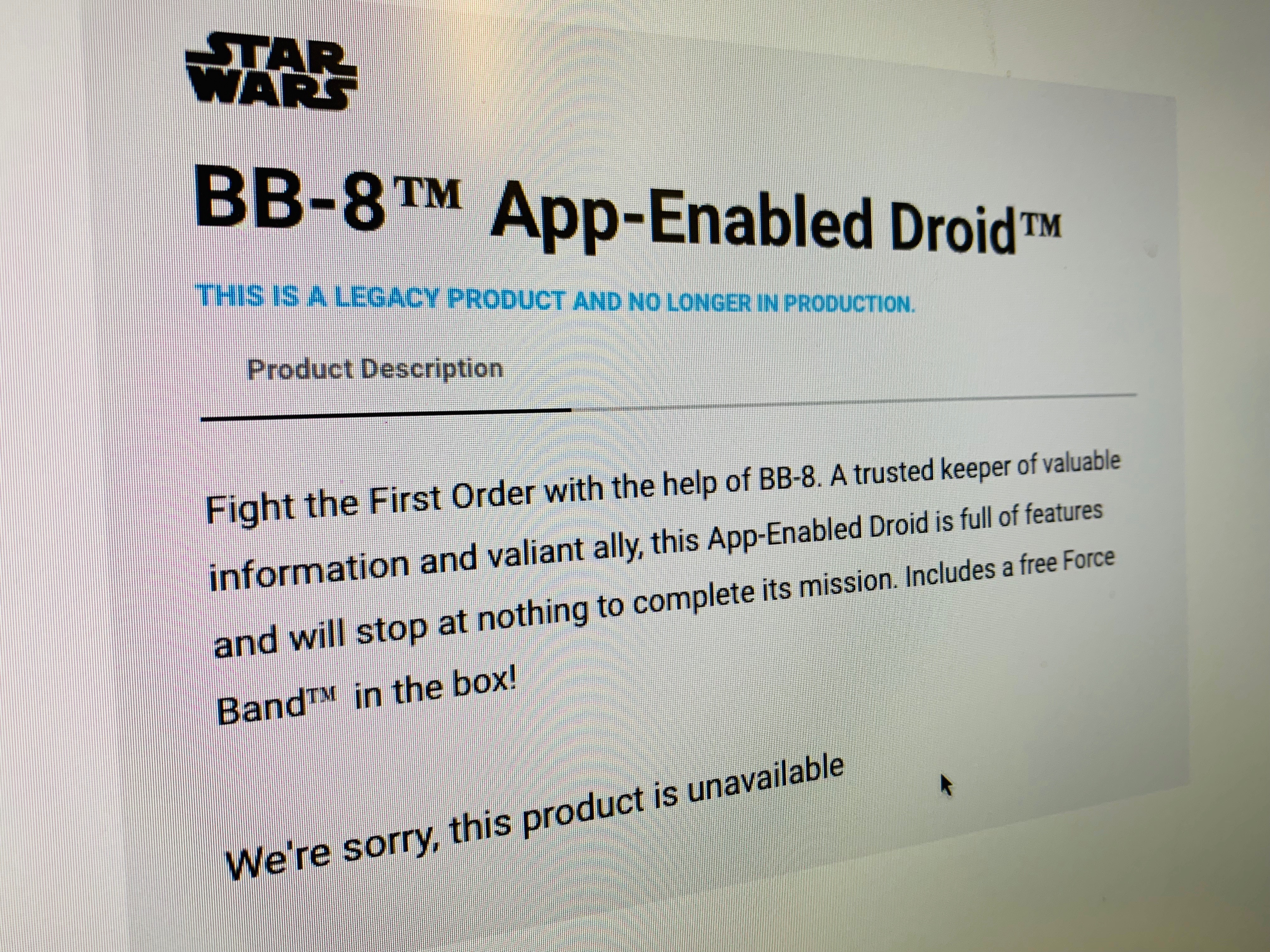
Sphero’s on-going deals are about more than just priming the pump for the holidays. The Colorado robotic toy startup is also in the process of cleaning out inventory of what are now be marked “legacy” products on its site. All of the Disney licensed products now carry a “THIS IS A LEGACY PRODUCT AND NO LONGER IN PRODUCTION” tag, and in many cases are no longer available through Sphero’s site.

The move is no surprise, of course. The company announced nearly a year ago amid layoffs that its licensed products would be a casualty of its shift toward education. Looks like that’s all finally run its course. Sphero CEO Paul Berberian confirmed the move with the Verge, noting shrinking returns.

“When you launch a toy, your first year’s your biggest,” he told the site. “Your second year’s way smaller, and your third year gets really tiny.”

BB-8 was a notable hit for the company, selling millions of units and putting Sphero on the map for many. It eventually spread itself too thin, however, double, tripling and quadrupling down with robotic toy takes on R2-DR, Lightning McQueen for cars and Spider-Man.

It was clearly too much, too fast, making its Disney partnership both a blessing and curse. Ultimately, the company saw STEM education as the clear path forward for its offerings.

For those who purchased one of the above, Sphero has promised to offer app support for “at least two years.” You might still be able to get a deal on one if you hurry. 

from Startups – TechCrunch https://ift.tt/2S7TqHJ

#USA Ada nets $19 million Series A to grow its customer service chatbot

//

Ada is on a mission to build chatbots powered by artificial intelligence. The company today is announcing a $19 million Series A that will go far in helping it reach that goal. The company sees the capital fueling international expansion and launching products into new verticals as well as doubling down on employees.

Chatbots were a buzzword several years back. After the initial buildup and bust, the remaining players in the space are building upon the expectations set early on. Users of chatbots expect services to take actions on their behalf and perform routine functions quickly and efficiently. Likewise, companies are seeking solutions that exceed customer expectations, while offering features that allow the company to scale and expand.

“While many enterprises are choosing to invest in AI and automation,” the company tells TechCrunch, “the recurring investment of time and resources to implement, manage and improve highly technical solutions is diminishing the ROI. In turn, businesses are seeking inclusive and accessible platforms that empower non-technical support teams to build, manage and track the automated customer experience. Even among our own clients, we’ve seen the formation of some of the world’s first automated automation customer experience service (ACX) departments–made up of customer service professionals, not programmers–dedicated to building an automated, AI-powered customer experience. Ada’s automation is changing how people are working and the role of customer service by creating completely new departments, titles, and roles.”

Ada sees the Series A capital to expand the features built-into its products, allowing for a deeper level of personalization and customization — items that will go far with its clients. Launched in 2016 the Toronto-based startup expects to double its staff in the coming months. Right now the company has 70 employees and hopes to be at 140 sometime in 2019.

“2018 was an exciting time for the customer service industry,” Ada said. “Reservations about chatbots and virtual assistants are dissipating, as consumers continue to realize the tremendous benefits of instant, automated, self-service support. Their rising expectations have resulted in an industry-wide shift, with businesses changing from an ‘agent-first’ to an ‘automation-first’ customer strategy.”

The Series A was round was led by FirstMark Capital with participation from Leaders Fund and Burst Capital, as well as returning investors Bessemer, Version One, and computer scientist, Barney Pell.

“Ada’s accessible and scalable platform lets non-technical customer service teams build and manage AI-powered chatbots to automate interactions. Ada has delivered transformational, measurable results to some of the world’s most innovative brands, helping them shift from a reactive, expensive support strategy to a proactive model that reduces customer effort,” said Matt Turck, Managing Director of FirstMark Capital, in a released statement “Ada has played an important role in driving automated customer experience, and we’re confident in the team and the platform to surpass their rapid projected growth.”

The company is based in Toronto. When asked why Toronto, the company points to several data points such as the city’s designation of the fastest growing tech market in North America and the recent announcements of significant new office complexes from Microsoft and Google .

from Startups – TechCrunch https://ift.tt/2rIlRQI