#USA Lightspeed is raising its largest China fund yet

//

Lightspeed China Partners, the China-focused affiliate of Silicon Valley-based Lightspeed Venture Partners, has set a $360 million target for its fourth flagship venture fund, according to a document filed with the U.S. Securities and Exchange Commission today.

If the target is reached, the fund will be Lightspeed China’s largest yet, per PitchBook. Lightspeed China’s previous two funds each closed on $260 million. The VC raised $168 million for its debut China-focused fund in 2013.

Lightspeed China is led by David Mi (pictured). Mi, an investor in multiple billion-dollar Chinese companies, was previously the director of corporate development at Google, where he helped lead the search giant’s investment in Baidu. He joined Lightspeed in 2008 and established the firm’s China presence in 2011. Yan Han, a long-time Lightspeed investor and co-founder of the Chinese branch, is also listed on the filing.

Lightspeed China has backed e-commerce platform Pingduoduo and loan provider Rong360, a pair of Chinese “unicorns” that both completed U.S. initial public offerings since 2017. Typically, the firm makes early-stage investments in the internet, mobile and enterprise spaces. 

Earlier this year, Lightspeed Venture Partners filed to raise a record $1.8 billion in new capital commitments. This month, it tacked five new partners onto its consumer and enterprise investment teams, including Slack’s former head of growth and Twitter’s former vice president of global business development.

Lightspeed didn’t immediately respond to a request for comment.

from Startups – TechCrunch https://ift.tt/2STsGue

#USA Ten pieces of friendly VC advice for when someone wants to buy your company

//

I’ve been fortunate to have been part of half a dozen exits this year, and have seen the process work smoothly, and other times, like a roller coaster with only the most tenuous connection to the track. Here are 10 bits of advice I’ve distilled from these experiences in the event someone makes you an offer for your startup.

1. Understand the motivations of your acquirer.

The first thing you need to understand is why the acquiring company wants your startup. Do you have a strategic product or technology, a unique team, or a sizable revenue run rate? Strategic acquirers, like Google and Facebook, likely want you for your tech, team, or sometimes even your user traction. Financial acquirers, like PE firms, care a great deal more about revenue and growth. The motivations of the buyers will likely be the single-biggest influencer of the multiple offered.

It’s also essential to talk price early on. It can be somewhat awkward for less experienced founders to propose a rich valuation for their company but it’s a critical step towards assessing the seriousness of the discussion. Otherwise, it’s far too easy for an acquirer to put your company through a distracting process for what amounts to an underwhelming offer, or worse, a ploy to learn more about your strategy and product roadmap.

2. Don’t “Test the waters.” Pass, or fully commit.

Going through an M&A process is the single most distracting thing a founder can do to his or her company. If executed poorly, the process can terminally damage the company. I’d strongly advise founders to consider these three points before making a decision:

Is now the right time? The decision to sell can be a tough choice for first-time founders. Often the opportunity to sell the company comes just as the process of running it becomes enjoyable. Serial entrepreneurship is a low-percentage game, and this may be the most influential platform a founder will ever have. But the reflex to sell is understandable. Most founders have never had a chance to add millions to their bank accounts overnight. Moreover, there is a team to consider; usually all with mortgages to pay, college funds to shore up, and the myriad of other expenses and their needs should factor into the decision.

Is it actually your choice to make? Most investors look at M&A as a sign your company could be even bigger and as an opportunity to put more capital to work. However, when VCs have lost confidence and see a fair offer come in, or they hear a larger competitor is looking at entering your space, they may push you to sell. Of course, the best position to be in is one where you can control your destiny and use profitability as the ultimate BATNA (“best alternative to a negotiated agreement”).

How long do you have to stay? In the case of competing offers, you may have limited ability to negotiate price, but other deal terms could be negotiable. One of the most important is the amount of time you have to stay at the company, and how much of the sale price is held in escrow, or dependent on earn-outs.

3. Manage your team.

As soon as you attract interest from an acquirer, start socializing the idea that most M&A deals fall apart — because they do. This is important for two reasons.

First, your executive team will likely start counting their potential gains, and they just may let KPIs key to running the business slip. If the deal fails to close, the senior team will be dejected, demotivated, and you may start to hear some mutinous noises. This attitude quickly percolates through the team and can be deadly for the culture. What was supposed to be your moment of triumph can quickly turn into a catastrophe for team morale.

This is typically the toughest part of the M&A process. You need the exec team to execute to close a deal, but you’re running into some of the deepest recesses of human nature too. Recognize the fact that managing internal expectations is as important as managing the external process.

4. Raise enough money to stay flush for a year.

Assuming you’re selling your company from a position of strength, make sure you have enough capital so that you don’t lose leverage due to a balance sheet lacking cash. I’ve seen too many companies start M&A discussions and take their foot off the gas in the business, only to see the metrics drop and runway shorten, allowing the acquirer to play hardball. In an ideal scenario, you want at least 9 months of cash in the bank.

5. Hire a banker.

If you get serious inbound interest, or if you’re at the point where you want to sell your company, hire a banker. Your VCs should be able to introduce you to a few strong firms. Acquisition negotiations are high stakes, and while bankers are expensive, they can help avoid costly rookie mistakes. They can also classically and plausibly play the bad cop to your good cop which can also contribute positively to your post-merger relations.

My only caveat is that bankers have a playbook and tend not to get creative enough. You can still be additive in helping fill the funnel of potential acquirers, especially if you’ve had communication with unlikely acquirers in the past.

6. Find a second bidder… and a third… and a fourth.

The hardest bit of advice is also the most valuable. Get a second bidder ASAP. It’s Negotiation 101, but without a credible threat of a competitive bid, it is all too easy to be dragged along.

Hopefully, you’ve been talking with other companies in your space as you’ve been building your startup. Now is the time to call your point of contact and warn them that a deal is going down, and if they want in, they need to move quickly.

Until you’re in a position of formal exclusivity, keep talking with potential acquirers. Don’t be afraid to add new suitors late in the game. You’d be amazed at how much info spreads through M&A back channels and you may not even be aware of rivalries that can be extremely useful to your pursuit.

Even when you’re far down the road with an acquirer, if they know you have a fallback plan in mind it can provide valuable leverage as you negotiate key terms. The valuation may be set, but the amount paid upfront vs. earnouts, the lock-up period for employees and a multitude of other details can be negotiated more favorably if you have a real alternative. Of course, nothing provides a better alternative than your simply having a growing and profitable business!

7. Start building your data room.

Founders can raise shockingly large sums of money with pitch decks and spreadsheets, but when it comes time to sell your startup for a large sum, the buyer is going to want to get access to documentation, sometimes down to engineering meeting minutes. Financial records, forward-looking models, audit records, and any other spreadsheet will be scrutinized. Large acquirers will even want to look at information like HR policies, pay scales, and other human resources minutiae. As negotiations progress, you’ll be expected to share almost every detail with the buyer, so start pulling this information together sooner rather than later.

One CEO said that during the peak of diligence, there were more people from the acquirer in his office than employees. Remember to treat your CFO and General Counsel well – chances are high that they get very little rest during this process.

8. Keep your board close, your tiny investors far away.

Founders are in a tough situation in that they’re starving for advice, but they should avoid the temptation to share info about negotiations with those who don’t have alignment. For instance, a small shareholder on the cap table is more likely to blab to the press than a board member whose incentives are the same as yours. We’ve seen deals scuttled because word leaked and the acquirer got cold feet.

Loose lips sink startups.

9. Use leaks when they inevitably happen.

Leaks are annoying and preventable, but if they do happen, try using them as leverage. If the press reports that you’ve been acquired, and you haven’t been, and also haven’t entered a period of exclusivity, try to ensure that other potential bidders take notice. If you’ve been having trouble drumming up interest with potential bidders, a report from Bloomberg, The Wall Street Journal, or TechCrunch can spark interest in the way a simple email won’t.

10. Expect sudden radio silence.

There’s a disconnect between how founders perceive a $500M acquisition and how a giant like Google does. For the founder, this is a life changing moment, the fruition of a decade of work, a testament to their team’s efforts. For the corp dev person at Google, it’s Tuesday.

This reality means that your deal may get dropped as all hands rush to get a higher-priority, multi-billion dollar transaction over the finish line. It can be terrifying for founders to have what were productive talks go radio silent, but it happens more often than you think. A good banker should be able to back channel and read the tea leaves better than you can. It’s their day job not yours.

No amount of advice can prepare you for the M&A process, but remember that this could be one of the highest quality problems you’re likely to experience as a founder. Focus on execution, but feel good about achieving a milestone many entrepreneurs will never experience!

from Startups – TechCrunch https://ift.tt/2rDwcNN

#USA Ten pieces of friendly VC advice for when someone wants to buy your company

//

I’ve been fortunate to have been part of half a dozen exits this year, and have seen the process work smoothly, and other times, like a roller coaster with only the most tenuous connection to the track. Here are 10 bits of advice I’ve distilled from these experiences in the event someone makes you an offer for your startup.

1. Understand the motivations of your acquirer.

The first thing you need to understand is why the acquiring company wants your startup. Do you have a strategic product or technology, a unique team, or a sizable revenue run rate? Strategic acquirers, like Google and Facebook, likely want you for your tech, team, or sometimes even your user traction. Financial acquirers, like PE firms, care a great deal more about revenue and growth. The motivations of the buyers will likely be the single-biggest influencer of the multiple offered.

It’s also essential to talk price early on. It can be somewhat awkward for less experienced founders to propose a rich valuation for their company but it’s a critical step towards assessing the seriousness of the discussion. Otherwise, it’s far too easy for an acquirer to put your company through a distracting process for what amounts to an underwhelming offer, or worse, a ploy to learn more about your strategy and product roadmap.

2. Don’t “Test the waters.” Pass, or fully commit.

Going through an M&A process is the single most distracting thing a founder can do to his or her company. If executed poorly, the process can terminally damage the company. I’d strongly advise founders to consider these three points before making a decision:

Is now the right time? The decision to sell can be a tough choice for first-time founders. Often the opportunity to sell the company comes just as the process of running it becomes enjoyable. Serial entrepreneurship is a low-percentage game, and this may be the most influential platform a founder will ever have. But the reflex to sell is understandable. Most founders have never had a chance to add millions to their bank accounts overnight. Moreover, there is a team to consider; usually all with mortgages to pay, college funds to shore up, and the myriad of other expenses and their needs should factor into the decision.

Is it actually your choice to make? Most investors look at M&A as a sign your company could be even bigger and as an opportunity to put more capital to work. However, when VCs have lost confidence and see a fair offer come in, or they hear a larger competitor is looking at entering your space, they may push you to sell. Of course, the best position to be in is one where you can control your destiny and use profitability as the ultimate BATNA (“best alternative to a negotiated agreement”).

How long do you have to stay? In the case of competing offers, you may have limited ability to negotiate price, but other deal terms could be negotiable. One of the most important is the amount of time you have to stay at the company, and how much of the sale price is held in escrow, or dependent on earn-outs.

3. Manage your team.

As soon as you attract interest from an acquirer, start socializing the idea that most M&A deals fall apart — because they do. This is important for two reasons.

First, your executive team will likely start counting their potential gains, and they just may let KPIs key to running the business slip. If the deal fails to close, the senior team will be dejected, demotivated, and you may start to hear some mutinous noises. This attitude quickly percolates through the team and can be deadly for the culture. What was supposed to be your moment of triumph can quickly turn into a catastrophe for team morale.

This is typically the toughest part of the M&A process. You need the exec team to execute to close a deal, but you’re running into some of the deepest recesses of human nature too. Recognize the fact that managing internal expectations is as important as managing the external process.

4. Raise enough money to stay flush for a year.

Assuming you’re selling your company from a position of strength, make sure you have enough capital so that you don’t lose leverage due to a balance sheet lacking cash. I’ve seen too many companies start M&A discussions and take their foot off the gas in the business, only to see the metrics drop and runway shorten, allowing the acquirer to play hardball. In an ideal scenario, you want at least 9 months of cash in the bank.

5. Hire a banker.

If you get serious inbound interest, or if you’re at the point where you want to sell your company, hire a banker. Your VCs should be able to introduce you to a few strong firms. Acquisition negotiations are high stakes, and while bankers are expensive, they can help avoid costly rookie mistakes. They can also classically and plausibly play the bad cop to your good cop which can also contribute positively to your post-merger relations.

My only caveat is that bankers have a playbook and tend not to get creative enough. You can still be additive in helping fill the funnel of potential acquirers, especially if you’ve had communication with unlikely acquirers in the past.

6. Find a second bidder… and a third… and a fourth.

The hardest bit of advice is also the most valuable. Get a second bidder ASAP. It’s Negotiation 101, but without a credible threat of a competitive bid, it is all too easy to be dragged along.

Hopefully, you’ve been talking with other companies in your space as you’ve been building your startup. Now is the time to call your point of contact and warn them that a deal is going down, and if they want in, they need to move quickly.

Until you’re in a position of formal exclusivity, keep talking with potential acquirers. Don’t be afraid to add new suitors late in the game. You’d be amazed at how much info spreads through M&A back channels and you may not even be aware of rivalries that can be extremely useful to your pursuit.

Even when you’re far down the road with an acquirer, if they know you have a fallback plan in mind it can provide valuable leverage as you negotiate key terms. The valuation may be set, but the amount paid upfront vs. earnouts, the lock-up period for employees and a multitude of other details can be negotiated more favorably if you have a real alternative. Of course, nothing provides a better alternative than your simply having a growing and profitable business!

7. Start building your data room.

Founders can raise shockingly large sums of money with pitch decks and spreadsheets, but when it comes time to sell your startup for a large sum, the buyer is going to want to get access to documentation, sometimes down to engineering meeting minutes. Financial records, forward-looking models, audit records, and any other spreadsheet will be scrutinized. Large acquirers will even want to look at information like HR policies, pay scales, and other human resources minutiae. As negotiations progress, you’ll be expected to share almost every detail with the buyer, so start pulling this information together sooner rather than later.

One CEO said that during the peak of diligence, there were more people from the acquirer in his office than employees. Remember to treat your CFO and General Counsel well – chances are high that they get very little rest during this process.

8. Keep your board close, your tiny investors far away.

Founders are in a tough situation in that they’re starving for advice, but they should avoid the temptation to share info about negotiations with those who don’t have alignment. For instance, a small shareholder on the cap table is more likely to blab to the press than a board member whose incentives are the same as yours. We’ve seen deals scuttled because word leaked and the acquirer got cold feet.

Loose lips sink startups.

9. Use leaks when they inevitably happen.

Leaks are annoying and preventable, but if they do happen, try using them as leverage. If the press reports that you’ve been acquired, and you haven’t been, and also haven’t entered a period of exclusivity, try to ensure that other potential bidders take notice. If you’ve been having trouble drumming up interest with potential bidders, a report from Bloomberg, The Wall Street Journal, or TechCrunch can spark interest in the way a simple email won’t.

10. Expect sudden radio silence.

There’s a disconnect between how founders perceive a $500M acquisition and how a giant like Google does. For the founder, this is a life changing moment, the fruition of a decade of work, a testament to their team’s efforts. For the corp dev person at Google, it’s Tuesday.

This reality means that your deal may get dropped as all hands rush to get a higher-priority, multi-billion dollar transaction over the finish line. It can be terrifying for founders to have what were productive talks go radio silent, but it happens more often than you think. A good banker should be able to back channel and read the tea leaves better than you can. It’s their day job not yours.

No amount of advice can prepare you for the M&A process, but remember that this could be one of the highest quality problems you’re likely to experience as a founder. Focus on execution, but feel good about achieving a milestone many entrepreneurs will never experience!

from Startups – TechCrunch https://ift.tt/2rDwcNN

#USA N26 launches its premium offering in the UK

//

Fintech startup N26 recently launched in the U.K. with a single product offering. You could sign up to a free account that gives you free payments around the world but no insurance and no free withdrawals in foreign currencies.

The company just added a second tier to its lineup in the U.K. And N26 is choosing to focus on N26 Metal in the U.K. You can now sign up to a Metal account for £14.90 per month (€16.59).

In other N26 markets, people can currently subscribe to N26 Black for €9.90 per month or N26 Metal for €16.90 per month. It’s interesting to see that N26 is using its fresh start in the U.K. to simplify its offering and target premium customers. The startup can still change its mind and launch N26 Black later down the road.

Basic customers can pay anywhere in the world without any foreign fee. The company uses Mastercard’s foreign exchange rates and doesn’t add anything on top. But ATM withdrawals in a foreign currency still cost 1.7 percent of the total amount.

Metal customers get the same perks in the U.K. and other European countries, such as foreign ATM withdrawals with no fee, a travel insurance package from Allianz and dedicated customer support.

N26 also provides partner offerings for N26 Metal subscribers. For instance, you can work from a WeWork office for free one day per month. Deals very from one country to another, and British customers get airport lounge access thanks to LoungeKey.

Your milage may vary depending on your favorite airport as LoungeKey doesn’t have a lounge in all terminals in all airports around the world. Now let’s see if N26 users outside of the U.K. will get a similar service in the future.

from Startups – TechCrunch https://ift.tt/2rCBN7g

#USA RightHand Robotics grabs $23 million in funding

//

RightHand Robotics announced a $23 million Series B this week. That brings the pick and place robotic arm manufacturer’s total funding up to around $34 million, including last year’s $8 million Series A.

The robotics startup has impressed investors with the dexterity and speed of its robotic picking system, having recruited some big VC names along the way. This latest round is led by Menlo Ventures, along with investments from GV (nee Google Ventures) joining the likes of existing investors, Playground Global, Dream Incubator and Matrix partners.

Picking and placing has been a difficult robotics problem and one that’s only become more pronounced with the growth of fulfillment centers from the likes of Amazon. the online mega-retailer purchased logistics robotics company Kiva Systems for $775 million, back in 2012 and has been rumored to be working on its own pick and place system.

As part of this round, former Kiva CEO Mick Mountz will be joining RightHand’s board of directors.“RightHand is picking up where we left off,” he said in a press release tied to the news. “Customers saw products coming directly to operators for picking and packing and would ask: ‘Why don’t you also automate this step with a robotic arm and gripper?’ But that was a difficult problem that we knew would require years of research and technical breakthroughs.”

RightHand will be using the funding to build out its technical and business teams.

from Startups – TechCrunch https://ift.tt/2GoiPvi

#USA But not a broken man

//

I’ve been living for the past few years in a limbo between journalist and entrepreneur, trying to build startups the way I saw them being built on stage at Disrupt and discovering that my skill and will to win are no match against the world. That’s fine. These days I’ll take it.

But for a few minutes in Chicago last May, I couldn’t.

That day was normal for me. I woke up, went and met some folks at a cool startup, visited at great guitar store, and had a mediocre deep dish pizza. I then went to an event where I gave my usual rant (and pissed people off) about how smaller market cities are having huge trouble innovating, and then went out with some good people to talk about cool stuff.

Then, on my way back to the hotel, I looked both ways on a busy, dark street and thought long and hard about stepping in front of a Chicago city bus.

Why not? I wasn’t helping. My first startup had failed and everything else was a slow burn. I wasn’t thinking about my family. I wasn’t thinking about my existence on a global scale but on a local one. I could turn off this brain once and for all and I thought everyone would be happier.

I got help. I discovered I was anhedonic and chronically depressed – I couldn’t feel happiness. I had been traveling through life in a haze. I drank a lot to hide this from myself – after all, if you’re hosed you don’t worry about not feeling anything – and I traveled obsessively and spoke on stage so I could feel something, anything, better than the flat grey note that played constantly in my head.

I feel better now. I have a lot of digging to do. I wonder if you’re in the same position.

I’m noodling on this because of Colin Kroll. The specifics of Kroll’s specific story are unclear but an overdose is definitely in the mental illness wheelhouse. Maybe he was having a blast, flush on investor money and celebrating a win. I won’t judge.

But he’s dead. And I don’t want you to follow him.

Any of us could end up gone for any number of reasons associated with entrepreneurship. There is the stress, the overwork. There is the sense of failure even amid the greatest successes. There is deep frustration and deep anger. Entrepreneurs are high performers who are used to getting As in life. When that same life gives you a D- you feel that it’s your fault, that your dreams of success are gold foil over a rotten sweet.

This isn’t true. We all have to work to remind ourselves of this. A startup, like any creative endeavor, is doomed to fail but its very existence is a miracle. We do it not because we want to make millions but because we want to fix something broken in the world. I write to share cool things with you all. I make startups to help bring to the next level of innovation. But I let these efforts get in the way of life. I thought my failures were systemic, that I was proving that I was a failure over and over again and that I had visible proof through my failed efforts. My startup wasn’t me, but I didn’t know that.

In the dull, hot blush of a depressive episode, the embarrassing moment you look at yourself and see nothing but junk, we have to remember that we are making real efforts, building real things, moving way ahead of the pack. The world will catch up.

There are lots of ways to get help. Ask around. You’ll be surprised to hear that your friends and family know great shrinks who can help. You’ll be surprised that going to meetings or talking to someone on the phone can be a great way to assuage mental grief. You’ll be surprised to know that there are people out there for you. Email me if you need help: john@techcrunch.com

This shit is hard. Don’t make it harder by letting it fester.

Photo by Nik Shuliahin on Unsplash

The National Suicide Prevention Lifeline is a 24-hour, toll-free, confidential suicide prevention hotline available to anyone in suicidal crisis or emotional distress. It provides Spanish-speaking counselors, as well as options for deaf and hard of hearing individuals. It is only available in the United States. A 24-hour an Online Chat in partnership with Contact USA is also available.
The National Suicide Prevention Lifeline can be reached at 1-800-273-8255.
The National Suicide Prevention Lifeline (ESP) can be reached at 1-888-628-9454
The National Suicide Prevention Lifeline (Deaf & Hard of Hearing Options) can be reached at 1-800-799-4889

from Startups – TechCrunch https://ift.tt/2CiEIrK

#USA But not a broken man

//

I’ve been living for the past few years in a limbo between journalist and entrepreneur, trying to build startups the way I saw them being built on stage at Disrupt and discovering that my skill and will to win are no match against the world. That’s fine. These days I’ll take it.

But for a few minutes in Chicago last May, I couldn’t.

That day was normal for me. I woke up, went and met some folks at a cool startup, visited at great guitar store, and had a mediocre deep dish pizza. I then went to an event where I gave my usual rant (and pissed people off) about how smaller market cities are having huge trouble innovating, and then went out with some good people to talk about cool stuff.

Then, on my way back to the hotel, I looked both ways on a busy, dark street and thought long and hard about stepping in front of a Chicago city bus.

Why not? I wasn’t helping. My first startup had failed and everything else was a slow burn. I wasn’t thinking about my family. I wasn’t thinking about my existence on a global scale but on a local one. I could turn off this brain once and for all and I thought everyone would be happier.

I got help. I discovered I was anhedonic and chronically depressed – I couldn’t feel happiness. I had been traveling through life in a haze. I drank a lot to hide this from myself – after all, if you’re hosed you don’t worry about not feeling anything – and I traveled obsessively and spoke on stage so I could feel something, anything, better than the flat grey note that played constantly in my head.

I feel better now. I have a lot of digging to do. I wonder if you’re in the same position.

I’m noodling on this because of Colin Kroll. The specifics of Kroll’s specific story are unclear but an overdose is definitely in the mental illness wheelhouse. Maybe he was having a blast, flush on investor money and celebrating a win. I won’t judge.

But he’s dead. And I don’t want you to follow him.

Any of us could end up gone for any number of reasons associated with entrepreneurship. There is the stress, the overwork. There is the sense of failure even amid the greatest successes. There is deep frustration and deep anger. Entrepreneurs are high performers who are used to getting As in life. When that same life gives you a D- you feel that it’s your fault, that your dreams of success are gold foil over a rotten sweet.

This isn’t true. We all have to work to remind ourselves of this. A startup, like any creative endeavor, is doomed to fail but its very existence is a miracle. We do it not because we want to make millions but because we want to fix something broken in the world. I write to share cool things with you all. I make startups to help bring to the next level of innovation. But I let these efforts get in the way of life. I thought my failures were systemic, that I was proving that I was a failure over and over again and that I had visible proof through my failed efforts. My startup wasn’t me, but I didn’t know that.

In the dull, hot blush of a depressive episode, the embarrassing moment you look at yourself and see nothing but junk, we have to remember that we are making real efforts, building real things, moving way ahead of the pack. The world will catch up.

There are lots of ways to get help. Ask around. You’ll be surprised to hear that your friends and family know great shrinks who can help. You’ll be surprised that going to meetings or talking to someone on the phone can be a great way to assuage mental grief. You’ll be surprised to know that there are people out there for you. Email me if you need help: john@techcrunch.com

This shit is hard. Don’t make it harder by letting it fester.

Photo by Nik Shuliahin on Unsplash

The National Suicide Prevention Lifeline is a 24-hour, toll-free, confidential suicide prevention hotline available to anyone in suicidal crisis or emotional distress. It provides Spanish-speaking counselors, as well as options for deaf and hard of hearing individuals. It is only available in the United States. A 24-hour an Online Chat in partnership with Contact USA is also available.
The National Suicide Prevention Lifeline can be reached at 1-800-273-8255.
The National Suicide Prevention Lifeline (ESP) can be reached at 1-888-628-9454
The National Suicide Prevention Lifeline (Deaf & Hard of Hearing Options) can be reached at 1-800-799-4889

from Startups – TechCrunch https://ift.tt/2CiEIrK

#USA B-Social raises £3.2M seed round to begin building a ‘social’ bank

//

B-Social, a London fintech that currently offers a ‘social finance’ app and beta debit Mastercard, has raised £3.2 million in Seed round funding from undisclosed high-net-worth individuals. However, the fundraise is just the first step in a journey in which B-Social want to eventually become a fully licensed bank that reimagines banking around everyday social interactions.

As it exists today, the B-Social app and accompanying card enables users to have control over everyday spending, track expenditure, and create groups between friends to split bills and record settlements. It’s currently in the hands of a limited number of beta testers, spanning employees, investors, friends and family, with plans for a wider U.K. launch in February next year.

“We recognise that almost all financial transactions are inherently social,” B-Social co-founder and CEO Nazim Valimahomed tells me. “We want to change the relationship people have with money by helping them overcome the anxiety, awkwardness and wasted time when they engage with their social finances. We are doing that by building a digital bank that truly accommodates the way people live their lives and is dedicated to connecting a person’s finances to their social world”.

The idea was born in part out of Valimahomed’s own frustrations and is informed by his belief that individuals are often a bank themselves, lending and borrowing to friends and family by making shared purchases and then getting paid back.

“A simple example might be that you pay for flights for two or more people and then get paid back individually,” he says. “For multiple transactions, this becomes complex often resulting in the trip organiser having to create a spreadsheet to work out what people owe across multiple transactions”.

To simplify this problem, B-Social wants to let you to make purchases with your card, which are flagged as an expense on behalf of a group of individuals. From here the bank to be will enable all members of a group — and where groups can be ad hoc and temporary or more long-term — to continuously see who is owed how much and to get paid back easily within the app and record settlements.

Dubbing this future proposition as the seeds of a “social bank,” the B-Social CEO cites competitors as traditional high street banks that currently dominate the U.K. consumer market (the so-called big 5 have around 87 percent market share in the U.K.).

“We are aiming at winning a part of their market share by targeting customers looking for a bank as social as they are that offers a unique digital experience in order to help change the banking ecosystem forever,” Valimahomed tells me, although he also concedes that challengers such as Monzo, N26, Starling and Revolut have also built some basic social features into their apps.

“Our entire technology and product focus is to build a bank from scratch through a social lens,” he says.

from Startups – TechCrunch https://ift.tt/2QDa5WW

#USA Careem launches delivery service as it nears closing a massive round

//

The ride-hailing giant Careem is now in the delivery business as the company seeks new verticals in its ever-increasing fight against other services in the Middle East including Uber. Starting with food delivery in Dhabi and Jeddah, the company sees the delivery service expanding to pharmaceuticals according to a report by Reuters. Careem is investing over $150m into the service.

“We believe the opportunity for deliveries in the region is even bigger than ride-hailing,” Chief Executive and Co-Founder Mudassir Sheikha told Reuters. “It is going to become a very significant part of Careem over time.”

Called Careem Now, the service will operate independently from its ride-hailing business. It will have its own app and Careem is building the service a dedicated call center.

This comes as the company is trying to close a $500m funding round. Back in October, the company announced it had already raised $200m from existing investors. Prior to this announcement, rumors were swirling around the company that several companies including Didi Chuxing could acquire the company.


from Startups – TechCrunch https://ift.tt/2A4e4RS

#USA K Health raises $25m for its AI-powered primary care platform

//

K Health, the startup providing consumers with an AI-powered primary care platform, has raised $25 million in series B funding. The round was led by 14W, Comcast Ventures and Mangrove Capital Partners, with participation from Lerer Hippeau, Primary Ventures, BoxGroup, Bessemer Venture Partners and Max Ventures – all previous investors from the company’s seed or Series A rounds.

Co-founded and led by former Vroom CEO and Wix co-CEO, Allon Bloch, K Health (previously Kang Health) looks to equip consumers with a free and easy-to-use application that can provide accurate, personalized, data-driven information about their symptoms and health.

“When your child says their head hurts, you can play doctor for the first two questions or so – where does it hurt? How does it hurt?” Bloch explained in a conversation with TechCrunch. “Then it gets complex really quickly. Are they nauseous or vomiting? Did anything unusual happen? Did you come back from a trip somewhere? Doctors then use differential diagnosis to prove that it’s a tension headache vs other things by ruling out a whole list of chronic or unusual conditions based on their deep knowledge sets.”

K Health’s platform, which currently focuses on primary care, effectively looks to perform a simulation and data-driven version of the differential diagnosis process. On the company’s free mobile app, users spend three-to-four minutes answering an average of 21 questions about their background and the symptoms they’re experiencing.

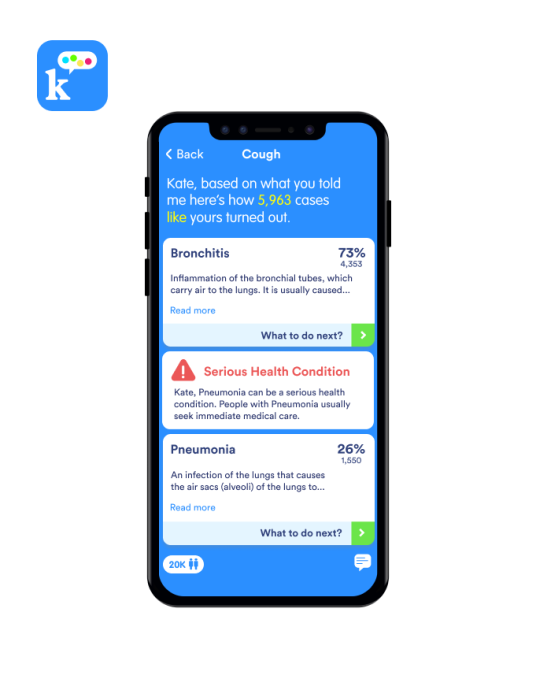
Using a data set of two billion historical health events over the past 20 years – compiled from doctors notes, lab results, hospitalizations, drug statistics and outcome data – K Health is able to compare users to those with similar symptoms and medical histories before zeroing in on a diagnosis. 

With its expansive comparative approach, the platform hopes to offer vastly more thorough, precise and user-specific diagnostic information relative to existing consumer alternatives, like WebMD or – what Bloch calls – “Dr. Google”, which often produce broad, downright frightening, and inaccurate diagnoses. 

Ease and efficiency for both consumers and physicians

Users are able to see cases and diagnoses that had symptoms similar to their own, with K Health notifying users with serious conditions when to consider seeking immediate care. (K Health Press Image / K Health / https://www.khealth.ai)

In addition to pure peace of mind, the utility provided to consumers is clear. With more accurate at-home diagnostic information, users are able to make better preventative health decisions, avoid costly and unnecessary trips to in-person care centers or appointments with telehealth providers, and engage in constructive conversations with physicians when they do opt for in-person consultations.

K Health isn’t looking to replace doctors, and in fact, believes its platform can unlock tremendous value for physicians and the broader healthcare system by enabling better resource allocation. 

Without access to quality, personalized medical information at home, many defer to in-person doctor visits even when it may not be necessary. And with around one primary care physician per 1000 in the US, primary care practitioners are subsequently faced with an overwhelming number of patients and are unable to focus on more complex cases that may require more time and resources. The high volume of patients also forces physicians to allocate budgets for support staff to help interact with patients, collect initial background information and perform less-demanding tasks.

K Health believes that by providing an accurate alternative for those with lighter or more trivial symptoms, it can help lower unnecessary in-person visits, reduce costs for practices and allow physicians to focus on complicated, rare or resource-intensive cases where their expertise can be most useful and where brute machine processing power is less valuable.

The startup is looking to enhance the platform’s symbiotic patient-doctor benefits further in early-2019, when it plans to launch in-app capabilities that allow users to share their AI-driven health conversations directly with physicians, hopefully reducing time spent on information gathering and enabling more-informed treatment.

With K Health’s AI and machine learning capabilities, the platform also gets smarter with every conversation as it captures more outcomes, hopefully enriching the system and becoming more valuable to all parties over time. Initial results seem promising with K Health currently boasting around 500,000 users, most having joined since this past July.

Using access and affordability to improve global health outcomes

With the latest round, the company has raised a total of $37.5 million since its late-2016 founding. K Health plans to use the capital to ramp up marketing efforts, further refine its product and technology, and perform additional research to identify methods for earlier detection and areas outside of primary care where the platform may be valuable.

Longer term, the platform has much broader aspirations of driving better health outcomes, normalizing better preventative health behavior, and creating more efficient and affordable global healthcare systems.

The high costs of the American healthcare system and the impacts they have on health behavior has been well-documented. With heavy copays, premiums and treatment cost, many avoid primary care altogether or opt for more reactionary treatment, leading to worse health outcomes overall.

Issues seen in the American healthcare system are also observable in many emerging market countries with less medical infrastructure. According to the World Health Organization, the international standard for the number of citizens per primary care physician is one for every 1,500 to 2,000 people, with some countries facing much steeper gaps – such as China, where there is only one primary care doctor for every 6,666.

The startup hopes it can help limit the immense costs associated with emerging countries educating millions of doctors for eight-to-ten years and help provide more efficient and accessible healthcare systems much more quickly.

By reducing primary care costs for consumers and operating costs for medical practices, while creating a more convenient diagnostic experience, K Health believes it can improve access to information, ultimately driving earlier detection and better health outcomes for consumers everywhere.

from Startups – TechCrunch https://ift.tt/2PDCDdv