#USA Starling’s Chief Platform Officer Megan Caywood has been recruited by Barclays

//

They say imitation is the highest form of flattery, but in the increasingly competitive world of banking, perhaps poaching your best people also counts. In a move that is bound to raise eyebrows in London’s fintech ecosystem and beyond, Megan Caywood, who up until this week was Starling Bank’s Chief Platform Officer, is joining banking incumbent Barclays.

According to sources, Caywood, who led Starling’s marketplace banking efforts — a key pillar of the challenger bank — handed in her notice two weeks ago, whilst Starling Marketplace partners were informed last week. I understand she is currently on “gardening leave” and will officially become Managing Director, Head of Barclays Consumer Strategy early next year.

With an academic background in cognitive science research, and a Silicon Valley import — having worked at Xero and Intuit in the U.S. — Caywood joined Starling in June 2016 where she soon became an important lieutenant to Starling CEO and founder Anne Boden, often appearing publicly as the second face of the challenger bank. I understand, however, that the pair remain good friends and that Starling threw a leaving party for Caywood last week.

Megan Caywood speaking at a Startup Grind event in London moderated by TechCrunch’s Steve O’Hear

Meanwhile, the move to Barclays is thought to be primarily motivated by the impact Caywood believes she can have at a large bank compared to an upstart, according to a source familiar with her thinking. Caywood has always talked passionately about making financial services work better for consumers and has long-argued that banks working with fintech startups is the best way to achieve this.

Related to this, Caywood’s new title at Barclays makes no reference to marketplaces, even though my fintech sources tell me Barclays is rumoured to be working on more third-party integrations. As a pointer, the incumbent bank has a number of existing partnerships, including with London startup Flux to offer itemised digital receipts and loyalty within the Barclays Launchpad app.

It is also noteworthy that Caywood’s title doesn’t include ‘UK’, and I understand that her remit is going to be international, perhaps expanding across the pond based on her Silicon Valley roots and the fact that she is American.

During her two and a half years at Starling, Caywood helped design and rapidly roll out the Starling Marketplace, which includes an open API and a marketplace of third-party financial services that sit inside of the Starling app. Marketplace partners include Flux, mortgage broker Habito, travel insurance provider Kasko, and investment products Wealthify and Wealthsimple, amongst others.

I’ve reached out to Caywood, who declined to comment, instead referring me to Barclays’ PR.

from Startups – TechCrunch https://ift.tt/2QCpYN4

#USA Meeshkan raises €370K for its ‘ChatOps’ bot for training machine learning models

//

Meeshkan, a Finnish startup that made quite a splash at the recent Slush conference, has quietly raised €370,000 in pre-seed funding to continue developing its “ChatOps” product for machine learning developers.

Deployed on Slack, the bot allows developers to “rapidly stop, restart, fork, tweak, monitor, deploy and test machine learning models” without interrupting the collaborative workflows they are accustomed to or being forced to go back and forth between disparate developer tools.

Under the hood, Meeshkan says it uses patent-pending tech for speedily partitioning of data-flow across distributed infrastructure. Related to this, the burgeoning company is currently partnering with Northeastern University and CUDA to develop “zero-downtime” checkpointing of ML models in TensorFlow and PyTorch.

In an email exchange, Meeshkan founder Mike Solomon explained that training ML models is currently done through command line interfaces and web dashboards, which is not optimum for collaboration. This is because teams typically need to communicate about ML model training, make decisions about models, act on these decisions instantly, and react to push notifications about a job’s status, none of which can conveniently happen through the command line or web dashboards.

“My generation writes less and less code, but we are iterating on it faster and faster with incremental changes,” he says. “In machine learning, this could be a small tweak in the learning rate of a model. In unit testing, this could be covering the corner case of an API that returns null values in certain circumstances. What unites these scenarios is that developers are dealing with externalities, like data or a third-party API, and trying to build fast on top of them. A world-class IDE, while it helps with lots of problems, does not provide much value for these small tweaks. We’ve found that what developers need is a frictionless environment to make the tweak/test/learn loop turn as fast as possible”.

To begin fixing this, Solomon tells me that Meeshkan set out to create a bot on Slack that helps teams monitor and tweak the training of their ML models in realtime. “For ML engineers, we found that they spent hours on Slack discussing what to do with their models but had to resort to arcane and byzantine hacks to apply, document and archive these changes,” he says.

“We made a simple bot where teams can turn their discussions on Slack about things like changing a learning rate or a batch size into action, right from Slack. From this simple idea, the floodgates opened. Developers really quickly let us know what they wanted to control from Slack, some of which is trivial to implement, some of which is profoundly difficult and leads us to uncharted engineering territory”.

Meeshkan has several patent-pending algorithms from the resulting work. Solomon also explained that the same underlying problem exists in continuous integration and “data wrangling” as well, and that the team is developing a suite of products that address this concern.

This includes a second product called unmock.io, which brings the same idea to testing and continuous integration and has seen traction at AWS re:Invent. “We look to be releasing more tools along this line during Q1 of 2018,” he adds.

Meanwhile, Meeshkan’s pre-seed backers include Risto Siilasmaa and Kim Groop (First Fellow Partners), Finnish angel Ali Omar, Christian Jantzen’s Futuristic.vc, and Neil Murray’s The Nordic Web Ventures.

from Startups – TechCrunch https://ift.tt/2UQAZcg

#USA The limits of coworking

//

It feels like there’s a WeWork on every street nowadays. Take a walk through midtown Manhattan (please don’t actually) and it might even seem like there are more WeWorks than office buildings.

Consider this an ongoing discussion about Urban Tech, its intersection with regulation, issues of public service, and other complexities that people have full PHDs on. I’m just a bitter, born-and-bred New Yorker trying to figure out why I’ve been stuck in between subway stops for the last 15 minutes, so please reach out with your take on any of these thoughts: @Arman.Tabatabai@techcrunch.com.

Co-working has permeated cities around the world at an astronomical rate. The rise has been so remarkable that even the headline-dominating SoftBank seems willing to bet the success of its colossal Vision Fund on the shift continuing, having poured billions into WeWork – including a recent $4.4 billion top-up that saw the co-working king’s valuation spike to $45 billion.

And there are no signs of the trend slowing down. With growing frequency, new startups are popping up across cities looking to turn under-utilized brick-and-mortar or commercial space into low-cost co-working options.

It’s a strategy spreading through every type of business from retail – where companies like Workbar have helped retailers offer up portions of their stores – to more niche verticals like parking lots – where companies like Campsyte are transforming empty lots into spaces for outdoor co-working and corporate off-sites. Restaurants and bars might even prove most popular for co-working, with startups like Spacious and KettleSpace turning restaurants that are closed during the day into private co-working space during their off-hours.

Before you know it, a startup will be strapping an Aeron chair to the top of a telephone pole and calling it “WirelessWorking”.

But is there a limit to how far co-working can go? Are all of the storefronts, restaurants and open spaces that line city streets going to be filled with MacBooks, cappuccinos and Moleskine notebooks? That might be too tall a task, even for the movement taking over skyscrapers.

The co-working of everything

Photo: Vasyl Dolmatov / iStock via Getty Images

So why is everyone trying to turn your favorite neighborhood dinner spot into a part-time WeWork in the first place? Co-working offers a particularly compelling use case for under-utilized space.

First, co-working falls under the same general commercial zoning categories as most independent businesses and very little additional infrastructure – outside of a few extra power outlets and some decent WiFi – is required to turn a space into an effective replacement for the often crowded and distracting coffee shops used by price-sensitive, lean, remote, or nomadic workers that make up a growing portion of the workforce.

Thus, businesses can list their space at little-to-no cost, without having to deal with structural layout changes that are more likely to arise when dealing with pop-up solutions or event rentals.

On the supply side, these co-working networks don’t have to purchase leases or make capital improvements to convert each space, and so they’re able to offer more square footage per member at a much lower rate than traditional co-working spaces. Spacious, for example, charges a monthly membership fee of $99-$129 dollars for access to its network of vetted restaurants, which is cheap compared to a WeWork desk, which can cost anywhere from $300-$800 per month in New York City.

Customers realize more affordable co-working alternatives, while tight-margin businesses facing increasing rents for under-utilized property are able to pool resources into a network and access a completely new revenue stream at very little cost. The value proposition is proving to be seriously convincing in initial cities – Spacious told the New York Times, that so many restaurants were applying to join the network on their own volition that only five percent of total applicants were ultimately getting accepted.

Basically, the business model here checks a lot of the boxes for successful marketplaces: Acquisition and transaction friction is low for both customers and suppliers, with both seeing real value that didn’t exist previously. Unit economics seem strong, and vetting on both sides of the market creates trust and community. Finally, there’s an observable network effect whereby suppliers benefit from higher occupancy as more customers join the network, while customers benefit from added flexibility as more locations join the network.

… Or just the co-working of some things

Photo: Caiaimage / Robert Daly via Getty Images

So is this the way of the future? The strategy is really compelling, with a creative solution that offers tremendous value to businesses and workers in major cities. But concerns around the scalability of demand make it difficult to picture this phenomenon becoming ubiquitous across cities or something that reaches the scale of a WeWork or large conventional co-working player.

All these companies seem to be competing for a similar demographic, not only with one another, but also with coffee shops, free workspaces, and other flexible co-working options like Croissant, which provides members with access to unused desks and offices in traditional co-working spaces. Like Spacious and KettleSpace, the spaces on Croissant own the property leases and are already built for co-working, so Croissant can still offer comparatively attractive rates.

The offer seems most compelling for someone that is able to work without a stable location and without the amenities offered in traditional co-working or office spaces, and is also price sensitive enough where they would trade those benefits for a lower price. Yet at the same time, they can’t be too price sensitive, where they would prefer working out of free – or close to free – coffee shops instead of paying a monthly membership fee to avoid the frictions that can come with them.

And it seems unclear whether the problem or solution is as poignant outside of high-density cities – let alone outside of high-density areas of high-density cities.

Without density, is the competition for space or traffic in coffee shops and free workspaces still high enough where it’s worth paying a membership fee for? Would the desire for a private working environment, or for a working community, be enough to incentivize membership alone? And in less-dense and more-sprawl oriented cities, members could also face the risk of having to travel significant distances if space isn’t available in nearby locations.

While the emerging workforce is trending towards more remote, agile and nomadic workers that can do more with less, it’s less certain how many will actually fit the profile that opts out of both more costly but stable traditional workspaces, as well as potentially frustrating but free alternatives. And if the lack of density does prove to be an issue, how many of those workers will live in hyper-dense areas, especially if they are price-sensitive and can work and live anywhere?

To be clear, I’m not saying the companies won’t see significant growth – in fact, I think they will. But will the trend of monetizing unused space through co-working come to permeate cities everywhere and do so with meaningful occupancy? Maybe not. That said, there is still a sizable and growing demographic that need these solutions and the value proposition is significant in many major urban areas.

The companies are creating real value, creating more efficient use of wasted space, and fixing a supply-demand issue. And the cultural value of even modestly helping independent businesses keep the lights on seems to outweigh the cultural “damage” some may fear in turning them into part-time co-working spaces.

And lastly, some reading while in transit:

from Startups – TechCrunch https://ift.tt/2PFeXFz

#USA Propel raises $12.8M for its free app to manage government benefits

//

Propel, maker of the Fresh EBT app for managing food stamps and other benefits, announced today that it has raised $12.8 million in Series A funding.

Fresh EBT (the EBT stands for the Electronics Transfer Benefit card, which is how food stamp participants receive their benefits) allows users to check their food stamp/SNAP balance and find stores that accept food stamps. Users can also track their spending. The app is free for consumers and government agencies — the company makes money through digital coupons and a job board.

Propel says Fresh EBT is now used by more than 1.5 million Americans each month, and that more than 30,000 people have applied for jobs this year that they discovered through the app. For example, the announcement quotes one user, Tracy B. from Fairland, Virginia — she described Fresh EBT as her “personal financial adviser,” and also said she used it to find discount zoo tickets, and even her current job.

When Propel raised its $4 million seed round last year, founder and CEO Jimmy Chen described his mission as building “a more user-friendly safety net.” He argued that there’s no conflict between Propel’s social mission and its structure as a for-profit business, a position he reiterated in today’s announcement.

“Our investors are world-class experts in their respective fields,” he said. “They share an understanding of the challenges of low-income Americans and a belief that Propel can build a massive business by fighting poverty.”

Those investors include Nyca Partners, which led the round. Andreessen Horowitz, Kleiner Perkins Caufield & Byers, Omidyar Network, Alexa von Tobel and Kevin Durant’s Thirty Five Ventures also participated.

“It’s not hard to see the huge opportunity in building better financial services for low-income people,” said Nyca Managing Partner Hans Morris in a statement. “We just haven’t seen many companies in this space that have an opportunity to have such a large impact at massive scale. That’s why we’re so excited to invest in Propel.”

from Startups – TechCrunch https://ift.tt/2CdDtdj

#USA Niantic reportedly raising $200M at $3.9B valuation

//

Pokémon Go creator Niantic is raising a $200 million Series C at a valuation of $3.9 billion according to a report from Katie Roof at the WSJ. The round is expected to be led by IVP with participation from Samsung and aXiomatic Gaming.

The upcoming raise would bring the company’s total funding to $425 million according to Crunchbase. Niantic’s last round was raised at a $3 billion valuation.

TechCrunch has reached out to Niantic for comment.

The gaming startup which has invested significantly in augmented reality technologies is also behind titles such as its recently updated Ingress title and an upcoming Harry Potter mobile game. The company was founded as a startup within Google in 2010 and was spun out as its own entity in 2015, releasing its hit title Pokémon Go the next year.

The company is currently working on its next big augmented reality mobile title Harry Potter: Wizards Unite, aiming to create a proper follow-up hit that can capture the excitement of its Pokémon title. The app’s success will likely be crucial to perceptions that Pokémon Go was more than a fluke breakout success. A release date has not yet been set for the title.

from Startups – TechCrunch https://ift.tt/2QyTm6Y

#USA Robinhood’s 3% interest checking & savings may not be properly insured

//

Robinhood’s new high-interest, zero-fee checking and savings feature seems to be too good to be true. Users’ money may not be fully protected. The CEO of the Securities Investor Protection Corporation, a non-profit membership corporation that insures stock brokerages, tells TechCrunch its insurance would not apply to checking and savings accounts the way Robinhood claims. “Robinhood would be buying securities for its account and sharing a portion of the proceeds with their customers, and that’s not what we cover” says SIPC CEO Stephen Harbeck. “I’ve never seen a single document on this. I haven’t been consulted on this.”

That info directly conflicts with comments from Robinhood’s comms team, which told me yesterday users would be protected because the SIPC insures brokerages and the checking/savings feature is offered via Robinhood’s brokerage that is a member of the SIPC.

If Robinhood checking and savings is indeed ineligible for insurance coverage from the SIPC, and since it doesn’t qualify for FDIC protection like a standard bank, users’ funds could be at risk. Robinhood co-CEO Baiju Bhatt told me that “Robinhood invests users’ checking and savings money into government-grade assets like US treasuries and we collect yield from those assets and pay that back to customers in the form of 3 percent interest.” But Harbeck tells me that means users would effectively be loaning Robinhood their money, and the SIPC doesn’t cover loans. If a market downturn caused the values of those securities to decline and Robinhood couldn’t cover the losses, the SIPC wouldn’t necessarily help users get their money back. 

Robinhood’s team insisted yesterday that customers would not lose their money in the event that the treasuries it invests in decline, and that only what users gamble on the stock market would be unprotected as is standard. But now it appears that because Robinhood is misusing its brokerage classification to operate checking and savings accounts where it says users don’t have to invest in stocks and other securities, SIPC insurance wouldn’t apply. “I have an issue with some of the things on their website about whether these checking and savings accounts would be protected. I refered the issue to the SEC” Harbeck tells me. TechCrunch has reached out to the SEC and will update if we hear back about its perspective on the issue.

Robinhood planned to start shipping its Mastercard debit cards to customers on December 18th with users being added off the waitlist in January. That might need to be delayed due to the insurance problem. We’ve repeatedly asked Bhatt and Robinhood’s team for a formal statement and clarification this morning, but have not heard back.

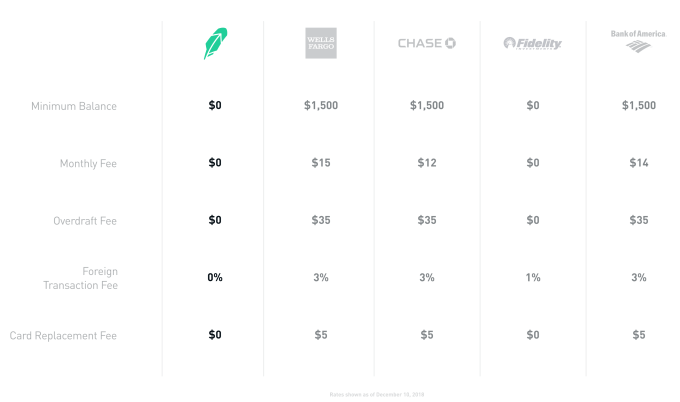
Robinhood touted how its checking and savings features have no minimum account balance, overdraft fees, foreign transaction fees, or card replacement fees. It also has 75,000 free-to-use ATMs in its network, which Bhatt claims is more than the top five US banks combined. And its 3 percent interest rate users earn is much higher than the 0.09% average interest rate for traditional savings, and beats  most name brand banks outside of some credit unions.

But for those perks, users must sacrifice brick-and-mortar bank branches that can help them with troubles, and instead rely on a 24/7 live chat customer support feature from Robinhood. The debit card has Mastercard’s zero-liability protection against fraud, and Robinhood partners with Sutton Bank to issue the card. But it’s unclear how the checking and savings accounts would be protected against other types of attacks or scams.

Robinhood was likely hoping to build a larger user base on top of its existing 6 million accounts by leveraging software scalability to provide such competitive rates. It planned to be profitable from its margin on the interest from investing users’ money and a revenue sharing agreement with Mastercard on interchange fee charged to merchants when you swipe your card. But long-term, Robinhood may use checking and savings as a wedge into the larger financial services market from which it can launch more lucrative products like loans.

But that could fall apart if users are scared to move their checking and savings money to Robinhood. Startups can suddenly fold or make too risky of decisions while chasing growth. Robinhood’s valuation went from $1.3 billion last year to $5.6 billion when it raised $363 million this year. That puts intense pressure on the company to grow to justify that massive valuation. In its rush to break into banking, it may have cut corners on becoming properly insured.

[DIsclosure: The author of this article knows Robinhood co-founders Baiju Bhatt and Vlad Tenev from college 10 years ago]

from Startups – TechCrunch https://ift.tt/2GeVtIA

#USA Last call for Polish pitch-offs

//

I’m heading back to Europe to hang out in Wroclaw and Warsaw so it’s last call for pitch off applications.

I’ll be at a Wroclaw event, called In-Ference, which is happening on December 17 and you can submit to pitch here. The team will notify you if you have been chosen. The winner will receive a table at TC Disrupt in San Francisco.

The Warsaw event, here, is on the 19th at WeWork in Warsaw. You can sign up to pitch here. I’ll notify the folks I’ve chosen and the winner gets a table at TC Disrupt, as well.

Special thanks to WeWork Labs in Warsaw for supplying some beer and pizza for the event and, as always, special thanks to Dermot Corr and Ahmad Piraiee for putting these things together. See you soon!

from Startups – TechCrunch https://ift.tt/2UL2bsM

#USA LemonBox, which brings US vitamins to Chinese consumers, raises $2M

//

LemonBox, a Chinese e-commerce startup that imports vitamins and health products from the U.S., has raised $2 million to develop its business.

The company graduated from Y Combinator’s most recent program in the U.S. and, fueled by the demo day, has pulled in the new capital from 10 investors, which include Partech, Tekton Ventures, Cathexis Ventures, Scrum Ventures and 122 West Ventures.

LemonBox started when co-founder and CEO Derek Weng, a former employee at Walmart in the U.S., saw an opportunity to organize the common practice of bringing health products back in China. Any Mainland Chinese person who has lived in, or even just visited, the U.S. will be familiar with such requests from family and friends, and LemonBox aims to make it possible for anyone in China to get U.S.-quality products without relying on a mule.

The service is primarily a WeChat app — which taps into China’s ubiquitous messaging platform — and a website, although Weng told TechCrunch in an interview this week that the company is contemplating a standalone app of its own. The benefit of that, beyond a potentially more engaging customer experience, could be to broaden LemonBox’s product selection and use data to offer a more customized selection of products. Related to that, LemonBox said it hopes to work with health and fitness-related services in the future to gather data, with permission, to help refine the personal approach.

LemonBox’s team has now grown to 20 people, with 12 full-time staff and 8 interns, and Weng said that the new funding will also go toward increased marketing, improvements to the WeChat app and upgrading the company’s supply chain. Business, he added, is growing at 35 percent per week as LemonBox has adopted a personal approach to its packaging, much like Amazon-owned PillPack.

“This is the first time people in China have ever seen this level of customization for their vitamins,” Weng told TechCrunch.

Members of the LemonBox team with Qi Lu, who heads up Y Combinator’s China business

Qi Lu, the former Microsoft and Baidu executive who leads YC’s new China unit, said he is “bullish” about the business.

“What LemonBox offers resonates with me and is serving a clear China market needs. Personally, I travel a lot between China and the U.S., and I often was asked by my relatives to help purchase and carry them similar products like vitamins,” he said in a prepared statement.

“More importantly, what LemonBox can do is to build an initial core user base and a growing brand. Over time, by serving their users well, it can reach and engage more users who want to better take care of their broader nutrition needs, use more data and take advantage of increasingly stronger AI technologies to customers and personalize, and become an essential service for more and more users and customers in China,” Lu added.

from Startups – TechCrunch https://ift.tt/2SKGabJ

#USA International money transfer company TransferGo scores $17.6M Series B

//

TransferGo, the London-based international money transfer startup, has raised just over $17.6 million in Series B funding, including an earlier tranche of funding closed in May. The round is led by Vostok Emerging Finance, and Silicon Valley’s Hard Yaka, with participation from Revo Capital, U-Start Club, and Practica Capital. The figure also includes around $830,000 in equity crowdfunding via Seedrs.

Founded in 2012, TransferGo currently operates in 47 countries around the world, with offices in London, Vilnius, Berlin, Warsaw and Istanbul. It claims a customer base of 833,000 users, adding more than 1,000 new customers per day, and positions itself as offering one of the fastest international money transfer services on the market. This sees it able to provide international “cross-network” transfers in 30 minutes.

The fintech company also recently launched a free international money transfer service, with what it says is a a zero transaction fee and with no mark up on exchange rates, allowing customers to transfer money globally at no cost. Essentially, if you aren’t time sensitive or perhaps are transferring larger amounts, you can elect to use the free tier. If you need a guaranteed arrival time for the money you are sending, you can use the paid tier, which still looks pretty competitive.

In a call and over follow-up emails, TransferGo co-founder and CEO Daumantas Dvilinskas explained that the fintech has built out its own “proprietary technology and infrastructure” to enable it to do 30 minute transfers on the corridors it offers and at a cost that remains low. This means having partner bank accounts as close to the final destination as possible, and re-routing the money being transferred to avoid unnecessary charges and to enough volume to afford economies of scale at the point of conversation.

“We cross-sell our customers different delivery options based on how quickly they want to receive the money,” Dvilinskas tells me. “TransferGo Now product, where customers can get a 30 minute guaranteed, together with other speedy delivery options, effectively pays for the TransferGo Free product… At the same time, economies of scale have been decreasing our direct cost of transactions to a point when we can offer the free product in a sustainable fashion”.

Dvilinskas says TransferGo’s typical customer is “a global citizen” who receives a salary abroad and sends around $500 back home every month. “Before using us they would have been using a cash bureau, bank or PayPal. In addition to this core segment, we see a growing larger transaction segment who are leveraging our competitive currency conversion rate for larger transactions to pay bills or buy goods abroad,” he adds.

Historically, TransferGo launched to enable people in the U.K. to send money to Central and Eastern Europe, a corridor where it claims 20 percent market share (based on the World Bank data). However, the fastest growing corridors today are Continental Europe to Ukraine, Turkey, India, and other emerging market destinations.

“Specifically, Poland, Germany, and Turkey are emerging as important send markets, which is where we opened up offices last year,” says Dvilinskas.

from Startups – TechCrunch https://ift.tt/2rAOtLZ

#USA A former Ofo exec is launching his own scooter startup

//

The funding extravaganza may be approaching its end for scooter “unicorns” Lime and Bird, but smaller startups in the micro-mobility space have continued to close venture capital rounds at a consistent pace. See Grin, Tier and Yellow for examples.

The latest is Dott, a European scooter startup founded by Maxim Romain, Ofo’s former head of Europe, the Middle East and Africa. Romain joined Ofo, a Chinese bike- and scooter-sharing company that raised more than $1 billion in venture capital funding but has struggled to scale overseas, in 2018 to help it expand. He only lasted seven months before realizing he could do it better himself.

“Why work for a Chinese company when we can do it ourselves in Europe where we better understand the market?” Romain told TechCrunch. 

Dott, headquartered in Amsterdam, has raised €20 million in a round co-led by EQT Ventures and Naspers. Axel Springer Digital Ventures, DN Capital, Felix Capital and others also joined. Dott is using the capital to launch in several cities across Europe, beginning with an early 2019 e-scooter pilot at Station F, a startup campus located in Paris. Additional launches are in the pipeline, as are electric bikes.

As a result of its learnings from Ofo, Bird and Lime, all of which have struggled to keep their equipment out of disadvantageous spots, like trees, lakes and garbage cans, Dott says it’s built sturdier scooters. They have 10” wheels, wider decks, a double brake system for safety, a speed cap at 20km/h and apparently are able to hold a charge longer than competing scooters — though we couldn’t independently verify this.

Dott says it’s taking a friendlier approach to launching in new cities, again, unlike some of its predecessors. If you remember, Bird showed up in a number of cities without permission — a move that resulted in it being denied a permit to operate in San Francisco. Dott will hire local teams to collaborate with city officials to develop pilot plans tailored to each market and it won’t rely on gig economy workers to recharge, clean and maintain scooters. Instead, it will hire and train a team of Dott employees dedicated to maintenance in each city.

“I think a lot of the companies grow too fast in the sense that they don’t necessarily have the product that can enable them to be profitable but because they want to win the race,” Romain said. “They want to raise as much money as possible as quick as possible and to deploy scooters as quick as possible. This creates an environment for them where their unit economics are extremely bad.”

“That’s exactly what we saw with bike-sharing in China. In the end, the reality of the unit economics came back to bite them. It’s a risk. Lime and Bird are doing a lot to improve their hardware but it’s a risk for the industry. For us, we are taking the view that we really need to focus on the product so we have the right unit economics and we can be sustainable. If you want to make it happen, you have to make it happen in a sustainable way.”

from Startups – TechCrunch https://ift.tt/2rAsMf1