#USA A former Ofo exec is launching his own scooter startup

//

The funding extravaganza may be approaching its end for scooter “unicorns” Lime and Bird, but smaller startups in the micro-mobility space have continued to close venture capital rounds at a consistent pace. See Grin, Tier and Yellow for examples.

The latest is Dott, a European scooter startup founded by Maxim Romain, Ofo’s former head of Europe, the Middle East and Africa. Romain joined Ofo, a Chinese bike- and scooter-sharing company that raised more than $1 billion in venture capital funding but has struggled to scale overseas, in 2018 to help it expand. He only lasted seven months before realizing he could do it better himself.

“Why work for a Chinese company when we can do it ourselves in Europe where we better understand the market?” Romain told TechCrunch. 

Dott, headquartered in Amsterdam, has raised €20 million in a round co-led by EQT Ventures and Naspers. Axel Springer Digital Ventures, DN Capital, Felix Capital and others also joined. Dott is using the capital to launch in several cities across Europe, beginning with an early 2019 e-scooter pilot at Station F, a startup campus located in Paris. Additional launches are in the pipeline, as are electric bikes.

As a result of its learnings from Ofo, Bird and Lime, all of which have struggled to keep their equipment out of disadvantageous spots, like trees, lakes and garbage cans, Dott says it’s built sturdier scooters. They have 10” wheels, wider decks, a double brake system for safety, a speed cap at 20km/h and apparently are able to hold a charge longer than competing scooters — though we couldn’t independently verify this.

Dott says it’s taking a friendlier approach to launching in new cities, again, unlike some of its predecessors. If you remember, Bird showed up in a number of cities without permission — a move that resulted in it being denied a permit to operate in San Francisco. Dott will hire local teams to collaborate with city officials to develop pilot plans tailored to each market and it won’t rely on gig economy workers to recharge, clean and maintain scooters. Instead, it will hire and train a team of Dott employees dedicated to maintenance in each city.

“I think a lot of the companies grow too fast in the sense that they don’t necessarily have the product that can enable them to be profitable but because they want to win the race,” Romain said. “They want to raise as much money as possible as quick as possible and to deploy scooters as quick as possible. This creates an environment for them where their unit economics are extremely bad.”

“That’s exactly what we saw with bike-sharing in China. In the end, the reality of the unit economics came back to bite them. It’s a risk. Lime and Bird are doing a lot to improve their hardware but it’s a risk for the industry. For us, we are taking the view that we really need to focus on the product so we have the right unit economics and we can be sustainable. If you want to make it happen, you have to make it happen in a sustainable way.”

from Startups – TechCrunch https://ift.tt/2rAsMf1

#USA A former Ofo exec is launching his own scooter startup

//

The funding extravaganza may be approaching its end for scooter “unicorns” Lime and Bird, but smaller startups in the micro-mobility space have continued to close venture capital rounds at a consistent pace. See Grin, Tier and Yellow for examples.

The latest is Dott, a European scooter startup founded by Maxim Romain, Ofo’s former head of Europe, the Middle East and Africa. Romain joined Ofo, a Chinese bike- and scooter-sharing company that raised more than $1 billion in venture capital funding but has struggled to scale overseas, in 2018 to help it expand. He only lasted seven months before realizing he could do it better himself.

“Why work for a Chinese company when we can do it ourselves in Europe where we better understand the market?” Romain told TechCrunch. 

Dott, headquartered in Amsterdam, has raised €20 million in a round co-led by EQT Ventures and Naspers. Axel Springer Digital Ventures, DN Capital, Felix Capital and others also joined. Dott is using the capital to launch in several cities across Europe, beginning with an early 2019 e-scooter pilot at Station F, a startup campus located in Paris. Additional launches are in the pipeline, as are electric bikes.

As a result of its learnings from Ofo, Bird and Lime, all of which have struggled to keep their equipment out of disadvantageous spots, like trees, lakes and garbage cans, Dott says it’s built sturdier scooters. They have 10” wheels, wider decks, a double brake system for safety, a speed cap at 20km/h and apparently are able to hold a charge longer than competing scooters — though we couldn’t independently verify this.

Dott says it’s taking a friendlier approach to launching in new cities, again, unlike some of its predecessors. If you remember, Bird showed up in a number of cities without permission — a move that resulted in it being denied a permit to operate in San Francisco. Dott will hire local teams to collaborate with city officials to develop pilot plans tailored to each market and it won’t rely on gig economy workers to recharge, clean and maintain scooters. Instead, it will hire and train a team of Dott employees dedicated to maintenance in each city.

“I think a lot of the companies grow too fast in the sense that they don’t necessarily have the product that can enable them to be profitable but because they want to win the race,” Romain said. “They want to raise as much money as possible as quick as possible and to deploy scooters as quick as possible. This creates an environment for them where their unit economics are extremely bad.”

“That’s exactly what we saw with bike-sharing in China. In the end, the reality of the unit economics came back to bite them. It’s a risk. Lime and Bird are doing a lot to improve their hardware but it’s a risk for the industry. For us, we are taking the view that we really need to focus on the product so we have the right unit economics and we can be sustainable. If you want to make it happen, you have to make it happen in a sustainable way.”

from Startups – TechCrunch https://ift.tt/2rAsMf1

#USA A former Ofo exec is launching his own scooter startup

//

The funding extravaganza may be approaching its end for scooter “unicorns” Lime and Bird, but smaller startups in the micro-mobility space have continued to close venture capital rounds at a consistent pace. See Grin, Tier and Yellow for examples.

The latest is Dott, a European scooter startup founded by Maxim Romain, Ofo’s former head of Europe, the Middle East and Africa. Romain joined Ofo, a Chinese bike- and scooter-sharing company that raised more than $1 billion in venture capital funding but has struggled to scale overseas, in 2018 to help it expand. He only lasted seven months before realizing he could do it better himself.

“Why work for a Chinese company when we can do it ourselves in Europe where we better understand the market?” Romain told TechCrunch. 

Dott, headquartered in Amsterdam, has raised €20 million in a round co-led by EQT Ventures and Naspers. Axel Springer Digital Ventures, DN Capital, Felix Capital and others also joined. Dott is using the capital to launch in several cities across Europe, beginning with an early 2019 e-scooter pilot at Station F, a startup campus located in Paris. Additional launches are in the pipeline, as are electric bikes.

As a result of its learnings from Ofo, Bird and Lime, all of which have struggled to keep their equipment out of disadvantageous spots, like trees, lakes and garbage cans, Dott says it’s built sturdier scooters. They have 10” wheels, wider decks, a double brake system for safety, a speed cap at 20km/h and apparently are able to hold a charge longer than competing scooters — though we couldn’t independently verify this.

Dott says it’s taking a friendlier approach to launching in new cities, again, unlike some of its predecessors. If you remember, Bird showed up in a number of cities without permission — a move that resulted in it being denied a permit to operate in San Francisco. Dott will hire local teams to collaborate with city officials to develop pilot plans tailored to each market and it won’t rely on gig economy workers to recharge, clean and maintain scooters. Instead, it will hire and train a team of Dott employees dedicated to maintenance in each city.

“I think a lot of the companies grow too fast in the sense that they don’t necessarily have the product that can enable them to be profitable but because they want to win the race,” Romain said. “They want to raise as much money as possible as quick as possible and to deploy scooters as quick as possible. This creates an environment for them where their unit economics are extremely bad.”

“That’s exactly what we saw with bike-sharing in China. In the end, the reality of the unit economics came back to bite them. It’s a risk. Lime and Bird are doing a lot to improve their hardware but it’s a risk for the industry. For us, we are taking the view that we really need to focus on the product so we have the right unit economics and we can be sustainable. If you want to make it happen, you have to make it happen in a sustainable way.”

from Startups – TechCrunch https://ift.tt/2rAsMf1

#USA Distinguished VCs back wholesale marketplace Faire with $100M at a $535M valuation

//

A slew of venture capitalists known for high-profile exits — Kirsten Green of Forerunner Ventures, Keith Rabois of Khosla Ventures, Alfred Lin of Sequoia Capital and Alex Taussig of Lightspeed Venture Partners — have invested in Faire (formerly known as Indigo Fair), a 2-year-old wholesale marketplace for artisanal products.

A quick glance at Faire suggests it’s a combination of Pinterest and Etsy, complete with trendy, pastel stationery, soap, baby products and more, all made by independent artisans and sold to retailers. Faire has today announced a $100 million fundraise across two financing rounds: a $40 million Series B led by Taussig at Lightspeed and a $60 million Series C led by Y Combinator’s Continuity fund. New investors Founders Fund, the venture firm founded by Peter Thiel, and DST Global also participated. The business has previously brought in a total of $16 million.

The latest financing values Faire at $535 million, according to a source familiar with the deal.

If you’re feeling a little bit of déjà vu, that’s because a similar startup also raised a sizeable round of venture capital funding, announced today. That’s Minted . The 10-year-old company, best known for its wide assortment of wedding invitations and stationery, raised $208 million led by Permira, with participation from T. Rowe Price. Though Minted is first and foremost a consumer-facing marketplace, it plans to double down on its wholesale business with its latest infusion of capital, setting it up to be among Faire’s biggest competitors.

Like Minted, Faire leverages artificial intelligence and predictive analytics to forecast which products will fly off its virtual shelves in order to to source and manage inventory as efficiently as possible. The approach appears to be working; Faire says it has 15,000 retailers actively purchasing from its platform, including Walgreens, Walmart, Sephora and Nordstrom — a 3,140 percent year-over-year increase. It’s completed 2,000 orders to date, garnering $100 million in run rate sales, and has expanded its community of artists 445 percent YoY, to 2,000.

The company, headquartered in San Francisco, with offices in Ontario and Waterloo, was founded by three former Square employees: chief executive officer Max Rhodes, who was product manager on a variety of strategic initiatives, including Square Capital and Square Cash; chief information officer Daniele Perito, who led risk and security for Square Cash; and chief technology officer Marcelo Cortes, a former engineering lead for Square Cash.

“Our mission at Faire is to empower entrepreneurs to chase their dreams,” Rhodes wrote in a blog post this morning. “We believe entrepreneurship is a calling. Starting a business provides a level of autonomy and fulfillment that’s become difficult to find for many elsewhere in the economy. With this in mind, we built Faire to help entrepreneurs on both sides of our marketplace succeed.”

from Startups – TechCrunch https://ift.tt/2zVpaZC

#USA Online ads and games would benefit from more rewards, according to UCLA survey

//

A new study from Versus Systems and the MEMES (Management of Enterprise in Media, Entertainment & Sports) Center at UCLA’s Anderson School of Management examines at how gaming and advertising are evolving, and how one influences the other.

As Versus Systems CEO Matthew Pierce put it, the goal was to study, “What is the impact on advertising as interactive media grows, and as more people consume interactive media?”

The individual findings — People like rewards! Not everyone who plays games calls themselves a gamer! — may not be that shocking to TechCrunch readers. And since Versus Systems has built a white-label platform for publishers to offer in-game rewards, the study might also seem a bit self-serving.

But again, this conducted was with UCLA’s Anderson School of Management, and both Pierce (who’s a lecturer at the school) and UCLA MEMES Head Jay Tucker pointed to size of the study, with 88,000 (U.S.-based) participants across a broad range of demographic groups.

Of those respondents, 50 percent said that they’ve played a video game (on any platform) in the past week, while 41 percent said they’ve played a game in the past 24 hours. However, only 13 percent of respondents described themselves as gamers. That “identification gap” is even larger among women, where 56 percent played a game in the past week but only 11 percent identified themselves as gamers.

Why does that matter? Well, the MEMES Center and Versus Systems argue in the study press release that “advertisers that are recognizing the value in advertising in-game may be underestimating how large and how diverse the gaming audience really is today.”

The study also suggests that traditional advertising may be facing more resistance from consumers, with 46 percent of respondents saying that they frequently or always avoid ads by “clicking the X” to close windows or changing channels or closing apps. Only 3.6 percent of respondents said they always watch ads all the way through.

When asked what would make them play games more, the most popular answer was “winning real things that I want when I achieve things in-game” — it was the number one result for 30 percent of respondents, and among millennials, it did even better. (In comparison, 18 percent put “if the games were less expensive” as their top answer and 11 percent said “my friends playing the same game(s).”) This attitude even extended to TV, where 77 percent of respondents listed rewards as one of the things (not necessarily the top reason) that would make them watch more television.

Meanwhile, 24 percent of respondents said listed “if more games/more shows were made for people like me” as the number one thing that would convince them to play or watch more.

Tucker suggested that these seemingly scattershot answers are actually connected. On the advertising side, “We’ve got folks who are used to being part of a community all day, every day, whether that’s social media or massively multiplayer games. We see users are increasingly connected and are not really interested in getting pulled out of an experience. Rewards, if done properly, can reinforce being part of a community … you can amplify that sense of connection.”

“The introduction of choice seems to make a big difference,” Pierce added. “We need new models where we can foster choice, foster community, foster more aspirational relationships between viewers and brands that ultimately allows content developers to have a relationship with the brands that isn’t so adversarial.”

Meanwhile, when it comes to content and storytelling, Tucker said we’re entering an “age of personalization.” Among other things, that means more diversity, in what he described as “a generational shift away from stories that assume everybody’s looking at life from the same perspective.”

Pierce and Tucker suggested that they’ll be taking an even closer look at the data in the coming months (“needs further study” was repeated several times during the interview), particularly by examining responses within smaller demographic groups.

from Startups – TechCrunch https://ift.tt/2rzNATC

#USA Online ads and games would benefit from more rewards, according to UCLA survey

//

A new study from Versus Systems and the MEMES (Management of Enterprise in Media, Entertainment & Sports) Center at UCLA’s Anderson School of Management examines at how gaming and advertising are evolving, and how one influences the other.

As Versus Systems CEO Matthew Pierce put it, the goal was to study, “What is the impact on advertising as interactive media grows, and as more people consume interactive media?”

The individual findings — People like rewards! Not everyone who plays games calls themselves a gamer! — may not be that shocking to TechCrunch readers. And since Versus Systems has built a white-label platform for publishers to offer in-game rewards, the study might also seem a bit self-serving.

But again, this conducted was with UCLA’s Anderson School of Management, and both Pierce (who’s a lecturer at the school) and UCLA MEMES Head Jay Tucker pointed to size of the study, with 88,000 (U.S.-based) participants across a broad range of demographic groups.

Of those respondents, 50 percent said that they’ve played a video game (on any platform) in the past week, while 41 percent said they’ve played a game in the past 24 hours. However, only 13 percent of respondents described themselves as gamers. That “identification gap” is even larger among women, where 56 percent played a game in the past week but only 11 percent identified themselves as gamers.

Why does that matter? Well, the MEMES Center and Versus Systems argue in the study press release that “advertisers that are recognizing the value in advertising in-game may be underestimating how large and how diverse the gaming audience really is today.”

The study also suggests that traditional advertising may be facing more resistance from consumers, with 46 percent of respondents saying that they frequently or always avoid ads by “clicking the X” to close windows or changing channels or closing apps. Only 3.6 percent of respondents said they always watch ads all the way through.

When asked what would make them play games more, the most popular answer was “winning real things that I want when I achieve things in-game” — it was the number one result for 30 percent of respondents, and among millennials, it did even better. (In comparison, 18 percent put “if the games were less expensive” as their top answer and 11 percent said “my friends playing the same game(s).”) This attitude even extended to TV, where 77 percent of respondents listed rewards as one of the things (not necessarily the top reason) that would make them watch more television.

Meanwhile, 24 percent of respondents said listed “if more games/more shows were made for people like me” as the number one thing that would convince them to play or watch more.

Tucker suggested that these seemingly scattershot answers are actually connected. On the advertising side, “We’ve got folks who are used to being part of a community all day, every day, whether that’s social media or massively multiplayer games. We see users are increasingly connected and are not really interested in getting pulled out of an experience. Rewards, if done properly, can reinforce being part of a community … you can amplify that sense of connection.”

“The introduction of choice seems to make a big difference,” Pierce added. “We need new models where we can foster choice, foster community, foster more aspirational relationships between viewers and brands that ultimately allows content developers to have a relationship with the brands that isn’t so adversarial.”

Meanwhile, when it comes to content and storytelling, Tucker said we’re entering an “age of personalization.” Among other things, that means more diversity, in what he described as “a generational shift away from stories that assume everybody’s looking at life from the same perspective.”

Pierce and Tucker suggested that they’ll be taking an even closer look at the data in the coming months (“needs further study” was repeated several times during the interview), particularly by examining responses within smaller demographic groups.

from Startups – TechCrunch https://ift.tt/2rzNATC

#USA The annual PornHub year in review tells us what we’re really looking at online

//

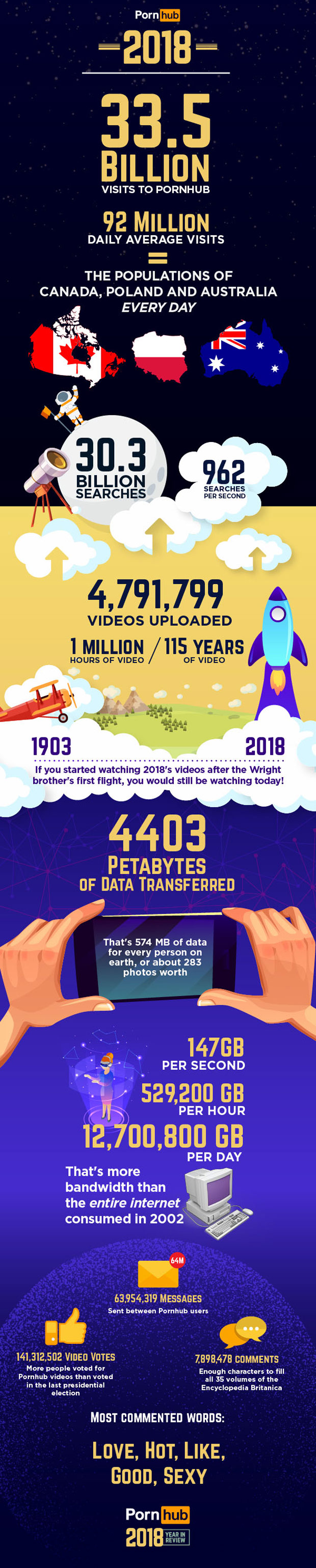
PornHub, a popular site feature people in various stages of undress, saw 33.5 billion visits in 2018. There are currently 7.53 billion people on Earth.

Y’all have been busy.

The company, which owns most of the major porn sites online, produces a yearly report that aggregates user behavior on the site. Of particular interest, aside from the fact that all of us are horndogs, is that the US, Germany, and India are in the top spots for porn browsing and that the company transferred 4,000 petabytes of data or about 500 MB per person on the planet.


We ignore this data at our peril. While it doesn’t seem important at first glance, the fact that these porn sites are doing more traffic than most major news organizations is deeply telling. Further, like the meme worlds of Twitter and Facebook, Stormy Daniels and Fortnite made the top searches which points to the spread of politics and culture into the heart of our desires. TV manufacturers should note that 4K searchers are rising in popularity, which suggests that consumer electronics manufacturers should start getting read for a shift (although it should be noted that there is sadly little free 4K content on these sites, a discovery I just made while researching this brief.)

Need more frightening/enlightening data? Here you go.

Just as ‘1080p’ searches had been a defining term in 2017, now “4k” ultra-hd has seen a significant increase in popularity through-out 2018. The popularity of ‘Romantic’ videos more than doubled, and remained twice as popular with female visitors when compared to men.

Searches referring to the dating app ‘Tinder’ grew by 161% among women, 113% among men and 131% by visitors aged 35 to 44. It was also a top trending term in many countries including the United Kingdom and Australia. The number of Tinder themed fantasy date videos on the site is now more than 3500.

Life imitates art, and eventually porn imitates everything, so perhaps it’s no surprise to see that ‘Bowsette’ also made our list of searches that defined 2018. After the original Nintendo fan-art went viral, searches for Bowsette exceeded 3 million in just one week and resulted in the release of a live-action Bowsette themed porn parody (NSFW) with more than 720,000 views.

Bowsette. Good. Moving on.

The Bible Belt representing well in the showings with Mississippi, South Carolina, and Arkansas spending the most time looking at porn. Kansas spent the least. Phones got the most use as porn distribution devices and iOS and Android nearly tied in terms of platform popularity.

Windows traffic fell considerably this year while Chrome OS became decidedly more popular in 2018. Chrome was popular when it came to browsers used while the Playstation was the biggest deliverer of flicks to the console user.

Porn is a the canary in the tech coal mine and where it goes the rest of tech follows. All of these data points, taken together, paint a fascinating picture of a world on the cusp of a fairly unique shift from desktop to mobile and from HD to 4K video. Further, given that these sites are delivering so much data on a daily basis, it’s clear that all of us are sneaking a peek now and again… even if we refuse to admit it.

from Startups – TechCrunch https://ift.tt/2UKcFsn

#USA The annual PornHub year in review tells us what we’re really looking at online

//

PornHub, a popular site feature people in various stages of undress, saw 33.5 billion visits in 2018. There are currently 7.53 billion people on Earth.

Y’all have been busy.

The company, which owns most of the major porn sites online, produces a yearly report that aggregates user behavior on the site. Of particular interest, aside from the fact that all of us are horndogs, is that the US, Germany, and India are in the top spots for porn browsing and that the company transferred 4,000 petabytes of data or about 500 MB per person on the planet.


We ignore this data at our peril. While it doesn’t seem important at first glance, the fact that these porn sites are doing more traffic than most major news organizations is deeply telling. Further, like the meme worlds of Twitter and Facebook, Stormy Daniels and Fortnite made the top searches which points to the spread of politics and culture into the heart of our desires. TV manufacturers should note that 4K searchers are rising in popularity, which suggests that consumer electronics manufacturers should start getting read for a shift (although it should be noted that there is sadly little free 4K content on these sites, a discovery I just made while researching this brief.)

Need more frightening/enlightening data? Here you go.

Just as ‘1080p’ searches had been a defining term in 2017, now “4k” ultra-hd has seen a significant increase in popularity through-out 2018. The popularity of ‘Romantic’ videos more than doubled, and remained twice as popular with female visitors when compared to men.

Searches referring to the dating app ‘Tinder’ grew by 161% among women, 113% among men and 131% by visitors aged 35 to 44. It was also a top trending term in many countries including the United Kingdom and Australia. The number of Tinder themed fantasy date videos on the site is now more than 3500.

Life imitates art, and eventually porn imitates everything, so perhaps it’s no surprise to see that ‘Bowsette’ also made our list of searches that defined 2018. After the original Nintendo fan-art went viral, searches for Bowsette exceeded 3 million in just one week and resulted in the release of a live-action Bowsette themed porn parody (NSFW) with more than 720,000 views.

Bowsette. Good. Moving on.

The Bible Belt representing well in the showings with Mississippi, South Carolina, and Arkansas spending the most time looking at porn. Kansas spent the least. Phones got the most use as porn distribution devices and iOS and Android nearly tied in terms of platform popularity.

Windows traffic fell considerably this year while Chrome OS became decidedly more popular in 2018. Chrome was popular when it came to browsers used while the Playstation was the biggest deliverer of flicks to the console user.

Porn is a the canary in the tech coal mine and where it goes the rest of tech follows. All of these data points, taken together, paint a fascinating picture of a world on the cusp of a fairly unique shift from desktop to mobile and from HD to 4K video. Further, given that these sites are delivering so much data on a daily basis, it’s clear that all of us are sneaking a peek now and again… even if we refuse to admit it.

from Startups – TechCrunch https://ift.tt/2UKcFsn

#USA They scaled YouTube. Now they’ll shard everyone with PlanetScale

//

When the former CTOs of YouTube, Facebook, and Dropbox seed fund a database startup, you know there’s something special going on under the hood. Jiten Vaidya and Sugu Sougoumarane saved YouTube from a scalability nightmare by inventing and open sourcing Vitess, a brilliant relational data storage system. But in the decade since working there, the pair have been inundated with requests from tech companies desperate for help building the operational scaffolding needed to actually integrate Vitess.

So today the pair are revealing their new startup PlanetScale that makes it easy to build multi-cloud databases that handle enormous amounts of information without locking customers into Amazon, Google, or Microsoft’s infrastructure. Battletested at YouTube, the technology could allow startups to fret less about their backend and focus more on their unique value proposition. “Now they don’t have to reinvent the wheel” Vaidya tells me. “A lot of companies facing this scaling problem end up solving it badly in-house and now there’s a way to solve that problem by using us to help.”

PlanetScale has quietly raised a $3 million seed round in April led by SignalFire and joined by a who’s who of engineering luminaries. They include YouTube co-founder and CTO Steve Chen, Quora CEO and former Facebook CTO Adam D’Angelo, former Dropbox CTO Aditya Agarwal, PayPal and Affirm co-founder Max Levchin, MuleSoft co-founder and CTO Ross Mason, Google director of engineering Parisa Tabriz, and Facebook’s first female engineer and South Park Commons Founder Ruchi Sanghvi. If anyone could foresee the need for Vitess implementation services, it’s these leaders who’ve dealt with scaling headaches at tech’s top companies.

But how can a scrappy startup challenge the tech juggernauts for cloud supremacy? First, by actually working with them. The PlanetScale beta that’s now launching lets companies spin up Vitess clusters on its database-as-a-service, their own through a licensing deal, or on AWS with Google Cloud and Microsoft Azure coming shortly. Once these integrations with the tech giants are established, PlanetScale clients can use it as an interface for a multi-cloud setup where they could keep their data master copies on AWS US-West with replicas on Google Cloud in Ireland and elsewhere. That protects companies from becoming dependent on one provider and then getting stuck with price hikes or service problems.

PlanetScale also promises to uphold the principles that undergirded Vitess. “It’s our value that we will keep everything in the query pack completely open source so none of our customers ever have to worry about lock-in” Vaidya says.

PlanetScale co-founders (from left): Jiten Vaidya and Sugu Sougoumarane

Battletested, YouTube Approved

He and Sougoumarane met 25 years ago while at Indian Institute Of Technology Bombay. Back in 1993 they worked at pioneering database company Informix together before it flamed out. Sougoumarane was eventually hired by Elon Musk as an early engineer for X.com before it got acquired by PayPal, and then left for YouTube. Vaidya was working at Google and the pair were reunited when it bought YouTube and Sougoumarane pulled him on to the team.

“YouTube was growing really quickly and the relationship database they were using with MySQL was sort of falling apart at the seams” Vaidya recalls. Adding more CPU and memory to the database infra wasn’t cutting it, so the team created Vitess. The horizontal scaling sharding middleware for MySQL let users segment their database to reduce memory usage while still being able to rapidly run operations. YouTube has smoothly ridden that infrastructure to 1.8 billion users ever since.

“Sugu and Mike Solomon invented and made Vitess open source right from the beginning since 2010 because they knew the scaling problem wasn’t just for YouTube, and they’ll be at other companies 5 or 10 years later trying to solve the same problem” Vaidya explains. That proved true, and now top apps like Square and HubSpot run entirely on Vitess, with Slack now 30 percent onboard.

Vaidya left YouTube in 2012 and became the lead engineer at Endorse, which got acquired by Dropbox where he worked for four years. But in the meantime, the engineering community strayed towards MongoDB-style key-value store databases, which Vaidya considers inferior. He sees indexing issues and says that if the system hiccups during an operation, data can become inconsistent — a big problem for banking and commerce apps. “We think horizontally-scaled relationship databases are more elegant and are something enterprises really need.

Database Legends Reunite

Fed up with the engineering heresy, a year ago Vaidya committed to creating PlanetScale. It’s composed of four core offerings: professional training in Vitess, on-demand support for open source Vitess users, Vitess database-as-a-service on Planetscale’s servers, and software licensing for clients that want to run Vitess on premises or through other cloud providers. It lets companies re-shard their databases on the fly to relocate user data to comply with regulations like GDPR, safely migrate from other systems without major codebase changes, make on-demand changes, and run on Kubernetes.
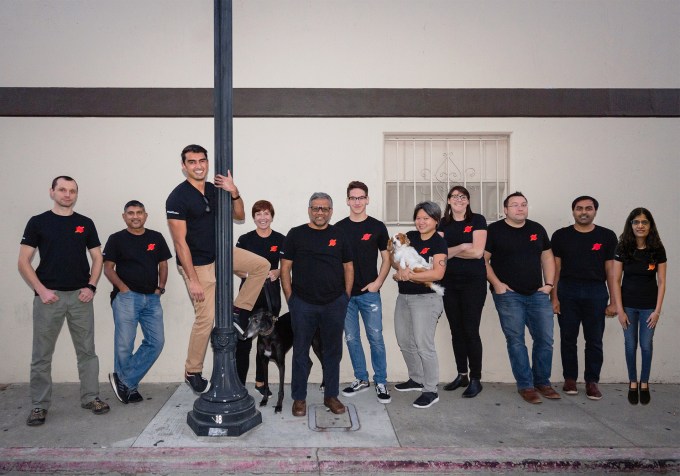
The PlanetScale team

PlanetScale’s customers now include Indonesian ecommerce giant Bukalapak, and it’s helping Booking.com, GitHub, and New Relic migrate to open source Vitess. Growth is suddenly ramping up due to inbound inquiries. Last month around when Square Cash became the number one app, its engineering team published a blog post extolling the virtues of Vitess. Now everyone’s seeking help with Vitess sharding, and PlanetScale is waiting with open arms. “Jiten and Sugu are legends and know firsthand what companies require to be successful in this booming data landscape” says Ilya Kirnos, founding partner and CTO of SignalFire.

The big cloud providers are trying to adapt to the relational database trend, with Google’s Cloud Spanner and Cloud SQL, and Amazon’s AWS SQL and AWS Aurora. Their huge networks and marketing war chests could pose a threat. But Vaidya insists that while it might be easy to get data into these systems, it can be a pain to get it out. PlanetScale is designed to give them freedom of optionality through its multi-cloud functionality so their eggs aren’t all in one basket.

Finding product market fit is tough enough. Trying to suddenly scale a popular app while also dealing with all the other challenges of growing a company can drive founders crazy. But if it’s good enough for YouTube, startups can trust PlanetScale to make databases one less thing they have to worry about.

from Startups – TechCrunch https://ift.tt/2BdiJ3C

#USA They scaled YouTube. Now they’ll shard everyone with PlanetScale

//

When the former CTOs of YouTube, Facebook, and Dropbox seed fund a database startup, you know there’s something special going on under the hood. Jiten Vaidya and Sugu Sougoumarane saved YouTube from a scalability nightmare by inventing and open sourcing Vitess, a brilliant relational data storage system. But in the decade since working there, the pair have been inundated with requests from tech companies desperate for help building the operational scaffolding needed to actually integrate Vitess.

So today the pair are revealing their new startup PlanetScale that makes it easy to build multi-cloud databases that handle enormous amounts of information without locking customers into Amazon, Google, or Microsoft’s infrastructure. Battletested at YouTube, the technology could allow startups to fret less about their backend and focus more on their unique value proposition. “Now they don’t have to reinvent the wheel” Vaidya tells me. “A lot of companies facing this scaling problem end up solving it badly in-house and now there’s a way to solve that problem by using us to help.”

PlanetScale has quietly raised a $3 million seed round in April led by SignalFire and joined by a who’s who of engineering luminaries. They include YouTube co-founder and CTO Steve Chen, Quora CEO and former Facebook CTO Adam D’Angelo, former Dropbox CTO Aditya Agarwal, PayPal and Affirm co-founder Max Levchin, MuleSoft co-founder and CTO Ross Mason, Google director of engineering Parisa Tabriz, and Facebook’s first female engineer and South Park Commons Founder Ruchi Sanghvi. If anyone could foresee the need for Vitess implementation services, it’s these leaders who’ve dealt with scaling headaches at tech’s top companies.

But how can a scrappy startup challenge the tech juggernauts for cloud supremacy? First, by actually working with them. The PlanetScale beta that’s now launching lets companies spin up Vitess clusters on its database-as-a-service, their own through a licensing deal, or on AWS with Google Cloud and Microsoft Azure coming shortly. Once these integrations with the tech giants are established, PlanetScale clients can use it as an interface for a multi-cloud setup where they could keep their data master copies on AWS US-West with replicas on Google Cloud in Ireland and elsewhere. That protects companies from becoming dependent on one provider and then getting stuck with price hikes or service problems.

PlanetScale also promises to uphold the principles that undergirded Vitess. “It’s our value that we will keep everything in the query pack completely open source so none of our customers ever have to worry about lock-in” Vaidya says.

PlanetScale co-founders (from left): Jiten Vaidya and Sugu Sougoumarane

Battletested, YouTube Approved

He and Sougoumarane met 25 years ago while at Indian Institute Of Technology Bombay. Back in 1993 they worked at pioneering database company Informix together before it flamed out. Sougoumarane was eventually hired by Elon Musk as an early engineer for X.com before it got acquired by PayPal, and then left for YouTube. Vaidya was working at Google and the pair were reunited when it bought YouTube and Sougoumarane pulled him on to the team.

“YouTube was growing really quickly and the relationship database they were using with MySQL was sort of falling apart at the seams” Vaidya recalls. Adding more CPU and memory to the database infra wasn’t cutting it, so the team created Vitess. The horizontal scaling sharding middleware for MySQL let users segment their database to reduce memory usage while still being able to rapidly run operations. YouTube has smoothly ridden that infrastructure to 1.8 billion users ever since.

“Sugu and Mike Solomon invented and made Vitess open source right from the beginning since 2010 because they knew the scaling problem wasn’t just for YouTube, and they’ll be at other companies 5 or 10 years later trying to solve the same problem” Vaidya explains. That proved true, and now top apps like Square and HubSpot run entirely on Vitess, with Slack now 30 percent onboard.

Vaidya left YouTube in 2012 and became the lead engineer at Endorse, which got acquired by Dropbox where he worked for four years. But in the meantime, the engineering community strayed towards MongoDB-style key-value store databases, which Vaidya considers inferior. He sees indexing issues and says that if the system hiccups during an operation, data can become inconsistent — a big problem for banking and commerce apps. “We think horizontally-scaled relationship databases are more elegant and are something enterprises really need.

Database Legends Reunite

Fed up with the engineering heresy, a year ago Vaidya committed to creating PlanetScale. It’s composed of four core offerings: professional training in Vitess, on-demand support for open source Vitess users, Vitess database-as-a-service on Planetscale’s servers, and software licensing for clients that want to run Vitess on premises or through other cloud providers. It lets companies re-shard their databases on the fly to relocate user data to comply with regulations like GDPR, safely migrate from other systems without major codebase changes, make on-demand changes, and run on Kubernetes.

The PlanetScale team

PlanetScale’s customers now include Indonesian ecommerce giant Bukalapak, and it’s helping Booking.com, GitHub, and New Relic migrate to open source Vitess. Growth is suddenly ramping up due to inbound inquiries. Last month around when Square Cash became the number one app, its engineering team published a blog post extolling the virtues of Vitess. Now everyone’s seeking help with Vitess sharding, and PlanetScale is waiting with open arms. “Jiten and Sugu are legends and know firsthand what companies require to be successful in this booming data landscape” says Ilya Kirnos, founding partner and CTO of SignalFire.

The big cloud providers are trying to adapt to the relational database trend, with Google’s Cloud Spanner and Cloud SQL, and Amazon’s AWS SQL and AWS Aurora. Their huge networks and marketing war chests could pose a threat. But Vaidya insists that while it might be easy to get data into these systems, it can be a pain to get it out. PlanetScale is designed to give them freedom of optionality through its multi-cloud functionality so their eggs aren’t all in one basket.

Finding product market fit is tough enough. Trying to suddenly scale a popular app while also dealing with all the other challenges of growing a company can drive founders crazy. But if it’s good enough for YouTube, startups can trust PlanetScale to make databases one less thing they have to worry about.

from Startups – TechCrunch https://ift.tt/2BdiJ3C