
#USA Coffee Meets Bagel goes anti-Tinder with a redesign focused on profiles, conversations

//

How do other dating apps compete with Tinder? By further distancing themselves from Tinder’s “hot-or-not” user interface design to focus on differentiating features — like conversation starters, commenting and richer profiles. Today, another anti-Tinder app is doing the same. On the heels of its $12 million Series B announced earlier this year, the oddly named app Coffee Meets Bagel is today announcing a significant makeover, which includes a change to the way the app works.

Its cleaner, lightweight and more modern design does away with bright, competing colors and other outdated features, the company says. But more notably, it has ditched the big “Pass” or “Connect” buttons — its earlier variation on Tinder’s “like” and “dislike” buttons, which nearly all dating apps have now adopted.

Instead, Coffee Meets Bagel’s new interface puts more emphasis on user profiles — showcasing more of the text, and giving users the option to “heart” the profile or now, even comment.

Before a match takes place, users can tap a new commenting button that allows them to respond to the user’s profile directly, before making a connection. This could help potential matches break the ice or even spark a connection that may not have otherwise happened.

The feature is similar, to some extent, to the commenting feature in Hinge, a relationship-focused app that allows users to directly comment on some aspect of another user’s profile.

Coffee Meets Bagel says that during its beta testing, members who sent comments to their matches had a 25 percent higher chance of getting liked back. And when comments led to conversations, there was a 60 percent increase in total messages exchanged.

Focusing on enabling better conversations is a good way for other dating apps to combat Tinder, which leaves communication up to the users to initiate, without much guidance. This leads to inboxes filled with “hi’s” and nothing much else to say. By integrating commenting into profiles, however, users will be prompted to start conversations based on something they’ve read — allowing people to connect based on more than just their photos.

The app has also revamped its Discover and Suggested sections to offer seamless scrolling and better navigation, respectively. These sections are less cluttered than before, too, in keeping with the more minimalist spirit. Even the Coffee Meets Bagel logo has gotten a makeover, where the C and B now meet in the shape of a heart.The company’s anti-Tinder stance is shaping up in its social content, too. While Tinder has more recently embraced hook-up culture and the single life with its online publication “Swipe Life,” CMB is instead creating content that’s more inspiring, it says.
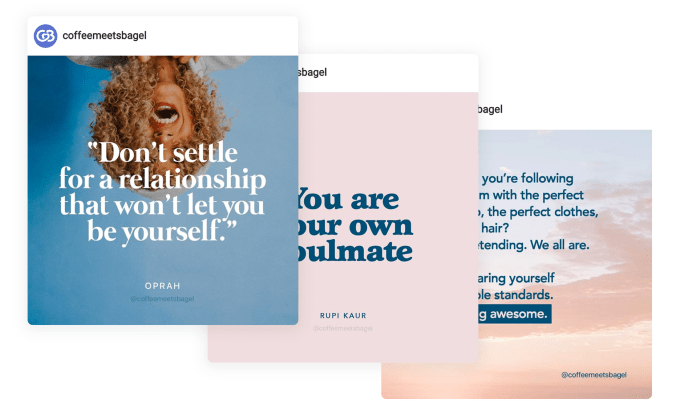
“We’re taking a stance against online dating conventions, like ghosting and treating people like profiles. We’re expanding the conversation to the self: self-reflection, self-discovery, and self-love,” the company explains in its announcement.

Coffee Meets Bagel has raised just under $20 million since launching back in 2012, but it’s faced threats from Tinder, which has challenged its model head-on with Tinder Picks — a curated selection of matches for Tinder Gold subscribers, similar to Coffee Meets Bagel’s curated daily picks.

The company’s app has close to 7 million installs to date, according to data from Sensor Tower, and more than $25 million in gross revenue. The revenue is growing over time, the firm also found, with users spending approximately $900,000 in the app last month, up 30 percent from November 2017.

from Startups – TechCrunch https://ift.tt/2L93PQN

#USA Coffee Meets Bagel goes anti-Tinder with a redesign focused on profiles, conversations

//

How do other dating apps compete with Tinder? By further distancing themselves from Tinder’s “hot-or-not” user interface design to focus on differentiating features – like conversation starters, commenting, and richer profiles. Today, another anti-Tinder app is doing the same. On the heels of its $12 million Series B announced earlier this year, the oddly named app Coffee Meets Bagel is today announcing a significant makeover, which includes a change to the way the app works.

Its cleaner, lightweight and more modern design does away with bright, competing colors and other outdated features, the company says. But more notably, it has ditched the big “Pass” or “Connect” buttons – its earlier variation on Tinder’s “like” and “dislike” buttons, which nearly all dating apps have now adopted.

Instead, Coffee Meets Bagel’s new interface puts more emphasis on user profiles – showcasing more of the text, and giving users the option to “heart” the profile or now, even comment.

Before a match takes place, users can tap a new commenting button that allows them to respond to the user’s profile directly, before making a connection. This could help potential matches break the ice or even spark a connection that may not have otherwise happened.

The feature is similar, to some extent, to the commenting feature in Hinge, a relationship-focused app that allows users to directly comment on some aspect of another user’s profile.

Coffee Meets Bagel says that during its beta testing, members who sent comments to their matches had a 25 percent higher chance of getting liked back. And when comments led to conversations, there was a 60 percent increase in total messages exchanged.

Focusing on enabling better conversations is a good way for other dating apps to combat Tinder, which leaves communication up to the users to initiate, without much guidance. This leads to inboxes filled with “hi’s” and nothing much else to say. By integrating commenting into profiles, however, users will be prompted to start conversations based on something they’ve read – allowing people to connect based on more than just their photos.

The app has also revamped its Discover and Suggested sections to offer seamless scrolling and better navigation, respectively. These sections are less cluttered than before, too, in keeping with the more minimalist spirit. Even the Coffee Meets Bagel logo has gotten a makeover, where the C and B now meet in the shape of heart.

The company’s anti-Tinder stance is shaping up in its social content, too. While Tinder has more recently embraced hook-up culture and the single life with its online publication “Swipe Life,” CMB is instead creating content that’s more inspiring, it says.

“We’re taking a stance against online dating conventions, like ghosting and treating people like profiles. We’re expanding the conversation to the self: self-reflection, self-discovery, and self-love,” the company explains in its announcement.

Coffee Meets Bagel has raised just under $20 million since launching back in 2012, but it’s faced threats from Tinder, which has challenged its model head-on with Tinder Picks – a curated selection of matches for Tinder Gold subscribers, similar to Coffee Meets Bagel’s curated daily picks.

The company’s app has close to 7 million installs to date, according to data from Sensor Tower, and more than $25 million in gross revenue. The revenue is growing over time, the firm also found, with users spending approximately $900,000 in the app last month, up 30% from November 2017.

from Startups – TechCrunch https://ift.tt/2L93PQN

#USA Coffee Meets Bagel goes anti-Tinder with a redesign focused on profiles, conversations

//

How do other dating apps compete with Tinder? By further distancing themselves from Tinder’s “hot-or-not” user interface design to focus on differentiating features – like conversation starters, commenting, and richer profiles. Today, another anti-Tinder app is doing the same. On the heels of its $12 million Series B announced earlier this year, the oddly named app Coffee Meets Bagel is today announcing a significant makeover, which includes a change to the way the app works.

Its cleaner, lightweight and more modern design does away with bright, competing colors and other outdated features, the company says. But more notably, it has ditched the big “Pass” or “Connect” buttons – its earlier variation on Tinder’s “like” and “dislike” buttons, which nearly all dating apps have now adopted.

Instead, Coffee Meets Bagel’s new interface puts more emphasis on user profiles – showcasing more of the text, and giving users the option to “heart” the profile or now, even comment.

Before a match takes place, users can tap a new commenting button that allows them to respond to the user’s profile directly, before making a connection. This could help potential matches break the ice or even spark a connection that may not have otherwise happened.

The feature is similar, to some extent, to the commenting feature in Hinge, a relationship-focused app that allows users to directly comment on some aspect of another user’s profile.

Coffee Meets Bagel says that during its beta testing, members who sent comments to their matches had a 25 percent higher chance of getting liked back. And when comments led to conversations, there was a 60 percent increase in total messages exchanged.

Focusing on enabling better conversations is a good way for other dating apps to combat Tinder, which leaves communication up to the users to initiate, without much guidance. This leads to inboxes filled with “hi’s” and nothing much else to say. By integrating commenting into profiles, however, users will be prompted to start conversations based on something they’ve read – allowing people to connect based on more than just their photos.

The app has also revamped its Discover and Suggested sections to offer seamless scrolling and better navigation, respectively. These sections are less cluttered than before, too, in keeping with the more minimalist spirit. Even the Coffee Meets Bagel logo has gotten a makeover, where the C and B now meet in the shape of heart.

The company’s anti-Tinder stance is shaping up in its social content, too. While Tinder has more recently embraced hook-up culture and the single life with its online publication “Swipe Life,” CMB is instead creating content that’s more inspiring, it says.

“We’re taking a stance against online dating conventions, like ghosting and treating people like profiles. We’re expanding the conversation to the self: self-reflection, self-discovery, and self-love,” the company explains in its announcement.

Coffee Meets Bagel has raised just under $20 million since launching back in 2012, but it’s faced threats from Tinder, which has challenged its model head-on with Tinder Picks – a curated selection of matches for Tinder Gold subscribers, similar to Coffee Meets Bagel’s curated daily picks.

The company’s app has close to 7 million installs to date, according to data from Sensor Tower, and more than $25 million in gross revenue. The revenue is growing over time, the firm also found, with users spending approximately $900,000 in the app last month, up 30% from November 2017.

from Startups – TechCrunch https://ift.tt/2L93PQN

#USA Coffee Meets Bagel goes anti-Tinder with a redesign focused on profiles, conversations

//

How do other dating apps compete with Tinder? By further distancing themselves from Tinder’s “hot-or-not” user interface design to focus on differentiating features – like conversation starters, commenting, and richer profiles. Today, another anti-Tinder app is doing the same. On the heels of its $12 million Series B announced earlier this year, the oddly named app Coffee Meets Bagel is today announcing a significant makeover, which includes a change to the way the app works.

Its cleaner, lightweight and more modern design does away with bright, competing colors and other outdated features, the company says. But more notably, it has ditched the big “Pass” or “Connect” buttons – its earlier variation on Tinder’s “like” and “dislike” buttons, which nearly all dating apps have now adopted.

Instead, Coffee Meets Bagel’s new interface puts more emphasis on user profiles – showcasing more of the text, and giving users the option to “heart” the profile or now, even comment.

Before a match takes place, users can tap a new commenting button that allows them to respond to the user’s profile directly, before making a connection. This could help potential matches break the ice or even spark a connection that may not have otherwise happened.

The feature is similar, to some extent, to the commenting feature in Hinge, a relationship-focused app that allows users to directly comment on some aspect of another user’s profile.

Coffee Meets Bagel says that during its beta testing, members who sent comments to their matches had a 25 percent higher chance of getting liked back. And when comments led to conversations, there was a 60 percent increase in total messages exchanged.

Focusing on enabling better conversations is a good way for other dating apps to combat Tinder, which leaves communication up to the users to initiate, without much guidance. This leads to inboxes filled with “hi’s” and nothing much else to say. By integrating commenting into profiles, however, users will be prompted to start conversations based on something they’ve read – allowing people to connect based on more than just their photos.

The app has also revamped its Discover and Suggested sections to offer seamless scrolling and better navigation, respectively. These sections are less cluttered than before, too, in keeping with the more minimalist spirit. Even the Coffee Meets Bagel logo has gotten a makeover, where the C and B now meet in the shape of heart.

The company’s anti-Tinder stance is shaping up in its social content, too. While Tinder has more recently embraced hook-up culture and the single life with its online publication “Swipe Life,” CMB is instead creating content that’s more inspiring, it says.

“We’re taking a stance against online dating conventions, like ghosting and treating people like profiles. We’re expanding the conversation to the self: self-reflection, self-discovery, and self-love,” the company explains in its announcement.

Coffee Meets Bagel has raised just under $20 million since launching back in 2012, but it’s faced threats from Tinder, which has challenged its model head-on with Tinder Picks – a curated selection of matches for Tinder Gold subscribers, similar to Coffee Meets Bagel’s curated daily picks.

The company’s app has close to 7 million installs to date, according to data from Sensor Tower, and more than $25 million in gross revenue. The revenue is growing over time, the firm also found, with users spending approximately $900,000 in the app last month, up 30% from November 2017.

from Startups – TechCrunch https://ift.tt/2L93PQN

#USA Capture lets you grab real 3D models with your iPhone X’s powerful camera

//

Three dimensional modeling used to be hard. It used to require something at least as big as the Xbox Kinect to get really high quality scans you needed high-powered laser sensor systems. Now all you need is your phone and Capture.

Capture is a proof-of-concept for a company called Standard Cyborg led by Jeff Huber and Garrett Spiegel. These YCombinator grads have worked in a number of high-profile vision startups and raised $2.4 million in seed from folks like Scott Banister, Trevor Blackwell, and Jeff Huber.

They launched the app on December 3 and it’s already making 3D waves. The tool, which uses the iPhone X’s front camera and laser scanning system to create a live color point cloud, can create 3D models that you can view inside the app or in an AR setting. You can also export them into a USDZ file for use elsewhere. The app is actually a Trojan horse for the company’s other applications including a programming framework for 3D scanning.

“We are at the bleeding edge – deploying 3D dense reconstruction and point cloud deep learning on mobile devices,” said Huber. “We package up this core technology for developers, abstracting away all the math and GPU acceleration, and giving them superpowers in just 3 lines of code.”

I’ve tried the app a few times and the resulting scans are still a little iffy. You have to take special care to slowly scan all facets of an object and if you move, as you see below, you end up with two noses. That said it’s an amazingly cool use of the iPhone’s powerful front-facing sensors.

“Standard Cyborg is building the API for the physical world,” said Huber. “We make it easy for developers to build 3D scanning, analysis, and design into their applications. Our Capture app is a showcase of our technology that makes it easy for anyone with a FaceID-enabled iPhone to play with the technology and share scans with their friends. Our scanning SDK is launching in January and is currently in beta with a few enterprise-level sporting goods companies.”

While you won’t be scanning your loved ones into a TRON remake with this thing just yet it’s cool to think about how far we’ve come from flailing around in our living rooms with a clunky Kinect next to our TV.

from Startups – TechCrunch https://ift.tt/2Gd4lhT

#USA Capture lets you grab real 3D models with your iPhone X’s powerful camera

//

Three dimensional modeling used to be hard. It used to require something at least as big as the Xbox Kinect to get really high quality scans you needed high-powered laser sensor systems. Now all you need is your phone and Capture.

Capture is a proof-of-concept for a company called Standard Cyborg led by Jeff Huber and Garrett Spiegel. These YCombinator grads have worked in a number of high-profile vision startups and raised $2.4 million in seed from folks like Scott Banister, Trevor Blackwell, and Jeff Huber.

They launched the app on December 3 and it’s already making 3D waves. The tool, which uses the iPhone X’s front camera and laser scanning system to create a live color point cloud, can create 3D models that you can view inside the app or in an AR setting. You can also export them into a USDZ file for use elsewhere. The app is actually a Trojan horse for the company’s other applications including a programming framework for 3D scanning.

“We are at the bleeding edge – deploying 3D dense reconstruction and point cloud deep learning on mobile devices,” said Huber. “We package up this core technology for developers, abstracting away all the math and GPU acceleration, and giving them superpowers in just 3 lines of code.”

I’ve tried the app a few times and the resulting scans are still a little iffy. You have to take special care to slowly scan all facets of an object and if you move, as you see below, you end up with two noses. That said it’s an amazingly cool use of the iPhone’s powerful front-facing sensors.

“Standard Cyborg is building the API for the physical world,” said Huber. “We make it easy for developers to build 3D scanning, analysis, and design into their applications. Our Capture app is a showcase of our technology that makes it easy for anyone with a FaceID-enabled iPhone to play with the technology and share scans with their friends. Our scanning SDK is launching in January and is currently in beta with a few enterprise-level sporting goods companies.”

While you won’t be scanning your loved ones into a TRON remake with this thing just yet it’s cool to think about how far we’ve come from flailing around in our living rooms with a clunky Kinect next to our TV.

from Startups – TechCrunch https://ift.tt/2Gd4lhT

#USA Capture lets you grab real 3D models with your iPhone X’s powerful camera

//

Three dimensional modeling used to be hard. It used to require something at least as big as the Xbox Kinect to get really high quality scans you needed high-powered laser sensor systems. Now all you need is your phone and Capture.

Capture is a proof-of-concept for a company called Standard Cyborg led by Jeff Huber and Garrett Spiegel. These YCombinator grads have worked in a number of high-profile vision startups and raised $2.4 million in seed from folks like Scott Banister, Trevor Blackwell, and Jeff Huber.

They launched the app on December 3 and it’s already making 3D waves. The tool, which uses the iPhone X’s front camera and laser scanning system to create a live color point cloud, can create 3D models that you can view inside the app or in an AR setting. You can also export them into a USDZ file for use elsewhere. The app is actually a Trojan horse for the company’s other applications including a programming framework for 3D scanning.

“We are at the bleeding edge – deploying 3D dense reconstruction and point cloud deep learning on mobile devices,” said Huber. “We package up this core technology for developers, abstracting away all the math and GPU acceleration, and giving them superpowers in just 3 lines of code.”

I’ve tried the app a few times and the resulting scans are still a little iffy. You have to take special care to slowly scan all facets of an object and if you move, as you see below, you end up with two noses. That said it’s an amazingly cool use of the iPhone’s powerful front-facing sensors.

“Standard Cyborg is building the API for the physical world,” said Huber. “We make it easy for developers to build 3D scanning, analysis, and design into their applications. Our Capture app is a showcase of our technology that makes it easy for anyone with a FaceID-enabled iPhone to play with the technology and share scans with their friends. Our scanning SDK is launching in January and is currently in beta with a few enterprise-level sporting goods companies.”

While you won’t be scanning your loved ones into a TRON remake with this thing just yet it’s cool to think about how far we’ve come from flailing around in our living rooms with a clunky Kinect next to our TV.

from Startups – TechCrunch https://ift.tt/2Gd4lhT

#USA Capture lets you grab real 3D models with your iPhone X’s powerful camera

//

Three dimensional modeling used to be hard. It used to require something at least as big as the Xbox Kinect to get really high quality scans you needed high-powered laser sensor systems. Now all you need is your phone and Capture.

Capture is a proof-of-concept for a company called Standard Cyborg led by Jeff Huber and Garrett Spiegel. These YCombinator grads have worked in a number of high-profile vision startups and raised $2.4 million in seed from folks like Scott Banister, Trevor Blackwell, and Jeff Huber.

They launched the app on December 3 and it’s already making 3D waves. The tool, which uses the iPhone X’s front camera and laser scanning system to create a live color point cloud, can create 3D models that you can view inside the app or in an AR setting. You can also export them into a USDZ file for use elsewhere. The app is actually a Trojan horse for the company’s other applications including a programming framework for 3D scanning.

“We are at the bleeding edge – deploying 3D dense reconstruction and point cloud deep learning on mobile devices,” said Huber. “We package up this core technology for developers, abstracting away all the math and GPU acceleration, and giving them superpowers in just 3 lines of code.”

I’ve tried the app a few times and the resulting scans are still a little iffy. You have to take special care to slowly scan all facets of an object and if you move, as you see below, you end up with two noses. That said it’s an amazingly cool use of the iPhone’s powerful front-facing sensors.

“Standard Cyborg is building the API for the physical world,” said Huber. “We make it easy for developers to build 3D scanning, analysis, and design into their applications. Our Capture app is a showcase of our technology that makes it easy for anyone with a FaceID-enabled iPhone to play with the technology and share scans with their friends. Our scanning SDK is launching in January and is currently in beta with a few enterprise-level sporting goods companies.”

While you won’t be scanning your loved ones into a TRON remake with this thing just yet it’s cool to think about how far we’ve come from flailing around in our living rooms with a clunky Kinect next to our TV.

from Startups – TechCrunch https://ift.tt/2Gd4lhT

#USA Capture lets you grab real 3D models with your iPhone X’s powerful camera

//

Three dimensional modeling used to be hard. It used to require something at least as big as the Xbox Kinect to get really high quality scans you needed high-powered laser sensor systems. Now all you need is your phone and Capture.

Capture is a proof-of-concept for a company called Standard Cyborg led by Jeff Huber and Garrett Spiegel. These YCombinator grads have worked in a number of high-profile vision startups and raised $2.4 million in seed from folks like Scott Banister, Trevor Blackwell, and Jeff Huber.

They launched the app on December 3 and it’s already making 3D waves. The tool, which uses the iPhone X’s front camera and laser scanning system to create a live color point cloud, can create 3D models that you can view inside the app or in an AR setting. You can also export them into a USDZ file for use elsewhere. The app is actually a Trojan horse for the company’s other applications including a programming framework for 3D scanning.

“We are at the bleeding edge – deploying 3D dense reconstruction and point cloud deep learning on mobile devices,” said Huber. “We package up this core technology for developers, abstracting away all the math and GPU acceleration, and giving them superpowers in just 3 lines of code.”

I’ve tried the app a few times and the resulting scans are still a little iffy. You have to take special care to slowly scan all facets of an object and if you move, as you see below, you end up with two noses. That said it’s an amazingly cool use of the iPhone’s powerful front-facing sensors.

“Standard Cyborg is building the API for the physical world,” said Huber. “We make it easy for developers to build 3D scanning, analysis, and design into their applications. Our Capture app is a showcase of our technology that makes it easy for anyone with a FaceID-enabled iPhone to play with the technology and share scans with their friends. Our scanning SDK is launching in January and is currently in beta with a few enterprise-level sporting goods companies.”

While you won’t be scanning your loved ones into a TRON remake with this thing just yet it’s cool to think about how far we’ve come from flailing around in our living rooms with a clunky Kinect next to our TV.

from Startups – TechCrunch https://ift.tt/2Gd4lhT

#USA InVision, valued at $1.9 billion, picks up $115 million Series F

//

“The screen is becoming the most important place in the world,” says InVision CEO and founder Clark Valberg . In fact, it’s hard to get through a conversation with him without hearing it. And, considering that his company has grown to $100 million in annual recurring revenue, he has reason to believe his own affirmation.

InVision, the startup looking to be the Salesforce of design, has officially achieved unicorn status with the close of a $115 million Series F round, bringing the company’s total funding to $350 million. This deal values InVision at $1.9 billion, which is nearly double its valuation as of mid-2017 on the heels of its $100 million Series E financing.

Spark Capital led the round with participation from Goldman Sachs, as well as existing investors Battery Ventures, ICONIQ Capital, Tiger Global Management, FirstMark and Geodesic Capital. Atlassian also participated in the round. Earlier this year, Atlassian and InVision built out much deeper integrations, allowing Jira, Confluence and Trello users to instantly collaborate via InVision.

As part of the deal, Spark Capital’s Megan Quinn will be joining the board alongside existing board members, Amish Jani, Vas Natarajan, Simon Nebel, Lee Fixel, and Mark Hastings.

InVision started out back in 2011 as a simple prototyping tool. It let designers build out their experience without asking the engineering/dev team to actually build it, to then send to the engineering and product and marketing and executive teams for collaboration and/or approval.

Over the years, the company has stretched its efforts both up and downstream in the process, building out a full collaboration suite called InVision Cloud (so that every member of the organization can be involved in the design process), Studio, a design platform meant to take on the likes of Adobe and Sketch, and InVision Design System Manager, where design teams can manage their assets and best practices from one place.

But perhaps more impressive than InVision’s ability to build design products for designers is its ability to attract users that aren’t designers.

“Originally, I don’t think we appreciated how much the freemium model acted as a fly wheel internally within an organization,” said Megan Quinn. “Those designers weren’t just inviting designers from their own team or other teams, but PMs and Marketing and Customer Service and executives to collaborate and approve the designs. From the outside, InVision looks like a design company. But really, they start with the designer as a core customer and spread virally within an organization to serve a multitude.”

InVision has simply dominated prototyping and collaboration, today announcing it has surpassed 5 million users. What’s more, InVision has a wide variety of customers. The startup has a long and impressive list of digital first customers — including Netflix, Uber, Airbnb and Twitter — but also serves 97 percent of the Fortune 100, with customers like Adidas, General Electric, NASA, IKEA, Starbucks, and Toyota.

Part of that can be attributed to the quality of the products, but the fundamental shift to digital (as predicted by Valberg) is most certainly under way. Whether brands like it or not, customers are interacting with them more and more from behind a screen, and digital customer experience is becoming more and more important to all companies.

In fact, a McKinsey study showed that companies that are in the top quartile scores of the McKinsey Design Index outperformed their counterparts in both revenues and total returns to shareholders by as much as a factor of two.

But as with any transition, some folks are adverse to change. Valberg identifies industry education and evangelism as two big challenges for InVision.

“Organizations are not quick to change on things like design, which is why we’ve built out a Design Transformation Team,” said Valberg. “The team goes in and gets hands on with brands to help them with new practices and to achieve design maturity within the organization.”

With a fresh $115 million and 5 million users, InVision has just about everything it needs to step into a new tier of competition. Even amongst behemoths like Adobe, which pulled in $2.29 billion in revenue in Q3 alone, InVision has provided products that can both compliment and compete.

But Quinn believes that the future of InVision rests on execution.

“As with most companies, the biggest challenge will be continued excellence in execution,” said Quinn. “InVision has all the right tail winds with the right team, a great product, and excellent customers. It’s all about building and executing ahead of where the pack is going.”

from Startups – TechCrunch https://ift.tt/2rrVX3M