#USA AR startup Blippar in danger of becoming a blip as shareholders fight over future funding

//

Blippar, the U.K.-based AR startup that raised more than $130 million, may be nearing the end of the road. The company has been burning through cash in a bid to pivot in search of a profitable AR business model, and now shareholders are in dispute over whether to throw Blippar any more money to aid that effort, according to a statement the company provided to TechCrunch.

The company has been on the brink for a while now, but things have taken a hard turn in the past few months on the back of yet another pivot.

A Blippar spokesperson told TechCrunch that a single shareholder is blocking the required unanimous vote to close on emergency funding, without which Blippar must begin insolvency proceedings. The company is hoping to continue negotiating with the holdout and come to a resolution this week.

A source close to the company confirmed The Sunday Times report from this weekend, which stated that Khazanah, a strategic investment fund from the Malaysian government, did not approve Blippar’s bid for emergency funding. In July, Khazanah’s board resigned as part of the transition to a new government, meaning that the top brass at the firm are not the same people who invested in Blippar originally.

In September, Blippar raised $37 million from Candy Ventures and Qualcomm Ventures, stating that the Series E financing would help the company achieve its goal of becoming profitable by September 2019. But the private company has posted losses for the past two years, according to BI. It’s unclear whether or not the emergency funding being blocked now is the same $37 million Series E the company claimed to have closed in September or new cash.

Blippar has been a contender in the AR space since 2011. The company started as a marketing agency that would allow brands to purchase augmented reality ads placed on real-world objects or on magazines. Users could scan these “Blipps” to unlock additional AR content and offers.

In 2013, Blippar launched in the U.S. and the company grew alongside the momentum of the AR space in general. But there were more than a few missteps.

The company spent time and money building for short-lived platforms like Windows Phone and Google Glass.

But even if resources weren’t wasted on now-defunct platforms, the general premise of Blippar was always somewhat questionable. Even if the format of the engagement was novel, an ad is still an ad. Few consumers are interested in downloading and engaging with an app that simply serves up brand content.

So Blippar switched things up. The company pivoted on the heels of its $45 million Series C to become a computer vision-powered visual search engine.

Blippar overhauled the technology to allow for content to be unlocked by any object in the real world via computer vision, instead of relying on physical stickers (Blipps). The company also started incorporating content that wasn’t necessarily ad-based but information-based, such as the make and model of a car or the scientific name of a plant.

Indeed, there seems to be a use case for visual-based search. There are times when we simply don’t have the words to properly identify something we see in the real world. But in a world where really only one company dominates search, executing on that proved incredibly complicated for Blippar.

Google has offered a form of visual search for years, and you could argue that those companies that are already strong players in search and information discovery might become strong players (or at least tough competition) in visual search, an extension of what they already do.

Blippar has claimed it has upwards of 65 million registered users via its network of brand and publishing partners, white-label SDK partners, etc.; actual downloads of its app were closer to 500,000 in 2017, reports BI. (And it’s not clear how many of those registered users were regular users, anyway.)

After a number of attempts at making visual search relevant — including a truly bizarre move into social with the launch of a Snapchat-esque feature called Halos — Blippar turned its attention to spaces.

In 2017, the company launched the AR City app, which lets users navigate their way through more than 300 cities using the camera on their smartphone. The company argued that navigation via its computer vision tech was more accurate than GPS. In August 2018, Blippar took the technology indoors with the launch of the Indoor Visual Positioning System. The hope with this launch is that it would attract whales for clients, as it was built to be used in large commercial spaces like stadiums, airports, shopping centers and large office buildings/campuses.

The positioning system not only allowed for hyper accurate indoor navigation, but also extra AR content such as points of interest, personalized content, etc.

Shortly after the launch, in September of this year, Blippar picked up its most recent $37 million Series E funding, which it said would “help the company reach its profitability goal within the next 12 months.”

But, if this report is true, it would appear that it’s just too little too late.

While being an early player can have its advantages, many pioneers in the tech startup landscape don’t have the benefit of learning from others’ mistakes. With a launch in 2011, Blippar most certainly falls into that category.

But beyond the timing, Blippar also seemed to be building technology for the sake of building technology, without ever really nailing down a focused way for that technology to earn money.

We reached out to the company and a Blippar spokesperson had this to say:

The rate of change in the AR industry resulted in a lack of standardisation across platforms and tools which has become a barrier to greater adoption and application of the technology. In response to these we refined our strategy to primarily focus on our SaaS self-service AR creation and publishing platform and we are on the path to accelerate the developments of this platform. Our goal is to unify and standardise all AR formats and make it easy for everybody to create AR.

Our strategy and product roadmap to enable this goal has unanimous approval from our board, for which we require an additional amount of funding to accelerate our growth and fulfill our profitability plans. The additional funding has been secured and approved by the whole board, but ultimately requires shareholders’ approval, which was given by all except one.

Despite not participating in any further funding of the business, that shareholder took the decision to vote against the additional funding. We tried to reach an agreement with them that would allow the business to continue with these plans and have offered various solutions, and so far they have refused all proposals.

Our board is still trying to negotiate with them and we hope to have a reasonable position at some point this week.

We also reached out to Qualcomm Ventures but have not heard back. We will update if/when we do.

from Startups – TechCrunch https://ift.tt/2rqz4xE

#USA AR startup Blippar in danger of becoming a blip as shareholders fight over future funding

//

Blippar, the U.K.-based AR startup that raised more than $130 million, may be nearing the end of the road. The company has been burning through cash in a bid to pivot in search of a profitable AR business model, and now shareholders are in dispute over whether to throw Blippar any more money to aid that effort, according to a statement the company provided to TechCrunch.

The company has been on the brink for a while now, but things have taken a hard turn in the past few months on the back of yet another pivot.

A Blippar spokesperson told TechCrunch that a single shareholder is blocking the required unanimous vote to close on emergency funding, without which Blippar must begin insolvency proceedings. The company is hoping to continue negotiating with the holdout and come to a resolution this week.

A source close to the company confirmed The Sunday Times report from this weekend, which stated that Khazanah, a strategic investment fund from the Malaysian government, did not approve Blippar’s bid for emergency funding. In July, Khazanah’s board resigned as part of the transition to a new government, meaning that the top brass at the firm are not the same people who invested in Blippar originally.

In September, Blippar raised $37 million from Candy Ventures and Qualcomm Ventures, stating that the Series E financing would help the company achieve its goal of becoming profitable by September 2019. But the private company has posted losses for the past two years, according to BI. It’s unclear whether or not the emergency funding being blocked now is the same $37 million Series E the company claimed to have closed in September or new cash.

Blippar has been a contender in the AR space since 2011. The company started as a marketing agency that would allow brands to purchase augmented reality ads placed on real-world objects or on magazines. Users could scan these “Blipps” to unlock additional AR content and offers.

In 2013, Blippar launched in the U.S. and the company grew alongside the momentum of the AR space in general. But there were more than a few missteps.

The company spent time and money building for short-lived platforms like Windows Phone and Google Glass.

But even if resources weren’t wasted on now-defunct platforms, the general premise of Blippar was always somewhat questionable. Even if the format of the engagement was novel, an ad is still an ad. Few consumers are interested in downloading and engaging with an app that simply serves up brand content.

So Blippar switched things up. The company pivoted on the heels of its $45 million Series C to become a computer vision-powered visual search engine.

Blippar overhauled the technology to allow for content to be unlocked by any object in the real world via computer vision, instead of relying on physical stickers (Blipps). The company also started incorporating content that wasn’t necessarily ad-based but information-based, such as the make and model of a car or the scientific name of a plant.

Indeed, there seems to be a use case for visual-based search. There are times when we simply don’t have the words to properly identify something we see in the real world. But in a world where really only one company dominates search, executing on that proved incredibly complicated for Blippar.

Google has offered a form of visual search for years, and you could argue that those companies that are already strong players in search and information discovery might become strong players (or at least tough competition) in visual search, an extension of what they already do.

Blippar has claimed it has upwards of 65 million registered users via its network of brand and publishing partners, white-label SDK partners, etc.; actual downloads of its app were closer to 500,000 in 2017, reports BI. (And it’s not clear how many of those registered users were regular users, anyway.)

After a number of attempts at making visual search relevant — including a truly bizarre move into social with the launch of a Snapchat-esque feature called Halos — Blippar turned its attention to spaces.

In 2017, the company launched the AR City app, which lets users navigate their way through more than 300 cities using the camera on their smartphone. The company argued that navigation via its computer vision tech was more accurate than GPS. In August 2018, Blippar took the technology indoors with the launch of the Indoor Visual Positioning System. The hope with this launch is that it would attract whales for clients, as it was built to be used in large commercial spaces like stadiums, airports, shopping centers and large office buildings/campuses.

The positioning system not only allowed for hyper accurate indoor navigation, but also extra AR content such as points of interest, personalized content, etc.

Shortly after the launch, in September of this year, Blippar picked up its most recent $37 million Series E funding, which it said would “help the company reach its profitability goal within the next 12 months.”

But, if this report is true, it would appear that it’s just too little too late.

While being an early player can have its advantages, many pioneers in the tech startup landscape don’t have the benefit of learning from others’ mistakes. With a launch in 2011, Blippar most certainly falls into that category.

But beyond the timing, Blippar also seemed to be building technology for the sake of building technology, without ever really nailing down a focused way for that technology to earn money.

We reached out to the company and a Blippar spokesperson had this to say:

The rate of change in the AR industry resulted in a lack of standardisation across platforms and tools which has become a barrier to greater adoption and application of the technology. In response to these we refined our strategy to primarily focus on our SaaS self-service AR creation and publishing platform and we are on the path to accelerate the developments of this platform. Our goal is to unify and standardise all AR formats and make it easy for everybody to create AR.

Our strategy and product roadmap to enable this goal has unanimous approval from our board, for which we require an additional amount of funding to accelerate our growth and fulfill our profitability plans. The additional funding has been secured and approved by the whole board, but ultimately requires shareholders’ approval, which was given by all except one.

Despite not participating in any further funding of the business, that shareholder took the decision to vote against the additional funding. We tried to reach an agreement with them that would allow the business to continue with these plans and have offered various solutions, and so far they have refused all proposals.

Our board is still trying to negotiate with them and we hope to have a reasonable position at some point this week.

We also reached out to Qualcomm Ventures but have not heard back. We will update if/when we do.

from Startups – TechCrunch https://ift.tt/2rqz4xE

#USA Solo.io raises $11M to help enterprises adopt cloud-native technologies

//

Solo.io, a Cambridge, Mass-based startup that helps enterprises adopt cloud-native technologies, is coming out of stealth mode today and announcing both its Series A funding round and the launch of its Gloo Enterprise API gateway.

Redpoint Ventures led the $11 million Series A round, with participation from seed investor True Ventures . Like most companies at the Series A state, Solo.io plans to use the money to invest in the product development of its enterprise and open-source tools, as well as to grow its sales and marketing teams.

Solo.io offers a number of open-source tools, like the Gloo function gateway, the Sqoop GraphQL server and the SuperGloo (see a theme here?) service mesh orchestration platform. In addition, the team has also, among others, open-sourced its Kubernetes debugger, a tool for building and running unikernels.

Its first commercial offering, though, is an enterprise version of the Gloo function gateway. Built on top of the Envoy proxy, Gloo can handle the routing necessary to connect incoming API requests to microservices, serverless applications (on the likes of AWS Lambda) and traditional monolithic applications behind the proxy. Gloo handles the load balancing and other functions necessary to aggregate the incoming API requests and route them to their destinations.

“Costumers who use Gloo to connect between microservices and serverless found that invocation of [AWS] Lambda is 350ms faster than the AWS API Gateway,” Idit Levine, the founder and CEO of Solo.io, told me. “Gloo also offers them direct money saving, since AWS bills per invocation. In general, Gloo offers money saving because it allows our clients to use the less expensive technologies — like their legacy apps, and sometimes containers — whenever they can, and limit the use of more expensive stuff to whenever it’s necessary.”

The enterprise version adds features like audit controls, single sign-on and more advanced security tools to the platform.

In addition to broadening its customer base, the company plans to invest heavily into its customer success and support teams, as well as its evangelism and education efforts, Levine tells me.

“Helping enterprises easily adopt innovative technologies like microservices, serverless and service mesh is our goal at Solo.io,” Levine in today’s announcement. “Melding different technologies into one coherent environment, by supplying a suite of tools to route, debug, manage, monitor and secure applications, lets organizations focus on their software without worrying about the complexity of the underlying environment.”

from Startups – TechCrunch https://ift.tt/2SEAYpU

#USA Q&A with Diversity VC’s Check Warner on newly-launched Diversity & Inclusion guide for tech companies

//

If the last few years has seen a growing consensus that the tech industry has a diversity and inclusion problem, then what is clearly needed next are practical solutions. While most people agree that building a diverse and inclusive company culture is easier to achieve the earlier you set out to do so, for startups and even much larger companies it is often difficult to know where to start, let alone what your own eventual D&I strategy might look like.

Conversely, there’s a body of evidence that points to diverse teams creating more successful and longer-lasting companies. Besides, it’s never smart to leave talent on the table. Enter a new initiative from Diversity VC, a non-profit partnership promoting diversity in Venture Capital, and London venture capital firm Atomico.

The pair have teamed up to launch what may well be an industry-first resource: a practical and hands-on guide for ambitious technology entrepreneurs to “help them build companies that have diversity and inclusion at their core”. The guide can be found online here, and is also in print. It was unveiled last week on stage at Slush 2018 by Diversity VC’s Check Warner and Atomico founder Niklas Zennström.

The objective of the “Founder Guide” is to be a central place for technology companies, large and small to “find pragmatic, actionable advice for planning, implementing and measuring their D&I strategy. It’s also meant to be a work in progress, and with the help of feedback and suggestions, will evolve as the industry’s understanding of D&I develops.

More broadly, the guide focuses on diversity and inclusion in the workplace in its broadest sense, looking at ethnicity, socio-economic backgrounds, disability, gender, sexuality, religious faith, cognitive differences, dependents, caring responsibilities and how all of those factors, and the “intersections of those factors,” can impact on an individual’s success in tech companies, and therefore the success of companies overall.

In an email Q&A with Diversity VC co-founder and CEO Check Warner, we delved deeper into what the guide hopes to achieve, why D&I matters, and what diversity and inclusion might look like as an end goal. I also argued that the way we think about D&I is currently too narrow and needs to put a greater emphasis on social mobility, which at times is seems to be missing from the conversation entirely.

TC: Why did you decide to create a Diversity & Inclusion guide for tech companies? And why was it needed?

CW: The conversation on Diversity and Inclusion until now has focused on highlighting the challenge we face (which are significant), but there’s been very little actionable advice. The idea of the Diversity and Inclusion guide is to move the discussion forward. We want to start a positive conversation around what tech companies can do to promote diversity and inclusion, and we want entrepreneurs to start making simple, meaningful changes today. 65% of founders surveyed in the Atomico State of European Tech Report said they didn’t have a Diversity and Inclusion policy for hiring, and 55% said there was no Diversity & Inclusion lead in their company (source – Atomico’s State of European Tech Report 2018).

The guide is intended to make it as simple and frictionless as possible to start that conversation and put in place a plan. At the same time, we know that this Guide is only the first step. It’s not a panacea for all ills. But we hope it helps moves the conversation forward, and constitutes a step towards tackling the deep and nuanced challenge of creating an industry where everyone has a fair chance to succeed.

The organisation Diversity VC is a non-profit dedicated to promoting diversity and inclusion in venture capital and tech. We focus on positive interventions and this guide is a high impact, useful resource for VCs to give their portfolio companies, and for the industry as a whole. Atomico share this mission and were being asked by their portfolio for help with Diversity and Inclusion, so we joined forces.

We hope that by publishing this guide now, and publishing it in a format which people can contribute and add to through our website www.inclusionintech.com, that we encourage input from companies who have had success in promoting Diversity and Inclusion. We’ve already started to see this happen, as we’ve had several notes from founders with suggestions of other interventions that can be made, even in the two days since the guide was released.

TC: Clearly diversity within the workforce is always going to be a ‘work in progress’, but in terms of an end goal, what does diversity actually look like?

CW: For us, success looks like a technology and venture capital industry where anyone, from any background, ability, religion, ethnicity, gender, sexuality and socio-economic background can succeed and thrive. We want there to be equity of opportunity between these groups and everyone else.

TC: What would you say to people who believe that although a diverse and inclusive workforce is a noble aim, early-stage companies and founders have much more immediate problems to solve, such as finding product-market fit, fundraising or making their first 10 hires. Therefore, a D&I strategy is a nice to have but ultimately a distraction for a startup?

CW: Having a diversity and inclusion strategy is not ‘additional to’ any of these things, but instead a key part of them, and an essential ingredient to success. When it comes to finding product market fit, having a diverse team has been shown to increase creativity, improve performance and profitability. A diverse team will also help the company connect to, and empathise with, a broader base of customers, which competitors who have homogenous teams will be in a much worse position to do. Having an inclusive company culture will ensure that a company can attract the broadest range of talent, and therefore pick and retain the very best people.

TC: The guide is pretty dense — yes, I’ve read it! — and packed with lots of actionable advice but at times asks as many questions of a company than it provides answers. Where should a founder or D&I champion within a company start if it all feels a bit overwhelming at first?

CW: Thank you for reading it! We’ve tried as much as possible to focus on practical advice and we have over 40 tech tools and resources included in the guide which can help with everything from hiring, to culture to product design. There’s also a two page summary of the key takeaways to make it as easy as possible for founders to digest. However – the structural inequalities that we’re talking about are multi-faceted and complex – so it’s unfortunately not something that can be simply ‘solved’ . In our research we found the companies that were most successful in fostering a diverse and inclusive culture were the ones that included their employees, at all levels, in inputting and crafting solutions and answers, so we suggest that starting a conversation, asking questions, and making sure that the whole company feels part of that conversation is a good beginning.

TC: The guide has a few passages on the role of PR as part of a D&I strategy. Shouldn’t this be one area where it explicitly isn’t about publicity as this leaves companies open to accusations — rightly or wrongly — of being superficial or so-called virtue signalling?

CW: The emphasis we have put on PR is about the need for leaders across the technology industry, to show public commitment to promoting diversity and inclusion in their companies. For too long, this is a subject that people have been afraid of talking about for fear of ‘getting it wrong’ or of revealing that they are not making progress fast enough. So long as the commitment to Diversity and Inclusion comes from a place of understanding and the actions being taken are genuine and actually helping, then companies should have nothing to fear in talking about their work in this area. In fact, I would like to see more leaders across the technology industry state, like Niklas Zennstrom has this week, where they are struggling and where they need to make more progress as I think this will accelerate getting answers!

TC: The report provides some very good tips on how to get ‘buy in’ for a D&I agenda across the whole company and from other stakeholders. Why is this important and what are the biggest mistakes a founder or other D&I champion can make in this regard along the way?

CW: Like any strategic project or undertaking, making sure that there’s a shared goal in terms of what the founder is trying to achieve is important, but it is particularly so when it comes to putting in place a D&I strategy because the impact of getting it wrong compounds as the company grows. One mistake I’ve seen is where well-meaning companies isolate a single group of people, and focus their a D&I strategy on them, which may actually be to the detriment of other underrepresented groups, or to those at the intersection of multiple groups.

TC: It is very noticeable that in the ‘The current state of diversity and inclusion in tech’ section of the guide the entire conversation is reduced to the underrepresentation of women in tech, leaving out other marginalised groups or other definitions of diversity. This seems to be quite common across the industry as a whole where diversity at is times simply a byword for gender imbalances. Do you see this as a problem?

CW: I see this as a big problem. The whole guide is written to address the broad topic of diversity and we have deliberately chosen contributors to reflect these diverse perspectives, from LGBTQ founders, to people with cognitive and physical disabilities, to BAME founders and combinations of the above. Unfortunately the section on the ‘State of Diversity in Tech’ is a reflection of the current frustrating lack of available data on any other aspect of diversity than gender diversity in the tech industry, which makes it very difficult to quantify the challenge.

This is something that Diversity VC and Atomico are working hard on. As an organization Diversity VC are focused on Diversity and Inclusion in its broadest sense, and one of the big challenges that we set out to tackle was the lack of data on diversity in the VC industry. In 2019 we will be publishing the first ever study on UK VCs that includes ethnicity data, educational backgrounds and career backgrounds, which will also help us understand the socio-economic backgrounds of the VC industry. Whilst this is not nearly enough, it goes some way to helping us understand diversity and inclusion beyond the narrow subject of gender imbalance.

TC: Related to this, socio-economic diversity or the tech industry’s need to do a better job promoting social mobility as part of a D&I agenda seems almost entirely lacking from the wider industry conversation and I’m not sure this guide does enough to change that. Isn’t this odd when it would seem evident to anyone who works in the tech industry that economic privilege and lack of social mobility is intrinsically linked to the marginalisation of many underrepresented groups?

CW: I agree that it’s hugely lacking in the conversation and that we need much more focus on this area. For me the biggest mindset shift required is to remove the rigid criteria of what hiring managers and recruiters are screening for when they are making hires. Our case study on Backstage Capital in section 3 is about recruiting through Twitter and Instagram, and having no set criteria for qualifications or subjects studied, and instead, hiring for aptitude and investing in training hires either on the job or through courses. Both apprenticeships and internships are an important part of this conversation and I’d like to see more done to promote these across the industry. At Diversity VC we are running an internship programme which aims to help people who don’t have qualifications (MBA or similar) which are sometimes sought by recruiters for venture capital. We’ve found this internship programme to be an effective way of getting young people into full-time jobs, despite the fact that a recruiter would probably have passed over their CV in a traditional recruitment process.

TC: I say this as a white male who comes from a middle class family (both my parents were teachers): you are a white woman who is private school and Oxbridge educated and so some might say you are part of the problem as much as the solution. How do you square that circle in the important work you are doing at Diversity VC?

CW: Absolutely – this is something I’m very conscious of. I’ve been privileged in the opportunities I’ve had, which has given me an enormous leg up in getting into the industry. I find it completely unjust that others haven’t had the same chance which made me determined, almost as soon as I got into the industry, to get together with Travis, Lillian, Farooq and Anna, as well as our advisors, to do something about it. But, to echo a sentiment that I’m sure all of us share, the worst thing you can do in the face of something unjust is to stay silent.

The mission and the organization are also so much bigger than any individual. There are over 50 people across the industry that have volunteered on Diversity VC’s data projects, joined training programmes, mentored founders from diverse backgrounds, spoken at schools and universities, contributed to the Guide. In order for Diversity VC to be successful in its aims it is important that the leadership group is as diverse as possible, which is not the case today.

TC: Lastly, it is great to see a practical guide that has the potential to help produce some really tangible improvements in how tech companies approach D&I. If we look ahead, how different do you hope or expect the industry to be with regards to diversity and inclusion in one, five or ten years time?

CW: I hope that in one year’s time the industry is more comfortable and proactive in discussing the subject of diversity and inclusion, and that we have significantly more data than we do today to enable us to target solutions. In five and ten years’ time I hope that the tech industry will have emerged as a leader in being inclusive and sets an example for other industries to follow. Since it is growing 5x faster than the economy, the impact that getting this right will make is hard to overstate.

from Startups – TechCrunch https://ift.tt/2C0VqvN

#USA Let’s meet in Poland next week.

//

I’m heading back to Europe to run a pitch-off in Wroclaw and Warsaw, Poland. Are you ready?

The Wroclaw event, called In-Ference, is happening on December 17 and you can submit to pitch here. The team will notify you if you have been chosen. The winner will receive a table at TC Disrupt in San Francisco.

The Warsaw event, here, is on the 19th. You can sign up to pitch here. I’ll notify the folks I’ve chosen and the winner gets a table as well.

Special thanks to WeWork Labs in Warsaw for supplying some beer and pizza for the event and, as always, special thanks to Dermot Corr and Ahmad Piraiee for putting these things together. See you soon!

from Startups – TechCrunch https://ift.tt/2QkTuHf

#USA Let’s meet in Poland next week.

//

I’m heading back to Europe to run a pitch-off in Wroclaw and Warsaw, Poland. Are you ready?

The Wroclaw event, called In-Ference, is happening on December 17 and you can submit to pitch here. The team will notify you if you have been chosen. The winner will receive a table at TC Disrupt in San Francisco.

The Warsaw event, here, is on the 19th. You can sign up to pitch here. I’ll notify the folks I’ve chosen and the winner gets a table as well.

Special thanks to WeWork Labs in Warsaw for supplying some beer and pizza for the event and, as always, special thanks to Dermot Corr and Ahmad Piraiee for putting these things together. See you soon!

from Startups – TechCrunch https://ift.tt/2QkTuHf

#USA Let’s meet in Poland next week.

//

I’m heading back to Europe to run a pitch-off in Wroclaw and Warsaw, Poland. Are you ready?

The Wroclaw event, called In-Ference, is happening on December 17 and you can submit to pitch here. The team will notify you if you have been chosen. The winner will receive a table at TC Disrupt in San Francisco.

The Warsaw event, here, is on the 19th. You can sign up to pitch here. I’ll notify the folks I’ve chosen and the winner gets a table as well.

Special thanks to WeWork Labs in Warsaw for supplying some beer and pizza for the event and, as always, special thanks to Dermot Corr and Ahmad Piraiee for putting these things together. See you soon!

from Startups – TechCrunch https://ift.tt/2QkTuHf

#USA How Uber will become an ad company, starting with Eats Pool

//

Where there is discovery in an app, there is paid discovery. Google helped you choose between links, then sold ads that promote a few. Facebook helped you choose between pieces of content, then sold ads that promote a few. And eventually, as Uber helps you choose between restaurants, it will sell ads that promote a few. It could become the marketing platform through which the physical world vies for your attention.

We got our first glimpse of this future last week when I reported that Uber Eats was offering restaurants in India bonus visibility in a Specials section if they’d offer discounts on meal bundles to Uber’s customers. Knock some rupees off the price of a sandwich, fries, and a drink, and a restaurants wins itself some enhanced discoverability. Whether a chef wants to boost orders during slow hours, get rid of surplus food, preference high margin items, or just score new customers, there’s plenty of reasons to pay Uber — even if currently only indirectly through discounts instead of a direct ad buy.

But now Uber’s senior director and head of Eats product Stephen Chau has confirmed to me the company’s intentions to become an ad company. “There’s a bunch of different ways we can work with restaurants over time. If we have all the restaurants on the marketplace and we give them tools to help them grow, then this will be a very efficient marketplace. They’re going to be spending those ad dollars somewhere” Chau tells me. “One of the things we’ve been experimenting with is allowing retailers to create promotions themselves and show them within the product.”

This conversation emerged from TechCrunch spotting Uber’s latest effort to influence where people choose to eat. To be worthy of ad dollars, Uber has to build leverage over restaurants by accruing sway over how people decide between restaurants. And with Uber confidentially filing to go public last week, it needs to prep new revenue streams. So it’s created what’s effectively “Uber Eats Pool”.

Gaining Leverage With Eats Pool

In response to our inquiry, Uber confirmed it’s now testing in some markets a system designed to batch multiple orders from different customers nearby each other to a single restaurant. That way, a single delivery driver can pick up all the orders at once and then speedily distribute them to neighbors or co-workers. Uber must incentivize customers who are close to each other to pick the same restaurant in rapid succession, so it offers a discount.
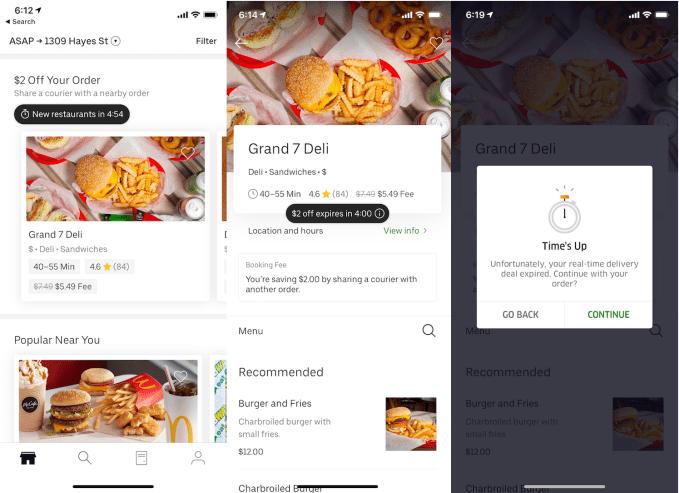
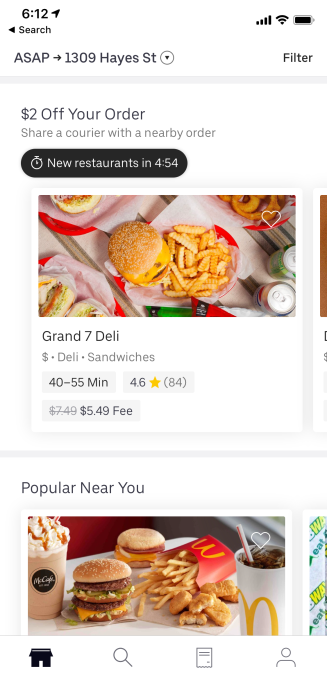
“$2 off your order — share a courier with a nearby order” the promotion announces atop the Uber Eats homescreen above a carousel of restaurants where you can grab the discount. It’s equipped with a countdown timer to when it will refresh the list of restaurants that follows users on an eatery’s order page. This triggers a sense of urgency to hurriedly buy through Uber Eats (and not check competitors), but also to ensure orders come in close enough together that the first one cooked won’t have to wait long for the last before they’re all scooped up for delivery.

Some customers actually play the Uber Eats Pool discounts like a game they can beat, waiting through several rounds of the timer until they spot one of their favorite restaurants, Chau says with a laugh. For now, passengers don’t ride alongside food orders, though that’s certainly a possibility in the future. And if Uber Eats can batch your order into a Pool with other customers, it will retroactively give you the discount.

“It’s similar to what we did with Uber Pool” Chau tells me. “Generally people are coming in with an intent to eat but there are many, many options available to them. We’re giving you a discount on the food delivery by using machine learning to understand these are some restaurants it might make sense to order from. When multiple people order from the same restaurant, delivery drivers can pick up multiple people’s food.”

Therein lies the leverage. As Stratechery’s Ben Thompson writes about aggregation theory, internet companies are gaining great influence by becoming marketplaces that connect customers with suppliers when previously customers preemptively chose a particular supplier. These platforms not only gain enormous amounts of data on customer preferences, but they also hold the power to point customers to certain suppliers that are willing to play ball.

Uber Builds A Toll Bridge

With all the data, the platforms know just who to show the ads to for a maximum conversion rate. And over time as the aggregator’s perks lure in more customers, it can pit suppliers against each other to further drop their prices or pay more for ads. Spotify used its own playlists to control what songs became popular, and the artists and record labels became beholden to cutting it sweeter deals to stay visible. Amazon looks like the best place to shop because it makes merchants fiercely fight to offer the lowest prices and best customer experience. With Uber Eats Pool, Uber is flexing its ability to influence where you eat, training you to trust where it points you when businesses eventually pay directly to be ranked higher in its app.

“Eats proves the power and potential of the Uber platform, showing how our logistics expertise can create the easiest way to eat” Chau tells me. “We partner with a wide selection of restaurants and bring our trademark speed and coverage to the food delivery experience. This feature shows how leveraging the Uber network allows us to offer people even more affordable dining options.” That quote is even more telling than at first glance. It’s the logistic network that accrues the power and creates leverage over the supplier to benefit customers with the lowest prices.

“We can see on Eats how much more business they’re bringing in and how much is incremental new business. Eventually we’ll be able to do very precise targeting. ‘People who haven’t tried my restaurant before, let’s give them a discount’” Chau tells us. Restaurants are asking him how to grow delivery as a percentage of their orders. “We can see the types of food people are ordering right now but also what they’re searching or are not able to order [because that cuisine isn’t available nearby]. We’re working with them to create new options to fill that gap. They’re able to get much more utilization of their fixed assets and iterate on these concepts much faster than they’re used to.”

Uber demonstrated the data science it could dangle over restaurants with its review of Uber Eats 2018 trends it published this morning. It predicts clean eating, plant-based foods, smoothie bowls, milk alternatives, fermented items like kimchi, and Instagrammably dark ‘goth food’ will rise in popularity next year. Meanwhile, now-tired social media bait ‘rainbow-colored foods’, brussel sprouts, and seaweed are on the decline.

It becomes easy to imagine restaurants running Uber Eats software for tracking order trends and predicting spikes to better manage food and staffing resources, with a baked-in option to buy ads or give deeper discounts to get seen by more hungry people. Chau concludes “Restaurants can think of Uber Eats as a platform that gives them this intelligence.”

from Startups – TechCrunch https://ift.tt/2SBHxJO

#USA How Uber will become an ad company, starting with Eats Pool

//

Where there is discovery in an app, there is paid discovery. Google helped you choose between links, then sold ads that promote a few. Facebook helped you choose between pieces of content, then sold ads that promote a few. And eventually, as Uber helps you choose between restaurants, it will sell ads that promote a few. It could become the marketing platform through which the physical world vies for your attention.

We got our first glimpse of this future last week when I reported that Uber Eats was offering restaurants in India bonus visibility in a Specials section if they’d offer discounts on meal bundles to Uber’s customers. Knock some rupees off the price of a sandwich, fries, and a drink, and a restaurants wins itself some enhanced discoverability. Whether a chef wants to boost orders during slow hours, get rid of surplus food, preference high margin items, or just score new customers, there’s plenty of reasons to pay Uber — even if currently only indirectly through discounts instead of a direct ad buy.

But now Uber’s senior director and head of Eats product Stephen Chau has confirmed to me the company’s intentions to become an ad company. “There’s a bunch of different ways we can work with restaurants over time. If we have all the restaurants on the marketplace and we give them tools to help them grow, then this will be a very efficient marketplace. They’re going to be spending those ad dollars somewhere” Chau tells me. “One of the things we’ve been experimenting with is allowing retailers to create promotions themselves and show them within the product.”

This conversation emerged from TechCrunch spotting Uber’s latest effort to influence where people choose to eat. To be worthy of ad dollars, Uber has to build leverage over restaurants by accruing sway over how people decide between restaurants. And with Uber confidentially filing to go public last week, it needs to prep new revenue streams. So it’s created what’s effectively “Uber Eats Pool”.

Gaining Leverage With Eats Pool

In response to our inquiry, Uber confirmed it’s now testing in some markets a system designed to batch multiple orders from different customers nearby each other to a single restaurant. That way, a single delivery driver can pick up all the orders at once and then speedily distribute them to neighbors or co-workers. Uber must incentivize customers who are close to each other to pick the same restaurant in rapid succession, so it offers a discount.

“$2 off your order — share a courier with a nearby order” the promotion announces atop the Uber Eats homescreen above a carousel of restaurants where you can grab the discount. It’s equipped with a countdown timer to when it will refresh the list of restaurants that follows users on an eatery’s order page. This triggers a sense of urgency to hurriedly buy through Uber Eats (and not check competitors), but also to ensure orders come in close enough together that the first one cooked won’t have to wait long for the last before they’re all scooped up for delivery.

Some customers actually play the Uber Eats Pool discounts like a game they can beat, waiting through several rounds of the timer until they spot one of their favorite restaurants, Chau says with a laugh. For now, passengers don’t ride alongside food orders, though that’s certainly a possibility in the future. And if Uber Eats can batch your order into a Pool with other customers, it will retroactively give you the discount.

“It’s similar to what we did with Uber Pool” Chau tells me. “Generally people are coming in with an intent to eat but there are many, many options available to them. We’re giving you a discount on the food delivery by using machine learning to understand these are some restaurants it might make sense to order from. When multiple people order from the same restaurant, delivery drivers can pick up multiple people’s food.”

Therein lies the leverage. As Stratechery’s Ben Thompson writes about aggregation theory, internet companies are gaining great influence by becoming marketplaces that connect customers with suppliers when previously customers preemptively chose a particular supplier. These platforms not only gain enormous amounts of data on customer preferences, but they also hold the power to point customers to certain suppliers that are willing to play ball.

Uber Builds A Toll Bridge

With all the data, the platforms know just who to show the ads to for a maximum conversion rate. And over time as the aggregator’s perks lure in more customers, it can pit suppliers against each other to further drop their prices or pay more for ads. Spotify used its own playlists to control what songs became popular, and the artists and record labels became beholden to cutting it sweeter deals to stay visible. Amazon looks like the best place to shop because it makes merchants fiercely fight to offer the lowest prices and best customer experience. With Uber Eats Pool, Uber is flexing its ability to influence where you eat, training you to trust where it points you when businesses eventually pay directly to be ranked higher in its app.

“Eats proves the power and potential of the Uber platform, showing how our logistics expertise can create the easiest way to eat” Chau tells me. “We partner with a wide selection of restaurants and bring our trademark speed and coverage to the food delivery experience. This feature shows how leveraging the Uber network allows us to offer people even more affordable dining options.” That quote is even more telling than at first glance. It’s the logistic network that accrues the power and creates leverage over the supplier to benefit customers with the lowest prices.

“We can see on Eats how much more business they’re bringing in and how much is incremental new business. Eventually we’ll be able to do very precise targeting. ‘People who haven’t tried my restaurant before, let’s give them a discount’” Chau tells us. Restaurants are asking him how to grow delivery as a percentage of their orders. “We can see the types of food people are ordering right now but also what they’re searching or are not able to order [because that cuisine isn’t available nearby]. We’re working with them to create new options to fill that gap. They’re able to get much more utilization of their fixed assets and iterate on these concepts much faster than they’re used to.”

Uber demonstrated the data science it could dangle over restaurants with its review of Uber Eats 2018 trends it published this morning. It predicts clean eating, plant-based foods, smoothie bowls, milk alternatives, fermented items like kimchi, and Instagrammably dark ‘goth food’ will rise in popularity next year. Meanwhile, now-tired social media bait ‘rainbow-colored foods’, brussel sprouts, and seaweed are on the decline.

It becomes easy to imagine restaurants running Uber Eats software for tracking order trends and predicting spikes to better manage food and staffing resources, with a baked-in option to buy ads or give deeper discounts to get seen by more hungry people. Chau concludes “Restaurants can think of Uber Eats as a platform that gives them this intelligence.”

from Startups – TechCrunch https://ift.tt/2SBHxJO

#USA How Uber will become an ad company, starting with Eats Pool

//

Where there is discovery in an app, there is paid discovery. Google helped you choose between links, then sold ads that promote a few. Facebook helped you choose between pieces of content, then sold ads that promote a few. And eventually, as Uber helps you choose between restaurants, it will sell ads that promote a few. It could become the marketing platform through which the physical world vies for your attention.

We got our first glimpse of this future last week when I reported that Uber Eats was offering restaurants in India bonus visibility in a Specials section if they’d offer discounts on meal bundles to Uber’s customers. Knock some rupees off the price of a sandwich, fries, and a drink, and a restaurants wins itself some enhanced discoverability. Whether a chef wants to boost orders during slow hours, get rid of surplus food, preference high margin items, or just score new customers, there’s plenty of reasons to pay Uber — even if currently only indirectly through discounts instead of a direct ad buy.

But now Uber’s senior director and head of Eats product Stephen Chau has confirmed to me the company’s intentions to become an ad company. “There’s a bunch of different ways we can work with restaurants over time. If we have all the restaurants on the marketplace and we give them tools to help them grow, then this will be a very efficient marketplace. They’re going to be spending those ad dollars somewhere” Chau tells me. “One of the things we’ve been experimenting with is allowing retailers to create promotions themselves and show them within the product.”

This conversation emerged from TechCrunch spotting Uber’s latest effort to influence where people choose to eat. To be worthy of ad dollars, Uber has to build leverage over restaurants by accruing sway over how people decide between restaurants. And with Uber confidentially filing to go public last week, it needs to prep new revenue streams. So it’s created what’s effectively “Uber Eats Pool”.

In response to our inquiry, Uber confirmed it’s now testing in some markets a system designed to batch multiple orders from different customers nearby each other to a single restaurant. That way, a single delivery driver can pick up all the orders at once and then speedily distribute them to neighbors or co-workers. Uber must incentivize customers who are close to each other to pick the same restaurant in rapid succession, so it offers a discount.

“$2 off your order — share a courier with a nearby order” the promotion announces atop the Uber Eats homescreen above a carousel of restaurants where you can grab the discount. It’s equipped with a countdown timer to when it will refresh the list of restaurants that follows users on an eatery’s order page. This triggers a sense of urgency to hurriedly buy through Uber Eats (and not check competitors), but also to ensure orders come in close enough together that the first one cooked won’t have to wait long for the last before they’re all scooped up for delivery.

Some customers actually play the Uber Eats Pool discounts like a game they can beat, waiting through several rounds of the timer until they spot one of their favorite restaurants, Chau says with a laugh. For now, passengers don’t ride alongside food orders, though that’s certainly a possibility in the future. And if Uber Eats can batch your order into a Pool with other customers, it will retroactively give you the discount.

“It’s similar to what we did with Uber Pool” Chau tells me. “Generally people are coming in with an intent to eat but there are many, many options available to them. We’re giving you a discount on the food delivery by using machine learning to understand these are some restaurants it might make sense to order from. When multiple people order from the same restaurant, delivery drivers can pick up multiple people’s food.”

Therein lies the leverage. As Stratechery’s Ben Thompson writes about aggregation theory, internet companies are gaining great influence by becoming marketplaces that connect customers with suppliers when previously customers preemptively chose a particular supplier. These platforms not only gain enormous amounts of data on customer preferences, but they also hold the power to point customers to certain suppliers that are willing to play ball.

With all the data, the platforms know just who to show the ads to for a maximum conversion rate. And over time as the aggregator’s perks lure in more customers, it can pit suppliers against each other to further drop their prices or pay more for ads. Spotify used its own playlists to control what songs became popular, and the artists and record labels became beholden to cutting it sweeter deals to stay visible. Amazon looks like the best place to shop because it makes merchants fiercely fight to offer the lowest prices and best customer experience. With Uber Eats Pool, Uber is flexing its ability to influence where you eat, training you to trust where it points you when businesses eventually pay directly to be ranked higher in its app.

“Eats proves the power and potential of the Uber platform, showing how our logistics expertise can create the easiest way to eat” Chau tells me. “We partner with a wide selection of restaurants and bring our trademark speed and coverage to the food delivery experience. This feature shows how leveraging the Uber network allows us to offer people even more affordable dining options.” That quote is even more telling than at first glance. It’s the logistic network that accrues the power and creates leverage over the supplier to benefit customers with the lowest prices.

“We can see on Eats how much more business they’re bringing in and how much is incremental new business. Eventually we’ll be able to do very precise targeting. ‘People who haven’t tried my restaurant before, let’s give them a discount’” Chau tells us. Restaurants are asking him how to grow delivery as a percentage of their orders. “We can see the types of food people are ordering right now but also what they’re searching or are not able to order [because that cuisine isn’t available nearby]. We’re working with them to create new options to fill that gap. They’re able to get much more utilization of their fixed assets and iterate on these concepts much faster than they’re used to.”

Uber demonstrated the data science it could dangle over restaurants with its review of Uber Eats 2018 trends it published this morning. It predicts clean eating, plant-based foods, smoothie bowls, milk alternatives, fermented items like kimchi, and Instagrammably dark ‘goth food’ will rise in popularity next year. Meanwhile, now-tired social media bait ‘rainbow-colored foods’, brussel sprouts, and seaweed are on the decline.

It becomes easy to imagine restaurants running Uber Eats software for tracking order trends and predicting spikes to better manage food and staffing resources, with a baked-in option to buy ads or give deeper discounts to get seen by more hungry people. Chau concludes “Restaurants can think of Uber Eats as a platform that gives them this intelligence.”

from Startups – TechCrunch https://ift.tt/2SBHxJO