
#USA Bios raises $4.5M to further develop its ‘neural interface’ and new ways to treat chronic medical conditions

//

Bios, a neural engineering startup originally based out of Cambridge, U.K. and now with an additional newly opened R&D office in Montreal, Canada, has raised $4.5 million in seed funding. The company is developing a “neural interface” that combines advances in hardware, big data, and machine learning/AI, which it’s hoped can be used to develop new cutting-edge treatments on organs and nerve systems throughout the body.

The round is led by Real Ventures, AME Cloud Ventures, and Ariel Poler (founder of the Human Augmentation syndicate on AngelList). Other funds and angel investors participating include Endure Capital, Heuristic Capital Partners, K5 Ventures, and Charles Songhurst (former GM corporate strategy at Microsoft).

The startup and Y Combinator alumnus is also disclosing additional non-dilutive funding in the form of grants and awards from Cisco, MassChallenge UK, and Innovate UK. Michael Baum’s Founder.org was also an early backer.

Formerly known as Cambridge Bio-Augmentation Systems (CBAS), Bios’ first product is described as akin to a “USB connector for the body” and has been used to develop a Prosthetic Interface Device (PID) that allows amputees to connect a range of prostheses directly to the nervous system. The PID is about to enter clinical trials and enables neural signals sent by a person’s nervous system to be interpreted and in turn control a connected artificial body part.
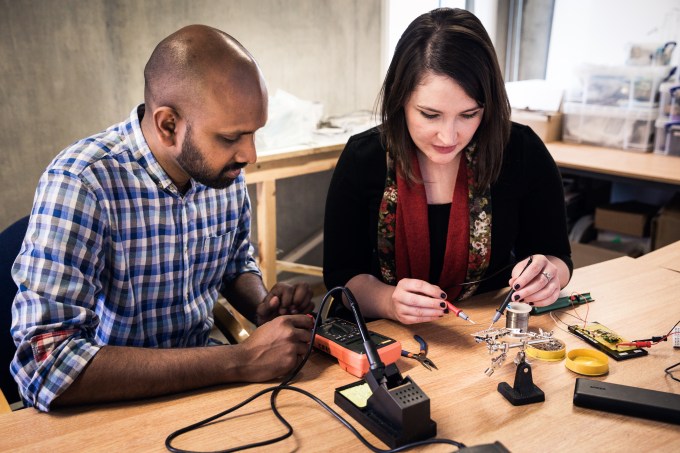
Bio is co-founded by computational neuroscientist Emil Hewage and bioengineer Oliver Armitage, and in a brief call the pair explained that the R&D involved to develop the PID saw the young company not only make significant breakthroughs in the hardware required, including developing safe and accurate hardware, but also enabled the company to amass a very large neural dataset and further develop its algorithms for future use cases.

More broadly, the challenge in this field is how to collect and process large amounts of neural data and then accurately interpret the neural signals, which Hewage and Armitage say are incredibly noisy, continuously changing and travel throughout the body at incredible speed. In other words, a job best suited to machines underpinned by machine learning/AI.

Further into the future, Bios wants to directly connect to the nervous system via its neural interface and then use AI to “read and write” onto the nervous system to deal with the root cause of various chronic conditions. The detection and potential to “correct” neural signals could mean, for example, the development of an alternative way of treating high blood pressure that doesn’t rely on conventional medicine or can treat drug-resistant hypertension.

The plan is for Bios to develop some products and treatments of its own, but also to partner with various companies and organisations. The premise is that the company can focus on the core interface and related AI, while the eventual applications can be as wide and vertical as advancements and interest allows. Related to this, Bios is advocating and helping to push industry standards and formats for neural data.

On that note, Bios says it will use the funding to double its technical team, and further develop its core neural interface technologies. In addition it plans to expand access for commercial and academic partners through a variety of tools, datasets, and algorithms for “discovering and leveraging biomarkers in neural data”.

from Startups – TechCrunch https://ift.tt/2RvZcT1

#USA Zopa, the UK P2P lending company, secures bank license

//

Zopa, the U.K. peer-to-peer lending company that wants to become a bank, has been awarded a bank license by the U.K.’s financial regulators, the Financial Conduct Authority (FCA) and Prudential Regulation Authority (PRA). The company wants to expand beyond P2P loans and investments to offer things liked savings accounts and credit cards.

Technically, however, this is only regulatory part one and Zopa’s bank licence comes “with restrictions,” meaning that it can’t launch fully just yet. Known as the ‘mobilisation’ phase of the license process, Zopa should eventually be granted a full licence once it meets various conditions set by the regulators.

In a statement, Zopa CEO Jaidev Janardana says acquiring a banking licence is the starting point that will see the company become a “major force” in retail banking. “When we pioneered the peer-to-peer lending model globally in 2005, we did so by listening to customers and creating a better product for them. We will bring the same focus to our banking products – drawing on tech innovation, our values of fairness and transparency, and better customer service,” he adds.

Once launched, Zopa’s bank will sit alongside its existing business, creating what the fintech says will be the first hybrid peer-to-peer and digital bank offering. It will roll out a money management app, and various financial products.

When the bank-to-be announced the second part of a £60 million funding round last month, a spokesperson told me this will include FSCS-protected savings accounts and P2P investments (including Innovative Finance ISAs) for investors, and personal loans, car finance and credit cards for people looking to borrow.

Zopa also says it will steer clear of hidden fees and charges, and is placing a lot of emphasis on customer service, delivered via its app or over the phone.

However, whether or not any of the above will be enough to stand out from an increasingly crowded challenger bank space in the U.K. which includes Monzo, Starling, Tandem and many others, remains to be seen. With that said, a fintech nerd can never have enough new banking upstarts.

from Startups – TechCrunch https://ift.tt/2EbWfEg

#USA Agricool raises another $28 million to grow fruits in containers

//

French startup Agricool is raising another $28 million round of funding (€25 million). The company is working on containers to grow fruits and vegetables in urban areas, starting with strawberries.

Bpifrance, Danone Manifesto Ventures, Marbeuf Capital, Solomon Hykes and other business angels participated in today’s funding round. Some existing investors also participated, such as daphni, XAnge, Henri Seydoux and Kima Ventures.

It might sound crazy but containers can be more efficient than traditional agricultural methods. For instance, a container lets you control the temperature, the humidity, the color spectrum and more. Agricool uses a ton of LEDs to replace the sun.

The result is quite telling. You can grow strawberries all year round, save water as a container is limited when it comes to space, save on transportation and more.

In other words, you end up with locally-produced, GMO-free, pesticide-free strawberries. You can already buy some of those strawberries in a couple of Monoprix in Paris.

Agricool plans to launch a hundred containers by 2021 in Paris and in Dubai. That’s why the company is going to hire around 200 people by 2021 to support this growth rate. Eventually, Agricool also plans to expand to other fruits and vegetables.

I’ve already covered Agricool multiple times in the past. The startup is still following the same roadmap, but with more funding. And it sounds like it requires a lot of capital to build this network of containers as there are not a lot of them out there. But it’s a promising product that could help cut down on gas emissions.

from Startups – TechCrunch https://ift.tt/2Svd1kV

#USA Agricool raises another $28 million to grow fruits in containers

//

French startup Agricool is raising another $28 million round of funding (€25 million). The company is working on containers to grow fruits and vegetables in urban areas, starting with strawberries.

Bpifrance, Danone Manifesto Ventures, Marbeuf Capital, Solomon Hykes and other business angels participated in today’s funding round. Some existing investors also participated, such as daphni, XAnge, Henri Seydoux and Kima Ventures.

It might sound crazy but containers can be more efficient than traditional agricultural methods. For instance, a container lets you control the temperature, the humidity, the color spectrum and more. Agricool uses a ton of LEDs to replace the sun.

The result is quite telling. You can grow strawberries all year round, save water as a container is limited when it comes to space, save on transportation and more.

In other words, you end up with locally-produced, GMO-free, pesticide-free strawberries. You can already buy some of those strawberries in a couple of Monoprix in Paris.

Agricool plans to launch a hundred containers by 2021 in Paris and in Dubai. That’s why the company is going to hire around 200 people by 2021 to support this growth rate. Eventually, Agricool also plans to expand to other fruits and vegetables.

I’ve already covered Agricool multiple times in the past. The startup is still following the same roadmap, but with more funding. And it sounds like it requires a lot of capital to build this network of containers as there are not a lot of them out there. But it’s a promising product that could help cut down on gas emissions.

from Startups – TechCrunch https://ift.tt/2Svd1kV

#USA Fintech investors and founders to judge Startup Battlefield Africa

//

TechCrunch will soon be returning to Africa to hold its Startup Battlefield competition dedicated to the African continent.

The event, in Lagos, Nigeria, on December 11, will showcase the launch of 15 of the hottest startups in Africa onstage for the first time. We’ll also be joined by some of the leading investment firms in the region. The event is now sold out, but keep your eyes on TechCrunch for video of all the panels and the Battlefield competition.

Here are just some of the investors and founders who will be judging the startups competing for US$25,000.


Olugbenga Agboola, Flutterwave

Olugbenga Agboola is the CEO of Flutterwave, a payments technology company headquartered in San Francisco with operations and offices across Africa and Europe. Prior to co-founding Flutterwave, Olugbenga contributed to the development of fintech solutions at several tech companies and financial institutions such as PayPal and Standard Bank, among others. He is a serial entrepreneur with two successful exits under his belt. He is a software engineer with a Master’s Degree in Information Technology Security and Behavioral Engineering, as well as an MBA.

Barbara Iyayi, Element

Barbara Iyayi is the chief growth officer and managing director of Africa for Element, which deploys AI-powered mobile biometrics software to develop digital platforms globally. Barbara was part of the founding team of Atlas Mara, a London stock exchange-listed company, co-founded by Bob Diamond, ex-CEO of Barclays Bank, which was the first-ever entity to raise more than $1 billion to invest in, operate and manage financial institutions in Sub-Saharan Africa. As the Regional Lead for M&A and Investments, she led investments into banks and developed the banking platform’s entry into seven countries in Africa. Notably, she led the acquisition and first-ever merger of two banks in Rwanda, to be the leading innovative retail bank — Banque Populaire du Rwanda — and led a $250 million equity investment in Union Bank of Nigeria.

Aaron Fu, MEST Africa

Aaron is an early-stage investor, entrepreneur and strategic advisor to both startups as they scale and corporates as they transform to gain agility for disruptive innovation. Over the last five years he has specifically focused on innovation in Africa, working with global brands and entrepreneurs across diverse industries, from financial services to health to mobile to agriculture.

As managing director at MEST, he is dedicated to training, investing in and incubating the next generation of global software entrepreneurs in Africa. He manages a portfolio of 30-plus startups spanning fintech, media, e-commerce and agritech. 

Sam Gichuru, Nailab

Sam Gichuru is founder and CEO of Nailab, one of Kenya’ s leading business incubators. His contribution in establishing the startup business ecosystem in Kenya, through Nailab, has been significant, and as a result was invited as a key speaker during the 2015 Global Entrepreneurship Summit, held in Nairobi and officiated by then U.S. President Barack Obama.

Sam has been instrumental in propagating the development of a strong and vibrant entrepreneurship ecosystem, and it’s through this engagement that he was most recently selected by Jack Ma to lead, through Nailab, the Africa Netpreneur Prize Initiative, a $10 million Initiative that seeks to discover, spotlight and support 10 African entrepreneurs every year for the next 10 years.

Olufunbi Falayi, Savannah Fund


Olufunbi Falayi  is a partner at Passion Incubator, an early-stage technology incubator and accelerator that invests in early-stage startups. He co-led investment in 12 startups, including Riby, BeatDrone, AdsDirect, TradeBuza and Waracake. Olufunbi also a principal at Savannah Fund, driving investment in West Africa.

from Startups – TechCrunch https://ift.tt/2QxL7XX

#USA Brazilian long-term rentals service QuintoAndar raises $64M Series C

//

There’s quite a bit wrong with real estate in Brazil, according to QuintoAndar founder and CEO Gabriel Braga. Those seeking long-term rentals in big Brazilian cities like São Paulo and Rio de Janeiro are throttled by bureaucratic policies that enforce outrageously expensive deposits, the requirement of local cosigners and sky-high insurance fees. On the supply side, amateur landlords are tunnel visioned on making money from transactions, creating a low quality of service and many wasted hours of apartment hunting for tenants.

This is where QuintoAndar, a São Paulo-based rental marketplace, comes in. Now, the 600-person company has raised a $64 million (R$ 250 million) round led by General Atlantic to accelerate expansion in Brazil. Existing investors Kaszek Ventures, Qualcomm Ventures and QED also participated in the round.

Marketplaces like OLX, Craigslist and VivaReal all surface listings for rentals in Brazil. But QuintoAndar wants to set itself apart as an end-to-end service that lets users search, book, rent and advertise rental properties. The site provides the listings, allows users to schedule tenant visits to the property (the founder says more than 86,000 property showings were booked in October) and processes the transactions. Landlords and tenants negotiate through the platform, where they also sign the contract. Braga says this process is much easier than working with — and paying for — an agent. QuintoAndar guarantees landlords that they’ll get rent every month as well as protection against any damages the renter may make to a property. Contracts are digitized and renters don’t need to physically go to a notary to finalize a contract, allowing landlords to be anywhere. If a property needs a repair or maintenance, users can tap into QuintoAndar’s network of service providers through the site. 

The company believes there’s a big opportunity to make renting in Brazil more efficient. “Twenty percent of the population in Brazil lives in rented properties, and the sentiment toward buying homes in Brazil is changing,” says Braga, citing data from the Brazilian Institute of Geography and Statistics. Brazilians are seeing home ownership as less of a long-term goal and are opting to rent, meaning more money in the bank and freedom to relocate. 

Brazil remains undercapitalized relative to other countries, meaning smaller check sizes for early-stage tech companies. So a private equity growth round like this represents a solid deal for tech-enabled businesses looking to gain market share of the world’s fifth most populous country. 

Before the private equity round, QuintoAndar had raised $25 million. General Atlantic is fairly active in Latin America, with 18 portfolio companies based in the region, according to its website. “GA is one of the largest investors in online marketplaces across the globe combined with deep pockets, a long-term mindset, and a strong commitment and success within Latin America,” says the founder of the GA partnership.

Braga certainly believes Brazil is a large enough market to build a digital service for people who want to rent properties, but doesn’t want to stop there. The new capital will enable QuintoAndar to consolidate its existing operations in Belo Horizonte, Brasília and Goiânia, and start new operations in Porto Alegre and Curitiba. The investment will also be used to create a partnership system with the country’s main real estate agencies, which will be able to use the platform to offer QuintoAndar’s renting experience to clients (both landlords and tenants). 

Investment into Latin American tech companies reached an all-time high in 2017 thanks to mega rounds from U.S. and Chinese investors — and the investment wave continued well into 2018. Brazilian credit card processor Stone recently went public. VCs continue pumping money into Latin America-based unicorns like Rappi and Nubank, and younger players are punching up against antiquated industries like banking and real estate.

QuintoAndar’s Series C brings the company’s total funding to $95 million (R$ 367,350,750). Braga declined to disclose the company’s valuation.

from Startups – TechCrunch https://ift.tt/2QrokNH

#USA Brazilian long-term rentals service QuintoAndar raises $64M Series C

//

There’s quite a bit wrong with real estate in Brazil, according to QuintoAndar founder and CEO Gabriel Braga. Those seeking long-term rentals in big Brazilian cities like São Paulo and Rio de Janeiro are throttled by bureaucratic policies that enforce outrageously expensive deposits, the requirement of local cosigners and sky-high insurance fees. On the supply side, amateur landlords are tunnel visioned on making money from transactions, creating a low quality of service and many wasted hours of apartment hunting for tenants.

This is where QuintoAndar, a São Paulo-based rental marketplace, comes in. Now, the 600-person company has raised a $64 million (R$ 250 million) round led by General Atlantic to accelerate expansion in Brazil. Existing investors Kaszek Ventures, Qualcomm Ventures and QED also participated in the round.

Marketplaces like OLX, Craigslist and VivaReal all surface listings for rentals in Brazil. But QuintoAndar wants to set itself apart as an end-to-end service that lets users search, book, rent and advertise rental properties. The site provides the listings, allows users to schedule tenant visits to the property (the founder says more than 86,000 property showings were booked in October) and processes the transactions. Landlords and tenants negotiate through the platform, where they also sign the contract. Braga says this process is much easier than working with — and paying for — an agent. QuintoAndar guarantees landlords that they’ll get rent every month as well as protection against any damages the renter may make to a property. Contracts are digitized and renters don’t need to physically go to a notary to finalize a contract, allowing landlords to be anywhere. If a property needs a repair or maintenance, users can tap into QuintoAndar’s network of service providers through the site. 

The company believes there’s a big opportunity to make renting in Brazil more efficient. “Twenty percent of the population in Brazil lives in rented properties, and the sentiment toward buying homes in Brazil is changing,” says Braga, citing data from the Brazilian Institute of Geography and Statistics. Brazilians are seeing home ownership as less of a long-term goal and are opting to rent, meaning more money in the bank and freedom to relocate. 

Brazil remains undercapitalized relative to other countries, meaning smaller check sizes for early-stage tech companies. So a private equity growth round like this represents a solid deal for tech-enabled businesses looking to gain market share of the world’s fifth most populous country. 

Before the private equity round, QuintoAndar had raised $25 million. General Atlantic is fairly active in Latin America, with 18 portfolio companies based in the region, according to its website. “GA is one of the largest investors in online marketplaces across the globe combined with deep pockets, a long-term mindset, and a strong commitment and success within Latin America,” says the founder of the GA partnership.

Braga certainly believes Brazil is a large enough market to build a digital service for people who want to rent properties, but doesn’t want to stop there. The new capital will enable QuintoAndar to consolidate its existing operations in Belo Horizonte, Brasília and Goiânia, and start new operations in Porto Alegre and Curitiba. The investment will also be used to create a partnership system with the country’s main real estate agencies, which will be able to use the platform to offer QuintoAndar’s renting experience to clients (both landlords and tenants). 

Investment into Latin American tech companies reached an all-time high in 2017 thanks to mega rounds from U.S. and Chinese investors — and the investment wave continued well into 2018. Brazilian credit card processor Stone recently went public. VCs continue pumping money into Latin America-based unicorns like Rappi and Nubank, and younger players are punching up against antiquated industries like banking and real estate.

QuintoAndar’s Series C brings the company’s total funding to $95 million (R$ 367,350,750). Braga declined to disclose the company’s valuation.

from Startups – TechCrunch https://ift.tt/2QrokNH

#USA Brazilian long-term rentals service QuintoAndar raises $64M Series C

//

There’s quite a bit wrong with real estate in Brazil, according to QuintoAndar founder and CEO Gabriel Braga. Those seeking long-term rentals in big Brazilian cities like São Paulo and Rio de Janeiro are throttled by bureaucratic policies that enforce outrageously expensive deposits, the requirement of local cosigners and sky-high insurance fees. On the supply side, amateur landlords are tunnel visioned on making money from transactions, creating a low quality of service and many wasted hours of apartment hunting for tenants.

This is where QuintoAndar, a São Paulo-based rental marketplace, comes in. Now, the 600-person company has raised a $64 million (R$ 250 million) round led by General Atlantic to accelerate expansion in Brazil. Existing investors Kaszek Ventures, Qualcomm Ventures and QED also participated in the round.

Marketplaces like OLX, Craigslist and VivaReal all surface listings for rentals in Brazil. But QuintoAndar wants to set itself apart as an end-to-end service that lets users search, book, rent and advertise rental properties. The site provides the listings, allows users to schedule tenant visits to the property (the founder says more than 86,000 property showings were booked in October) and processes the transactions. Landlords and tenants negotiate through the platform, where they also sign the contract. Braga says this process is much easier than working with — and paying for — an agent. QuintoAndar guarantees landlords that they’ll get rent every month as well as protection against any damages the renter may make to a property. Contracts are digitized and renters don’t need to physically go to a notary to finalize a contract, allowing landlords to be anywhere. If a property needs a repair or maintenance, users can tap into QuintoAndar’s network of service providers through the site. 

The company believes there’s a big opportunity to make renting in Brazil more efficient. “Twenty percent of the population in Brazil lives in rented properties, and the sentiment toward buying homes in Brazil is changing,” says Braga, citing data from the Brazilian Institute of Geography and Statistics. Brazilians are seeing home ownership as less of a long-term goal and are opting to rent, meaning more money in the bank and freedom to relocate. 

Brazil remains undercapitalized relative to other countries, meaning smaller check sizes for early-stage tech companies. So a private equity growth round like this represents a solid deal for tech-enabled businesses looking to gain market share of the world’s fifth most populous country. 

Before the private equity round, QuintoAndar had raised $25 million. General Atlantic is fairly active in Latin America, with 18 portfolio companies based in the region, according to its website. “GA is one of the largest investors in online marketplaces across the globe combined with deep pockets, a long-term mindset, and a strong commitment and success within Latin America,” says the founder of the GA partnership.

Braga certainly believes Brazil is a large enough market to build a digital service for people who want to rent properties, but doesn’t want to stop there. The new capital will enable QuintoAndar to consolidate its existing operations in Belo Horizonte, Brasília and Goiânia, and start new operations in Porto Alegre and Curitiba. The investment will also be used to create a partnership system with the country’s main real estate agencies, which will be able to use the platform to offer QuintoAndar’s renting experience to clients (both landlords and tenants). 

Investment into Latin American tech companies reached an all-time high in 2017 thanks to mega rounds from U.S. and Chinese investors — and the investment wave continued well into 2018. Brazilian credit card processor Stone recently went public. VCs continue pumping money into Latin America-based unicorns like Rappi and Nubank, and younger players are punching up against antiquated industries like banking and real estate.

QuintoAndar’s Series C brings the company’s total funding to $95 million (R$ 367,350,750). Braga declined to disclose the company’s valuation.

from Startups – TechCrunch https://ift.tt/2QrokNH

#USA Brazilian long-term rentals service QuintoAndar raises $64M Series C

//

There’s quite a bit wrong with real estate in Brazil, according to QuintoAndar founder and CEO Gabriel Braga. Those seeking long-term rentals in big Brazilian cities like São Paulo and Rio de Janeiro are throttled by bureaucratic policies that enforce outrageously expensive deposits, the requirement of local cosigners and sky-high insurance fees. On the supply side, amateur landlords are tunnel visioned on making money from transactions, creating a low quality of service and many wasted hours of apartment hunting for tenants.

This is where QuintoAndar, a São Paulo-based rental marketplace, comes in. Now, the 600-person company has raised a $64 million (R$ 250 million) round led by General Atlantic to accelerate expansion in Brazil. Existing investors Kaszek Ventures, Qualcomm Ventures and QED also participated in the round.

Marketplaces like OLX, Craigslist and VivaReal all surface listings for rentals in Brazil. But QuintoAndar wants to set itself apart as an end-to-end service that lets users search, book, rent and advertise rental properties. The site provides the listings, allows users to schedule tenant visits to the property (the founder says more than 86,000 property showings were booked in October) and processes the transactions. Landlords and tenants negotiate through the platform, where they also sign the contract. Braga says this process is much easier than working with — and paying for — an agent. QuintoAndar guarantees landlords that they’ll get rent every month as well as protection against any damages the renter may make to a property. Contracts are digitized and renters don’t need to physically go to a notary to finalize a contract, allowing landlords to be anywhere. If a property needs a repair or maintenance, users can tap into QuintoAndar’s network of service providers through the site. 

The company believes there’s a big opportunity to make renting in Brazil more efficient. “Twenty percent of the population in Brazil lives in rented properties, and the sentiment toward buying homes in Brazil is changing,” says Braga, citing data from the Brazilian Institute of Geography and Statistics. Brazilians are seeing home ownership as less of a long-term goal and are opting to rent, meaning more money in the bank and freedom to relocate. 

Brazil remains undercapitalized relative to other countries, meaning smaller check sizes for early-stage tech companies. So a private equity growth round like this represents a solid deal for tech-enabled businesses looking to gain market share of the world’s fifth most populous country. 

Before the private equity round, QuintoAndar had raised $25 million. General Atlantic is fairly active in Latin America, with 18 portfolio companies based in the region, according to its website. “GA is one of the largest investors in online marketplaces across the globe combined with deep pockets, a long-term mindset, and a strong commitment and success within Latin America,” says the founder of the GA partnership.

Braga certainly believes Brazil is a large enough market to build a digital service for people who want to rent properties, but doesn’t want to stop there. The new capital will enable QuintoAndar to consolidate its existing operations in Belo Horizonte, Brasília and Goiânia, and start new operations in Porto Alegre and Curitiba. The investment will also be used to create a partnership system with the country’s main real estate agencies, which will be able to use the platform to offer QuintoAndar’s renting experience to clients (both landlords and tenants). 

Investment into Latin American tech companies reached an all-time high in 2017 thanks to mega rounds from U.S. and Chinese investors — and the investment wave continued well into 2018. Brazilian credit card processor Stone recently went public. VCs continue pumping money into Latin America-based unicorns like Rappi and Nubank, and younger players are punching up against antiquated industries like banking and real estate.

QuintoAndar’s Series C brings the company’s total funding to $95 million (R$ 367,350,750). Braga declined to disclose the company’s valuation.

from Startups – TechCrunch https://ift.tt/2QrokNH

#USA Corporate food catering startup Chewse raises $19 million

//

Chewse, a food catering and company culture startup, just announced a $19 million fundraising round as it gears up to expand its operations in the Silicon Valley area. This brings Chewse’s total funding to more than $30 million. Chewse’s investors include Foundry Group, 500 Startups and Gingerbread Capital.

Instead of plopping down meals in the office and bouncing, Chewse aims to create a full experience for its customers by offering family-style meals. In order to ensure quality, Chewse employs drivers and meal hosts so that it can provide them with training. Chewse also offers it drivers and meal hosts benefits.

“We initially started with a contractor model but then very quickly started to realize our customers often mentioned the host or the driver in their feedback,” Chewse CEO and Co-founder Tracy Lawrence told TechCrunch.

“I know there’s a lot of other companies that are like food tech or logistics but for us, it’s all about elevating and improving company culture,” Lawrence said. “We have technology but we’re investing in it to create an exceptional real-life experience.”

“On the tech side, we’re using a ton of machine learning and algorithms to learn what people like to eat and create custom meal schedules,” Lawrence said.

To date, Chewse has hundreds of customers across three markets. Chewse initially launched in Los Angeles, but paused operations for a little over one year in order to focus on achieving market profitability in San Francisco. Chewse has since relaunched in Los Angeles, in addition to launching in cities like Palo Alto and San Jose. As part of the Silicon Valley launch, Chewse has partnered with restaurants like Smoking Pig, HOM Korean Kitchen and Oren’s Hummus Shop.

Within the next year, the goal is to double the number of markets where Chewse operates. But Chewse faces tough competition in the corporate meal catering space.

Earlier this year, Square acquired Zesty to become part of its food delivery service, Caviar. The aim of the acquisition was to strengthen Caviar’s corporate food ordering business, Caviar for Teams.

At the time, Zesty counted about 150 restaurant customers in San Francisco, which is the only city in which it operates. Some of Zesty’s customers include Snap, Splunk and TechCrunch. Zesty, which first launched in 2013 under a different name, had previously raised $20.7 million in venture funding.

“Zesty is a direct competitor of ours for sure,” Lawrence said. “When we’re thinking about the things that set us apart from Zesty and Zerocater, the investment in using the technology and building a meal algorithm — which is something we know they’re doing by hand — and then automatically calibrate when we’re getting feedback because we employ our hosts and our drivers. Yes, it’s more expensive for us but because it provides such a superior experience, we retain our customer longer.”

from Startups – TechCrunch https://ift.tt/2QaYoGv