#USA Lyft’s pink-wheeled shareable bikes will be available to rent soon

//

Lyft has finally given us a glimpse of its forthcoming line of shareable bikes, which the ridesharing company says will be available to rent within its mobile app in select cities “soon.”

The news comes as the $15 billion company announces the final close of its acquisition of Motivate, the New York City-based mobility startup that owns a number of bike-rental services, like Citi Bike, Ford GoBike, Divvy, Blue Bikes and Capital Bikeshare. The transaction was reportedly worth some $250 million.

Lyft brought in $600 million in fresh funding in June from backers Fidelity Research & Management, AllianceBernstein, Baillie Gifford, KKR, CapitalG, Rakuten and others.

Now that its bike deal is complete, Lyft becomes the largest bike service provider in the U.S. That’s a big leap forward for a company that hopes to have the largest dockless bike fleet in the world — outside of China, of course, where companies like Mobike have deployed millions of bikes.

As part of the deal, Lyft will invest $100 million in New York’s Citi Bike, tripling the number of bikes available to 40,000 by 2023. 

Lyft launched its first fleet of scooters earlier this year in Denver, hot off the heels of scooter-mania, which saw companies like Bird and Lime garner billion-dollar valuations and complete launches all over the world.

The company says the scooters have been a success thus far. In Denver, for example, 15 percent of Lyft rides in 2018 were taken on scooters. The company has also made scooters available to rent within its app in Santa Monica and Washington, DC — a list that will undoubtedly swell in 2019.

Here’s hoping Lyft’s bike wheels are actually pink. If not, I will be gravely disappointed.

from Startups – TechCrunch https://ift.tt/2Av7hjE

#USA Legacy freezes your sperm so you don’t have to

//

Legacy is tackling an interesting problem: the reduction of sperm motility as we age. By freezing our sperm, this Swiss-based company promises to keep our boys safe and potent as we get older, a consideration that many find vital as we marry and have kids later. Legacy, which exhibited in Startup Alley at Disrupt Berlin 2018, was chosen as the wildcard company to present its services onstage during Startup Battlefield.

How does it work? Well, the company delivers a system for grabbing sperm. The material is kept in a specially made container and shipped to a nearby clinic where they then test the sperm and place it in cryogenic storage. You can then make a withdrawal when you’re ready for babies.

“Our unique at-home solution allows men to have their sperm analyzed and frozen at a clinic without leaving their home or having to meet with a physician,” said founder Khaled Kteily. “All clients receive a full fertility analysis, including personalized recommendations using our machine learning-driven technology.”

Kteily ensures us that our special sauce will stay safe over the years.

“Our core values of privacy, quality, and security ensure discretion, anonymity, and the highest level of quality for all our clients, including multi-site storage, whereby our clients’ deposits are stored in multiple tanks in multiple locations at high security.”

The company offers three packages: Bronze, Gold and Platinum. The $1,000 Bronze package requires you to take your sperm to a clinic where it will be tested and cryogenically stored. The Platinum plan costs $10,000 and ensures the company will keep up to six samples of your swimmers indefinitely, affording your genetic material practical immortality.

Kteily founded the company after a friend looked for solutions to sperm storage while facing cancer treatment. Realizing there was nothing that looked trustworthy or usable, he used his background in health and entrepreneurship to build Legacy.

The company has raised $250,000 and they are profitable. Kteily sees his company as the “Swiss Bank” of sperm storage.

“Male fertility has declined by 50 percent. Every 8 months, men produce a new genetic mutation that gets passed on to their children. Birth rates around the world are plummeting and men are responsible for infertility in 30-50 percent of couples. Meanwhile, you can freeze sperm indefinitely with no loss in quality — through Legacy, without having to leave your home and at a tenth of the cost of egg freezing,” he said. “We treat our clients as a private bank would — our core values of quality, privacy and security ensure our clients are taken care of at every level.”


from Startups – TechCrunch https://ift.tt/2PafM8Y

#USA Koo! is a social network for short-form podcasts

//

Alexandre Meregan says that music, and audio in general, has always been core to his life. But one day on his five-minute commute to work, trying to listen to a podcast for the first time, he realized that by the time he arrived at work he had only heard an introduction and a commercial jingle.

He immediately went to work on Koo!, a short-form podcast app aimed at young people. Koo! lets users record up to one minute of audio, add “sound stickers” like a drum roll or a poop sound, and share the “Koo” in a feed with their friends and followers.

Meregan believes that some young people are hesitant to share their thoughts on social media, which is mostly picture or video-based, because of the quantification of their self-worth through Like counters. With Koo! users can simply speak their thoughts without having to share a picture or video.

“At Koo! we believe a lot of great content is being held back by teenagers due to insecurities that comes with photo and video,” said Meregan onstage at TechCrunch Disrupt Berlin on the Startup Battlefield. “We feel that what you say should be more important than how you look.”

Like most social networks, Koo! is primarily focused on acquiring new users before focusing on a revenue model. Ad-supported revenue is the most obvious option to make money, but Meregan says that the team has been floating around a few other ideas, as well.

One user-acquisition tactic, according to Meregan, is to target YouTube content creators and give them a complimentary service to share their thoughts and voice.

A handful of startups have tried their hand at audio-based social networks, but few have managed to gain much traction.

Koo! is backed by Sweet Studio, though Meregan declined to share the amount of funding the company has received to date.

from Startups – TechCrunch https://ift.tt/2SiiwDu

#USA Rlay offers a blockchain-powered platform to help companies build better crowdsourced data sets

//

The team behind Rlay believes that blockchain technology can play a crucial role in helping businesses crowdsource their data-gathering tasks.

Founder Michael Hirn said this is a problem he encountered while working with Sunstone Capital to develop a more quantitative approach to venture capital, which meant pulling startup data from a wide variety of online sources. It ended up being an incredibly time-consuming process, and he said, “90 percent of the time was spent cleaning the data and acquiring the data.”

CTO Max Goisser argued that this is a broad problem. There are already successful examples of crowdsourced data, most notably Wikipedia, but in his view, they succeeded because “these things were of value for the entire world — everyone’s interested in that.”

“But what if you wanted to crowdsource something that is [only] interesting to you as a company?” Goisser said. Then you’d need the right incentive system to convince people to contribute. And that’s where Rlay (pronounced “relay”) comes in — the startup is launching onstage today as part of our Startup Battlefield at Disrupt Berlin.

There are other startups, like Dirt Protocol, offering blockchain-powered tools for data collection and verification. But it sounds like one of Rlay’s big selling points is its ability to integrate with existing enterprise database technology.

In other words, Rlay leverages the blockchain side of things to provide a mechanism for people to contribute data and be rewarded for their contributions (each customer decides how they want to structure the incentives), but the goal is to collect the data in a format that’s useful for the company, and where, if the company desires, it can be kept private.

“We abstract over the backend database that you as a company would use, we abstract over the blockchain or ledger technology — it’s currently Ethereum, but technically, it doesn’t matter,” Hirn said. “So you don’t have to figure out how to work between Postgres and Ethereum, you don’t have to figure out ‘How do we represent the data?’, all of that is taken care of by Rlay.”

Rlay screenshot

As for the incentives, he said:

There are almost as many ways [of] incentivizing as there are different types of financial products. Obviously some ways are more robust than others and we outlined a very general and universal incentive mechanism in our whitepaper, but for most of the applications that is a little bit to complex. So with Rlay, we will provide some templates in the future and certainly advice for certain ways when we work with a client, but Rlay just gives a good interface to define these things very easily.

Ultimately, this should allow companies to acquire the data they need at a lower cost than going out and buying data sets or hiring their own data collection team. For example, Hirn said Rlay is working with “a big name in the blockchain space” to gather environmental, social and governance (ESG) data required by hedge funds and other investors.

For now, Hirn said Rlay is focused on working with developers to collect data that’s online but not aggregated or structured in a way that makes it easily accessible. In the ESG case, that means writing scripts to pull the data from the reports that many companies are already publishing. Ultimately, Rlay could move into collecting data from the physical world, as well.

Goisser said the company is also developing various ways to recognize and resolve conflicting data, so its customers can be sure that the information they’re collecting is accurate.

from Startups – TechCrunch https://ift.tt/2KIzSqd

#USA Agtech startup Imago AI is using computer vision to boost crop yields

//

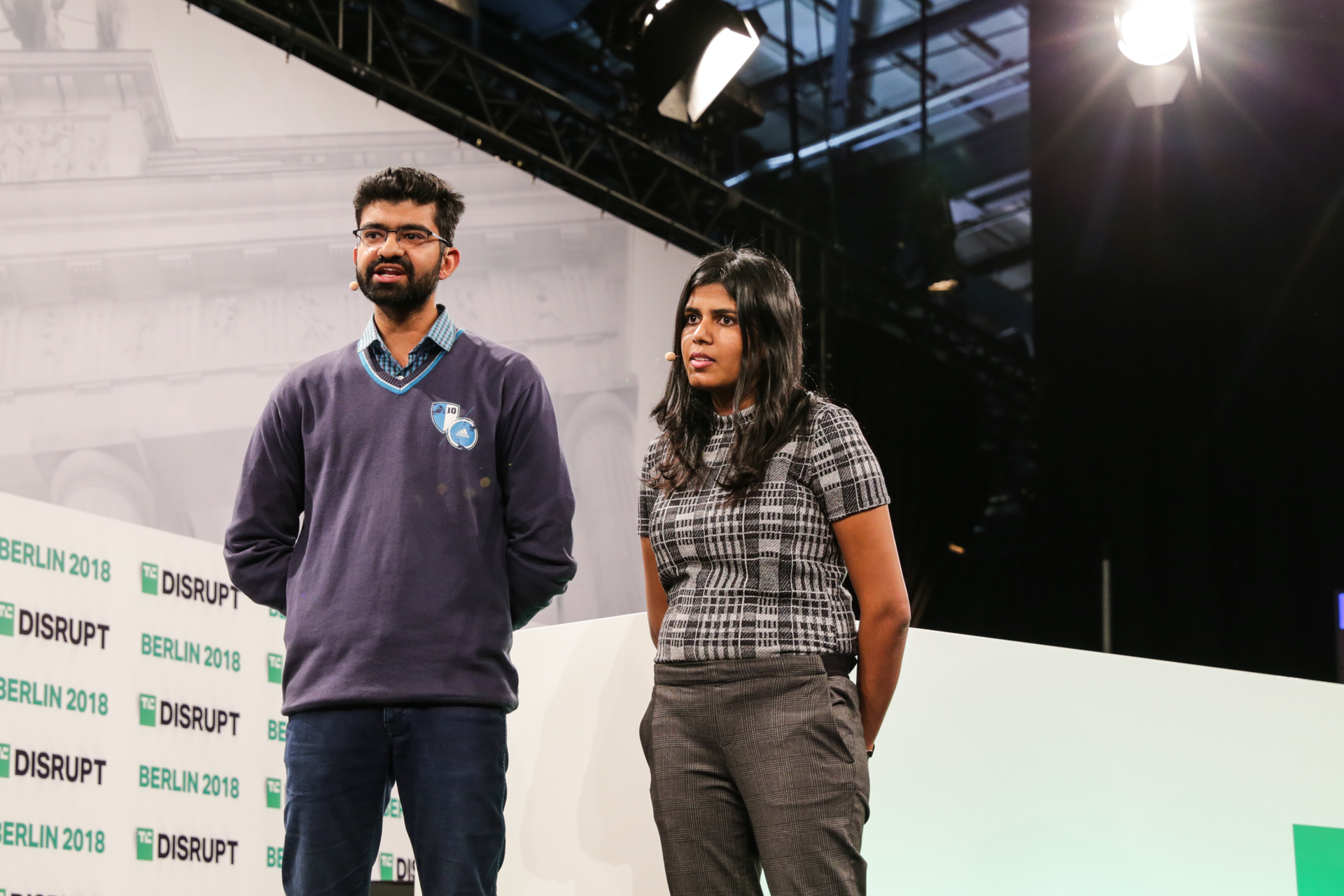
Presenting onstage today in the 2018 TC Disrupt Berlin Battlefield is Indian agtech startup Imago AI, which is applying AI to help feed the world’s growing population by increasing crop yields and reducing food waste. As startup missions go, it’s an impressively ambitious one.

The team, which is based out of Gurgaon near New Delhi, is using computer vision and machine learning technology to fully automate the laborious task of measuring crop output and quality — speeding up what can be a very manual and time-consuming process to quantify plant traits, often involving tools like calipers and weighing scales, toward the goal of developing higher-yielding, more disease-resistant crop varieties.

Currently they say it can take seed companies between six and eight years to develop a new seed variety. So anything that increases efficiency stands to be a major boon.

And they claim their technology can reduce the time it takes to measure crop traits by up to 75 percent.

In the case of one pilot, they say a client had previously been taking two days to manually measure the grades of their crops using traditional methods like scales. “Now using this image-based AI system they’re able to do it in just 30 to 40 minutes,” says co-founder Abhishek Goyal.
Using AI-based image processing technology, they can also crucially capture more data points than the human eye can (or easily can), because their algorithms can measure and asses finer-grained phenotypic differences than a person might pick up on or be easily able to quantify just judging by eye alone.

“Some of the phenotypic traits they are not possible to identify manually,” says co-founder Shweta Gupta. “Maybe very tedious or for whatever all these laborious reasons. So now with this AI-enabled [process] we are now able to capture more phenotypic traits.

“So more coverage of phenotypic traits… and with this more coverage we are having more scope to select the next cycle of this seed. So this further improves the seed quality in the longer run.”

The wordy phrase they use to describe what their technology delivers is: “High throughput precision phenotyping.”

Or, put another way, they’re using AI to data-mine the quality parameters of crops.

“These quality parameters are very critical to these seed companies,” says Gupta. “Plant breeding is a very costly and very complex process… in terms of human resource and time these seed companies need to deploy.

“The research [on the kind of rice you are eating now] has been done in the previous seven to eight years. It’s a complete cycle… chain of continuous development to finally come up with a variety which is appropriate to launch in the market.”

But there’s more. The overarching vision is not only that AI will help seed companies make key decisions to select for higher-quality seed that can deliver higher-yielding crops, while also speeding up that (slow) process. Ultimately their hope is that the data generated by applying AI to automate phenotypic measurements of crops will also be able to yield highly valuable predictive insights.

Here, if they can establish a correlation between geotagged phenotypic measurements and the plants’ genotypic data (data which the seed giants they’re targeting would already hold), the AI-enabled data-capture method could also steer farmers toward the best crop variety to use in a particular location and climate condition — purely based on insights triangulated and unlocked from the data they’re capturing.

One current approach in agriculture to selecting the best crop for a particular location/environment can involve using genetic engineering. Though the technology has attracted major controversy when applied to foodstuffs.

Imago AI hopes to arrive at a similar outcome via an entirely different technology route, based on data and seed selection. And, well, AI’s uniform eye informing key agriculture decisions.

“Once we are able to establish this sort of relation this is very helpful for these companies and this can further reduce their total seed production time from six to eight years to very less number of years,” says Goyal. “So this sort of correlation we are trying to establish. But for that initially we need to complete very accurate phenotypic data.”

“Once we have enough data we will establish the correlation between phenotypic data and genotypic data and what will happen after establishing this correlation we’ll be able to predict for these companies that, with your genomics data, and with the environmental conditions, and we’ll predict phenotypic data for you,” adds Gupta.

“That will be highly, highly valuable to them because this will help them in reducing their time resources in terms of this breeding and phenotyping process.”

“Maybe then they won’t really have to actually do a field trial,” suggests Goyal. “For some of the traits they don’t really need to do a field trial and then check what is going to be that particular trait if we are able to predict with a very high accuracy if this is the genomics and this is the environment, then this is going to be the phenotype.”

So — in plainer language — the technology could suggest the best seed variety for a particular place and climate, based on a finer-grained understanding of the underlying traits.

In the case of disease-resistant plant strains it could potentially even help reduce the amount of pesticides farmers use, say, if the the selected crops are naturally more resilient to disease.

While, on the seed generation front, Gupta suggests their approach could shrink the production time frame — from up to eight years to “maybe three or four.”

“That’s the amount of time-saving we are talking about,” she adds, emphasizing the really big promise of AI-enabled phenotyping is a higher amount of food production in significantly less time.

As well as measuring crop traits, they’re also using computer vision and machine learning algorithms to identify crop diseases and measure with greater precision how extensively a particular plant has been affected.

This is another key data point if your goal is to help select for phenotypic traits associated with better natural resistance to disease, with the founders noting that around 40 percent of the world’s crop load is lost (and so wasted) as a result of disease.

And, again, measuring how diseased a plant is can be a judgement call for the human eye — resulting in data of varying accuracy. So by automating disease capture using AI-based image analysis the recorded data becomes more uniformly consistent, thereby allowing for better quality benchmarking to feed into seed selection decisions, boosting the entire hybrid production cycle.
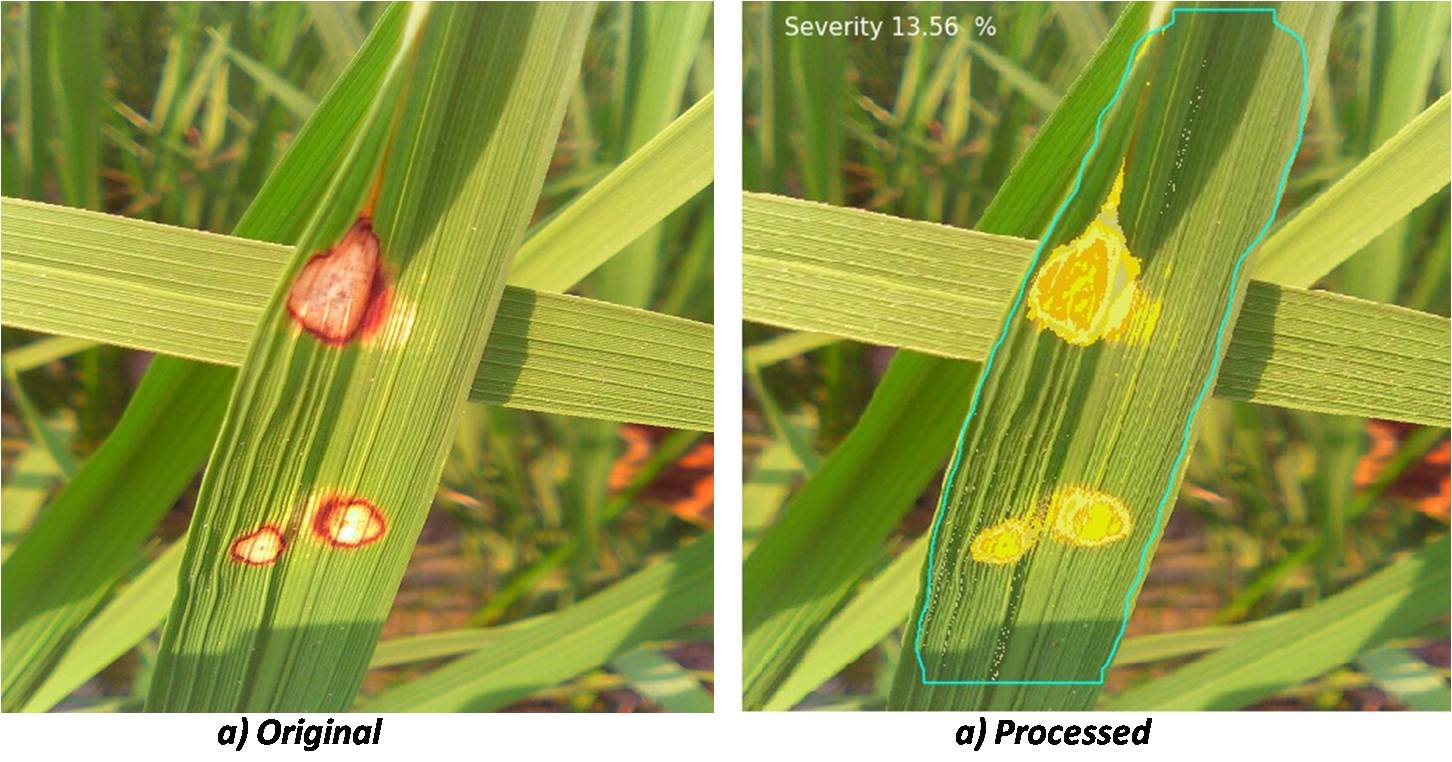
Sample image processed by Imago AI showing the proportion of a crop affected by disease

In terms of where they are now, the bootstrapping, nearly year-old startup is working off data from a number of trials with seed companies — including a recurring paying client they can name (DuPont Pioneer); and several paid trials with other seed firms they can’t (because they remain under NDA).

Trials have taken place in India and the U.S. so far, they tell TechCrunch.

“We don’t really need to pilot our tech everywhere. And these are global [seed] companies, present in 30, 40 countries,” adds Goyal, arguing their approach naturally scales. “They test our technology at a single country and then it’s very easy to implement it at other locations.”

Their imaging software does not depend on any proprietary camera hardware. Data can be captured with tablets or smartphones, or even from a camera on a drone or using satellite imagery, depending on the sought for application.

Although for measuring crop traits like length they do need some reference point to be associated with the image.

“That can be achieved by either fixing the distance of object from the camera or by placing a reference object in the image. We use both the methods, as per convenience of the user,” they note on that.

While some current phenotyping methods are very manual, there are also other image-processing applications in the market targeting the agriculture sector.

But Imago AI’s founders argue these rival software products are only partially automated — “so a lot of manual input is required,” whereas they couch their approach as fully automated, with just one initial manual step of selecting the crop to be quantified by their AI’s eye.

Another advantage they flag up versus other players is that their approach is entirely non-destructive. This means crop samples do not need to be plucked and taken away to be photographed in a lab, for example. Rather, pictures of crops can be snapped in situ in the field, with measurements and assessments still — they claim — accurately extracted by algorithms which intelligently filter out background noise.

“In the pilots that we have done with companies, they compared our results with the manual measuring results and we have achieved more than 99 percent accuracy,” is Goyal’s claim.

While, for quantifying disease spread, he points out it’s just not manually possible to make exact measurements. “In manual measurement, an expert is only able to provide a certain percentage range of disease severity for an image example; (25-40 percent) but using our software they can accurately pin point the exact percentage (e.g. 32.23 percent),” he adds.

They are also providing additional support for seed researchers — by offering a range of mathematical tools with their software to support analysis of the phenotypic data, with results that can be easily exported as an Excel file.

“Initially we also didn’t have this much knowledge about phenotyping, so we interviewed around 50 researchers from technical universities, from these seed input companies and interacted with farmers — then we understood what exactly is the pain-point and from there these use cases came up,” they add, noting that they used WhatsApp groups to gather intel from local farmers.

While seed companies are the initial target customers, they see applications for their visual approach for optimizing quality assessment in the food industry too — saying they are looking into using computer vision and hyper-spectral imaging data to do things like identify foreign material or adulteration in production line foodstuffs.

“Because in food companies a lot of food is wasted on their production lines,” explains Gupta. “So that is where we see our technology really helps — reducing that sort of wastage.”

“Basically any visual parameter which needs to be measured that can be done through our technology,” adds Goyal.

They plan to explore potential applications in the food industry over the next 12 months, while focusing on building out their trials and implementations with seed giants. Their target is to have between 40 to 50 companies using their AI system globally within a year’s time, they add.

While the business is revenue-generating now — and “fully self-enabled” as they put it — they are also looking to take in some strategic investment.

“Right now we are in touch with a few investors,” confirms Goyal. “We are looking for strategic investors who have access to agriculture industry or maybe food industry… but at present haven’t raised any amount.”

from Startups – TechCrunch https://ift.tt/2ramQZP

#USA Agtech startup Imago AI is using computer vision to boost crop yields

//

Presenting onstage today in the 2018 TC Disrupt Berlin Battlefield is Indian agtech startup Imago AI, which is applying AI to help feed the world’s growing population by increasing crop yields and reducing food waste. As startup missions go, it’s an impressively ambitious one.

The team, which is based out of Gurgaon near New Delhi, is using computer vision and machine learning technology to fully automate the laborious task of measuring crop output and quality — speeding up what can be a very manual and time-consuming process to quantify plant traits, often involving tools like calipers and weighing scales, toward the goal of developing higher-yielding, more disease-resistant crop varieties.

Currently they say it can take seed companies between six and eight years to develop a new seed variety. So anything that increases efficiency stands to be a major boon.

And they claim their technology can reduce the time it takes to measure crop traits by up to 75 percent.

In the case of one pilot, they say a client had previously been taking two days to manually measure the grades of their crops using traditional methods like scales. “Now using this image-based AI system they’re able to do it in just 30 to 40 minutes,” says co-founder Abhishek Goyal.

Using AI-based image processing technology, they can also crucially capture more data points than the human eye can (or easily can), because their algorithms can measure and asses finer-grained phenotypic differences than a person might pick up on or be easily able to quantify just judging by eye alone.

“Some of the phenotypic traits they are not possible to identify manually,” says co-founder Shweta Gupta. “Maybe very tedious or for whatever all these laborious reasons. So now with this AI-enabled [process] we are now able to capture more phenotypic traits.

“So more coverage of phenotypic traits… and with this more coverage we are having more scope to select the next cycle of this seed. So this further improves the seed quality in the longer run.”

The wordy phrase they use to describe what their technology delivers is: “High throughput precision phenotyping.”

Or, put another way, they’re using AI to data-mine the quality parameters of crops.

“These quality parameters are very critical to these seed companies,” says Gupta. “Plant breeding is a very costly and very complex process… in terms of human resource and time these seed companies need to deploy.

“The research [on the kind of rice you are eating now] has been done in the previous seven to eight years. It’s a complete cycle… chain of continuous development to finally come up with a variety which is appropriate to launch in the market.”

But there’s more. The overarching vision is not only that AI will help seed companies make key decisions to select for higher-quality seed that can deliver higher-yielding crops, while also speeding up that (slow) process. Ultimately their hope is that the data generated by applying AI to automate phenotypic measurements of crops will also be able to yield highly valuable predictive insights.

Here, if they can establish a correlation between geotagged phenotypic measurements and the plants’ genotypic data (data which the seed giants they’re targeting would already hold), the AI-enabled data-capture method could also steer farmers toward the best crop variety to use in a particular location and climate condition — purely based on insights triangulated and unlocked from the data they’re capturing.

One current approach in agriculture to selecting the best crop for a particular location/environment can involve using genetic engineering. Though the technology has attracted major controversy when applied to foodstuffs.

Imago AI hopes to arrive at a similar outcome via an entirely different technology route, based on data and seed selection. And, well, AI’s uniform eye informing key agriculture decisions.

“Once we are able to establish this sort of relation this is very helpful for these companies and this can further reduce their total seed production time from six to eight years to very less number of years,” says Goyal. “So this sort of correlation we are trying to establish. But for that initially we need to complete very accurate phenotypic data.”

“Once we have enough data we will establish the correlation between phenotypic data and genotypic data and what will happen after establishing this correlation we’ll be able to predict for these companies that, with your genomics data, and with the environmental conditions, and we’ll predict phenotypic data for you,” adds Gupta.

“That will be highly, highly valuable to them because this will help them in reducing their time resources in terms of this breeding and phenotyping process.”

“Maybe then they won’t really have to actually do a field trial,” suggests Goyal. “For some of the traits they don’t really need to do a field trial and then check what is going to be that particular trait if we are able to predict with a very high accuracy if this is the genomics and this is the environment, then this is going to be the phenotype.”

So — in plainer language — the technology could suggest the best seed variety for a particular place and climate, based on a finer-grained understanding of the underlying traits.

In the case of disease-resistant plant strains it could potentially even help reduce the amount of pesticides farmers use, say, if the the selected crops are naturally more resilient to disease.

While, on the seed generation front, Gupta suggests their approach could shrink the production time frame — from up to eight years to “maybe three or four.”

“That’s the amount of time-saving we are talking about,” she adds, emphasizing the really big promise of AI-enabled phenotyping is a higher amount of food production in significantly less time.

As well as measuring crop traits, they’re also using computer vision and machine learning algorithms to identify crop diseases and measure with greater precision how extensively a particular plant has been affected.

This is another key data point if your goal is to help select for phenotypic traits associated with better natural resistance to disease, with the founders noting that around 40 percent of the world’s crop load is lost (and so wasted) as a result of disease.

And, again, measuring how diseased a plant is can be a judgement call for the human eye — resulting in data of varying accuracy. So by automating disease capture using AI-based image analysis the recorded data becomes more uniformly consistent, thereby allowing for better quality benchmarking to feed into seed selection decisions, boosting the entire hybrid production cycle.

Sample image processed by Imago AI showing the proportion of a crop affected by disease

In terms of where they are now, the bootstrapping, nearly year-old startup is working off data from a number of trials with seed companies — including a recurring paying client they can name (DuPont Pioneer); and several paid trials with other seed firms they can’t (because they remain under NDA).

Trials have taken place in India and the U.S. so far, they tell TechCrunch.

“We don’t really need to pilot our tech everywhere. And these are global [seed] companies, present in 30, 40 countries,” adds Goyal, arguing their approach naturally scales. “They test our technology at a single country and then it’s very easy to implement it at other locations.”

Their imaging software does not depend on any proprietary camera hardware. Data can be captured with tablets or smartphones, or even from a camera on a drone or using satellite imagery, depending on the sought for application.

Although for measuring crop traits like length they do need some reference point to be associated with the image.

“That can be achieved by either fixing the distance of object from the camera or by placing a reference object in the image. We use both the methods, as per convenience of the user,” they note on that.

While some current phenotyping methods are very manual, there are also other image-processing applications in the market targeting the agriculture sector.

But Imago AI’s founders argue these rival software products are only partially automated — “so a lot of manual input is required,” whereas they couch their approach as fully automated, with just one initial manual step of selecting the crop to be quantified by their AI’s eye.

Another advantage they flag up versus other players is that their approach is entirely non-destructive. This means crop samples do not need to be plucked and taken away to be photographed in a lab, for example. Rather, pictures of crops can be snapped in situ in the field, with measurements and assessments still — they claim — accurately extracted by algorithms which intelligently filter out background noise.

“In the pilots that we have done with companies, they compared our results with the manual measuring results and we have achieved more than 99 percent accuracy,” is Goyal’s claim.

While, for quantifying disease spread, he points out it’s just not manually possible to make exact measurements. “In manual measurement, an expert is only able to provide a certain percentage range of disease severity for an image example; (25-40 percent) but using our software they can accurately pin point the exact percentage (e.g. 32.23 percent),” he adds.

They are also providing additional support for seed researchers — by offering a range of mathematical tools with their software to support analysis of the phenotypic data, with results that can be easily exported as an Excel file.

“Initially we also didn’t have this much knowledge about phenotyping, so we interviewed around 50 researchers from technical universities, from these seed input companies and interacted with farmers — then we understood what exactly is the pain-point and from there these use cases came up,” they add, noting that they used WhatsApp groups to gather intel from local farmers.

While seed companies are the initial target customers, they see applications for their visual approach for optimizing quality assessment in the food industry too — saying they are looking into using computer vision and hyper-spectral imaging data to do things like identify foreign material or adulteration in production line foodstuffs.

“Because in food companies a lot of food is wasted on their production lines,” explains Gupta. “So that is where we see our technology really helps — reducing that sort of wastage.”

“Basically any visual parameter which needs to be measured that can be done through our technology,” adds Goyal.

They plan to explore potential applications in the food industry over the next 12 months, while focusing on building out their trials and implementations with seed giants. Their target is to have between 40 to 50 companies using their AI system globally within a year’s time, they add.

While the business is revenue-generating now — and “fully self-enabled” as they put it — they are also looking to take in some strategic investment.

“Right now we are in touch with a few investors,” confirms Goyal. “We are looking for strategic investors who have access to agriculture industry or maybe food industry… but at present haven’t raised any amount.”

from Startups – TechCrunch https://ift.tt/2ramQZP

#USA Spike Diabetes applies social pressure to keep patients safe

//

It can be tough for diabetes patients to keep a constant eye on their glucose levels. Spike Diabetes lets family and doctors lend a hand by sending them real-time alerts about the patient’s stats. And the app’s artificial intelligence features can even send helpful reminders or suggest the most diabetes-friendly meals when you walk into a restaurant.

Today onstage at the TechCrunch Disrupt Berlin Startup Battlefield, Spike Diabetes is launching its Guardian Portal so loved ones with permission can get a closer look at a patients’ data and coach them about staying healthy.

“Diabetes is an incurable chronic disease that forces diabetics to live a life of carb-counting and insulin injections. Since diabetics are forced to do those mundane tasks for the rest of their lives, they tend to fall off the tracks sometimes simply because of how demanding those tasks can be,” says Spike co-founder Ziad Alame. “As for guardians and parents, they are left in the dark about their loved ones.” With doctors often only getting data during quarterly or semi-annual checkups, patients are often left on their own. A lifetime of management is very stressful, especially if your life depends on it.”

The startup faces stiff competition from literally hundreds of apps claiming to help patients monitor their vitals. MySugr, Diabetes Connect and Health2Sync are amongst the most popular. But Alame says many require users to track their levels through complex spreadsheets. Spike offers customizable mobile charts, and will even read users their stats out loud to make staying safe an easier part of daily life. Spike is invite-only and just on iOS, but it also touts an Apple Watch app plus optimized engineering to minimize battery usage.

“Spike started off as a personal project to help myself adhere better to my medication after reaching critical times in my diabetic life,” Alame tells me. Now he’s bringing to the problem his experience as CTO of the GivingLoop charity platform, TeensWhoCode summer camp and Zoomal crowdfunding site for the Arab world. Alame has assembled a team of diabetics, engineers and PhDs, plus $200,000 in seed funding from MEVP, Cedar Mundi and Phoenician Funds. They hope to see the premium paid version of Spike’s freemium app overtake longstanding competition through word-of-mouth triggered by bringing loved ones and doctors into the loop.

One of the app’s most interesting features is the proactive info it delivers. “For example, you walk into McDonald’s around 2 PM. Spike would automatically know it’s lunch time for you and suggest the top three options you can have with approximate carb counts,” Alame tells me. “After some time (~25 minutes) Spike automatically reminds you of your insulin and syncs with your diabetic devices to log all the details. With time, as the app gets to know the diabetic’s taste more, Spike would be able to suggest small behavioral tweaks to enhance lifestyle such as walking routes suggestions or new places similar to the diabetic’s taste but with a lower insulin consumption rate.”

Alame jokes that “The biggest risk [to Spike] is the best thing that can happen — which is finding a cure for diabetes.” But even if that happens, he believes Spike’s app for tracking and actively coaching users could be relevant to other diseases, as well. For now, though, it will have to convince users that an app could make managing diabetes simpler rather than more complex.

from Startups – TechCrunch https://ift.tt/2P7sdT5

#USA Insurance app Lemonade prepares for European expansion

//

Lemonade this morning revealed plans to expand into the European market. The news marks the first international expansion for the AI-powered insurance app, which launched in New York City, back in 2016.

The official announcement issued by the company is extremely light on detail, with the promise to reveal more pertinent information — namely which country will be the first on its list — “shortly.” Instead, the news is a bit of flag planting from the company, as it navigates the tricky international insurance waters.

It also notably comes a few months after the startup dropped a short-lived lawsuit alleging that German company WeFox had essentially reverse engineered the Lemonade model for ONE Insurance. “We intend to defend ourselves vigorously,” Wefox’s founder told TechCrunch at the time. “This lawsuit appears to be an attempt to bait the media into covering a non-issue.” Court filings showed that the suit was unceremoniously dropped.

For its part, Lemonade is positioning its global expansion among the list of some of tech’s most successful names in recent years.

“Whether in Chicago, Paris, or Singapore, today’s consumers listen to music on Spotify, ride with Uber, and stay with Airbnb. Great digital brands don’t stop at the water’s edge,” Lemonade CEO Daniel Schreiber said in a press release. “That’s why going global feels so natural for us: consumers are increasingly cosmopolitan, socially aware, and tech-native – everything Lemonade was built to be.”

The age of the digital startup has certainly afforded companies a more rapid path to international success, though the list of companies cited does, perhaps unintentionally point to some of the difficulties dealing with local regulations. And healthcare has enough complex nuances to put even song publishing to shame.

from Startups – TechCrunch https://ift.tt/2RicL8p

#USA Looking back at Readdle’s journey from zero to hero

//

Readdle launched its first app on the App Store ten years ago and recently celebrated 100 million downloads. Readdle’s Denys Zhadanov came to TechCrunch Disrupt to look back at the past ten years.

“I think it's about timing. Back in 2007 when the iPhone was launched for the first time, there was no app or no App Store,” Zhadanov said. “And then we got a call from Apple that said: ‘Hey guys, we're launching the App Store.’”

One of the reasons why Readdle ended up on Apple’s radar is that they started working on a solution to read books and documents even before the App Store. It was a web app and it was already listed on Apple’s website.

This web app alone attracted 60,000 users — again, that was before the App Store and with a small iPhone install base.

Today, Readdle has eight productivity apps. If you have an iPhone, chances are you’re using some of them, such as Scanner Pro, Documents, PDF Expert and Spark.

And it says a lot about Readdle’s skills. When you’re building productivity apps, you’re competing with built-in apps. There’s already a calendar app and an email app on your iPhone when you first set it up.

“The way we look at this, if our work can inspire one of the biggest companies to move into this area, we're doing something right,” Zhadanov said. “But we have to be very fast and move and run faster because there is no way you can compete with giants like Apple, Google and Microsoft.”

What’s next for Readdle now? The company has received acquisition offers in the past. “We've had offers from different partners but we never discuss and disclose publicly either these talks or our revenues because we're still private,” Zhadanov said.

But it doesn’t mean that Readdle is standing still. When Readdle released Spark four years ago, it was a free app from day one. Spark now has 500,000 daily active users.

“Now we're at this stage where we are trying to accomplish a much bigger challenge than ever before, which is reinventing email,” Zhadanov said.

You can now use Spark to share inboxes with your team. It lets you comment on an email thread, assign emails to team members and more. If you want to unlock all the collaborative features, you need to pay a premium subscription.

It’s still the very beginning of the team product. “I think we have thousands of teams but only tens or hundreds are paying,” Zhadanov said.

Eventually, Readdle could end up raising money to iterate faster — maybe, maybe not. “I'm not saying we need [to raise money ]. I'm saying we might raise money next year to scale faster,” Zhadanov said.

Being a bootstrapped company has some great advantages for now. Readdle doesn’t feel any pressure from investors saying that they need to launch something now. The company can spend more time refining products.

Finally, TechCrunch’s Ingrid Lunden asked about the political climate in Ukraine. A few days ago, a presidential decree introduced martial law in some parts of Ukraine due to tensions with Russia.

“We're trying not to comment on political issues as well. But, right now, we're not affected as a company, as a business,” Zhadanov said. "I think the perception from outside might be affected.”

According to him, Readdle has already thought about “plan B and plan C” in case it gets worse.

from Startups – TechCrunch https://ift.tt/2BGehvS

#USA Robotic Exoskeleton company Roam raises a $12 million Series A

//

Bay Area-based robotic exoskeleton company Roam announced this morning that it has secured a $12 million series A. The round, led by Yamaha Motors, with investments from Boost VC, Heuristics Capital Partners, Menlo Ventures, R7 Partners, Spero Ventures, Valor Equity Partners and Venture Investment Associates, brings the company’s total funding up to around $15 million.

Investors are understandably bullish on the space, which has far-reaching implications for industrial workers and mobility. Of course, Roam’s got a fair bit of competition in the robotic exoskeleton category, including prominent names like Ekso and SuitX. So far, however, the company has looked to carve out a niche with a product focused on skiers.

The Elevate, first announced in March, will finally be available for demo rental over the Christmas holiday in select Lake Tahoe locations, followed by Park City, Utah over the Presidents’ Day holiday. This new round will go a ways toward boosting sales and marketing for the first product.

In addition to the funding, Yamaha partner Amish Parashar and Spero general partner Shripriya Mahesh will be joining Roam’s board of directors. Here’s the former on the deal, “By making these robotic exoskeletons affordable, scalable, and powerful Roam has removed the biggest barriers to widespread adoption. We envision these products will one day be commonly used to create new thrilling experiences and support human mobility.”

from Startups – TechCrunch https://ift.tt/2raBxMq