
#USA Standard Cognition raises $40M to replace retailers’ cashiers with cameras

//

The Amazon Go store requires hundreds of cameras to detect who’s picking up what items. Standard Cognition needs just 27 to go after the $27 trillion market of equipping regular shops with autonomous retail technology.

Walk into one of its partners’ stores and overhead cameras identify you by shape and movement, not facial recognition. Open up its iOS or Android app and a special light pattern flashes, allowing the cameras to tie you to your account and payment method. Grab whatever you want, and just walk out. Standard Cognition will bill you. It even works without an app. Shop like normal and then walk up to kiosk screen, the cameras tell it what items you nabbed, and you can pay with cash or credit card. That means Standard Cognition stores never exclude anyone, unlike Amazon Go.

“Our tagline has been ‘rehumanizing retail’” co-founder Michael Suswal tells me. “We’re removing the machines that are between people: conveyor belts, cash registers, scanners…”
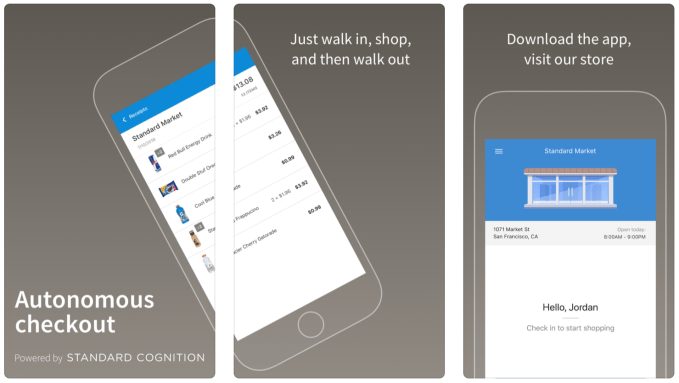
The potential to help worried merchants compete with Amazon has drawn a new $40 million Series A funding round to Standard Cognition, led by Alexis Ohanian and Garry Tan’s Initialized Capital . CRV, Y Combinator, and Draper Associates joined the round that builds on the startup’s $11 million in seed funding. Just a year old, Standard Cognition already has 40 employees, but plans to hire 70 to 80 more over the next 6 months so it can speed up deployment to more partners. Suswal wouldn’t reveal Standard Cognition’s valuation but said the round was roughly in line with the traditional percentage startups sell in an A round, That’s usually about 20 to 25 percent, indicating the startup could be valued around $160 million to $200 million pre-money.

Instead of some lofty tech solution that requires a whole new store to be built around it, Standard Cognition gets retailers to pay for the capital expenditures to install its low number of ceiling cameras and a computer to run them. They can even alter their store layout without working with an engineer as they pay a monthly SAAS fee based on their store’s size, SKUs, and product changes.
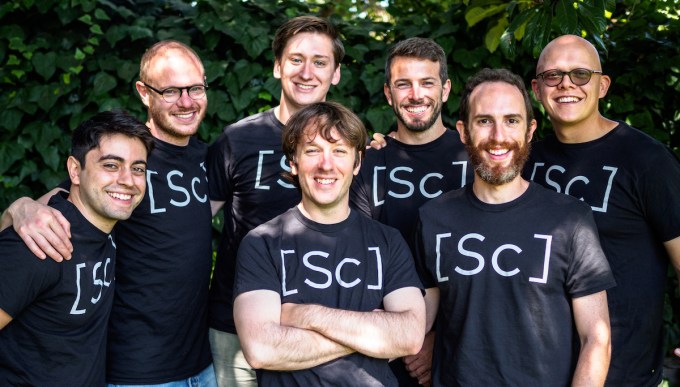
Standard Cognition’s founding team

Amazon Go uses thousands of cameras to track what you pick up

Suswal tells me “Retailers’ two biggest complaints are long lines and poor customer service.” Standard Cognition lets stores eliminate the lines and reassign cashiers to become concierges who make sure customers find the perfect products. “It’s already fun to shop, but I think it’s going to become a lot more fun in the future” Suswal predicts.

Having seven co-founders is pretty atypical for startups, but it’s helped Standard Cognition move quickly. The crew came together while all working at the SEC. They’d meet up as part of a technology research group, discussing the latest findings on computer vision and machine learning. Suswal recalls that “After about a year, we said ‘if we were going to productize this somehow, what would we do?” They settled on retail, and narrowed it down to autonomous checkout. Then a bombshell dropped. Amazon Go, the first truly signficant cashierless store, was announced.

“We initially thought ‘oh no, this is bad.’ And then we quickly came to our senses that this was the best thing that could happen” Suswal explains. Retailers would be desperate for assistance to fight off Amazon. So the squad quit their jobs and started Standard Cognition.

Now with plenty of capital and eager customers, the company is equipping stores for its first four partners — all public companies. Three refuse to be named but include US grocery, drug store, and convenience store businesses. The fourth is Japan’s pharmacy chain Yakuodo. Standard Cognition is already working on its store mapping for its cameras and will begin camera installation next month, though it will be a little while until it opens.

Japan is the perfect market for Standard Cognition because their aging population has produced a labor shortage. “They literally can’t find people to work in their stores” Suswal explains. Autonomous checkout could keep Japanese retailers growing. And because 70 percent of transactions in Japan are cash-based, it also forced the startup to learn how to handle payments outside of its app. That could make Standard Cognition appealing for retailers that want to embrace the future without abandoning the past.

Getting long-running retail businesses to invest in evolving may be the startup’s biggest challenge. Since they have to pay up front for the installation, they’re gambling that the system will reliably increase sales or at least decrease labor costs. But if it makes their stores too confusing, they could see an exodus of customers instead of an influx.

As for Standard Cognition’s impact on the labor class, Suswal admits that “the major chains will have some reduction . . . no one is going to get fired but fewer people will get hired.” He believes his tech could actually save some jobs too. “I was walking around NYC talking to (small chains and mom-and-pop) retailers about problems they face, and an alarming number of them told me ‘we’re closing in a year. We’re closing in 6 months.’ And it was all tied to the next minimum wage hike” Suswal tells me.

Reducing labor costs could keep those shops viable. “These stores can stay open with a reduction of labor so people are keeping their jobs, not losing them” he claims. Whether that proves true will take some time, but at least Standard Cognition’s tech could incentivize merchants to retrain their clerks for more fulfilling roles as concierges.

from Startups – TechCrunch https://ift.tt/2zUfIVf

#USA Plus-sized clothing startup Dia&Co gets another $70M from Sequoia, USV

//

The retail industry has and continues to fail the growing number of American women size 14 or larger, says Nadia Boujarwah, the co-founder and chief executive officer of Dia&Co, a personal styling service for plus-sized women.

According to Plunkett Research, nearly 70 percent of women in the U.S. are plus-sized; Dia&Co wants to expand the options available to that growing demographic. Today, the New York-based startup is announcing that it’s brought in another $70 million in venture capital funding from existing backers Sequoia Capital and Union Square Ventures (USV).

“I’ve been a plus-sized woman my whole life and no one can convince me that this isn’t a failure of retail,” Boujarwah told TechCrunch.”The current state of the plus size market is in no way reflective of how [it] should look going forward. There is so much work ahead of us.”

Dia&Co co-founder and chief executive officer Nadia Boujarwah.

Boujarwah started Dia&Co in 2015 with Lydia Gilbert. To date, the pair have raised $95 million and accumulated 4 million users on its Stitch Fix-like direct-to-consumer marketplace. The latest investment represents a previously unannounced $30 million Series B led by Sequoia and a $40 million Series C led by USV. As part of the Series C, USV partner Rebecca Kaden will join the startup’s board of directors; Sequoia partner Alfred Lin already sits on the board.

Dia&Co has also hired Francis Nzeuton as its chief financial officer. Most recently, Nzeuton led finance for Amazon’s U.S. consumables business.

Boujarwah declined to disclose Dia&Co’s latest valuation.

from Startups – TechCrunch https://ift.tt/2zSIaqP

#USA Lies, damn lies, and HQ2

//

There are few things certain in our world except for the uplifting tendencies of technology. I’ve spent the past few years trying to prove this to myself, at least, by interviewing hundreds of thinkers on the topic. I’ve come to a singular conclusion: when tech moves into a city, be it an iOS dev shop or a robotic facility for making widgets, things change primarily for the better. Given the recent rush to gain 25,000 or so jobs from Amazon’s HQ2 and the subsequent grumbling by cities passed over, it is difficult to refute this, but I’d like explore it.

Many cities have gained from tech, both historically and recently. Pittsburgh, for example, had a plan to become a tech city back in the early 1990s after seeing the value coming out of Carnegie Mellon and the other universities in town. Anecdotally, Pittsburgh remained a fairly depressed steel town until at least 2000. I recall walking on CMU’s campus one weekend, long after my graduation in 1997, and marveling at how the small school had blossomed thanks to an influx of tech money. Next to halls named after dead and gone thinkers and makers was the Gates building, built with the largesse of the biggest tech maker in recent history. Then Uber moved in and all hell broke loose. In 19997 the Lawrenceville neighborhood was a rundown riverfront redoubt full of brown fields and finely-made hovels. Then Uber landed there. Now it’s become the hub for multiple research and tech companies and the neighborhood has blossomed, even rating it’s own corporation and team of boosters who invite you to dine in a spot once associated with dive bars and non-ironic pierogi. A few weeks ago I enjoyed Nashville hot chicken and Manhattans in what was once a funeral home for steel workers.

In short, having tech brings about what Richard Florida called the “creative class.” This group of makers, be they chefs, artists, coders, or engineers, all come to a place and almost inevitably improve it. In some cases this creative class is disparate, spreading throughout a city like a symbiotic fungus. In other places they are centered in a single neighborhood, working their magic from the core out. I’ve seen this in many places but none more clearly than in Toledo, Ohio or Flint, Michigan where a small core of artists are working mightily to turn a city in ruin into a place to live.

And I understand that all is not rosy in the world urban growth. Uber drivers in creative-classed cities are usually people displaced from their cheap rents by rich hipsters. As a friend noted, when you gentrify a place where to those who cannot afford artisanal kombucha, let alone the rent, go? They are either thrust into the suburbs – an irony that should give cities like Grosse-Point-ringed Detroit pause – or they vanish from view even though they exist in plain sight. Nowhere is this clearer then in the refuse-strewn streets of San Francisco.

Yet cities with deep, systemic problems still debase themselves to get tech jobs. They offer tax abatements, $1 land leases, and produce cloying videos to prove that they, alone, are the hardest working of the bunch. The first and most galling effort appeared when Foxconn, a massive manufacturing company, promised to land like an alien invasion force in rural Wisconsin. The idea there was simple: Foxconn wanted tax cuts in exchange for “creating” “jobs” – scare quotes in both cases necessary. As it had in Brazil before, Foxconn promised more than it could ever deliver. From a previous report:

Foxconn has created only a small fraction of the 100,000 jobs that the government projected, and most of the work is in low-skill assembly. There is little sign that it has catalyzed Brazil’s technology sector or created much of a local supply chain.

Manufacturing jobs are not tech jobs. In the end these true manufacturing jobs will end up going to countries with historically cheap labor pools and Foxconn will use its tax breaks to build a facilities in the US to help it abate future cross-border taxes. The jobs that it will create will be done by robots and only the smartest in these rural counties will get jobs… watching robot arms lift flatscreens off of an assembly line for years. Gone are the days of ubiquitous middle class manufacturing jobs and they will never come back. The sooner the heartland accepts this the better.

So cities turn to true tech. Cities know that tech helps and they bow to its captains of industry. But why won’t tech help cities?

Tech companies reduce inefficiencies. Self-driving car companies are aimed at reducing the number of inefficient truckers on the road. Drone companies are aimed at reducing the number of inefficient postal carriers on the sidewalk. And always-on audio assistants and smart devices are there to reduce our dependence on nearly every facet of a local ecosystem including the local weatherperson, the chef with an empty restaurant but hundreds of Seamless orders, and the local cinema. They know that when they land in a place they take over, much like Wal-Mart did in its early heyday. The benefits of this takeover are myriad but the erosion of culture they bring is catastrophic. Yet mayors still don silly hats and dance a merry jig to get them to move to their blighted areas. After all, it’s far easier than actually doing something.

The answer for cities, then, is to build from within. Pittsburgh didn’t get Uber because it prayed for that rude beast to stalk its shores. It got Uber because it built one of the best robotics programs in the country. Denver and Boulder aren’t tech hubs because they gave anyone a massive abatement. They became tech hubs because they became places that techies wanted to congregate and they built networks of technologists who left their cubicles on a weekly basis and met for lunch. That’s right: in many cases, all it takes for a tech scene to thrive is for the CTOs of all the major organizations to meet over curry. The network effects created by this are manifold. In fact, some of the biggest complaints I heard in many cities was that the CTOs of corporations who called those cities home – Chase Bank, GrubHub, etc. – rarely stepped out of their carefully manicured cubicle farms. An ecosystem cannot thrive if its most successful hide. Just ask Detroit.

Cities must subsidize creative districts, not creative destruction. Cities must woo technologists with a network of rich angels, not bribery. Cities must prepare for a future that doesn’t yet exist and hope that some behemoth will find a home there. Otherwise they’re sunk.

This sort of forward thinking is done in dribs and drabs across the country. Every city has its accelerators full of potential failure. These companies quickly discover that without seed capital, St. Louis or Chicago might as well be the Death Valley. Detroit has worked hard to create a startup culture and it seems to be working but in many cases these startups are folded, Borg-like into Quicken Loans and cannot stand on their own. The south is stuck in energy production and invests little in things that would draw technologists to the beautiful cities along the coast.

Maybe this is because startups make no money. Maybe this is because innovation is expensive. And maybe the lack of long-term strategy exists because mayoral staffs turn over so quickly in these convoluted times. These are valid excuses but woe betide the city that clings to them.

New York and Virginia got HQ2 because their cultures are mercenary at worst and transient at best. They already knew the hard bargain of technology versus culture and were willing to make the deal. The tens of thousands of folks who will walk through Amazon’s doors on the first day will change Long Island City for the better and no other city will claim those benefits (and detriments.) Tech is a business. It doesn’t care where it lands as long as there are enough college-educated behinds to sit on blue inflatable desk balls and enough mouths to drink free nitro coffee. It bypasses places that are seemingly entrenched in political infighting and failed innovation and it will continue to do so until cities do for themselves what Amazon will never do: future-proof their place in the world and create a place for generations to grow and change.


Photo by Michael Browning on Unsplash

from Startups – TechCrunch https://ift.tt/2qLXu4f

#USA Lies, damn lies, and HQ2

//

There are few things certain in our world except for the uplifting tendencies of technology. I’ve spent the past few years trying to prove this to myself, at least, by interviewing hundreds of thinkers on the topic. I’ve come to a singular conclusion: when tech moves into a city, be it an iOS dev shop or a robotic facility for making widgets, things change primarily for the better. Given the recent rush to gain 25,000 or so jobs from Amazon’s HQ2 and the subsequent grumbling by cities passed over, it is difficult to refute this, but I’d like explore it.

Many cities have gained from tech, both historically and recently. Pittsburgh, for example, had a plan to become a tech city back in the early 1990s after seeing the value coming out of Carnegie Mellon and the other universities in town. Anecdotally, Pittsburgh remained a fairly depressed steel town until at least 2000. I recall walking on CMU’s campus one weekend, long after my graduation in 1997, and marveling at how the small school had blossomed thanks to an influx of tech money. Next to halls named after dead and gone thinkers and makers was the Gates building, built with the largesse of the biggest tech maker in recent history. Then Uber moved in and all hell broke loose. In 19997 the Lawrenceville neighborhood was a rundown riverfront redoubt full of brown fields and finely-made hovels. Then Uber landed there. Now it’s become the hub for multiple research and tech companies and the neighborhood has blossomed, even rating it’s own corporation and team of boosters who invite you to dine in a spot once associated with dive bars and non-ironic pierogi. A few weeks ago I enjoyed Nashville hot chicken and Manhattans in what was once a funeral home for steel workers.

In short, having tech brings about what Richard Florida called the “creative class.” This group of makers, be they chefs, artists, coders, or engineers, all come to a place and almost inevitably improve it. In some cases this creative class is disparate, spreading throughout a city like a symbiotic fungus. In other places they are centered in a single neighborhood, working their magic from the core out. I’ve seen this in many places but none more clearly than in Toledo, Ohio or Flint, Michigan where a small core of artists are working mightily to turn a city in ruin into a place to live.

And I understand that all is not rosy in the world urban growth. Uber drivers in creative-classed cities are usually people displaced from their cheap rents by rich hipsters. As a friend noted, when you gentrify a place where to those who cannot afford artisanal kombucha, let alone the rent, go? They are either thrust into the suburbs – an irony that should give cities like Grosse-Point-ringed Detroit pause – or they vanish from view even though they exist in plain sight. Nowhere is this clearer then in the refuse-strewn streets of San Francisco.

Yet cities with deep, systemic problems still debase themselves to get tech jobs. They offer tax abatements, $1 land leases, and produce cloying videos to prove that they, alone, are the hardest working of the bunch. The first and most galling effort appeared when Foxconn, a massive manufacturing company, promised to land like an alien invasion force in rural Wisconsin. The idea there was simple: Foxconn wanted tax cuts in exchange for “creating” “jobs” – scare quotes in both cases necessary. As it had in Brazil before, Foxconn promised more than it could ever deliver. From a previous report:

Foxconn has created only a small fraction of the 100,000 jobs that the government projected, and most of the work is in low-skill assembly. There is little sign that it has catalyzed Brazil’s technology sector or created much of a local supply chain.

Manufacturing jobs are not tech jobs. In the end these true manufacturing jobs will end up going to countries with historically cheap labor pools and Foxconn will use its tax breaks to build a facilities in the US to help it abate future cross-border taxes. The jobs that it will create will be done by robots and only the smartest in these rural counties will get jobs… watching robot arms lift flatscreens off of an assembly line for years. Gone are the days of ubiquitous middle class manufacturing jobs and they will never come back. The sooner the heartland accepts this the better.

So cities turn to true tech. Cities know that tech helps and they bow to its captains of industry. But why won’t tech help cities?

Tech companies reduce inefficiencies. Self-driving car companies are aimed at reducing the number of inefficient truckers on the road. Drone companies are aimed at reducing the number of inefficient postal carriers on the sidewalk. And always-on audio assistants and smart devices are there to reduce our dependence on nearly every facet of a local ecosystem including the local weatherperson, the chef with an empty restaurant but hundreds of Seamless orders, and the local cinema. They know that when they land in a place they take over, much like Wal-Mart did in its early heyday. The benefits of this takeover are myriad but the erosion of culture they bring is catastrophic. Yet mayors still don silly hats and dance a merry jig to get them to move to their blighted areas. After all, it’s far easier than actually doing something.

The answer for cities, then, is to build from within. Pittsburgh didn’t get Uber because it prayed for that rude beast to stalk its shores. It got Uber because it built one of the best robotics programs in the country. Denver and Boulder aren’t tech hubs because they gave anyone a massive abatement. They became tech hubs because they became places that techies wanted to congregate and they built networks of technologists who left their cubicles on a weekly basis and met for lunch. That’s right: in many cases, all it takes for a tech scene to thrive is for the CTOs of all the major organizations to meet over curry. The network effects created by this are manifold. In fact, some of the biggest complaints I heard in many cities was that the CTOs of corporations who called those cities home – Chase Bank, GrubHub, etc. – rarely stepped out of their carefully manicured cubicle farms. An ecosystem cannot thrive if its most successful hide. Just ask Detroit.

Cities must subsidize creative districts, not creative destruction. Cities must woo technologists with a network of rich angels, not bribery. Cities must prepare for a future that doesn’t yet exist and hope that some behemoth will find a home there. Otherwise they’re sunk.

This sort of forward thinking is done in dribs and drabs across the country. Every city has its accelerators full of potential failure. These companies quickly discover that without seed capital, St. Louis or Chicago might as well be the Death Valley. Detroit has worked hard to create a startup culture and it seems to be working but in many cases these startups are folded, Borg-like into Quicken Loans and cannot stand on their own. The south is stuck in energy production and invests little in things that would draw technologists to the beautiful cities along the coast.

Maybe this is because startups make no money. Maybe this is because innovation is expensive. And maybe the lack of long-term strategy exists because mayoral staffs turn over so quickly in these convoluted times. These are valid excuses but woe betide the city that clings to them.

New York and Virginia got HQ2 because their cultures are mercenary at worst and transient at best. They already knew the hard bargain of technology versus culture and were willing to make the deal. The tens of thousands of folks who will walk through Amazon’s doors on the first day will change Long Island City for the better and no other city will claim those benefits (and detriments.) Tech is a business. It doesn’t care where it lands as long as there are enough college-educated behinds to sit on blue inflatable desk balls and enough mouths to drink free nitro coffee. It bypasses places that are seemingly entrenched in political infighting and failed innovation and it will continue to do so until cities do for themselves what Amazon will never do: future-proof their place in the world and create a place for generations to grow and change.


Photo by Michael Browning on Unsplash

from Startups – TechCrunch https://ift.tt/2qLXu4f

#USA Urban Massage re-brands to ‘Urban’ as it launches wellness services beyond massage

//

Urban Massage, the London-headquartered startup that lets you book a vetted massage therapist “on-demand”, is expanding into new wellness services in addition to changing its name.

Now simply called Urban, the company, which operates in several U.K. cities along with Paris, is adding the ability to book an expert nail technician, GOsC-regulated osteopath, or skin therapist. It will utilise the same logistics tech and app experience that enables therapists to be booked with as little as an hour’s notice.

Founder Jack Tang tells me the move into new wellness categories forms part of a wider strategy to build Europe’s leading “holistic wellness” platform. This will see the company add fitness, yoga and other mental wellbeing-focused activities in the near future, including meditation.

Further ahead, Urban has plans to integrate digital therapy services, such as counselling.

Urban founder Jack Tang

Urban founder Jack Tang

Tang says that since Urban launched back in 2014, it has provided 389,000 treatments, and today sees a 42 percent repeat rate for bookings. The company claims 101,000 active users, and 2,500 active therapists on its platform. Its wellness practitioners have collectively earned £16.4 million via Urban in the past four years, and, I’d suggest, in a much fairer deal than the “self-employed” terms often offered to massage therapists by hotels or spas.

As a side note, I’m a user of Urban, and book a regular massage after I injured my neck and shoulder earlier this year. Tang says this is pretty common, in that many people only embrace massage therapy to combat pain, but afterwards discover the longer term wellness benefits, especially in terms of managing stress within a major city.

He also says that customers were asking for additional wellness category products. Notably, many of Urban’s registered massage therapists have related expertise and treatment skills and also wanted a way to utilise them within a familiar platform.

Since TechCrunch last covered Urban, a lot has happened, including an announced funding round: In August 2016, Urban closed £3.5 million in a Series A led by Felix Capital. “We got on and focused on delivering best experiences to our customers,” says Tang, refreshingly. With no current neck pain, I reply that this was probably the right decision.

In February, Urban acquired two competitors: Milk Beauty, on the consumer side, and B2B focussed Freauty to bolster its corporate wellness offering. Most recently, the company raised a further £3.5 million in an equity crowdfunding campaign on Seedrs. This saw Urban add 800-plus new investors, the majority of whom are current customers, therapists, and staff, along with existing VC backers.

And this March, Urban launched “Urban Curates,” a collection of at-home treatments in collaboration with top beauty and wellness brands including the likes of Estee Lauder Companies, and Unilever Prestige. This, Tang explained, is viewed as a new retail channel for brands, whereby consumers want to make “experience-led” purchases as an alternative to the high street.

from Startups – TechCrunch https://ift.tt/2FpgmQS

#USA Legrand acquires smart home startup Netatmo

//

French hardware startup Netatmo got acquired by the biggest manufacturer of switches and sockets in the world, Legrand. Terms of the deal are undisclosed.

Legrand and Netatmo already collaborated together on some products. Back in 2017, the company announced that it would work with industrial groups to connect everything in your home, starting with Legrand and Velux.

With Legrand’s “Céliane with Netatmo” switches and power outlets, you could build a house with a smart electrical installation from day one. This way, you could have a wireless master switch near your entrance, activate some outlets using Amazon Alexa and control your home from Messenger.

“Our strategy is the connected home. But there are some connected features that we can’t sell to consumers because those products are sold to professionals directly,” Netatmo founder and CEO Fred Potter told me at the time of the original announcement.

Netatmo’s team is going to be integrated into Legrand. Legrand plans to release more connected objects in the future. Netatmo founder and CEO Fred Potter is becoming CTO of Legrand’s research & development division. According to the announcement, Netatmo was generating $51 million (€45 million) in annual revenue.

Netatmo’s first product was a weather station. It works over Wi-Fi and was one of the first weather stations that you could check from your phone.

More recently, the company released security products, such as a connected camera that identifies faces on the device itself, a similar camera that works outdoor and a connected smoke alarm. Some people called Netatmo the “Nest of Europe” as the company also released smart thermostats and radiator valves.

from Startups – TechCrunch https://ift.tt/2OEBi5H

#USA Sweetgreen is officially a unicorn

//

Salad startup and retailer Sweetgreen recently raised a $200 million Series H round led by Fidelity that valued the company at more than $1 billion. This round brings Sweetgreen’s total amount of funding to $365 million.

With this additional $200 million in funding, Sweetgreen is setting its eyes on other food categories and looking to expand its delivery offerings. Sweetgreen is also looking at using blockchain technology to create more transparency in the supply chain.

“As a company we are focused on democratizing real food,” Sweetgreen co-founder and CEO Jonathan Neman said in a statement. “Our vision is to evolve from a restaurant company to a food platform that builds healthier communities around the world.

Sweetgreen has always been a tech-focused business with its order-ahead mobile app built in-house at the company. According to Forbes, Sweetgreen’s online ordering revenue is growing at 50 percent year over year. Since its launch in 2007, Sweetgreen has grown to 90 locations across eight states.

from Startups – TechCrunch https://ift.tt/2OHMrCH

#USA Sweetgreen is officially a unicorn

//

Salad startup and retailer Sweetgreen recently raised a $200 million Series H round led by Fidelity that valued the company at more than $1 billion. This round brings Sweetgreen’s total amount of funding to $365 million.

With this additional $200 million in funding, Sweetgreen is setting its eyes on other food categories and looking to expand its delivery offerings. Sweetgreen is also looking at using blockchain technology to create more transparency in the supply chain.

“As a company we are focused on democratizing real food,” Sweetgreen co-founder and CEO Jonathan Neman said in a statement. “Our vision is to evolve from a restaurant company to a food platform that builds healthier communities around the world.

Sweetgreen has always been a tech-focused business with its order-ahead mobile app built in-house at the company. According to Forbes, Sweetgreen’s online ordering revenue is growing at 50 percent year over year. Since its launch in 2007, Sweetgreen has grown to 90 locations across eight states.

from Startups – TechCrunch https://ift.tt/2OHMrCH

#USA Pirate Studios raises $20M from Talis Capital for its ‘self-service’ tech-enabled music studios

//

Pirate Studios, the music technology company that operates fully automated and self-service 24 hour music studios, has secured $20 million. The investment was led by Talis Capital, the London-based VC family office.

Talis was already an existing backer of Pirate Studios, with Talis’ Matus Maar also named as a co-founder of the startup. Other investors include Eric Archambeau (Spotify investor and ex-partner at Benchmark and Wellington Partners), Bart Swanson of Horizons Ventures, and partners of Gaw Capital, the $20 billion Hong Kong-headquartered proptech fund.

The new funding will enable Pirate Studios to continue to expand across the U.K., Germany and the U.S., where it has been building what the startup describes as a community of musicians, DJs, producers and podcasters who need access to professional rehearsal, production and recording studios at affordable rates. The company charges as little as £4 per hour, depending on what kind of music studio space and facilities you book.

However, what really sets Pirate Studios apart from a lot of existing rehearsal rooms and music production and recording studios, is that the startup is employing a lot of tech to power the logistics around its service and, in theory, make it a lot more scalable. This includes online booking, 24 hour keycode access, and other IoT controls for managing facilities.

Perhaps even smarter, Pirate Studios offers “automated recording” and live streaming from many of its studios. This means that bands or DJs rehearsing in one of the company’s rooms can easily record their session via built in room mics and other inputs, and the studio’s cloud software will handle mixing and mastering afterwards. Likewise, rooms are set up to be able to video and audio stream sessions, too.

Both options tap into the YouTube, SoundCloud, and Spotify generation’s unstoppable appetite for more content from their favourite upcoming and established acts, as well as the dreaded music industry’s favourite new metric: how much social media reach an act has, which can in turn make or break a recording contract opportunity or the chance to get booked at larger, more lucrative live events.

I say all of the above as someone who was previously in quite a serious band and used to book rehearsal rooms on a regular basis. I’m also still in touch and collaborating with a number of gigging musicians and professional acts. However, during the last ten years, I’ve seen quite a few studios in London go out of business as property owners look to cash in, and even though there is something a little WeWork about Pirate Studios’ model (and being backed by relatively large amounts of VC cash at this stage) which makes me slightly uneasy, overall I’m very bullish on what the company offers.

Without a place to practice, hone your craft, in addition to somewhere to perform, rock ‘n’ roll really would be dead.

To that end, in just three years, Pirate has grown to 350 studios in 21 locations, including London, New York, and Berlin.

Cue statement from David Borrie, co-founder and CEO of Pirate Studios: “When we founded Pirate Studios our dream was to create innovative spaces to support emerging talent. We want to see music thrive and help musicians get their music out to their fans, through whatever route they think is most appropriate. We are building both the physical space to create, as well as the technology to record and share, that puts power back into the hands of musicians in a period when the digitisation of music continues to radically upset the old order of this industry”.

from Startups – TechCrunch https://ift.tt/2RS2vnm

#USA Pirate Studios raises $20M from Talis Capital for its ‘self-service’ tech-enabled music studios

//

Pirate Studios, the music technology company that operates fully automated and self-service 24 hour music studios, has secured $20 million. The investment was led by Talis Capital, the London-based VC family office.

Talis was already an existing backer of Pirate Studios, with Talis’ Matus Maar also named as a co-founder of the startup. Other investors include Eric Archambeau (Spotify investor and ex-partner at Benchmark and Wellington Partners), Bart Swanson of Horizons Ventures, and partners of Gaw Capital, the $20 billion Hong Kong-headquartered proptech fund.

The new funding will enable Pirate Studios to continue to expand across the U.K., Germany and the U.S., where it has been building what the startup describes as a community of musicians, DJs, producers and podcasters who need access to professional rehearsal, production and recording studios at affordable rates. The company charges as little as £4 per hour, depending on what kind of music studio space and facilities you book.

However, what really sets Pirate Studios apart from a lot of existing rehearsal rooms and music production and recording studios, is that the startup is employing a lot of tech to power the logistics around its service and, in theory, make it a lot more scalable. This includes online booking, 24 hour keycode access, and other IoT controls for managing facilities.

Perhaps even smarter, Pirate Studios offers “automated recording” and live streaming from many of its studios. This means that bands or DJs rehearsing in one of the company’s rooms can easily record their session via built in room mics and other inputs, and the studio’s cloud software will handle mixing and mastering afterwards. Likewise, rooms are set up to be able to video and audio stream sessions, too.

Both options tap into the YouTube, SoundCloud, and Spotify generation’s unstoppable appetite for more content from their favourite upcoming and established acts, as well as the dreaded music industry’s favourite new metric: how much social media reach an act has, which can in turn make or break a recording contract opportunity or the chance to get booked at larger, more lucrative live events.

I say all of the above as someone who was previously in quite a serious band and used to book rehearsal rooms on a regular basis. I’m also still in touch and collaborating with a number of gigging musicians and professional acts. However, during the last ten years, I’ve seen quite a few studios in London go out of business as property owners look to cash in, and even though there is something a little WeWork about Pirate Studios’ model (and being backed by relatively large amounts of VC cash at this stage) which makes me slightly uneasy, overall I’m very bullish on what the company offers.

Without a place to practice, hone your craft, in addition to somewhere to perform, rock ‘n’ roll really would be dead.

To that end, in just three years, Pirate has grown to 350 studios in 21 locations, including London, New York, and Berlin.

Cue statement from David Borrie, co-founder and CEO of Pirate Studios: “When we founded Pirate Studios our dream was to create innovative spaces to support emerging talent. We want to see music thrive and help musicians get their music out to their fans, through whatever route they think is most appropriate. We are building both the physical space to create, as well as the technology to record and share, that puts power back into the hands of musicians in a period when the digitisation of music continues to radically upset the old order of this industry”.

from Startups – TechCrunch https://ift.tt/2RS2vnm