#USA The Correspondent launches campaign to bring its ad-free journalism to the U.S.

//

De Correspondent, a Dutch news organization aiming to “unbreak the news,” is planning to launch in the United States next year as The Correspondent. To fund its efforts, it’s hoping to raise $2.5 million from future readers.

Co-founder and CEO Ernst Pfauth (a former tech journalist who previously served as editor in chief at The Next Web) said this campaign is meant to test the waters of whether U.S. readers are interested in The Correspondent’s journalism. If it raises the money, it will launch in the U.S. next spring. If it doesn’t, it will reconsider those plans.

“We want there to be a critical mass that supports this,” Pfauth said. “We don’t want to launch, then see if enough people are interested.”

What the company has developed in the Netherlands, and what it’s hoping to replicate in the U.S., is a news organization with a direct connection to readers. For one thing, that means foregoing any ad revenue and relying entirely on readers for support. (Hence the crowdfunding campaign, where you can sign up by paying any amount you want.) It has a paywall, but any member can circumvent it and promote stories they think are important by sharing the individual links.

For another, it means treating readers as a key source for stories. In Pfauth’s view, by signing up as a “founding member,” you’re not so simply paying for a subscription, “You’re joining a cause. You not just giving us your money — though the money is essential — but you’re sharing your knowledge and spreading articles.”

The Correspondent

If that sounds a bit touchy-feely, here’s a concrete example: Last year, the organization broke the news that a videotape and related documents showed that Shell had detailed knowledge about the dangers of climate change as far back as 1991. And apparently it obtained the crucial material from a reader.

Pfauth said that in most cases, reporters at The Correspondent will share their story ideas with members as soon they start working on it, which allows readers to share their perspectives as the story develops. That can mean talking to doctors about hospital bureaucracy, or interviewing refugees about their experiences. It also means that The Correspondent encourages its journalists to spend 30 to 50 percent of their time going through the comments section (which it calls the “contributions” section), where only members can post.

Pfauth argued that all of this is crucial for breaking out of the limited perspective of so many news stories, where journalists “only talk to people who get paid to talk to the press.” That description struck close to home — I’m someone who spends a lot of their time dealing with PR pros who, yes, get paid to talk to me, or to entrepreneurs who are trying to convince me to write about their companies.

So how do you get people to share their perspective in a less self-interested (or, in the case of comments, less rant-y) way? Pfauth pointed to tactics like making sure to verify the identity of sources and asking “really specific questions.” But he also said, “Most people are idealistic about the thing they really care about. They want the information to be good.”

“You are going to find examples of other newspapers who have done things like this, but it’s always incidental, it’s not routine,” he added. “In our organization, we have this systematic approach to every story that we cover.”

This strategy makes it harder to quickly cover breaking news, but in fact, Pfauth said that’s quite intentional.

“We tell our correspondents, please ignore the news — the news is about incidents,” he said. “Focus on the topics in your beat that are really changing our society.”

As part of this campaign, The Correspondent has also enlisted a number of high-profile “ambassadors” who support its mission. Those ambassadors include FiveThirtyEight’s Nate Silver, Wikimedia’s Jimmy Wales, director Judd Apatow, journalist, musician Roseanne Cash, journalist and investor Om Malik and others.

from Startups – TechCrunch https://ift.tt/2FmDv6e

#USA Meet Jennifer Tejada, the secret weapon of one of Silicon Valley’s fastest-growing enterprise software startups

//

PagerDuty, an eight-year-old, San Francisco-based company that sends companies information about their technology, doesn’t receive a fraction of the press that other fast-growing enterprise software companies receive. In fact, though it counts as customers heavyweight companies like Capital One, Spotify and Netflix; it employs 500 employees; and it has five offices around the world, it has largely operated out of the spotlight.

That’s changing. For one thing, the company is now a so-called unicorn, after raising $90 million in a September round led by Wellington and T. Rowe Price that brought its total funding to $173 million and its valuation to $1.3 billion. Crowded as the unicorn club may be these days, that number, and those backers, makes PagerDuty a startup of interest to a broader circle of industry watchers.

Another reason you’re likely to start hearing more about PagerDuty is its CEO of three years, Jennifer Tejada, who is rare in the world of enterprise startups because of her gender, but whose marketing background makes her even more of an anomaly — and an asset.

In a world that’s going digital fast, Tejada knows PagerDuty can appeal to a far wider array of customers by selling them a product they can understand.

It’s a trick she first learned at Proctor & Gamble, where she spent seven years after graduating from the University of Michigan with both a liberal arts and a business management degree. In fact, in her first tech job out of P&G, working for the bubble-era supply chain management startup I2 Technologies (it went public and was later acquired), Tejada says she became “director of dumb it down.”

Sitting in PagerDuty’s expansive second floor office space in San Francisco — space that the company will soon double by taking over the first floor — Tejada recalls acting “like a filter for very technical people who were very proud of the IP they’d created” but who couldn’t explain it to anyone without relying on jargon. “I was like, ‘How are you going to get someone to pay you $2 million for that?’”

Tejada found herself increasingly distilling the tech into plain English, so the businesspeople who have to sign big checks and “bet their careers on these investments” could understand what they were being pitched. She’s instilling that same ethos at PagerDuty, which was founded in 2009 to help businesses monitor their tech stacks, manage disruptions and alert engineers before things catch on fire but, under Tejada’s watch, is evolving into a service that flags opportunities for its customers, too.

As she tells it, the company’s technology doesn’t just give customers insights into their service ecosystem and their teams’ health, and it doesn’t just find other useful kernels, like about which operations teams are the most productive and why. PagerDuty is also helping its clients become proactive. The idea, she says, is that “if you see traffic spiking on a website, you can orchestrate a team of content marketers or growth hackers and get them in that traffic stream right then, instead of reading about it in a demand-gen report a week later, where you’re, like, ‘Great, we totally missed that opportunity.’”

The example is a bit analogous to what Tejada herself brings to the table, which includes strong people skills (she’s very funny) and a knack for understanding what consumers want to hear, but also a deep understanding of financing and enterprise software.

As corny as it sounds, Tejada seems to have been working toward her current career her whole life.

Not that, like the rest of us, she knew exactly what she was doing at all times. On the contrary, one part of her path started when, after spending four years as the VP of global marketing for I2 — four years during which the dot-com bubble expanded wildly, then popped — Tejada quit her job, went home for the holidays and, while her baffled family looked on, booked a round-trip ticket to Australia to get away and learn about yachts.

She left the experience not only with her skipper certification but in a relationship with her now-husband of 16 years, an Australian with whom she settled in Sydney for roughly 12 years.

There, she worked for a private equity firm, then joined Telecom New Zealand as its chief marketing officer for a couple of years, then landed soon after at an enterprise software company that catered to asset-intensive industries, including mining, as its chief strategy officer. When that private-equity backed company was sold, Tejada took a breath, then was recruited to lead, for the first time, another company: Keynote Systems, a publicly traded internet and mobile cloud testing and monitoring company that she steered to a sale to the private equity firm Thomas Bravo a couple of years later.

The move gave her an opportunity to spend time with her now teenage daughter and husband, but she also didn’t have a job for the first time in many years, and Tejada seems to like work. Indeed, within one year, after talking with investors who’d gotten to know her over the years, as well as eager recruiters, Tejada —  who says she is “not a founder but a great adoptive parent” — settled on the 50th of 51 companies she was asked to consider joining. It was PagerDuty.

She has been overseeing wild growth ever since. The company now counts more than half of the Fortune 50 as its customers. It has also doubled its headcount a couple of times since she joined roughly 28 months ago, and many of its employees (upwards of 43 percent) are now women, as well as engineers from more diverse backgrounds than you might see at a typical Silicon Valley startup.

That’s no accident. Diversity breeds diversity, in Tejada’s view, and diversity is good for business.

“I wouldn’t say we market to women,” offers Tejada, who says diversity to her is not just about gender but also age and ethnic background and lifestyle choice and location and upbringing (and functional expertise).

“We’ve made a conscious effort to build an inclusive culture where all kinds of people want to work. And you send that message out into the market, there’s a lot of people who hear it and wonder if it could possibly be true. And then they come to a PagerDuty event, or they come into the office, and they see something different than they’ve seen before. They see people they can relate to.”

Why does it matter when it comes to writing code? For one thing, because a big part of coding is problem-solving, says Tejada. “When you have people from diverse backgrounds chunking through a big hairy problem together, those different perspectives will get you to a more insightful answer.” Tejada also believes there’s too much bias in application development and user experience. “There’s a lot of gobbledygook in our app that lots of developers totally understand but that isn’t accessible to everyone — men, women, different functional types of users, people of a different age. Like, how accessible is our mobile app to someone who’s not a native-first mobile user, who started out on an analog phone, moved to a giant desktop, then to a laptop and is now using a phone? You have to think about the accessibility of your design in that regard, too.”

What about the design of PagerDuty’s funding? We ask Tejada about the money PagerDuty raised a couple of months ago, and what it means for the company.

Unsurprisingly, as to whether the company plans to go public any time soon, her answers are variously, “I’m just building an enduring company,” and, “We’re still enjoying the benefits of being a private company.”

But Tejada also seems mindful of not raising more money for PagerDuty than it needs to scale, even while there’s an ocean of capital surrounding it.

“Going back to the early ’90s, in my career I have not seen a market where there has been more ready availability to capital, between tax reforms and sovereign cash and big corporates and low interest rates and huge venture funds, not to mention the increased willingness of big institutional investors to become LPs.” But even while the “underlying drivers and secular trends and leading indicators” suggest a healthy market for SaaS technology for a long time to come, that “doesn’t mean the labor markets are going to stay the same. It doesn’t mean the geopolitical environments are not going to change. When you let the scarcity issue in the market drive your valuation, you’re also responsible for growing into that valuation, no matter what happens in the macro environment.”

Where Tejada doesn’t necessarily want to be so measured is when it comes to PagerDuty’s place in its market. And that can be challenging as the company gains more traction — and more attention.

“If you do the right thing for your customers, and you do the right thing by your employees, all the rest will fall into place,” she says. “But the minute you take your eye off the ball, the minute you don’t earn the trust of your customer every day, the minute you stop innovating in service of them, you’re gonna start going backwards,” she says with a shrug.

Tejada recalls a conversation she had with her executive team last week, including with Alex Solomon, the company’s CTO and the one of three PagerDuty founders who remains actively engaged with the company. (Co-founder Andrew Miklas moved on to venture capital last year; Baskar Puvanathasan meanwhile left the company in March.) “They probably wanted to kill me,” she says laughing. “I told them I don’t think we’re disrupting ourselves enough. They’re like, ‘Jenn, let up.’ But that’s what happens to companies. They have their first success and they miss that second wave or third wave, and the next thing you know, you’re Kodak.”

PagerDuty, she says, “is not going to be Kodak.”

from Startups – TechCrunch https://ift.tt/2B5HKPs


#USA iBanFirst raises $17 million to help companies move money around the world

//

French startup iBanFirst is raising another $17 million (€15 million) from Serena Capital and Breega Capital, with existing investor Xavier Niel putting more money as well.

iBanFirst solves a very specific problem. If you operate a company that works with suppliers all over the world, chances are you waste a ton of money exchanging and sending money. iBanFirst wants to make currency conversion as easy as transferring money from your savings account to your current account.

You first send money from your corporate bank account to your iBanFirst account. You can then convert and hold money in 28 currencies. iBanFirst shows you the interbank exchange rate and how many fees you’ll pay. But you’ll likely pay way less than using your traditional bank account.

With 100 employees and 2,000 clients, iBanFirst now focuses on clients who transfer at least €100,000 per year. “We’ve already done a €50 million transfer,” iBanFirst founder and CEO Pierre-Antoine Dusoulier told me.

After that, you can send money to a client, a supplier, a partner, etc. It’ll look like a local transfer and you’ll save money on fees.

Many companies already do that. But iBanFirst goes one step further by giving you banking information for each currency. If you’re an iBanFirst customer, you can share a Turkish IBAN, an American account number or Chinese banking details. It’s easier to get paid from all your clients.

With your French IBAN, the startup is doing something special. “We realized that some IBANs had a letter here and there,” Dusoulier said. “We called SWIFT, and they told us that we could put whatever we wanted for 10 characters.”

iBanFirst took advantage of that to create a sort of domain names for IBANs. If you want, you can put your company name in your banking information.

The company wants to add more currencies and more features. Thanks to the upcoming European regulation, you could imagine connecting to your regular corporate account from the iBanFirst interface to initiate a transfer. That would be much more straightforward than transferring money to iBanFirst before using it.

from Startups – TechCrunch https://ift.tt/2PuwKE0

#USA Unicorn shoe startup Allbirds debuts a high-top sneaker

//

Allbirds, the shoe startup that entered the unicorn club last month following a $50 million funding round, has unveiled its latest feet holders. Dubbed the Tree Topper, the high-top sneaker marks Allbirds’ fifth shoe style. The Tree Topper, which retails for $115, features merino wool knit, eucalyptus tree fiber fabric and sugarcane-based foam.

“The Tree Topper is a true representation of our approach to design and sustainability,” Allbirds Head of Design Jamie McLellan said in a press release. “With just the right amount of nothing and comfort as a non-negotiable, the Tree Topper is a playful canvas for showcasing our three hero materials.”

Allbirds, founded by Joey Zwillinger and Tim Brown, first launched in 2015. Since then, the shoe startup has raised $75 million in funding from investors like T. Rowe Price, Tiger Global, Fidelity Investments, Leonardo DiCaprio and others. Allbirds is worth a reported $1.4 billion.

The startup began as a direct-to-consumer online retailer but has since expanded into the traditional retail space with the launch of brick-and-mortar locations in San Francisco and New York.

from Startups – TechCrunch https://ift.tt/2qNGfjc

#USA Unicorn shoe startup Allbirds debuts a high-top sneaker

//

Allbirds, the shoe startup that entered the unicorn club last month following a $50 million funding round, has unveiled its latest feet holders. Dubbed the Tree Topper, the high-top sneaker marks Allbirds’ fifth shoe style. The Tree Topper, which retails for $115, features merino wool knit, eucalyptus tree fiber fabric and sugarcane-based foam.

“The Tree Topper is a true representation of our approach to design and sustainability,” Allbirds Head of Design Jamie McLellan said in a press release. “With just the right amount of nothing and comfort as a non-negotiable, the Tree Topper is a playful canvas for showcasing our three hero materials.”

Allbirds, founded by Joey Zwillinger and Tim Brown, first launched in 2015. Since then, the shoe startup has raised $75 million in funding from investors like T. Rowe Price, Tiger Global, Fidelity Investments, Leonardo DiCaprio and others. Allbirds is worth a reported $1.4 billion.

The startup began as a direct-to-consumer online retailer but has since expanded into the traditional retail space with the launch of brick-and-mortar locations in San Francisco and New York.

from Startups – TechCrunch https://ift.tt/2qNGfjc

#USA Unicorn shoe startup Allbirds debuts a high-top sneaker

//

Allbirds, the shoe startup that entered the unicorn club last month following a $50 million funding round, has unveiled its latest feet holders. Dubbed the Tree Topper, the high-top sneaker marks Allbirds’ fifth shoe style. The Tree Topper, which retails for $115, features merino wool knit, eucalyptus tree fiber fabric and sugarcane-based foam.

“The Tree Topper is a true representation of our approach to design and sustainability,” Allbirds Head of Design Jamie McLellan said in a press release. “With just the right amount of nothing and comfort as a non-negotiable, the Tree Topper is a playful canvas for showcasing our three hero materials.”

Allbirds, founded by Joey Zwillinger and Tim Brown, first launched in 2015. Since then, the shoe startup has raised $75 million in funding from investors like T. Rowe Price, Tiger Global, Fidelity Investments, Leonardo DiCaprio and others. Allbirds is worth a reported $1.4 billion.

The startup began as a direct-to-consumer online retailer but has since expanded into the traditional retail space with the launch of brick-and-mortar locations in San Francisco and New York.

from Startups – TechCrunch https://ift.tt/2qNGfjc

#USA Unicorn shoe startup Allbirds debuts a high-top sneaker

//

Allbirds, the shoe startup that entered the unicorn club last month following a $50 million funding round, has unveiled its latest feet holders. Dubbed the Tree Topper, the high-top sneaker marks Allbirds’ fifth shoe style. The Tree Topper, which retails for $115, features merino wool knit, eucalyptus tree fiber fabric and sugarcane-based foam.

“The Tree Topper is a true representation of our approach to design and sustainability,” Allbirds Head of Design Jamie McLellan said in a press release. “With just the right amount of nothing and comfort as a non-negotiable, the Tree Topper is a playful canvas for showcasing our three hero materials.”

Allbirds, founded by Joey Zwillinger and Tim Brown, first launched in 2015. Since then, the shoe startup has raised $75 million in funding from investors like T. Rowe Price, Tiger Global, Fidelity Investments, Leonardo DiCaprio and others. Allbirds is worth a reported $1.4 billion.

The startup began as a direct-to-consumer online retailer but has since expanded into the traditional retail space with the launch of brick-and-mortar locations in San Francisco and New York.

from Startups – TechCrunch https://ift.tt/2qNGfjc

#USA Uber launches rider loyalty Rewards like credits & upgrades 9 cities

//

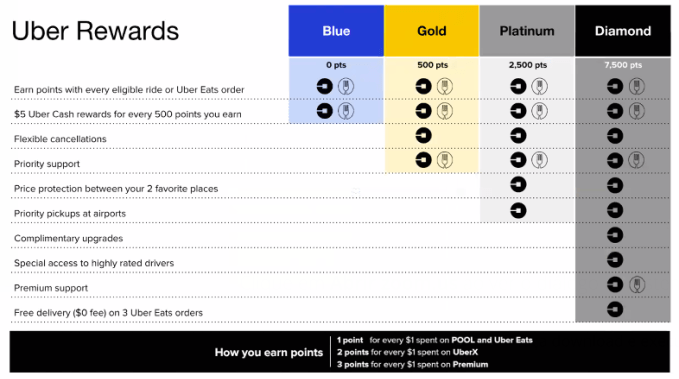
Uber’s new loyalty program incentivizes you not to check Lyft or the local competitor. Riders earn points for all the money they spend on Uber and Uber Eats that score them $5 credits, upgrades to nicer cars, access to premium support, and even flexible cancellations that waive the fee if they rebook within 15 minutes.

Uber Rewards launches today in nine cities before rolling out to the whole US in the next few months, with points for scooters and bikes coming soon. And as a brilliant way to get people excited about the program, it retroactively counts your last six months of Uber activity to give you perks as soon as you sign up for free for Uber Rewards. You’ll see the new Rewards bar on the homescreen of your app today if you’re in Miami, Denver, Tampa, New York, Washington, DC, Philadelphia, Atlanta, San Diego, or anywhere in New Jersey, as Uber wanted to test with a representative sample of the US.

The loyalty program ties all of the company’s different transportation and food delivery options together, encouraging customers to stick with Uber across a suite of solutions instead of treating it as interchangeable with alternatives. “As people use Uber more and more in their everyday, we wanted to find a way to reward them for choosing Uber” says Uber’s director of product Nundu Janikaram. “International expansion is top of mind for us” adds Holly Ormseth, Uber Rewards’ product manager.

As for the drivers, “They absolutely get paid their full rate” Ormseth explains. “We understand that offering the benefits has a cost to Uber but we think of it as an investment” says Janakiram.

So how much Ubering earns you what perks? Let’s break it down:

In Uber Rewards you earn points by spending money to reach different levels of benefits. Points are earned during 6 month periods, and if you reach a level, you get its perks for the remainder of that period plus the whole next period. You earn 1 point per dollar spent on UberPool, Express Pool, and Uber Eats; 2 points UberX, Uber XL, and Uber Select; and 3 points on Uber Black and Black SUV. You’ll see your Uber Rewards progress wheel at the bottom of the homescreen fill up over time.

Blue: $5 Credits

The only Uber perk that doesn’t reset at the end of a period is that you get $5 of Uber Cash for every 500 points earned regardless of membership level. “Even as a semi-frequent Uber Rewards member you’ll get these instant benefits” Janakiram says. Blue lets you treat Uber like a video game where you’re trying to rack up points to earn an extra life. To earn 500 points, you’d need about 48 UberPool trips, 6 Uber Xs, and 6 Uber Eats orders.

Gold: Flexible Cancellations

Once you hit 500 points, you join Uber Gold and get flexible cancellations that refund your $5 cancellation fee if you rebook within 15 minutes, plus priority support Gold is for users who occasionally take Uber but stick to its more economical options. “The Gold level is all about being there when things aren’t going exactly right” Janakiram explains. To earn 500 points in six months, you’d need to take about 2 UberPools per week, one Uber X per month, and one Uber Eats order per month.

Platinum: Price Protection

At 2,500 points you join Uber Platinum, which gets you the Gold benefits plus price protection on a route between two of your favorite places regardless of traffic or surge. And Platinum members get priority pickups at airports. To earn 2,500 points, you’d need to take UberX 4 times per week and order Uber Eats twice per month. It’s designed for the frequent user who might rely on Uber to get to work or play.

Diamond: Premium Support & Upgrades

At 7,500 points, you get the Gold and Platinum benefits plus premium support with a dedicated phone line and fast 24/7 responses from top customer service agents. You get complimentary upgrade surprises from UberX to Uber Black and other high-end cars. You’ll be paired with Uber’s highest rated drivers. And you get no delivery fee on three Uber Eats orders every six months. Reaching 7,500 points would require UberX 8 times per week, Uber Eats once per week, and Uber Black to the airport once per month. Diamond is meant usually for business travelers who get to expense their rides, or people who’d ditched car ownership for ridesharing.


Uber managed to beat Lyft to the loyalty game. Lyft just announced that its rewards program would roll out in December. Uber spent the better part of last year asking users through surveys and focus groups what they’d want in a loyalty program. It found that customers wanted to constantly earn rewards and make their dollar go further, but use the perks when they wanted. The point was to avoid situations where riders says “Oh I’ve been an Uber user for years. When something goes wrong, I feel like I’m being treated like everyone else.” When riders think they’re special, they stick around.

One risk of the program is that Uber might make users at lower tiers or who don’t even qualify for Gold feel like second class citizens of the app. “One thing that’s important is that we don’t want to make the experience for people who are not in these levels poor in any sense” Janakiram notes. “It’s not like 80% of people will suddenly get priority airport pickups, but we do want to monitor very closely to make sure we’re not harming the service more broadly.”

Overall, Uber managed to pick perks that seem helpful without making me wonder why these features aren’t standard for everyone. Even if it takes a short-term margins hit, if Uber can dissuade people from ever looking beyond its app, the lifetime value of its customers should easily offset the kickbacks.

[Disclosure: Uber’s Janakiram and I briefly lived in the same three-bedroom apartment five years ago, though I’d already agreed to write about the redesign when I found out he was involved.]

from Startups – TechCrunch https://ift.tt/2PZBFwj

#USA Tinder’s head of product has left

//

Tinder’s chief product officer Brian Norgard wants to get back to his entrepreneurial roots, citing former PayPal executive-turned-venture capitalist Keith Rabois as inspiration.

Norgard, who joined Tinder as part of the acquisition of his Kleiner Perkins-backed ephemeral messaging startup Tappy in 2014, has confirmed to TechCrunch that he’s left the app-based dating company to focus on building products and investing in early-stage businesses. Tinder has not yet identified his successor, but Norgard says “it’s all positive vibes” between him and the company.

Norgard began as Tinder’s head of revenue before being promoted to the chief product role in late 2016. Prior to joining Tinder via Tappy, he co-founded two other successful startups: Chill, a Facebook application that garnered 30 million users, and adtech startup Newroo, which was acquired by FOX Interactive in 2006.

“It’s been a great ride but my strength has always been in the early-stage game,” Norgard told TechCrunch. “What I’m trying to do now is take all the learnings from that wonderful experience and bring them into my investing.”

Though he’s yet to sign on in any official capacity, Norgard said he is in talks with several different entities about investing roles.

Brian Norgard has invested in Coinmine, a developer of a sleek cryptocurrency mining device.

Norgard said he’s invested in one company so far, a cryptocurrency mining startup called Coinmine founded by Justin Lambert, who helped design the second iteration of the Pebble watch, and Farb Nivi, the former chief product officer at Learnist. Coinmine is selling a crypto mining device, similar in size and look to an Xbox, that’s controlled by a mobile app. The device is meant to help anyone, crypto enthusiasts and otherwise, mine crypto easily. Nivi told TechCrunch the internet-connected device uses less energy than a PlayStation.

The Los Angeles-based startup is officially launching today with Norgard signed on as an active advisor.

“There are a lot of parallels I draw from Coinmine and Tinder,” Norgard said. “Online dating was very complicated six years ago. It was an arduous process and so is mining. You have to be pretty sophisticated, but this takes it down to the studs. A normal consumer with no technical knowledge can get into the crypto game.”

Coinmine, which raised a total of $2 million, is also backed by Coinbase Ventures, Social Leverage, Arrington Capital, Wonder VC and angel investors like Coinbase’s chief technology officer Balaji Srinivasan.

from Startups – TechCrunch https://ift.tt/2RRLqdq

#USA Home insurance provider Hippo brings in $70M amid a record year in funding for insurtech startups

//

Felicis Ventures and Lennar Corporation have co-led the $70 million Series C funding round for Hippo, a tech-enabled home insurance marketplace.

Existing investors in the startup, like Comcast Ventures, Fifth Wall Ventures, Horizons Ventures and GGV Capital, also participated in the round.

Hippo has raised $109 million to date, including a $25 million Series B earlier this year. Co-founder and chief executive officer Assaf Wand declined to disclose Hippo’s valuation.

Wand, who co-founded the startup in 2015 with Eyal Navon, said he spent 14 years imagining the technology that would become Hippo, inspired by his father’s career in the antiquated insurance industry.

Hippo co-founder and chief executive officer Assaf Wand.

“I was born into insurance,” Wand told TechCrunch. “Now, the entire real estate ecosystem is changing and the industry is massive. We are getting a crazy good challenge. We think the sky’s the limit with this thing.”

The Mountain View, California-based company officially launched to consumers in 2017. It plans to use its latest investment to fuel the growth of its product, which sells home insurance plans at lower premiums. So far this year, Hippo has expanded into 10 new states and says its sales have grown 30 percent month-over-month since January.

“Hippo has set the bar for the future of insurance with its fully automated, proprietary policy management and proactive underwriting,” Felicis managing director Victoria Treyger said in a statement. “Insurance is the next big sector to undergo the dramatic transformation of customer experience and improved risk management enabled by access to real time data. We see Hippo’s current growth rate and efficient automated policy management system as just the beginning of driving this transformation.”

Treyger will join Hippo’s board of directors as part of the round.

The insurance industry is indeed undergoing a dramatic transformation as a result of technology companies targeting the sector, which are part of a relatively new category of startups dubbed insurtech.

According to PitchBook, insurtech startups have raised nearly $6 billion in venture capital funding since 2012. This year alone, companies in the space have brought in a record amount of capital at $1.8 billion across 94 deals.

Whether or not the hype for the emerging category will continue into 2019 remains to be seen.

from Startups – TechCrunch https://ift.tt/2PrbGP4