#USA Audioburst turns the best part of podcasts into personalized news briefs

//

Tel Aviv-based Audioburst has been developing a search engine for audio news, which allows users to locate audio content within podcast and other talk radio programs. Today, the company is capitalizing on its technology to launch personalized playlists that deliver custom newsbriefs that get better over time the more you use the product.

The feature has been built using deep A.I. learning, the company says.

The content itself is drawn from top podcasts and the radio stations in Audioburst’s index, and will alert you to new information based on your chosen keywords and topics.

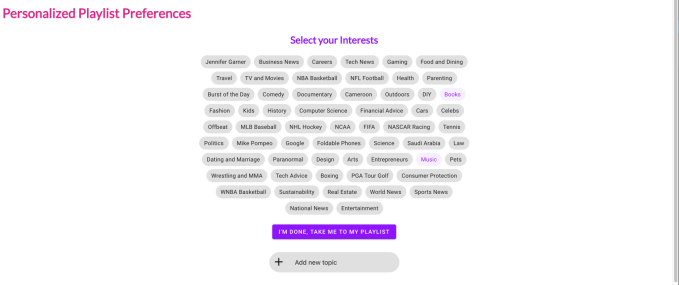
To use the feature, you first sign up on the Audioburst website, then select from a set of interests or add your own. When you’re finished with the selection process, you just hit the “I’m done” button to be taken to your personalized playlist of audio clips.

The end result is being about to listen to the parts of the podcasts or other audio programs you would actually care about, rather than slogging through half an hour or more of chatter, for the one tidbit of news you were interested in.

For example, when testing the feature this morning, I chose a variety of topics like “tech news,” “movies,” “entertainment,” “tech news,” “science,” “parenting,” and more, and was delivered a set of audio clips that included a discussion of Disney’s “Star Wars” spinoff series starring Diego Luna; a chat about the 2018 MacBook Air overhaul; an assessment the smog in L.A.; and a lot of other clips I chose to skip (but will hopefully train the A.I. further.)

You can try the feature yourself at search.audioburst.com by clicking on “Personalized Playlist” in the top left.

The results were hit or miss, which is expected – to some extent –  fresh out of the gate. But there were also times when the clips didn’t actually serve up too much information. That is, you’d still need to turn to the podcast itself for the full story.

However, the feature itself isn’t necessarily going to be used by consumers directly on Audioburst’s website.

Instead, its development came about thanks to requests from partners using its API.

The company says you can expect to see the personalized playlists integrated into its partners’ products in the smart speaker, mobile, in-car infotainment, and wearable tech space in 2019.

Audioburst currently has partnerships with Bytedance, Nippon, Bose, Harman, Samsung and more.

“Our mission is to deliver the most interesting news and audio content to our users wherever they are and personalization is the key ingredient. Through this feature, Audioburst is changing the way people consume audio in the same way that users consume music on Spotify,” said Assaf Gad, VP Marketing and Strategic Partnerships at Audioburst. “Expanding this experience through our partnerships with top OEMs, media companies and content creators means this has the power to reach users wherever they are,” he added.


from Startups – TechCrunch https://ift.tt/2FgbfSQ

#USA Audioburst turns the best part of podcasts into personalized news briefs

//

Tel Aviv-based Audioburst has been developing a search engine for audio news, which allows users to locate audio content within podcast and other talk radio programs. Today, the company is capitalizing on its technology to launch personalized playlists that deliver custom newsbriefs that get better over time the more you use the product.

The feature has been built using deep A.I. learning, the company says.

The content itself is drawn from top podcasts and the radio stations in Audioburst’s index, and will alert you to new information based on your chosen keywords and topics.

To use the feature, you first sign up on the Audioburst website, then select from a set of interests or add your own. When you’re finished with the selection process, you just hit the “I’m done” button to be taken to your personalized playlist of audio clips.

The end result is being about to listen to the parts of the podcasts or other audio programs you would actually care about, rather than slogging through half an hour or more of chatter, for the one tidbit of news you were interested in.

For example, when testing the feature this morning, I chose a variety of topics like “tech news,” “movies,” “entertainment,” “tech news,” “science,” “parenting,” and more, and was delivered a set of audio clips that included a discussion of Disney’s “Star Wars” spinoff series starring Diego Luna; a chat about the 2018 MacBook Air overhaul; an assessment the smog in L.A.; and a lot of other clips I chose to skip (but will hopefully train the A.I. further.)

You can try the feature yourself at search.audioburst.com by clicking on “Personalized Playlist” in the top left.

The results were hit or miss, which is expected – to some extent –  fresh out of the gate. But there were also times when the clips didn’t actually serve up too much information. That is, you’d still need to turn to the podcast itself for the full story.

However, the feature itself isn’t necessarily going to be used by consumers directly on Audioburst’s website.

Instead, its development came about thanks to requests from partners using its API.

The company says you can expect to see the personalized playlists integrated into its partners’ products in the smart speaker, mobile, in-car infotainment, and wearable tech space in 2019.

Audioburst currently has partnerships with Bytedance, Nippon, Bose, Harman, Samsung and more.

“Our mission is to deliver the most interesting news and audio content to our users wherever they are and personalization is the key ingredient. Through this feature, Audioburst is changing the way people consume audio in the same way that users consume music on Spotify,” said Assaf Gad, VP Marketing and Strategic Partnerships at Audioburst. “Expanding this experience through our partnerships with top OEMs, media companies and content creators means this has the power to reach users wherever they are,” he added.


from Startups – TechCrunch https://ift.tt/2FgbfSQ

#USA Framer, the interactive design platform, scores $24M Series B led by Atomico

//

Framer, the Amsterdam-based startup behind interactive design platform Framer X, has raised $24 million in Series B investment. The round is led by European VC firm Atomico, with participation from Accel, and AngelList. The startup says it will use the new capital to continue building out its platform for designers and product teams. It brings the total raised to date by Framer to $33 million.

Founded by ex-Facebookers Koen Bok and Jorn van Dijk, Framer has set out to ride (and power) a trend that is seeing every company having to become a digital business and often a product-first company, as consumers become accustomed to high quality apps and other desirable digital experiences. This means that better tools are required to prototype news apps or features, and therefore help shorten the feedback loop and speed up the development process overall.

To that end, Framer X is described as a “fully integrated design, prototyping and developer handoff tool” that makes it easy to create app designs and prototypes that are as visually polished as a production app. Designs created in Framer X are powered by the React framework, and the platform enables a lot of off-the-shelf interactivity, rather than prototypes simply being static wireframes or designs with limited transitions or hotspots. You can also export front-end code for use in your production apps, should you so desire.

However, as explained during a video presentation by Bok and Dijk, what potentially sets Framer X apart from other competing app design and prototyping tools is that you can also import production components and assets into the software for re-use so that designers aren’t continually re-inventing the wheel. Via the “Framer X Store,” these React-based components can also come from and be shared by the wider developer community. Examples include video players (such as YouTube), live maps and data generators, to UI kits and interactive design systems.

This means that Framer is attempting to be a platform play in the true sense of the word, while in turn the Framer X Store is a clever way of creating network effects. Tech brands that have their own developer ecosystems (and are in part “API businesses”) can make components and visual assets available in the store to further lower the barriers for third-party app developers who want to build integrations.

Related to this, the company is announcing the beta launch of a private design store for teams on Framer X. The Team Store enables members of teams at the same company to collaborate and share brand assets, design components, and more, so as to allow for internal interactive design systems to also live within the Framer platform.

Cue a statement from Atomico Partner Hiro Tamura, who led on behalf of the London-based venture capital firm: “The world’s best digital products, like Google, Facebook, Dropbox, Twitter and Snap, are designed and built by teams. Those teams are already using Framer X. We are excited about partnering with Koen, Jorn and the Framer team to help make that level of digital product excellence and innovation accessible to any company in any traditional industry, from financial services to retail and beyond.”

Meanwhile, the Framer founding back story is worth noting. Bok and Dijk previously founded app and design studio Sofa, which they sold to Facebook in 2011. As part of the deal they relocated to Facebook’s headquarters in the U.S., and worked on various products, reporting directly to Facebook founder Mark Zuckerberg. However, seeing an opportunity to help more companies transition to becoming digital-first and product-led, the pair left to found Framer in 2014.

from Startups – TechCrunch https://ift.tt/2OFEgqn

#USA London’s transport regulator looks to startups to help fix urban mobility

//

London’s transport regulator, TfL has announced a partnership with Bosch for its forthcoming co-working space in Shoreditch.

The civic tech project is intended to run for 18 months as a pilot — though Bosch’s ‘Connectory’ co-working facility won’t open until the end of January. A company spokeswoman confirmed the partnership is nonetheless up and running now.

The aim of the collaborative project is to share data and expertise, including by tapping into London’s startup ecosystem, to land on new ideas for tackling urban mobility issues — from traffic jams to awful air quality.

Transport issues are especially pressing for the city as London’s population is forecast to reach a staggering 10.8 million by 2041 — which would mean around six million additional trips being generated per day.

Specific issues TfL is looking for help with include developing more efficient, greener and safer vehicles; reducing congestion; and encouraging more people to walk, cycle and take public transport across London, it said today.

TfL will be providing technical knowledge and “a wide range” of datasets throughout the pilot to allow participating companies to test ideas and “understand patterns in more detail than has previously been possible”, it added.

The data will be based on its existing Unified API and open data platform, which it notes is already underpinning nearly 700 apps used by approaching half (42 per cent) of Londoners.

Startups selected for the collaboration will be provided with dedicated space within Bosch’s Connectory, alongside TfL staff who will also be based there during the pilot.

Commenting in a statement, Arun Srinivasan, executive VP and head of mobility solutions at Bosch UK said: “We believe that the collaboration between Bosch and TfL will enable us to accelerate the development of technologies, products and services that have a positive impact on city life.”

Startups will be selected by Bosch, according to a TfL spokesman. We’ve asked for more details on selection criteria.

“This new ‘urban mobility’ lab is the first of its kind with a primary focus on urban mobility, and will provide the forum for private sector partners, academia and public sector to work together to tackle a range of problems facing Londoners in years to come,” the pair said in a press release today.

“By facilitating closer collaboration, TfL and Bosch hope to support start-ups to develop a range of smart products and help them identify ways to bring them to market more quickly through open procurement,” they added.

Bosch’s co-working facility will not be solely focused on urban mobility — so they are also flagging wider opportunities for collaboration and knowledge-sharing for participating startups.

The company’s network of Connectory co-innovation spaces also links out to cities internationally, including Chicago and Stuttgart, further expanding potential knowledge-sharing opportunities.

Commenting in a statement, the mayor of London, Sadiq Khan, said: “This initiative will foster closer working between London’s tech sector and other leading tech cities. If we are to use data and smart technology to help solve the biggest problems our city faces, it’s crucial we take a more collaborative approach. I see London’s future as a global ‘test-bed city’ for civic innovation, where the best ideas are developed, amplified and scaled.”

Depending on the outcome of the pilot, TfL said the Greater London Authority may seek similar collaborative approaches to support other aspects of its work — including housing, environment and policing, aligning with the mayor of London’s strategic priorities.

“I’ve been clear I want London to become the world’s smartest city and this is a further step towards realising that ambition,” Khan added.

from Startups – TechCrunch https://ift.tt/2DB8pGx

#USA London’s transport regulator looks to startups to help fix urban mobility

//

London’s transport regulator, TfL has announced a partnership with Bosch for its forthcoming co-working space in Shoreditch.

The civic tech project is intended to run for 18 months as a pilot — though Bosch’s ‘Connectory’ co-working facility won’t open until the end of January. A company spokeswoman confirmed the partnership is nonetheless up and running now.

The aim of the collaborative project is to share data and expertise, including by tapping into London’s startup ecosystem, to land on new ideas for tackling urban mobility issues — from traffic jams to awful air quality.

Transport issues are especially pressing for the city as London’s population is forecast to reach a staggering 10.8 million by 2041 — which would mean around six million additional trips being generated per day.

Specific issues TfL is looking for help with include developing more efficient, greener and safer vehicles; reducing congestion; and encouraging more people to walk, cycle and take public transport across London, it said today.

TfL will be providing technical knowledge and “a wide range” of datasets throughout the pilot to allow participating companies to test ideas and “understand patterns in more detail than has previously been possible”, it added.

The data will be based on its existing Unified API and open data platform, which it notes is already underpinning nearly 700 apps used by approaching half (42 per cent) of Londoners.

Startups selected for the collaboration will be provided with dedicated space within Bosch’s Connectory, alongside TfL staff who will also be based there during the pilot.

Commenting in a statement, Arun Srinivasan, executive VP and head of mobility solutions at Bosch UK said: “We believe that the collaboration between Bosch and TfL will enable us to accelerate the development of technologies, products and services that have a positive impact on city life.”

Startups will be selected by Bosch, according to a TfL spokesman. We’ve asked for more details on selection criteria.

“This new ‘urban mobility’ lab is the first of its kind with a primary focus on urban mobility, and will provide the forum for private sector partners, academia and public sector to work together to tackle a range of problems facing Londoners in years to come,” the pair said in a press release today.

“By facilitating closer collaboration, TfL and Bosch hope to support start-ups to develop a range of smart products and help them identify ways to bring them to market more quickly through open procurement,” they added.

Bosch’s co-working facility will not be solely focused on urban mobility — so they are also flagging wider opportunities for collaboration and knowledge-sharing for participating startups.

The company’s network of Connectory co-innovation spaces also links out to cities internationally, including Chicago and Stuttgart, further expanding potential knowledge-sharing opportunities.

Commenting in a statement, the mayor of London, Sadiq Khan, said: “This initiative will foster closer working between London’s tech sector and other leading tech cities. If we are to use data and smart technology to help solve the biggest problems our city faces, it’s crucial we take a more collaborative approach. I see London’s future as a global ‘test-bed city’ for civic innovation, where the best ideas are developed, amplified and scaled.”

Depending on the outcome of the pilot, TfL said the Greater London Authority may seek similar collaborative approaches to support other aspects of its work — including housing, environment and policing, aligning with the mayor of London’s strategic priorities.

“I’ve been clear I want London to become the world’s smartest city and this is a further step towards realising that ambition,” Khan added.

from Startups – TechCrunch https://ift.tt/2DB8pGx

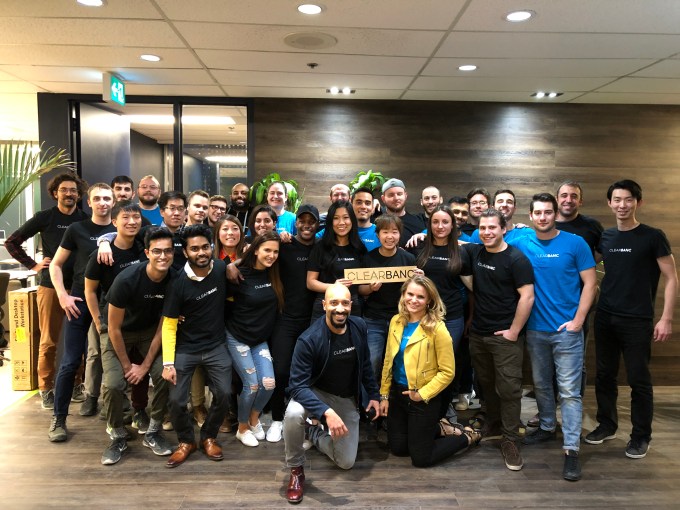
#USA Clearbanc raises $70M to fund startups with ad money for a rev share

//

Selling equity to buy Facebook and Google ads is a bad deal for startups. Clearbanc offers a fundraising alternative. For fast-growing businesses reliably earning sales from their marketing spend, Clearbanc offers funding from $5,000 to $10 million in exchange for a steady revenue share of their earnings until its paid back plus a 6 percent fee. Clearbanc picks what merchants qualify by developing tech that scanns their Stripe, Facebook ads, and other accounts to asses financial health and momentum. It’s already doled out $100 million this year.

“As a business successfully scales, we continue to provide them ongoing capital” co-founder and CEO Andrew D’Souza tells me. “Our goal is the be the first and last backer of a successful business and save the entrepreneur from having to take hundreds of pitch meetings to keep their company funded.”

After largely flying under the radar since being found in 2015, now Clearbanc has some big funding news of its own. It’s now raised $70 million from a seed and new Series A round from Emergence Capital, Social Capital, CoVenture, Founders Fund, 8VC, and more with Emergence’s Santi Subotovsky joining the board.

“Venture capital has shifted. Instead of funding true research and development, today 40% of venture capital goes directly to buying Google and Facebook ads” D’Souza explains. “Equity is the most expensive way to fund digital ad spend and repeatable growth. So we created something new.”

Clearbanc emerged from an angel investing alliance between two serial entrepreneurs. D’Souza had built Andreessen Horowitz-funded social recruiting site Top Prospect, USV-backed education tech company Top Hat, and Mastercard portfolio  biometric authentication wearable startup Nymi. He’d helped raise over $300 milliion in venture after a stint at McKinsey. He had begun co-investing with Michele Romanow, a VC from Canada’s version of the TV show Shark Tank called Dragons’ Den. She’d bootstrapped shopping hub Buytopia that acquired 10 other ecommerce companies, and discount-finder SnapSaves that she sold to Groupon in 2014.

“We started investing together in some of the deals we would see from Dragons’ Den and often found that an equity investment wasn’t the right structure for these consumer product companies. They had great economics and had found a niche of customers, but often didn’t want to exit the business at any point” D’Souza recalls. “They needed money to acquire more customers, scale up their marketing efforts and online ad spend. So we started to do these revenue share deals.”

Both engineers, they built tech to automate the due dilligence and find companies with healthy unit economics and customer acquisition costs. The partnership blossomed into Clearbanc, and romance. “We’re also a couple, so we spend a lot of time together :)” D’Souza writes.

Now Clearbanc has poured over $100 million into 500 companie in 2018 like Vinebox. The subscription wine box company used Clearbanc to grow its membership numbers while raising a Series A for developing new products. Clearbanc’s companies pay out 5 percent in revenue share until the investment plus 6 percent is paid back.

With the new cash that also comes from iNovia Capital, Real Ventures, Portag3, Precursor, WTI, Berggruen, and FJ Labs, Clearbanc plans to expand abroad after doing deals in the US and Canada. It’s also going to invest in building awareness as well as its data science capabilities.

D’Souza and Romanow must have confidence in their tech, as a wrong investment means they might never get their cash back. “We pay a lot of attention to our underwriting and decision-making process because if we make a mistake, we can lose a lot of money. Unlike a VC, we don’t expect the majority of our companies to fail and have the winners make up for the losses” says D’Souza. One big misstep could wipe out the gains from a bunch of other investments. Meanwhile, it has to break the norm of startups immediately seeking traditional venture or debt financing.

While riskier hard tech startups that will take years to get to market will still need to rely on venture, a new crop of direct-to-consumer products and other fast-monetizing startups that are already humming can avoid diluting their team and investors by using Clearbanc.

from Startups – TechCrunch https://ift.tt/2RRrEyE

#USA SAP agrees to buy Qualtrics for $8B in cash, just before the survey software company’s IPO

//

Ryan Smith of Qualtrics speaks onstage during TechCrunch Disrupt SF 2015

Enterprise software giant SAP announced today that it has agreed to acquire Qualtrics for $8 billion in cash, just before the survey and research software company was set to go public. The deal is expected to be completed in the first half of 2019. Qualtrics last round of venture capital funding in 2016 raised $180 million at a $2.5 billion valuation.

This is the second-largest ever acquisition of a SaaS company, after Oracle’s purchase of Netsuite for $9.3 billion in 2016.

In a conference call, SAP CEO Bill McDermott said Qualtrics’ IPO was already oversubscribed and that the two companies began discussions a few months ago. SAP claims its software touches 77 percent of the world’s transaction revenue, while Qualtrics’ products include survey software that enables its 9,000 enterprise users to gauge things like customer sentiment and employee engagement.

McDermott compared the potential impact of combining SAP’s operational data with Qualtrics’ customer and user data to Facebook’s acquisition of Instagram. “The legacy players who carried their ‘90s technology into the 21st century just got clobbered. We have made existing participants in the market extinct,” he said. (SAP’s competitors include Oracle, Salesforce.com, Microsoft, and IBM.)

SAP, whose global headquarters is in Walldorf, Germany, said it has secured financing of €7 billion (about $7.93 billion) to cover acquisition-related costs and the purchase price, which will include unvested employee bonuses and cash on the balance sheet at close.

Ryan Smith, who co-founded Qualtrics in 2002, will continue to serve as its CEO. After the acquisition is finalized, the company will become part of SAP’s Cloud Business Group, but retain its dual headquarters in Provo, Utah and Seattle, as well as its own branding and personnel.

According to Crunchbase, the company raised a total of $400 million in VC funding from investors including Accel, Sequoia, and Insight Ventures. It had intended to sell 20.5 million shares in its debut for $18 to $21, which could have potentially grossed up to about $495 million. This would have put its valuation between $3.9 billion to $4.5 billion, according to CrunchBase’s Alex Wilhelm.

This year, Qualtrics’ revenue grew 8.5 percent from $97.1 million in the second-quarter to $105.4 million in the third-quarter, according to its IPO filing. It reported third-quarter GAAP net income of $4.9 million. That represented an increase from the $975,000 it reported in the previous quarter, as well as its net profit in the same period a year ago of $4.7 million. Qualtrics grew its operating cash flow to $52.5 million in the first nine months of 2018, compared to $36.1 million during the same period in 2017.

In today’s announcement, Qualtrics said it expects its full-year 2018 revenue to exceed $400 million and forecasts a forward growth rate of more than 40 percent, not counting the potential synergies of its acquisition by SAP.

Qualtrics’ main competitors include SurveyMonkey, which went public in September.

from Startups – TechCrunch https://ift.tt/2PR5XkJ

#USA Travel startups are taking off

//

The second wave of Internet-era travel companies has captured the attention of venture capitalists.

In the last five years, travel companies have raised more than $1 billion in venture capital funding. That includes short-term rental startups, travel and tourism apps, marketplaces for “experiences” and other travel or hospitality tech platforms. Airbnb, a $38 billion company and an anomaly in the category, has raised $3 billion in that same time frame, according to PitchBook.

In the last few months alone, aspiring Concur-competitor TripActions and travel activities platform Klook entered the “unicorn” club with large venture rounds that valued both of the businesses at more than $1 billion. Meanwhile, luggage maker Away raised $50 million at a $400 million valuation and smaller startups in the space like Freebirds, IfOnly, KKDay, Duffel and RedDoorz all closed modest funding rounds.

“Something is really happening in the industry; something bigger than us,” TripActions co-founder Ariel Cohen said in a recent conversation with TechCrunch about his company’s $154 million Series C financing. “Different startups are identifying the opportunity here and the fact that companies want to make sure their employees are happy while they are on the go. That’s why you see investments in companies like Brex and like TripActions.”

Brex, though not classified as a travel startup, lets startup employees earn extra points on business travel with its corporate credit card for startups. It recently raised a $125 million Series C at a $1.1 billion valuation.

Global travel and tourism is one of the most valuable industries worth some $7 trillion. The online travel market, in particular, is expected to grow to $817 billion by 2020. VCs are hunting for tech-enabled startups poised to dominate that slice.

“You have a new wave of businesses where all of that digital infrastructure is set up, so the focus can be on things like efficiency, improved customer service, scale and growth — you have a ton of companies popping up catering to those needs,” Defy Partners co-founder Neil Sequeira told TechCrunch. Sequeira was a managing director at General Catalyst when the firm made its first investment in Airbnb.

On the other hand, you have a whole cohort of travel business founded amid the dot-com boom that are looking to technology startups for a much-needed infusion of innovation. Many of those larger companies have become active acquirers, fueling VC interest in the space. SAP Concur, for example, acquired the formerly VC-backed travel-booking startup Hipmunk in 2016. Before that, it bought travel planning company TripIt for $120 million, among others.

Expedia has gobbled up a number of travel brands too, like travel photography community Trover; Airbnb-competitor HomeAway, which it paid a whopping $3.9 billion for in 2015; and most recently, both Pillow and ApartmentJet.

Many of these acquisitions are for peanuts, which is far from ideal for a venture-funded company. And building a travel business is cash intensive, hence the $4.4 billion Airbnb has raised to date or even TripActions’ $236 million in total VC funding. To keep momentum in the space, companies need to be striking larger M&A deals.

It doesn’t help that many in and around the venture capital industry are predicting an imminent turn in the market. Travel companies, which are reliant upon a consumer’s tendency to spend excess cash, will be among the first sectors to be impacted by hostile economic conditions.

“If the market turns, people aren’t going to spend $10,000 on a trip to Zimbabwe,” Sequeira said, referencing companies like IfOnly, which sells curated experiences.

Travel startups should raise now while the market is hot. The conditions may not remain favorable for long.

from Startups – TechCrunch https://ift.tt/2OBzYjT

#USA A tale of two scooter cities

//

The kids in Madrid’s El Retiro Park are loving their new on-demand joyriding toys. Lime launched its scooters in the Spanish capital this summer.

Spending a weekend in the city center last month the craze was impossible to miss. Scooters parked in clusters vying for pay-to-play time. Sometimes lined up tidily. All too often not.

The bright Lime rides really stood out, though it’s not the only brand in town. Scooter startups have been quick to hop on the international expansion bandwagon as they gun for growth.

Grandly proportioned El Retiro clearly makes a great spot for taking a scooter for a spin. Test rides beget joyrides, and so the kids were hopping on. Sometimes two to one.

The boulevard linking the Prado with the Reina Sofia was another popular route to scoot.

While a busy central bar district was a hot ride-ditching spot later on. Lines of scooters were vying for space with the vintage street bollards.

The appeal was obvious: Bowl up to the bar and drink! No worries about parking or how to get your ride home afterwards. But for Saturday night revellers there was suddenly a new piece of street furniture to lurch around, with slouching handlebars sticking up all over the place. Anyone trying to navigate the pavement in a wheelchair wouldn’t have had much fun.

In another of Spain’s big tourist cities the scooter story is a little different: Catalan capital Barcelona hasn’t had an invasion of on-demand scooter startups yet but scooters have crept in. In recent years locals have tapped in of their own accord — buying not renting.

Rides are a front-of-store sight in electronics shops, big and small — costing a few hundred euros. Even for a flashy Italian design…

Electronic scooters

Take a short walk in one of the more hipster barrios and chances are you’ll pass someone who’s bought into the craze for nipping around on two wheels. There’s lots of non-electric scooters too but e-scooters do seem to have carved out a growing niche for themselves with a certain type of Barcelona native.

Again, you can see the logic: Well-dressed professionals can zip around narrow streets that aren’t always great for finding a place to (safely) lock up a bike.

There’s actually a pretty wide variety of wheeled e-rides in play for locals with the guts to get on them. Some with seats and/or handles, others with almost nothing. (The hands-in-pockets hipsters on self-balancing unicycles are quite the sight.)

In both of these Spanish cities it’s clear people are falling for — and, well, sometimes off — the micro-mobility trend.

But the difference between the on-demand scooters being toyed with in Madrid vs Barcelona’s locally owned two wheelers is a level of purpose and intent.

The Lime rides in Madrid’s center seemed mostly a tourist novelty. At least for now, having only had a couple of months to bed in.

Whereas the organic growth of scooters in Barcelona barrios is about people who live there feeling a need.

Even the unicycling hipsters seem to be actually on their way somewhere.

Hop on

What does this mean for scooter startups? It’s another example of how technology’s utility and wider societal impacts can vary when you parachute a new thing into a market and hope people jump on board vs growth being organic and more gradual because it’s led by real-world demand.

And it’s essential to think about impacts where scooters and micro-mobility is concerned because all this stuff must piggyback on shared public spaces. No one has the luxury of being able to avoid what’s buzzing up and down their street.

That’s why lots of on-demand scooters have ended up trashed and vandalized — as residents make their feelings known (having not been asked about the alien invaders in the first place).

In Europe there’s a further twist because the spaces scooter startups are seeking to colonize are already well served with all sorts of public transport options. So there’s a clear and present danger that these new kids on the block won’t displace anything. And will just mean more traffic and extra congestion — as happened with ride-hailing.

In Madrid, the first tranche of on-demand scooters seems to be generating pretty superficial and additive use. Offering a novel alternative to walking between sights or bars on a trip to-do list. Just possibly they’re replacing a short taxi or metro hop.

In the park, they were being used 100% for fun. Perhaps takings are down at the boating lake.

Barcelona has plenty of electro-powered joyriding down at the beach front in summer — where shops rent all sorts of wheels to tourists by the hour. But away from the beach locals don’t seem to be wasting scooter charge riding in circles.

They’re stepping out for regular trips like commuting to and from work. In other words, scooters are useful.

Given all this activity and engagement micro-mobility does seem to offer genuine transformative potential in dense urban environments. At least where the climate doesn’t punish for most of the year.

This is why investors are so hot on scooters. But the additive nature of micro-mobility underlines a pressing need for the technology to be properly steered if cities, residents and societies are to get the best benefits.

Scooters could certainly replace some moped trips. Even some local car journeys. So they could play an important role in reducing pollution and noise by taking trips away from petrol- and diesel-powered vehicles.

Because they offer a convenient, low-barrier-to-entry alternative with populist pull.

Not being too high speed also means, in and of themselves, they’re fairly safe.

If you’re just barrio hopping or can map most of your social life across a few city blocks there’s no doubting their convenience. Novelty is not the only lure.

Hop off

Though, equally, the local-level journeys that scooters are best suited for could just as easily be completed on foot, by bike or via public transit options like a metro.

And Barcelona’s congested streets don’t look any less packed with petrol engines — yet.

Which means scooters are both an opportunity and a risk.

If policymakers get the regulations right, a smart city could leverage their fun factor to nudge commuters away from more powerful but less environmentally friendly vehicles — with, potentially, some very major gains up for grabs.

Subsidized scooters coupled with a framework of congestion zones that levy fees on petrol/diesel engines is one simple example.

A clever policy could open the possibility of excluding cars almost entirely from city centers — so that streets could be reclaimed for new leisure and retail opportunities that don’t demand masses of parking space on tap.

Pollution is a chronic problem in almost all large cities in the world. So reshaping city centers to be more people-centric and less toxic to human health by displacing cars would be an incredible win for micro-mobility.

Even as the hop on, hop off ease of scooters offers a suggestive glimpse of what’s possible if we dare to rethink urban architecture to put people rather than four-wheeled vehicles first.

Yet get the policy wrong and scooters could end up — at very best — a frivolous irrelevance. A joyride that disrupts going nowhere. Yet another nuisance on already choked streets. An optional extra that feels disposable and gets rudely discarded because no one feels invested.

In this scenario the technology is not socially transformative. It’s more likely an antisocial nuisance. And a pointless drain on resources because it’s doing no more than disrupting walking.

Scooter startups have already run into some of these issues. And that’s not surprising given how fast they’ve been trying to grow. Their early expansionist playbook does also risk looking like Uber all over again.

Yet Uber could have pioneered micro-mobility itself. But being ‘laser focused on growth’ seemingly gave the company tunnel vision. Only now, under a new CEO, it’s all change. Now Uber wants to be a one-stop platform for all sorts of transport options.

But how many years did it waste missing the disruptive potential of micro-mobility coming down the road because it was too busy trying to fit more cars into cities — and ignoring how residents felt about that?

An obsession with growth at all costs may well be a side effect of major VC dollars flooding in. But for startups it really does pay to stay self-aware, perhaps especially when you’re rolling in money. Else you might find your investors funding your biggest blind spot — if you end up missing the next even more transformative disruption.

The really clever trick to pull off is not ‘scale fast or die trying’; it’s smart growth that’s predicated upon applying innovative technologies in ways that bring whole communities along with them. That’s true transformation.

For scooters that means not just dumping them on cities without any thought beyond creaming a profit off of anything that moves. But getting residents and communities engaged with the direction of travel. Partnering with people and policymakers on the right incentives to steer innovation onto its best track.

Move people around cities, yes, and shift them out of their cars.

There’s little doubt that Uber’s old ‘growth at any cost’ playbook was hugely wasteful and damaging (not least to the company’s own reputation). And now it’s having to retrofit a more inclusive approach at the same time as unpicking an ‘environmentally insensitive’ legacy that original playbook really doesn’t look so smart.

Scooter startups are still young and have made some of their own mistakes trying to chase early scale. But there are reasons to be cheerful about this new crop of mobility startups too.

Signs they see value and opportunities in being pro-actively engaged with the environments they’re operating in. Having also learnt some hard early lessons about the need to be very sensitive to shared spaces.

Bird announced a program this summer offering discounted rides to people on low incomes, for example. Lime has a similar program.

These are small but interesting steps. Here’s hoping we’re going to see a lot more.

from Startups – TechCrunch https://ift.tt/2ODlX57

#USA Bubble lets you create web applications with no coding experience

//

Meet Bubble a bootstrapped startup that has been building a powerful service that lets you create a web application even if you don’t know how to code. Many small and big companies rely on Bubble for their website.

I have to say I was quite skeptical when I first heard about Bubble. Many startups have already tried to make coding as easy as playing with Lego bricks. But it’s always frustratingly limited.

Bubble is more powerful than your average website building service. It recreates all the major pillars of web programming in a visual interface.

It starts with a design tab. You start with a blank canvas and you can create web pages by dragging and dropping visual elements on the screen. You can put elements wherever you want, resize maps, text boxes, images and more. You can click on the preview button to see the development version of your time whenever your want.

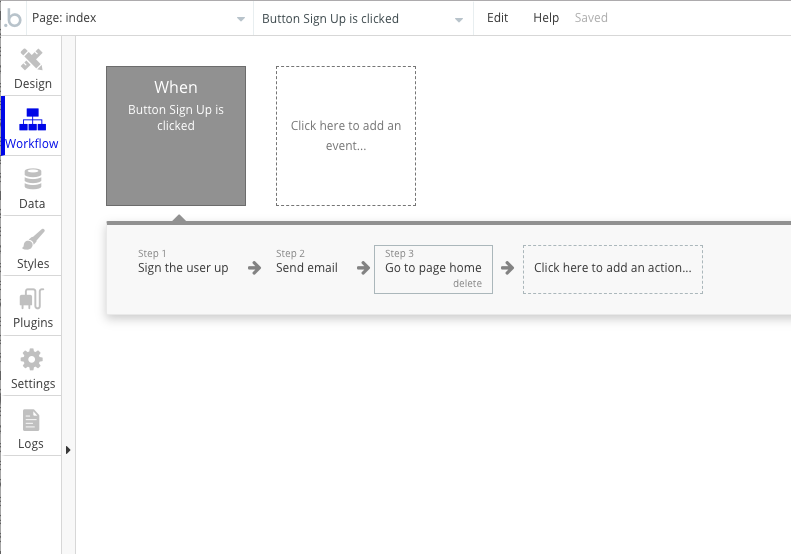
In the second tab, you can create the logic behind your site. It works a bit like Automator on the Mac. You add blocks to create a chronological action. You can set some conditions within each block.

In the third tab, you can interact with your database. For instance, you can create a sign up page and store profile information in the database. At any time, you can import and export data.

There are hundreds of plugins that let you accept payments with Stripe, embed a TypeForm, use Intercom for customer support via chat, use Mixpanel, etc. You can also use your Bubble data outside of Bubble. For instance, you can build an iPhone app that relies on your Bubble database.

Many small companies started using Bubble, and it’s been working fine for some of them. For instance, Plato uses Bubble for all its back office. Qoins and Meetaway run on Bubble. Dividend Finance raised $365 million and uses Bubble.

The startup takes care of hosting your application for you. Every time you resize your instance as your application gets bigger, you pay more.

Even though the company never raised any money, it already generates $115,000 in monthly recurring revenue. Bubble is still a small startup, which can be scary for bigger customers. But the company wants to improve the product so that customers don’t see the limitations of Bubble. Now, the challenge is to grow faster than customers’ needs.

from Startups – TechCrunch https://ift.tt/2Pp4tPc