#USA Nested, the online estate agent that makes home sellers ‘chain-free’, raises further £120M

//

Nested, the London-based “data-driven” estate agency that provides a cash advance to help you buy a new home before you’ve sold your old one, has raised a further £120 million in funding. The new round is a mixture of equity and debt: £20 million and £100 million, respectively. Leading the equity round is Northzone, and Balderton Capital, while the debt finance comes from an unnamed institutional investor.

It is noteworthy that Balderton has only just invested in Nested several rounds into the company’s existence, considering that the London-based venture capital firm typically invests earlier at Series A. Balderton is also a backer of GoCardless, the payments company previously co-founded by Nested founder Matt Robinson. That said, Balderton General Partner Tim Bunting did invest in Nested in a personal capacity very early on.

Launched in late 2016, Nested competes with high-end estate agents by providing all of the services needed to sell your house, but with a key difference. In addition to handling valuation, marketing and sales, the startup will loan you up to 95 per cent of the market value of your property as a cash advance, that way you’re able to purchase a new home prior to your old one selling. Before Brexit and the uncertainty it has caused with regards to London house prices, that figure was up to 97 percent of the market value of the property, and I understand Nested hopes to return to that percentage once things settle down.

More broadly, the idea behind Nested is to eliminate much of the stress and uncertainty of selling and buying a home, including what your final budget will be, and also ensure that you’re never caught up in the dreaded property ‘chain’ and miss out on your desired home, or are kept in limbo indefinitely waiting for your property to sell. By becoming a cash buyer, it also puts you in the strongest possible position to negotiate on your onward purchase. Robinson says this typically sees savings of 2-4 percent.

In return, Nested charges a fee from 2-4 per cent (plus VAT) depending on how soon you want to receive the advance, and takes a loss if it fails to sell the property for an amount above its initial advance. The idea is to incentivise the startup to always try to get you the genuine market price or more.

TechCrunch’s Steve O’Hear giving Nested’s Matt Robinson (pictured right) a hard time at Startup Grind London earlier this year.

Asked how well that is working out so far, Robinson tells me historical valuation accuracy is on average within 1.5 percent of what the company predicted. Better still, Nested is running at 100 percent accuracy for 2018 and is confident enough to make this data public.

“The traditional agents don’t even track it and the online players do their best to obscure the fact that they sell only roughly 4/10th of properties they take on i.e. most customers pay them £1,000 up-front to not sell their house and are left out-of-pocket!” says the Nested founder.

To date, Nested has helped over 400 home-owners, and, aside from increasing volume, including helping property owners outside of London, the company says it plans to further expand its product offering. The bulk of these new products will continue to target sellers to “radically improve the selling experience”. However, I understand that since sellers are buyers, too, future services could also include using Nested’s data, tech and expertise to help with the buying process as well.

Adds Robinson in a statement: “We’re excited to receive the backing from some of Europe’s top VCs who share our vision for fixing the age-old problem of buying and selling homes. We are building an incredible team to offer an unassailable service with the most progressive technology in the property industry. This investment will allow us to continue solving the problems that prevent people from moving home with ease”.

from Startups – TechCrunch https://ift.tt/2T73GRx
#USA Can the startup building a Fortnite for VR become the Fortnite of VR?

//

Virtual reality hasn’t proven itself to be the lucrative escape of the every-man, but the medium has done a fairly good job enticing the gaming community and keeping that niche (mostly) happy. While a couple of big titles have gotten some halfway-decent ports to VR, for the most part VR users are confined to whatever indies can build or whatever Oculus can fund.

BigBox VR has been trying to capture attention in the space by not building solo adventures that lead users to find themselves, but instead by trying to match VR’s physicality and immersion with social gameplay that leads users to gain greater appreciation for the medium’s scale.

The company just closed a $5 million funding round led by Shasta Ventures with participation from GSR Ventures and Pioneer Square Labs Ventures. As part of the round, Shasta partner Jacob Mullins will be getting a seat on the board.

Venture cash for VR content hasn’t exactly been free-flowing in 2018, more so for startups that aren’t caught up in building out a “platform play.” Co-founders Chia Chin Lee and Gabe Brown are more interested in just building out titles and hopefully creating one so successful that they don’t have to stop evolving it. The team at BigBox VR got its start with a cartoonish shooter title called Smashbox Arena; the small team has been really interested in finding what VR enables when it comes to competitive online play.

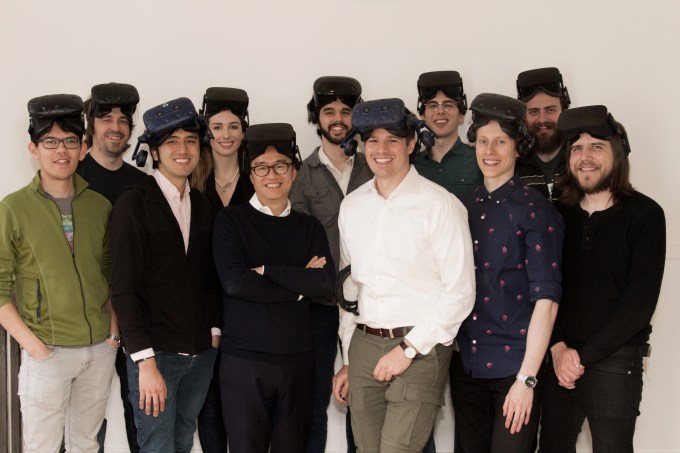
The BigBox VR team

Funding rounds aren’t often about the achievements of the past; however, the company is currently going full-steam ahead with its next ambitious title, a battle royale title called “POPULATION: ONE.”

I had a chance to suit up in VR and dive-in with Jacob and the founding team. I got my ass kicked a couple times, but then they let me win at some point, which I admit I was pretty okay with.

To say the game shares some similarities with Fortnite is an understatement. Not only is it a battle royale title with a shrinking environment, but certain mechanics like gliding in at the beginning to scrounge for weapons and even Fortnite’s building feature are central to the gameplay. That being said, battle royale titles have exploded in the wake of PUBG and they seem to all share a lot among each other. For BigBox, VR is the distinguishing feature, with motion controls and the general feeling that everything is life-sized and in your control.

To be honest, a lot of it really does work. Every surface in the game is climbable (by physically grabbing surfaces with the controllers and then doing the arm-work to scale) but more central movements like turning and moving are left to buttons, a technique that ultimately isn’t for the faint of stomach but is a lot more fluid than teleporting around. There are certainly mechanics which could have felt smoother, but this is a private beta game with a lot of room to finesse.

One of the really powerful things about the game was what happened after I was repeatedly sniped and killed off early on in the first couple rounds. The spectator mode is great and it’s interesting how much the precise controls of VR lend to allowing you to get more actively enveloped in matches that you aren’t even competing in. There are companies in the VR space working exclusively on this, but for a gaming audience obsessed with streamers, adapting traditional games with a VR spectating workflow or doing so natively seems like a huge opportunity.

Battle royale games remain white-hot, and VR game studios have been trying to find the right way to get a slice of the pie. Perhaps the key is knowing where to innovate while also realizing that the multi-platform grandiose of Fortnite has yet to find its way to VR, so maybe finding a title that scratches that itch is the best place to start.

from Startups – TechCrunch https://ift.tt/2Dcg1OC

#USA Growing pains at venture-backed Moogsoft lead to layoffs

//

Eight months after bringing in a $40 million Series D, Moogsoft‘s co-founder and chief executive officer Phil Tee confirmed to TechCrunch that the IT incident management startup had shed 18 percent of its workforce or just over 30 employees.

The layoffs took place at the end of October; shortly after, Moogsoft announced two executive hires. Among the new additions is Amer Deeba, who recently resigned from Qualys after the U.S. Securities and Exchange Commission charged him with insider trading.

Founded in 2012, San Francisco-based Moogsoft provides artificial intelligence for IT operations (AIOps) to help teams avoid outages and work more efficiently. The startup has raised $90 million in equity funding to date, garnering a $220 million valuation with its latest round, according to PitchBook. It’s backed by Goldman Sachs, Wing Venture Capital, Redpoint Ventures, Dell’s corporate venture capital arm, Singtel Innov8, Northgate Capital and others. Wing VC founder and long-time Accel managing partner Peter Wagner and Redpoint partner John Walecka are among the investors currently sitting on Moogsoft’s board of directors.

Tee, the founder of two public companies in Micromuse and Riversoft, admitted the layoffs affected several teams across the company while emphasizing that the cuts were not a sign of a struggling business, but rather a right of passage for a startup seeking venture scale.

“We are a classic VC-backed startup that has sort of grown up,” Tee told TechCrunch earlier today. “In pretty much every successful company, there is a point in time where there’s an adjustment in strategy … Unfortunately, when you do that, it becomes a question of do we have the right people?”

Moogsoft doubled revenue last year and added 50 Fortune 200 companies as customers, according to a statement announcing its latest capital infusion. Tee said he’s “extremely chipper” about the road ahead and the company’s recent C-suite hires.

Moogsoft’s newest hires, CFO Raman Kapur (left) and COO Amer Deeba (right).

The company announced its latest executive hires on Nov. 2, only one week after completing the round of layoffs, a common strategy for companies looking to cast a shadow on less-than-stellar news, like major staff cuts. Moogsoft has brought on former Splunk vice president of finance Raman Kapur as its first-ever chief financial officer and Amer Deeba, a long-time Qualys executive, as its chief operating officer.

Deeba spent the last 17 years at Qualys, a publicly-traded provider of cloud-based security and compliance solutions. In August, he resigned amid allegations of insider trading. The SEC announced its charges against Deeba on Aug. 30, claiming he had notified his two brothers of Qualys’ missed revenue targets before the company publicly announced its financial results in the spring of 2015.

“Deeba informed his two brothers about the miss and contacted his brothers’ brokerage firm to coordinate the sale of all of his brothers’ Qualys stock,” the SEC wrote in a statement. “When Qualys publicly announced its financial results, it reported that it had missed its previously-announced first-quarter revenue guidance and that it was revising its full-year 2015 revenue guidance downward. On the same day, Deeba sent a message to one of his brothers saying, “We announced the bad news today.” The next day, Qualys’s stock price dropped 25%. Although Deeba made no profits from his conduct, Deeba’s brothers collectively avoided losses of $581,170 by selling their Qualys stock.”

Under the terms of Deeba’s settlement, he is ineligible to serve as an officer or director of any SEC-reporting company for two years and has been ordered to pay a $581,170 penalty.

Tee, for his part, said there was never any admission of guilt from Deeba and that he’s already had a positive impact on Moogsoft.

“Amer is a tremendously impressive individual and he has the full confidence of myself and the board,” Tee said.


from Startups – TechCrunch https://ift.tt/2AYfxdo

#USA Pure Bit, a South Korean exchange, pulls a $2.8 million exit scam

//

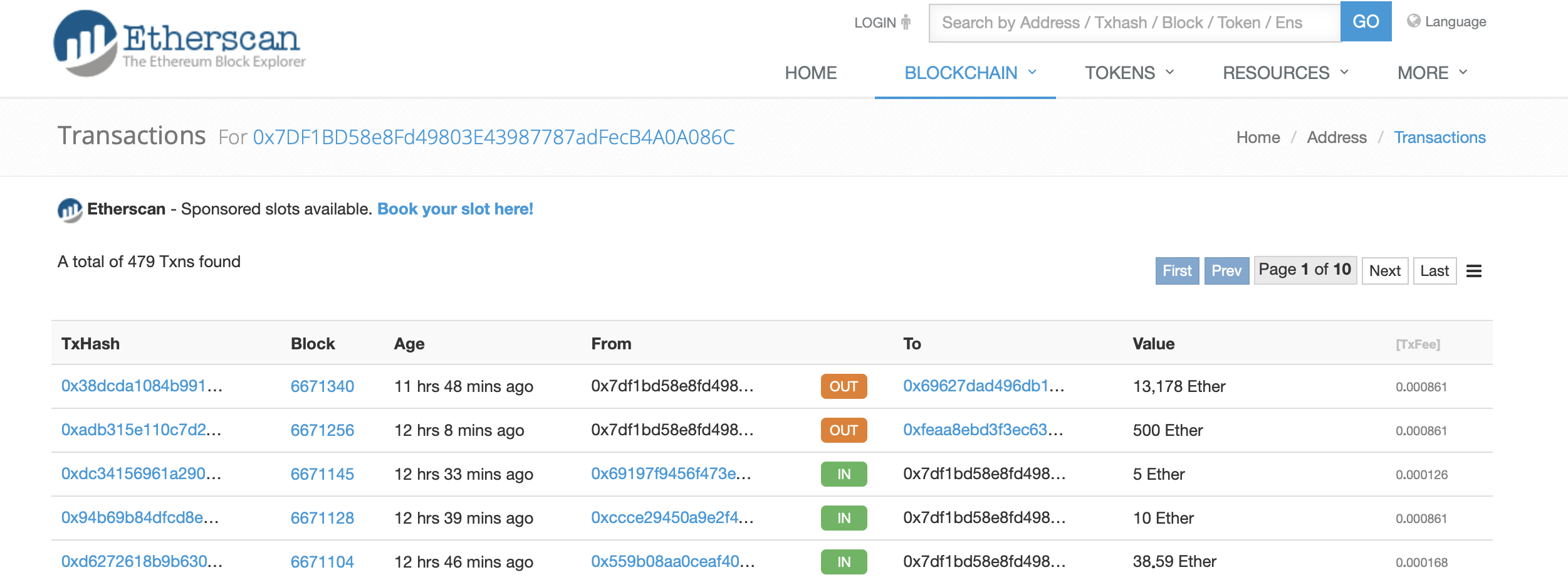
Another day, another exit scam. This time it comes to us from South Korea where an exchange, Pure Bit, has completely shut down after raising $2.8 million in Ethereum from investors.

The exchange, which promised to deliver something call Pure Coin, was live yesterday and today is completely shut down after posting “Sorry” and “Thanks” to their communications channels.

According to a Reddit thread, the team was anonymous and that the process of building and pumping exchange tokens is a “popular trend in Korea.”

“They have gotten rid of every evidence,” wrote one reader. “Website hosted by fake name / out of Korea host / messenger / contacts were all fake too. Now their only hope is to keep on track with that ether and hope for the best.”

There is no proof yet that the team has pulled a full exit scam – there are examples of founders pretending to scam their investors to “teach them a lesson” – but given the abrupt movement of 13,000 ETH out of the collection wallet we can assume that the story ends here.

Even their chat room, hosted on their own site, is shut down.

It should be noted that South Korea has banned ICOs, giving scammers the perfect cover for absolute anonymity.

from Startups – TechCrunch https://ift.tt/2qzgbrU

#USA Everything you missed from the Startup Battlefield Latin America

//

The tech scene in São Paulo is an absolute delight, and we’re honored to have seen such an amazing turnout at the Startup Battlefield Latin America.

In case you missed it, we’ve put together a little recap of the event below.

Editor’s Note: We will embed videos from the event as soon as they’re available.

A China Twist to Brazil’s Mobility Revolution

Featuring Ariel Lambrecht (Yellow), Eduardo Musa (Yellow), Tony Qiu (Didi Chuxing), Hans Tung (GGV)

Mobility is a massive challenge for megacities around the world, including Sao Paulo. The first panel of the event featured notable founders and investors attempting to solve this problem in Brazil and throughout Latin America.

Eduardo Musa is the cofounder and CEO of Yellow and was joined on stage by his cofounder Ariel Lambrecht. Lambrecht also founded the mobility company 99, which is the only startup worth more than 1 billion USD in Brazil. Didi Chuxing recently invested and purchased 99, and current CEO and former investor Tony Qiu sat on the panel as well. Lastly, Hans Tung, managing partner at the Silicon Valley firm GGV and lead investor on 99’s latest round, joined the group. The panel was moderated by TechCrunch’s Managing Editor, Matt Burns.

Both Musa and Qiu acknowledged the crisis facing the Brazilian market and noted parallels with the Chinese market. Both markets have megacities with a diverse population, and there are countless opportunities for startups to address.

Throughout the panel, it was noted that Brazilian startups face several obstacles including finding enough talent and investment. The panelists agreed that often companies in Brazil are looking to Silicon Valley for both. For hiring, they said, there are not enough engineers locally, and to obtain funding, it’s best to show growth to local investors and the look tow Silicon Valley for additional investors.

Fireside Chat with Cristina Junquiera (Nubank) and David Velez (Nubank)

Any kind of partnership with a global internet giant is a big win for a startup. Nubank co-founders David Velez and Cristina Junquiera took the stage at Startup Battlefield Latin America to discuss Tencent’s $180M investment into their Sao Paulo-based digital banking company. Nubank is has raised over $700M from hard hitting investors like DST and Sequoia, valuing the company at over $4B, so it’s not about the money. While the invest to buy strategy is common for Chinese internet giants, Velez says that isn’t the goal for Nubank.
The founders are focused on the 20 million customers who have already applied for their credit card, and building culture from the ground up. There’s a lot wrong with Brazilian banks, and Nubank is taking a customer-focused approach to provide its digital banking service for Brazil’s huge population. When you’re one of the most successful companies in a region, you feel a responsibility to give back to the ecosystem. The best way to do that, say Velez and Junquiera, is to set an example of success.

Venture Investing In Latin America Today

Featuring Eric Acher (Monashees),Veronica Allende Serra (Innova Capital Consultoria Ltda), Hernan Kazah (Kaszek), Fernando Lelo de Larrea (ALLVP)

Latin American startup companies have hit an inflection point. No longer an afterthought for global investment firms the region is on pace to surpass $1 billion in committed capital for the second year in a row.

Driving that growth, according to investors Eric Acher, the co-founder of Monashees; Veronica Allende Serra, the founder of Innova Capital; Hernan Kazah of Kaszek Ventures and Fernando Lelo de Larrea of ALL VP; is a rash of exits like the public offering for the payment technology provider Stone and the sale of ride-hailing company, 99, to the Chinese global giant mobility company, DiDi.

Yet, as the market grows, entrepreneurs need to consider the partners they’re bringing on board as the aim for international growth. And while Brazil leads the pack in terms of committed capital — grabbing 73% of the total money invested in the region in the first half of the year — Argentina, Colombia, Mexico, Peru and Chile are all emerging as important capital markets in their own right.

20 Years Ahead of the Curve

Featuring Fabricio Bloisi (Movile)

For Fabricio Bloisi, the journey to building a multi-billion dollar company in Movile wasn’t always easy. Building a business requires making tough decisions along the way and a commitment to constantly churning through ideas.

Over the first ten years of its existence, Movile struggled as a smaller content provider. It was once the company agreed to consolidate and control more of the market that it began to grow, Bloisi said.

Now, businesses like iFood, which brought in over $100 million in revenue in the month of October alone, and new payment businesses like Zoop and its delivery and logistics companies, are contributing to a powerhouse that Bloisi thinks could be a $10 billion company in a few years.

Bloisi believes in the region, and the promise it holds for local and international investors to build more multi-billion dollar businesses. The future belongs to the entrepreneurs in the audience, Bloisi said. And if they can make the tough decisions (and get the right investment partners) they could find themselves on the TechCrunch stage.

New Wave Latin Founders

Ana Lu McLaren (Enjoie), David Arana (Konfio), Sebastian Mejia (Rappi), Juan Pablo Bruzzo

A vast majority of startup and investment activity across Latin America is coming out of Brazil. But that doesn’t mean entrepreneurship doesn’t thrive in other parts of the region. Rappi co-founder Sebastian Mejia, Konfio’s David Arana, Moni’s Juan Pablo Bruzzo and Ana McLaren from Enjoie discussed the challenges of launching and scaling an early stage tech company in this new wave founder discussion. Volatile economies, scarce technical talent, and undercapitalized markets aren’t so much challenges, but opportunities for these founders.

Logistics, fintech and ecommerce sectors are getting shaken up by these founders, and the foreign investment dollars are following. Rappi just raised a $200M round to grow its last-mile delivery service, and

from Startups – TechCrunch https://ift.tt/2qEN7iG

#USA Burgerbot startup Creator hires inventor of Boston Dynamics’ Big Dog

//

Disney Imagineering animatronics wizard Dr. Martin Buehler is a legend in the robotics world. His work leading development of the galloping Big Dog quadruped at Boston Dynamics both inspired and terrified a new generation of makers. But after playing in the worlds of fantasy and science fiction that consumers can’t buy, Buehler has been poached to work on something much more tangible. In fact, it’s edible. He’s joining burger-making robot startup Creator as VP of engineering.

“It was a great experience working on experimental validation [at Boston Dynamics]” Buehler tells me, “But one of the things I really value at Creator is the immediacy of real impact to real people. With burgers being such a big segment of the food market, we have the potential to touch millions of people.” Creator opened its first restaurant to the public in September, selling San Franciscans gourmet hamburgers at a surprisingly low $6 price tag by replacing a kitchen full of cooks with a massive, transparent robot.

Formerly known as Momentum Machines, Creator has raised over $24 million according to SEC filings. It hopes to make fast-food healthier, tastier, and cheaper by saving money on labor to replace preserved ingredients with premium, freshly cut beef, cheese, and veggies. Patrons can choose from several burger styles, and then get to watch their bun sliced and toasted as a conveyor belt slides it beneath dispensers for other fixins. Instead of cooking, the restaurant staff serves a concierge to customers while keeping the robot stocked.

With Buehler’s help, Creator could make the robot more efficient, flexible enough to handle more custom orders, and more delightful to watch…and Instagram. The whole restaurant industry is trying to become more shareable on social media with kitschy decor and plating. But the robot gives Creator natural virality by making the cooking process itself entertainment — like some futuristic Benihana.

Creator’s new VP of Engineering Dr. Martin Buehler

“At Disney I was in charge of robotics at Imagineering. We used advanced robotics and AI to bring walking and talking Disney characters to life so our guests who meet the characters on the silver screen first can meet and interact with them physically in the parks. What I really learned was to position technology as second fiddle to the guest experience” he tells me.

Buehler calls Creator “a stunning symphony of motion —  the visual experience supports the central culinary experience. The downfall of a lot of robotics companies is that they fall in love with the technology and they lose track of what it takes to deliver value to the customer.” Creator’s approach is working so far. The company claims to be hitting its revenue targets and have a higher net promoter score than fast-food favorite Chick-Fil-A.

But the success of the company will depend on its ability to scale. Creator co-founder and CEO Alex Vardakostas reveals that “the next announcement is going to be more burger stores.” That means the Creator contraption can’t be a one-off art piece. “Right now “Right now the task at hand is to make the current robot scalalable — make it cost less and more reliable — so we can provide robots to many more restaurants” Buehler says.

The concern, though, is that Creator could be the tip of the spear of automation decimating employment as food service workers are replaced by bots. Vardakostas grew up flipping burgers himself at his parents’ restaurant, and he believes machines can take care of the dirty and dangerous work that perhaps humans shouldn’t be doing in the first place. The company already pays its service workers $16 and hour, and offers ‘five percent time’ where they can take time to read or learn about the culinary arts. Eventually it hopes to retrain former fast-food cooks in robot maintenance to offer them a path get paid more.

“The basic mission of the founders is to build a company culture focused on learning and personal development. I like the aspect of the service of giving back” Buehler says. “All the team members get coaching to help them grow, not just technically but personally.

from Startups – TechCrunch https://ift.tt/2FaV9da

#USA SoftBank’s debt, Ford buys Spin, and Chinese coffee is huge money

//

Hello and welcome back to Equity, TechCrunch’s venture capital-focused podcast, where we unpack the numbers behind the headlines.

This week was a blast. Connie and I were in the studio with our guest, True Ventures’s Tony Conrad, while Danny repped the other side of the country, dialing in from New York.

It was another week shaped by news from Asia. Once we had sorted the sartorially expedient, we first turned to the world of SoftBank, this time taking a close look at its debt load. While SoftBank is currently famous for its investments through its Vision Fund, the company is picking up some notable, debt-powered investments into its vehicle that could add to its risk profile.

After all, who doesn’t want more risk as 2018 comes to a close?

Moving on, Ford is doubling-down on its wager that mobility means more than cars, this time picking up Spin for some sum of money between $40 and $100 million, with most figures coming in a bit light from the nine-figure range.

We care as it’s a fresh turn in the scooter skirmish, not to mention the greater micromobility wars. Bird and Lime have a new competitor that has, possibly, super-deep pockets.

Next, we took a peek at Luckin Coffe’s meteoric rise. This is where our guest selection really showed off; Conrad is a former investor in Blue Bottle, making him a functional caffeine expert. We dug through margins, growth, and why venture players are interested in Luckin at all.

And finally, a look at how recently-public companies are selling more shares after their initial debut. So, when it comes to money on the table, don’t fret it too much.

Equity drops every Friday at 6:00 am PT, so subscribe to us on Apple PodcastsOvercast, Pocket Casts, Downcast and all the casts.

from Startups – TechCrunch https://ift.tt/2zEjmmk

#USA Sneaker marketplace GOAT announces an AR-centric Black Friday giveaway

//

Black Friday giveaways have become a tradition for online sneaker marketplace GOAT. Today it’s announcing the details of this year’s campaign, which will be its first to incorporate augmented reality.

Director of Communications Liz Goodno described this as “the largest digital sneaker event of the year.” The company says it will be offering more than 1,000 prizes, including sneakers like the Air Jordan 1 Retro High OG Shattered Backboard, KAWSx Air Jordan 4 Retro Black, Pharrell x BBC x NMD Human Race Trail Heart/Mind, plus curated sneaker packs and up to $10,000 in GOAT credit.

You can enter the drawing anytime between now and 11:59pm Pacific on Thursday, November 22, with the winners notified at noon on Black Friday.

All participants will receive 100 tickets, but you can earn bonus tickets by visiting locations on an interactive GOAT map, which will highlight spots around the world that are tied to all-time great athletes and to sneaker history. Those locations really are global, and they include “Sneaker Street” in Hong Kong, San Francisco’s Moscone Center (where the iPhone debuted) and the location of Muhammad Ali’s historic victory over George Foreman in the Democratic Republic of Congo.

Also on the list are the New York and Los Angeles locations of Flight Club, the famous sneaker retailer that GOAT merged with earlier this year. And you can earn even more tickets by sharing augmented reality graphics that superimpose a “Greatest of All Time” message, or a newspaper highlighting sneaker history, on real-world imagery.

GOAT

IT Manager Clint Arndt, CEO Eddy Lu

GOAT showed off the AR capabilities at an event with Apple last week at Flight Club New York. The AR elements were built using Apple’s ARKit, and it sounds like the startup plans to do more with the technology in the future.

“We’ve always wanted to incorporate augmented reality technology,” Goodno said, but the challenge, until ARKit, was integrating the technology into the GOAT app. “As a sneaker marketplace there are so many use cases for AR.” (Nike has also been using AR to connect with sneakerheads through its SNKRS app.)

At the event, co-founder and CEO Eddy Lu also talked about the company’s plans beyond AR, saying that “next year, international is a huge thing for us” — which means it’ll be doing more to localize its apps. In addition, it’s getting ready to open its next Flight Club store, this time in Miami.

from Startups – TechCrunch https://ift.tt/2OzBymk

#USA Olho do Dono is the winner of Startup Battlefield Latin America

//

Fifteen startups spent the day presenting onstage in São Paulo, Brazil. For the finalists, that meant presenting twice — once in the initial rounds, then again for our finalist judges.

This was all part of Startup Battlefield Latin America, an event that we put on in partnership with Facebook’s FB Start program. After a full day of pitches and panels, the judges have chosen a winner, who will receive $25,000 (equity free) and a trip for two to TechCrunch Disrupt San Francisco 2019.

Check back on TechCrunch tomorrow to watch the full videos of the presentation. In the meantime, our winner (all descriptions provided by the companies):

Olho do Dono

Olho do Dono offers software that uses a portable 3D camera to estimate cattle weight, allowing cattle owners to monitor livestock weight evolution in a frequent and stress-free manner.

And our runner up:

Unima

Unima developed a fast and low-cost diagnostic and disease surveillance technology that allows anyone, even people with no technical training, to diagnose a disease at the point of care, without using lab equipment, with results in 15 minutes and at $1 per test.

And our finalists:

1Doc3

1Doc3 has developed a platform that allows users to ask healthcare questions to doctors anonymously, and for free.

Agilis

Agilis is an online asset-backed lending platform, based in Argentina. Agilis monetizes customer assets to empower them with simple and fast access to convenient financing.

Cuenca

Cuenca offers a no fee, fast response banking service.

from Startups – TechCrunch https://ift.tt/2PfY6hc

#USA AdRoll expands its B2B data and tech by acquiring Growlabs

//

AdRoll Group announced today that it has acquired Growlabs, a two-year-old startup with business-to-business sales tools tools and data.

While AdRoll is best known for its retargeting technology for consumer advertising, it’s been building out a suite of B2B marketing technology under its RollWorks business unit, which launched earlier this year.

The company says that by marrying its artificial intelligence technology with Growlabs’ database of 12 million companies and 320 million business identities, as well as the startup’s lead generation and sales automation tools, it can help customers run multi-channel campaigns with messages that are automatically sequenced to the sales stage.

Asked why Growlabs was an appealing acquisition target, CEO Toby Gabriner (who joined AdRoll last year) told me via email that both quantity and quality of data is crucial for building an account-based marketing program.

“Growlabs has not only built one of the largest B2B data-sets, but more importantly they have developed a number of industry leading techniques to ensure that the data is accurate,” Gabriner said. “With the combination of the Growlabs and AdRoll Group identity graphs, our RollWorks division will provide our customers access to one of the largest independent B2B identity graphs in the world.”

The financial terms of the acquisition were not disclosed, but Gabriner said the entire 18-person Growlabs team will be joining AdRoll.

“Our mission has always been to help marketers grow fast – a
mission we share with AdRoll Group,” said Growlabs CEO Ben Raffi in the acquisition announcement. “Together, we’ll accelerate marketers’ ability to drive revenue.”

from Startups – TechCrunch https://ift.tt/2PgcA0s