#USA AdRoll expands its B2B data and tech by acquiring Growlabs

//

AdRoll Group announced today that it has acquired Growlabs, a two-year-old startup with business-to-business sales tools tools and data.

While AdRoll is best known for its retargeting technology for consumer advertising, it’s been building out a suite of B2B marketing technology under its RollWorks business unit, which launched earlier this year.

The company says that by marrying its artificial intelligence technology with Growlabs’ database of 12 million companies and 320 million business identities, as well as the startup’s lead generation and sales automation tools, it can help customers run multi-channel campaigns with messages that are automatically sequenced to the sales stage.

Asked why Growlabs was an appealing acquisition target, CEO Toby Gabriner (who joined AdRoll last year) told me via email that both quantity and quality of data is crucial for building an account-based marketing program.

“Growlabs has not only built one of the largest B2B data-sets, but more importantly they have developed a number of industry leading techniques to ensure that the data is accurate,” Gabriner said. “With the combination of the Growlabs and AdRoll Group identity graphs, our RollWorks division will provide our customers access to one of the largest independent B2B identity graphs in the world.”

The financial terms of the acquisition were not disclosed, but Gabriner said the entire 18-person Growlabs team will be joining AdRoll.

“Our mission has always been to help marketers grow fast – a
mission we share with AdRoll Group,” said Growlabs CEO Ben Raffi in the acquisition announcement. “Together, we’ll accelerate marketers’ ability to drive revenue.”

from Startups – TechCrunch https://ift.tt/2PgcA0s

#USA Datacoral raises $10M Series A for its data infrastructure service

//

Datacoral aims to make it easier for enterprises to build data products by abstracting away all of the complex infrastructure to organize and process data. The company today announced that it has raised a $10 million Series A financing round led by Madrona Venture Group, with participation from Social Captial, which also led its $4 million seed round in 2017.

Datacoral CEO Raghu Murthy tells me that the company plans to use the new funding to grow its business team in order to be able to reach more potential customers and to expand its engineering team as well.

The promise of Datacoral is to offer enterprises an end-to-end data infrastructure that will allow businesses and their data scientists to focus on generating insights over having to manage and integrate their data sources. Since nobody wants to move large amounts of data between clouds — and take the performance hit that comes with that — Datacoral sits right inside a company’s AWS systems. It’s still a fully managed service, though, but the data is encrypted and never leaves a customer’s virtual private cloud.

“As companies look to their data to deliver value – data practitioners are finding that configuring and managing their own data infrastructure is a time-consuming job that is expensive and fraught with errors,” said Murthy. “We have built a platform that easily and automatically brings together data from different applications and databases, organizes that data in any query engine and acts on insights that are critical to running their business. A crucial component is that it works securely and privately within the customer’s cloud, instead of us ingesting data from their systems.”

Murthy was an early engineer at Facebook and part of the team that was in charge of scaling that company’s data infrastructure and ran a part of the engineering team at Bebop, Diane Greene’s startup that was later acquired by Google.

To scale Datacoral, the team is betting on a serverless platform itself. It’s making extensive use of AWS Lambda and other PaaS solutions on Amazon’s cloud computing platform. That doesn’t mean Datacoral plans to only support AWS, though. Murthy tells me that Azure support is next. “We plan to work across all of the top cloud providers by leveraging their unique services and provide a consistent ‘data-centric interface’ to our customers — essentially be ‘cloud best’ instead of ‘cloud agnostic.’”

Current Datacoral users include Greenhouse, Front, Ezetap, Swing Education, mPharma and Mason Finance.

from Startups – TechCrunch https://ift.tt/2Pfx1e2

#USA Japan is cracking down on SoftBank’s revenue

//

First, a couple of quick follow-ups to our coverage of Form Ds yesterday, and then a deeper dive into the challenges SoftBank is facing with regards to its revenue in Japan. Finally, some notes on recent articles we have read.

We are experimenting with new content forms at TechCrunch. This is a rough draft of something new – provide your feedback directly to the authors: Danny at danny@techcrunch.com or Arman at Arman.Tabatabai@techcrunch.com if you like or hate something here.

Form D(isappearing)

Form Ds are (usually) filed by startups to the SEC when they take on venture capital. However, there appears to be an increasing pattern of startups foregoing the filing, which has implications for both reporters (we have less info about what’s happening in the venture world) as well as with aggregate VC stats, which often rely at least partially on filings to determine the state of venture capital.

A number of readers emailed us with their views on the matter. One lawyer and multi-time startup founder wrote to say that:

Some additional considerations are cost: the Form D can be expensive with all of the associated state blue sky filings, especially if you have participation from a number of angels or smaller funds.

When you file a Form D, that generally pre-empts any equivalent state filing. HOWEVER, we were wrong yesterday when we said that “the form pre-empts most state securities laws so that startups don’t have to file in state jurisdictions.” Startups DO have to file in state jurisdictions, but usually just to point out that they have filed with the SEC.

Beyond cost, one issue with filing is when the round is smaller than the ultimate intended size. One reader reported in:

I was CFO at a startup and after consulting legal counsel, we didn’t file Form D for a Series C capital raising. Why? Because we didn’t want some investors to see how much is left in the round and defer funding

You might have convinced an investor to put in say $30 million into a round, and then they are shocked to find out that the round is really intended to be $50 million when the Form D hits the presses. Obviously, this is something that should be transparent to all parties, but I actually could see this happening more commonly at the seed stage, where some rounds almost certainly fundraise continuously and investors are more skittish.

Finally, it’s not just the finance and legal folks pushing for less filings, but also PR firms. One notable PR firm head told me that:

We’ve pushed a bunch of our clients to pursue [a 4(a)(2) exemption], but they were raising / had raised money from Tier One VCs.

That exemption allows startups to avoid a Form D filing, which “protects our launches from getting scooped.” The same PR head told me that this has been a policy for the past 18 months or so.

The data is still early, but the norms for filing do seem to be changing, and we are still doing more work on this. Reach out directly with your thoughts.

Japan is going after carrier revenue

KIM KYUNG-HOON/AFP/Getty Images

Now for the big story. We have been obsessed this week with SoftBank, first covering the telco group’s penchant for debt, and then covering the unusual financing situation between the IPO of its Japanese mobile division and its bankers, in which SoftBank is demanding its underwriters provide a massive bond to the Vision Fund in order to lever it up and juice returns.

It feels like the more we dig into all of SoftBank’s moving pieces, the stranger the story gets.

Over the past few weeks, the Japanese telco market has been absolutely crushed by traders. Market leader NTT DoCoMo announced about a week ago that it would cut customer rates by 40% on mobile services, and warned investors that it may take five years for the company to return to this fiscal year’s profitability. Concerned over industry-wide rate reductions, a possible pricing war and potential upticks in churn, investors rapidly sold the country’s three major wireless companies — including SoftBank — causing their collective market caps to plunge $34 billion the following day.

Japan’s telcos are extraordinarily profitable and exist in a mature market, so why the sudden rate change?

The two-dimensional answer is that the Japanese government has become more strident in its criticisms of the telcos, which charge some of the highest fees of any carriers in the world.

That’s partly because Japan’s mobile market has functioned essentially as an oligopoly, dominated by NTT DoCoMo, au-KDDI, and SoftBank, which currently account for around 45%, 31% and 24% market share, respectively. The lack of competition has led to unreasonably high bills for customers, but hefty and growing profits for the telcos.

Jun Sato/WireImage via Getty Images

The Japanese government, led by prime minister Shinzo Abe, has been trying to force prices lower. As Bloomberg’s Maiko Takahashi and Dave McCombs pointed out in a recent article, the government has been trying to reverse this trend for a while now:

In 2015 Prime Minister Shinzo Abe called for lower prices and the companies eventually responded by offering reduced-cost service plans that didn’t undermine revenue growth, as they were offset by rising average revenue per user for data. Comments by government officials about lowering prices in 2016 brought a similar response. Still, carriers said they are concerned the pressure could increase this time.

This time around, the Japanese government has gotten more serious. It’s now also pushing for structural changes that will not only create pricing competition, but that will also make it easier for others to enter the market. As Takahashi and McCombs continued:

The government has also been pushing to boost competition by making it harder for the big three to lure new users by offering the latest phones at little or no upfront cost. Officials have also pushed to end SIM locking, a practice by which carriers lock their handsets to be used only on their network.

They are not only looking at bills, but also other competitive barriers,” said [Tachibana Securities GM Shigetoshi] Kamada. “They want bills to drop naturally by making the environment more competitive.

To make matters tougher for the incumbents, Rakuten, Japan’s “Amazon-esque” e-commerce giant, has decided to test the waters in the telco market, having received an operating license to start service in 2019.

All this is backdrop to the main stage, which is that SoftBank intends to IPO its Japanese mobile carrier division, in what could be the world’s largest IPO float in history. That IPO is critical for cleaning up SoftBank Group’s balance sheet, which is heavily loaded with debt.

That leads us to a three-dimensional analysis: could NTT DoCoMo and KDDI be preemptively cutting rates at exactly the time that SoftBank needs to show good financial results and projections to investors in its IPO roadshow? It’s a brilliant play, since some pain today to the bottom line could potentially knock out or at least diminish one competitor in the market, turning this oligopoly into a duopoly, Rakuten’s telco initiative not withstanding.

SoftBank is acutely aware of the changing landscape, yet remains full steam ahead on the IPO front. In fact, SoftBank didn’t even seem slightly worried about the rate cuts, with Group CEO Masayoshi Son stating “I can make a commitment right here that profit and revenue in the mobile business will continue to grow.” SoftBank noted that its telco profits will be fine, with the company planning to cut costs in the business by reducing its workforce by around 40%.

We’re not saying this is blatant marketing for the IPO, but what makes SoftBank’s claim seem a bit dubious is the fact that when NTT announced its rate cuts last week, even NTT stated it expected to see its operating profit and revenues drop, not to mention that the company wasn’t even targeting a full recovery from the impact until 2023. And in an already saturated market with well-resourced new entrants, generating enough new users (let alone keeping existing ones) to offset a rate cut and maintain even a steady Average Revenue Per User (ARPU) seems like a pretty tall task.

When you combine the losses other Japanese telcos expect with the fact that SoftBank has been pretty transparent about the IPO proceeds going towards future Vision Fund investments rather than back into the telco unit, it’s a little perplexing on how there can be such a rosy outlook for the business. And that ultimately may fuel disinterest with this particular public float, and therefore broader challenges to both SoftBank and its Vision Fund, with all the implications for growth-stage startups that entails.

Thoughts on Articles

‘Gun-Shy’: How Federal Prosecutors Forgot Silicon Valley: Great overview and analysis from Matt Drange at The Information about the decline of white-collar prosecutions out of the U.S. Attorney’s office in San Francisco, which was once managed by Robert Mueller before he became director of the FBI. “The number of white-collar cases prosecuted by the U.S. attorney for the Northern District of California has plunged from a peak of 354 in 1995 to 72 in fiscal 2018.” Major challenges include a decline of interest in white-collar prosecutions nationwide, bad office culture and botched executions of several high-profile cases. Definitely worth a full read. (~2,300 words)

LA Is Trying to Fix its Prostitution Problem by Banning Right Turns at Night—and it Might be Working: Too long article about a unique tactic of the LAPD: in order to generate sufficient probable cause to stop a car trolling for sex, the city installed “no right turn” signs at intersections in areas with high prostitution in order to have more reasons to stop cars. What a hack of the system. (~1900 words, but probably should be like 800)

‘The Bus Is Still Best’: Helpful analysis by notable transit pundit Jarrett Walker, discussing the role of microtransit options like Via or Chariot in city transportation networks. Walker doesn’t believe that ride-sharing will be the future of mass transit, and instead posits that a properly-managed and well-resourced bus system is much more efficient from a cost, coverage, space, and equality perspective. While some of the conclusions are a bit binary, he offers an effective and revealing comparison of transportation unit economics, while also providing a useful primer on the actual functions an effective public transport system has to service. Worth reading, even if only to serve as a clear overview of the various aspects city transit agencies have to consider in transportation and infrastructure decisions. (~2,050 words)

What’s next

Definitely drop us a line if you have thoughts about Form Ds or SoftBank – we are continuing to investigate. We are thinking of focusing on Rakuten’s new telco a bit as well, so ping us if you have thoughts or data to share.

Reading docket

What we are reading (or at least, trying to read)

Articles

Books

from Startups – TechCrunch https://ift.tt/2qz1h4O

#USA Bonobo AI raises $4.5M seed round to help companies turn interactions with customers into valuable data

//

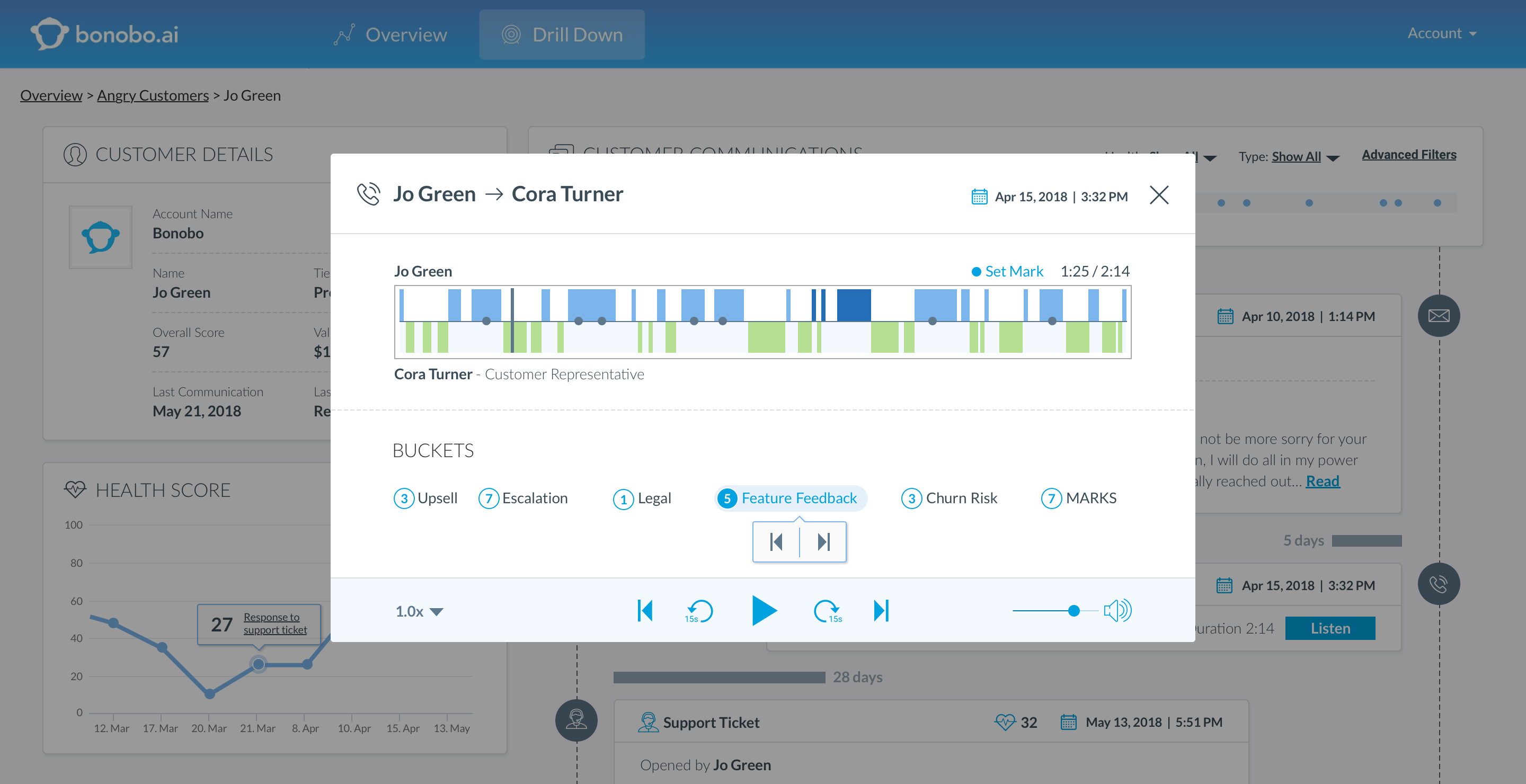
Bonobo AI, an AI-based platform that helps companies get insights from customer support calls, texts, and other interactions, announced today that it has raised $4.5 million in seed funding led by G20 Ventures and Capri Ventures. Founded in 2016 and led by co-founder and CEO Efrat Rapoport, the Tel Aviv-based startup claims that its technology has been used to analyze more than a billion interactions so far and that it has signed up a “few dozen” clients including DreamCloud and Honeybook.

The idea behind Bonobo is that even though customer service texts and voice calls can provide companies with a trove of valuable information, these data points are difficult to aggregate and analyze at scale. Bonobo’s technology integrates into the platforms that its clients use to communicate with customers, like Gmail, Zendesk, or Twilio) and CRM platforms like Salesforce or Hubspot. Then it analyzes interactions for “events of interest in calls,” Rapoport told TechCrunch, like “when customers ask for a discount, complain, ask for a missing feature, become dissatisfied, etc.”

There are two main types of issues that Bonobo helps its clients with. One is opportunity detection, or identifying things that can either help the closing of a sale, like features that have proven popular among past buyers, or hinder it, such as customer questions that aren’t satisfactorily answered. By doing so, Bonobo is also able to help clients create very targeted marketing campaigns. For example, instead of sending marketing material all customers who need to renew their subscriptions, Rapoport says Bonobo’s clients can create campaigns to help retain customers who need to renew their subscriptions but have complained about the price being too high or missing a feature.

Another example of how Bonobo can increase conversion rates is predicting customer cancellations and other potentially costly issues. For example, one vehicle repair company was losing millions of dollars due to cancelled jobs. Bonobo helped it identify factors associated with a higher likelihood of cancellations during customer interactions with the company’s representatives, which helped it retain thousands of customers.

The second is risk detection. For example, Bonobo detects if a customer starts mentioning a competitor, threatens to post their complaint on social media, or brings up problems that are a legal or compliance risk. Rapoport says that Bonobo’s technology can identify specific segments in conversations, so companies can review it directly from Bonobo’s dashboard without having to perform a time-consuming search.

Rapoport says that she and her co-founders (CTO Idan Tsitiat, COO Barak Goldstein, and VP of research and development Ohad Hen) began working on Bonobo after they realized that while there are many tools from companies like Tableau, Oracle, Microsoft, SAP, and Salesforce for gathering insights from structured data (like customer behavior on websites), very few exist for analyzing unstructured data, including conversational data, at scale. “It’s easy to measure how many people go to their cart but then change their mind and exit, but how do you do the same on thousands of customers calls? How do you know what’s the reason customers change their minds?” says Rapoport. “That’s the gap we are filling.”

from Startups – TechCrunch https://ift.tt/2PkeBZw

#USA The scooters arrive in Australia

//

The scooter startups are taking over the world — or trying to.

Earlier this week, Bird debuted its electric scooters in London’s Queen Elizabeth Olympic Park; today, Lime is announcing its foray into the land down under with the launch of a three-month scooter pilot at Monash University in Melbourne, Australia.

Lime has also released several hundred of its dockless electric bikes in Sydney and plans to introduce its scooters there, as well as in Brisbane, soon.

“Sydney’s need for innovative transport solutions, which cater to the first and last mile, gives us confidence we will see high uptake of Lime electric bikes within the community,” said Mitchell Price, Lime’s director of government affairs and strategy in Australia and New Zealand.

The company is also announcing that it’s clocked in 20 million rides just two months after it surpassed 10 million.

Using the nearly half a billion dollars it’s raised to date, Lime is rapidly expanding across the globe and filling out its C-suite. Last week, it brought on David Richter as its first-ever chief business officer, followed by the appointment of GV general partner Joe Kraus as its chief operating officer.

Headquartered in San Francisco, the startup is backed by GV, Andreessen Horowitz, IVP, Section 32, GGV Capital and more.

from Startups – TechCrunch https://ift.tt/2ATkWCw

#USA RealtimeBoard, a visual collaboration platform for companies, raises $25M led by Accel

//

RealtimeBoard, a visual collaboration tool particularly suited to distributed teams, has picked up $25 million in Series A funding. Accel led the round, with participation from existing investor AltaIR Capital.

The 150 person-strong company — which itself is distributed across offices in San Francisco, Los Angeles, Amsterdam, and Perm — says it will use the additional capital to continue to scale, including building out its customer acquisition capabilities by bolstering sales and marketing teams, and growing its user community.

To that end, RealtimeBoard counts the likes of Hubspot, Skyscanner, Qlik, Autodesk, Netflix, and Twitter as customers, and claims 2 million users worldwide. The startup generates revenue by charging for use of its SaaS on a per seat basis for teams or company wide.

“As companies continue to compete for talent, and how we work rapidly changes, connecting the dots between teams in different offices, hubs or cultures becomes harder and harder,” says RealtimeBoard founder and CEO Andrey Khusid.

“Often the first teams to be distributed are product teams (to resolve the war for talent), and rituals that are built into product development frameworks like design thinking or scrum, which require visual collaboration (usually on a whiteboard), are challenging to scale”.

To solve this, Khusid says RealtimeBoard is building a visual collaboration platform that enables white-boarding work to happen in a digital space, and can serve as the glue between other collaboration platforms used by companies.

“[It] can be the visual hub for teams to huddle around and use throughout the product development process, design, sprint, or project lifecycle,” he says. “RealtimeBoard creates transparency and continuity through all stages of the product development process from ideation to development to launch”.

Features RealtimeBoard offers include the ability for teams to create virtual spaces or huddle boards to collaborate, where users can sketch, annotate, add posts, create flow charts or draw freehand on an infinite whiteboard canvas. The tool also supports comments, @mentions, live chat and video conferencing.

Crucially, the platform integrates with other commonly-used workforce tools such as Google Docs, Slack, Sketch, Jira, Trello, and Dropbox and more.

“All the major productivity tools can be embedded into RealtimeBoard, so we are enabling work that happens between systems happen in one place by incorporating all relevant content and conversations into the same visual space,” explains Khusid. “And, with some bi-directional integrations with Google Docs, Office 365, and Jira, you can do work in RealtimeBoard and update information in other systems and visa versa”.

Meanwhile, Khusid tells me the company’s early adopters have been “rapidly scaling tech companies” that leverage modern collaboration frameworks like Agile, Scrum, Lean, Design Thinking, etc., and that these teams are used to leveraging whiteboard rituals and are looking for ways to improve and scale in order to better engage remote team members. RealtimeBoard is also being used by around 100 enterprises, such as Salesforce, Netflix, SAP, Autodesk, Ikea, and Cisco.

Adds Khusid: “[They] have active workforce transformation initiatives to roll out things like ‘Design Thinking; globally or drive innovation through new tools and ways of collaborating. We also see a lot of management consulting companies like PwC, McKinsey, BCG and Deloitte that leverage RealtimeBoard to innovate with their customers”.

from Startups – TechCrunch https://ift.tt/2yXG4Gt

#USA Corporate travel startup TripActions raises $154M at $1B valuation

//

TripActions, one of the most well-capitalized travel startups in Silicon Valley, has raised yet another round of capital valuing the corporate travel manager at more than $1 billion.

Andreessen Horowitz co-founder Ben Horowitz will join TripActions’ board of directors as part of the startup’s $154 million in Series C funding. Lightspeed Venture Partners, Zeev Ventures and SGVC also participated in the round.

Co-founders Ariel Cohen and Ilan Twig said TripActions’ $236 million raised to date, as well as its new “unicorn” valuation, is justified by its 700 percent annual growth rate and more than 1,000 customers.

“We mean it when we say our solution is so good we want to make sure we are bringing it to as many companies, as many employees as possible,” TripActions’ CEO Cohen told TechCrunch. “The main reason to raise more money is just to continue to go for that as fast as we can.”

Cohen and Twig previously co-founded StreamOnce, business collaboration software that was acquired by Jive Software for an estimated $10 million in 2013. They founded TripActions in 2015.

The Palo Alto-based company provides a corporate travel platform that integrates with company HR and expense systems. Using TripActions, business travelers can arrange flights, hotels and transportation, with 24/7 global support from the startup’s staff. Dropbox, Lyft, Twilio, Allbirds and Tuft & Needle are among its customers.

The company has expanded its platform by adding TripActions Luxe, a VIP program for executive travelers; TripActions’ in-house Meetings & Event solution for group travel; and TripActions’ Guest Invite Portal, designed for HR and recruiting teams. It also recently opened its European headquarters, an engineering and data science hub in Amsterdam, and plans to double down on R&D, AI and machine learning with the fresh investment.

Travel companies have been raking in capital this year in what Cohen sees as a big moment for tech startups in the space. The global travel and tourism industry is, after all, one of the most valuable industries, worth some $7 trillion. The online travel market, in particular, is expected to grow to $817 billion by 2020.

“Something is really happening in the industry; something bigger than us,” Cohen said. “Different startups are identifying the opportunity here and the fact that companies want to make sure their employees are happy while they are on the go, that’s why you see investments in companies like Brex and like TripActions.”

“It’s about time that employees really feel great while they are booking their trip, while they are on the go and while they are doing their expenses at the end.”

from Startups – TechCrunch https://ift.tt/2zBg3w1

#USA Here are the startups and the agenda for the TC’s first Startup Battlefield Latin America

//

In just a half hour, we’ll be starting Startup Battlefield LATAM in Sao Paulo, Brazil. Along with interviews with Nubank, Movile, Yellow, and a keynote from Facebook (TC’s partner for the event through FB Start), 15 startups from all across Latin America will be pitching their innovative companies on the TechCrunch stag for the first time.

We will be posting videos of the pitches, panels, and the competition winner on TechCrunch later today, so if you can’t be here in person check back.

In partnership with FB Start, this is the first year that TechCrunch is hosting Startup Battlefield in Latin America. TechCrunch reviewed hundreds upon hundreds of startups from all across the region, finally selecting 15 of the companies most promising startups to compete for Startup Battlefield. Startups are competing for a $25,000 prize (equity free), plus a trip for 2 to TechCrunch Disrupt San Francisco 2019 and the coveted, objectively correct title of “Latin America’s Favorite Startup.”

Founders have received extensive coaching from the TC team and are ready to launch on this prestigious international stage. For each round, teams will pitch for six minutes, including a live demo, followed by an intense six minute Q&A with the judges – elite VCs and product experts. After judge deliberations, five companies will move on to the final round of TechCrunch Startup Battlefield – the same pitch but a more rigorous Q&A.

Who are the 15 top companies? From rapid diagnostic TB tests and cattle weight management artificial intelligence, to finance banking solutions, management systems and point of sale solutions, this batch of companies impacts the lives of millions globally. Companies also include, at-work medical service innovations, music management platforms for brands, blockchain based prescription management, and even innovations in keyless entry for short term rentals and office spaces. Founders in the agricultural tech industry are poised to revolutionize how we grow food.

From innovations in utility tracking and management, farm management platforms, to women focused direct sales optimization platforms, Startup Battlefield LATAM is poised to showcase the regions top innovations. Stay tuned for videos on TechCrunch.com after the event.

Session 1: 9:35am – 10:40am

Cuidas, Nube, Beluga Pay, SimpliRoute, Unima

Session 2: 11:40am – 12:40pm

Elenas, Finerio, Space AG, Agilis, Olho do Dono

Session 3: 1:40pm – 2:40pm

LoopKey, 1Doc3, Brandtrack, RxChain by Prescrypto, Cuenca

Finals: 4:00pm

_________________________________________________

9:30 am – 9:35 am: Welcome Remarks by Jordan Crook (TechCrunch)

9:35 am – 10:40 am: Startup Battlefield Session 1

TechCrunch’s iconic startup competition is here and for the first time in LATAM, as entrepreneurs from around the region pitch expert judges and vie for US$25,000 no-equity cash prize and a trip for two to compete in the Startup Battlefield at TechCrunch Disrupt in 2019.

10:40 am – 11:05 am: A China Twist to Brazil’s Mobility Revolution with Ariel Lambrecht (Yellow), Eduardo Musa (Yellow), Tony Qiu (Didi Chuxing), Hans Tung (GGV Capital)

With Didi Chuxing’s acquisition of car-sharing service 99 and GGV’s investment in scooter / bike mobility startup Yellow, what lessons from China’s mobility revolution will unfold in Brazil?

11:05 am – 11:20 am: Break

11:20 am – 11:40 am: Keynote by Konstantinos Papamiltiadis (Facebook)

Facebook’s Director of Platform Partnerships discusses the Facebook developer ecosystem. Sponsored by Facebook.

11:40 am – 12:40 pm: Startup Battlefield Session 2

TechCrunch’s iconic startup competition is here and for the first time in LATAM, as entrepreneurs from around the region pitch expert judges and vie for US$25,000 no-equity cash prize and a trip for two to compete in the Startup Battlefield at TechCrunch Disrupt in 2019.

12:40 pm – 1:40 pm: Break

1:40 pm – 2:40 pm: Startup Battlefield Session 3

TechCrunch’s iconic startup competition is here and for the first time in LATAM, as entrepreneurs from around the region pitch expert judges and vie for US$25,000 no-equity cash prize and a trip for two to compete in the Startup Battlefield at TechCrunch Disrupt in 2019.

2:40 pm – 3:00: Fireside Chat with Cristina Junqueira (Nubank) and David Velez (Nubank)

With $180 million in fresh capital and a $4 billion valuation, where will Nubank go from here

3:00 pm – 3:20 pm: Keynote by Rodrigo Schmidt (Instagram)

The director of engineering at Instagram discusses the rapid growth and development of the popular photo-sharing app. Sponsored by Facebook.

3:20 pm – 3:45 pm: Venture Investing In Latin America Today Eric Acher (Monashees),Veronica Allende Serra (Innova Capital ), Hernan Kazah (Kaszek), Fernando Lelo de Larrea (ALLVP)

The pace and scale of venture investing in Latin America is accelerating fast. How will the ecosystem adapt?

3:45 pm – 4:00 pm: Break

4:00 pm – 5:15 pm: Startup Battlefield Final

The final round. One of these five finalists will be the winner of Startup Battlefield winning US$25,000 no-equity cash prize and a trip for two to compete in the Startup Battlefield at TechCrunch Disrupt in 2019.

5:15 pm – 5:35 pm20 Years Ahead of the Curve with Fabricio Bloisi (Movile)

Movile started with SMS and ringtones in 1998 and evolved into a powerful conglomerate of digital businesses on mobile platforms. Founder Fabricio Bloisi discusses the journey and what’s next.

5:35 pm – 6:00 pm: New Wave Latin Founders with David Arana (Konfio), Juan Pablo Bruzzo (Moni), Ana McLaren (Enjoie), Sebastian Mejia (Rappi)

The latest generation of tech founders in Latin America may be more disruptive than their predecessors but also face rapidly rising expectations at home and abroad.

6:00 pm – 6:15 pm: Startup Battlefield Closing Awards Ceremony

from Startups – TechCrunch https://ift.tt/2RJXvRU

#USA Infarm expands its ‘in-store farming’ to Paris

//

Infarm, the Berlin-based startup that has developed vertical farming tech for grocery stores, restaurants and local distribution centres to bring fresh and artisan produce much closer to the consumer, is expanding to Paris.

Once again, the company is partnering with Metro in a move that will see Infarm’s “in-store farming” platform installed in the retailer’s flagship store in the French capital city later this month. The 80 metre square “vertical farm” will produce approximately 4 tonnes of premium quality herbs, leafy greens, and microgreens annually, and means that Metro will become completely self-sufficient in its herb production with its own in-store farm.

Founded in 2013 by Osnat Michaeli, and brothers Erez and Guy Galonska, Infarm has developed an “indoor vertical farming” system capable of growing anything from herbs, lettuce and other vegetables, and even fruit. It then places these modular farms in a variety of customer-facing city locations, such as grocery stores, restaurants, shopping malls, and schools, thus enabling the end-customer to actually pick the produce themselves.

The distributed system is designed to be infinitely scalable — you simply add more modules, space permitting — whilst the whole thing is cloud-based, meaning the farms can be monitored and controlled from Infarm’s central control centre. It’s data-driven: a combination of IoT, Big Data and cloud analytics akin to “Farming-as-a-Service”.

The idea isn’t just to produce fresher and better tasting produce and re-introduce forgotten or rare varieties, but to disrupt the supply chain as a whole, which remains inefficient and produces a lot of waste.

“Many before have tried to solve the deficiencies in the current supply chain, we wanted to redesign the entire chain from start to finish; Instead of building large-scale farms outside of the city, optimising on a specific yield and then distributing the produce, we decided it would be more effective to distribute the farms themselves and farm directly where people live and eat,” explains Erez Galonska, co-founder and CEO of Infarm, in a statement.

Meanwhile, the move into France follows $25 million in Series A funding raised by Infarm at the start of the year and is part of an expansion plan that has already seen one hundred farms powered by the Infarm platform launch. Other recent installations include Edeka locations in Düsseldorf, Frankfurt, Stuttgart, and Hannover. Further expansion into Zurich, Amsterdam, and London is said to be planned over the coming months.

“One thousand in-store farms are being rolled out in Germany alone,” adds Infarm’s Osnat Michaeli. “We are expanding to other European markets each and every day, partnering with leading supermarket chains and planning our North America expansion program for 2019. Recognising the requirements of our customers we have recently launched a new product; DC farm – a ‘Seed to Package’ production facility tailored to the needs of retail chains’ distribution centres. We’ve just installed our very first ‘DC farm’ in EDEKA’s distribution center”.

from Startups – TechCrunch https://ift.tt/2qvT5T0

#USA Zopa, the UK P2P lending company, closes £60M round on path to launching a bank

//

Obtaining a banking license and then launching an actual new retail bank requires capital. A lot of capital. Enter Zopa, the U.K. peer-to-peer lending company that wants to become a bank, which today is announcing that it has closed £60 million in further funding. Only £16 million is actually new new money, having already disclosed £44 million in August, so this is effectively an extension of that earlier fund-raise.

The purpose remains the same, however: Zopa says it will use the latest round of investment toward the capital needs for its yet-to-launch “next generation bank.” The company began applying for a bank license with the U.K. regulators in 2016. The new funding also comes off the back of what the fintech claims is its sustainable and profitable peer-to-peer business, having achieved full-year profitability in 2017 for the first time since 2012.

An early mover in the space — launching all the way back in 2005 — Zopa says it has served nearly half a million customers, either through loans or investing in peer-to-peer loans. It has lent more than £3.7 billion in unsecured personal loans to customers in the U.K.

The next phase of Zopa is all about becoming a new digital bank, alongside its peer-to-peer business, in order to be able to offer “a unique and broader set of products to customers.”

“Our bank will allow us to give more people a better experience with their finances by introducing more simple, fair products — like savings accounts and credit cards,” a company spokesperson tells me.

At launch this will include offering FSCS-protected savings accounts, and P2P investments (including IFISAs for investors), and personal loans, car finance and credit cards for people looking to borrow.

“Our money management app will offer our customers a more personalised approach to managing their money,” adds the spokesperson.

Cue Jaidev Janardana, Zopa CEO (pictured above): “This new funding takes us a step closer to realising our vision of being the best place for money in the U.K. Having served half a million customers to date, Zopa is set to redefine the finance industry once again through our next generation bank to meet a broader set of U.K. customers’ financial needs.”

from Startups – TechCrunch https://ift.tt/2yWVqea