
#USA Scared to trade stocks? Titan algorithmically invests for you

//

Titan could put an end to stock market FOMO. The app choose the best 20 stocks by scraping top hedge fund data, adds some shorts based on your personal risk profile, and puts your money to work. No worrying about market fluctuations or constantly rebalancing your portfolio. You don’t have do anything, but can get smarter about stocks thanks to its in-app explanations and research reports. Titan wants to be the easiest way to invest in stocks for a mobile generation who want an affordable coach to guide them through the market themselves.

“Our goal is to take things that aren’t accessible [in wealth management] and make them accessible, starting with hedge fund” says Titan co-founder Joe Percoco. That potential to democratize one of the keys to financial mobility has won Titan a $2.5 million seed round from Y Combinator’s co-founder Paul Graham, president Sam Altman, and partners including Gmail creator Paul Bucheit. The rest of the capital comes from Maverick Ventures, BoxGroup, and Liquid2 Ventures.
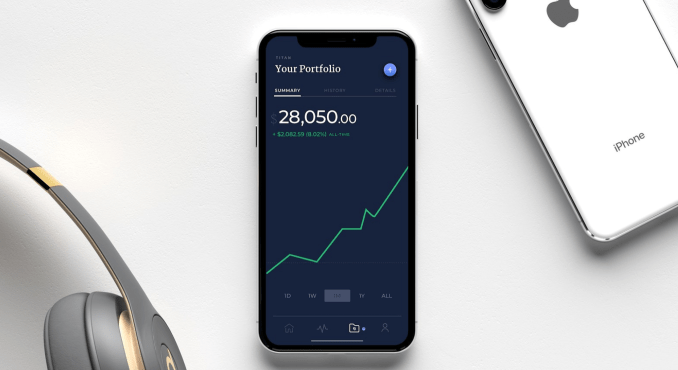
Titan is where investing meets virality” says Graham. “Those are two very powerful forces.” Since TechCrunch broke the news of Titan’s launch in August, it’s doubled its assets under management to $20 million and hired its first non-founder engineer.

Now it’s launching in-app educational videos so stock market dummies can get up to speed if they want to understand where there money’s going amidst a swirling see of financial news..”There are so many different headlines telling so many different narratives” Percoco tells me. “Everyone is searching for explanations in a voice they trust. An ‘ETF’ can’t talk back. Sometimes a human face is better than writing. A video can really help people make choices.” Here’s it’s two-minute video about Facebook’s Q2 earnings a few months ago, explaining why the share price crashed 25 percent:

Percoco and Clayton Gardner met on their first day of Wharton business school while their third co-founder was earning a hedge fund patent and studying computer science at Stanford. They went on to work at hedge funds and private equity firms like Goldman Sachs, but got fed up just growing the fortunes of the already rich.

So they started Titan to invent a modern, mobile version of BlackRock, the investment giant founded in the 80s. Titan uses the public disclosures of hedge funds to find consensus around the 20 best performing stocks. With as little as $1000, users can let Titan robo-manage their investments for a 1 percent fee on assets. Users provide some info on how big they want to gamble, and Titan personalizes their portfolio with more or less conservative shorts to hedge their bets.
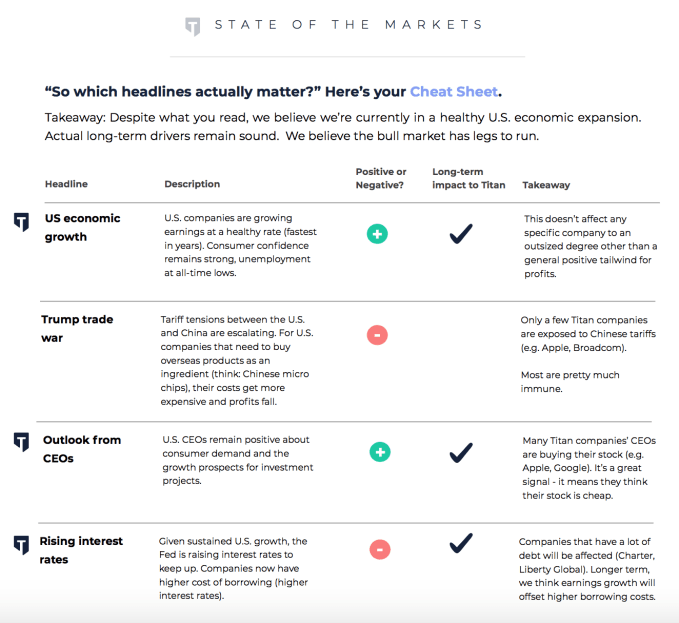
Titan’s simplicity combined with the sense of participation could help it grow quickly. It sits between do-it-yourself options like Robinhood or E*Trade where you’re basically left to fend for yourself, and totally passive options like Wealthfront and Betterment, where you’re so divorced from your portfolio that you’re not learning. Managed hedge funds and fellow active investment vehicles like BlackRock with a human advisor can require a $100,000 minimum investment that’s too steep for millennials.

“Even the best hedge fund in the world is only going to send you a PDF every 90 days” Percoco explains. But Titan doesn’t want you nervously checking your portfolio non-stop. “Our median user checks the app once per day.” That seems like a healthy balance between awareness and sanity. It thinks its education and informative push notifications make it worth a higher required investment and fees than Wealthfront charges.


Essentially, Titan is a stock trading auto-pilot merged with a flight simulator so you improve your finance skills without having to fear a crash. Percoco tells me the sense of accomplishment that engenders is why clients say they’re telling friends about Titan. “When I invest, I look for companies that are growing quickly and making a huge positive impact on the world. Titan is one of those companies” investor Altman says. “I think they could improve the financial wellbeing of an entire generation.”

from Startups – TechCrunch https://ift.tt/2OigZdW

#USA Scared to trade stocks? Titan algorithmically invests for you

//

Titan could put an end to stock market FOMO. The app choose the best 20 stocks by scraping top hedge fund data, adds some shorts based on your personal risk profile, and puts your money to work. No worrying about market fluctuations or constantly rebalancing your portfolio. You don’t have do anything, but can get smarter about stocks thanks to its in-app explanations and research reports. Titan wants to be the easiest way to invest in stocks for a mobile generation who want an affordable coach to guide them through the market themselves.

“Our goal is to take things that aren’t accessible [in wealth management] and make them accessible, starting with hedge fund” says Titan co-founder Joe Percoco. That potential to democratize one of the keys to financial mobility has won Titan a $2.5 million seed round from Y Combinator’s co-founder Paul Graham, president Sam Altman, and partners including Gmail creator Paul Bucheit. The rest of the capital comes from Maverick Ventures, BoxGroup, and Liquid2 Ventures.

Titan is where investing meets virality” says Graham. “Those are two very powerful forces.” Since TechCrunch broke the news of Titan’s launch in August, it’s doubled its assets under management to $20 million and hired its first non-founder engineer.

Now it’s launching in-app educational videos so stock market dummies can get up to speed if they want to understand where there money’s going amidst a swirling see of financial news..”There are so many different headlines telling so many different narratives” Percoco tells me. “Everyone is searching for explanations in a voice they trust. An ‘ETF’ can’t talk back. Sometimes a human face is better than writing. A video can really help people make choices.” Here’s it’s two-minute video about Facebook’s Q2 earnings a few months ago, explaining why the share price crashed 25 percent:

Percoco and Clayton Gardner met on their first day of Wharton business school while their third co-founder was earning a hedge fund patent and studying computer science at Stanford. They went on to work at hedge funds and private equity firms like Goldman Sachs, but got fed up just growing the fortunes of the already rich.

So they started Titan to invent a modern, mobile version of BlackRock, the investment giant founded in the 80s. Titan uses the public disclosures of hedge funds to find consensus around the 20 best performing stocks. With as little as $1000, users can let Titan robo-manage their investments for a 1 percent fee on assets. Users provide some info on how big they want to gamble, and Titan personalizes their portfolio with more or less conservative shorts to hedge their bets.

Titan’s simplicity combined with the sense of participation could help it grow quickly. It sits between do-it-yourself options like Robinhood or E*Trade where you’re basically left to fend for yourself, and totally passive options like Wealthfront and Betterment, where you’re so divorced from your portfolio that you’re not learning. Managed hedge funds and fellow active investment vehicles like BlackRock with a human advisor can require a $100,000 minimum investment that’s too steep for millennials.

“Even the best hedge fund in the world is only going to send you a PDF every 90 days” Percoco explains. But Titan doesn’t want you nervously checking your portfolio non-stop. “Our median user checks the app once per day.” That seems like a healthy balance between awareness and sanity. It thinks its education and informative push notifications make it worth a higher required investment and fees than Wealthfront charges.


Essentially, Titan is a stock trading auto-pilot merged with a flight simulator so you improve your finance skills without having to fear a crash. Percoco tells me the sense of accomplishment that engenders is why clients say they’re telling friends about Titan. “When I invest, I look for companies that are growing quickly and making a huge positive impact on the world. Titan is one of those companies” investor Altman says. “I think they could improve the financial wellbeing of an entire generation.”

from Startups – TechCrunch https://ift.tt/2OigZdW

#USA Lendix is now called October

//

French startup Lendix is changing its name to October. The company is using this opportunity to redesign its branding assets and refresh the design of the website for new users. The product remains the same — a lending platform connecting individual and institutional investors with small and medium companies.

From what I’ve heard, October had to change its name due to some trademark issue. But the company used this opportunity to move away from its original, pretty boring name. Lendix is a straightforward name that suggests that it’s all about lending money.

But there are so many companies with “lend” in their names that it quickly became a disadvantage — Lendopolis, Unilend, Lendosphère, LendingClub…

October is easy to understand and to write down in a casual conversation. If the company wants to branch out and start offering other financial products, it won’t be awkward.

That’s about it. I just wanted to note the change given that I’ve covered October a few times over the years.

from Startups – TechCrunch https://ift.tt/2Rrt829

#USA Lendix is now called October

//

French startup Lendix is changing its name to October. The company is using this opportunity to redesign its branding assets and refresh the design of the website for new users. The product remains the same — a lending platform connecting individual and institutional investors with small and medium companies.

From what I’ve heard, October had to change its name due to some trademark issue. But the company used this opportunity to move away from its original, pretty boring name. Lendix is a straightforward name that suggests that it’s all about lending money.

But there are so many companies with “lend” in their names that it quickly became a disadvantage — Lendopolis, Unilend, Lendosphère, LendingClub…

October is easy to understand and to write down in a casual conversation. If the company wants to branch out and start offering other financial products, it won’t be awkward.

That’s about it. I just wanted to note the change given that I’ve covered October a few times over the years.

from Startups – TechCrunch https://ift.tt/2Rrt829

#USA Brex has partnered with WeWork, AWS and more for its new rewards program

//

Brex, the corporate card built for startups, unveiled its new rewards program today.

The billion-dollar company, which announced its $125 million Series C three weeks ago, has partnered with Amazon Web Services, WeWork, Instacart, Google Ads, SendGrid, Salesforce Essentials, Twilio, Zendesk, Caviar, HubSpot, Orrick, Snap, Clerky and DoorDash to give entrepreneurs the ability to accrue and spend points on services and products they use regularly.

Brex is lead by a pair of 22-year-old serial entrepreneurs who are well aware of the costs associated with building a startup. They’ve been carefully crafting Brex’s list of partners over the last year and say their cardholders will earn roughly 20 percent more rewards on Brex than from any competitor program.

“We didn’t want it to be something that everyone else was doing so we thought, what’s different about startups compared to traditional small businesses?” Brex co-founder and chief executive officer Henrique Dubugras told TechCrunch. “The biggest difference is where they spend money. Most credit card reward systems are designed for personal spend but startups spend a lot more on business.”

Companies that use Brex exclusively will receive 7x points on rideshare, 3x on restaurants, 3x on travel, 2x on recurring software and 1x on all other expenses with no cap on points earned. Brex carriers still using other corporate cards will receive just 1x points on all expenses.

Most corporate cards offer similar benefits for travel and restaurant expenses, but Brex is in a league of its own with the rideshare benefits its offering and especially with the recurring software (SalesForce, HubSpot, etc.) benefits.

San Francisco-based Brex has raised about $200 million to date from investors including Greenoaks Capital, DST Global and IVP.  At the time of its fundraise, the company told TechCrunch it planned to use its latest capital infusion to build out its rewards program, hire engineers and figure out how to grow the business’s client base beyond only tech startups.

“This is going to allow us to compete even more with Amex, Chase and the big banks,” Dubugras said.

from Startups – TechCrunch https://ift.tt/2DeuUk6

#USA Monzo, the U.K. challenger bank, raises £85M Series E at a £1B pre-money valuation

//

Monzo, the U.K. challenger bank that now boasts more than a million customers, has raised £85 million in Series E funding. The round is led by U.S. venture capital firm General Catalyst, and Accel. Existing backers Passion Capital, Goodwater, Thrive Capital, Orange Digital Ventures, and Stripe also participated.

The latest funding was at a pre-money valuation of £1 billion (~$1.27b), meaning that Monzo is now a bonafide member of the U.K. fintech unicorn club, joining recent entrant Revolut.

Meanwhile, the bank upstart is also planning to launch a large crowdfunding round later this year. Like a lot of other fintechs — and before it was fashionable — Monzo has historically opened up its fundraising to its passionate community and other armchair investors.

In a brief call earlier today with Monzo co-founder and CEO Tom Blomfield, he told me the new funding will be primarily used for increasing headcount to further develop the Monzo product line and to cover other operational costs now that the challenger bank has reached “contribution margin positive”.

In other words, on average each customer is generating more revenue than the cost of servicing their current account, which is undoubtedly evidence of how much progress Monzo has made over the last year. This includes bringing down costs, such as weaning customers off costly debit card “top ups” and imposing a cap on fee-free foreign ATM withdrawals — as well as starting to generate meaningful revenue.

On where that revenue is now coming from, Blomfield cited lending in the form of Monzo’s overdraft product, interest it earns on deposits (currently Monzo doesn’t share that interest with customers, even if it is very small in percentage terms), and interchange fees (the money Monzo makes any time you spend on your Monzo debit card).

Another revenue stream is the nascent Monzo marketplace, which he says will be the next focus going forward now that the Monzo current account, with the omission of savings accounts and cash deposits, is basically “done“.

That’s noteworthy given that Monzo embraced developers extremely early on in its existence, holding four very popular hackathons and conducting a few early partnership pilots, but has since mostly stalled on the roll out of marketplace banking and other partnership integrations, sometimes to the frustration of the wider U.K. fintech ecosystem and developers. The exception being the recent integration with TransferWise for sending money abroad.

Blomfield doesn’t dispute this framing but says it wasn’t that Monzo changed course on offering an open API or working on deeper integrations that will put partner products inside of the Monzo banking app, but that gaining a banking license and building out all of the features of the current account had to be the short-term priority. Now that heavy lifting is complete and armed with new operational capital, it is marketplace game on.

To that end, the Monzo CEO says headcount over the next year could double again, from around 450 now to 900. And in terms of customer growth, extrapolating stats from a recent Nationwide annual report (PDF link), the challenger bank says it now accounts for 15 percent of all new bank accounts opened each month in the U.K. It also says it has 800,000 monthly active users.

Account switching — that is customers ditching their existing bank — still makes up the bulk of customer acquisition, even if Monzo recently began targeting 16-18 year olds who would be opening their first ever bank account. Another key metric: the number of customers who deposit their salary each month with Monzo is now at around 26 percent, although I’m told that this isn’t as important for Monzo as it might be for traditional banks and isn’t the main correlation with engagement or those accessing a Monzo overdraft.

Asked what Monzo’s biggest challenge will be over the next year, its CEO doesn’t mince his words: “Increasing revenue,” he says. This means ensuring that its lending models are correct (ie avoiding too many defaults as it scales) and steadfastly growing the marketplace and third-party product partnerships that will bring in additional revenue.

I was also intrigued to see a U.S. venture capital firm once again back the U.K. challenger bank — many of its existing backers have a U.S. bent and Blomfield has made no secret of his ambitions to expand across the pond at some stage. In an email exchange a few hours before publication, General Catalyst’s Adam Valkin (who was previously at Accel in London where he invested in GoCardless, which Blomfield also co-founded), gave me the following statement:

We’re investing in Tom and his team because they are delivering a high-quality banking experience for consumers at scale that is sorely missing from the market. Today’s incumbent UK banks represent billions of market cap but suffer from low NPS scores, reflecting their inability to meet their customers’ needs. Monzo, in contrast, explicitly builds product and banking features in a community-driven approach based on customers’ feedback and requests. This has driven very high organic growth, strong retention and engagement, and unprecedented customer love for and trust in Monzo. Beyond this, Tom and the Monzo team have improved upon the traditional business model of banking, removing the traditional offline retail-based banking model in favor of a highly scalable and lower cost mobile-only experience. All of this creates the potential for Monzo to become a leading U.K. bank, launch a successful financial marketplace, and eventually expand internationally.

from Startups – TechCrunch https://ift.tt/2COPc2G

#USA Even Financial acquires Birch Finance, a credit card rewards startup

//

On the heels of a funding round to the tune of $18.8 million, Even Financial has acquired Birch Finance for an undisclosed sum.

Even offers products like a pre-approval API, real-time pricing, machine learning optimization, a product comparison and recommendation engine for consumers and more. Birch Finance, a TC Startup Battlefield alum that raised $1 million earlier this year, aims to help people make the most of the credit cards in their wallets by telling them which cards will earn them the most points. It works by analyzing your transaction history to identify missed rewards opportunities. Even’s plan with this acquisition is for Even to expand its offerings within the credit card space.

“The credit card market continues to expand with millions of consumers opening up hundreds of different types of credit cards every year for countless reasons,” Rosen said in a statement. “Birch already has one of the largest credit card databases and their technology perfectly complements our existing platform as we expand our offering to the credit card space. This acquisition will allow our partners to optimize the process of getting the right cards to the right consumers.”

Even’s slate of partners includes Credit.com, a personal loans marketplace, The Penny Hoarder and Transunion. With the Birch team on board, Even will enable its partners to save on consumer acquisition while also scaling its credit card recommendation platform. At Even, Birch co-founder Cohen will serve as senior director of the credit card marketplace.

In a statement, Cohen said, “We saw a clear synergy with Even’s business strategy and growth plans, and I’m thrilled to join Even’s team as we expand and scale our offerings into new areas.”

from Startups – TechCrunch https://ift.tt/2qmf1Qp

#USA ZypMedia raises $5.6M to help traditional media companies embrace online ads

//

Local advertising startup ZypMedia is announcing that it has raised $5.6 million in Series C funding.

That’s relatively small amount of money for a Series C (the company had previously raised $6.9 million total, according to Crunchbase), but co-founder Aman Sareen said, “We had the opportunity to raise a lot more, but we chose not to.” In fact, Sareen said ZypMedia became profitable last year.

So the new funding round should allow the company to continue expanding its product lineup and its team — it has plans to double its headcount in the United States and India over the next year — while still leaving room for organic growth.

“We didn’t want to be a cautionary tale [like] other previous adtech companies,” Sareen said. “We are buckling down for the long haul … We didn’t want to necessarily raise money just for the sake of it.”

Sareen founded ZypMedia with his former college roommate Ramandeep Ahuja, as well as former Current TV executive Mark Goldman, with the aim of helping local broadcasters move into programmatic advertising.

The idea is to help those media companies offer campaigns that can reach advertisers’ desired audiences across traditional and digital channels, such as display, video (including over-the-top), social media and native advertising.

“Local digital advertising has been very neglected,” Sareen said. “It’s a huge market, and our goal was to be one of the leaders. I’ll be honest, it wasn’t an easy to task, but we have been decently successful in our mission.”

“Decently successful” means signing up partners like Sinclair Broadcast Group and Univision. It also means enlisting Archer Venture Capital as the lead investor in the new round. (Existing investors US Venture Partners and Sinclair also participated.)

“Not only have Aman and Ramandeep created a superior tech stack for delivering local advertising, they’ve also developed a really smart and defensible business model, partnering with local media companies to act as their direct sales force,” said Archer Managing Director John Hadl in the funding announcement.

And ultimately, the vision goes beyond bringing incremental revenue to traditional media companies. Sareen argued that ZypMedia’s model positions it right at the intersection of traditional and digital advertising.

“Within next two-to-five years, digital or linear, over-the-top or over-the-air, it will jump through one platform,” he said. “Everything will use the same technology and currency.”

from Startups – TechCrunch https://ift.tt/2SwYTZa

#USA Emotional wellness startup Aura raises $2.7 million from Cowboy Ventures and Reach Capital

//

Aura, an app for emotional well-being, has raised a $2.7 million seed round co-led by Cowboy Ventures and Reach Capital, with participation from others.

When Aura first launched a couple of years ago, its bread and butter was short, three-to-seven-minute meditations based on your current mood — be that stressed, anxious, happy or sad. Since then, co-founders Steve and Daniel Lee say the company has grown to a few million users.

“We’ve since grown to become everyone’s emotional wellness assistant,” Steve told me. “We ask how people are feeling right now and then offer content to help them feel better.”

Aura works with therapists, coaches and meditation teachers to offer a variety of content to help people get the type of help they’re looking for. In addition to meditation, Aura offers life coaching, music and inspirational stories.

Premium users, who pay $60 per year, have unlimited access to content, while free users are limited to three minutes of wellness content once every two hours. Aura is not currently sharing how many paid customers it has.

“At Reach, we often ask how we can empower people to achieve at their fullest potential,” Reach Capital Partner Wayee Chu said in a statement. “We are thrilled to be supporting two founders who are not only deeply driven by their own personal narrative in living with a family member with a mental illness, but who have committed themselves in building a world-class technology and tool to empower others in building a regular mental health and wellness practice.”

With the funding in tow, Aura has plans to expand its base of content creators and grow its team — which currently consists just of the Lee brothers. Down the road, Aura envisions integrating the app with wearable devices and their respective sensors to detect mood automatically. That way, Aura would be able to serve up what you need before you know you need it. The company also plans to become more than just a content platform by building additional tools on top of the core service.

from Startups – TechCrunch https://ift.tt/2SuNZ68

#USA Freebird flies off with $8M to rescue passengers after flight cancellations

//

There are few things more irritating than a canceled flight, whether it’s on your way to a friend’s wedding, a conference or to celebrate a holiday back home. Wouldn’t it be nifty if technology could put an end to our travel woes? Freebird, a travel rebooking service, has raised an $8 million Series A to do just that.

The startup charges a minimum of $19 per flight — more depending on distance, time of year, location and more — to independent travelers and companies that partner with the service to help travelers rebook flights after cancellations or other “disruption events.” Most of the time, flights are on-time and without issue, which means that most of the time, Freebird pockets all of its customer’s cash. But if there is a disruption event, Freebird guarantees it will rebook with just three taps of your phone and without any additional charge.

American Express Ventures has led the round, with support from Citi Ventures, PAR Capital Ventures, General Catalyst and Accomplice. Freebird is currently in discussions with Amex and Citi, as well as other banks, to roll its travel benefits into their corporate card services. To date, the startup works with 100 corporate clients and 10 corporate travel agency partners, including BCD Travel. Freebird says it expects to support 250,000 travelers this year.

Founded in 2015 by Ethan Bernstein, Cambridge, Mass.-based Freebird aggregates data on flight patterns to predict the probability of a flight disruption. If the probability is high, Freebird chargers more for its rebooking service.

“If you’re flying out of Buffalo in the winter, it’s going to be a higher risk flight,” Freebird chief executive officer Bernstein told TechCrunch. “If you’re flying out of Phoenix in the summer, you’re at a very low risk of being disrupted. We understand those risks and we are able to price our product differently based on those factors.”

Freebird has raised a total of $16.5 million in funding to date. It’s one of many travel technology startups to bring in venture capital this year. IfOnly, a marketplace for experiences, secured $20 million in April; luggage startup Away brought in a $50 million in June; and travel activities platform Klook raised $200 million in August.

Freebird, though focused specifically on flights, says its experiences are at the forefront of its business model.

“There are a million different products that will help you automate your life but one of the things we are focused on is transforming personal experiences,” Bernstein said. “Do they go through these disruption events tearing their hair out or do they go through it knowing that they have control, agency, support and information? It’s funny what happens when people deal with uncertainty; uncertainty is the worse. As soon you give people information, human support and technology to help them solve their problems, they experience the event so much differently.”

from Startups – TechCrunch https://ift.tt/2qh7F0t