#USA Eaze co-founder Keith McCarty raises $5M for his new B2B cannabis startup

//

Keith McCarty couldn’t stay out of the booming weed business for long.

The co-founder and former chief executive officer of the well-funded marijuana delivery startup Eaze has launched WAYV, a B2B cannabis logistics and compliance platform that delivers inventory to cannabis retailers. Today, the company is announcing its first round of funding, a $5 million seed round led by David Sacks at Craft Ventures. The round represents the former PayPal executive’s first investment in the cannabis technology sector.

Other investors in the round declined to be named.

McCarty and Sacks previously worked together at Yammer, a private social networking tool used by businesses created by Sacks in 2008. The company sold to Microsoft in 2012 for $1.2 billion, giving McCarty and several others enough cash to experiment. For McCarty, that meant exploring the hazy and uncharted territory that was marijuana delivery.

McCarty, however, mysteriously left Eaze right as the company gained significant traction. Neither the company nor McCarty ever explained the shake-up; McCarty was quickly replaced by another former Yammer employee, Jim Patterson, the founder and former CEO of Zinc. In a conversation with TechCrunch, McCarty didn’t clarify the nature of his exit.

He did say that the idea for WAYV came from observing the difficulties of cannabis supply chain logistics during his time at Eaze .

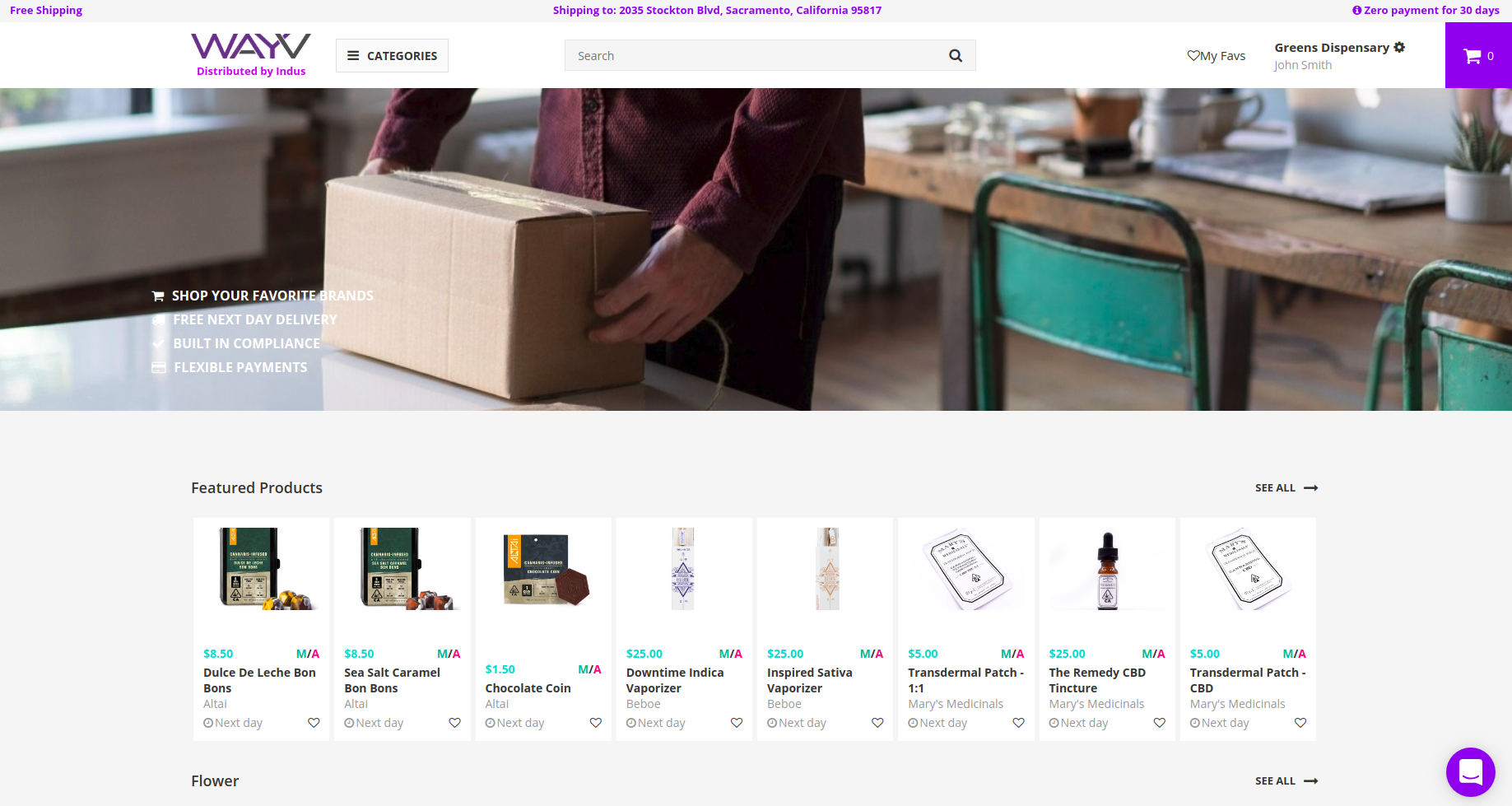
Headquartered in Los Angeles, WAYV connects licensed cannabis companies to licensed brands and provides next-day delivery of cannabis products — it’s essentially Eaze for the cannabis enterprise not the average cannabis consumer. The startup was founded last year and has so far delivered to retailers in California only.

As a second-time cannabis founder, McCarty said building WAYV has been a lot different than launching Eaze, which was one of the first big-name marijuana tech companies.

“Back in 2014, [Eaze was] one of the first to raise venture capital, it was kind of unheard of,” McCarty told TechCrunch. “Now, the majority of Americans favor legalization. For medical, it’s 90 percent and for adult recreational, it’s more than 60 percent. As we Americans continue to favor legalization and that stigma is removed, not just medical but also adult use, it’s going to draw attention and also investment.”

Venture capital investment in cannabis startups has continued to climb, most notably after the state of California voted to legalize recreational marijuana use in 2016. According to Crunchbase, $700 million has been funneled into the space since 2014.

“The industry is moving at such a fast cadence, it’s really exciting to be a part of,” McCarty added.

from Startups – TechCrunch https://ift.tt/2JmY4hf

#USA Eaze co-founder Keith McCarty raises $5M for his new B2B cannabis startup

//

Keith McCarty couldn’t stay out of the booming weed business for long.

The co-founder and former chief executive officer of the well-funded marijuana delivery startup Eaze has launched WAYV, a B2B cannabis logistics and compliance platform that delivers inventory to cannabis retailers. Today, the company is announcing its first round of funding, a $5 million seed round led by David Sacks at Craft Ventures. The round represents the former PayPal executive’s first investment in the cannabis technology sector.

Other investors in the round declined to be named.

McCarty and Sacks previously worked together at Yammer, a private social networking tool used by businesses created by Sacks in 2008. The company sold to Microsoft in 2012 for $1.2 billion, giving McCarty and several others enough cash to experiment. For McCarty, that meant exploring the hazy and uncharted territory that was marijuana delivery.

McCarty, however, mysteriously left Eaze right as the company gained significant traction. Neither the company nor McCarty ever explained the shake-up; McCarty was quickly replaced by another former Yammer employee, Jim Patterson, the founder and former CEO of Zinc. In a conversation with TechCrunch, McCarty didn’t clarify the nature of his exit.

He did say that the idea for WAYV came from observing the difficulties of cannabis supply chain logistics during his time at Eaze .

Headquartered in Los Angeles, WAYV connects licensed cannabis companies to licensed brands and provides next-day delivery of cannabis products — it’s essentially Eaze for the cannabis enterprise not the average cannabis consumer. The startup was founded last year and has so far delivered to retailers in California only.

As a second-time cannabis founder, McCarty said building WAYV has been a lot different than launching Eaze, which was one of the first big-name marijuana tech companies.

“Back in 2014, [Eaze was] one of the first to raise venture capital, it was kind of unheard of,” McCarty told TechCrunch. “Now, the majority of Americans favor legalization. For medical, it’s 90 percent and for adult recreational, it’s more than 60 percent. As we Americans continue to favor legalization and that stigma is removed, not just medical but also adult use, it’s going to draw attention and also investment.”

Venture capital investment in cannabis startups has continued to climb, most notably after the state of California voted to legalize recreational marijuana use in 2016. According to Crunchbase, $700 million has been funneled into the space since 2014.

“The industry is moving at such a fast cadence, it’s really exciting to be a part of,” McCarty added.

from Startups – TechCrunch https://ift.tt/2JmY4hf

#USA Eaze co-founder Keith McCarty raises $5M for his new B2B cannabis startup

//

Keith McCarty couldn’t stay out of the booming weed business for long.

The co-founder and former chief executive officer of the well-funded marijuana delivery startup Eaze has launched WAYV, a B2B cannabis logistics and compliance platform that delivers inventory to cannabis retailers. Today, the company is announcing its first round of funding, a $5 million seed round led by David Sacks at Craft Ventures. The round represents the former PayPal executive’s first investment in the cannabis technology sector.

Other investors in the round declined to be named.

McCarty and Sacks previously worked together at Yammer, a private social networking tool used by businesses created by Sacks in 2008. The company sold to Microsoft in 2012 for $1.2 billion, giving McCarty and several others enough cash to experiment. For McCarty, that meant exploring the hazy and uncharted territory that was marijuana delivery.

McCarty, however, mysteriously left Eaze right as the company gained significant traction. Neither the company nor McCarty ever explained the shake-up; McCarty was quickly replaced by another former Yammer employee, Jim Patterson, the founder and former CEO of Zinc. In a conversation with TechCrunch, McCarty didn’t clarify the nature of his exit.

He did say that the idea for WAYV came from observing the difficulties of cannabis supply chain logistics during his time at Eaze .

Headquartered in Los Angeles, WAYV connects licensed cannabis companies to licensed brands and provides next-day delivery of cannabis products — it’s essentially Eaze for the cannabis enterprise not the average cannabis consumer. The startup was founded last year and has so far delivered to retailers in California only.

As a second-time cannabis founder, McCarty said building WAYV has been a lot different than launching Eaze, which was one of the first big-name marijuana tech companies.

“Back in 2014, [Eaze was] one of the first to raise venture capital, it was kind of unheard of,” McCarty told TechCrunch. “Now, the majority of Americans favor legalization. For medical, it’s 90 percent and for adult recreational, it’s more than 60 percent. As we Americans continue to favor legalization and that stigma is removed, not just medical but also adult use, it’s going to draw attention and also investment.”

Venture capital investment in cannabis startups has continued to climb, most notably after the state of California voted to legalize recreational marijuana use in 2016. According to Crunchbase, $700 million has been funneled into the space since 2014.

“The industry is moving at such a fast cadence, it’s really exciting to be a part of,” McCarty added.

from Startups – TechCrunch https://ift.tt/2JmY4hf

#USA Eaze co-founder Keith McCarty raises $5M for his new B2B cannabis startup

//

Keith McCarty couldn’t stay out of the booming weed business for long.

The co-founder and former chief executive officer of the well-funded marijuana delivery startup Eaze has launched WAYV, a B2B cannabis logistics and compliance platform that delivers inventory to cannabis retailers. Today, the company is announcing its first round of funding, a $5 million seed round led by David Sacks at Craft Ventures. The round represents the former PayPal executive’s first investment in the cannabis technology sector.

Other investors in the round declined to be named.

McCarty and Sacks previously worked together at Yammer, a private social networking tool used by businesses created by Sacks in 2008. The company sold to Microsoft in 2012 for $1.2 billion, giving McCarty and several others enough cash to experiment. For McCarty, that meant exploring the hazy and uncharted territory that was marijuana delivery.

McCarty, however, mysteriously left Eaze right as the company gained significant traction. Neither the company nor McCarty ever explained the shake-up; McCarty was quickly replaced by another former Yammer employee, Jim Patterson, the founder and former CEO of Zinc. In a conversation with TechCrunch, McCarty didn’t clarify the nature of his exit.

He did say that the idea for WAYV came from observing the difficulties of cannabis supply chain logistics during his time at Eaze .

Headquartered in Los Angeles, WAYV connects licensed cannabis companies to licensed brands and provides next-day delivery of cannabis products — it’s essentially Eaze for the cannabis enterprise not the average cannabis consumer. The startup was founded last year and has so far delivered to retailers in California only.

As a second-time cannabis founder, McCarty said building WAYV has been a lot different than launching Eaze, which was one of the first big-name marijuana tech companies.

“Back in 2014, [Eaze was] one of the first to raise venture capital, it was kind of unheard of,” McCarty told TechCrunch. “Now, the majority of Americans favor legalization. For medical, it’s 90 percent and for adult recreational, it’s more than 60 percent. As we Americans continue to favor legalization and that stigma is removed, not just medical but also adult use, it’s going to draw attention and also investment.”

Venture capital investment in cannabis startups has continued to climb, most notably after the state of California voted to legalize recreational marijuana use in 2016. According to Crunchbase, $700 million has been funneled into the space since 2014.

“The industry is moving at such a fast cadence, it’s really exciting to be a part of,” McCarty added.

from Startups – TechCrunch https://ift.tt/2JmY4hf

#USA Translating startup-speak for the corporate buyer

//

Startups salivate at the prospect of entering the enterprise — and for good reason. The enterprise is rife with legacy systems and circuitous processes that frustrate employees and hinder results — and the startup has just the perfect product to fix the problem.

Too often though, the pitch to the enterprise falls flat or a promising pilot gets sidelined. Sometimes there’s a clear obstacle, like a mismatch between product and problem to be solved, an inability to scale, or the loss of an internal sponsor. But more often than one would expect, the startup’s value is simply getting lost in translation.

Even the most forward-looking enterprise leaders are operating in an environment what I like to call “GAAP-based digital strategy.” The budgeting process supports only certain kinds of purchases, like renewable software licensing fees and support contracts with fixed costs. New models, like variable costs for open source development, require workarounds and explanation in the budget process and cause even the most eager internal champion to lose time and energy.

So what’s a startup to do? The more you can help your internal sponsor translate the cost model to adhere to the established norm, the more traction they are likely to get from the hydra of procurement and finance. Once the project has momentum, your champion can work to change the budgeting process – but that’s a tall order before your pilot is launched and showing results.

The concept of GAAP-based digital strategy extends well beyond accounting practices. Consider internal reporting: large organizations spend an inordinate amount of time reporting up, across, and down in an effort to improve transparency and inspire shared ownership of outcomes. What are the KPIs for the department you are serving? How easily will your results translate into their storytelling? Spend some time up front with your client to ensure your results align with (and show up in!) the existing framework for reporting.

Corporations are aware of how hard it is to navigate these control systems, and so they are increasingly creating “innovation departments” with dedicated funding for one-off experiments using new technology. This is often the start of the relationship between a startup and a new client.

For startups, this can be a beneficial approach, since it offers the opportunity to deliver value before wrangling with cumbersome procurement or IT requirements. But too often these divisions lurch from pilot to pilot, and struggle to find line-of-business champions willing to absorb startup technology into their operations. The biggest challenge here is that there’s often no enterprise template for the handoff from the innovation setting – where experiments can operate in a “clean room” apart from procedures and regulations – to ongoing operations.

Here’s how one startup providing augmented reality headsets and software to a complex pharma manufacturing environment crossed over. Their pilot showed clear results: testing with four-five headsets, their AR software measurably helped workers on the floor by augmenting the workflow with voice recording and hands-free capabilities.

The startup team then came on-site, and they partnered with the workers testing the solution to document the improvements and discuss how to ensure the process complied with regulations. This direct interaction fed into their results reporting to make the case for the 30-40 headsets needed on the shop floor. Rather than wait for middle management, the startup developed a grassroots-fortified case for moving into operations.

Similarly, a startup piloting an analytics product in a CPG enterprise was immediately pigeonholed into the IT department’s analytics budget. Surrounded by a range of solutions from business intelligence dashboards to marketing technology tools, their pilot was getting lost.

By closely analyzing results, the startup saw promising early findings in the trade promotions area. They worked through their contacts to reach the executive in charge of trade promotions who took the pilot under her wing – and into her budget. They avoided being locked into a GAAP-based bucket (analytics), and were connected with an executive to unlock a whole different conversation.

In addition to finding your internal champion and changing the GAAP conversation, spend time understanding the larger enterprise backdrop: the initiatives and themes that are driving this quarter’s shareholder value. Help your client position the solution not only in the context of the specific problem to solve, but the overall enterprise goals.

The annual report is your friend here. The focus may be digital transformation or global collaboration or risk management, and aligning to this priority may enable your client to get buy-in internally. Make sure you are fluent in the visible, budgeted, CEO-led, cross departmental initiatives — and how your solution plays a role here.

Take heart: this translation won’t always be a one-way street. The deeper your engagement, the more your enterprise clients will benefit from your startup’s perspective, and change technology, process, and language to reflect that understanding. Ideally, GAAP-based digital strategy recedes as long-established protocols reduce structural lag with how business is conducted today. In the meantime, consider the art of translation as important as pitching the outcome.

from Startups – TechCrunch https://ift.tt/2Da0mjs

#USA Expedia acquires Pillow and ApartmentJet to conquer the short-term rental market

//

To keep up with the rising demand for short-term rentals in U.S. cities and compete with the home-sharing giant Airbnb, travel booking site Expedia has picked up a pair of venture-backed hospitality startups, Pillow and ApartmentJet.

Employees of both companies will join Expedia . The company declined to disclose the financial terms of the deals.

“Acquiring Pillow and ApartmentJet will help unlock urban growth opportunities that, over time, will contribute to HomeAway’s ability to add an even broader selection of accommodations to its marketplace and marketplaces across Expedia Group brands, ensuring travelers always find the perfect place to stay,” the company explained in a statement.

Expedia paid $3.9 billion for HomeAway and its portfolio of travel brands in 2015. The deal was its first major move in the alternative accommodations space, as well as the beginning of a series of efforts to outdo VC darling Airbnb. Its latest targets provide software tools for property managers to easily manage short-term rentals on Airbnb competitors like HomeAway and VRBO.

Located in San Francisco, Pillow helps residents list their apartments as short-term rentals without violating their leases. It’s raised a total of $16.5 million in VC backing since 2013, including a $13.5 million round last year led by Mayfield, with participation from Sterling.VC, Peak Capital Partners, Expansion VC, Chris Anderson, Gary Vaynerchuk, Dennis Phelps and Veritas Investments.

ApartmentJet helps property owners earn money off vacancies. Founded in 2016, the Chicago-headquartered startup had raised a reported $1.2 million in capital from Network Ventures and BlueTree.

Bellevue-based Expedia Group owns several travel brands, including HomeAway, VRBO, Travelocity, trivago, Orbitz and Hotels.com. The company is both an active investor in and acquirer of startups.

Expedia’s shares rose 9.4 percent Thursday after its third-quarter earnings beat analyst expectations. The company posted $3.28 billion in revenue, a notable increase from last year’s $2.97 billion.

from Startups – TechCrunch https://ift.tt/2z6zKeX

#USA Epic Games, the creator of Fortnite, raises $1.25 billion

//

It pays to have the most popular game in the world.

Epic Games, the creators of the runaway gaming smash hit Fortnite, have raised $1.25 billion in a new round of financing.

via GIPHY

It’s been 20 years since Epic Games first released its Unreal game development engine in concert with its first person shooter, Unreal. Since then, the company has been releasing free-to-play games as a loss leader to show off what its powerful development toolkit can do.

Now, with the insane success of Fortnite, the company has flipped the script.

Since Fortnite became the thing that nearly every gamer in the world plays, the company has slashed prices on the Unreal game engine even as it keeps upgrading the technology.

And the company has been plowing that cash back into the community to support esports tournaments with a $100 million prize pool to support competitive Fortnite gamers.

The company’s game has become the kind of old-school cultural phenomenon that one rarely sees in the fractured age of internet silos. It’s inspired dance crazes, Halloween costumes, and even a Monopoly game and a Nerf gun.

And now it appears that the game has also inspired some of the biggest names in Silicon Valley’s venture capital investment scene to commit huge sums to continue its success.

Investors in the latest round include KKR, Iconiq Capital, Smash Ventures,Vulcan Capital, Kleiner Perkins and Lightspeed Venture Partners, as well as gaming companies like aXiomatic, which announced a significant investment from the NBA legend Michael Jordan earlier in October.

The new investors are joining Tencent, Disney, and Endeavor as minority shareholders in the company — which amazingly still is controlled by its chief executive and founder, Tim Sweeney.

Epic Games has fundamentally changed the model for interactive entertainment under the company’s visionary leadership,” said Ted Oberwager of KKR, in a statement.

from Startups – TechCrunch https://ift.tt/2D9kYZa

#USA China’s Nio invests in LiDAR startup Innovusion

//

Innovusion, a two-year-old startup developing LiDAR sensor technology for autonomous vehicles, has raised $30 million in a Series A funding round co-led by Chinese firms Nio Capital and Eight Roads Ventures along with U.S.-based F-Prime Capital.

Other seed round and strategic investors joined the round, the startup said.

Nio Capital is the venture arm of Nio, the Chinese electric automaker aiming to compete with Tesla. Nio, which raised $1 billion when it debuted on the New York Stock Exchange in September, has operations in the U.S., U.K. and Germany, although it only sells its ES8 vehicle in China.

Innovusion, which was founded in November 2016, says it will use the funding to scale up its operations, specifically to ramp up production of its light detection and ranging sensor system called Innovusion Cheetah. The company began shipping samples of the system in the second quarter of 2018 and is beginning to take customer orders.

The round of funding will allow the Los Altos, California-based company to expand its R&D team and manufacturing facilities to more quickly develop, market and deliver Innovusion Cheetah LiDAR to customers around the world, according to Junwei Bao, the company’s co-founder and CEO. The company primarily is targeting customers in China and the U.S.

LiDAR is used by companies developing autonomous vehicles to detect and measure objects on the road around them. Most of the companies testing AVs believe LiDAR is an essential sensor required to deploy self-driving vehicles safely on public roads. It’s what has propelled demand for LiDAR and, in turn, an array of startups to pop up and try to capture market share away from Velodyne, the long-time dominant leader in the space.

from Startups – TechCrunch https://ift.tt/2JjciQm

#USA Chat fiction startup Hooked unveils ‘Dark Matter,’ its first feature-length thriller

//

Chat fiction startups have been exploring the types of stories that you can tell in the form text message conversations, and now Hooked is taking that exploration one step further with the launch of “Dark Matter.” The company describes this as its first feature-length story.

“Dark Matter” tells the story of Tasneem (Taz) Singh, a South Asian American student at Stanford who, after the mysterious death of her twin sister, discovers that she has the ability to interact with the paranormal.

The story debuts today on Snapchat, with a new chapter coming out every day until Tuesdsay, October 30. According to CEO Prerna Gupta, the full script totals 32,000 words — in other words, it’s the length of a feature film script or short novel: “I think it’s fair to say this is the longest chat fiction story. It’s certainly the longest on we’ve ever produced for Hooked .”

If you’re you’re not already a chat fiction fan, you may be skeptical about reading something that long in text message format. Gupta admitted that she and her husband Parag Chordia had similar doubts when they started the company together.

“I would be lying if I didn’t say if we also didn’t have that question ourselves,” she told me. “When a new kind of format or really new medium comes up, you start with the basics first. You tell the simplest stories, then as you become more adept at communicating with that format, you can start to go deeper.”

That’s meant going beyond text — “Dark Matter,” for example, will include a voice track and custom illustrations.

Dark Matter excerpt

“The length makes a big difference,” Gupta added. “You can take your time, slow it down and spend more time with world, developing deeper relationships between the characters.”

“Dark Matter” was written by Hooked staff writer Elyse Endick, but Gupta said the writing process was “almost more like a writers room — it was very collaborative, she did a show bible, then at each step she and I and our head of content would sit in a Google Hangout and just kind of flesh it out.”

Although the story is premiering on Snapchat, it will also make its way to the main Hooked app. Gupta said that she’s less focused on owning the distribution channel than on reaching big, global audiences — and distributing via Snapchat can help with that.

“I’m not trying to be the next Instagram,” she said. “It’s not about the app or any given app. For me, it’s really about our stories.”

And while Snapchat has recently lost some of its luster (daily active user count fell by another 1 percent in its most recent quarter), Gupta said, “I think people are underestimating their whole strategy around entertainment, around being TV for the next generation.”

She added that engagement around Hooked content on Snapchat has been “insane.”

“Why are we investing our resources with Snap? Because of what we’re seeing,” she said. “Our audience and how engaged they are, that’s real.”

from Startups – TechCrunch https://ift.tt/2Rh1HYT

#USA Tap, a new startup from Sam Rosen, wants to be the Google of drinking water

//

MakeSpace founder and former CEO Samuel Rosen is ready to launch his next venture, and it has little or nothing to do with the on-demand economy. This time, Rosen is setting his sights on the world of water.

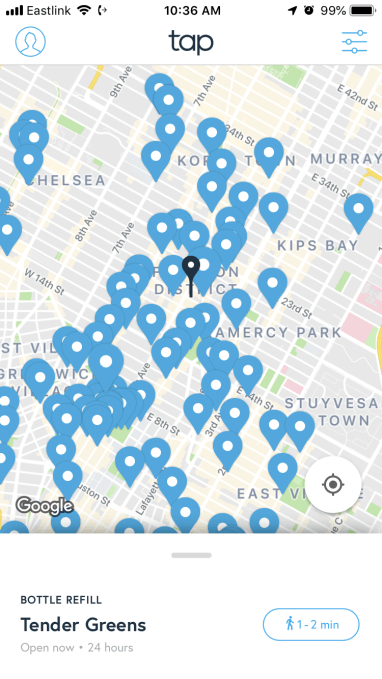
Tap aims to be the world’s first public index and global search engine for drinking water.

Plastic water bottles are, in many ways, the scourge of the planet. More than 90 percent of the environmental impact of plastic water bottles happens during manufacture, and the Guardian reported that more than 1 million plastic water bottles were sold a minute across the globe in 2016.

Some people have switched over to reusable water bottles and canteens, but once they do, there is no way to search for water fountains or sources of drinking water. That’s where Tap comes in.

In its first iteration, Tap is a bit like the Waze for water. Using a combination of user-generated content and data from water fountain manufacturers, Tap aims to be a public search engine for where to find water. As it stands now, Tap has more than 34,000 Refill Stations across 30 countries indexed on the app.

But Tap also has ambitions to offer a backend system for water fountain companies. Normally, these companies sell a number of units to airports or other commercial or government properties. Those customers then install the fountains wherever they see fit, and the water fountain company is more or less uninvolved.

However, those companies then need to maintain the fountains, installing new filters and repairing broken parts, etc. But one fountain may be far more trafficked than another, and thus need higher frequency maintenance.

Tap wants to offer an SDK to these companies so that when users report bad filters or a broken water fountain, that information shows up on their dashboard.

Rosen sees an opportunity to generate revenue in a manner similar to Google, offering an advertising product for companies down the line.

from Startups – TechCrunch https://ift.tt/2yAUGv1