#USA Tap, a new startup from Sam Rosen, wants to be the Google of drinking water

//

MakeSpace founder and former CEO Samuel Rosen is ready to launch his next venture, and it has little or nothing to do with the on-demand economy. This time, Rosen is setting his sights on the world of water.

Tap aims to be the world’s first public index and global search engine for drinking water.

Plastic water bottles are, in many ways, the scourge of the planet. More than 90 percent of the environmental impact of plastic water bottles happens during manufacture, and the Guardian reported that more than 1 million plastic water bottles were sold a minute across the globe in 2016.

Some people have switched over to reusable water bottles and canteens, but once they do, there is no way to search for water fountains or sources of drinking water. That’s where Tap comes in.

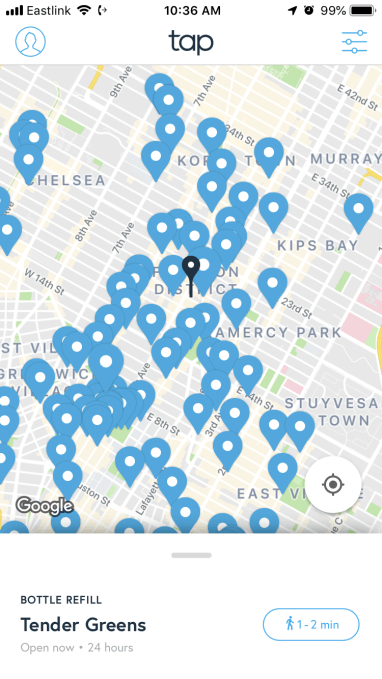
In its first iteration, Tap is a bit like the Waze for water. Using a combination of user-generated content and data from water fountain manufacturers, Tap aims to be a public search engine for where to find water. As it stands now, Tap has more than 34,000 Refill Stations across 30 countries indexed on the app.

But Tap also has ambitions to offer a backend system for water fountain companies. Normally, these companies sell a number of units to airports or other commercial or government properties. Those customers then install the fountains wherever they see fit, and the water fountain company is more or less uninvolved.

However, those companies then need to maintain the fountains, installing new filters and repairing broken parts, etc. But one fountain may be far more trafficked than another, and thus need higher frequency maintenance.

Tap wants to offer an SDK to these companies so that when users report bad filters or a broken water fountain, that information shows up on their dashboard.

Rosen sees an opportunity to generate revenue in a manner similar to Google, offering an advertising product for companies down the line.

from Startups – TechCrunch https://ift.tt/2yAUGv1

#USA More than half of crypto news sites are pay-for-play

//

In a clever bit of sleuthing by Corin Faife at Breaker, we find that over half of the most popular crypto blogs offer pay-for-play posts including “CEO interviews” that are not labelled as sponsored. Further, many sites offer premium services in which blog writers will repost PR content without a sponsored tag.

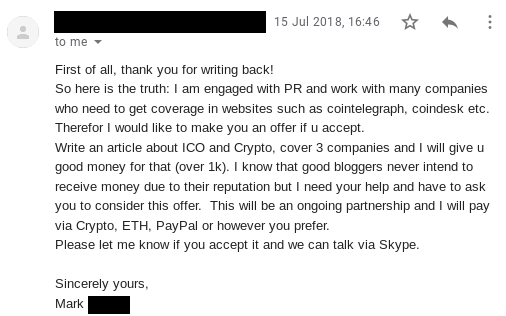
As I noted a few weeks ago, the crypto industry is awash with money and “journalists” are taking advantage of the naivety and dishonesty of the marketers tasked with pushing another me-too crypto product in front of an unreceptive audience. Faife received multiple emails like this one asking him to accept payment for placing articles at the places he worked, including Motherboard and Coindesk:

“I know that I would never take money for coverage, nor would any serious journalist. But covering the cryptocurrency industry, I read content on a daily basis that comes from a large number of outlets that I can’t vouch for. If these offers of pay-for-post are out there, can we rely on all of the journalists and editors to turn them down? Can we believe in the objectivity of the coverage we see every day, or has it simply been paid for by a company flush with cash?” he wrote. “The more I thought about it, the more it seemed like there was a simple way to find out. As a BREAKER investigation, we’d ask to pay for coverage of an ICO, and see who said yes.”

Faife reached out to 28 cryptocurrency news sites and received 22 definitive responses. Posing as a Russian PR professional, Faife first asked for rates for posting information on the site. When he received a response, he asked if the posts would have a “sponsored” tag, a traditional signal that a post wasn’t explicitly written by the news organization’s reporters.

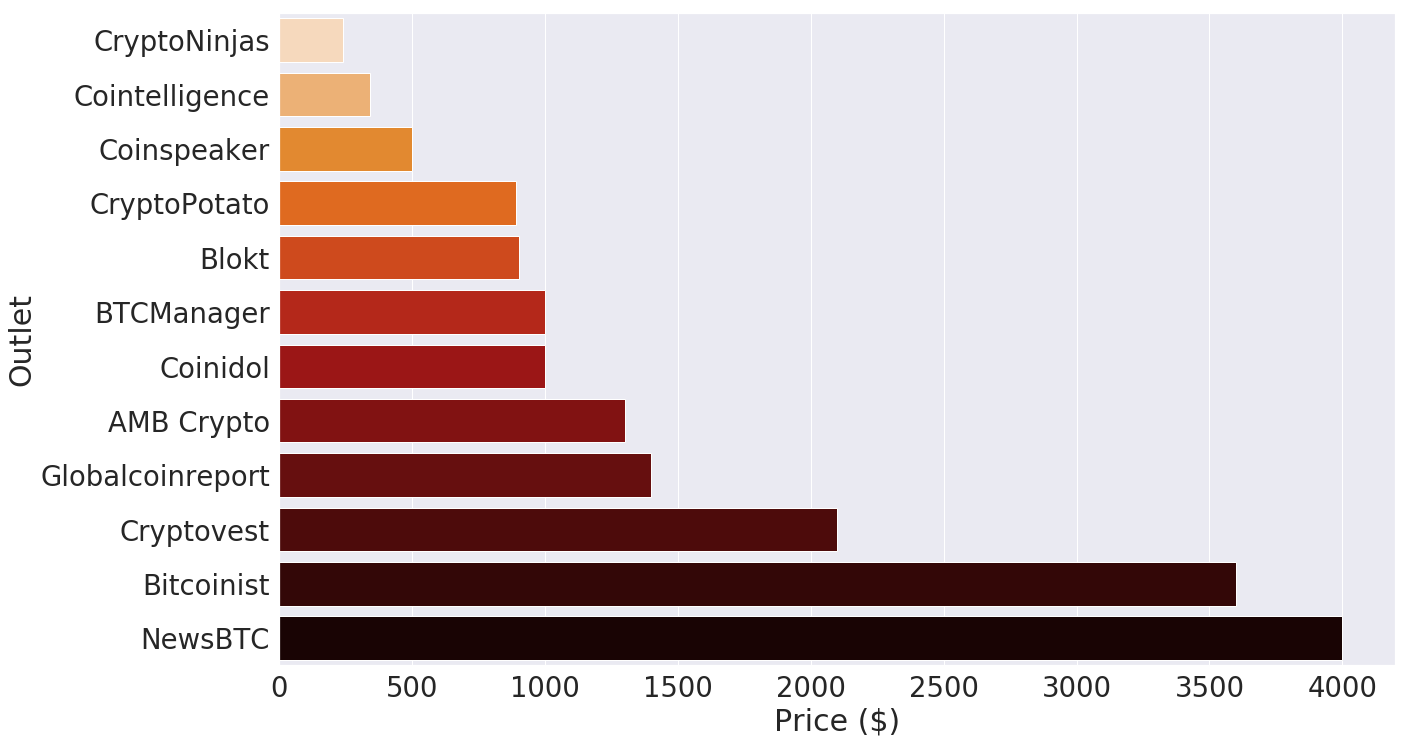
Of the 22 replies, he received 14 agreeable responses including an offer to remove the sponsored tag for $4,500. This helpful graph shows how quickly sites will abandon journalistic ethics to grab a little cash:

One site, NewsBTC, responded to Faife when pressed about payola:

Contacted about the story, Samuel Rae, CEO of NewsBTC, responded:

“It’s come to my attention that one of our sales team has mistakenly suggested that we could publish content without disclosure that it has been paid for (i.e. a sponsored article) to one of your undercover reporters posing as a PR agent. This is not our policy. The sales executive offering this has been removed from our company active immediately and won’t be dealing with/offering our advertising (or otherwise) services again, be it to a PR company, a reseller or anyone else.”

Pressed to offer evidence that the staff member had been removed, and to explain a second source quoting NewsBTC’s willingness to publish sponsored content without disclosure, Rae declined to give further comment.

The important thing to note here are the sums of money that many of these crypto and ICO organizations will raise thanks to a small investment in media. A solid blog post can move untrained “investors” to buy or sell crypto and tokens in an instant, creating situations ripe for pump and dump schemes where the actual level of interest in a company is clouded by payola. Most sane, mature news organizations see this problem and address it by refusing to accept paid content. That said, times are changing and the lines are blurring between paid and unpaid content. Ultimately, however, the behavior Faife uncovered is implicitly wrong.

There’s an old saying: fools and their money are soon parted. Uneducated and uninformed crypto investors are fools, but they visit crypto sites for a proper education. When news organizations create so-called fake news in order to drum up a little advertising cash, everyone loses.

from Startups – TechCrunch https://ift.tt/2OPtWRH

#USA Valentin Stalf to talk about scaling N26 at Disrupt Berlin

//

We couldn’t put together a conference in Berlin without inviting Valentin Stalf from N26, the co-founder and CEO of one of Europe's most promising startups.

A few years ago, few people would have bet on a startup creating a bank from scratch. N26 now has over 1.5 million clients and a ton of funding.

N26 originally launched at TechCrunch Disrupt London back in 2014. The company didn't win the Startup Battlefield. At the time, the company was called Number26 and they had 0 client. It was probably too early and too risky for our panel of judges. But we wanted to bet on them and give them some stage time.

I’ve covered N26 relentlessly over the years. They let me test the product back when everything was in German. They’re now available all around Europe (including the U.K.). And it always feels great when Startup Battlefield companies graduate and come back to Disrupt as regular speakers.

But N26 also faces a lot of scrutiny — all eyes are on that young company that wants to manage your money. N26 isn’t the only challenger bank either. It’s still fine for now as they’re all converting customers from traditional banks. But at some point, they’ll compete directly with each other.

Up next, N26 wants to expand to the U.S. It’s an interesting market as it’s highly fragmented with inconsistent regulation across all 50 states. And let’s be honest, American banks suck. They’re riddle with fees and a bad customer experience.

If you want to hear how Stalf plans to go to the next level, come to Disrupt Berlin. The conference will take place on November 29-30 and you can buy your ticket right now.

In addition to fireside chats and panels, like this one, new startups will participate in the Startup Battlefield Europe to win the highly coveted Battlefield cup.


Valentin Stalf

CEO & Co-founder, N26

Born in Vienna, Valentin studied Accounting & Finance (M.A. HSG) at the University of St. Gallen, Sophia University in Tokyo and the Vienna University of Economics and Business Administration. During his studies he worked in a number of fields including Strategy Consulting and Investment Banking/Mergers & Acquisition. Before he founded N26 together with Maximilian Tayenthal, he was with the Internet Incubator Rocket Internet as Entrepreneur in Residence and involved in building different companies

from Startups – TechCrunch https://ift.tt/2D5oZhd

#USA Quizlet hits 50M monthly users

//

Most students in the U.S. have used or at least heard of Quizlet, the website for creating digital flashcards.

The company leverages machine learning to predict in which areas its users need the most help and provides 300 million user-generated study decks, maps, charts and other tools for learning.

Roughly eight months after closing a $20 million financing, Quizlet chief executive officer Matthew Glotzbach has disclosed some notable feats for the emerging edtech: it’s reached 50 million monthly active users, up from 30 million one year ago, and though it’s not profitable yet, its revenue is growing 100 percent YoY.

As a result of its recent growth, the company is opening its first office outside of Silicon Valley, in Denver.

“We by no means feel like our work is done; 50 million is a very small fraction of the 1.4 billion students on the planet,” Glotzbach told TechCrunch. “Our focus is growing the platform. If we continue to be successful in that mission, we will be the largest study and learning brand.”

The company has been around for a while. Founded in 2005 by then 15-year-old Andrew Sutherland, Quizlet was fully bootstrapped until 2015.

Its growth really began when Glotzbach, a seasoned executive most recently at YouTube, took the reigns in 2016. The $20 million round earlier this year, its largest yet, has allowed the company to blossom, too. Led by Icon Ventures, with participation from Union Square Ventures, Costanoa Ventures and others, it brought Quizlet’s total raised to just over $30 million.

Part of its growth, according to Glotzbach, has to do with its recent focus on its international users. The site has always been accessible around the world, but not until late 2016 did Quizlet begin offering the tool in other languages. Today, it’s available in more than 15 languages, a number the company is actively working to expand.

Newly added capabilities have also contributed to recent spikes in MAUs. Students can now access diagram-based content, which is helpful for STEM subjects, an area the company has historically been less helpful with.

Quizlet operates a freemium model but has three subscription products for power users. At $12 per year, Quizlet Go has no ads and provides an offline studying option on mobile. Quizlet Plus, at $20 per year, also provides an ad-free study experience, as well as image uploading and voice recording capabilities. Finally, Quizlet for Teachers offers educators a $35 per year option that lets them create their own decks for students and access to additional data, analytics and reporting.

from Startups – TechCrunch https://ift.tt/2q7RJO6

#USA NBA All-Star Michael Jordan leads a $26 million round for esports group aXiomatic

//

NBA legend Michael Jordan is playing the esports game now, leading a $26 million round of funding for the ownership group aXiomatic.

For Jordan and new co-investor Declaration Capital — the family office investing the personal wealth of David Rubenstein, who co-founded and serves as co-executive chairman of the multi-billion-dollar private equity firm, The Carlyle Group — investing in esports looks like a slam dunk.

The company announced the investment from Jordan, Declaration Capital and Curtis Polk, the managing partner and alternate governor of Hornets Sports & Entertainment, and manager of the financial and business affairs of Michael Jordan and his related companies, earlier today. Bloomberg reported the $26 million figure.

As owners of the TeamLiquid esports franchise, which Forbes estimates as the second most valuable gaming team in the industry, aXiomatic has a solid base in the budding world of esports — an increasingly lucrative market.

Indeed, the most successful esports company, Cloud9, just raised $53.6 million in a new round of funding, according to documents filed with the Securities and Exchange Commission.

“I’m excited to expand my sports equity portfolio through my investment in aXiomatic. Esports is a fast-growing, international industry and I’m glad to partner with this great group of investors,” said Jordan, in a statement.

Athletes and owners of professional sports teams have flooded into the esports industry, plunking down $20 million to own teams in the officially sanctioned Overwatch League and placing similar-sized and smaller bets on companies developing services for the esports ecosystem.

The Philadelphia 76ers were among the first NBA teams to dip their toe in the esports waters when they acquired Team Dignitas in a deal that was rumored to be worth up to $15 million at the time. Earlier this year, Dignitas brought home a world championship in RocketLeague for the Sixers.

Now, the Golden State Warriors, Cleveland Cavaliers and Houston Rockets are all backing esports teams in Riot Games’ League of Legends tournaments, according to a recent report in Bloomberg.

“The next generation of sports fans are esports fans,” said Ted Leonsis, co-executive chairman of aXiomatic and the founder, chairman, chief executive and majority owner of Monumental Sports & Entertainment (which owns the Washington Wizards, Capitals and the WNBA Mystics franchise), in a statement. “Esports is the fastest-growing sector in sports and entertainment, and aXiomatic is at the forefront of that growth. We are thrilled to welcome Michael and Declaration Capital to aXiomatic and look forward to working together on some truly cutting-edge opportunities.”

from Startups – TechCrunch https://ift.tt/2D5W0Kn

#USA Daily Crunch: Tesla is profitable again

//

The Daily Crunch is TechCrunch’s roundup of our biggest and most important stories. If you’d like to get this delivered to your inbox every day at around 9am Pacific, you can subscribe here:

1. Tesla earns its first profit in two years

Tesla reported a profit in the third quarter, reversing seven consecutive quarters of losses. This is only the third time in the company’s history that it has achieved this milestone.

The turnaround was driven by sales of the Model 3. The company said customers are trading up their relatively cheaper vehicles to buy a Model 3, even though there is not yet a leasing option and the starting price was $49,000.

2. Trump has two ‘secure’ iPhones, but the Chinese are still listening

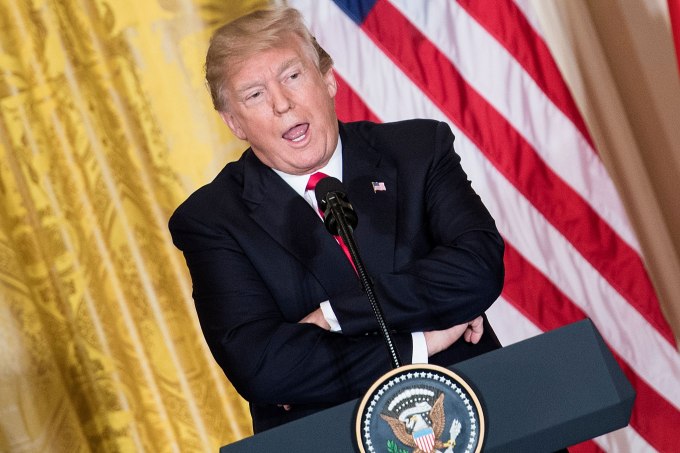
A new report by The New York Times puts a spotlight on the president’s array of devices and how he uses them. However, both Trump and a spokesperson for China’s foreign ministry have denied the story.

(BRENDAN SMIALOWSKI/AFP/Getty Images)

3. Red Dead Redemption 2 sets the bar high for the next generation of open world games

Tomorrow, Red Dead Redemption 2 goes live after months of breathless speculation. And according to Devin Coldewey and Jordan Crook, it’s as good as you’ve been hoping.

4. Facebook is building Lasso, a video music app to steal TikTok’s teens

Facebook is building a standalone product where users can record and share videos of themselves lip syncing or dancing to popular songs, according to information from current and former employees.

5. One-year-old Ribbon raises $225m to remove the biggest stress of home buying

The startup wants to replace the incredible stress of securing a mortgage during the home-buying process with a Ribbon Offer: If a buyer can’t secure a mortgage in time for close, Ribbon will pay for the house itself and give the buyer extra time to get financing.

6. Twitter beats Wall St Q3 estimates with $758M in revenue

Twitter reported a 29 percent increase in ad revenue to $650 million, and the company says total ad engagements increased 50 percent year over year. However, user growth didn’t quite match expectations.

7. Confirmed: ShopRunner acquires Spring, raises $40M

ShopRunner is announcing its first infusion of venture funding under CEO Sam Yagan, plus an acquisition of the shopping app Spring. Sources also say it’s readying a major overhaul of its mobile app.

from Startups – TechCrunch https://ift.tt/2CCTZnM

#USA Teikametrics raises $10M to optimize Amazon ads

//

Teikametrics is a Boston-based startup that helps retailers tackle the challenges of advertising on Amazon. Today, the company is announcing that it has raised $10 million in Series A funding.

CEO Alasdair McLean-Foreman said third-party sellers represent 60 percent of the transactions on Amazon. But they don’t have any real data science capabilities, so they need help advertise their goods in a way that maximizes profitability.

“We are using big data to help sellers optimize for profitability,” McLean-Foreman said. He compared it to the work that Amazon has done “optimizing on the consumer side — all the advanced econometrics” to determine things like the price of Amazon Prime. “We’re on the other side. We’re helping sellers and brands.”

That’s a very different challenge from optimizing Facebook ads to get the most clicks. McLean-Foreman argued that it’s not even something Amazon can do properly, because, “They don’t have critical information on cost of goods sold, and they also don’t have the context of being on the supply chain side.”

(At the same time, he emphasized, “We’re aligned with Amazon, we’re pro-Amazon and we’ve built our company off the back of Amazon.”)

In contrast, Teikametrics — through its “retail optimization platform” Flywheel — allows sellers to incorporate things like transaction data, inventory data and pricing data. So when they look at the results of of their campaigns, they can see their gross profit margins and profitability after ad spend.

How appealing is this to sellers? Well Teikametrics says it’s being used by advertisers who represent 1 percent of all sales on Amazon, including brands like Razer, Power Practical and Zipline Ski. Eventually, the company plans to expand its technology beyond Amazon, to other marketplaces.

Teikametrics has been bootstrapped since its founding in 2013, at least until now. McLean-Foreman said he decided to raise outside funding because “the crown jewel is the sheer amount of data that we can model,” which means hiring “a tremendous amount of very, very high-powered machine learning folks.”

The Series A funding was led by Granite Point Capital, Jump Capital and FJ Lab.

from Startups – TechCrunch https://ift.tt/2z20qNS

#USA Confirmed: ShopRunner acquires Spring, raises $40M

//

ShopRunner chief executive Sam Yagan conquered the online dating world. Can he conquer the e-commerce world, too?

Hot off the heels of its first profitable year, ShopRunner is announcing its first infusion of venture funding under Yagan, an acquisition of the shopping app Spring and, sources tell TechCrunch, it’s readying a major overhaul to its mobile app, signaling what could be a new era for the company.

Yagan, the co-founder of OkCupid, former CEO and vice chairman of The Match Group and managing director of the venture fund Corazon Capital joined ShopRunner in 2016 to test the waters of online retail.

“If you look at founding OkCupid, running Match and incubating Tinder, arguably, I had my hands on the three most important dating businesses ever,” Yagan told TechCrunch. “Finally, I was like, ‘what else is there?’ I am either going to the grave as the online dating guy, or this was the moment.”

Yagan replaced former PayPal president Scott Thompson as ShopRunner’s CEO, moved the Alibaba -backed subscription-based digital shopping company from Silicon Valley to his hometown, Chicago, and readied for battle against Amazon.

ShopRunner teams with mid- to high-end retailers to offer its paying members free two-day shipping and free returns on their sites, taking a small cut of each purchase. As much as it might like to, it doesn’t compete with Amazon Prime. It doesn’t even have a centralized marketplace where users can shop all the ShopRunner partner brands at once, but that may change.

This week, it announced a $40 million investment from August Capital, bringing its total equity funding to around $140 million since it was founded in 2009. The company says it plans to use the cash for product development, data science and to amp up its M&A strategy. It’s already begun the latter, confirming to TechCrunch that it’s acquired Alan and David Tisch’s Spring, a deal first reported by Recode.

Yagan declined to disclose both ShopRunner’s latest valuation and the terms of the Spring acquisition. Though he did say ShopRunner’s valuation is in the “hundreds of millions” range and that they had purchased Spring’s platform and 30 of its employees, a majority of which are engineers.

ShopRunner did not take on all of Spring’s employees. Why? Yagan said it was because the two were similar companies and there wasn’t a need for Spring’s entire team. As a result, Spring’s remaining employees, a mix of engineers and otherwise, are joining real estate tech startup Compass as part of a separate transaction, Spring’s CEO Alan Tisch confirmed to TechCrunch.

Backed with $105 million in VC funding, Spring had reportedly struggled to scale and had drifted from the mobile-first strategy it touted right out of the gate. TechCrunch’s Ingrid Lunden has more on this and Compass’ acquihire.

ShopRunner and Spring had some preexisting ties. Recode reports that Michael Rubin, the billionaire owner of ShopRunner via Kynetic, ShopRunner’s parent company, is close friends with Alan. Moving forward, Alan is serving as an advisor to ShopRunner, while Spring’s president Marshall Porter will continue to lead the startup.

“Shopping on your phone isn’t fun and it’s not easy,” Alan told TechCrunch. “And many of the brands that people love and shop every day you can’t find on Amazon. We wanted to create an experience that was as fun and easy as walking into a great store. We still don’t feel today that the dream has been fully realized but we think combining the scale of ShopRunner and the product Spring has really puts us in the position to make that happen.”

By pairing up with Spring, ShopRunner is multiplying the number of brands available to its paying members by 10 and offering, for the first time, an actual marketplace where customers can gain access to hundreds of those brands at once.

For now, both companies will continue to operate independently, but Yagan says they will revisit whether to fully merge the platforms in 2019.

Spring is ShopRunner’s first major M&A deal, but won’t be its last. Yagan said they have their eyes peeled for any-point solutions that help retailers take on Jeff Bezos, or that have large member bases and provide a great shopping experience.

Finally, according to sources familiar with the company, ShopRunner is planning to unveil a major update to its mobile app in November. Historically, users weren’t able to access ShopRunner brands via its app, making it an essentially useless piece of the company’s product. The update, coupled with the acquisition of Spring, will put ShopRunner on the path toward creating a digital mall with frictionless payments, a necessary step forward for the aspiring Amazon competitor.

from Startups – TechCrunch https://ift.tt/2PWGbZe

#USA Summersalt raises $6M for its direct-to-consumer line of eco-friendly swimsuits

//

Founders Fund has led the $6 million Series A for Summersalt, an early-stage e-commerce startup embracing the next-gen consumer’s penchant for inclusivity and affordability.

Headquartered in St. Louis, the 1-year old company sells swimsuits designed in-house with eco-friendly fabrics directly to consumers. Like other D2C brands, Summersalt cuts out the middlemen to give its customers access to its swimsuits for $95 or less. What sets it apart is its data-focused fit system. With a patent on recommending garments based on body type and consumer preference, it uses more than 10,000 scans of real women’s bodies and some 1.5 million measurements to create what it says are designer-quality garments.

Co-founder and chief executive officer Lori Coulter designs all the swimsuits herself and sources the fabrics directly with factories in the U.S. and Asia. With the latest investment, Coulter says the company will launch a line of travel wear and expand its inventory to offer more sizes.

“A core value of the brand really is inclusivity and we know from an economic perspective that by moving up to size 22, we really can acquire a broader set of consumers,” Coulter told TechCrunch.

Reshma Chattaram Chamberlin, co-founder and chief brand officer, said their strategy is to cater to women like them. Chamberlin herself is an immigrant, originally from Mumbai, while Coulter, a mother of two, was born and raised in Missouri.

“We were both tired of seeing the oversexualized approach to swimwear,” Chamberlain told TechCrunch. “We wanted a brand to appeal to women like us so we could feel sexy on our own terms. We wanted to appeal to women across the country, whether that’s a mom in Missouri or a stylish girl in Brooklyn.”

“Women like us are immigrants. Women like us are moms. Women like us are size 2 and women like us are size 22,” she added.

The pair said the move to incorporate a travel line is in keeping with their wanderlust-themed brand, which appeals to younger consumers.

“It’s a unique time in retail; women prefer experiences over things,” Coulter said. “We really see this as the next frontier in retail. We want to position Summersalt as the next-generation brand focused around travel.”

It’s the Peter Thiel -owned Founders Fund’s first investment in the startup, which previously raised a $2 million seed round in March 2018. Lewis and Clark Ventures, Revolution’s Rise of the Rest Seed Fund, Dundee Venture Capital, Breakout Capital, Cultivation Capital, Victress Capital, Amplifyher Ventures, M25 and Giuliana and Bill Rancic also participated in the funding.

from Startups – TechCrunch https://ift.tt/2O7Xhl4

#USA Summersalt raises $6M for its direct-to-consumer line of eco-friendly swimsuits

//

Founders Fund has led the $6 million Series A for Summersalt, an early-stage e-commerce startup embracing the next-gen consumer’s penchant for inclusivity and affordability.

Headquartered in St. Louis, the 1-year old company sells swimsuits designed in-house with eco-friendly fabrics directly to consumers. Like other D2C brands, Summersalt cuts out the middlemen to give its customers access to its swimsuits for $95 or less. What sets it apart is its data-focused fit system. With a patent on recommending garments based on body type and consumer preference, it uses more than 10,000 scans of real women’s bodies and some 1.5 million measurements to create what it says are designer-quality garments.

Co-founder and chief executive officer Lori Coulter designs all the swimsuits herself and sources the fabrics directly with factories in the U.S. and Asia. With the latest investment, Coulter says the company will launch a line of travel wear and expand its inventory to offer more sizes.

“A core value of the brand really is inclusivity and we know from an economic perspective that by moving up to size 22, we really can acquire a broader set of consumers,” Coulter told TechCrunch.

Reshma Chattaram Chamberlin, co-founder and chief brand officer, said their strategy is to cater to women like them. Chamberlin herself is an immigrant, originally from Mumbai, while Coulter, a mother of two, was born and raised in Missouri.

“We were both tired of seeing the oversexualized approach to swimwear,” Chamberlain told TechCrunch. “We wanted a brand to appeal to women like us so we could feel sexy on our own terms. We wanted to appeal to women across the country, whether that’s a mom in Missouri or a stylish girl in Brooklyn.”

“Women like us are immigrants. Women like us are moms. Women like us are size 2 and women like us are size 22,” she added.

The pair said the move to incorporate a travel line is in keeping with their wanderlust-themed brand, which appeals to younger consumers.

“It’s a unique time in retail; women prefer experiences over things,” Coulter said. “We really see this as the next frontier in retail. We want to position Summersalt as the next-generation brand focused around travel.”

It’s the Peter Thiel -owned Founders Fund’s first investment in the startup, which previously raised a $2 million seed round in March 2018. Lewis and Clark Ventures, Revolution’s Rise of the Rest Seed Fund, Dundee Venture Capital, Breakout Capital, Cultivation Capital, Victress Capital, Amplifyher Ventures, M25 and Giuliana and Bill Rancic also participated in the funding.

from Startups – TechCrunch https://ift.tt/2O7Xhl4