#USA Sources: Balderton Capital gearing up to invest in Swedish e-scooter startup VOI

//

We already knew that the electronic scooter space in Europe was heating up, with Berlin’s Tier announcing today it has raised €25 million in a round led by Northzone, and rumours circulating that Delivery Hero founder Lukasz Gadowski has ventured into the space — all within the context of U.S. companies Bird and Lime recently expanding to Europe. However, now it seems that Balderton Capital could be about to make its move by investing in Sweden’s VOI Technology, another e-scooter rental play with pan-European ambitions.

According to multiple sources, the London-based venture capital firm is gearing up to lead a round in Stockholm-based VOI. Two sources say the amount being invested is $15 million at a pre-money valuation of between $35-40 million, while another source said it could be as much as $25 million. Separately, I’m hearing that with multiple term sheets on the table and the pace at which the company is growing, VOI is actually considering increasing the round to $50 million.

Other VC firms thought to be participating are Berlin’s Project A, and Netherland-based Prime Ventures.

To date, VOI has raised around just shy of $3 million in seed funding from Vostok New Ventures.

I contacted Balderton Capital earlier today, but haven’t heard back. A spokesperson for Project also declined to comment. Neither Prime Ventures or VOI could be reached at the time of publication.

What is particularly noteworthy about Balderton’s entrance into the e-scooter market is that three of the other “big four” London VC firms have already made U.S. investments in the space. Index and Accel have backed Bird, and Atomico has backed Lime.

As I noted in my earlier Tier funding story — which marked the biggest financial backing for a European company in the space to date — this isn’t stopping a number of European investors getting busy trying to create the “Bird or Lime of Europe,” even if it is far from clear that Bird or Lime won’t take that title for themselves (which is obviously the bet being made by Index, Accel and Atomico). The general sentiment of European VCs steadfastly trying to nurture a European born competitor is that they don’t want to see the e-scooter rental market be rolled over by the U.S. in the same way that Uber rode in and knocked out many local players.

With that said, the worse case scenario in the eyes of many of those same VCs (and those VCs standing on the sidelines not participating) is that Bird or Lime will eventually acquire the most promising European e-scooter company or companies. In other words, the downside is mitigated somewhat, failing an outright home run.

Meanwhile, Tier, VOI and Gadowski’s Go Flash aren’t the only European born e-scooter startups with pan-European ambitions. There’s also Coup, an e-scooter subsidiary owned by Bosch and backed by BCG Digital Ventures that operates in Berlin, Paris and Madrid. And just two month’s ago Taxify announced its intention to do e-scooter rentals under the brand Bolt, first launched in Paris but also planning to be pan-European, including Germany.

Not that everyone is convinced. Two early-stage European VCs I spoke to today said they hated the space. “I just don’t understand, isn’t it going to be a massive bloodbath?” said one of the VCs, before questioning the total number of rides we could see in Europe annually. “I just don’t see how Europe is going to produce multiple multibillion dollar businesses in this space. I think the market size caps it”.

from Startups – TechCrunch https://ift.tt/2CzQsXy

#USA Y Combinator issues a request for geo-engineering startups because climate change is real and we’re all going to die

//

Y Combinator, the wildly successful San Francisco-based startup accelerator, is issuing a request for startups that will focus on different kinds of geo-engineering technologies in a bid to mitigate the effects of climate change.

With the acknowledgement earlier this month from the Intergovernmental Panel on Climate Change that drastic measures are going to be required to reverse climate change and protect the globe from catastrophic climatological events by 2050, the startup accelerator is hoping that its call to action might spur some new thinking.

“I’ve been thinking about this over the past year or so. [And I] keep meeting really smart people, and the situation keeps seeming to get more dire. This isn’t anyone’s plan A, but we seem to totally be failing at curbing emissions fast enough,” wrote Y Combinator partner Sam Altman, in an email. “If one talented group of people decided to take this seriously and work on one of these ideas, I’d be delighted. We have good luck with RFS’s that sound extremely ambitious in the past. I believe you have to set out very ambitious goals, and think about what’s at the edge of possible, in order to get significant breakthroughs to happen.”

Limiting the damage caused by climate change, global net human-caused emissions of carbon dioxide (CO2) would need to fall by about 45 percent from 2010 levels by 2030, reaching “net zero” around 2050 — meaning that any remaining emissions would need to be balanced by removing CO2 from the air. No government is anywhere near achieving this goal, and certainly not the world’s most populous and most polluting nations — including the U.S., India and China.

Indeed, the response from the current U.S. administration seems to be “smoke ’em if you got ’em.”

As the Y Combinator statement announcing the new initiative itself suggests, the world is well past reversing climate change by simply reducing emissions.

“Phase 1” of climate change is reversible by reducing emissions, but we are no longer in “Phase 1.” We’re now in “Phase 2” and stopping climate change requires both emission reduction and removing CO2 from the atmosphere. “Phase 2” is occurring faster and hotter than we thought. If we don’t act soon, we’ll end up in “Phase 3” and be too late for both of these strategies to work.

So the company has put out its call for what it’s dubbing “frontier technologies.” These include developing new strains of ocean phytoplankton, carbon fixing through electro-geochemical processes, genetically modified enzymatic carbon fixing using cell-free systems and desert flooding to create micro-oases and carbon sinks of new (somewhat arable) land.

If all of these things sound insane and completely unfeasible without government support, that’s because they essentially are.

But as we’ve written ourselves, it’s time for the world to start thinking about geo-engineering as an option.

Some iterations of Y Combinator’s plan for carbon sequestration already exist or have been tried by previous startups. In its blog post, the accelerator pointed to bio-energy with carbon capture and storage, which would require growing new biomass to convert into energy and then capturing the emissions created when that biomass is burned for power and burying it in the ground. Other methods that have been floated include direct air capture; a technology used by companies like Carbon Engineering — a Bill Gates-backed company that takes carbon dioxide from the air and converts it into fuels and chemicals; LanzaTech, a New Zealand company that converts carbon into chemicals and fuels; and the Australian cement manufacturer Calix.

Further afield is solar radiation management, which would reflect inbound sunlight back into space. Researchers have proposed sending satellites into space that would reflect solar energy, injecting sulfate aerosols into the stratosphere, cloud-seeding to make them more reflective, or whitening roofs and developing reflective crops that would not absorb as much sun.

Those technologies are (to some degree) here already; what Y Combinator is asking for from startups and entrepreneurs are the next generation of geo-engineering technologies.

This new initiative from Y Combinator is both the ultimate expression of Silicon Valley hubris and a clear-eyed attempt to wrestle with what is quickly becoming accepted as the reality of climate change and its impact on the world.

And fortunately or unfortunately for everyone, without the support of the world’s governments, none of these solutions, however viable or compelling, will ever see the light of day. What’s equally troubling is the thought that some government, recognizing how dire the situation is, might go rogue and unilaterally implement some of these technologies without regard to the consequences of the global ecosystem.

If the apocryphal butterfly flapping its wings could create monsoons halfway around the world, what might the potential implications be of creating new life in the ocean to absorb global emissions?

Altman acknowledges that the best solution is still emissions reduction — and he’s invested in nuclear power companies that could be a part of that solution — but the growing consensus is that emissions reduction may no longer be enough (unless a moonshot discovery is made).

That leaves building a world that’s better able to adapt to the consequences or changing the world to the solve the problem.

from Startups – TechCrunch https://ift.tt/2NZcswM

#USA Predictive sales tool People.ai racks up $30M Series B led by Andreessen Horowitz

//

Dirty data means bad business. Yet sales operations are still largely based on incomplete, manually entered activity logging done by sales reps. Anyone who’s worked in a sales role can attest to the wasted hours of task logging that managers require as part of their oversight. But what if a company could automatically track the steps employees took to land a deal, freeing up reps’ schedules to do their actual jobs? People.ai has raised $30 million to try to achieve just that.

People.ai, a startup that tracks every communication touchpoint between sales teams and customers, wants to solve this problem. Now, the company (and the youngest Y Combinator graduate to make the accelerator’s list of its most successful startups) has attracted the attention of Andreessen Horowitz, scoring a fresh $30 million to move forward on this mission. Also participating in the round were Series A investors Lightspeed Venture Partners, GGV Capital and Y Combinator. In addition to the investment, Andreessen Horowitz general partner Peter Levine is joining People.ai’s board.

The startup, founded by Oleg Rogynskyy, previously raised $7 million. It started as a software meant to give sales managers a predictive playbook for the best way to close a deal, but investors have a master plan for the long term.

While this kind of live data mapping tech resembles an acquisition target for Microsoft or Salesforce, it’s no secret that Andreessen likes to build massive software franchises like Skype, Airbnb and GitHub. As we enter Q4 of 2018, early-stage SaaS investment is stabilizing and public cloud stocks are soaring. Salesforce continues to pump more money into the AI sales concept, paving the way for startups like People.ai to thrive. But when it comes to exit strategy, selling to a large enterprise player is not the goal.

An example People.ai dashboard

While Rogynskyy tells me he’d eventually like to take the company public, People.ai first needs to solidify itself as an AI solution for enterprises. To do so, the founder says they will use about half of the Series B investment to fund commercial expansion and customer acquisition (something the Andreessen network will undoubtedly catalyze) and the other half to fuel data science and engineering advancements within the business. The San Francisco-based company has also opened offices in Boston and Los Angeles, and is considering building out an engineering-focused team in Canada.

People.ai works with companies like Lyft, Palo Alto Networks and New Relic to help sales and customer support teams improve performance. But how exactly does it operate? The company built a machine learning technology meant to perfectly populate CRM records of salespeople’s processes as they work to close deals. The tech scans email, phone calls and calendar meetings to reveal how much time top performers are spending at each phase of a deal, and where struggling reps may be deviating from typically successful methods. Are salespeople too zoned in on one phase of a deal? Not spending enough time talking to product managers, executives or other decision makers? Are they focusing on the right leads to begin with? Those are the questions People.ai’s algorithms seek to answer.

“We’ve expanded so that we don’t solely work with salespeople. We now work with everyone who touches the customer interactions, including marketing, inside sales engineers, customer success and sales support services. People.ai not only captures the activity of salespeople, but now gives teams a 360 degree view of everything that is happening with a customer across an entire team,” explains Rogynskyy.

As data cleans up, a bigger question for managers unfolds. While companies shouldn’t fly blind with years of incomplete CRM records, automative software like this removes the human element from business. If managers have the insights to reward individuals purely based on data rather than immeasurable qualitative soft skills or personal style, a product like this could internally redefine an organizations’ best practices.

Investors view People.ai as a foundational company in the next generation of SaaS that could provide greater efficiency within existing workforces. There are ways for best practices to be culled from these communications and distributed across an organization, and Andreessen thinks People.ai has the head start. “Every organization in an enterprise is collecting data through email and manual entry right now, that we believe can unlock tremendous efficiency and optimization not only in sales but across HR, services, marketing and finance using the exact same algorithms that People.ai is applying to sales,” says Levine.

from Startups – TechCrunch https://ift.tt/2ywQ6Oy

#USA TC Sessions AR/VR surveys an industry in transition

//

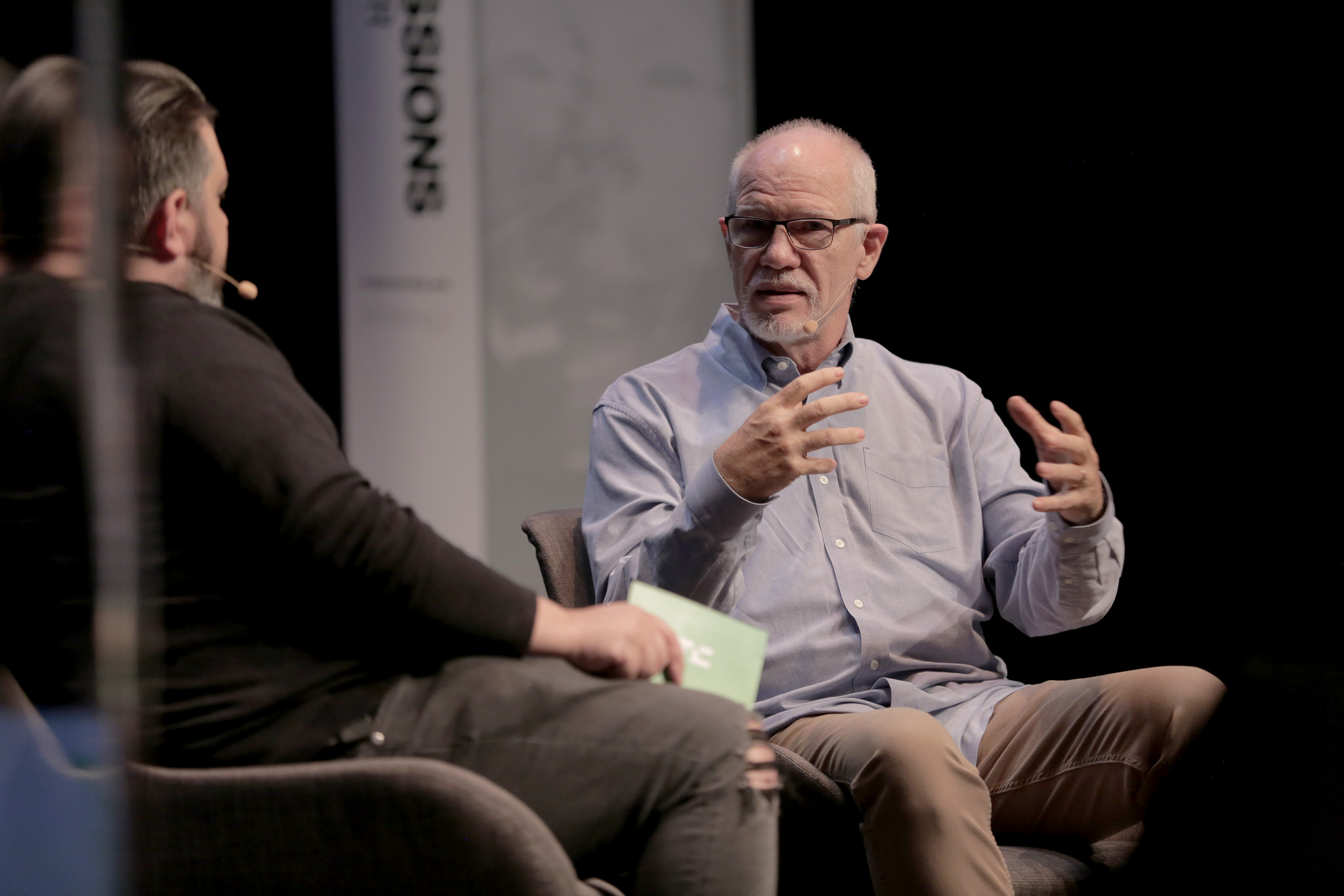
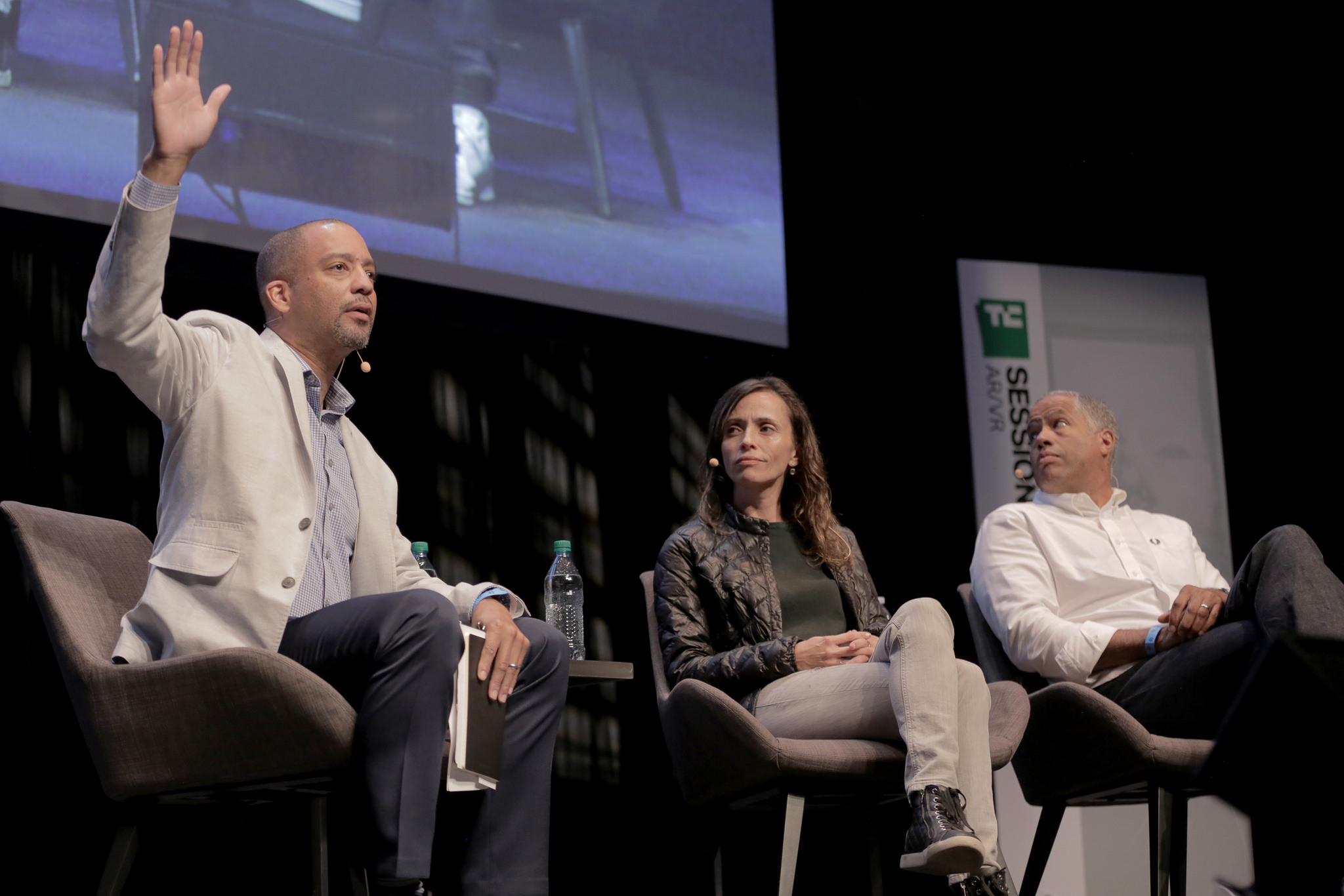
Industry vets and students alike crammed into UCLA’s historic Royce Hall last week for TC Sessions AR/VR, our one day event on the fast-moving (and hype-plagued) industry and the people in it. Disney, Snap, Oculus and more stopped by to chat and show off their latest; if you didn’t happen to be in LA that day, read on and find out what we learned — and follow the links to watch the interviews and panels yourself.

To kick off the day we had John Snoddy from Walt Disney Imagineering. As you can imagine this is a company deeply invested in “experiences.” But he warned that VR and AR storytelling isn’t ready for prime time: “I don’t feel like we’re there yet. We know it’s extraordinary, we know it’s really interesting, but it’s not yet speaking to us deeply the way it will.”

Next came Snap’s Eitan Pilipski. Snapchat wants to leave augmented reality creativity up to the creators rather than prescribing what they should build. AR headsets people want to wear in real life might take years to arrive, but nevertheless Snap confirmed that it’s prototyping new AI-powered face filters and VR experiences in the meantime.

I was on stage next with a collection of startups which, while very different from each other, collectively embody a willingness to pursue alternative display methods — holography and projection — as businesses. Ashley Crowder from VNTANA and Shawn Frayne from Looking Glass explained how they essentially built the technology they saw demand for: holographic display tech that makes 3D visualization simple and real. And Lightform’s Brett Jones talked about embracing and extending the real world and creating shared experiences rather than isolated ones.

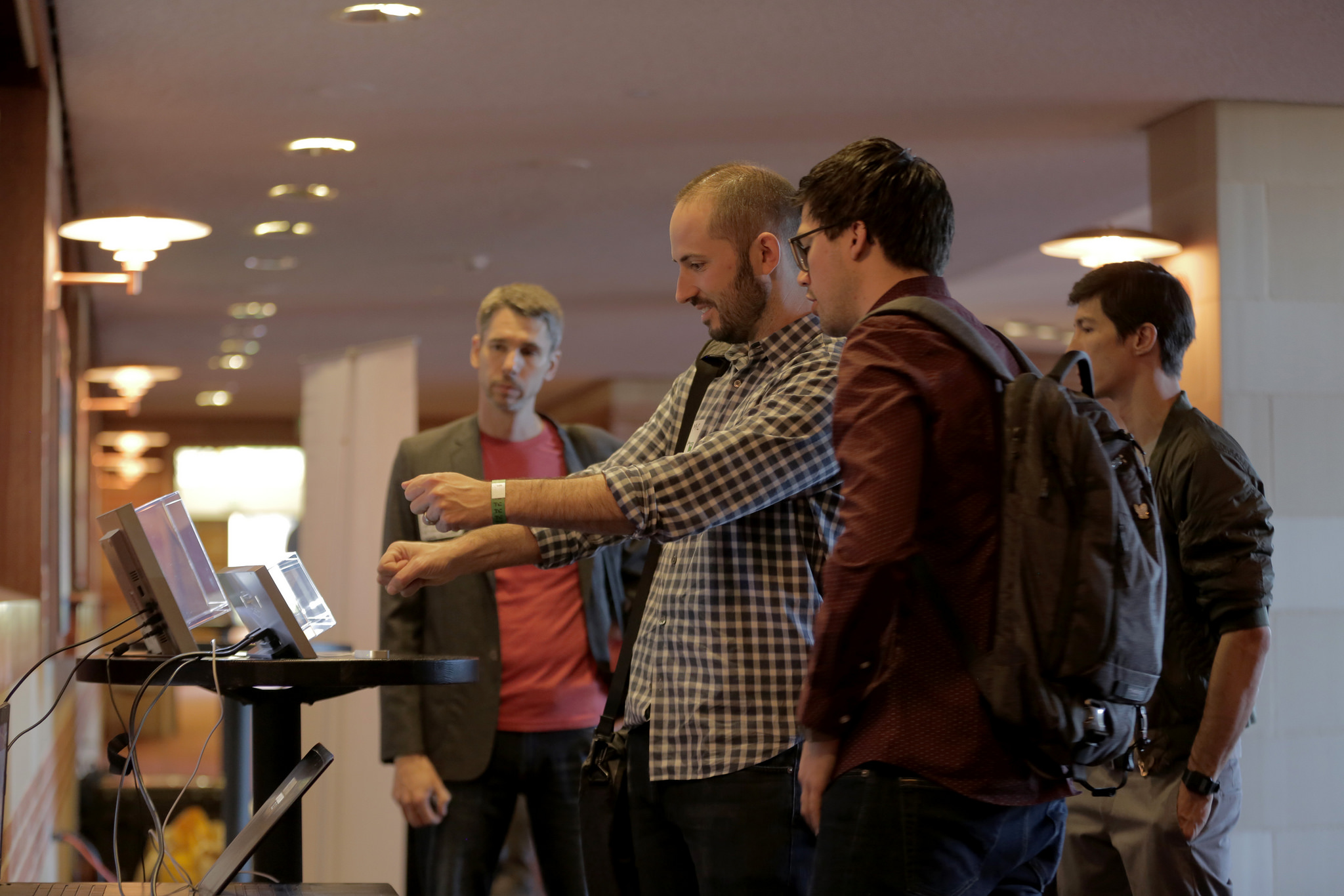
Frayne’s holographic desktop display was there in the lobby, I should add, and very impressive it was. People were crowding three or four deep to try to understand how the giant block of acrylic could hold 3D characters and landscapes.

Maureen Fan from Baobob Studios touched on the importance of conserving cash for entertainment-focused virtual reality companies. Previewing her new film, Crow, Fan noted that new modes of storytelling need to be explored for the medium, such as the creative merging of gaming and cinematic experiences.

Up next was a large panel of investors: Niko Bonatsos (General Catalyst), Jacob Mullins (Shasta Ventures), Catherine Ulrich (FirstMark Capital), and Stephanie Zhan (Sequoia). The consensus of this lively discussion was that (as Fan noted earlier) this is a time for startups to go lean. Competition has been thinned out by companies burning VC cash and a bootstrapped, efficient company stands out from the crowd.

Oculus is getting serious about non-gaming experiences in virtual reality. In our chat with Oculus Executive Producer Yelena Rachitsky, we heard more details about how the company is looking to new hardware to deepen the interactions users can have in VR and that new hardware like the Oculus Quest will allow users to go far beyond the capabilities of 360-degree VR video.

Of course if Oculus is around, its parent company can’t be far away. Facebook’s Ficus Kirkpatrick believes it must build exemplary ‘lighthouse’ AR experiences to guide independent developers towards use cases they could enhance. Beyond creative expression, AR is progressing slowly since no one wants to hold a phone in the air for too long. But that’s also why Facebook is already investing in efforts to build its own AR headset.

Matt Miesnieks, from 6d.ai, announced the opening of his company’s augmented reality development platform to the public and made a case of the creation of an open mapping platform and toolkit for opening augmented reality to collaborative experiences and the masses.

Augmented reality headsets like Magic Leap and Hololens tend to hog the spotlight, but phones are where most people will have their first taste. Parham Aarabi (Modiface), Kirin Sinha (Illumix) and Allison Wood (Camera IQ) agreed that mainstreaming the tech is about three to five years away, with a successful standalone device like a headset somewhere beyond that. They also agreed that while there are countless tech demos and novelties, there’s still no killer app for AR.

Derek Belch (STRIVR), Clorama Dorvilias (DebiasVR), and Morgan Mercer (Vantage Point) took on the potential of VR in commercial and industrial applications. They concluded that making consumer technology enterprise grade remains one of the most significant adoption to virtual reality applications in business. (Companies like StarVR are specifically targeting businesses, but it remains to be seen whether that play will succeed.)

With Facebook running the VR show, how are small VR startups making a dent in social? The CEOs of TheWaveVR, Mindshow and SVRF all say that part of the key is finding the best ways for users to interact and making experiences that bring people together in different ways.

After a break, we were treated to a live demo of the VR versus boxing game Creed: Rise to Glory, by developer Survios co-founders Alex Silkin and James Iliff. They then joined me for a discussion of the difficulties and possibilities of social and multiplayer VR, both in how they can create intimate experiences and how developers can inoculate against isolation or abuse in the player base.

Early stage investments are key to the success of any emerging industry and the VR space is seeing a slowdown in that area. Peter Rojas of Betaworks and Greg Castle from Anorak offered more details on their investment strategies and how they see success in the AR space coming along as the tech industry’s biggest companies continue to pump money into the technologies.

UCLA contributed a moderator with Anderson’s Jay Tucker, who talked with Mariana Acuna (Opaque Studios) and Guy Primus (Virtual Reality Company) about how storytelling in VR may be in very early days, but that this period of exploration and experimentation is something to be encouraged and experienced. Movies didn’t begin with Netflix and Marvel — they started with picture palaces and one-reel silent shorts. VR is following the same path.

And what would an AR/VR conference be without the creators of the most popular AR game ever created? Niantic already has some big plans as it expands its success beyond Pokémon GO. The company which is deep in development of Harry Potter: Wizards Unite is building out a developer platform based on their cutting edge AR technologies. In our chat, AR research head Ross Finman talks about privacy in the upcoming AR age and just how much of a challenger Apple is to them in the space.

That wrapped the show; you can see more images (perhaps of yourself) at our Flickr page. Thanks to our sponsors, our generous hosts at UCLA, the motivated and interesting speakers, and most of all the attendees. See you again soon!

from Startups – TechCrunch https://ift.tt/2CxG5n3

#USA Dating app Vibes aims to create a safe, authentic space for people to meet

//

Online dating is trash. Seriously, try to find anyone who disagrees with me.

Vibes, founded by an all-female team, aims to be different. Sure, the swipe mechanics are still there, but that’s about the only similarity you’ll find between Vibes and the likes of Tinder, Hinge, Bumble and others.

“Because of how crowded the space is, when people hear the words ‘dating app’ they’re like ‘ugh, why do I need another one? My dance card’s full,” Vibes co-founder Jenais Zarlin told TechCrunch. “But those same people are also the ones to say the ratio of good experiences to negative ones, or ones that feel transactional is way off.”

The basis for Vibes is that meaningful connections are rooted in respect and authenticity, Zarlin told me. That’s why she sees Vibes as an extension of physical safe spaces “we know and admire.”

“Text and semi-anonymity really embolden people to behave in ways they wouldn’t in person,” Zarlin said.

That’s why text-based messaging is not part of the experience at all. When you sign up (via Facebook)*, you first must agree to the app’s code of conduct. Vibes’ code of conduct centers around respecting difference (not being racist, sexist, misogynistic, homophobic, transphobic and body-shaming) and generally respecting others by not being sexually explicit or threatening harm.

Next, you select whether you’re down to vibe with people whose preferred pronouns are him, her or them.


“In other apps, the heteronormative agenda is pretty front and center and gender binaries are pretty core to them,” Zarlin said. “It feels like we’re at a time where we need to move past that.”

Next, you select some photos you want to feature and then choose a conversation starter. If you match with someone, you’ll record a short, pixelated video answering their question.

Vibes pixelates the video for those who may be shy. But even with the video pixelated, people can still hear your voice and pick up on mannerisms, just as they would be able to in person.

“It’s a much heavier lift sending a video message, but we expect that it will result in more quality interactions — but probably fewer overall interactions,” Zarlin said.

Its emphasis on moderation also sets Vibes apart from other dating apps. For every first message you receive, Vibes requires you to actively acknowledge if the message was or was not okay with you.

The present day also feels like the right time for Vibes to launch to the masses, Zarlin told me.

“2018 has been a very interesting year for a lot of reasons and there’s been dialogue around self-care, respect and equality,” Zarlin said. “We’ve never talked so much about those issues and yet I think we’re still not innovating around them, or not innovating enough. So Vibes really does to me feel like it has so much potential to be transformative and it was always designed with all of those ideals and values in mind.”

Vibes soft-launched back in July and currently has a few hundred people using the app. Vibes, which has $1.5 million in funding, is free to use but envisions developing a freemium model down the road.

*Zarlin said the decision to use Facebook was made before all of Facebook’s data scandals. Vibes does eventually plan to remove Facebook from the sign-up process.

from Startups – TechCrunch https://ift.tt/2AnQS1v

#USA GoEuro raises $150 million for its travel aggregator

//

Berlin-based startup GoEuro just raised a new $150 million funding round from Kinnevik and Temasek, with Hillhouse Capital also participating. According to Crunchbase, the company has raised nearly $300 million to date.

Chances are you’ve used some sort of flight aggregator before to compare prices and find the best deal. But if you live in Europe, this isn’t enough. Sometimes, you want to compare flights with trains and buses.

GoEuro allows you to do just that. After entering two cities, you can compare all possible routes and book a ticket.

This is a tedious problem as there are countless of airlines, train and bus companies. But it is also a different offering compared to all the flight aggregators out there.

You can see why investors see some value in GoEuro. Transportation in Europe is fragmented. You can book tickets for 80 percent of transport providers on GoEuro. It creates an important barrier to entry for other aggregators. In other words, in addition to generating revenue from ticket sales, GoEuro’s technology platform is valuable by itself.

GoEuro operates in 36 European countries and works with all transportation providers in 15 markets. In fact, GoEuro recently acquired BusRadar to improve bus search results. 27 million people use GoEuro every month.

from Startups – TechCrunch https://ift.tt/2OIqDM8

#USA iPharmacy Roman fights stigmas with premature ejaculation meds

//

There’s a war brewing to become the cloud pharmacy for men’s health. Roman, which launched last year offering erectile dysfunctional medication and recently added a ‘quit smoking’ kit, is taking on $97 million-funded Hims for the hair loss market. Today, Roman launched four new products it hopes to cross-sell to users through a unified telemedicine subscription and pill delivery app. It now sells meds for premature ejaculation, oral herpes, genital herpes, and hair loss at what’s often a deep discount versus your local drug store. And for those who are too far gone, it’s launching a “Bald Is Beautiful, Too” microsite for finding the best razors, lotions, and head shaving tips.

Roman CEO Zachariah Reitano

“It’s unlikely that you’ll buy razors from Bonobos or pants from Dollar Shave Club. But with a doctor, it’s actually the exact opposite” Roman CEO Zachariah Reitano tells me. “As a customer you’re frustrated if they send you somewhere else.” And so what started as a single product startup is blossoming into a powerful product mix that can keep users loyal.

Roman starts with a telemedicine doctor’s visit where patients can talk about their health troubles without the embarrassment of going to their general practitioner. When appropriate, the doc can then prescribe medications customers can then instantly buy through Roman.

“If you have something that’s truly consuming your day-to-day, it makes it really hard or nearly impossible to think about the long-term. If you’re 30 pounds overweight and experiencing erectile dysfunction, [it’s the latter symptom] that’s dominating your head space” Reitano explains. The doctor might focus on the underlying health issue, but most humans aren’t so logical, and want the urgent issue fixed first. Reitano’s theory is that if it can treat someone’s erectile dysfunction or hair loss first, they’ll have the resolve to tackle bigger lifelong health challenges. “We’re hoping to work on this so you can take a deep breath and get the monkey off your back” the CEO tells me.

But one thing Roman won’t do is prescribe homeopathic remedies or spurious remedies. “We will only ever offer products that are backed by science and proven to work” Reitano declares. Taking a shot at Roman’s competitor, he says “Hims sells gummies. Roman does not.  No doctor would say Biotin would help you regrow hair”, plus the vitamin can distort blood pressure readings that make it tough to tell if someone is having a heart attack.

“Roman will never slap sugar on vitamins, sell them on Snapchat, and say they’ll regrow your hair” Reitano jabs. Roman also benefits from the fact that Reitano’s father and one of the company’s advisors Dr. Michael Reitano was a lead author on a groundbreaking study about how Valacyclovir could be used to suppress transmission of genital herpes.

So what is Roman selling?

With Roman, Hims, Amazon acquisition PillPack, and more, there’s a powerful trend in direct-to-consumer medication emerging. Reitano sees it as the outcome of five intersecting facts.

  1. The evolution of telemedicine regulation allowing physicians to have a national presence by seeing patients online
  2. Physicians are being reimbursed less by Medicare, Medicaid, and private insurers for the same activity, pushing them towards telemedicine
  3. A patent cliff is making many medications suddenly affordable under generic names.
  4. Insurance deductibles are increasing, turning patients into consumers
  5. Technology is making it easier and cheaper to start medical startups

Roman’s $88 million Series A it announced last month is proof of this growing trend. Investors see the traditional pharmacy structure as highly vulnerable to disruption.

Roman will have defeat not just security threats and competitors, but also the status quo of keeping a stiff upper lip. A lot of men silently suffer these conditions rather than speak up. By speaking candidly about his own erectile dysfunction as a side-effect of heart medication, Reitano is trying to break the stigma and get more patients seeking help wherever feels right to them.

from Startups – TechCrunch https://ift.tt/2yWTGAO

#USA Bright Machines lands $179M to bring smarter robotics to manufacturing

//

Robotics has had a role in manufacturing since the 1970s, but even today they are aren’t often driven by the latest software. Bright Machines, a San Francisco startup wants to change that and it got a whopping $179 million Series A today to get this thing going. While it was at it, it also officially launched the company.

The startup wants to bring a software-driven approach to robotics, one that would let you take dumb robotics and program it in a more automated fashion to perform a set of tasks, taking advantage of artificial intelligence and machine learning in ways that they say most manufacturing companies simply aren’t equipped to handle right now.

This is clearly not your typical Series A and Bright Machines does not appear to be a typical Series A company, feeling its way trying to get a product to market. Perhaps that’s because the company began life as incubated project inside Flex, a customized manufacturing company. It was then spun out as a startup called AutoLab AI and changed the name to Bright Machines today for the big company unveiling.

It already boast over 300 employees and brought in CEO, Armar Hanspal, who was most recently co-CEO at Autodesk to run the show. Former Autodesk CEO Carl Bass is a board member. Other board members include Mike McNamara, CEO of Flex and Steve Luszo, CEO of Seagate. Eclipse led the round.

What is attracting all of this money and talent to such a young company? Bright Machines is trying to solve a hard and expensive manufacturing problem. “We’re putting together the people, the tech stack and funding and other resources to go really go tackle this big under-served environment by bringing more automation and software to the factory floor,” CEO Hanspal told TechCrunch.

While he acknowledges we have seen a move toward automating the factor floor for decades, they are attacking an area that up until now has been underserved by robotics because the technology simply wasn’t ready to handle it. “What we’re doing that’s different is going from dumb, blind and costly robots to ones that are sensor rich, have computer vision, machine learning and are adaptable,” he said.

What’s more, they are bringing a subscription model to this approach, allowing customers to set up custom manufacturing lines on the fly with what they claim is much lower cost and fuss they faced with more traditional approaches. 

They are taking on this sum of money so early because they believe it is a huge market and if they can attract the right talent, they can bring a substantive change to manufacturing that is lacking today. Time will tell if the bet pays off.

from Startups – TechCrunch https://ift.tt/2PlFQlG

#USA EyeSight scores $15M to use computer vision to combat driver distraction

//

The idea of using computer vision and AI to enable cars to drive themselves is well-established, but how about using similar technology to keep an eye on a human driver instead of the road? That’s the thinking behind Tel Aviv-based EyeSight, which has developed an in-car “AI vision” system that claims to be able to detect when a driver loses concentration or gets dangerously distracted.

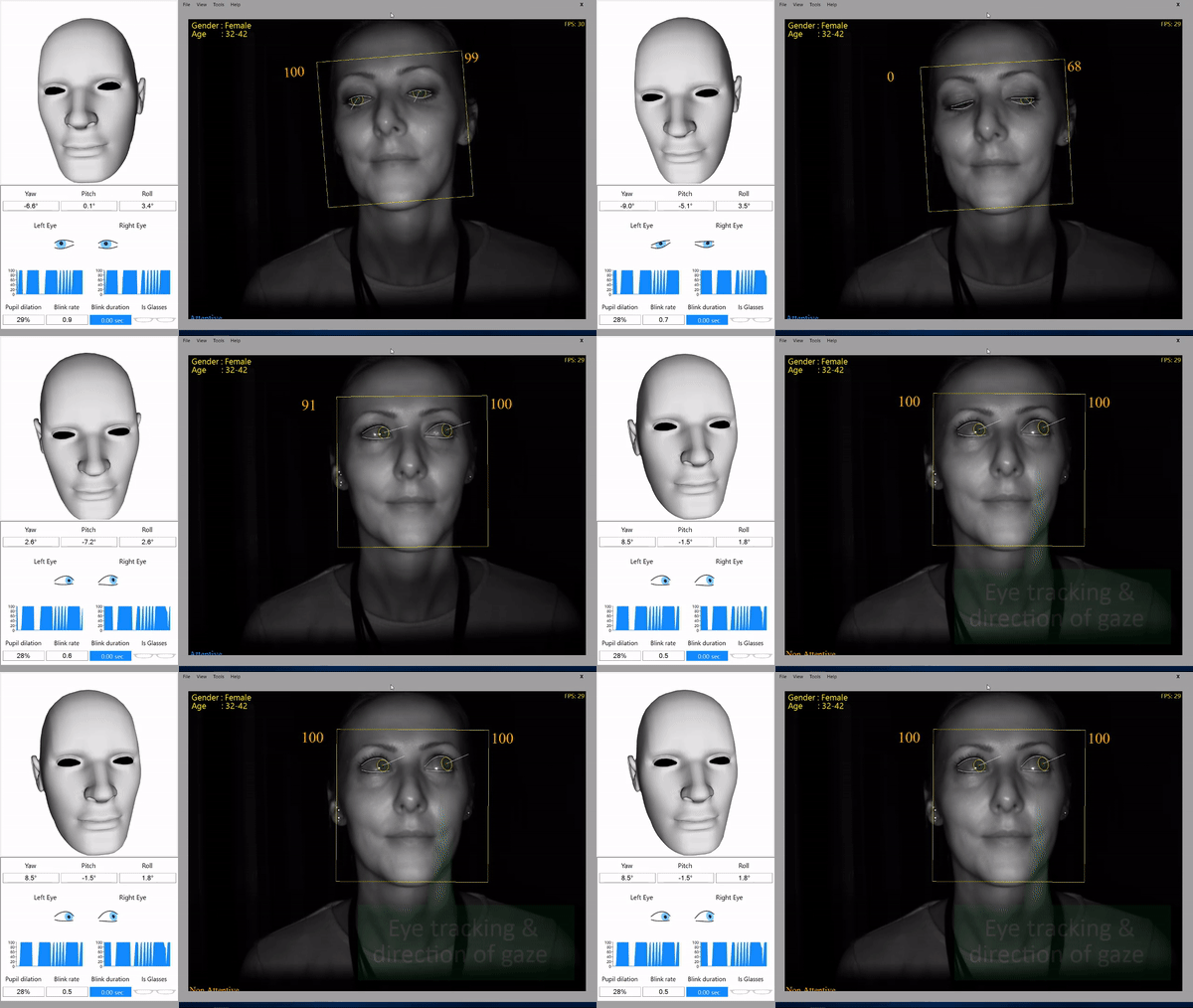
Using advanced facial processing, it tracks a driver’s gaze direction, pupil dilation, eye openness and head position and uses proprietary algorithms to determine attentiveness. The resulting “smart car” can either do something to alert the driver (e.g. sounds and vibrations) or potentially temporarily activate self-driving mode. So far, so clever.

However, in terms of the business case for selling EyeSight’s tech into car manufacturers, there are two other noteworthy dynamics at play. The European New Car Assessment Program (Euro NCAP), a voluntary vehicle safety rating system backed by the European Union, will require new car models to have Driver Monitoring Systems (DMS) by 2020. Cars released after this point without DMS won’t be able to achieve a five-star safety rating.

This is also where autonomous vehicles comes into focus, too. It is well accepted that in the interim stages before we reach level 5 or full autonomy, semi autonomous driving technology that goes well beyond cruise control will become more and more commonplace. This sees AI and computer vision take over various driving functions, but still requires human assistance, intervention and responsibility. However, some argue that this stage is potentially more dangerous than either human driving or fully autonomous vehicles as there is a much higher risk that a human will lose concentration or stop paying enough attention to remain safe.

“DMS is even more important for semi-autonomous vehicles, which have some self-driving features. The autonomous system must be sure that a driver is alert and awake before it hands over control of a moving car to a human,” notes EyeSight.

In addition to driver monitoring, the EyeSight tech can scan the entire cabin of a car, understanding who and what is in the vehicle. This includes being able to detect children, thus “helping ensure that babies aren’t forgotten in locked cars,” which is also a feature that Euro NCAP will require by 2022.

All of which hasn’t gone unnoticed by investors, with EyeSight picking up $15 million in growth funding. The round is led by Jebsen Capital, Arie Capital, and Mizrahi Tefahot, and will be used to deploy in-car AI vision system. The Israeli company is already partnering with two major car manufacturers and says the technology will be in at least four car models by 2020.

from Startups – TechCrunch https://ift.tt/2yu4Ldn

#USA EyeSight scores $15M to use computer vision to combat driver distraction

//

The idea of using computer vision and AI to enable cars to drive themselves is well-established, but how about using similar technology to keep an eye on a human driver instead of the road? That’s the thinking behind Tel Aviv-based EyeSight, which has developed an in-car “AI vision” system that claims to be able to detect when a driver loses concentration or gets dangerously distracted.

Using advanced facial processing, it tracks a driver’s gaze direction, pupil dilation, eye openness and head position and uses proprietary algorithms to determine attentiveness. The resulting “smart car” can either do something to alert the driver (e.g. sounds and vibrations) or potentially temporarily activate self-driving mode. So far, so clever.

However, in terms of the business case for selling EyeSight’s tech into car manufacturers, there are two other noteworthy dynamics at play. The European New Car Assessment Program (Euro NCAP), a voluntary vehicle safety rating system backed by the European Union, will require new car models to have Driver Monitoring Systems (DMS) by 2020. Cars released after this point without DMS won’t be able to achieve a five-star safety rating.

This is also where autonomous vehicles comes into focus, too. It is well accepted that in the interim stages before we reach level 5 or full autonomy, semi autonomous driving technology that goes well beyond cruise control will become more and more commonplace. This sees AI and computer vision take over various driving functions, but still requires human assistance, intervention and responsibility. However, some argue that this stage is potentially more dangerous than either human driving or fully autonomous vehicles as there is a much higher risk that a human will lose concentration or stop paying enough attention to remain safe.

“DMS is even more important for semi-autonomous vehicles, which have some self-driving features. The autonomous system must be sure that a driver is alert and awake before it hands over control of a moving car to a human,” notes EyeSight.

In addition to driver monitoring, the EyeSight tech can scan the entire cabin of a car, understanding who and what is in the vehicle. This includes being able to detect children, thus “helping ensure that babies aren’t forgotten in locked cars,” which is also a feature that Euro NCAP will require by 2022.

All of which hasn’t gone unnoticed by investors, with EyeSight picking up $15 million in growth funding. The round is led by Jebsen Capital, Arie Capital, and Mizrahi Tefahot, and will be used to deploy in-car AI vision system. The Israeli company is already partnering with two major car manufacturers and says the technology will be in at least four car models by 2020.

from Startups – TechCrunch https://ift.tt/2yu4Ldn